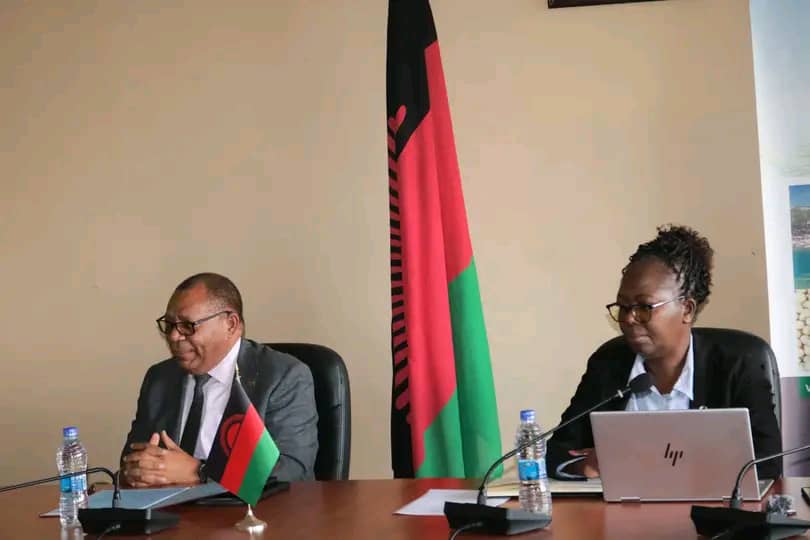
LILONGWE-(MaraviPost)-President Peter Mutharika’s cabinet ministers have submitted their monthly reports as demanded following their sown in, two months ago.
Presidential Press Secretary Cathy Maulidi has confirmed the development saying President Mutharika will thoroughly review and assess how ministries have performed and which plans have been implemented.
Mutharika issued the directive during the swearing-in ceremony of Cabinet ministers, emphasizing professionalism, transparency, and accountability in serving the public.
Meanwhile, National Advocacy Platform (NAP) Chairperson Benedict Kondowe expects the Malawi leader to provide clear direction after reviewing the reports.
Kondowe has since expressed confidence that the President might introduce changes following the review.
Mutharika put together a lean cabinet of 24 which three ministers combined into one eventually scoring credits from the general public on austerity measures.
Share this:
Like this:
LikeLoading…
Discover more from The Maravi Post
Subscribe to get the latest posts sent to your email.
BLANTYRE-(MaraviPost)-Minister of Information and Digitalisation, Dr. Shadrick Namalomba, has emphasized the critical role of the media in promoting justice, peace, and unity in Malawi’s digital era.
Speaking at the Blantyre Press Club’s annual general meeting, Namalomba said journalists are frontline defenders of justice, architects of peace, and weavers of unity.
“Justice, peace, and unity are not just ideals; they are prerequisites for the social and economic transformation we seek under Malawi 2063,” he stated.
Namalomba acknowledged the challenges posed by the digital revolution, including misinformation and digital divides, but stressed that journalists’ role in curating truth and promoting accountability has never been more vital.
He reassured the audience of the government’s commitment to providing an enabling environment, anchored in the Communications Act and Access to Information Act.
The minister also encouraged journalists to read broadly, asking how many had read manifestos from major political parties, DPP, UTM, and MCP.
“Only a few had done so”, he noted.
“Your scrutiny strengthens governance. Your investigations make society fairer. Your stories help move our nation forward,” he said.
Namalomba donated MK2 million to the Blantyre Press Club, which was received by Interim President George Banda. Banda expressed gratitude for the donation, saying it would support their activities and strengthen journalists’ capacity.
The AGM’s theme was “Promoting Justice, Peace, and Unity in the Digital Era”.
Share this:
Like this:
LikeLoading…
Discover more from The Maravi Post
Subscribe to get the latest posts sent to your email.
The blocking of a search warrant targeting Namuleri Farms Limited, owned by former Finance Minister Simplex Chithyola Banda, has once again thrust Malawi’s justice system into the center of a heated national debate on transparency, accountability, and the independence of the judiciary.
At the heart of the matter lies a fundamental constitutional question: why do search warrants exist, and under what circumstances should courts restrain their execution?
The Constitutional Purpose of Search Warrants
Under Malawi’s Constitution and criminal procedure laws, search warrants exist to strike a delicate balance between two competing interests.
On one hand is the right to privacy and protection from arbitrary state intrusion, guaranteed to every citizen regardless of status or political affiliation.
On the other hand is the public interest in investigating crime, particularly when allegations involve the plundering or misuse of public resources.
Search warrants are not instruments of punishment. They are investigative tools, designed to preserve evidence, prevent its concealment or destruction, and enable the State to establish whether criminal conduct has occurred.
When courts block or delay search warrants, they are not merely protecting private rights; they are also shaping the trajectory of criminal accountability itself.
Criminal Suspects and the Presumption of Innocence
It is constitutionally correct that criminal suspects are presumed innocent until proven guilty.
Former ministers, businesspeople, and politically exposed persons enjoy the same rights as ordinary citizens.
However, the presumption of innocence does not mean immunity from investigation.
Nor does it justify erecting procedural barriers so high that investigators are effectively paralyzed before evidence can even be examined.
In corruption-related cases, evidence is often perishable, movable, or easily concealed.
Blocking a search warrant at a preliminary stage risks undermining the very purpose for which the warrant was sought.
Blocking Search Warrants: Legal Safeguard or Tactical Shield?
Courts have the lawful authority to stay or set aside warrants if they are defective, vague, or obtained through abuse of process.
In this case, the argument advanced was that the State failed to provide batch numbers or serial identifiers for the allegedly stolen fertilizer.
Legally, this argument has merit.
But context matters.
Search warrants are often sought precisely because investigators lack full details and need access to premises to confirm or disprove suspicions.
If courts begin to demand near-conclusive proof before a search is conducted, then the investigative process is reversed and weakened.
The danger is that judicial caution, while well-intentioned, may inadvertently become a tactical shield for those with resources, lawyers, and influence.
Judicial Independence Versus Public Perception
Malawi’s judiciary is constitutionally independent, and that independence must be protected at all costs.
Yet independence does not place courts beyond public scrutiny.
Repeated judicial interventions that appear to benefit politically connected individuals, while ordinary citizens face swift and unforgiving processes, inevitably raise questions.
These questions are not attacks on the courts. They are symptoms of eroding public trust.
When citizens begin to believe that the law moves slowly—or stops entirely—when powerful figures are involved, confidence in justice collapses.
Political Bias or Structural Weakness?
It is tempting to label such court decisions as politically biased.
However, the more uncomfortable truth may lie in structural weaknesses within Malawi’s criminal justice system:
Overreliance on technicalities
Poorly prepared applications by the State
Weak investigative capacity
A legal culture that favors form over substance
These weaknesses combine to produce outcomes that look biased, even when courts may be acting within the letter of the law.
The Cost to Transparency and Accountability
When search warrants are blocked in high-profile corruption cases, the immediate beneficiaries are not constitutional rights alone.
The broader effect is a chilling signal to investigators, whistleblowers, and the public that accountability is negotiable.
For a country struggling with economic hardship, donor fatigue, and public anger over corruption, this perception is deeply damaging.
Justice must not only be done; it must be seen to be done, especially where public resources are concerned.
Conclusion: A Constitutional Crossroads
Malawi stands at a constitutional crossroads.
The courts must continue to safeguard rights and prevent abuse of state power.
But they must also be conscious that excessive procedural insulation of suspects—particularly politically exposed persons—risks turning constitutional protections into obstacles to accountability.
Search warrants are not convictions. They are questions.
And when courts consistently prevent those questions from being asked, the nation is entitled to ask a harder one in return:
Who is the law truly protecting?
Share this:
Like this:
LikeLoading…
Discover more from The Maravi Post
Subscribe to get the latest posts sent to your email.
LILONGWE-(MaraviPost)-Minister of Industrialisation, Business, Trade and Tourism, Dr. George Partridge, has urged Illovo Sugar Malawi to ensure that sugar is available to the public throughout the Christmas season and up to the next production cycle.
The Minister made these remarks during a high-level meeting this morning with Illovo Sugar Malawi’s management team and the Competition and Fair Trading Commission (CFTC) at the Ministry headquarters in Lilongwe.
Dr. Partridge emphasized that Malawians expect to find sugar on the shelves as they prepare for Christmas.
He reassured Illovo Sugar management of his full support as the government works to resolve the ongoing supply issues.
In response, Illovo Sugar Malawi’s Managing Director, Ronald Ngwira, assured the Minister that the company has sufficient reserves to sustain the country through the lean period.
Ngwira explained that production is temporarily halted due to wet fields that make cane cutting impossible, but with over 70,000 metric tonnes in storage, he is confident that the stock will last until production resumes in April.
Malawi consumes around 15,000 metric tonnes of sugar per month, and Ngwira believes that the current reserve should be enough to meet the country’s needs if domestic demand remains stable.
However, Ngwira highlighted some challenges impacting sugar availability on the market, including hoarding and smuggling by certain traders.
In response, Minister Partridge assured the meeting that his Ministry would collaborate with relevant authorities such as the Ministry of Local Government, the Ministry of Homeland Security, and the Malawi Revenue Authority (MRA) to investigate and take action against those involved in these illegal activities.
This joint effort aims to ensure that the sugar supply remains stable and that any malpractices are addressed swiftly.
Share this:
Like this:
LikeLoading…
Discover more from The Maravi Post
Subscribe to get the latest posts sent to your email.
LILONGWE-(Maravipost)-In a year marked by acute food shortages and deepening hardship across Malawi, thousands of apostles and prophets rose to the challenge through charitable work.
Yet one man of God stood out above the rest Apostle Clifford Kawinga, founder and leader of Salvation For All Ministries International (SFAMI) whose compassion, courage, and innovative initiatives have earned him wide recognition as Malawi’s Outstanding Man of God of Charity in 2025.
From the very beginning of the year, Apostle Kawinga’s ministry became a beacon of hope for vulnerable and underserved communities.
In early February, as food insecurity escalated nationwide, he launched a bold and far-reaching relief initiative, distributing maize and essential food items to thousands of families threatened by hunger.
Where many organizations struggled with distance and logistics, Apostle Kawinga and his team went further both literally and figuratively ensuring that no community was forgotten.
Among the most remarkable achievements of this outreach was reaching Likoma Island, a remote district in Lake Malawi that is often neglected due to transport barriers.
At a major outreach crusade held at Madimba Ground under Senior Chief Mkumpha III, SFAMI distributed food relief to 2,000 households and provided 40 bags of maize to local traditional leaders.
This act of compassion brought tangible support to a community long left behind.
Senior Chief Mkumpha III publicly commended the ministry, describing the assistance as timely and life-changing in an area where both basic necessities and spiritual nourishment are difficult to access.
Apostle Kawinga’s vision extends well beyond emergency relief. In addition to feeding households in four southern districts Neno, Zomba, Chikwawa, and Mwanza SFAMI also celebrated the opening of a new church branch, firmly anchoring spiritual growth alongside humanitarian service.
The ministry has also embraced innovative agricultural empowerment through its Hope Field Initiative, which provides rural families with irrigation equipment, seeds, fertilizer, and other farming inputs.
This program is designed to move communities from dependency toward self-reliance and sustainable food production.
This holistic approach has taken root across numerous districts, including Machinga, Chiradzulu, Thyolo, Ntchisi, Zomba, Neno, Chikwawa, Mwanza, Mangochi, and Salima, among others.
Notably, through food distribution efforts alone, SFAMI has reached all 28 districts of Malawi in 2025.
Farming cooperatives are now being established nationwide to maximize productivity and strengthen long-term community resilience.
The scale of Apostle Kawinga’s impact is striking. In Lilongwe alone, SFAMI has provided food assistance to over 10,000 households, alongside farming resources and the creation of support clubs aimed at improving long-term food security.
Community members consistently testify that these interventions have been life-saving offering not only immediate sustenance but also the tools and knowledge necessary for a more hopeful and secure future.
What truly distinguishes Apostle Clifford Kawinga is not merely the breadth of his charity, but the depth of his commitment.
He seamlessly blends faith with practical action, firmly believing that addressing both spiritual and material needs is central to his calling.
His leadership is grounded in love, dignity, and sustainable empowerment principles that continue to shape SFAMI’s outreach across Malawi.
Under his guidance, the ministry has become a model of compassionate, faith-driven leadership, demonstrating that spiritual conviction paired with action can bring lasting transformation.
As 2025 draws to a close, Apostle Clifford Kawinga stands out not only as a respected religious leader, but as a visionary humanitarian a man whose acts of charity have truly changed lives and restored hope across Malawi.
Share this:
Like this:
LikeLoading…
Discover more from The Maravi Post
Subscribe to get the latest posts sent to your email.
LILONGWE-(MaraviPost)-The recent semifinal defeat of Malawi’s Queens to Uganda’s She-Cranes at the Griffin Saenda Sports Complex in Lilongwe was more than just a loss; it was a painful blow to the very heart of Malawian netball pride.
To witness the Queens – once a formidable force feared even by the mighty South African Proteas – capitulate so thoroughly on home soil to a team many still regard as minnows is a bitter pill to swallow.
The venue itself, named after the late Griffin Saenda, a legendary figure who once elevated Malawian netball to unprecedented heights, should have been a fortress. Instead, it turned into a painful reminder of how far the Queens have slipped from their former glory.
For those who remember the halcyon days under Griffin Saenda’s tutelage, the current situation is nothing short of heartbreaking.
Saenda, a coach who sculpted the Queens with limited resources and without the luxury of motivation or modern facilities, managed to build a team that commanded respect and fear across the continent.
The She-Cranes, for all their current strength, would not have dared to challenge the Queens at that time, certainly not on Malawian soil.
The Proteas of South Africa, a powerhouse in African netball, were genuinely wary of the Queens’ tenacity and skill. But today, the narrative has shockingly reversed.
The Queens’ struggles began right from the first quarter of Saturday’s semifinal.
Their inability to maintain possession and convert scoring opportunities was glaringly evident. Uganda’s aggression and disciplined defense dismantled the Queens’ rhythm, leaving them chasing shadows. A 12-8 deficit in the opening quarter quickly ballooned to 24-15 by halftime.
The She-Cranes, seizing momentum with ruthless efficiency, further extended their lead to 37-23 by the third quarter and sealed the game at 46-32 after full time. Such a wide margin of defeat at home, especially in a tournament as prestigious as the African Netball Cup, is both embarrassing and deeply painful for Malawian fans.
This loss at the Griffin Saenda Sports Complex is particularly shameful given the symbolic weight the venue carries.
Named after a man who dedicated his life to nurturing Malawian netball against all odds, the complex should inspire the Queens to rise to their best.
Instead, it has witnessed a humbling defeat that raises uncomfortable questions about the current state of netball in Malawi. One can only imagine how the spirit of Griffin Saenda would react to this outcome.
Known for his relentless pursuit of excellence and his ability to inspire players to perform beyond their limitations, Saenda would likely be devastated by the lack of discipline, resilience, and tactical nous displayed by the Queens.
The late coach’s legacy was built on overcoming hardship.
Saenda worked with meagre resources, often in environments void of adequate funding, training facilities, and even basic motivation for his players.
Yet, the results spoke volumes. Under his guidance, the Queens became a source of national pride, a beacon of hope that united Malawians.
For years, while the Flames – Malawi’s football team – struggled and disappointed despite massive public support, the Queens offered solace and joy.
They were the team that Malawians could rally behind, a symbol that dedication and talent could triumph despite systemic challenges.
Today, however, the Queens seem to be struggling to unlock the secret that Griffin Saenda held so dearly: the combination of discipline, strategic acumen, and an unyielding fighting spirit.
The current squad’s performance suggests a disconnect from those core values.
Losing to Uganda, a team that was once considered a step below Malawi in netball hierarchy, especially on Malawian turf, stings deeply.
It is a stark reminder that the Queens have become a punching bag, a team that is no longer feared but rather exploited by opponents who now see them as vulnerable.
This reversal of fortunes is particularly galling when one considers that Malawi once held a position of dominance in African netball. The Proteas, giants of the sport, were cautious about facing the Queens.
The transformation from a respected powerhouse to a team struggling against rising neighbors is a narrative that demands urgent introspection.
The challenge for Malawi netball administrators, coaches, and players is now to reflect on what has been lost and how to recapture the spirit of excellence that defined the Saenda era.
Looking ahead, the Queens face Zimbabwe in the battle for third place. While this match offers a chance for redemption, it also serves as a critical juncture.
Will the Queens rise to reclaim some dignity, or will they continue to fall deeper into mediocrity?
The answer depends on whether the team and those who lead it can reconnect with the resilience and passion that once made them the pride of Malawi.
The semifinal defeat to Uganda is not just a match lost; it is a reflection of a deeper malaise afflicting Malawian netball.
The loss at the Griffin Saenda Sports Complex is a symbolic defeat that challenges the very identity of the Queens.
It calls for a revival rooted in the principles that Griffin Saenda championed: hard work, strategic discipline, and an unbreakable spirit.
Only by embracing these values can the Queens hope to shed the image of a punching bag and reclaim their rightful place atop African netball.
Until then, the pain of this loss will linger as a stark reminder of what once was and what could be again.
Share this:
Like this:
LikeLoading…
Discover more from The Maravi Post
Subscribe to get the latest posts sent to your email.