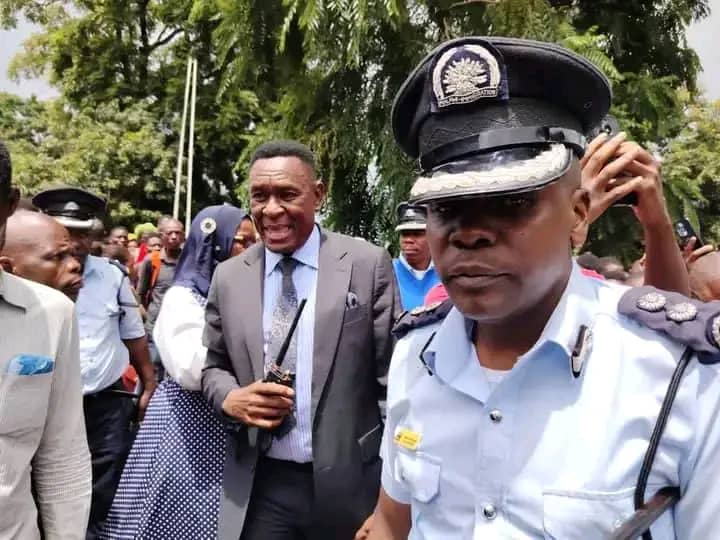
LILONGWE-(MaraviPost)-A dramatic turn of events unfolded at the Immigration Department in Lilongwe, as Rowland Brown, an immigration officer, was arrested for allegedly scamming a client MK300, 000.
The arrest was made possible by a surprise visit from Deputy Minister of Homeland Security, Norman Chisale, who had received a tip about corrupt practices within the department.
Chisale’s visit was a bolt out of the blue, aimed at catching officers off guard and rooting out corruption.
And it seems his efforts paid off, as Brown was caught red-handed, leading to his immediate arrest.
This bold move by the Deputy Minister sends a strong message that corruption will no longer be tolerated in the Immigration Department.
The arrest has been met with jubilation, with many seeing it as a step in the right direction towards eradicating corruption in public institutions.
The public is eager to see more of such actions, and for those involved in corrupt practices to face the music.
The Immigration Department has been plagued by allegations of corruption, with many claiming that officers are more interested in lining their pockets than serving the people.
Brown’s arrest is a clear indication that the authorities are serious about stamping out this menace.
The Deputy Minister’s actions are a testament to his commitment to fighting corruption and promoting transparency.
His bravery in taking on corrupt officials is commendable, and we hope that this is just the beginning of a long and fruitful war against corruption.
The case has sparked widespread interest, with many calling for more stringent measures to tackle corruption.
The public is watching, and it’s time for institutions to take concrete actions to restore trust and faith in the system.
As the case unfolds, one thing is clear: corruption will no longer be tolerated, and those involved will face the full force of the law.
The people of Malawi demand accountability, and it’s time institutions delivered.
Way forward
The arrest of Rowland Brown is a victory for the people, and a reminder that together, we can create a corruption-free Malawi.
Let’s keep the momentum going and ensure that those who abuse their power are brought to book.
This is just the beginning of a new chapter in Malawi’s fight against corruption.
Let’s make sure it’s a chapter that ends with a corruption-free nation, where institutions serve the people, not their own interests.
Don Lemon is going off on Nicki Minaj! The former CNN news anchor stopped by “TMZ Live” and unloaded on the rapper, telling her to “sit the f*** down” … and while she’s at it — “get a life and grow some brains.” As you know … Nicki bashed Don…
BLANTYRE-(MaraviPost)-Petroleum Importers Limited (PIL), has stepped in to support government efforts to address food insecurity by donating fuel worth K400 millionto the Office of the President and Cabinet (OPC) for the Lean Season Food ResponseProgramme.
The donation is intended to support the transportation and distribution of relief food to hunger-affected households across the country.
The support comes at a time when government, through the Department of Disaster Management Affairs (DoDMA), continues to implement the National Lean Season Food Insecurity Response Plan, which focuses on addressing immediate, life-saving needs while also replenishing national food stocks.
Speaking during the handover ceremony, PIL Vice Chairperson Zubeir Bhana said the fuel contribution was made in response to the government’s declaration of a state of disaster in several districts following severe food shortages experienced last year.
“We wish to affirm our solidarity with the people of Malawi. This country is our home, and when it is in distress, we have a responsibility to act,” said Bhana.
He said the fuel will enhance the government’s ability to reach vulnerable populations, including communities in hard-to-reach areas, ensuring the timely delivery of humanitarian assistance.
“This fuel will enable the transportation of essential food supplies to affected communities. It is our contribution to keeping relief efforts moving and hope alive,” he explained.
He urged fellow private sector players, development partners, and well-wishers to partner with the government in responding to the emergency.
Receiving the donation, Chief Secretary to the President and Cabinet , Dr Justin Saidi, commended PIL for the timely support, saying the private sector has demonstrated strong commitment to complementing government efforts in responding to hunger.
“ We thank Petroleum Importers Limited for the generous and timely contribution towards the food insecurity response programme. This donation will greatly facilitate the efficient movement and distribution of humanitarian food to food-insecure households across the country,” said Saidi.
He added that the support from a local private sector player is a strong demonstration of togetherness, solidarity, and shared responsibility in achieving national aspirations such as food security and poverty reduction, as outlined in Malawi 2063.
The Response Plan requires an estimated MK209.4 billionto address all needs across the prioritized clusters out of which MK138 billionhas been mobilized from government and partners, with the remaining MK71 billion stillto be mobilized.
PIL is a consortium of four oil marketing companies namely Puma Energy, TotalEnergies, Vivo Energy and Petroda
TOKYO, Japan, Jan 19 2026 (IPS) – Thirty years ago, the groundbreaking report by Graça Machel, renowned and widely respected global advocate for women’s and children’s rights, to the United Nations General Assembly laid bare the devastating impact of armed conflict on children and shook the conscience of the world. It led to the historic decision of the General Assembly to create the mandate of the Special Representative of the Secretary-General for Children and Armed Conflict (SRSG-CAAC).
Special Representatives of the Secretary-General are high-level envoys entrusted with carrying out specific responsibilities on behalf of the Secretary-General. Appointed at the rank of Under-Secretary-General, the SRSG-CAAC has since served as the global advocate for raising the awareness about the condition of children affected by armed conflict as well as their comprehensive protection and reintegration in the society.
Children and armed conflict as a peace and security agenda
The children and armed conflict (CAAC) agenda has evolved significantly over the past three decades. As appropriately affirmed in Security Council resolution 1261 (1999), the impact of armed conflict on children constitutes a matter affecting international peace and security. Subsequent resolutions firmly anchored the CAAC agenda within the work of the Security Council and established critical protection mechanisms.
Among the most significant of these is the Monitoring and Reporting Mechanism (MRM), created by Security Council resolution 1612 (2005). The MRM provides verified, credible, and timely information on grave violations committed against children in situations of armed conflict. It has become the backbone of the United Nations’ engagement with parties to conflict to halt such violations.
Credit: UN News
Through this mechanism, parties to conflict are encouraged to commit to ending and preventing grave violations through the development and implementation of time-bound action plans. To date, forty action plans have been concluded with parties to conflict, including non-State armed groups, in eighteen countries, resulting in full compliance by twelve parties.
UNICEF has played a pivotal role on the ground as the United Nations’ lead agency for children, supporting the operation of the MRM and monitoring the implementation of action plans.
Children and armed conflict as a fundamental child rights issue
Beyond peace and security, children and armed conflict is fundamentally a child rights issue. It was the first thematic area addressed as early as 1992 by the United Nations Committee on the Rights of the Child, the treaty body monitoring implementation of the Convention on the Rights of the Child adopted by the United Nations General Assembly in 1989.
That initiative paved the way for the Graça Machel report and the subsequent establishment of the SRSG-CAAC mandate in 1996. It also led to the adoption, in 2000, of the Optional Protocol to the Convention on the Rights of the Child on the involvement of children in armed conflict.
In March of this year, the Human Rights Council will dedicate its annual day on the rights of the child to children and armed conflict and is expected to adopt a related resolution, underscoring the continued relevance of this agenda.
Thirty years after the inception of the CAAC mandate
Despite these advances, grave violations against children in armed conflict reached an unprecedented 41,370 cases in 2024 alone. Calls for accountability have understandably grown louder.
The impact of armed conflict on children extends far beyond the six grave violations identified by the Security Council. Today, one in five children worldwide lives in a conflict-affected area, where the full spectrum of their rights is compromised, directly or indirectly.
This stark reality demands renewed urgency, enhanced political will, and more focused action.
Toward child rights-based and child-centred accountability
Children who are victims of armed conflict have too often been excluded from accountability processes.
Some positive developments deserve recognition. In 2023, the Office of the Prosecutor of the International Criminal Court adopted a revised Policy on Children that explicitly embraces a child rights approach. In the same year, the Secretary-General’s Guidance Note on Child Rights Mainstreaming called for the systematic integration of child rights into the mandates of United Nations investigative and accountability mechanisms, including commissions of inquiry and fact-finding missions.
Accountability must be both child rights-based and child-centred. Meaningful child participation is essential. Listening to children and taking their views seriously is fundamental to justice, remedies, and healing. Accountability processes must address children’s immediate and long-term needs, including education, psychosocial support, and family reunification.
Children as peacebuilders
Children want peace. Sustainable peace is the indispensable foundation for the full realization of child rights.
The Convention on the Rights of the Child guarantees the right of children to be heard and to have their views respected in all matters affecting them. Children also have the right to reintegration and to participate in efforts aimed at restoring social cohesion within fractured and traumatized communities.
In many conflict-affected societies, children constitute more than half of the population. Their role as peacebuilders is therefore not optional—it is essential. Recognizing and empowering children as agents of peace will also reinforce both the women, peace and security agenda and the youth, peace and security agenda.
Time for renewed mobilization, in partnership with civil society and children
Graça Machel reminded us that “universal concern for children presents new opportunities to confront the problems that cause their suffering.”
Children and armed conflict goes to the very core of our shared humanity. It demands broader public awareness, stronger political commitment, and sustained global mobilization.
Civil society organizations, working alongside children themselves, have a crucial role to play in advocacy, awareness-raising, and mobilizing support for the CAAC agenda.
The Special Representative of the Secretary-General for Children and Armed Conflict, created by the General Assembly, carries a unique responsibility as the Secretary-General’s envoy to strengthen cooperation and partnerships among United Nations entities, Member States, civil society, and children themselves.
Children and armed conflict must remain at the forefront of the global agenda and be treated as a central priority by the Secretary-General of the United Nations.
Dr. Mikiko Otani, widely recognized as an international human rights lawyer, is currently the President of the Child Rights Connect, a Geneva-based global NGO network promoting child rights. She was the Chair of the United Nations Committee on the Rights of the Child (2021-2023) during her eight-year membership for two terms.