Wars Impose Lasting Economic Costs, While More Defense Spending Means Hard Choices

Armed Conflicts, Civil Society, Crime & Justice, Democracy, Global, Headlines, Human Rights, IPS UN: Inside the Glasshouse, TerraViva United Nations

Opinion

Wars Impose Lasting Economic Costs, While More Defense Spending Means Hard Choices

Credit: 279photo/iStock by Getty Images. Source: IMF

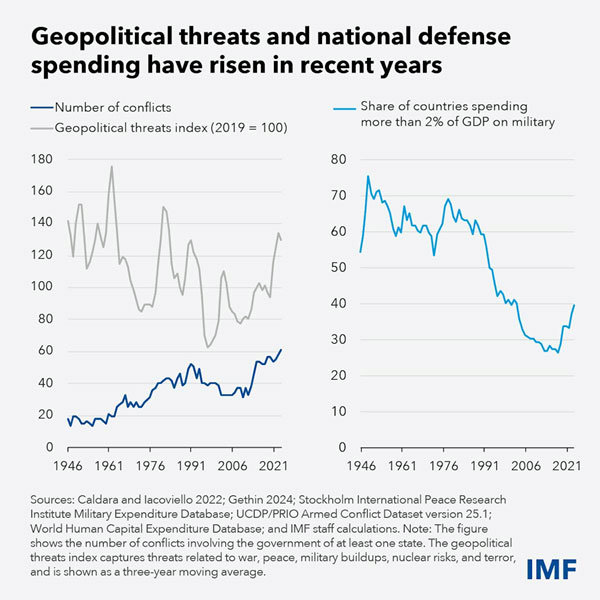
WASHINGTON DC, Apr 16 2026 (IPS) – War is again defining the global landscape. After decades of relative calm following the Cold War, the number of active conflicts has surged in recent years to levels not seen since the end of the Second World War.


Meanwhile, rising geopolitical tensions and heightened security concerns are prompting many governments to reassess their priorities and spend more on defense.

Beyond their devastating human toll, wars impose large and lasting economic costs, and pose difficult macroeconomic trade-offs, especially for those countries where the fighting is taking place.

Even without active conflicts, rising defense spending can raise economic vulnerabilities in the medium term. After the war, governments face the urgent post-conflict task of securing durable peace and sustaining recovery.

In an era of proliferating conflicts, our research in two analytical chapters of the latest World Economic Outlook highlights the deep and prolonged economic harm inflicted by war, which has particularly affected sub-Saharan Africa, Europe, and the Middle East.

We also show that rising defense spending—which can boost demand in the short term—imposes difficult budgetary trade offs that make good policy design and lasting peace more important than ever.
Wars Impose Lasting Economic Costs, While More Defense Spending Means Hard Choices

Economic losses

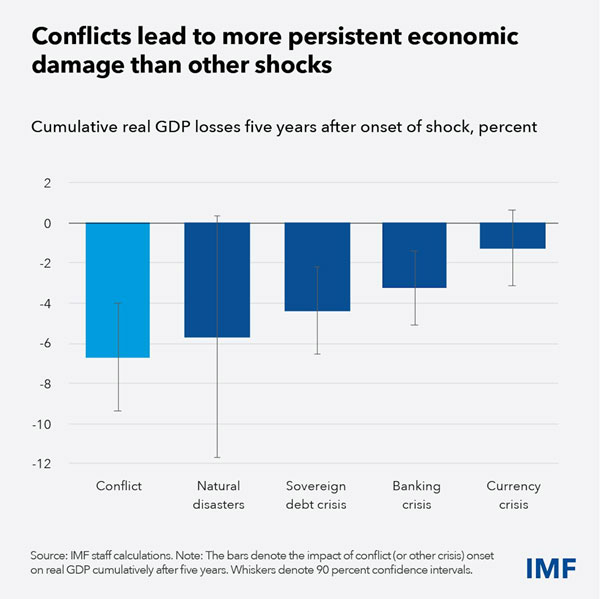
For countries where wars occur, economic activity drops sharply. On average, output in countries where fighting takes place falls by about 3 percent at the onset and continues falling for years, reaching cumulative losses of roughly 7 percent within five years.

Output losses from conflicts typically exceed those associated with financial crises or severe natural disasters. Economic scars also persist even a decade later.
Wars Impose Lasting Economic Costs, While More Defense Spending Means Hard Choices

Wars also tend to have significant spillover effects. Countries engaged in foreign conflicts may avoid large economic losses—partly because there is no physical destruction on their own soil.

Yet, neighboring economies or key trading partners with the country where the conflict is taking place will feel the shock. In the early years of a conflict, these countries often experience modest declines in output.

Major conflicts—those involving at least 1,000 battle-related deaths—force difficult trade-offs in economies where they occur. Government budgets deteriorate as spending shifts toward defense and debt increases, while output and tax collection collapse.

These countries may also face strains on their external balances. As imports contract sharply because of lower demand, exports decrease even more substantially, resulting in a temporary widening of the trade deficit.

Heightened uncertainty triggers capital outflows, with both foreign direct investment and portfolio flows declining. This forces wartime governments to rely more heavily on aid and, in some cases, remittances from citizens abroad to finance trade deficits.

Despite these measures, conflicts contribute to sustained exchange rate depreciation, reserve losses, and rising inflation, underscoring how widening external imbalances amplify macroeconomic stress during wartime. Prices tend to increase at a pace higher than most of central banks’ inflation targets, prompting monetary authorities to raise interest rates.

Taken together, our findings show that major conflicts impose substantial economic costs and difficult trade-offs on economies that experience conflicts within their borders, as well as hurting other countries. And these costs extend well beyond short-term disruption, with enduring consequences for both economic potential and human well-being.

Spending trade-offs

More frequent conflicts and rising geopolitical tensions have also prompted many countries to reassess their security priorities and increase defense spending. Others plan to do so. This situation presents policymakers with a crucial question about trade-offs involved with such a boost to spending.

Our analysis looks at episodes of large buildups in defense spending in 164 countries since the Second World War. We find that these booms typically last nearly three years and increase defense spending by 2.7 percentage points of gross domestic product.

That’s broadly similar to what is required by North Atlantic Treaty Organization (NATO) members to reach the 5 percent of GDP defense spending target by 2035.

Ramping up defense spending primarily acts as a positive demand shock, boosting private consumption and investment, especially in defense-related sectors. This can raise both economic output and prices in the short term, requiring close coordination with monetary policy to temper inflationary pressures.

Overall, the aggregate effects on output of scaling up defense spending are likely modest. Increases in defense spending typically translate almost one for one into higher economic output, rather than having a bigger multiplier effect on activity.

That said, the multiplier or ripple effects of such spending vary widely depending on how outlays are sustained, financed and allocated, and how much equipment is imported.

For instance, output gains are smaller and external balances deteriorate when the stimulus is partly spent to import foreign goods, which is especially the case for arms importers. By contrast, a buildup of defense spending that prioritizes public investment in equipment and infrastructure, together with less fragmented procurement and more common standards, would expand market size, support economies of scale, strengthen industrial capacity, limit import leakages, and support long-term productivity growth.

The choice of how to finance defense spending entails critical trade-offs. Defense spending booms are mostly deficit-financed in the near-term, while higher revenues play a larger role in later years of defense spending booms and when the defense spending buildup is expected to be permanent.
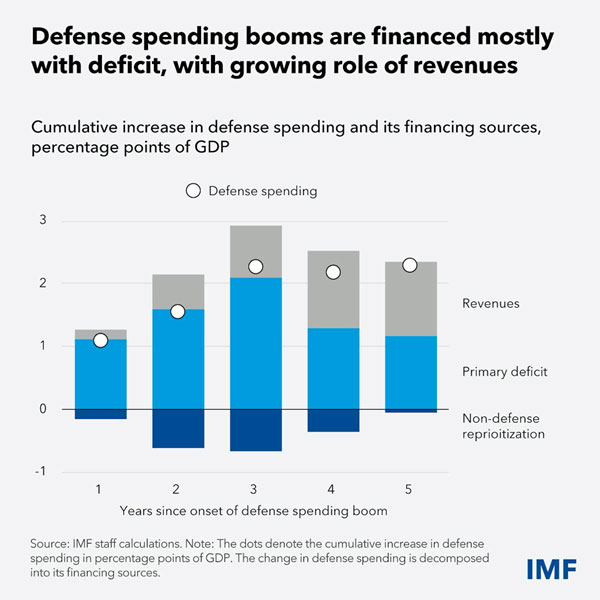
The reliance on deficit financing can stimulate the economy in the short term, but strain fiscal sustainability over the medium term, particularly in countries with limited room in government budgets.

Deficits worsen by about 2.6 percentage points of GDP, and public debt increases by about 7 percentage points within three years of the start of a boom (14 percentage points in wartime). The resulting increase in public debt can crowd out private investment and offset the initial expansionary effect of defense spending.

The buildup of fiscal vulnerabilities can be mitigated by durable financing arrangements, especially when the increase in defense spending is permanent. However, raising revenues come at the cost of reducing consumption and dampening the demand boost, while re-ordering budget priorities tends to come at the expense of government spending on social protection, health, and education.

Policies for recovery

Our analysis also shows that economic recoveries from war are often slow and uneven, and crucially depend on the durability of peace. When peace is sustained, output rebounds but often remains modest relative to wartime losses. By contrast, in fragile economies where conflict flares up again, recoveries frequently stall.

These modest recoveries are driven primarily by labor, as workers are reallocated from military to civilian activities and refugees gradually return, while capital stock and productivity remain subdued.

Early macroeconomic stabilization, decisive debt restructuring, and international support—including aid and capacity development—play a central role in restoring confidence and promoting recovery. Recovery efforts are most effective when complemented by domestic reforms to rebuild institutions and state capacity, promote inclusion and security, and address the lasting human costs of conflict, including lost learning, poorer health, and diminished economic opportunities.

Importantly, effective post-war recovery requires comprehensive and well-coordinated policy packages. Such an approach is far more effective than piecemeal measures. Policies that simultaneously reduce uncertainty and rebuild the capital stock can reinforce expectations, encourage capital inflows, and facilitate the return of displaced people.

Ultimately, successful post-war recovery lays the foundation for stability, renewed hope and improved livelihoods for communities affected by conflict.

This IMF blog is based on Ch. 2 of the April 2026 World Economic Outlook, “Defense Spending: Macroeconomic Consequences and Trade-Offs,” and Ch. 3, “The Macroeconomics of Conflicts and Recovery.” For more on fragile and conflict-affected states: How Fragile States Can Gain by Strengthening Institutions and Core Capacities.

IPS UN Bureau

  Source

The Five Enablers of the Israeli-Palestinian Conflict

Armed Conflicts, Civil Society, Democracy, Featured, Global Governance, Headlines, International Justice, IPS UN: Inside the Glasshouse, Middle East & North Africa, TerraViva United Nations

Opinion

The Five Enablers of the Israeli-Palestinian Conflict

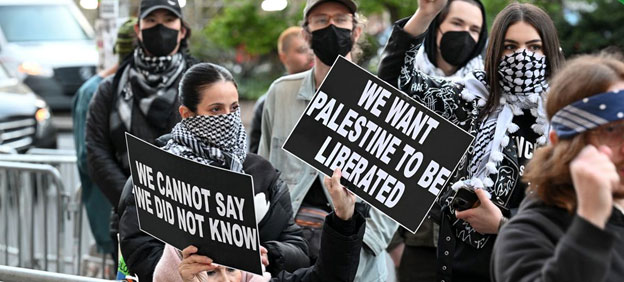
Protesters demonstrate outside the Columbia University campus in New York City. Credit: UN Photo/Evan Schneider

 
For decades, five powerful actors—the United States, the Arab states, the European Union, AIPAC, and Israel’s own opposition—have all claimed to seek Israeli-Palestinian peace while enabling permanent occupation, together burying the two-state solution.

NEW YORK, Apr 15 2026 (IPS) – Every powerful actor in the Israeli-Palestinian conflict professes to seek peace. The US and EU repeat the two-state mantra, the Arab states invoke Palestinian rights, AIPAC proclaims its defense of Israel’s security, and Israeli opposition parties promise “responsible” leadership and stability.


Yet each, in its own way, has enabled and entrenched a destructive status quo—shielding Israel from accountability, normalizing permanent ruthless occupation, and rendering Palestinian statehood ever more illusory while fueling radicalization on both sides.

The US as the Prime Enabler

Successive US administrations have long recited support for a two-state solution, yet in practice, Washington has done more to bury that prospect than to realize it. For decades, the United States has shielded Israel from real international accountability while refusing to use its vast leverage to compel any meaningful movement toward Palestinian statehood.

By turning the “peace process” into an empty ritual, the US has provided cover for a status quo that is neither peaceful nor temporary.

At the same time, unconditional US military, financial, and diplomatic backing has enabled Israel’s relentless settlement expansion and creeping annexation of Palestinian land. American officials issue ritual complaints about settlements, but the financial and military aid kept flowing and the vetoes at the UN kept coming, signaling that no red line would ever be enforced.

This toxic mix of lofty rhetoric and impunity has locked both peoples into an ever more entrenched, zero-sum conflict and foreclosed the only viable formula—two states—for ending it.

The Gaza war has stripped away any remaining illusions. Even amid mass devastation and accusations of genocidal conduct, Washington has continued to arm and protect Israel diplomatically, becoming complicit in Israel’s war crimes. To be sure, in the name of protecting Israel, the United States has gravely imperiled Israel’s viability as a democratic state and its long-term security while setting the stage for the next violent conflagration, to Israel’s detriment.

The Arab States’ Shortcomings

The Arab states, though never tiring of affirming the justice of the Palestinian cause and the necessity of a two-state solution, have consistently fallen short of their words. Although they possess enormous strategic weight—withholding or granting diplomatic recognition, and opening markets, energy, airspace, and security cooperation—they have rarely used these tools to force Israel to choose between occupation and peace with the Palestinians.

This failure has signaled to Israel that it can normalize relations with some Arab states, à la the Abraham Accords, while maintaining its grip on Palestinian land without risking any backlash.

Even in the face of Israel’s genocidal war in Gaza, most Arab governments limited themselves to statements, summits, and carefully choreographed outrage that stopped well short of meaningful pressure.

The Arab states that normalized relations with Israel continued to protect key political and economic ties, while the front-line states—Egypt and Jordan—maintained security coordination that shielded Israel from real strategic isolation.

By doing so little when so much was at stake, Arab states have become, in effect, accomplices to the perpetuation of the conflict they denounce. Their inaction has left Palestinians without a credible Arab shield, allowed Israel to entrench settlement and annexation, and pushed the two-state solution—the only realistic path to a just peace and security for both Israel and the Palestinians—to the wayside.

The EU’s Shortsightedness

The European Union is Israel’s largest trading partner and a major source of investment, technology, and diplomatic legitimacy. Yet, it has systematically refused to wield this considerable leverage to force a choice between occupation and peace with the Palestinians.

Instead of linking market access, research cooperation, or association agreements to clear benchmarks on settlements and Palestinian rights, Brussels has largely confined itself to criticism and symbolic measures that Israel has comfortably ignored.

The EU’s posture has effectively insulated Israel from serious economic or diplomatic consequences for entrenching an apartheid one-state reality of perpetual domination.

At the same time, although individual EU states, including France, the United Kingdom, and Spain, have recognized the Palestinian state, they have done virtually nothing to turn that recognition into hard power; arms exports and trade preferences continue with Israel as usual. Recognition becomes a cheap, cost-free declaration rather than a meaningful constraint on Israeli policy.

Thus, EU passivity has helped normalize occupation and settlement expansion while leaving Palestinians without an effective European counterweight, making a genuine two-state solution ever more remote, to the detriment of both Israel and the Palestinians.

AIPAC’s Culpability

AIPAC presents itself as a friend of Israel. Still, by relentlessly reinforcing the country’s most hardline positions, it has turned “pro-Israel” into a rigid orthodoxy that equates any pressure on Israeli governments with betrayal, thereby narrowing the range of policies American lawmakers feel politically safe to support.

For decades, AIPAC has backed Israeli governments without qualification—endorsing military campaigns, providing political cover for settlement expansion, and supporting a maximalist posture toward the Palestinians.

It rallies Congress behind unconditional aid, arms transfers, and diplomatic protection. This has helped Israeli leaders believe they can permanently deepen occupation and de facto annexation while still counting on automatic American support.

AIPAC has refused to use its considerable leverage to press for peace-oriented concessions and territorial compromise. Instead, it has rendered the two state solution an empty slogan while supporting the Israeli policies that make it impossible. In doing so, AIPAC has directly contributed to the ever worsening conflict and put Israel’s security under constant threat.

Still, AIPAC has not awakened from its blind support that jeopardizes Israel’s very existence and, with that, scuttles any prospect for an Israeli-Palestinian peace.

Israeli Opposition Parties’ Dismal Failure

Israel’s opposition parties have failed to offer a credible, sustained alternative to the right’s permanent conflict paradigm, and in doing so have gravely weakened Israel’s chances for peace. Instead of forcefully championing a two-state solution, most opposition leaders tiptoe around the very words “Palestinian state,” intimidated by electoral backlash and the charge of being “soft” on security. Their political inaptitude has allowed the right to define what is “realistic,” narrowing the political options to endless occupation and recurrent war.

Thus, they have directly contributed to the current impasse, making the conflict ever more intractable. Without a major party willing to argue that Israel’s long-term security depends on a two-state solution, the public hears only variations of the same message: manage, contain, punish, but never resolve. This abdication cedes the strategic debate to the extremist Netanyahu and his messianic lunatics, who are creepingly implementing their scheme of greater Israel, which would bury any prospect for peace.

It is a dire reality for the country that the opposing parties failed to coalesce and present a united front to push for a two-state solution, even following the Gaza war, which has unequivocally demonstrated that after nearly 80 years of conflict, only peace would provide Israel with ultimate security.

Every leader from these parties feels they are the most qualified to be the prime minister, but has failed miserably to offer realistic plans to end the conflict.

By failing to unite, organize, educate, and mobilize Israelis around a clear two state vision, these parties are undermining Israel’s security, eroding its international standing, and endangering its very future as a Jewish, democratic state.

The record of these five enablers is devastating. They made a just peace ever more remote, pushing Israel precariously toward an apartheid one state reality it cannot sustain morally, demographically, or strategically, while abandoning the Palestinians to the cruelest, inhumane occupation.

They must change course now—or condemn Israelis and Palestinians to generations of bloodshed that will erase Israel’s reason for being and extinguish Palestinian nationhood.

Dr. Alon Ben-Meir is a retired professor of international relations, most recently at the Center for Global Affairs at NYU. He taught courses on international negotiation and Middle Eastern studies.

IPS UN Bureau

  Source

Why the Rohingya Refugees in Bangladesh Need Work, Not Just Rations

Armed Conflicts, Asia-Pacific, Civil Society, Crime & Justice, Democracy, Featured, Headlines, Human Rights, Humanitarian Emergencies, IPS UN: Inside the Glasshouse, Migration & Refugees, TerraViva United Nations

Opinion

Why the Rohingya Refugees in Bangladesh Need Work, Not Just Rations

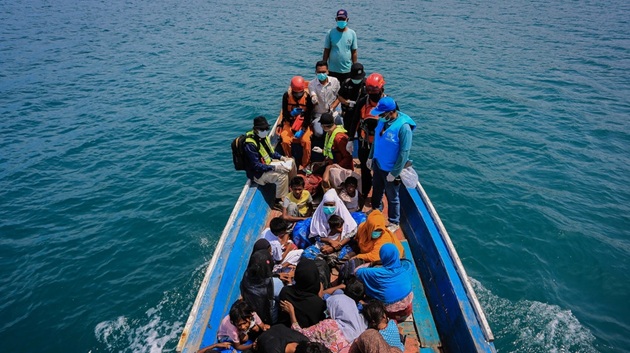
The Rohingya did not choose dependency on aid. It was created by the restrictions surrounding them. Credit: UNHCR/Amanda Jufrian

COX’S BAZAR, Bangladesh, Apr 14 2026 (IPS) – While global attention right now is on escalating geopolitical tensions involving the United States, Israel, and Iran, another crisis continues quietly in Bangladesh.


Beginning April 1, 2026, the World Food Programme (WFP) introduced a revised Targeting and Prioritisation Exercise (TPE) for Rohingya refugees living in camps in Cox’s Bazar and Bhasan Char, according to a statement released by the United Nations in Bangladesh on April 2.

Under the new system, refugee households will receive food assistance of $12, $10, or $7 per person per month, depending on their assessed level of food insecurity. Previously, all refugees received $12 per person.

On paper, vulnerability-based targeting appears reasonable. In many humanitarian crises, such systems help ensure that limited resources reach those most in need. However, the Rohingya context is different.

Nearly nine years after fleeing genocide and persecution in Myanmar, more than one million Rohingya refugees remain confined to camps in Bangladesh, according to the latest data from UNHCR Bangladesh including 144,456 biometrically identified new arrivals and 1,040,408 Registered refugees 1990s & post-2017. 78% them are Women and children.

Unlike refugees in many other countries, Rohingya in Bangladesh have extremely limited freedom of movement and cannot legally work or run small businesses within the camps. Refugees are also not formally employed by humanitarian organizations—except as volunteers receiving small daily allowances. As a result, they remain almost entirely dependent on humanitarian assistance.

Within this context, reducing aid raises serious concerns. When refugees are not permitted to engage in meaningful economic activity, food insecurity becomes less a household condition and more a structural outcome.

Humanitarian agencies have provided life-saving support for years, and their efforts should not be overlooked. But survival is not the same as stability. Instead of creating pathways toward self-reliance for Rohingya and local communities in Cox’s Bazar who are affected due to refugee statements, the current system has largely institutionalized dependency.

Many programs labeled as “livelihood initiatives” have not produced meaningful outcomes. Skills training programs—such as electrical repair or other technical courses—often fail to translate into real opportunities because refugees do not own motorbikes, electricity access is limited in many camp areas, refugees cannot legally move beyond the camps to seek work, and humanitarian organizations don’t employ trained refugees within their own operational structures.

This raises difficult questions: Why invest donor resources in skills that cannot realistically be applied? And what long-term strategy do these initiatives serve?

The new targeting model categorizes refugees as extremely food insecure, highly food insecure, or food insecure. Some vulnerable households—such as those led by elderly individuals, persons with disabilities, or children—will continue receiving the highest level of assistance.

Yet the broader reality remains unchanged: the entire Rohingya population in Bangladesh faces severe restrictions on economic participation.

Recent protests in the camps are often described as reactions to ration reductions. In reality, they reflect deeper concerns about uncertainty and the absence of long-term planning. Refugees are asking a simple question: What happens if funding declines further in the future? Where will we go? Well Bangladesh alone will be left dealing with the Rohingya crisis?

They want to send a message to the world: dependency on aid was designed around the Rohingya. It is time to think beyond relief and give them the tools to stand on their own feet.

Long-term strategic thinking is urgently needed. This includes serious discussions about ensuring safe and dignified lives in the camps until the Rohingya are able to return to Myanmar, expanding economic participation for refugees, and creating policies that allow them to contribute economically while remaining under appropriate regulation.

At the same time, Bangladesh itself is going through a transitional period after the election, and the new government and said it will work closely to make Rohingya repatriation possible and shared data on 8.29 lakh Rohingyas with Myanmar.

But the Rohingya crisis cannot be a lesser priority, the new government also needs to recognize that prolonged displacement cannot be managed indefinitely through restriction and relief alone—the same approach that largely characterized the policies of the previous government.

Carefully regulated work opportunities—such as camp-based enterprises, pilot employment schemes, or limited work authorization programs—could help reduce humanitarian dependency while preserving government oversight.

If even one or two members of each refugee household were allowed to work legally under controlled frameworks, humanitarian costs could gradually decline, camp economies could stabilize, and youth frustration could decrease.

Most importantly, dignity could begin to return.

After nearly nine years, international agencies have managed one of the world’s largest refugee operations with remarkable logistical capacity. Yet the central question remains: what durable systems have been created to help refugees stand on their own feet?

As global funding pressures increase and donor fatigue grows, humanitarian assistance is being recalibrated downward. Without structural reforms, this risks managing dependency more efficiently rather than reducing it.

The Rohingya did not choose dependency on aid. It was created by the restrictions surrounding them. Food assistance remains essential. But the future of an entire population cannot be defined solely by ration cards and vulnerability categories.

The Rohingya crisis requires more than improved targeting of aid. It requires policies that combine protection with participation and living with safety.

The world has learned how to feed the Rohingya.

The real test is whether it will allow them to stand—until the day they can safely return home to Myanmar with rights, safety, and dignity.

Otherwise, families quietly reduce meals. Young people seek unsafe informal labor. The risks of child labor, early marriage, unsafe migration. and involvement in illicit activities increase. When opportunity disappears, desperation fills the gap.

Mohammed Zonaid is a Rohingya SOPA 2025 honoree, freelance journalist, award-winning photographer, and fixer. He works with international agencies and has contributed to Myanmar Now, The Arakan Express News, The Diplomat Magazine, Frontier Myanmar, Inter Press Service, and the Myanmar Pressphoto Agency.

IPS UN Bureau

  Source

Nations pledge $3.9bn to Global Environment Facility as Race to Meet 2030 Goals Tightens

Biodiversity, Climate Action, Combating Desertification and Drought, Conferences, Development & Aid, Editors’ Choice, Environment, Featured, Global, Headlines, IPS UN: Inside the Glasshouse, Least Developed Countries, Natural Resources, Ocean Health, Sustainable Development Goals, TerraViva United Nations

Environment

This replenishment sends a clear message: the world is not giving up on nature even in a time of competing priorities. Our donor countries have risen to the challenge and made bold commitments towards a more positive future for the planet. – Claude Gascon, Interim CEO and Chairperson of the GEF

The Global Environment Facility (GEF) announced that donor countries ​p​ledged an initial ​U​SD 3.9 billion to ​the facility for the ninth replenishment cycle​, indicating that nature remains a priority, as in this image, where a veterinary team applies a collar to a sedated elephant​ in KwaZulu-Natal​, South Africa, as part of an ambitious project aimed at conserving the animals. Credit: Dan Ingham/IPS

The Global Environment Facility (GEF) announced that donor countries ​p​ledged an initial ​U​SD 3.9 billion to ​the facility for the ninth replenishment cycle​, indicating that nature remains a priority, as in this image, where a veterinary team applies a collar to a sedated elephant​ in KwaZulu-Natal​, South Africa, as part of an ambitious project aimed at conserving the animals. Credit: Dan Ingham/IPS

SAINT LUCIA, Apr 9 2026 (IPS) – With just four years left to meet a series of global environmental targets, governments are committing to shore up one of the world’s main environmental funds, the Global Environment Facility (GEF), with a $3.9 billion pledge.


The funding will form the backbone of the GEF’s ninth replenishment cycle, known as GEF-9, a four-year financing round running from July 2026 to June 2030. Those years are widely seen as decisive for slowing biodiversity loss, tackling pollution and keeping climate goals within reach.

While the $3.9 billion pledge signals renewed momentum, it comes at a moment of deepening environmental strain. Ecosystems are continuing to decline, coral reefs are bleaching at scale and small island states are already grappling with the economic and social fallout of environmental change.

“This replenishment sends a clear message: the world is not giving up on nature,” said Claude Gascon, the GEF’s interim chief executive. He noted that donor countries had “risen to the challenge and made bold commitments towards a more positive future for the planet” despite competing global priorities.

“The coming four years of the GEF-9 cycle will reflect this high-ambition push to achieve the 2030 environmental goals,” he said.

The GEF, the world’s largest multilateral environmental fund, supports developing countries in meeting commitments under major global agreements on climate change, biodiversity, land degradation, chemicals, and ocean governance. Since its establishment, it has provided more than $27 billion in grants and mobilised a further $155 billion in co-financing.

The GEF announced it had raised USD 3.9 billion for its ninth replenishment cycle to meet international environmental goals. Credit: Kea Mowat/Unsplash

GEF’s next funding round, its ninth replenishment cycle, aims to scale investment and mobilise private capital to close widening environmental financing gaps. Credit: Kea Mowat/Unsplash

Rewiring Economies Around Nature

At the centre of the new funding cycle is a push toward what the GEF calls “nature-positive development”. It is an effort to embed environmental value into economic decision-making rather than treating it as a secondary concern.

That includes reworking systems that drive environmental degradation, such as food production, energy, urban development and public health, so they operate within ecological limits.

The strategy also leans heavily on attracting private investment. Around 25% of GEF-9 resources are expected to be used to mobilise private capital, reflecting a growing recognition that public funding alone cannot close the global environmental financing gap.

Focus on the Most Vulnerable

The allocation of funds carries a clear political signal.

At least 35 percent of resources are expected to go to Least Developed Countries and Small Island Developing States (SIDS), countries that contribute least to environmental degradation but face some of its most severe impacts. A further 20% is earmarked for Indigenous Peoples and local communities.

For Caribbean nations, where coastal erosion, stronger storms and coral reef loss are already reshaping economies, the funding could prove significant if it translates quickly into action on the ground.

“We need multilateral cooperation more than ever to protect our planet for future generations,” said Niels Annen, describing the replenishment as a “joint effort” between countries in the Global North and South. “Environmental action and sustainable development have to go hand in hand. In GEF-9, we see Germany’s priorities very well reflected: innovative finance for nature and people, better cooperation with the private sector and stable resources for the most vulnerable countries.”

Support for the funding round has also come from Spain and Mexico, with Inés Carpio San Román emphasising the importance of “effective multilateralism” and Mexico backing “country-driven solutions” to global environmental challenges.

Calls to Deliver Results

Civil society groups have welcomed the increased emphasis on inclusion, particularly the allocation for Indigenous Peoples and local communities.

“This will strengthen a whole-of-society approach,” said Faizal Parish, Chair of the GEF’s Civil Society Organization Network, while Aliou Mustafa, of the GEF’s Indigenous Peoples Advisory Group, said the shift reflects efforts to place Indigenous groups “at the centre of decision-making.”

Still, expectations are high and time is short.

“The environmental crises we face are accelerating,” said Richard Bontjer. He described the  replenishment as “a vote of confidence” while stressing that “every dollar must count.”

“This replenishment will sharpen the GEF’s focus on impact, drive greater efficiency and mobilize private finance alongside public investment. It will also strengthen support to SIDS and LDCs and give recognition to the importance of supporting Indigenous Peoples and local communities.”

With the 2030 deadline fast approaching, the success of this funding round will ultimately be judged not by the size of the pledges but by how quickly they translate into measurable gains—restored ecosystems, protected coastlines and more resilient economies.

For countries on the frontlines, including those in the Caribbean, the $3.9 billion is not just another funding cycle.

It is a narrowing window of opportunity.

Additional pledges are expected before the end-of-May GEF Council meeting, when countries will lock in the final size and ambition of the four-year funding round.

The 71st GEF Council meeting will be held in Samarkand, Uzbekistan, from May 31 to June 3, 2026. The meeting will take place in advance of the Eighth GEF Assembly, when individual country pledges will be publicly announced.

Note: This feature is published with the support of the GEF. IPS is solely responsible for the editorial content, and it does not necessarily reflect the views of the GEF.

IPS UN Bureau Report


Over 1,000 Humanitarian Workers Killed Distributing Food, Water, Medicine & Shelter

Armed Conflicts, Civil Society, Democracy, Development & Aid, Global, Headlines, Human Rights, Humanitarian Emergencies, TerraViva United Nations

Opinion

Over 1,000 Humanitarian Workers Killed Distributing Food, Water, Medicine & Shelter

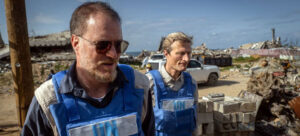
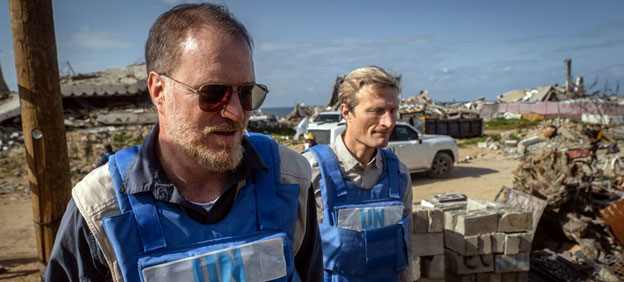
Shaun Hughes (left), WFP Country Director for Palestine, walks amid massive destruction in Gaza. Credit: WFP/Maxime Le Lijour
 
Excerpts from a statement by Tom Fletcher, Under-Secretary-General for Humanitarian Affairs and Emergency Relief Coordinator, to the Security Council, pursuant to resolution 2730 (2024) on the safety and security of humanitarian personnel and the protection of United Nations and associated personnel.

UNITED NATIONS, Apr 9 2026 (IPS) – In 2025, at least 326 humanitarians were recorded as killed across 21 countries, bringing the total number of humanitarians killed in three years to over 1,010. We recognise, grieve and honour each of our 326 colleagues, and commit the work ahead to their memory.


Of those over 1,000 deaths, more than 560 were in Gaza and the West Bank, 130 in Sudan, 60 in South Sudan, 25 in Ukraine and 25 in [the Democratic Republic of the Congo].

That number – over 1,000 – compares to 377 recorded as killed globally over the previous three years – so that’s almost tripling the death count. This is not an accidental escalation – it is the collapse of protection.

These humanitarians were killed while distributing food, water, medicine, shelter. They died in clearly marked convoys and on missions coordinated directly with authorities. And, too often, they were killed by Member States of the United Nations.

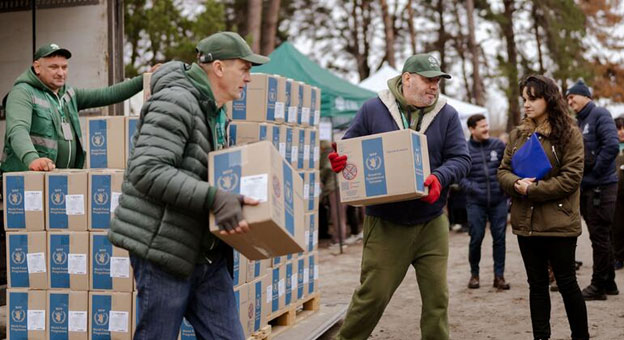
Credit: WFP/Sayed Asif Mahmud / Source: UN News

Humanitarians know we face risks. It is the nature of our work, the places in which we operate.
These deaths are not because we are reckless with our lives. They are because parties to the conflict are reckless with our lives.

So, on behalf of over a thousand dead humanitarians and their families, we ask: why?

Is it because the world no longer believes in Security Council resolution 2730, in which you spoke with such moral urgency about ending violence against humanitarians?

Is it because international humanitarian law, forged by a generation of wiser political leaders for just such a time as this, is no longer convenient?

Is it because it is more important to protect those designing, selling, supplying and firing lethal weapons – including drones, cyber tools, artificial intelligence – than protecting us?

Is it because those killing us feel no cost for their actions? How many were prosecuted? How many of their leaders resigned? On how many investigations did the UN Security Council insist? Were you ever selective in your outrage?

Or is it because Member States see these numbers as collateral damage, part of the fog of war? Or worse, are we now seen as legitimate targets?

And perhaps the most chilling question: if these deaths were ‘preventable,’ why then were they not prevented?

Over 110 Member States have chosen to act together through the political declaration on the protection of humanitarians. Yet across multiple crises, humanitarians are not just being killed.

Our action is being restricted, penalized, delegitimized. We are told where not to go, whom not to help. We are harassed or arrested for doing our job. And we are lied about – and those lies have these consequences.

And, of course, when humanitarians are harmed, aid often stops. Clinics close, food doesn’t arrive. In Yemen, 73 UN and dozens of NGO personnel remain arbitrarily detained by the Houthis. In Afghanistan and Yemen, women humanitarians are prevented from doing their jobs.

In Gaza, Israel restricts UN agencies and international NGOs. In Myanmar, insecurity and access constraints cut off aid to over 100,000 people in a single month.

And in Ukraine, drone attacks have forced aid groups to pull back from frontline communities.

In all these cases, the results of the deaths of humanitarians are too often the death of hope for millions who rely on them. These trends, alongside the collapse in funding for our lifesaving work, are a symptom of a lawless, bellicose, selfish and violent world. Killing humanitarians is part of the broader attack on the UN Charter and on international humanitarian law.

International humanitarian law was never, and is not now, an academic exercise. In honour of our colleagues killed, and in solidarity with those now risking their lives, we ask you to act with much greater conviction, consistency and courage.

I normally conclude with three asks of this Council. But it seems insulting to over one thousand colleagues killed to echo back to you the commitments of SCR 2730: protection, integrity, accountability.

We come here not to remind you of these commitments, but to challenge you to uphold them.
Because if we cast aside these hard-won principles, then the integrity of this Council, and the laws we are here to protect, die with our colleagues.

IPS UN Bureau

  Source

Regime Change – Sometimes It Works, Often It Doesn’t

Armed Conflicts, Civil Society, Crime & Justice, Democracy, Economy & Trade, Energy, Global, Global Geopolitics, Headlines, Human Rights, North America, TerraViva United Nations

Opinion

Credit: US Department of Defense / Wiki Commons

Apr 6 2026 (IPS) –  
Donald Trump ran on a platform of ending wars. After his success in Venezuela, he is intoxicated by his military achievements and is banking on regime change in several countries.


In a swift and decisive move, US forces abducted Venezuelan leader Nicolás Maduro and his wife to the United States. The current government in Caracas has little choice but to largely submit to Washington’s dictates. Trump’s motives for the war against Iran remain unclear, partly because the US president has cited various reasons: to finally destroy the Iranian nuclear program, to end the Iranian threat to the Middle East, to support the Iranian people, and to overthrow the terrible regime in Tehran. He remains vague about his reasoning and seems to make off the cuff suggestions for regime change. Trump had a lofty idea at how he envisions the end of this war. He has suggested “unconditional surrender,” followed by his personal involvement in the selection of a successor: I must be involved in picking Iran’s next leader.

The swift victory against Iran failed to materialize, an end to the war is not in sight, and a new leader has been chosen without Trump’s involvement. The structures of the mullah regime appear so entrenched that the anticipated regime change following the rapid decapitation of the leadership did not occur. Yet Donald Trump had proclaimed: “What we did in Venezuela is, in my opinion, the perfect, the perfect scenario.” The Atlantic calls this attitude a “hostile corporate takeover of an entire country”. Now the US government expects Cuba to surrender. “I think I could do anything I want” with Cuba, Trump declared, now that the island is virtually cut off from energy supplies and its economy is in ruins. He is demanding the removal of Cuban President Diaz-Canel.

In the business world hostile corporate takeovers sometimes work, sometimes they fail. Similarly with Trump’s idea of swift government surrenders. In the case of Iran, he was misguided by the Wall Street playbook. Irresponsibly, he called on Iranians to overthrow the government before the bombing campaign started. Regime change in Iran has now been forgotten and Trump is agnostic about democracy. He is interested to get the oil price down and the stock market up.

Lessons from the past

The concept of regime change—replacing the top of the government to install one more agreeable to the US—is not new to US foreign policy. Proponents of regime change usually point to Japan and Germany as positive examples of successful democratization. Often, however, the goal is not, or at least not primarily, democratization, but rather the installation of a government that is ideologically close to the US or amenable to them. But the “Trump Corollary”, as explicitly stated in the National Security Strategy to enforce the Monroe Doctrine, is not new either. In reality, it was already the Kennedy, Nixon, Reagan, and Bush doctrine.

Both Trump’s idea of regime change and his rigorously pursued territorial ambitions (Canada, Greenland, the Panama Canal) are reminiscent of the Monroe Doctrine of 1823, particularly the version of this doctrine expanded by President Roosevelt in 1904. This doctrine legitimized American interventions in Latin America. At the beginning of the 20th century, the US intervened in numerous Latin American countries in ‘its backyard’, using military and intelligence means: in Colombia, to support Panamanian separatists in controlling the Panama Canal; repeatedly in the Dominican Republic; they occupied Cuba from 1906 to 1909 and intervened there repeatedly afterward; in Nicaragua during the so-called ‘Banana War’, to protect the interests of the US company United Fruit; in Mexico, as well as in Haiti and Honduras.

The New York Times recently suggested that Trump’s current enthusiasm for regime change is most comparable to that of Dwight D. Eisenhower. During his two terms in office from 1953 to 1961, the once coldly calculating general allowed himself to be seduced into a downward spiral from one coup to the next. In 1953, the US succeeded in overthrowing the elected Iranian Prime Minister Mohammad Mossadegh with Operation Ajax. Mossadegh wanted to nationalize the British-owned oil industry. The coup succeeded with CIA support. The US installed the Shah as its puppet. He ruled with absolute power until the so-called Iranian Revolution and the dictatorship of Ayatollah Khomeini in 1979. After the successful overthrow of the government in Iran, Eisenhower decided to intervene in Guatemala. The elected president, Jacobo Árbenz Guzmán, who initiated far-reaching land reform laws, was overthrown in a coup d’état in 1954 and replaced by the pro-American colonel, Castillo Armas.

During this period, the US government also formulated the so-called domino theory, which aimed to prevent governments, particularly in Asia, from aligning themselves with the Soviet Union. The assumption was that if one domino fell, others would follow. It was during this time that the costly war in Korea ended in an armistice. Therefore, countries like Vietnam, Laos, Burma, Indonesia, and others were on Eisenhower’s domino list. However, the destabilization campaigns carried out by the CIA sometimes had the opposite effect. Governments in Indonesia and Syria emerged strengthened from the interventions. Eisenhower left Kennedy with the loss of American influence in Cuba. The failed Bay of Pigs invasion in April 1961, intended to overthrow Fidel Castro, was the starting point for the decades-long blockade of Cuba, which Trump is determined to end now through regime change.

The most dramatic example of failed regime change in recent history is undoubtedly the Iraq War, which began in 2003 under President George W. Bush. The stated goal was to remove Saddam Hussein from power and destroy his weapons of mass destruction. The war led to the overthrow of the regime. The United Nations and US teams found no weapons of mass destruction despite intensive on-site investigations. Attempts to establish an orderly state in Iraq failed. These experiences, and especially the disastrous outcome of two decades of military intervention in Afghanistan, discredited the concept of regime change.

What are the implications?

The most important lesson taught by efforts to affect externally forced regime change is that interventions often lead to crises that were ostensibly meant to be prevented or solved. The temptation was too great for Trump to miss the opportunity to depose the despised Maduro government.

Scholarly studies of the numerous attempted regime changes and democratization efforts reveal three key findings. First, simply removing the government from power (whether through assassination, as in the case of Saddam Hussein in Iraq or now in Iran, or through kidnapping as in Venezuela) is insufficient, as such actions often lead to chaos, state collapse, or even civil war. Thus, it will be interesting to watch further developments in Venezuela, Cuba, and Iran.

A second lesson from empirical studies of regime change is that democratization is more likely to succeed if democratic experience already existed in the country. However, this is often not the case.

Finally, if the real goal is democratization (and not just to secure spheres of influence or oil supplies etc.), it is far more promising not only to hold elections (as in Afghanistan, for example), but to renounce violence and initiate a long-term program with development aid and support for civil society.

Whether the US government will be impressed by these findings, or even acknowledge them, is doubtful. Currently, the American president is euphoric, despite the strong reaction from the Iranian government which he, surprisingly, did not expect. His promises to end the senseless wars and not start any new ones, however, seem to have been forgotten.

Related articles:
The US: Good at Starting but Bad at Ending Wars
Failure of US–Iran Talks Was All Too Predictable — But Turning to Military Strikes Creates Dangerous Unknowns
The ‘Donroe Doctrine’
The Return of the Ugly American

Herbert Wulf is a Professor of International Relations and former Director of the Bonn International Center for Conflict Studies (BICC). He is presently a Senior Fellow at BICC, an Adjunct Senior Researcher at the Institute for Development and Peace, University of Duisburg/Essen, Germany, and a Research Affiliate at the National Centre for Peace and Conflict Studies, University of Otago, New Zealand. He serves on the Scientific Council of SIPRI.

This article was issued by the Toda Peace Institute and is being republished from the original with their permission.

IPS UN Bureau

  Source