Author: emandowa

Epidemic: Bodies Remember What Was Done to Them

A black-and-white photograph from 1976 shows a female doctor leaning over the bed of a patient recovering from surgery. The image caption reads: “A doctor greets a woman who has undergone tubectomy operation at the AIWC-Family Planning Hospital at the Jamshedpur Blood Bank.”
In the early ’50s, India launched a family planning program in which the government would use various tactics to sterilize people — some voluntary, some for a monetary reward, some by force. In this 1976 photo published by Tata Steel in TISCO News, patients are recovering from a sterilization procedure. The image caption reads: “A doctor greets a woman who has undergone tubectomy operation at the AIWC – Family Planning Hospital at the Jameshedpur Blood Bank.” (TISCO News Volume 24: No. 1, June 1976, Page 73)

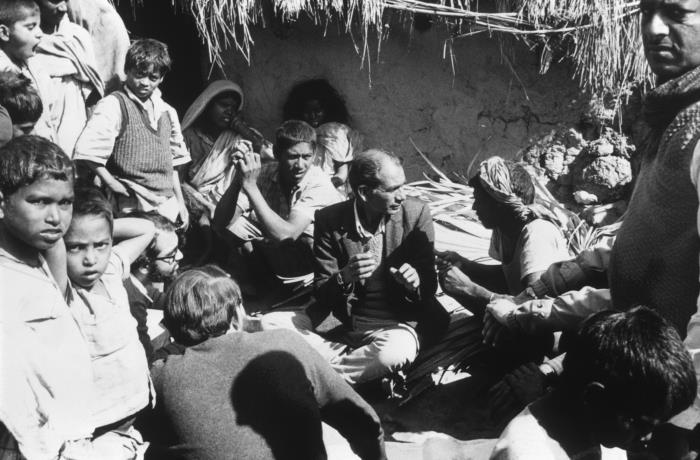
A black-and-white photograph from 1975 shows a health care worker sitting on the ground among a small crowd as he speaks to them.
In this photograph from 1975, an Indian health care worker speaks with families about ways to stop the spread of smallpox. Smallpox eradication workers say that violent and coercive tactics during India’s family planning campaign created distrust that was hard to overcome as they worked to vaccinate people against smallpox. Sitting down and speaking with community leaders directly helped rebuild trust. (J.D. Millar/CDC)

Global fears of overpopulation in the ’60s and ’70s helped fuel India’s campaign to slow population growth. Health workers tasked to encourage family planning were dispatched throughout the country and millions of people were sterilized — some voluntarily, some for a monetary reward, and some through force.

This violent and coercive campaign — and the distrust it created — was a backdrop for the smallpox eradication campaign happening simultaneously in India. When smallpox eradication worker Chandrakant Pandav entered a community hoping to persuade people to accept the smallpox vaccine, he said, he was often met with hesitancy and resistance.

“People’s bodies still remember what was done to them,” said medical historian Sanjoy Bhattacharya.

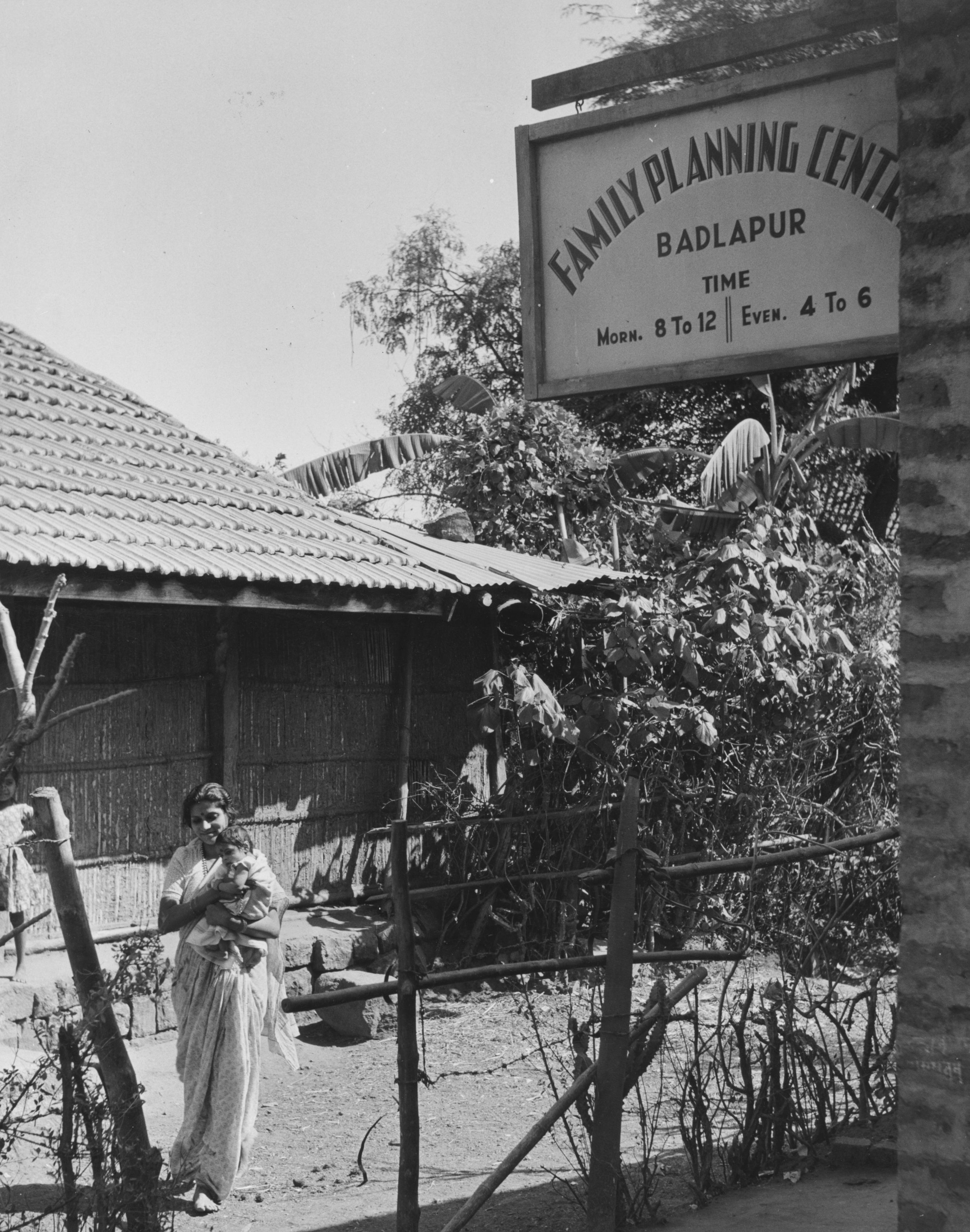
A woman carries a baby outside the family planning center in the village of Badlapur in 1954.
A woman carries a baby outside the family planning center in the village of Badlapur in 1954. India’s family planning campaign created an atmosphere of intimidation and harassment that was nearly impossible to escape, says “Epidemic” host Céline Gounder. (Hulton Archive/Getty Images)

Episode 6 of “Eradicating Smallpox” shares Pandav’s approach to mending damaged relationships.

To gain informed consent, he sat with people, sang folk songs, and patiently answered questions, working both to rebuild broken trust and slow the spread of smallpox.

To conclude the episode, host Céline Gounder speaks with the director of the global health program at the Council on Foreign Relations, Thomas Bollyky. He said public health resources might be better spent looking for ways to encourage cooperation in low-trust communities, rather than investing to rebuild trust.

The Host:

In Conversation With Céline Gounder:

Voices From the Episode:

Podcast Transcript 
Epidemic: “Eradicating Smallpox” 
Season 2, Episode 6: Bodies Remember What Was Done to Them 
Air date: Oct. 10, 2023 

Editor’s note: If you are able, we encourage you to listen to the audio of “Epidemic,” which includes emotion and emphasis not found in the transcript. This transcript, generated using transcription software, has been edited for style and clarity. Please use the transcript as a tool but check the corresponding audio before quoting the podcast. 

Céline Gounder: In the early 1970s, all around the world, worries about overpopulation were mounting. 

Politicians warned about the dangers. 

Richard Nixon: Our cities are gonna be choked with people. They’re going to be choked with traffic. They’re gonna be choked with crime. … And they will be impossible places in which to live. 

Céline Gounder: And news outlets repeated the claims. A 1970 news analysis from The New York Times described “two avenues” to deal with the problem of overpopulation. 

Voice actor reading from NYT article: “… one is persuasion of people to limit family size voluntarily, by contraception, sterilization or abortion. The other is compulsory, through such means as large‐scale injection of at least temporary infertility drugs into food or water. 

Céline Gounder: Popular books like “The Population Bomb” suggested an impending, apocalyptic future. Pulpy paperbacks were passed around — capturing people’s imagination and stoking fears. 

Two million copies of “The Population Bomb” were sold. And the author landed on late-night television, his dire predictions becoming entertainment for Americans sitting at home on their couches. 

Meanwhile, on the other side of the globe, India — with its growing population — was in the crosshairs of the world’s anxieties. 

[Solemn music plays.] 

Céline Gounder: In the early ’50s, India had launched a family planning program. 

Narrator of Indian Family Planning Film: There are 5 million more mouths to feed every year. … If our population continues to grow unchecked at the present alarming rate, we cannot solve our problems of food and shelter. 

Céline Gounder: And that state-sponsored campaign got political and financial backing from international organizations like the World Bank and American foundations like Ford and Rockefeller. 

Health workers were dispatched across India to get people to have fewer children. 

Sometimes voluntarily. 

Sometimes for a monetary reward. 

Sometimes using force. 

Violence and coercion created distrust. 

In this episode, we’ll explore how that distrust affected the public health campaign to stop smallpox. 

And ask: What is the path to restoring trust? 

I’m Dr. Céline Gounder and this is “Epidemic.”  

[“Epidemic” theme music plays.] 

Chandrakant Pandav: Ready? Good afternoon. My name is Dr. Chandrakant Pandav. This is a recording in my office at New Delhi. 

Céline Gounder: Chandrakant Pandav’s office is decorated with his academic degrees, lantern lights, and floral wallpaper. There are photos of Mahatma Gandhi, Mother Teresa, and various Hindu deities framed in gold. 

And on his desk is a small saffron-white-and-green flag. 

Chandrakant Pandav: Most important, I have India’s flag always in front of me. 

Céline Gounder: And what’s the reason for that?  

Chandrakant Pandav: Patriotism, mera desh mahaan

Céline Gounder: Mera desh mahaan — “My great Nation”— he says in Hindi. Chandrakant was so eager to share his pride that at one point he picked up the flag and waved it around a bit. 

He could barely contain his love for his country — and its culture. 

He even got up out of his chair, turned on a song, and started dancing. 

[Video of Chandrakant dancing to upbeat music playing.] 

Céline Gounder: A twist of the hand here, a little shimmy there; he did a few hand mudras with a look of delight on his face. 

I couldn’t help but smile along with him. 

[Dance video continues playing, Céline and Chandrakant laugh.] 

Céline Gounder: But even with all that joy, when the music stopped and he shuffled back to his chair, you’re reminded that Chandrakant is in his 70s, with more than 50 years of experience in public health. 

[Video of Chandrakant dance video fades out.] 

Céline Gounder: He was one of thousands of people asked to take part in the smallpox eradication program in the early and mid-’70s. He didn’t hesitate when he got the call. 

Chandrakant Pandav: I said, this is the time to serve my India. Because India has spent so much of money on my education and making me a doctor, so I came from this culture strong, strong ethical background that your life is not for yourself. Money is … doesn’t matter. Serve the society. 

Céline Gounder: Chandrakant led a team of smallpox eradication workers. He says nearly every person he talked to about taking the smallpox vaccine seemed to have the same worry, the same questions. 

Chandrakant Pandav: “What is this vaccine? What is this you’re doing us? Maybe it’s a population control measure.” So the strongest question they had: “This is the government of India’s new policy for sterilization?” 

Céline Gounder: Sterilization. The government’s decades-long family planning campaign was very much top of mind. 

Decades later, when Chandrakant thinks about the program — and the unethical tactics India used — the pride melts off his face. 

Chandrakant Pandav: It was a very aggressive strategy, unfortunately. I don’t want to go into that period. It was very aggressive. 

Céline Gounder: Chandrakant didn’t want to talk about it. But you can’t tell the story of smallpox eradication success without talking about the family planning policies that came first. 

Without talking about the state-sponsored coercive tactics that were commonplace and accepted by many. 

Without acknowledging the violence of forced sterilizations. 

Public health doesn’t happen in a vacuum. 

And India’s approach to family planning eroded trust in public health workers for years. 

So — in this season all about smallpox — we’re going to spend some time this episode diving into the details of the family planning program. 

Gyan Prakash: My name is Gyan Prash and I’m professor of history at Princeton University. 

Céline Gounder: Gyan has spent years studying India’s family planning campaign and the various tactics the government used to sterilize millions of people. 

The government would pay people to get sterilized, and after natural disasters, like a drought, when many were desperate, any amount of money could be a powerful motivator. Patients might receive fewer than 100 rupees as compensation — which translates to only a few days’ wages, according to a 1986 article published in the journal “Studies in Family Planning.” 

Gyan Prakash: It was a very small amount, but it mattered; it mattered to the poor. It was coercive, because it was between going hungry and, and not going hungry. 

Céline Gounder: And if you chose not to get sterilized, Gyan says, the government found other ways to twist the screw. Families would receive food rations for up to only three children — any child beyond that would not be allotted food. 

Gyan Prakash: Which punishes families which have more than three children. 

Céline Gounder: At one point, the government began to prioritize men for sterilization. 

Vasectomies were sometimes pushed on men, according to a 1972 report from The Associated Press. 

Céline Gounder: Gyan says India’s family planning campaign created an atmosphere of intimidation and harassment that was nearly impossible to escape. 

Gyan Prakash: You know, sending district authorities, backed by police, to the countryside and hold sterilization camps. So, I mean, the entire state machinery was mobilized to get people to the sterilization table. 

Céline Gounder: Some of the harshest treatment during the sterilization campaign was aimed at Muslims and Indigenous populations like Adivasi tribes living in remote and rural parts of the country. I spoke to Sanjoy Bhattacharya about this. 

Sanjoy Bhattacharya: I’m a historian of medicine with a deep interest in health policy, national, international, and global. And I’m the head of the School of History at the University of Leeds, United Kingdom. 

Céline Gounder: Sanjoy says marginalized communities were often scapegoated. 

Sanjoy Bhattacharya: That global narrative of overpopulation took the shape of, oh, Muslims have more children than Hindus, therefore Muslims are the problem behind Indian overpopulation. So we need to control the Muslim birthrate. What sterilization did was to violently sterilize men from a certain community who were blamed for a population problem that was a general population problem. 

Céline Gounder: Sanjoy says many Adivasi and Muslim communities, in particular, lost trust in the government. This distrust lingered and simmered for years. 

Imagine for a moment that for decades government trucks have descended on your village unannounced. Tents were set up. Equipment was unloaded. Workers fanned out to talk to village leaders. 

This is what it looks like when Indian health workers showed up to sterilize you and your people. 

And then, in the early 1970s, more government trucks arrived, maybe with familiar faces at the wheel. Maybe it’s some of the same public health workers. 

They unload similar sharp-edged tools and set up their tents, but this time they promise it’s not for sterilization, it’s for a smallpox eradication program. You’d have a hard time trusting them. 

Sanjoy Bhattacharya: And there are tales of how villages would empty when rumors would spread that these teams were coming ostensibly to vaccinate, but maybe really to sterilize. I mean, people’s bodies still remember what was done to them. 

Chandrakant Pandav: They were treated like animals. Coercion, coercion, coercion. 

Céline Gounder: That’s community medicine physician and longtime public health leader Chandrakant Pandav again. He says when he arrived in the northern region of the state of Bihar, he knew these communities had every reason to doubt his team. 

So first he worked to earn people’s trust. 

Chandrakant Pandav: So when you sit with the leader of the village, along with the batch of people there, you talk to them, you explain to them. 

Céline Gounder: And Chandrakant says it’s helpful to think of yourself more as a guest than a guest of honor. 

Chandrakant Pandav: You don’t sit on a chair. Céline, I didn’t sit on a chair. I sat next to them to make them feel that I’m part of that community. 

Céline Gounder: It sounds like convincing the village leader was enough to convince the villagers. 

Chandrakant Pandav: It is the first step. 

Céline Gounder: Another important step, he says, was to learn the local traditions around smallpox. Locals in Bihar faced the disease for many years, and they’d developed their own ways of dealing with it. 

They would tie the leaves of a neem tree outside the homes of infected people. 

The neem tree is said to have medicinal properties. Displaying its leaves outside homes where an active infection was present alerted others to stay away — a strategy designed to slow disease spread. 

It didn’t stop the virus — it wasn’t effective in the same way as vials of vaccine or the bifurcated needle — but the traditions needed to be honored. 

So Chandrakant and the other public health workers adopted some of the local strategies. 

Chandrakant Pandav: So it was a very good combination of ancient medicine, ancient practice, with modern approach. Very good combination. 

Céline Gounder: Another tradition his team tapped into was folk songs. They frequently used drums, songs, and the public address systems to communicate with people about smallpox.  

Music was an especially good match for Chandrakant’s lively personality. 

Remember all that joy for India I witnessed in his office in New Delhi — the flag? The dancing? Imagine that harnessed on behalf of his mission to wipe out smallpox. 

In fact, he still remembers some of those folk songs nearly half a century later. 

Chandrakant Pandav: Because it’s part of me, every atom, every molecule residing [sings folk song in Hindi]. So, it became an important method of communication. I come back again and again, Céline, to the same point: Establish a rapport and instill a sense of faith, anything is possible. 

Céline Gounder: Chandrakant was able to pave the way for acceptance of the smallpox vaccine and rebuild trust in public health. But he was one charismatic man. His approach, his compassion were admirable — and it worked, where he was, with the people in front of him. 

But the Indian government broke trust with tens of millions of its citizens during the family planning campaign. It makes me wonder about what it might look like to repair trust at that level, across the public health system, across an entire country. 

Maybe that would mean an apology. Maybe that would be some kind of reparation to victims for the damage done to their bodies. 

My friend and colleague Tom Bollyky says there’s no single silver bullet for rebuilding trust. 

Tom Bollyky: That is too big of a mission for public health. We have enough challenges as it is. Instead of planning for how do we rebuild trust, we should be planning for dysfunction. 

Céline Gounder: That’s after the break. 

[Music fades out.] 

Céline Gounder: Distrust and mistrust in the government became something of a defining feature of the response to the covid pandemic here in the United States. And while that might have taken many Americans by surprise, it was totally predictable to Tom Bollyky. He’s the director of the global health program at the Council on Foreign Relations. Bollyky says trust in the U.S. has been deteriorating since Watergate, and that decline accelerated around the 2008 financial crisis. Mistrust here divides along racial lines. It’s lower among African Americans, for example. And most notably, mistrust tends to be partisan. But it didn’t start that way during the covid pandemic. 

Tom Bollyky: I think we all forget that there was, for a period of time, a surprising level of political consensus. Almost all states imposed protective policy mandates and most states imposed them at the same time. But as the fall stretched out, you saw some of those mandates and responses become more politicized. 

And the moment I regret is, I think there was a moment, when the Biden administration came in and there was an attempt to reset and I … myself and many others really again focused on this message of following the science. But I do feel like perhaps we missed a opportunity to try to pull in some people across partisan lines at that moment. 

Céline Gounder: So, as I’m hearing you describe this, restoring trust seems like a really massive undertaking. 

I wonder whether you think that’s even the right framework that we should be using to think about this challenge. 

Tom Bollyky: Such a great question. No, I think it isn’t. I think if we set an agenda for public health to rebuild the cohesiveness of our societies, to make us have a better relationship with our government, with each other, we will fail. 

That is too big of a mission for public health. We have enough challenges as it is. Instead of planning for how do we rebuild trust, we should be planning for dysfunction. That’s really what preparedness is about. 

Céline Gounder: So what are some of the ways that public health officials can reach skeptical communities? 

Tom Bollyky: Through kinship networks and, uh, local leaders has been important. In some other public health crises, like HIV, people have used soap operas. 

Céline Gounder: I remember being in South Africa in the early 2000s. There was a soap opera called “Soul City.” We pulled a clip of it, and there’s this one scene where a husband comes home to find his wife has placed a romantic gift by their bedside. He opens it up and sees condoms. 

[Music

“Soul City” clip: Woman: So that we can have safe sex. Man: Safe sex. Woman: I can’t have sex with you while I’m anxious about getting sick. Or, would you prefer I use condoms maybe? Man: We don’t need condoms. Woman: I do. 

Tom Bollyky: I was in South Africa and the country was riveted. People really talked about it. It took, it took hold. Uh, they did a nice job of making it interesting, like weaving in the themes you wanted to weave in about people getting tested and talking to their partners and loved ones about their circumstances. 

I know, Céline, you were very involved in the Ebola response, in 2013 through 2016. You know, there is high levels of mistrust in government in those post-conflict settings that were most affected in that epidemic. 

Céline Gounder: People there don’t trust government, they think that people who serve in government do so to enrich themselves and their family and friends. 

When I was in Guinea during the Ebola epidemic, they said Ebola was a hoax, that it was just a way for government officials and international organizations to enrich themselves. And yet, we were able to make some inroads convincing people to comply with Ebola control measures, so hand-washing, testing, safe burials. 

Much of that was done through imams and other religious and community leaders. 

Tom Bollyky: Those are the types of strategies we should be deploying when the next health crisis emerges, but not simply waiting until that happens. We need to start to build the infrastructure, the relationships. Again, even if it isn’t around fundamentally transforming, you know, communities, relationships with the government, or even how community members feel about, uh, one another, because interpersonal trust, social trust is a big part of this, too. 

It’s about building the connections, the networks, about starting to engage individuals in these programs or through those institutions so that when the crisis emerges, you’re not building that from scratch. 

Céline Gounder: Well, and to your point, as we prepare for the next pandemic, do you think we’ve learned those lessons about trust or are there things we’re still getting wrong? 

Tom Bollyky: I think there is a greater appreciation for trust as an important issue. You hear that messaging. What I worry about is we’re not seeing it reflected yet in where the money is going. Where the money is going by and large is to developing vaccines faster, better vaccines in the future. But if really the lessons we’re drawing from this crisis are that developing a vaccine instead of in 326 days in 250 days … if we really think that would have made a difference in this pandemic, we haven’t been paying attention. 

Céline Gounder: Next time on “Epidemic” … 

Daniel Tarantola: They did not consider smallpox as the major issues among the many issues they were confronting. … No. 1 priority is food and food and food. And the second priority is food and food and food. 

CREDITS 

Céline Gounder: “Eradicating Smallpox,” our latest season of “Epidemic,” is a co-production of KFF Health News and Just Human Productions. 

Additional support provided by the Sloan Foundation. 

This episode was produced by Taylor Cook, Zach Dyer, Bram Sable-Smith, and me. 

Saidu Tejan-Thomas Jr. was scriptwriter for the episode. 

Swagata Yadavar was our translator and local reporting partner in India. 

Our managing editor is Taunya English. 

Oona Tempest is our graphics and photo editor. 

The show was engineered by Justin Gerrish. 

We had extra editing help from Simone Popperl. 

Music in this episode is from the Blue Dot Sessions and Soundstripe. 

This episode featured clips from National Education & Information Films Limited 

We’re powered and distributed by Simplecast. 

If you enjoyed the show, please tell a friend. And leave us a review on Apple Podcasts. It helps more people find the show. 

Follow KFF Health News on X (formerly known as Twitter), Instagram, and TikTok

And find me on X @celinegounder. On our socials, there’s more about the ideas we’re exploring on our podcasts. 

And subscribe to our newsletters at kffhealthnews.org so you’ll never miss what’s new and important in American health care, health policy, and public health news. 

I’m Dr. Céline Gounder. Thanks for listening to “Epidemic.” 

[“Epidemic” theme fades out.] 

Additional Newsroom Support

Lydia Zuraw, digital producer 
Tarena Lofton, audience engagement producer 
Hannah Norman, visual producer and visual reporter 
Simone Popperl, broadcast editor 
Chaseedaw Giles, social media manager 
Mary Agnes Carey, partnerships editor 
Damon Darlin, executive editor 
Terry Byrne, copy chief
Gabe Brison-Trezise, deputy copy chief
Chris Lee, senior communications officer 

Additional Reporting Support

Swagata Yadavar, translator and local reporting partner in India
Redwan Ahmed, translator and local reporting partner in Bangladesh

Epidemic” is a co-production of KFF Health News and Just Human Productions.

To hear other KFF Health News podcasts, click here. Subscribe to “Epidemic” on Apple Podcasts, Spotify, Google, Pocket Casts, or wherever you listen to podcasts.

Source

Lazarus Chakwera hails Unga trip

President Lazarus Chakwera has said his trip to the 78th Session of the United Nations General Assembly (Unga) in New York, the United States, was successful.

Chakwera said this Monday at Kamuzu International Airport in Lilongwe when he arrived from New York.

He said he took advantage of the trip to engage investors, who have since expressed interest in investing in Malawi.

On October 21, Chakwera addressed the Unga, where he asked developed countries to cancel debts that poor countries owe them.

“I was happy to represent our nation and was able to not just represent Malawi but also other nations, in terms of least developed countries, since we have just handed over the chairpersonship of that group. And, so, I spoke concerning things that really have troubled least developed countries.

– Advertisement –

“And then I had side meetings and I was happy that the Secretary General [of the United Nations] was able to send an assistant Secretary General for Humanitarian Affairs to the Malawian Partners in Development Meeting. We were actually surprised, presantly surprised, because of the turnout,” Chakwera said.

The Malawi leader said some African Americans showed particular determination to invest in the country so that they can be part of Malawi’s story.

Chakwera left the country for Unga on September 15 2023.

Source

Music: Parchman Prison Prayer: Some Mississippi Sunday Morning (Glitterbeat Records)

WHEN the Grammy-winning world music producer and political activist Ian Brennan first approached Parchman Prison, the Mississippi state penitentiary, to ask whether he could record there, he started a ball rolling on a project that would yield extraordinary results. Brennan takes a particular interest in prisons, and the plight of those incarcerated. His previous prison recording, “I have no everything”, recorded the voices of those locked in Malawi’s maximum-security facility in Zomba. Such was its vibrant urgency, it earned a Grammy nomination in 2016.

Brennan tried for several years to get permission to record in Parchman, one of the world’s most notorious penal institutions. When it was finally given, with only a week’s notice, he was only allowed to record sound: no photographs and no video. The resulting recording is truly remarkable, in turns stark and mournful, and then joyful and hopeful. It seems to capture the authentic spiritual life of the Parchman prisoners.

Parchman is an awful place. Founded in 1901, the maximum-security penitentiary occupies 28 square miles of farmland, and houses death-row prisoners and the state execution chamber. In 2019, five prisoners were killed, and dozens more were injured, in a series of riots. Lawsuits filed the following year claimed that the prison was violent and rat-infested, and that prisoners lived in “abhorrent conditions”.

Long after slavery was outlawed, campaigners claimed that Mississippi authorities were circumventing legislation by “leasing” the majority African American prisoners to farmers, in effect re-enslaving them. Although conditions have improved markedly over recent years, the sonorous cries of the jailed men speak of the deep spiritual need still felt by those behind bars. One baritone simply, repeatedly, intones “Solve My Need” — perhaps the most authentic prayer that I have heard. In documenting their songs, Brennan has ensured that the plight of the incarcerated cannot be overlooked.

Parchman Prison Prayer: Some Mississippi Sunday Morning is released by Glitterbeat Records.

Source

Chakwera urges African Americans to invest back in their respective countries

The Malawi President Dr. Lazarus Chakwera, currently attending the 78th Session of the United Nations General Assembly (UNGA) in New York, USA, has urged Africans naturalized in America to start investing in their respective countries.

Chakwera made the remarks when he delivered a speech at the African Investment Summit held as a side event during the UNGA Summit.

Malawi University of Science and Technology (MUST), Enyo International, and the National Forum for Black Public Administrators (NFBPA) organized the African Investment Summit to provide a platform for President Chakwera to highlight investment opportunities critical to Africa’s sustainable development.

The summit drew high level participation from Mozambican President Fillipe Nyusi and Lesotho Prime Minister Sam Matekane, among others.

President Chakwera, who co-hosted the summit with Darnell Brown, President of the National Forum for Black Public Administrator, said African governments were committed to creating an environment that fosters transparency, stability, and inclusivity.

The President prompted the audience to consider investing in real estate and infrastructure development, which he said was vital for Africa’s urbanisation and economic growth.

“But most of all, Africa is your motherland, your homeland, and there is nothing more precious in this life than to invest in your home to make it better,” said President Chakwera.

“We invite you to be a part of shaping our cities and building the infrastructure of tomorrow,” he added.

On the other hand, the Malawi leader touted transformative potential of innovation and technology in Africa and encouraged countries to adopt digitalisation, promotion of research and development and nurturing of tech start-ups.

“These initiatives can leverage Africa’s youthful population, unleash creative potential and drive economic growth across the continent,” he said.

The President emphasised that Africa was a continent of investment opportunities and resilience, dispelling its associated negativity.

Such investments, President Chakwera noted, would enhance global food security, reduce poverty and create employment opportunities for Africa’s youthful population.

The Malawi leader said the continent’s fertile lands have potential to catapult Africa into a global breadbasket.

Follow and Subscribe Nyasa TV :

Sharing is caring!

Source

Meet the Black students who were instrumental in developing the first Covid-19 shots

CNN  — 

It was a meeting that changed their lives forever.

The year was 2020, and reports had emerged from China that a never-before-seen coronavirus was spreading quickly, sickening hundreds of people and turning deadly.

More than 7,000 miles away in Bethesda, Maryland, tensions were high in Dr. Barney Graham’s lab at the Vaccine Research Center of the National Institutes of Health. He convened a meeting of the lab’s scientists who were developing vaccines for other types of respiratory viruses.

Among about two dozen scientists in Graham’s lab were three young students: Olubukola Abiona, Geoffrey Hutchinson and Cynthia Ziwawo.

“We were sitting in that meeting, and Dr. Graham said, ‘It’s time to start thinking about running the drill,’ ” said Hutchinson, now 33 and a fourth-year doctoral student at the University of Washington.

“At the Vaccine Research Center, the mindset is sort of like anytime there’s something like that spreading, you can use it as an opportunity for a drill — a drill for the big one — if there’s going to be a real pandemic,” he said.

Geoffrey Hutchinson working in the NIH lab on coronavirus vaccine research.

The “drill” consisted of Abiona and Hutchinson making lab versions of this novel coronavirus’ protein. As with other types of coronaviruses, the scientists knew that this one carried a structure called a spike protein, which it uses to enter human cells and cause infections. Next, the protein went to Ziwawo, who tested the kind of immune responses a vaccine would elicit in response to it.

“We knew we were doing things that were important, but then it was like ‘Oh, wow, this is really big,’ ” Ziwawo said. “And then Fauci is coming to the lab.”

Shortly after the official drill was launched, Dr. Anthony Fauci, then director of the National Institute of Allergy and Infectious Diseases, announced to the world that the NIH was working on a vaccine against the coronavirus, part of an existing collaboration with the biotechnology company Moderna.

What the world didn’t know at the time was that those three students — Abiona, Hutchinson and Ziwawo — were doing the foundational work for those vaccines to eventually save lives.

‘It was just all hands on deck’

At the lab, Abiona, Hutchinson and Ziwawo worked under renowned immunologist Dr. Kizzmekia Corbett, then an NIH senior research fellow who guided them through their experiments and testing. The students hadn’t known each other before working together in the lab.

“At that point, it was just all hands on deck, and we were ready to go,” Corbett said of developing the Moderna Covid-19 vaccines, adding that the team felt confident and trusted each other through their work.

<div data-uri="cms.cnn.com/_components/video-resource/instances/clmjdchjz000k3b6i0ijtk519@published" data-component-name="video-resource" data-editable="settings" class="video-resource" data-fixed-ratio="16×9" data-video-id="politics/2021/04/04/covid-vaccine-kizzmekia-corbett-black-scientist-orig.cnn" data-live data-analytics-aggregate-events="true" data-custom-experience data-asset-type="hlsTs" data-medium-env="prod" data-autostart="unmuted" data-show-ads="true" data-source="CNN" data-featured-video="true" data-headline="Meet the trailblazing Black woman scientist behind a Covid-19 vaccine" data-description="34-year-old Kizzmekia Corbett is a key developer behind the Moderna vaccine. She tells CNN's Abby Phillip about her life in science, preparing for the next pandemic and the importance of empathy when it comes to tackling vaccine hesitancy in the Black community." data-duration="09:09" data-source-html=" – Source: CNN ” data-fave-thumbnails=”{"big": { "uri": "https://media.cnn.com/api/v1/images/stellar/prod/210404120025-kizzmekia-corbett-orig-thumbnail.jpg?q=x_0,y_0,h_1080,w_1919,c_fill/h_540,w_960" }, "small": { "uri": "https://media.cnn.com/api/v1/images/stellar/prod/210404120025-kizzmekia-corbett-orig-thumbnail.jpg?q=x_0,y_0,h_1080,w_1919,c_fill/h_540,w_960" } }” data-vr-video=”false” data-show-html=”” data-byline-html=”

By Jacqueline Howard, CNN

” data-check-event-based-preview data-network-id data-details>

Kizzmekia Corbett orig thumbnail

Meet the trailblazing Black woman scientist behind a Covid-19 vaccine
09:09 – Source: CNN

“The work that these four people did in particular, I think, has been underappreciated and somewhat heroic, in my opinion,” said Graham, who was deputy director of the Vaccine Research Center and chief of the Viral Pathogenesis Laboratory at the time.

“Their work led to not just the Moderna vaccine rapidly entering clinical trials but also to the discovery of monoclonal antibodies that were used for treatments and informed the development of other coronavirus vaccines, as well,” he said.

Graham, who is now a professor at the Morehouse School of Medicine and inaugural director of the school’s newly announced David Satcher Global Health Equity Institute, added that he made an effort to select a cohort of scientists in his lab who reflected the diversity of the rest of the United States in race, ethnicity and background.

“When he’s brought in different people in his laboratory from different backgrounds and ZIP codes and ethnicities, he’s had the opportunity to engage with them and understand how they think about science, how they would apply discoveries and how those discoveries would be integrated into a community differently,” said Dr. Valerie Montgomery Rice, president and CEO of the Morehouse School of Medicine.

“They’re going to ask questions from a different lens because of the differences they’ve experienced throughout life.”

The need for greater diversity in medicine has been an ongoing challenge for the scientific community. Only about 5.7% of physicians in the United States are Black or African American, according to data from the Association of American Medical Colleges. In the communities they serve, an estimated 12% of the US population is Black or African American.

Abiona, Hutchinson and Ziwawo are well aware of the lack of diversity in science and medicine. This week, as they reunited in person for the first time since working together in that NIH lab during the early days of the Covid-19 pandemic, they discussed it and their own journeys to where they are today – including working hard in school, learning lessons when lab experiments failed and chasing curiosity.

Their nostalgia quickly turned to laughter when Abiona joked that after she left the NIH, she felt like her life mirrored that of the Disney Channel’s Hannah Montana, a fictional character with a double life as a typical teenager by day and a famous pop singer at night.

Abiona described herself as a medical student by day and a Covid-19 vaccine researcher by night, finishing some of the pivotal work produced at one of the most renowned labs in the world and helping develop a lifesaving vaccine in record time.

Mutual admiration

As the trio met for lunch at the Morehouse School of Medicine in Atlanta ahead of the inaugural Dr. David Satcher Global Health Equity Summit, hosted by the Morehouse School of Medicine and KPMG LLP, each grew emotional when they reflected on what they admired about each other.

While working side by side in Graham’s lab, Abiona, whose family is from Nigeria, and Ziwawo, whose family is Malawian, bonded over choosing to be doctors without the typical pressure some children face from their parents to pursue medicine — while acknowledging that they somehow still ended up giving in to the African stereotype of becoming a doctor, lawyer or engineer.

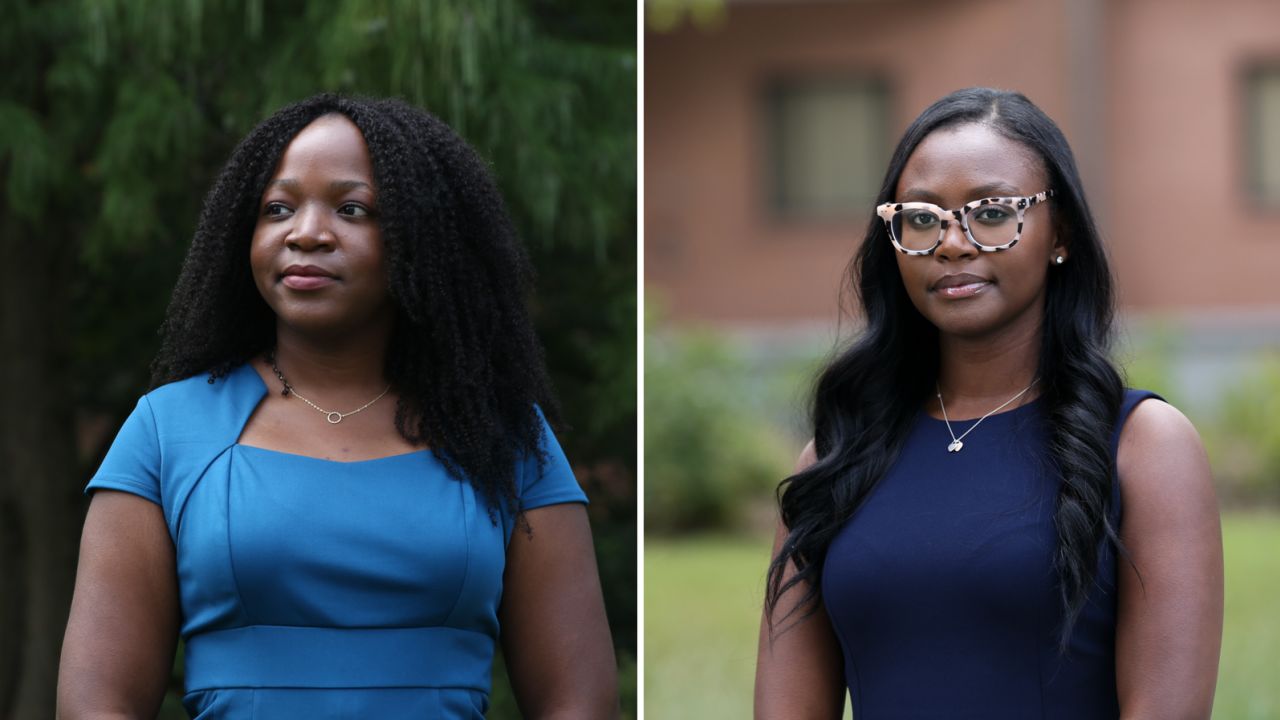
The two are now in pursuit of medical degrees: Ziwawo, 25, is a fourth-year student at Indiana University School of Medicine, and Abiona, 27, is a third-year dual-degree medical and Ph.D. student at Case Western Reserve University.

Olu Abiona, left, and Cynthia Ziwawo

Abiona said she admired Ziwawo’s confidence and determination. Ziwawo said she saw Abiona as a mentor who made her feel welcome in the lab.

All three students grew up with a genuine interest in science and medicine. Ziwawo knew that she wanted to be a doctor since the age of 5. Abiona fell in love with science later, as a teenager, after doing a science and technology program in high school.

Hutchinson always thought science was interesting, but his passion for studying infectious diseases grew after his time in Mozambique. As he studied protein and the role it would play in the design of vaccines, he would often reflect on his time in a rural town in the northern part of the country, where, before joining the NIH lab, he served in the Peace Corps and taught chemistry to high school students.

He saw firsthand the devastating illnesses, such as hepatitis B, that easily could have been prevented with vaccinations. But many of the children there didn’t have access to such life-saving vaccines.

“The dormitory actually had to kick a bunch of students out of the dorms. They had chronic viral infections, something that we all get vaccinated against here” in the United States, Hutchinson said.

Abiona and Ziwawo both admired Hutchinson’s compassion.

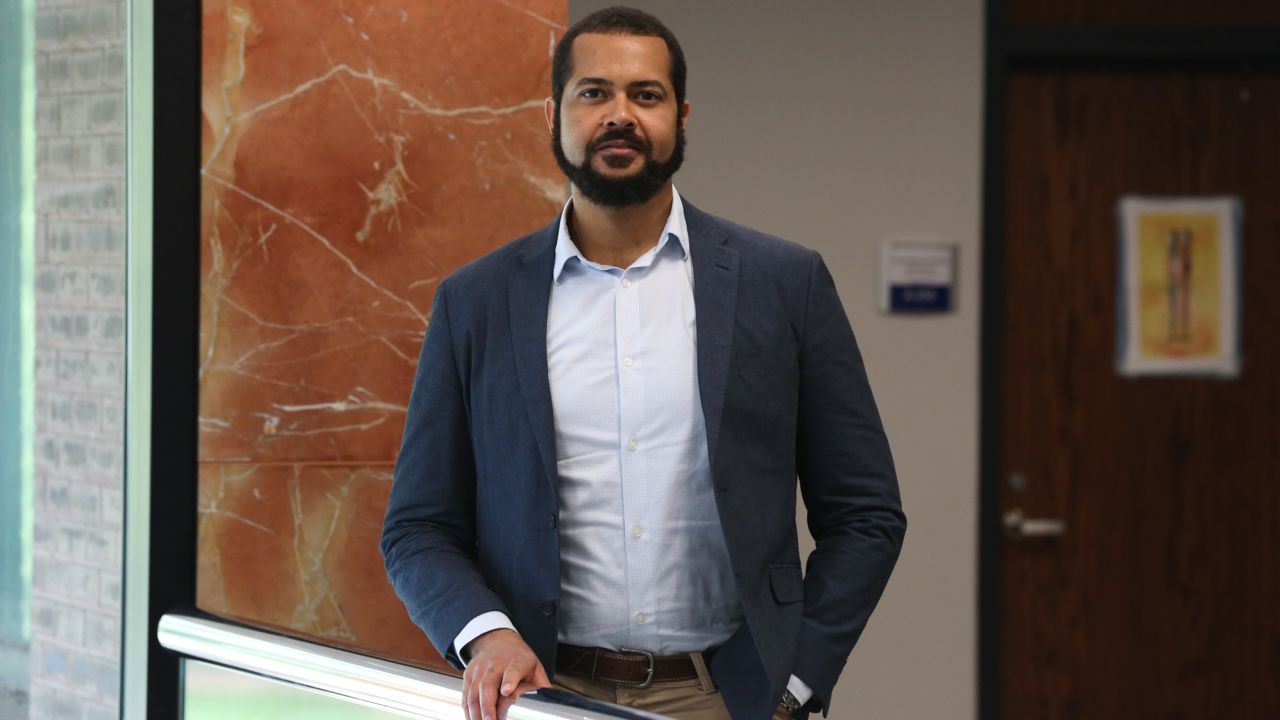
Geoffrey Hutchinson poses for a photo at Morehouse School of Medicine in Atlanta on September 13, 2023.

The three students had hope in the world’s battle against the Covid-19 pandemic much sooner than many other people did.

The rest of the world cheered when the first Covid-19 shots went into arms — but for Abiona, Hutchinson and Ziwawo, the moment came much earlier, when their work indicated that the vaccine elicited an immune response in lab tests.

“It will turn yellow when it tells you, ‘Yes, you have a response,’ ” Ziwawo said about the tests. “That’s when I understood the gravity of what we were doing.”

They saw the results and cheered.

The fruits of Abiona, Hutchinson and Ziwawo’s labor were evident this week as the United States began to roll out updated versions of the Moderna and Pfizer/BioNTech Covid-19 vaccines.

The updated vaccines “validate the work we did” in the early days of the pandemic, Graham said. “It’s now established a new pathway for developing new and better vaccines.”

The mRNA vaccines have been updated to teach the body to fight the XBB.1.5 subvariant of the coronavirus and other closely related strains that are currently circulating.

“Barring the emergence of a markedly more virulent variant, the FDA anticipates that the composition of COVID-19 vaccines may need to be updated annually, as is done for the seasonal influenza vaccine,” the US Food and Drug Administration said in a statement Monday when it signed off on the new vaccines.

On Tuesday, the US Centers for Disease Control and Prevention recommended the vaccines for everyone 6 months and older.

Abiona, Hutchinson and Ziwawo all confirmed Wednesday that although they haven’t made their appointments yet, they plan to get the updated shots.

“Booster me up,” Ziwawo proclaimed.

Source

Malawians celebrate Moyenda Mutharikas’ rare feat, say she has put Malawi on global map

She has every reason to smile

Hundreds of Malawians have stormed the social media celebrating a rare feat achieved by American lawyer of Malawi Origin Moyenda Mutharika Knapp saying she has put Malawi on the map.

Moyenda Mutharika Knapp, has been shortlisted among the top 100 black American attorneys by the National Black Lawyers, an elite network of legal experts in the United States who are selected based on their success and influence based  for providing excellent legal representation in their respective practice areas.

According to the National Black Lawyers website https://nbltop100.org. The daughter to former President Peter Mutharika, Moyenda has made it to the 100 Top Black American Lawyers in the USA.

She is an attorney with in-house and law firm experience with experience handling employer side employment law, commercial litigation, and ERISA long term disability matters.

Among other things, Moyenda Knapp has represented employers in employment law matters; plans, administrators, and employers in ERISA long term disability lawsuits; and companies in business disputes.

In an interview with our publication, the former Malawi’s leader daughter said she has over the years  defended employers in employment discrimination, harassment, retaliation, and wrongful termination cases in state and federal courts and before administrative agencies, such as the Illinois Department of Human Rights, the Equal Employment Opportunity Commission, and the Financial Industry Regulatory Authority (FINRA) and that based on her performance, she thinks that has helped her to be enlisted among the top 100 Black Lawyers in the USA.

The US-Based Malawian barrister has been an adjunct professor at Northwestern University Pritzker School of Law, where she teaches two courses: Trial Advocacy and Civil Discovery since 2005.

She is admitted in Illinois,U.S. District Court for the Northern District of Illinois, including the Trial Bar, U.S. Court of Appeals for the Seventh Circuit, U. S. District Court for the Central District of Illinois, U.S. District Court for the Southern District of Indiana, U. S. District Court for the Eastern District of Michigan, U.S. District Court for the Eastern District of Wisconsin, U.S. District Court for the Western District of Wisconsin, Washington, DC (Inactive but in good standing),Massachusetts (Retired but in good standing)

Source

RSS
Follow by Email