Author: emandowa

35th Annual Africa in April: A year of renewal and rebirth

The annual parade that helps propel the Africa in April Cultural Awareness Festival returned in 2021 after a pandemic-forced absence. (TSD Archives)

The highly anticipated Africa in April Cultural Awareness Festival (AIA) 2022 has in store some spectacular sights and sounds, according to directors, David and Yvonne Acey.

“This is our 35th year,” said David Acey, executive director. “We can hardly believe it has been 35 years. The time has flown by. We hit a snag in 2020 COVID-19 pandemic restrictions shut everything down.

“But all that is behind us now. This is our year of rebirth and renewal. It will be a more colorful, more joyful experience because everything is open again.”

<img data-attachment-id="316601" data-permalink="https://tri-statedefender.com/35th-annual-africa-in-april-a-year-of-renewal-and-rebirth/04/17/14aceys/" data-orig-file="http://www.malawidiaspora.com/wp-content/uploads/2022/04/35th-annual-africa-in-april-a-year-of-renewal-and-rebirth-1.jpg" data-orig-size="729,525" data-comments-opened="0" data-image-meta="{"aperture":"0","credit":"","camera":"","caption":"","created_timestamp":"0","copyright":"","focal_length":"0","iso":"0","shutter_speed":"0","title":"","orientation":"1"}" data-image-title="14aceys" data-image-description data-image-caption="

David Acey and Yvonne Acey have shepherded the Africa in April International Cultural Awareness Festival for 35 years, serving as ambassadors throughout the year at multiple events. (TSD Archives)

” data-medium-file=”http://www.malawidiaspora.com/wp-content/uploads/2022/04/35th-annual-africa-in-april-a-year-of-renewal-and-rebirth-8.jpg” data-large-file=”http://www.malawidiaspora.com/wp-content/uploads/2022/04/35th-annual-africa-in-april-a-year-of-renewal-and-rebirth-1.jpg” class=”size-full wp-image-316601″ src=”http://www.malawidiaspora.com/wp-content/uploads/2022/04/35th-annual-africa-in-april-a-year-of-renewal-and-rebirth-1.jpg” alt width=”729″ height=”525″ srcset=”http://www.malawidiaspora.com/wp-content/uploads/2022/04/35th-annual-africa-in-april-a-year-of-renewal-and-rebirth-1.jpg 729w, http://www.malawidiaspora.com/wp-content/uploads/2022/04/35th-annual-africa-in-april-a-year-of-renewal-and-rebirth-8.jpg 300w, http://www.malawidiaspora.com/wp-content/uploads/2022/04/35th-annual-africa-in-april-a-year-of-renewal-and-rebirth-9.jpg 696w, http://www.malawidiaspora.com/wp-content/uploads/2022/04/35th-annual-africa-in-april-a-year-of-renewal-and-rebirth-10.jpg 583w” sizes=”(max-width: 729px) 100vw, 729px”>

David Acey and Yvonne Acey have shepherded the Africa in April Cultural Awareness Festival for 35 years, serving as ambassadors throughout the year at multiple events. (TSD Archives)

The Aceys wanted to create a festival that would celebrate an African country each year. Not only an educational experience, but the event was designed to teach African Americans about their “countries of origin.”

The couple envisioned strengthening the bond between “us and our homeland.

“We are so thrilled about what the festival has become,” said David Acey. “People call from all over the country, and they come to Memphis from other countries — Germany, Switzerland, England. Pandemic restrictions have lifted, and this 35th festival is our renaissance, a year of renewal.”

Slated from Wednesday through Sunday, April 20-25, 2022, the 35th Africa in April Cultural Awareness Festival will honor the Republic of Malawi.

<img data-attachment-id="316602" data-permalink="https://tri-statedefender.com/35th-annual-africa-in-april-a-year-of-renewal-and-rebirth/04/17/malawi/" data-orig-file="http://www.malawidiaspora.com/wp-content/uploads/2022/04/35th-annual-africa-in-april-a-year-of-renewal-and-rebirth-2.jpg" data-orig-size="1010,964" data-comments-opened="0" data-image-meta="{"aperture":"0","credit":"","camera":"","caption":"","created_timestamp":"0","copyright":"","focal_length":"0","iso":"0","shutter_speed":"0","title":"","orientation":"1"}" data-image-title="Malawi" data-image-description data-image-caption="

Located in southeastern Africa, Malawi’d capital is Lilongwe, which is located Malawi’s on the Lilongwe River of the landlocked nation.

” data-medium-file=”http://www.malawidiaspora.com/wp-content/uploads/2022/04/35th-annual-africa-in-april-a-year-of-renewal-and-rebirth-11.jpg” data-large-file=”http://www.malawidiaspora.com/wp-content/uploads/2022/04/35th-annual-africa-in-april-a-year-of-renewal-and-rebirth-2.jpg” loading=”lazy” class=”size-full wp-image-316602″ src=”http://www.malawidiaspora.com/wp-content/uploads/2022/04/35th-annual-africa-in-april-a-year-of-renewal-and-rebirth-2.jpg” alt width=”1010″ height=”964″ srcset=”http://www.malawidiaspora.com/wp-content/uploads/2022/04/35th-annual-africa-in-april-a-year-of-renewal-and-rebirth-2.jpg 1010w, http://www.malawidiaspora.com/wp-content/uploads/2022/04/35th-annual-africa-in-april-a-year-of-renewal-and-rebirth-11.jpg 300w, http://www.malawidiaspora.com/wp-content/uploads/2022/04/35th-annual-africa-in-april-a-year-of-renewal-and-rebirth-12.jpg 768w, http://www.malawidiaspora.com/wp-content/uploads/2022/04/35th-annual-africa-in-april-a-year-of-renewal-and-rebirth-13.jpg 696w, http://www.malawidiaspora.com/wp-content/uploads/2022/04/35th-annual-africa-in-april-a-year-of-renewal-and-rebirth-14.jpg 440w, http://www.malawidiaspora.com/wp-content/uploads/2022/04/35th-annual-africa-in-april-a-year-of-renewal-and-rebirth-15.jpg 880w” sizes=”(max-width: 1010px) 100vw, 1010px”>

Located in southeastern Africa, Malawi’s capital is Lilongwe, which is located on the Lilongwe River of the landlocked nation.

Malawi is a country of nearly 46,000 sq. mi., with about 19.5 million in population. It has been dubbed “The Warm Heart of Africa” because of the friendliness of its people. English is the official language, although other Africa dialects are used in various regions.

Malawi is bordered by Zambia on the west, Tanzania on the north and northeast, and Mozambique to the east, south, and southwest.

“This year, we wanted to honor a country we had never honored before and one that is little known to most of us,” said Yvonne Acey, associate executive director.

“Malawi is largely under-developed, rural country that depends largely on agriculture. But the culture is rich in dance and mask-making. We hope that bringing attention to Malawi this year will help open up more economic opportunities for its people.”

<img data-attachment-id="316603" data-permalink="https://tri-statedefender.com/35th-annual-africa-in-april-a-year-of-renewal-and-rebirth/04/17/malawi-flag-png-large/" data-orig-file="http://www.malawidiaspora.com/wp-content/uploads/2022/04/35th-annual-africa-in-april-a-year-of-renewal-and-rebirth-3.jpg" data-orig-size="1000,667" data-comments-opened="0" data-image-meta="{"aperture":"0","credit":"","camera":"","caption":"","created_timestamp":"0","copyright":"","focal_length":"0","iso":"0","shutter_speed":"0","title":"","orientation":"0"}" data-image-title="malawi-flag-png-large" data-image-description data-image-caption="

The flag of Malaŵi. Officially the Republic of Malawi, the African nation was formerly known as Nyasaland. It has an estimated population of 19,431,566 (as of January 2021). The name Malawi comes from the Maravi, an old name for the Chewa people who inhabit the area. The country is nicknamed “The Warm Heart of Africa” because of the friendliness of its people.

” data-medium-file=”http://www.malawidiaspora.com/wp-content/uploads/2022/04/35th-annual-africa-in-april-a-year-of-renewal-and-rebirth-16.jpg” data-large-file=”http://www.malawidiaspora.com/wp-content/uploads/2022/04/35th-annual-africa-in-april-a-year-of-renewal-and-rebirth-3.jpg” loading=”lazy” class=”size-full wp-image-316603″ src=”http://www.malawidiaspora.com/wp-content/uploads/2022/04/35th-annual-africa-in-april-a-year-of-renewal-and-rebirth-3.jpg” alt width=”1000″ height=”667″ srcset=”http://www.malawidiaspora.com/wp-content/uploads/2022/04/35th-annual-africa-in-april-a-year-of-renewal-and-rebirth-3.jpg 1000w, http://www.malawidiaspora.com/wp-content/uploads/2022/04/35th-annual-africa-in-april-a-year-of-renewal-and-rebirth-16.jpg 300w, http://www.malawidiaspora.com/wp-content/uploads/2022/04/35th-annual-africa-in-april-a-year-of-renewal-and-rebirth-17.jpg 768w, http://www.malawidiaspora.com/wp-content/uploads/2022/04/35th-annual-africa-in-april-a-year-of-renewal-and-rebirth-18.jpg 696w, http://www.malawidiaspora.com/wp-content/uploads/2022/04/35th-annual-africa-in-april-a-year-of-renewal-and-rebirth-19.jpg 630w” sizes=”(max-width: 1000px) 100vw, 1000px”>

The flag of Malaŵi. Officially the Republic of Malawi, the African nation was formerly known as Nyasaland. It has an estimated population of 19,431,566 (as of January 2021). The name Malawi comes from the Maravi, an old name for the Chewa people who inhabit the area. The country is nicknamed “The Warm Heart of Africa” because of the friendliness of its people.

David Acey said presenting the festival this year in its rightfully designated month of April is “thrilling.” Last year, COVID-19 restrictions prompted the festival’s move to August.

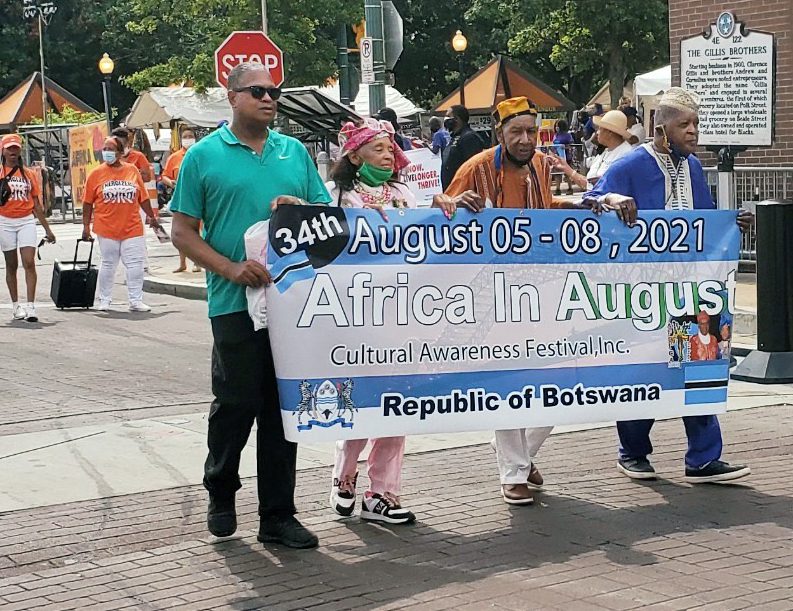
“Last year, we were Africa in April in August,” said David Acey. “We honored the Republic of Botswana. We decided to have the festival in 2021 because I just couldn’t cancel the festival two years in a row.

“This year, 2022, the pandemic is finally past, and everything is open again. Definitely, this is our renaissance after a very long and dark night.”

On Wednesday afternoon, the festival will kick off with the traditional International Entrepreneur’s Luncheon at the Holiday Inn-University of Memphis, 3700 Central Ave., 11:30 a.m. to 1 p.m.

Friday is “Children and Seniors Day & Parade,” which begins at 10 a.m. The parade will come down world-famous Beale Street and wind its way to the historic Robert R. Church Park at 4th and Beale Streets. Vendors and activities will be staged and situated throughout the park from 8 a.m. until 11 p.m., with emphasis on children and seniors.

Saturday in Church Park, vendors and activities will be set up from 8 a.m. until 12 midnight. Saturday is Health, Wellness & Community Day.

Sunday is International Music Day in Church Park, from 8 a.m. until 8 p.m. A day-long schedule of music groups and spectacles will celebrate a wide variety of music, from gospel to jazz, and everything in between. 

“As always, we invite people of every race and culture to come out and enjoy the festival,” said David Acey.

“Each year, there are unique experiences in store for those who attend. We expect this 35th festival to be extra special. All are welcome.”

Source

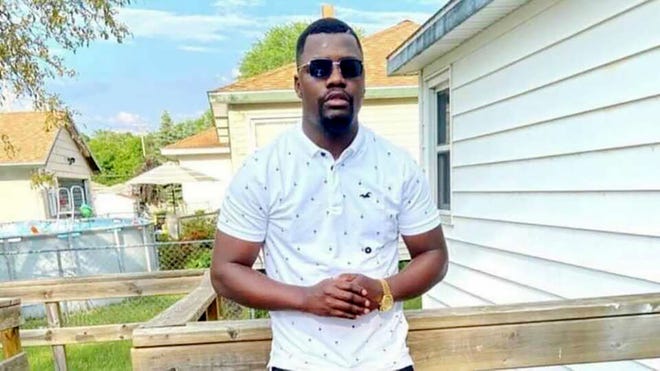
Patrick Lyoya escaped violence in Congo for the ‘safe haven’ of the US. Then police killed him.

  • About 4.6 million, or one in 10, Black people living in American are immigrants, according to a January report from Pew Research Center.
  • Although they are only 7% of the non-citizen population, Black immigrants make up 20% of deportations on criminal grounds, according to a 2018 Black Alliance for Just Immigration report.

When the Lyoya family arrived in the United States in 2014 after facing years of war and persecution in the Democratic Republic of Congo, the refugees thought they had finally made it.

They were living in Malawi when they won asylum to live in the U.S., part of a growing number of refugees from Congo in Michigan.

“They told us that in America, there’s peace, there’s safety, you’re not going to see killing anymore, that it was basically a safe haven,” Dorcas Lyoya said in Congolese during an interview with the Detroit Free Press, part of the USA TODAY Network, through a translator. 

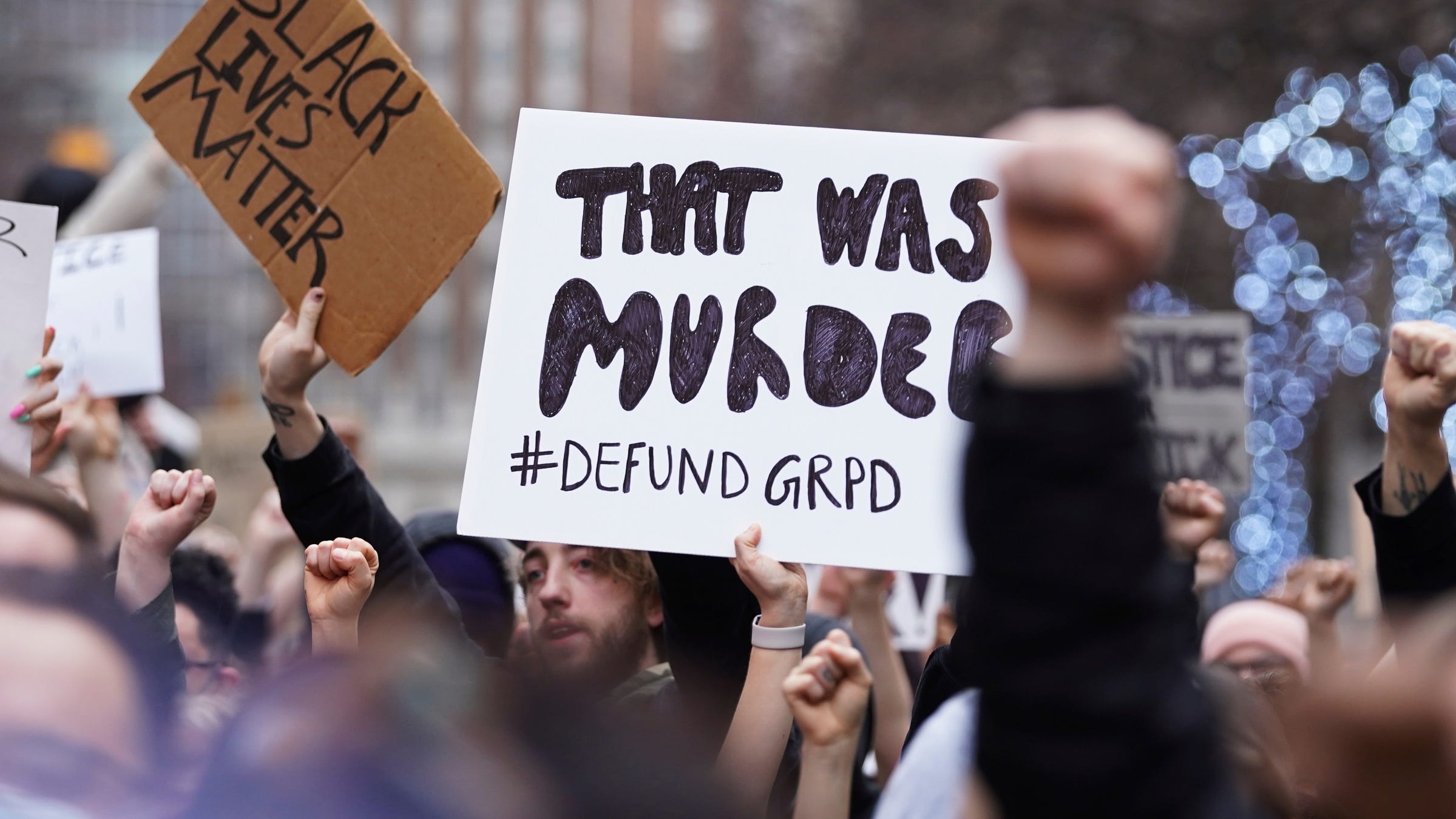
But last week, her first-born son, Patrick Lyoya, was fatally shot in the back of the head by a police officer after a struggle, an incident that has outraged civil rights advocates and led to protests in Grand Rapids, Michigan.

Patrick Lyoya was killed after struggling with a police officer during a traffic stop.

WHAT WE KNOW:Patrick Lyoya killed after struggle with officer during Grand Rapids traffic stop

Lyoya’s death and others like it can rattle the sense of security of Black immigrants and refugees who came to the U.S. to escape violence only to find themselves vulnerable to the same brutality and racism African Americans encounter from police as well as the additional specter of federal immigration authorities, immigration advocates told USA TODAY.

“It’s shocking to Black migrants who have this vision of the United States as the land of the free and the home of the brave,” said Nana Gyamfi, executive director of the Black Alliance for Just Immigration. “There’s a notion that police here are going to be different.”

Patrick Lyoya’s death brings fear in growing Black immigrant community

About 4.6 million, or one in 10, Black people living in American are immigrants and that number is projected to double by 2060, according to a January report from Pew Research Center. The Black immigrant population is racially and ethnically diverse, but in the last decade Africans have become one of the fastest growing segments through refugee admissions and the diversity visa lottery program, according to the Migration Policy Institute.

Although refugee admissions hit a record low in 2021, over the past two fiscal years people from the Congo became the the largest group of refugees to settle in Michigan, according to data from the U.S. State Department. 

Grand Rapids is home to the largest Congolese refugee population in the state thanks to employment opportunities as well as family and social connections like churches, said Chris Cavanaugh, director of Samaritas’ New American Resettlement program in West Michigan.

‘OUR COMMUNITY DESERVES ANSWERS’:Michigan police release video of fatal shooting of Patrick Lyoya after traffic stop in Grand Rapids

Samaritas helps refugees meet many of their immediate needs and offers a cultural orientation on what it means to live life in America, he said. But they didn’t talk much about the racial implications of being Black in America until George Floyd’s murder sparked a nationwide racial justice protest movement in 2020, which Cavanaugh said a number of Congolese refugees joined.

In the wake of Lyoya’s death, Cavanaugh said Samaritas is hoping to support refugee communities by providing resources to help them access services in their native language including during interactions with law enforcement.

“Certainly the Congolese community is feeling some fear, kind of scared over what happened and I would say rightfully so,” Cavanaugh said. “Those maybe who have much less English skills are just more apprehensive about getting pulled over or how they’re supposed to respond in certain situations.”

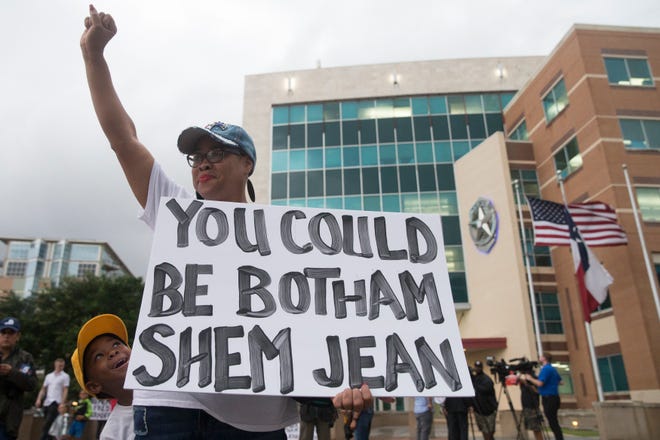
Dr. Pamela Grayson raises her fist as "Young King" Solomon Grayson, 6, peaks behind her sign during a Mothers Against Police Brutality candlelight vigil for Botham Jean at the Jack Evans Police Headquarters on Friday, Sept. 7, 2018, in Dallas.

A history of violence, from Amadou Diallo in 1999 to Botham Jean in 2018

Many Black immigrants and refugees are surprised when they encounter violence from both police and immigration officials, said Gyamfi.

“We have to deal with the violence that police inflict on us because we’re Black,” Gyamfi said. “And then the additional violence that then often is inflicted on us by ICE in this immigration enforcement system because of our migrant status.”

But Black migrants have long been subjected to the same racism and brutality that disproportionately affects Black Americans.

‘I’M LEAVING, AND I’M JUST NOT COMING BACK’:Fed up with racism, Black Americans head overseas

Protests broke out for several weeks in 1999 after Guinean immigrant Amadou Diallo was killed by four white police officers in New York City who said they thought his wallet was a gun. All four officers were acquitted of second-degree murder charges. That same year Patrick Dorismond, a 26-year-old Haitian American, was killed by police sparking another wave of protests in New York. 

In 2016, prosecutors declined to charge a suburban San Diego police officer for fatally shooting 38-year-old Alfred Olango, who arrived in the United States as a refugee from Uganda in 1991. Then, Amber Guyger, a former Dallas police officer, was convicted of murder for the 2018 killing of Botham Jean, a native of the Caribbean island of St. Lucia. 

‘Double-barreled racism’ embedded in immigration laws, law enforcement

Black immigrants are also disproportionately detained and deported by Immigration and Customs Enforcement, said Bill Ong Hing, a law and migration studies professor at the University of San Francisco.

“Embedded in the immigration laws are these anti-Black aspects beginning with the visa system,” Hing said. “They face this double-barreled racism when it comes to law enforcement.”

Although they are only 7% of the non-citizen population, Black immigrants make up 20% of those deported on criminal grounds, according to a 2018 report from the Black Alliance for Just Immigration.

Even minor offenses can trigger deportation proceedings, which can make common interactions with police like traffic stops more tense. Black drivers in Michigan are more likely to be pulled over, searched and arrested by troopers, a study of 2020 traffic stops found.

OPINION:Police should stop making minor traffic stops that too often turn into major tragedies

“The way that most Black migrants end up getting deported is through contact with the police,” Gyamfi said. “There is an awareness that this can happen and there is a lot of anxiety around any type of police contact.”

Hing, founder of the Immigrant Legal Resource Center, said more immigration advocacy organizations began paying attention to this issue in the wake of Floyd’s death. Personal experiences of racism and high-profile cases like Lyoya’s have also started to shift the way Black migrants view themselves.

“They may start out seeing themselves as different from African Americans, but realize that the mainstream, including the police, treat them like any other Black person which is not good,” he said.

Contributing: The Associated Press

Contact Breaking News Reporter N’dea Yancey-Bragg at nyanceybra@gannett.com or follow her on Twitter @NdeaYanceyBragg

Source

In the new Wakanda cookbook, Black Panther food lore comes to life

Braised Kale and Tomatoes

Active time:25 mins

Total time:35 mins

Servings:4

Active time:25 mins

Total time:35 mins

Servings:4

The fictional worlds spun in many TV shows, movies and video games can feel as real and as meaningful to fans as places with actual Zip codes. Think of Hogwarts, the magic-filled, honey-lit boarding school in the world of Harry Potter books and movies; the faraway galaxy of “Star Wars”; or even the lovably quirky small town of Stars Hollow in “Gilmore Girls.”

Wakanda, the wealthy, technologically advanced, mountain-ringed land of the “Black Panther” comics and blockbuster 2018 movie, though, occupies an even more rarefied role. It’s not just the setting for the action in a beloved franchise; it has become a symbol of African greatness, a mythical place that feels like an actual homeland to many people, and not just to comics geeks with posters of King T’Challa on their bedroom walls.

This week, the mythical country is seeing its culture expand with “The Official Wakanda Cookbook,” a collection of recipes sanctioned by “Black Panther” publisher Marvel.

“I definitely felt a combination of pressure and pride,” says Nyanyika Banda, the freelance writer and chef who created the cookbook. “The lore of Black Panther and what Wakanda means now socially is so important, not just for Black Americans but to people of African descent around the world.”

Banda, who has long been a student of the foodways of the African diaspora, developed both the 70-plus recipes and the story-within-the-story of the cookbook: It’s written from the perspective of a young woman who is plucked from her mother’s stall in the capital city’s marketplace to become the royal chef to King T’Challa, a woman who — like Banda — was influenced by the elder women in her family.

Aside from the challenges posed by satisfying an avid fan base and respecting a cultural touchstone, Banda faced another, more practical task. Often, a cookbook author writing about a region of the world is concerned about staying true to the dishes, the ingredients, the people and the history of the land. But what does it mean to be faithful to something that doesn’t actually exist?

Scale this recipe and get a printer-friendly, desktop version here.

Banda says that before signing on to the project, they had seen the movie but hadn’t read many of the comics. And so they delved in and also explored the deep well of fan-fueled websites, seeking to understand the characters and the landscape of Wakanda. Food doesn’t figure prominently in the comics or in the movie, so some creativity was in order.

Some ideas came more easily. Wakanda has a lake, Banda notes, so fish recipes would work. Produce and ingredients available in sub-Saharan Africa (where Wakanda is located, according to the comics), such as cassava, mangoes and goat (you can substitute lamb, Banda instructs), figure prominently. Vegetable dishes are also featured — in a recipe for eggplant and herbs, the narrator notes that “many Wakandans eat a predominantly vegetarian diet,” perhaps a reference to the moment depicted in the movie in which the tribal leader M’Baku threatens to feed a CIA agent to his children, before revealing the threat is just a joke. “I’m kidding,” he says. “We’re vegetarians.”

An important part of the kingdom’s story is that it is incredibly technically advanced, so Banda wanted a few recipes that incorporated gadgets, such as a sous vide machine or a dehydrator, to represent that.

One such dish, a smoked mushroom jerky, was inspired by the Dora Milaje, Wakanda’s elite team of female warriors. “I imagined it would be something that would be fueling but that would carry well,” Banda says.

Jennifer Simms, Banda’s editor at Insight Editions, the publisher of the Wakanda cookbooks as well as dozens of other pop-culture spinoff cookbooks, says that from the outset, she didn’t want to create a cookbook that was generically “African.” “We wanted to make sure we weren’t trying to represent Africa as having one food culture,” she says.

To create a cuisine that is fictional, yet feels specific, Banda drew not just on studies of African foodways, but on family recipes. One dish, braised kale with tomatoes, was cribbed directly from the last meal Banda cooked with their aunt, who, like Banda’s father, was born in Malawi. “We talked and laughed, and it was a special moment,” says Banda, whose aunt died in 2020. “I thought of her a lot while I was writing this.”

One of the trickier conditions imposed by the Black Panther narrative was that Wakanda, unlike many other African nations, was never colonized — according to its lore, it had long remained hidden from the rest of the world to protect itself, and the valuable metal it contained, from outsiders. And so Banda had to find storylines to explain Western influences.

Visits to Wakanda by Captain America explained a simple trout dish and an iced coffee laced with cocoa. Travels to New York by the narrator character, the fictional palace chef, explain a pasta dish. And the current king, T’Challa, was educated in America and Europe under an assumed name, and some dishes are described as being food he discovered while abroad.

Banda and Simms worked closely with the team at Marvel when developing the dishes and the stories around them. “We would talk about whether or not they felt like it would be a part of Wakanda,” Banda says. “I wanted there to be integrity within the dish, but also have integrity in terms of storytelling.”

Banda developed the recipes while staying with their 90-year-old grandmother in Amherst, Mass., during the pandemic. And all along, they considered how important the Black Panther story was to its most devoted admirers. “I was never not thinking about Black Panther fans, hoping they would see the time and thought that went into this,” Banda says.

Black Panther fans aren’t the only cooks that publishing houses are thinking about these days. The Wakanda cookbook is part of a growing trend of pop-culture cookbooks, based on popular franchises with loyal fan bases. Insight Editions CEO Raoul Goff said he first saw the potential for the genre after the success of a 2016 “World of Warcraft” cookbook based on the popular online role-playing game.

Since then, the publisher has produced dozens of titles tied to games such as “The Elder Scrolls” and “Street Fighter,” plus movies and TV, including “Star Wars,” “Friends,” “Downton Abbey,” and forthcoming cookbooks on “Seinfeld” and “Emily in Paris.”

Goff sees these books as more than just the present you give your game-obsessed nephew or Crawley fangirl friend for Christmas. Cooking, he says, helps fans connect with the stories and characters they love in a way that no T-shirt could. “It’s another aspect of getting immersed in that world, whatever it is,” he says.

Are there any shows for which he couldn’t imagine a cookbook spinoff? Maybe “The Walking Dead,” this reporter suggests? Surely there’s nothing appetizing about struggling to stay alive after a zombie apocalypse.

He laughs. “We’ve done that one,” he says. “It was a cookbook and survival guide. Fans loved it.”

“‘Okay, what about ‘Dexter?’ I challenge him, throwing out the name of the show whose serial-killer title character spends his evenings carving up human flesh.

There’s a pause, but Goff isn’t wiling to concede, entirely. “Dexter,” he says, “would be a tough one.”

Braised Kale and Tomatoes

Want to save this recipe? Click the bookmark icon below the serving size at the top of this page, then go to My Reading List in your washingtonpost.com user profile.

Scale this recipe and get a printer-friendly, desktop version here.

Storage notes: Refrigerate for up to 3 days.

Ingredients

  • 2 tablespoons olive oil
  • 1 small yellow onion (about 5 ounces), halved and sliced
  • 5 cloves garlic, minced or grated
  • 2 vine-ripe tomatoes, diced
  • 1 teaspoon ground cumin
  • 1 tablespoon paprika
  • Fine salt
  • Freshly cracked black pepper
  • 8 cups curly kale, stemmed and chopped
  • 1 cup low-salt vegetable broth

In a large, heavy-bottomed pot or Dutch oven over medium heat, heat the oil until shimmering. Add the onion and garlic and cook, stirring, until the onions are translucent and the garlic is just starting to brown, about 4 minutes. Stir in the tomatoes, cumin and paprika, and lightly season with salt and pepper.

Add the kale a handful at a time, stirring occasionally and waiting for it to wilt before adding more. Once all the kale has been added, pour in the stock.

Bring to a simmer, cover and heat for 15 minutes, adjusting the heat as needed to keep it at a simmer. Taste and add more salt and/or pepper, as needed.

Remove from the heat and serve family style or divide among the bowls.

Nutrition Information

Per serving (3/4 cup)

Calories: 163; Total Fat: 8 g; Saturated Fat: 1 g; Cholesterol: 0 mg; Sodium: 172 mg; Carbohydrates: 22 g; Dietary Fiber: 7 g; Sugar: 6 g; Protein: 6 g

This analysis is an estimate based on available ingredients and this preparation. It should not substitute for a dietitian’s or nutritionist’s advice.

Adapted from “Marvel’s Black Panther: The Official Wakanda Cookbook” by Nyanyika Banda (Insight Editions, 2022).

Tested by Alexis Sargent; email questions to voraciously@washpost.com.

Scale this recipe and get a printer-friendly, desktop version here.

Browse our Recipe Finder for more than 9,700 Post-tested recipes.

Did you make this recipe? Take a photo and tag us on Instagram with #eatvoraciously.

Loading…

Source

Federal dollars narrowed Covid-19 racial gaps. That may soon change.

The congressional stalemate threatens to upend the fragile progress that has been made since the early days of the pandemic when the federal government’s decision to make Covid interventions available to everyone free of charge temporarily helped level the playing field in a nation where access to health care is usually tied to employment and income and often correlated with race.

“I’m concerned that we’ll go back to the status quo, which we know carries with it great disparities and suffering,” Rep. Raul Ruiz (D-Calif.), the leader of the Congressional Hispanic Caucus and an emergency physician, told POLITICO. “And the hardest-to-reach communities will be the first to suffer and the most to suffer from the lack of funds.”

While the lack of Covid funding is expected to have an outsize impact on communities of color, low-income white people, particularly those in rural communities where vaccine hesitancy is higher and hospital closures are on the rise, are likely to be hurt as well.

The Biden administration cautioned lawmakers in a meeting last week that without immediate new funding, the federal government will stop reimbursing doctors for testing, vaccinating and treating the uninsured. If a second booster shot is recommended for the general population, the government won’t be able to provide it free of charge. Disease surveillance will also be hampered, they warned, meaning public health workers won’t know about outbreaks or the emergence of new variants before they’re already widespread.

Global health experts additionally fear that congressional inaction will stall the government’s efforts to vaccinate low-income countries around the world, furthering the chances of a new, more dangerous variant emerging.

“It’s quite a long list of very serious issues,” Sen. Jeff Merkley (D-Ore.) said as he emerged from the briefing with top administration officials. Merkley added that a new Covid surge “could very well hit us again, and to fail to be prepared for the next potential wave would be failure of Congress.”

Racial and ethnic gaps have narrowed considerably since the pandemic began. During the initial Covid-19 wave, Black Americans were dying at about three times the rate of white Americans. That gap began to narrow in the summer of 2020 as Covid-19 moved from more urban, densely populated areas into more rural parts of the country. The Covid death rate for white people is now higher than the rates for their Black, Latino and Asian American counterparts, and roughly even to the death rate for American Indian and Alaska Native people, according to the Centers for Disease Control and Prevention.

That’s in part because of the vaccines. Even as people of color are more likely than whites to have housing, transportation and jobs that put them at higher risk of catching Covid, the vaccination gap that existed at the beginning of 2021 is closing, improving outcomes for people of color. Fifty-seven percent of Black Americans have had at least one shot, compared with 62 percent of whites and 64 percent of Hispanics, the Kaiser Family Foundation found.

Public health experts say the government’s early decision to provide free testing for people exposed to the virus and free treatment for those who become ill eventually helped mitigate Covid-19 health disparities by making pricey new drugs and precautionary checkups accessible to many who otherwise couldn’t afford them.

Cutting off funding now for those key Covid-fighting tools threatens to undo two years of progress toward more equitable health outcomes, public health experts warn.

Yet lawmakers remain at an impasse with many Republicans questioning the need for more money and demanding it be paid for with cuts to other programs. Some Democrats refused to approve the money if it came out of pandemic aid to their states, while others warned that the $22.5 billion the White House is requesting will only last a few months before another cash infusion is needed.

An analysis by the nonprofit Surgo Foundation found that Alaska, Florida and Washington, D.C., would see the biggest impact on racial disparities if new Covid funding is not approved given their higher percentages of uninsured, immunocompromised and people of color. But their researchers stress that communities of color in every state are disproportionately vulnerable to a surge in Covid cases, which many fear is looming given the rise in infections in Europe.

In Alabama, for example, Black residents were significantly more likely to die from Covid-19 than the state’s white residents at the beginning of the pandemic. But successful outreach campaigns have so improved vaccine uptake among Black Alabamians that their rates now exceed that of their white counterparts — and white and Black residents in the state are now dying from the virus at roughly equal rates.

Some disparities have narrowed because of the higher rates of vaccine hesitancy and opposition to masking among white conservatives. When the highly contagious Omicron variant spread through those areas, hospitalization and death rates for white people matched those of people of color.

But if the federal government can’t subsidize a potential fourth dose of the vaccine it could be a “disaster” for the state’s uninsured population — nearly half of whom are non-white, though people of color make up just about a third of the population — said Scott Harris, Alabama’s state health officer.

“If a second booster dose is approved soon and there’s no money for booster doses, then we’re just creating just another health disparity on the basis of our funding policy,” Harris said. “That’s just a really sad situation.”

A Kaiser Family Foundation analysis published Friday found that without more funding, the government could be short more than 118 million doses if a new booster is recommended for Americans of all ages. If there is a shortage, experts expect people of color will lose out to those better able to take time off work to hunt for an appointment or travel farther to find a dose.

“When we have a constrained set of resources, as when the vaccines became first available, the people able to get them were the people with the resources and time to navigate the system,” said Samantha Artiga, vice president and director of the Racial Equity and Health Policy Program at the Kaiser Family Foundation.

Over the last year, state and local health officials have worked to convince residents that there was no cost for the shots and have seen their efforts pay off in terms of narrowing disparities. Now those on the front lines fear that work could be undone.

Cheryl Bettigole, Philadelphia’s health commissioner, said Latino residents initially experienced some of the worst outcomes from Covid-19 but now have among the highest immunization rates in the city.

“The fact that we could clearly message that the vaccine is free, that tests are free, the treatment of Covid is free, it has made an immense difference because every time you have to waffle on that, people step back,” Bettigole said. “The fact that we’re having this conversation two months after the Omicron wave basically leveled us is just mind-boggling.”

For those who are at high risk of becoming seriously ill if infected, treatments like monoclonal antibodies may no longer be covered by the government without new funding from Congress, worsening the disparities that plagued their distribution even when they were fully covered. CDC data released in January found that monoclonal antibodies were given to Hispanic patients 58 percent less often than to white patients over the past year, and rates for Black, Asian and other patients similarly lag. Without government funding, a single treatment could cost an uninsured person thousands of dollars.

“That’s something that if you don’t have insurance, I’m not sure how you would even begin to pay for,” said Judith O’Donnell, hospital epidemiologist at Penn Presbyterian Medical Center.

The lack of funding is also threatening the United States’ global vaccination efforts, which public health experts say will worsen already stark global health disparities. More than a dozen low-income countries that are depending on U.S. donations, for example, have vaccination rates below 10 percent, the overwhelming number of them in Africa, including Kenya, Malawi and Cameroon.

State and local health officials say it’s not an “us vs. them” situation, arguing that investing in vaccination abroad is crucial to protecting vulnerable residents at home in the U.S.

“Each time as the wave hits, or just after the wave, there are people saying — and I’m pointing very clearly to the places where we’re not vaccinating the world — ‘We have to do this. We have to do this. If we don’t do this, it’s going to happen again.’ And then it happens again, and somehow we’re surprised,” Bettigole said. “We know exactly what we can do to prepare. We’re just choosing not to.”

Source

Museum showcases the work of Costume Designer Ruth E. Carter

A museum in Virginia is showcasing the work of costume designer Ruth E. Carter, the first African American to win an Oscar for Best Costume Design in 2019.

The exhibition entitled “Afrofuturism in Costume Design” spans nearly four decades of collaborations with directors such as Spike Lee and Steven Spielberg., amongst others.

Ruth E. Carter is currently working on the set of “Black Panther 2” after the death of actor Chadwick Boseman in 2020.

“It’s a very sensitive story to tell this in the sequel since we lost our dear Chadwick Boseman. And so we all approached it very carefully from the rewriting of the script between Ryan Coogler and Joe Robert Cole, to how we deal with our own grief”, said Ruth E. Carter, US costume designer and Oscar winner.

The costume designer feels that her Oscar is a step towards more inclusiveness in the movie industry.

“I see that there is a bigger influence that I can bring to people based on the fact that I did win an Oscar and I, you know, I’m the hometown girl make good. So if that is inspiring to young people who were like me and sat in their room, drawing and sewing, I want to be that, I want to be more of that for people, I want to be that light for them” admitted the Oscar winner.

The artist admits that the fight is not over as there are still many challenges ahead to make Hollywood more inclusive.

“To say that, you know, ‘Oscars not so white anymore,’ when it was built on a foundation of exclusion… and we didn’t see ourselves in front of the camera, or people of color in front of the camera, winning awards, for many years; that this is not something that can be erased overnight. That’s what that exhibition communicates, that you can dream, you can be an artist and you can eventually win an Oscar”, concluded Ruth E. Carter.

The costumes will be on display at the Taubman Museum of Art until the 3rd of April.

Source: Africanews

The Maravi Post has over one billion views since its inception in December of 2009. Viewed in over 100 countries Follow US: Twitter @maravipost
Facebook Page : maravipost Instagram: maravipost    

NBS Bank Your Caring BankNBS Bank Your Caring Bank

Source

PICS: Curvy female barber breaks the internet

Many people may probably think, why should this even be news?

But in reality, especially in Ghana, it’s very difficult to see or find such a beautiful and gorgeous young lady in such a field and does it with a passion too.

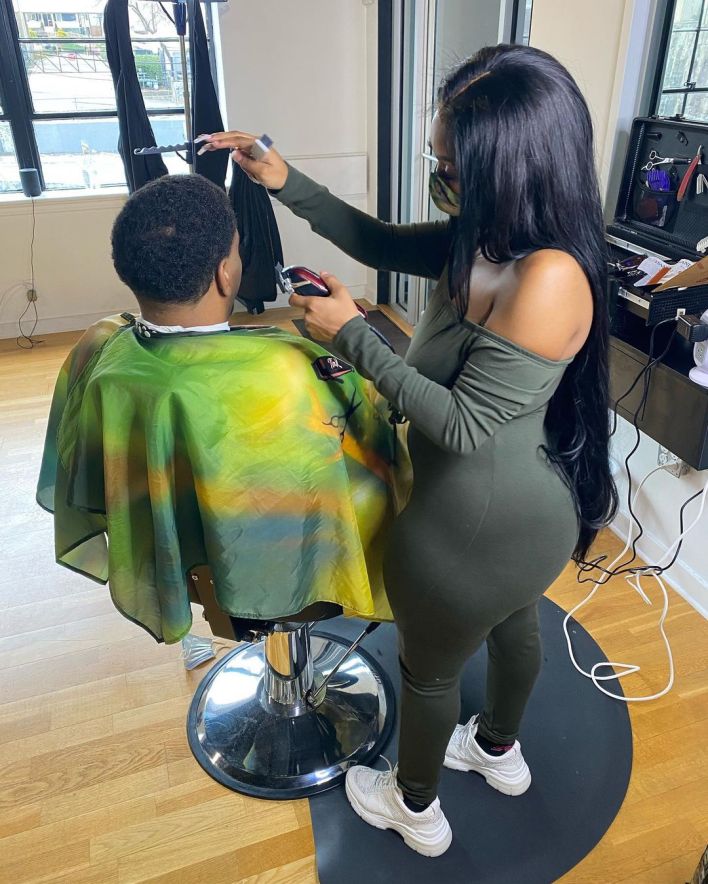
Many beautiful young ladies have such talents but rather focus on slaying for money because of their beauty but this social media influencer who is also a barber has shown her worth.Curvy female barber breaks the internet - Photos1

Dallas Barber as many people refers to her on social media as a Black American young lady who is well known on the internet for showcasing her talent of being a barber on her Instagram page.

The young lady has been an inspiration to many young ladies to rather pursue their dreams rather than follow men for money.

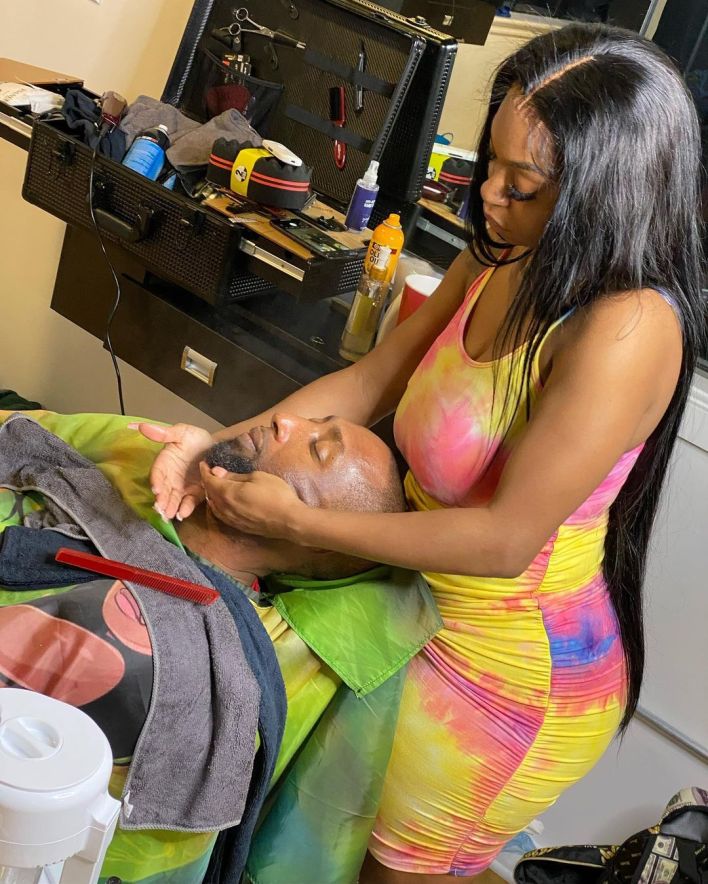
Dallas Barber became well known on the internet for her beauty and sizzling photos showing her heavy and well-endowed God-given goods.Curvy female barber breaks the internet - Photos2

Upon all these qualities she has shown that she can be of herself and not depend on someone fully.

This article should serve as a source of motivation to many young ladies out there, especially those celebrity Slay Queens, who claim big on social but earn below R1000. 00 as monthly salary.Curvy female barber breaks the internet - Photos3

(Visited 107 times, 11 visits today)

Source

RSS
Follow by Email