Biblical allusions in “There is no Wine” by Mlaka Maliro

With the attainment of multiparty democracy in 1994, Malawi weaned itself from a repressive reign of Dr Hastings Kamuzu Banda of the Malawi Congress Party (MCP). Through the Censorship and Control of Entertainment Act, the Kamuzu regime established the Malawi Censorship Board, under whose mandate, art such as music was strictly controlled and artists detained without charge and some exiled (Jack Mapanje as an example).

From the early 1990s, with the end of the one party authoritarian regime, Malawi became open to outside influence and with some Malawians migrating to South Africa and Zimbabwe to work in the mines who secretly smuggled various genres of music back home. As a result, there was an influx of music cassettes and compact discs including Jamaican reggae, South African Kwaito, Black American hip-hope and West African Kwasa Kwasa that changed the music landscape of the country. From these various genres of music combined with Malawian traditional cultures, the country gave birth to its own music which was and still is known as Malawian Local Reggae. The art imbued with Biblical allusions and lyrics of resistance and also a longing for independence and democracy, it became hugely popular which was now an instrument for opposition against government atrocities and oppression.

Malawian artists used music to satirise current affairs and local events, it acted as a mirror on socio-political happenings such as inadequate healthcare, the gap between the bourgeoisie and proletariat, food insecurity and of course government corruption. As some scholars stipulates, Malawian music was blended with religion this was and is because religion is the main matrix of Malawian identity. It is also from this religion; Malawi saw the birth of musicians such as Lucius Banda and Mlaka Maliro of Allelluya Band before branching into their own respective bands. This discussion, therefore, is on Mlaka Maliro’s newly released song titled There is no wine.

In the absence of a strong opposition in parliament, and media platforms largely connected to or owned by politicians, Mlaka Maliro for example has for so many years used music to provide expression for political resistance against government oppression.

With various sporadic arrests of political activists and whistle-blowers, it can be said that despite Malawi claiming to be a democratic republic, Malawians are afraid to freely express about political and developmental issues.

There has been rumours for example that social media is monitored by government spies to watch those who are vocal against the government (MCP led government) and no wonder some Facebook political activists have been arrested several times based on what they posted on their walls.

Nevertheless, Mlaka Maliro can be said to be a spokesperson, arbiter of public opinion and intermediary for grievances of the poor people to those in power. In the song, the persona takes us into a church and him or her as a preacher.

The congregants of the church need to be appreciated by watching the video of the song; the congregants come from various works of life: lawyers, security officers, engineers and students who cheer to the sermon by the persona but there is a fracas in the church when someone enters the church with an empty bucket and they are told that there is no wine (Vinyo watha).

The sermon starts with a Biblical allusion of the Wedding at Cana in Galilee in the Book of John. The words say Jesus and his mother were invited to a wedding in Cana. At the wedding, Jesus revealed his true divine while saving the host’s reputation (John 2: 1-12) by performing his first miracle of turning water into wine when the host run short of wine for the guests. However, the story in the song changes its direction when the persona says asala ndi masanje usapusisike palibe chilipo. One wonders if the persona is still talking about miracle at Cana or maybe its cryptic to mean something else. The mist is cleared in the next lines as the persona continues

Usakomedwe ndi sweet talk                don’t be coaxed by butter up language

Mwana wanga chonde                        please my son

Anthuwa vinyo watha                         there is no wine

The persona advises his son (Malawians) to be careful with flowery language and mere promises by of course political leaders during campaign time. Coincidentally, on 8th March, the Catholic Bishops issued a Pastoral Letter in their celebration of Lent, commemorating the 30th anniversary of Living Our Faith, a pastoral letter that was authored in 1992 which criticised the Banda regime. Similarily, the current letter reminded the current regime (MCP/Tonse Alliance) about the democratic principle and corruption and also warning political leaders about mere campaign promises without taking steps to fulfil them.

In the same vein, the line anthuwa vinyo watha can be speculatively assumed that the leaders have run out of ideas or solutions to problems bolting the country such as high prices of goods and corruption.

The persona then wonders that amid all these problems but the leaders swagger around with flags hovering on their cars but without any plan to help curb the problems as in the lines akuyenda mwa mdidi, mbendera petupetu. This also comes at a point when there have been a public outcry about the president’s internal and external trips including those he would have attended virtually.

The persona goes on to regret his choice for voting for those in power for mere promises. On this, the persona also alludes to the Biblical story about the Israelites who were rescued from Egypt to Canaan.

Moreover, the persona was also promised that he will be eating thrice in a day but it is not happening as he fails to eat even once a day and he even cry for those days he was able to eat a single meal in a day as in ndikanasala konkuja kumaphula njerwa kumadya kamodzi.

The persona also talks about nepotism by the leaders in the line Kenani munkanena munkanena uja anali wapachibale. It is no hidden fact that the current regime has been in a number of instances criticised for appointing relatives including the president’s daughter and son in law in lucrative public positions but as the persona vinyo watha the leader has turned a deaf eye calling the claims mere political gimmick.

In the line kulalika zikutheka, kunenera molapitsa komatu vinyo watha, Mzimu oyera ukamochoka, umachoka mwa ulemu poti siwusazika, akusatira zozizwa poti uko kulikulu osaziwa vinyo watha, the persona leaves the listener to wonder what he really mean as the listener is left in the dark.

However, some people speculate that the musician who was also an ordained Pastor of Bushiri’s Enlightened Christian Gathering Chirch (ECG) is at loggerhead with the ECG leader. This is because the musician cum pastor made a shocking announcement that he has resigned from the church few seconds to the release of his song There is no Wine (Vinyo Watha) but insisted that he has only dumped ECG claiming he wants to revive his music career and be with his family and coincidentally he releases the song Vinyo Watha. But he claims he is still a pastor.

Before his resignation, he served as a pastor in several branches of the church in South Africa and rose up to the ladder of the overseer of the ECG main branch in Swaziland (Eswatin).

Currently, the ECG leader boasts to attract huge crowds across the globe with his prophecies and miracles, rides in fancy cars and enjoys local media coverage, claims to have international and local investments amid charges of fraud, money laundering and promiscuity levelled against him by for example the South African government and also for several times he has been accused of making false prophecies and fake miracles.

From this, should we say the persona is talking about the musician relationship with ECG? Is the persona accusing the ECG leader, the musician former boss for nepotism? What about Roland Barthes’s Death of the Author Theory that holds that the author’s intentions and background (including their politics and religion) should have no weight in determining the interpretation of their work as after the release of the work the author enters his or her own death.

We should be ashamed as literary critics to bring in the experiences of the author in the interpretation of the song. The enjoyment of the song needs not to be mixed with the musician life experiences and the song needs to be reviewed on its own right as a piece of art. That said, it has to be noted that Malawian popular art is well known for its camouflage but one can deduce that the lines tries to ridicule Malawian politicians who are customarily religious people but they do not walk the words of what their religions preach because they are easily corrupted by their positions.

In conclusion, the song There is no wine, with its Biblical allusions, is one of those Malawian popular songs which act as a voice for the voiceless to criticise political arrogance, acceleration of public corruption, deteriorating medical standards, low educational standards, the widen gap between the poor and the rich and exorbitant prices of basic things. For one to appreciate the artistry of the song, watching the video is a must to appreciate the nature and the faces of the congregants the persona preaches to.

Source

Beauty and Self esteem May be the Keys to a Healthy Mind

Beauty and Self esteem May be the Keys to a Healthy Mind – African American News Today – EIN Presswire

Trusted News Since 1995

A service for global professionals · Thursday, March 10, 2022 · 565,149,482 Articles · 3+ Million Readers

News Monitoring and Press Release Distribution Tools

News Topics

Newsletters

Press Releases

Events & Conferences

RSS Feeds

Other Services

Questions?

Source

Senior royals speak out against Russia’s invasion of Ukraine

A war in Europe was unimaginable two weeks ago. There’s been widespread shock around the world over Russian President Vladimir Putin’s merciless and unprovoked attack on Ukraine, and among many in his own homeland.

It is at times like these that we look to our own leaders to express how we feel and to respond accordingly. Britain’s Prime Minister, Boris Johnson, has risen to the occasion enough for many to forget — for now at least — about lockdown parties that led to calls for his resignation.

The Queen has been lying low at Windsor Castle as she continues to recover from COVID-19. She has been well enough to do paperwork and host virtual audiences but little else (more on that later). We learned on Thursday, though, that she was so moved by events in Ukraine she had privately made a “generous” donation to the humanitarian appeal from the Disasters Emergency Committee — a group of 15 leading U.K. aid charities. Buckingham Palace confirmed the Queen’s donation but would not comment further, telling us it was a “private matter.”

Other members of her family have stepped up in her absence, as is the form these days.

The Duke and Duchess of Cambridge said in a tweet over the weekend that they “stand with the President and all of Ukraine’s people as they bravely fight for that future.”

Ukraine’s President, Volodymyr Zelensky, tweeted back, saying he and wife Olena were grateful to the couple that “at this crucial time, when Ukraine is courageously opposing Russia’s invasion, they stand by our country and support our brave citizens.”

From California, on the day Russia launched its invasion, Prince Harry and Meghan expressed their solidarity with the people of Ukraine “against this breach of international and humanitarian law” and urged “the global community and its leaders to do the same.”

On Tuesday, Prince Charles went further, speaking of “democracy” and “an open society” coming under attack in Ukraine “in the most unconscionable way.” He went on: “We are in solidarity with all those who are resisting brutal aggression.”

If the U.K. were ever to try to rebuild bridges with Putin, these comments will hang over Charles. That’s why, as a rule, royals don’t cast judgment on foreign heads of state. They’re in it for life, unlike transient politicians. Putin, however, has crossed the line on this one for Charles, as he has for most of the Western world.

But it was perhaps his wife, the Duchess of Cornwall, who best expressed the nation’s shock without words, during the couple’s visit to a Ukrainian Catholic Cathedral in London on Wednesday.

The pair went to the Cathedral of the Holy Family — which has become a rallying point for the British Ukrainian community — where they met the Ukrainian Ambassador to the U.K., Vadym Prystaiko, and his wife, Inna Prystaiko, as well as Bishop Kenneth Nowakowski.

On arrival, the royals met children from an associated Ukrainian school and received a traditional offering of bread and salt. The couple also lit a candle and laid sunflowers, Ukraine’s national flower, at the altar.

Addressing members of the Ukrainian community working to support relief efforts, Charles praised the group for their courage in the face of wanton aggression. He said: “My wife and I have been deeply moved by everything we’ve heard today during our visit and, above all, by the extraordinary bravery, generosity and fortitude of the Ukrainian community in the face of such truly terrible aggression. So, if I may say so, our thoughts and prayers, however inadequate they may be, are with all of you at this most critical time.”

During the visit, a camera picked up tears in Camilla’s eyes and a journalist from the Royal Rota covering the event reported the duchess “wept frequently during the engagement and comforted the ambassador’s wife, who was also crying.”

NEWS OF THE WEEK

The Queen seems to be on the mend after contracting coronavirus nearly two weeks ago, undertaking a number of video calls this week.

On Thursday, she held two virtual audiences from Windsor with the new ambassadors for Trinidad and Tobago and Malawi. Earlier this week, she also welcomed incoming envoys to the U.K. from Andorra and Chad in video meetings.

The palace has been reluctant to give a daily health update but clearly the monarch is feeling well enough to return to virtual engagements. It is understood she will continue with other duties and has some private engagements in her diary.

One event that was taken off the books was a diplomatic reception that was due to take place at Windsor Castle on Wednesday. Buckingham Palace said over the weekend the Queen had “accepted the Foreign Secretary’s advice” to postpone the event. Rather than being related to her health, it’s likely UK Foreign Secretary Liz Truss made the suggestion in the light of the ongoing crisis facing Ukraine.

The next major events the Queen is hoping to attend are the annual Commonwealth Service at Westminster Abbey on March 14 and a service of thanksgiving for her late husband, Prince Philip, at the same venue on March 29.

WHAT ELSE IS HAPPENING?

Charles celebrates success of Black Britons.

The Prince of Wales brought together some of the most influential Black Britons when he hosted a reception for supporters of the Powerlist at Clarence House on Tuesday. The Powerlist is an annual celebration of 100 of the most influential people of African, African-Caribbean and African-American heritage. “These communities have made and continue to make an incredibly positive difference to society as a whole and, in doing so, have built a real community spirit and cohesion,” Charles said. The heir to the throne added it was “particularly pleasing to see the diversity of talent” recognized by the initiative, from the arts to business, the environment and technology, among other sectors. Charles said the Powerlist — now in its 16th year — has helped identify “expertise and leadership” that will aid the UK in meeting the challenges it continues to face across society.

William and Kate mark St. David’s Day in Wales.

The Cambridges took a trip to Wales to celebrate St. David’s Day, where they were greeted by throngs of well-wishers. The trip was focused on the importance of the agricultural industry, with their engagements centered around how community groups are supporting young people, while also celebrating the region’s history. In Abergavenny, they stopped at a goat farm that has supplied milk to local cheesemakers for almost two decades. Meanwhile, in Blaenavon, the pair rolled up their sleeves in the kitchen of a local youth center, where they baked Welsh cakes before playing a game of pool.

DID YOU KNOW?

Meghan praises historic Supreme Court nomination.

The Duchess of Sussex weighed in on Ketanji Brown Jackson’s historic Supreme Court nomination to become the first Black woman to sit on the highest court in the United States. Meghan spoke to Anita Hill, an American lawyer who became a household name in 1991 when she testified about sexual harassment she allegedly endured from then-Supreme Court nominee Clarence Thomas, for URL Media. Reflecting on Jackson’s nomination, Hill wrote in an op-ed that she wanted to seek the thoughts of others who had “entered arenas once thought to be inaccessible,” so she reached out to Meghan. The duchess praised President Joe Biden’s pick, telling her “the civil rights history of tomorrow is being written today.” Meghan added that Jackson’s nomination “opened new ground for women’s representation at the highest level of a judicial system that for too long has tilted against the very community she hails from.” Read Hill’s op-ed here.

DON’T MISS

New Diana portrait goes on display.

An exhibition opening Friday at London’s Kensington Palace will debut a portrait of Princess Diana that’s never been seen by the public. Taken by fashion photographer David Bailey in 1988, the image was originally commissioned by the National Portrait Gallery but has remained in Bailey’s archive until now. The black-and-white image shows an elegant 27-year-old Diana gazing into the distance, wearing a satin off-the-shoulder gown and a pair of teardrop earrings.

Bailey, who has photographed multiple cultural legends, including Andy Warhol, Twiggy and the Beatles, was selected by Diana for his high-contrast lighting and minimalist style. Her choice “reflected her desire to establish a new photographic identity for herself,” distinct from the more established forms of royal portraiture, according to a news release from Historic Royal Palaces, the British charity tasked with running six of the UK’s palaces. Revealed now after 34 years, the image further solidifies her public reputation as one of the most fashion-forward members of the British royal family. Read more on CNN Style.

FEATURED PHOTOS

In addition to the Diana portrait, the exhibition, titled “A Life Through A Royal Lens,” will showcase a range of works exploring the relationship between photography and the monarchy.

It includes photos snapped on royal tours and portraits of heads of state, as well as off-duty moments away from the public eye. Also on show for the first time is a selection of images taken by members of the royal family themselves.

Nearly 1,000 images were submitted from people around the world who were keen to share their encounters with royals, with photographs ranging from royal walkabouts in the 1950s to the traditional Christmas Day service at Sandringham, the Queen’s private residence in Norfolk.

Check out more of the amateur snaps here.

IN THE ROYAL DIARY

The Duchess of Cornwall has a busy week ahead, with two major engagements on her calendar.

Tuesday, March 8: In her role as president of WOW – Women of the World Festival, Camilla will host a reception to mark International Women’s Day at Clarence House in London.

Thursday, March 10: She’ll open the new Royal Academy of Dance (RAD) headquarters in Battersea, south London. The duchess has been vice-patron of the RAD since 2020.

PHOTO OF THE WEEK

Charles, Camilla, Pier Train

Prince Charles and Camilla unveiled an eco-friendly pier train named in honor of murdered British politician David Amess, during a visit to Southend, east of London on March 1. Amess, a veteran Conservative lawmaker, was stabbed to death in his constituency in October.

Source

Yeshua, not Josh: Why Americans need a Jesus of color

One of my favorite things about my university’s library is its generosity. As it is excruciatingly old, from time to time it decides to rid itself of its multitude of outdated material. Every once in a while, when you walk in to crank out a paper, you might pass by a cart stacked from bottom to top with books, primarily related to the parenting, ministry or both. However, sometimes the free book cart contains other material. Today on my journey into distraction, I found that the library was giving away some illustrated children’s books. Per usual, I decided my backpack had enough room. I found some fun copies of fairy tales, books teaching children about the world and, of course, some illustrated Bible stories. As I excitedly opened the “Children’s Old and New Testaments,” I physically winced at the bright white skin I saw on the faces of Adam and Eve. In almost a morbid curiosity, I flipped farther ahead, and my suspicions were confirmed. There, before my very eyes, was a white-skinned, red-haired Jesus Christ.

What’s wrong with “white Jesus,” you might ask? Christianity is a global religion! Is it not best expressed in an artistic sense through a multicultural lens? In fact, if you were to step into the office of John Brown University’s intercultural studies professor, you might see on her walls art representing Bible stories in a Picasso-esque style with a Chinese flair. This is the work of He Qi, a Chinese artist and theologian who has sought to combine his culture with his training and understanding of Scripture. For generations, as formerly colonized countries have come forth in claiming Christianity as their very own, their artists have similarly taken ownership of Biblical narratives by portraying them as appropriate to their cultural contexts. As early as the 1970s, Christian artistry has arisen from Malawi, Puerto Rico, native New Zealand and Papua New Guinea, portraying the Madonna and Child, Nativity scenes, Adoration of the Magi and more.

As Christianity spread through Europe and retained its claim for generations, a wealth of Eurocentric Christian art has been produced. This fits within the pattern of cultural claims to Christianity. As the faith spreads, depictions of Scripture and Christ Himself are made to resemble the culture which it now bears. If this is all true, then why negate the existence of “white Jesus”? Is his existence not an extension of the European claim to the Christian faith?

If there is one characteristic that Christ was certain to take on in his human form, it was lowliness. “For the Son of Man came not to be served but to serve, and to give his life a ransom for many” (Mark 10:45, NRSV). Jesus walked on this earth as a humble servant and poor teacher who was inevitably put to death by the political powers of the time. Even his ethnic identity as a Jew put him at a lower social rung than most in his ancient Roman context. Jesus Christ was not associated with social or earthly power. He possessed none of it whatsoever. However, his modern-day followers of European descent, especially in the United States, do possess said power. America was founded upon a race-based hierarchy, with Black, brown and Indigenous people at the bottom, topped off with none other than white people. After years of oppression, slavery and outright genocide, with a multitude of legislation attempting to make up for what had been stolen, to this day a power distance remains.

Generational wealth has been gained by white Americans, extending back even to times when many of their ancestors were slaveholders. Black Americans are unabashedly behind, often confined to a lower-class status due to their lack of a head start. Native Americans, having been ripped from their ancestral land, live on pathetic reservations which are far from comfortable or quality living. The cultural consciousness of the average American favors whiteness and looks down on or feels threatened by Black, brown, and Indigenous citizens. To me, it is undeniably clear that in the United States, whiteness is power. It is privilege. As Americans look upon this lover of us all, Jesus Christ, through the lens of whiteness, we are sorting him into our own social structure. He receives the benefit of white power and privilege and is placed at a distance from his followers of color. For Americans to truly understand the character of Jesus Christ, we must see him through our social cultural context. He was not white. He was Indigenous. He was Black. He was downtrodden, oppressed and impoverished.

To love this image of Jesus is to love the weary and downcast of our world, and to truly wear the desires of his own heart. “Truly I tell you, just as you did it to one of the least of these who are members of my family, you did it to me” (Matthew 25:40, NRSV). 

Photo courtesy of Arturo Rey at Unsplash

Source

Why Justice Clarence Thomas should resign from the Supreme Court

Justice Clarence Thomas under scrutiny

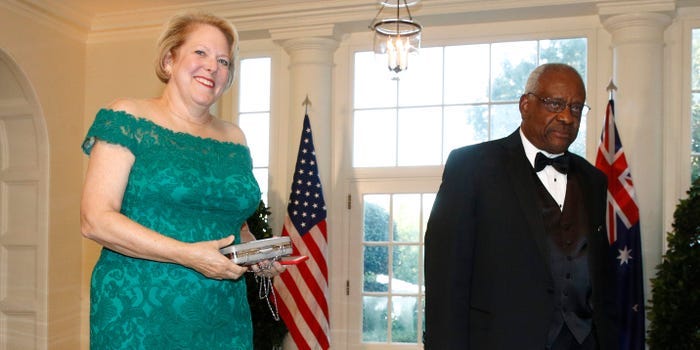
Amid myriad news reports yesterday that Virginia Thomas, wife of U.S. Supreme Court Justice Clarence Thomas, was (and remains) a leading member of a conservative group that sought to discredit Joe Biden’s victories over President Donald Trump in the 2020 election aftermath, the question that begs asking is: “Should Clarence Thomas resign from office?”

Well, as I learned during my very first day of law school orientation many years ago, the simple answer is: “it depends.”

To make it plain, I have known for the better part of two decades that the entire concept of “non-partisan” judges is somewhat of a sham. Meaning, judges are privately political the same as every other American, even if they can’t publicly advocate on behalf of Democratic or Republican candidates or policies. But there is a reason that when it comes to judicial selections that presidents and governors nominate judges that share the same ideological bent; recent President Barack Obama would not have selected qualified conservatives Brett Kavanaugh, Neil Gorsuch, or Amy Coney Barrett, no more than former President Trump would have selected qualified moderate or progressive jurists like Merrick Garland or Ketanji Brown Jackson.

So the issue that must be squared is whether Virginia Thomas has used her current position as a leader of the Council for National Policy to impact any cases or controversies that her husband, Justice Thomas, has or must render a legal opinion? Thus, the “it depends” language because while the 2020 election cases didn’t reach full hearings or decisions that may have compelled Justice Thomas to recuse himself, recent events are far more sketchy—and the source of Thomas’s current scrutiny.

Specifically, all of the major media outlets yesterday, including the NY Times, noted that Virginia Thomas: “co-signed a letter in December calling for House Republicans to expel Representatives Liz Cheney and Adam Kinzinger from their conference for joining the Jan. 6 committee. Thomas and her co-authors said the investigation ‘brings disrespect to our country’s rule of law’ and ‘legal harassment to private citizens who have done nothing wrong,’ adding that they would begin ‘a nationwide movement to add citizens’ voices to this effort.’”

Ordinarily, there would be nothing wrong with Virginia Thomas signing such a letter per her official position within the organization but with one exception—she had to know that issues surrounding the January 6th MAGA Riots, and whether to release records from the Trump White House about those riots, would eventually make its way to her husband’s desk…which it did…with the Supreme Court ruling 8-1 to release the records. 

The one “no” vote in dissent? None other than Virginia’s hubby, Justice Clarence Thomas!

What renders Justice Thomas’s refusal to recuse odd is that each of the three conservatives that Trump appointed, the aforementioned Kavanaugh, Gorsuch, and Coney-Barrett, voted with the entire court to release the records. One must not be a brilliant legal scholar to realize that a former president no longer holds executive privilege to block such records, which is why the ENTIRE Court ruled to release them—except for Thomas. Which leads to the legitimate question as to whether his legally flawed “no” vote was in support of his wife’s position? 

Well, only Justice Thomas can know the basis of his decision, but what is crystal clear is that Thomas violated one of the oldest judicial canons that’s repeated time and again by judges in the field, which is that a judge “is to avoid even the appearance of impropriety.” Nevertheless, like most things within the legal profession, how discipline is meted when impropriety occurs from a jurist depends greatly upon the whims of those making the decision!

Which makes me circle back to the original hot topic, “should Clarence Thomas resign?” I think that he very well should, but I have read enough of his legal opinions, public speeches, biographies, and his autobiography “My Grandfather’s Son” to know that he is a tough and ornery man who will not admit fault in any way, shape, or form. 

Knowing that Thomas will not resign, that would only leave impeachment as a route to remove him from office. But the reality is that only one Supreme Court Justice, Samuel Chase, has ever been impeached—and that was way back in 1805 during the Thomas Jefferson administration. Even then, Chase was acquitted in the Senate and held his position. 

Similarly, with the Senate divided along partisan lines, there is no way on Earth that a super-majority of Senators would vote to remove Thomas, especially with Senate Minority Leader Mitch McConnell routinely praising him as the most brilliant justice on the current court. 

So no, Justice Thomas will remain in office until he retires or passes away—while the rest of us are reminded that hubris in the highest levels of government remains painfully unchecked in the modern era. 

Black History Hobbservations: Homer Plessy

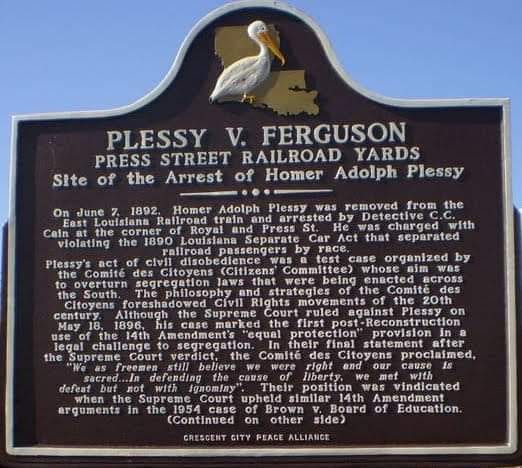
In 1896, when Homer Plessy challenged the new racial caste system that forbade Blacks from sitting alongside whites on trains, the United States Supreme Court held that such “Jim Crow” laws were constitutional. By so doing, the Supreme Court ensured that within a decade, no Blacks held high elected office anywhere in the South, that Black voting became a nullity, and that Black businesses were either eliminated outright—or directly controlled by white “benefactors.”

But who was the plaintiff, Mr. Plessy?

Homer Plessy was born on March 17, 1862 in New Orleans to Joseph Adolphe Plessy and Rosa Debergue, both of whom were Creole. Plessy’s grandfather, Germain, was a white Frenchman who fled Saint-Domingue in the early days of General Toussaint L’Ouverture’s revolution in Haiti. The elder Plessy settled in New Orleans and married Catherine Mathieu—a free Black woman—and together they had eight children (including Joseph Plessy, Homer’s father). 

As a young adult, Homer Plessy became a shoemaker by trade and supplemented his income as a postal clerk and an insurance agent. In 1887, as Louisiana, like most of its former Confederate sister states, began drafting laws that usurped Black rights under the 14th and 15th Amendments to the Constitution, Plessy joined and became Vice President of the “Justice, Protective, Educational, and Social Club,” a group that unsuccessfully challenged the segregation of Orleans Parish public schools. Indeed, Louisiana schools had become segregated after Reconstruction despite a provision in the Louisiana state constitution that prohibited the establishment of separate schools on the basis of race. 

Plessy’s journey into American historical infamy would begin on June 7, 1892, when he presented to the Press Street Depot in New Orleans, bought a first-class ticket to Covington, and boarded the East Louisiana Railroad’s Number 8 train. Plessy knew that the nascent segregation customs would compel the train’s conductors to force him off the train—or get himself arrested (or both). In a scene that would be replicated decades later by Rosa Parks in Montgomery, Alabama, the train conductor asked Plessy, a fair skinned Black man who could have passed for white (but was unapologetically Black), whether he was “Colored.” After boldly replying “yes,” the Conductor demanded that Plessy move to the “Colored” car and when Plessy refused, he was dragged off the train and thrown into jail. 

The next morning, Plessy was charged with violating Louisiana’s “Separate Car Act” and his lawyers moved to dismiss on the grounds that the law violated the 14th Amendment’s provision of equal justice regardless of race. After the motion was denied, his lawyers appealed the decision to the Louisiana Supreme Court, one that upheld the lower court’s decision. Thus, the stage was set for an appeal to the United States Supreme Court, one that ultimately held that Louisiana’s “Separate Car Act” was constitutional because it provided “separate but equal” accommodations to white and Black passengers alike. This decision, as referenced above, gave Southern states full authority to segregate on account of race —an authority that would remain legally intact until 1954, when the Brown vs. Board of Education case overturned this ignominious precedent.

As for Plessy, after suffering defeat in the United States Supreme Court, he paid the $25 fine and spent the rest of his life quietly working as a laborer and insurance salesman until his death in 1925 in Metairie, Louisiana.

Black College Feature

Each day during Black History Month, I will feature one of America’s leading HBCUs.

Next up: Meharry Medical College

History: Meharry Medical College was founded in 1876 in Nashville, Tennessee, following a generous gift from Samuel Meharry, a Scot-Irish immigrant who had been helped by a formerly enslaved family when his wagon broke down while traveling through the Commonwealth of Kentucky.  The college was established by the Methodist Episcopal Church and the Freedman’s Aid Society that year as the Medical Department of Central Tennessee College, with the school’s express purpose being the provision of medical training for the formerly enslaved.

In 1886, the school expanded to include a Dental Department, and a Pharmacy Department was added in 1889.

In 1900, Central Tennessee College changed its name to Walden University in honor of John Morgan Walden, a bishop of the Methodist Church who had often ministered to the formerly enslaved. In 1915, the medical department faculty of Walden University received a separate charter as Meharry Medical College which included the departments of pharmacy and dentistry. The Medical College remained in its original buildings, while Walden University moved to another campus in Nashville.

In 1952, Dr. Harold D. West became Meharry’s first Black president, and under his leadership, the campus expanded and a new wing was added to Hubbard Hospital. 

Academics: Meharry students may earn professional and graduate degrees within the Schools of Medicine, Dentistry, Allied Health Professions and Graduate Studies and Research. Meharry is also home to an Asthma Disparities Center, the Center for Molecular and Behavioral Neurosciences, the Center for Women’s Health Research, a Clinical Research Center, the Export Center for Health Disparities, and the Meharry Center for Health Disparities Research in HIV

Meharry also partners with several HBCUs to provide a BS/MD program. These universities include Alabama A&M University, Albany State University, Fisk University, Grambling State University, Jackson State University, Southern University, and Tennessee State University.

Meharry is among the top five producers of Black PhD’s in America, and holds the distinction of having educated 41 percent of Black dentists in the country. 

Meharry is home to numerous student groups ranging from the NAACP to the Gospel Choir. Divine Nine Black Greek Letter Organizations represented on campus include the Kappa Chapter of Kappa Alpha Psi Fraternity, Inc., Chi Chapter of Alpha Phi Alpha Fraternity, Inc., Delta Chapter of Omega Psi Phi Fraternity, Inc., and the Kappa Chapter of Phi Beta Sigma Fraternity, Inc.

Motto: “Worship of God Through Service to Mankind” 

Famous Alumni/Figures: Former Meharry President and US Surgeon General David Satcher; Dr. Hastings Banda, former President of Malawi, Dr. Audrey Manley, first Black to serve as Assistant Surgeon General; Dr. Robert Walter Johnson, former  coach of tennis legend Althea Gibson; Dr. Walter Tucker, former Mayor of Compton, CA. Dr. Willie Adams, Mayor of Albany, Ga.; Dr. Charles Wright—Founder of the Wright Museum of African American History in Detroit, MI; Dr. Dorothy Brown, first Black woman admitted to American College of Surgeons; Dr. Huda Zoghbi, geneticist, winner of the Breakthrough Prize in Life Sciences; Minnesota State Rep. Alice Mann, MD; Dr. Conrad Murray, physician convicted of manslaughter in the death of music legend Michael Jackson; Dr. Corey Hebert, physician, educator, journalist, Dr. E. Anthony Rankins, Chief of Orthopaedic Surgery at Providence Hospital & Founder of Rankin Orthopaedics and Sports Medicine, Dr. Joseph Durham, Founder- Morris College (HBCU);  Dr. Charles Roman, author: “A History of Meharry Medical College.”

Thank you and please subscribe to the Hobbservation Point—have a wonderful day!

Chuck Hobbs is a freelance journalist who won the 2010 Florida Bar Media Award and has been twice nominated for the Pulitzer Prize for Commentary.

Source

My Take On It: Salute to UK’s Queen Elizabeth II who sits on the glass ceiling past 70 years!


Like all the best families, we have our share of eccentricities, of impetuous and wayward youngsters, and of family disagreements.” – Queen Elizabeth II

Queen Elizabeth the Second of the United Kingdom, leader of the 54-member independent countries that make up the Commonwealth in Africa, Asia, the Americas, Europe, and the Pacific, is arguably the most powerful woman in the world. On June 2, 2022, the British Monarch already having sailed into history on several other rounds, is the fourth longest-serving monarch, head of state and government, and in a democracy. She is celebrating 70 years of being on the throne since 1953 when she was crowned Queen.

Queen Elizabeth II

But Elizabeth was not on the line to be the Monarch of the former sea power and greatest empire in pre-World War II years. Her uncle King Edward VIII, for love, abdicated his royal position to marry American divorcee Wallis Simpson in 1936. Elizabeth’s father was crowned King George VI and thrust his daughter on the path to being Queen, a fate that propelled her to rule and in an era women spent over 50 years wedging sticks in the glass ceiling. Queen Elizabeth II is on the other side of the ceiling, seated comfortably, ordering both men and women, redirecting the course of events, effortlessly commanding love and respect from her staff, children and relatives, world leaders, and the ordinaries (whether in the UK or around the world).

As head of the Commonwealth, Queen Elizabeth is head of a community of countries that has 2.5 billion citizens, with more than 60 percent aged 29 or under. The Leaders of member countries shape Commonwealth policies and priorities and meet every two years at the Commonwealth Heads of Government meeting.

There is a lot that can be written about the soft-spoken Queen Elizabeth II, who married Phillip Mountbatten in 1947 in a colorful wedding that drew 100,000 outside the Buckingham Palace Mall and 200 million watching on television. But what is globally fascinating is that there are probably truckloads of pictures of Elizabeth and Philip, who was crowned the Duke of Edinburgh, smiling, or chuckling at each other.

Despite the miles and miles of floor and wallpaper stories that can be written about her, celebrating the gallantry, courage, stoicism, and pure statesperson-hood that has been embodied in Queen Elizabeth II of the House of Windsor, a comment will be made on four of these. Whatever else may be said about her, she is first to talk strongly and passionately about her faith; she is a bible-reading and praying Christian, takes seriously the values of her faith, and is guided by them in all she does.

1.     From colonial power to Commonwealth of Nations. — By the time of her coronation, Great Britain, once a naval power and commanding the largest colonial footprint that spanned from the Americas, Africa, Asia, and Pacific islands including Australia and New Zealand. From losing its place as a superpower, Britain within a decade of her becoming Queen was losing its empire as colony after colony untangled itself from the clutches of the colonial ruler and gained independence. As colonies became independent they sent in applications to the Commonwealth of Nations. The 54-member organization has a combined population of 2.4 billion, which is almost a third of the world’s population, of whom 1.21 billion live in India, and 95% live in Asia and Africa combined.

2.     Women rule long in British monarch. – Of the world’s three female long-reigning monarchs, Queen Elizabeth is the longest-reigning at 70 years. Her great Grandmother Queen Victoria reigned for 64 years, and Queen Wilhelmina I of The Netherlands reigned for 58 years. The remarkable trait of the two British Queens is that while Victoria left a legacy of strict morality stranglehold on her subjects in and outside Britain, Elizabeth’s reign has been during an era where women have for over half a century strained to get recognition, fight for a place at the table, crack the viciously hard glass ceiling, or champion equality with male counterparts. Elizabeth has been at the table, sitting on the glass ceiling and due to the abdication of an uncle was thrust through the ceiling and managed to grasp the power thrust at her, her charismatic nature leading to the whole world embracing her as its Queen.

3.     Strong family riddled with scandals and globally-felt painful tragedies. – The picture of Queen Elizabeth and her husband, the late Duke of Edinburgh, married for 73 years was the proverbial prince and princess fairy tale. The tale was lived writ large in front of a global platform that through the years moved from telegrams and radios to television, then social media portals such as Facebook, Instagram, and Zoom. What used to be hidden from public eyes, became globally visible to a wide audience. Regrettably, three of Queen Elizabeth’s children experienced a divorce. Her own sister, the late Princess Margaret finally married, but not before a long affair with a married man. Charles divorced his highly popular wife, Princess Diana after the room got crowded with his affair with the married Camila. His ex-wife Diana moved on to an affair with an Egyptian film producer Dodi Fayed. His brother Andrew divorced Fergie after infidelity; however, in 2021 Prince Andy was stripped of his royal title after being accused of paying a minor for sex. Other scandals on the heel of scandals emerged when after marrying his princess, Harry and African American princess hear the Brits wondered loudly (what! No more stiff upper lips!?) how dark his child would be. Prince Harry, like his grand uncle, gave up royalty and took his family across the Atlantic. He did not want to experience what his mother went through.

4.     Other long reigns. – There are 25 long-reigning monarchs, with King Sobhuza of Swaziland (now known as Eswatini) ruled from age of four months until his death, reigning for 82 years.

                                  I.         Sobhuza II, Swaziland (Eswatini) (1899-1982), 82 years

                               II.         Louis XIV, France (1643-1715), 72 years

                            III.         Bhumibol Adulyadej, Thailand (1946-2016), 70 years

                             IV.         Elizabeth II, England (1952-present), 70 years … and counting

                                V.         Johan II, Liechtenstein (1858-1929), 70 years

                             VI.         K’inich Janaab’ Pakal, Mayan Civilization (615-683 C.E.), 68 years

                          VII.         Franz Joseph I, Austria-Hungary (1848-1916), 68 years

                       VIII.         Constantine VIII, Byzantine Empire (960-1028 C.E.), 68 years

                             IX.         Victoria, England (1837-1901), 64 years

                                X.         James I, Aragon (1213-1276), 63 years

                             XI.         Hirohito, Japan (1926-1989), 63 years

                          XII.         Kangxi Emperor, China (1661-1722), 61 years

                       XIII.         Christian IV, Denmark and Norway (1588-1648), 60 years

                       XIV.         Friedrich Günther, Schwarzburg, Germany (1807-1867), 60 years

                          XV.         Qianlong, China (1735-1796), 60 years

                       XVI.         Honoré III, Monaco (1733-1793), 59 years

                    XVII.         George III, England (1760-1820), 59 years

                 XVIII.         Honoré I, Monaco (1523-1581), 58 years

                        XIX.         Nicholas I, Montenegro (1860-1918), 58 years

                           XX.         Pedro II, Brazil (1831-1889), 58 years

                        XXI.         Wilhelmina I, Netherlands (1890-1948), 58 years

                     XXII.         Ludovico I, Italy (1416-1475), 58 years

                  XXIII.         Louis XV, France (1715-1774), 58 years

                  XXIV.         James VI, Scotland (1567-1625), 57 years

                     XXV.         Athelstan, England (895-939 C.E.), 44 years

Queen Elizabeth II was thrust into the monarchy when her uncle abdicated the throne to marry his love, leaving his brother George VI to take over. Elizabeth found herself to be Queen when her father suddenly died. From there, she has become the face of leadership, and pictures of world leaders fawning over her are uplifting.

It is an uplifting fairy tale in real-time. Congratulations Your Royal Majesty and God save the Queen!

The Maravi Post has over one billion views since its inception in December of 2009. Viewed in over 100 countries Follow US: Twitter @maravipost
Facebook Page : maravipost Instagram: maravipost    

NBS Bank Your Caring BankNBS Bank Your Caring Bank

Source