On Monday afternoon, 26 November 2001, Evison Matafale was being held at Area 3 Police Station in Lilongwe.
He had been arrested at his home in Chileka, Blantyre, on Saturday, 24 November 2001, while already in poor health and appeared visibly frail.
During his detention, Matafale repeatedly requested to be taken to a medical facility for urgent treatment, but the police refused.
His father arrived at the station and pleaded for him to be allowed to go to a private clinic, but the request was again denied.
The police eventually relented, allowing Matafale to be taken to a public hospital—Kamuzu Central Hospital (KCH) in Lilongwe—but still refused private medical care.
He was transported in a police Land Cruiser, accompanied by two Rastafarians, Natty Prince and Ras David Chikomeni Chirwa, members of a newly formed band preparing to perform with him in Lilongwe.
At KCH, Matafale was wheeled into a consultation room, where the attending doctor recommended admission and close observation.
While admitted, Matafale requested porridge, which was initially brought by Congo Justice but was too hard for him to swallow, prompting arrangements for softer porridge the next morning.
Later that night, he was administered three drips, but his condition worsened dramatically, leading Congo Justice to try cooling him with a wet cloth, although his health continued to deteriorate.
In the early hours of Tuesday, 27 November 2001, Congo Justice returned to Ras Walusako’s home with Matafale’s clothes and delivered the tragic news that Evison Matafale had passed away.
Share this:
Like this:
LikeLoading…
Discover more from The Maravi Post
Subscribe to get the latest posts sent to your email.
The fatal plane crash that killed Malawi’s Vice President Saulos Chilima and nine others on June 10, 2024, has been officially attributed to a combination of human error and poor weather conditions, specifically the crew’s decision to fly despite limited visibility.
However, the official findings have been met with widespread public suspicion and a “secret tale” of conspiracy theories in Malawi, largely due to political tensions and significant operational failures highlighted in independent investigations.
A government-appointed Commission of Inquiry and a subsequent report by German investigators (BFU) concluded that the primary cause was the flight crew’s decision to proceed in bad weather, leading to the plane clipping a tree and crashing in the Chikangawa Forest.
Despite the official reports, many Malawians, including Chilima’s wife, do not accept the official narrative, leading to a persistent “secret tale” of political foul play.
The skepticism is fueled by several factors.
Chilima was a popular politician, especially among the youth, and a potential rival to President Lazarus Chakwera in the upcoming 2025 presidential election.
Tensions between their political parties (the Tonse Alliance) were public knowledge.
President Chakwera initially stated the plane was told to turn back from Mzuzu Airport due to bad weather; however, German investigators later reported the plane never reached Mzuzu and no such orders were recorded.
The German investigation revealed shocking negligence by the Malawi Defence Forces (MDF), which operated the military aircraft.
Key safety concerns included: An inoperable Emergency Locator Transmitter (ELT) with an expired battery from 2004.
The absence of crucial flight recorders (Cockpit Voice Recorder and Flight Data Recorder).
Unrecorded radar data and radio communications.
An allegedly medically unfit pilot.
The aircraft’s certification was reportedly expired or had unresolved mechanical issues.
In the absence of a fully trusted and transparent official account, rumors and calls for an independent, non-military inquiry continue among the Malawian public.
The perception of a “secret tale” stems from the belief that the government and military are not being fully accountable or transparent about the preventable nature of the crash and the potential political dimensions surrounding the death of the popular Vice President.
Share this:
Like this:
LikeLoading…
Discover more from The Maravi Post
Subscribe to get the latest posts sent to your email.
….Train up a child in the way he should go: and when he is old, he will not depart from it. – Proverbs 22:6
…“If you are planning for a year, sow rice; if you are planning for a decade, plant trees; if you are planning for a lifetime, educate people.” – Asian Proverb
If you think education is expensive, try ignorance. -Derek Bok, Ann Landers, or Char Meyers
As an educator, I often pay close and particular attention to government policies. It was thus very exciting news that was released by Malawi leader Arthur Peter Mutharika, upon his re-election to the high seat: that his government was going to introduce free secondary school education in Malawi. I was instantly caused to think about other Malawi leaders who made similar impacts to the education system of our country.
These are former first President Dr. H. Kamuzu Banda who introduced free university education to every student. This was complete with a $6.00 stipend. The second was Muluzi who introduced free primary school education, living true to the tradition of “m’mela m’poyamba (sic – growth starts early).
Mutharika’s free secondary school finishes the picture of the attempts to ease the burden of educating the children of Malawi – the future leaders of the country.
All three paths cost money. Lots of money, but they are all worth the struggle.
Kamuzu’s free tertiary education built in three decades, a cadre of highly educated professional people that filled middle and high managerial positions in companies in and outside Malawi. More importantly, the country has had four vice presidents and one president that are former graduates of free university education.
When the era of free university education came to an end, two friends of mine (Margaret Mbilizi, Thandikile Chisala and I formed Magzeentha Promotions to raise money and establish a scholarship fund for university students. The NGO raised over $5,000.00 that went into the Vice Chancellor’s Scholarship Fund.
More importantly, because I was in the media, I used any space I could garner in the papers I worked for, to raise awareness of the need to keep standards of university education at the same levels experienced in the 30 years. Such activism led to companies and NGOs to start making contributions to the University of Malawi. Such social responsibility by local companies allowed them to pay for the education of their future employees.
President Muluzi’s introduction of free primary school education, giving credence to an old proverb, was cheaper than funding university students; however, truckloads of students filled to register for entry.
This created the need for more calls to companies for social responsibility and to contribute; as educationists scrambled to ensure that the quality and standards of education was maintained in a landscape of growing freedoms.
As a media practitioner, calls were made or stories highlighted on the education sector. The story of William Kamkwamba, Malawi’s pride of a young lad who from his humble beginnings created a windmill that produced electricity for his village.
Another landmark concern raised was of a young 9-year old kwasa-kwasa dancer, who despite the enormous money her dancing skills was being raised, had to be stopped due to her age. These caused Malawians to pay attention to the raising of their children.
Enter President Peter Mutharika’s dance on the educational platform. The policy offers great new hope to Malawian youth, many of whom are living in humble circumstances.
According to the World Bank, 58% of Malawians face multidimensional poverty with deprivations in health, education, food security, climate change and others.
The Bank, the cost of schooling is the main reason secondary students dropout of school. (Government of the Republic of Malawi, 2019.
With a population of 20.93 million. 80% of the population works in agriculture, Malawi is considered a low-income country with 76.31% of people living below the international poverty line of $3.00 per day, and 71% living in extreme poverty. A severe drought in 2024 led to poor harvests and higher food prices. Food insecurity has been increasing in the past few years.
In the 2025 school year, approximately 80,876 students passed the Malawi School Certificate of Education (MSCE) exams, with a total of 194,584 students who wrote the exams.
This is a significant number of secondary school graduates that are entering the employment or informal sectors. (Quoted from Fact Sheet 2025 and Ip-ed.org on 11.24.2025).
The country’s formal education has primary, secondary, and tertiary levels. Free secondary education puts a bright shining light in Malawi education tunnel.
This is my second call for Malawians everywhere and companies operating in Malawi to help President Mutharika’s vision of educating all Malawians to secondary level; help him turn the grimy picture of our education system to one of glimmer and hope for all Malawians.
The call is for every economically-abled Malawian lining inside or outside the country to contribute either a one-off annual contribution or a monthly contribution into the Malawi Secondary School Fund. This will help the country attain its picture-perfect education scenery.
Additionally, and also very important, the call is made to Malawi government officials in charge of receiving or handling the contributions to this new venture the country is embarking, to PLEASE tighten your belts, close your pockets and handbags, and definitely wash your gluey hands so that Malawi continues its recovery journey.
Your sterling, excellent, and authentic diligence and corrupt-free manner, will permit Malawi school children to get the education they need and must have so they can play their future roles of leadership, equipped with knowledge and wisdom.
Please donate to educating Malawi’s secondary school students.
Knowledge is less expensive than ignorance.
Share this:
Like this:
LikeLoading…
Discover more from The Maravi Post
Subscribe to get the latest posts sent to your email.
Arsenal supporters across the globe are experiencing a wave of excitement this season, with the club producing performances that many believe are the best seen in years.
After seasons filled with frustrations, inconsistencies and painful near misses, the Gunners have finally found a rhythm that is capturing the attention of the football world.
Much of the current joy among Arsenal fans stems from the team’s consistency.
Unlike past campaigns where the club would win a few matches and then suddenly lose form, this season’s Arsenal has shown relentless control and determination.
Their ability to dominate matches and secure results even under pressure has become a major talking point.
A defining feature of this Arsenal team is its solid defense. For many seasons, the Gunners were criticized for defensive errors and lack of coordination but this time, the backline led strongly by William Saliba and Gabriel Magalhães operates with confidence, discipline and unity, providing a strong foundation for the team.
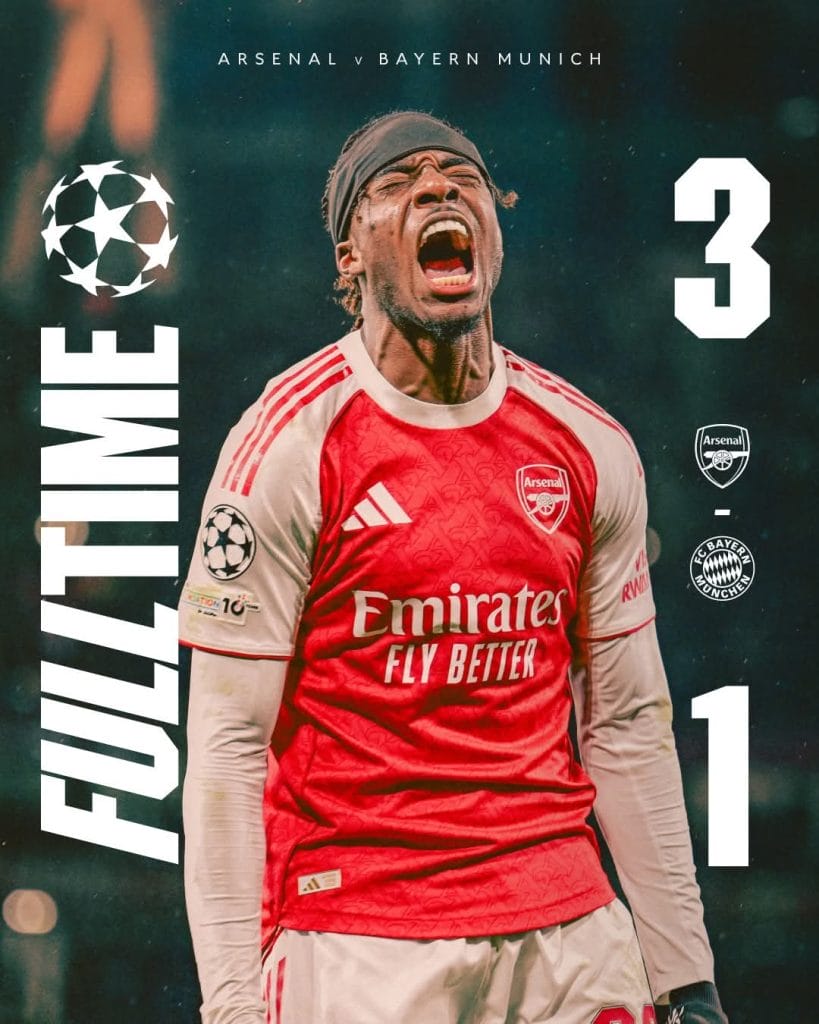
Arsenal humiliated Bayern Munich in Champions league crash
The midfield has also been a powerhouse, combining creativity, physicality and tactical intelligence. Arsenal’s midfielders now control the tempo effectively, create chances and contribute defensively.
This balance has made the team more unpredictable and dangerous.
Upfront, Arsenal’s attack has been firing on all cylinders. Their forwards have shown improved finishing, movement and confidence, allowing the team to break down both high pressing opponents and defensive teams that sit deep.
The fluidity in attack is one of the strongest seen under Mikel Arteta.
Speaking of Arteta, his influence cannot be overstated. The manager has successfully instilled a winning mentality, improved tactical discipline and placed players in their ideal roles. His long-term project, once doubted by many, is now showing maturity and bearing fruit.
Arteta has also managed the squad effectively, ensuring players remain fresh, competitive and motivated.
His decision to rotate the team smartly has helped avoid burnout and injuries, two issues that previously haunted Arsenal in title races.
Another major factor contributing to Arsenal’s success is the improved relationship between players and the coaching staff.
Reports highlight a united dressing room, strong communication and shared belief in the club’s ambitions. This harmony is reflected in their performances on the pitch.
Football experts worldwide have taken notice. Analysts from Europe, Africa and beyond have praised Arsenal’s tactical evolution and mental toughness.
Many now view the Gunners as genuine title contenders, capable of challenging for the Premier League trophy.
However, the road ahead remains difficult. The Premier League is unpredictable and one or two bad results can shift the momentum.
Rivals like Manchester City and Liverpool remain strong, while clubs such as Tottenham, Manchester United Chelsea and Aston Villa are capable of causing upsets.
Arsenal’s ability to handle pressure in high stakes matches will be vital.
In previous seasons, the team sometimes collapsed in crucial games but this season, their composure and maturity have improved, giving fans hope that they can maintain their momentum.
Squad fitness will also play a key role. Injuries have previously derailed Arsenal’s title hopes, so keeping key players healthy will be essential as the season progresses.
The depth of the squad will be tested during the demanding fixtures ahead.
The supporters have also been instrumental in boosting team morale.
The atmosphere at the Emirates Stadium has been electric and traveling fans have shown unwavering support.
This connection between the team and supporters is stronger than it’s been in years.
Share this:
Like this:
LikeLoading…
Discover more from The Maravi Post
Subscribe to get the latest posts sent to your email.
LILONGWE-(MaraviPost)-It is November 28, the date many Malawians now recall as the infamous National Bridgin Foundation Day.
It is a day etched in memory not for celebration, but for the collective shock that swept across the country.
It marks the moment when a foreign organisation walked into Malawi with grand promises that many believed would change the nation’s economic fortunes.
The group claimed they were prepared to inject billions into Malawi’s development agenda, speaking confidently of investments that sounded too good to be true.
They promised loans, grants, and financial rescue packages that were said to be ready for immediate release.
They presented themselves as global saviours with access to unimaginable financial resources.
They held meetings with senior government officials, adding a sense of legitimacy to their presence.
They convinced the public and the leadership that they had the financial muscle to uplift Malawi from its prolonged economic struggles.
They generated excitement across various sectors, with many Malawians imagining a sudden improvement in livelihoods.
They pushed forward documents, proposals, and promises that painted a future filled with prosperity.
They used polished presentations and elaborate claims that made their story sound credible enough to believe.
They impressed just enough people to win high-level attention despite the red flags that later became obvious.
They spread hope that Malawi would soon be receiving unprecedented financial support.
They fed into the national desperation for economic stability, which made their promises even more attractive.
They allowed the fantasy to grow, knowing it appealed directly to Malawi’s most pressing needs.
They allowed people to dream of a country healed from poverty, corruption, and fiscal crisis.
They capitalised on the desire for a breakthrough that Malawi had long been waiting for.
They sold a vision so powerful that it overshadowed the need for caution and verification.
They manipulated the national narrative by blending confidence, persuasion, and strategic charm.
They kept pushing the idea that Malawi was on the verge of an economic miracle.
They convinced the nation that financial relief was just days away.
They allowed the story to flourish until the truth could no longer be hidden.
They left behind confusion, embarrassment, and deep disappointment when the truth finally came out.
They disappeared as quickly as they had arrived, leaving Malawi to face the reality of being misled.
They exposed the dangers of desperation and the ease with which false hope can be sold to a struggling nation.
They triggered debates across the country about accountability, transparency, and due diligence.
They forced Malawians to confront the reality that not all who promise help come with genuine intentions.
They reminded the nation that gullibility can be costly and humiliating at a national scale.
They demonstrated how easily public trust can be exploited when a country is desperate for solutions.
They left behind a painful but crucial lesson about the need for cautious engagement with unknown entities.
They highlighted the importance of verifying claims before embracing them as national truth.
They exposed the cracks within systems that allowed such deception to gain momentum.
They showed the world how vulnerable Malawi had become due to its economic struggles.
They turned November 28 into a symbolic reminder of the day the nation stood on fragile ground.
They turned it into a date remembered with disbelief, frustration, and painful reflection.
They left the nation wiser, more alert, and more cautious moving forward.
They turned what was once a hopeful moment into a national warning sign that endures to this day.
And today, as Malawi marks National Bridgin Foundation Day, the flashback remains a powerful reminder that not all promises are meant to be believed.
Share this:
Like this:
LikeLoading…
Discover more from The Maravi Post
Subscribe to get the latest posts sent to your email.
In an era when the quality of education stands as a cornerstone for national development, the Democratic Progressive Party (DPP) under the leadership of President Peter Mutharika has demonstrated commendable foresight by deploying seasoned professionals from parastatals into Malawi’s public universities.
This bold and strategic move signals a profound commitment to enhancing the academic and practical experience of students, ensuring that education is not only theoretical but also deeply rooted in real-world expertise.
This initiative, which has seen experts in diverse fields such as water engineering, energy, accounting, public finance, human resources, and governance taking on lecturer roles at institutions like the University of Malawi, Mzuzu University (MZUNI), Malawi University of Business and Applied Sciences (MUBAS), and the Malawi School of Government (MSG), deserves high praise.
It is a testament to the DPP government’s thoughtful approach to education reform, one that recognizes the intrinsic value of bridging academia with industry.
The importance of this secondment strategy cannot be overstated.
Malawi’s public universities have historically faced challenges in aligning their curricula with the dynamic demands of the job market.
By integrating professionals such as Water Engineer Mwakwenda, Energy Engineer Dr. Chitawo, and Public Finance Expert Silli Mbewe CA into the academic fold, the government is ensuring that students are exposed to the latest developments, practical insights, and applied knowledge in their respective fields.
This not only enriches the learning environment but also enhances students’ readiness to contribute effectively to Malawi’s socio-economic development upon graduation.
President Peter Mutharika’s administration deserves applause for recognizing that the future of the nation depends heavily on the quality of tertiary education.
It is a forward-thinking approach that addresses the gap between theoretical teaching and practical application.
The presence of experts like Accountant Francis Munthali CA and HR specialist Dr. Chimbamba in universities means that students are benefiting from mentorship by individuals who have already navigated the complexities of their professions.
This mentorship is invaluable in cultivating a generation of graduates who are confident, competent, and competitive.
Furthermore, the deployment of governance and development expert Dr. Henry Kamata to these institutions is a particularly strategic move.
Governance remains a critical issue in Malawi’s public sector and broader development agenda.
By bringing such expertise into the classroom, the government is fostering a culture of good governance and ethical leadership among future public servants and private sector leaders alike.
This influence is likely to ripple through Malawi’s institutions for years to come, contributing to a more transparent, accountable, and efficient governance framework.
This initiative also reflects the DPP government’s sensitivity to the need for sustainable development.
Malawi’s challenges in water management, energy supply, and public finance are significant barriers to progress.
By involving experts who understand these sectors intricately, the government is not only improving education but also indirectly bolstering the country’s capacity to address these critical issues through a well-prepared workforce.
It is essential to emphasize that this approach should not be viewed as a temporary fix but rather as a foundational strategy for long-term educational and national development.
The continuity of such programs will ensure that Malawi keeps pace with global trends in education and economic development.
It will also build a resilient knowledge economy where talented individuals are nurtured, and national resources are optimally utilized.
The DPP government under Peter Mutharika is setting a benchmark not only for Malawi but for the broader Southern African region.
In a time when many countries struggle to connect academic institutions with industry needs, this initiative is a shining example of what can be achieved through thoughtful policy and leadership.
It encourages other governments to consider similar collaborations that leverage the expertise within parastatals and other professional sectors to enrich education.
The deployment of experienced professionals to Malawi’s public universities is a masterstroke by the DPP government.
It highlights a genuine commitment to uplifting tertiary education and preparing Malawian youth for meaningful contributions to society.
This visionary policy deserves sustained support and expansion, ensuring that the nation’s educational institutions continue to produce graduates who are not only knowledgeable but also equipped with the practical skills necessary for Malawi’s development.
Applause is due to President Peter Mutharika and the entire DPP leadership for this transformative step—may this initiative continue to thrive and inspire future governments.
Share this:
Like this:
LikeLoading…
Discover more from The Maravi Post
Subscribe to get the latest posts sent to your email.