Russia’s long-standing requests are predominant in a peace deal for Ukraine brokered by American and Russian envoys. Rep. Marjorie Taylor Green, R-Ga., says she will resign her Congressional seat in January. Pill versions of the obesity drugs now requiring injections are on the way. BONUS: 2025’s best plot-driven books.
The CDC quietly rewrites its vaccine guidance online to suggest shots might cause autism, raising new questions about political influence over public health. President Trump unveils a 28-point Ukraine peace plan that leans on territorial concessions Kyiv has repeatedly rejected. And New York City mayor-elect Zohran Mamdani heads to the White House for a meeting with a president who has labeled him a radical threat.
Want more comprehensive analysis of the most important news of the day, plus a little fun? Subscribe to the Up First newsletter.
<
p class=”readrate”>Today’s episode of Up First was edited by Jane Greenhalgh, Rebekah Metzler, Megan Pratz, Mohamad ElBardicy, and Alice Woelfle.
<
p class=”readrate”>
<
p class=”readrate”>It was produced by Ziad Buchh, Nia Dumas and Christopher Thomas.
<
p class=”readrate”>
<
p class=”readrate”>We get engineering support from Stacey Abbott. And our technical director is Carleigh Strange.
<
p class=”readrate”>
<
p class=”readrate”>Our Executive Producer is Jay Shaylor
Titan II ICBM – decommissioned nuclear missile – at the Titan Missile Museum, Green Valley, Sahuarita, Arizona. Credit: Stephen Cobb/Unsplash
UNITED NATIONS, Nov 6 2025 (IPS) – In recent days, nuclear state leaders have flouted the regulations and norms around nuclear non-proliferation and are flirting more openly with nuclear might in the name of projecting strength.
In the last week, the United States and the Russian Federation have made public shows of their nuclear messaging. On the 27th of October, President Vladimir Putin revealed a new nuclear-powered missile capable of staying airborne far longer than conventional missiles and even evading missile defense systems. Some experts have suggested that this is meant to reinforce Russia’s nuclear might, which Putin has leaned on since the start of the Ukraine invasion in February 2022.
More recently, on 29 October, President Donald Trump announced via social media that he wanted to resume nuclear testing for the first time in thirty years. In his post he wrote, “Because of other countries testing programs, I have instructed the Department of War to start testing our Nuclear Weapons on an equal basis.”
As he made this announcement just before his meeting with President Xi Jinping, some experts have considered that China’s expanding nuclear arsenal has prompted some calls in Washington D.C. to quickly modernize the U.S.’s own nuclear forces. Nuclear testing by major powers like China, Russia or the U.S. has not been conducted in decades. Yet analyses have warned that such an act would only further complicate relations between this triad.
All these developments should not come as a surprise. Even as countries have been aware of the dangers of nuclear weapons since 1945, this has not completely stopped them from expanding their forces. As of June 2025, there are over 12,400 nuclear warheads in the world in only a small percentage of countries. The U.S. and Russia account for 90 percent of those warheads, both possessing more than 5,000 nuclear warheads. According to the Stockholm International Peace Research Institute (SIPRI), nearly all nine of the nuclear states moved to modernize their existing nuclear arsenals and acquire new missiles in 2024.
Increasing geopolitical tensions have increased feelings of uncertainty and instability, which seems to have led countries to prioritize national security. The nuclear-armed states have made moves to expand the capabilities of their arsenals. SIPRI estimates that China now owns 600 nuclear warheads. Both the United Kingdom and France have ongoing programs to develop strategic weapons, including missiles and submarines. North Korea continues to expand its military nuclear program, accelerating the production of fissile material to make more nuclear warheads.
Concerns about nuclear testing have been reflected in headlines. Credit: IPS
The threat of nuclear weapons seemed to loom over major events this year, even as their efficacy as a deterrent was thrown into question. As India and Pakistan engaged in aerial battles and strategic strikes in May, the conflict demonstrated to the world how close two nuclear powers could come to war.
Meanwhile, in the context of the ongoing war in Ukraine and the perceived threat from Russia, European nations, including France and the U.K., are moving to prioritize investments in defense, including deterrence. Germany, Denmark and Lithuania are among some of the countries that have also expressed interest in hosting nuclear weapons for the nuclear states.
William Potter, Director of the James Martin Center for Nonproliferation Studies, expressed concern over the dangers posed by nuclear weapons due to miscalculations and misperceptions at a time when “there is a total lack of trust, respect, and empathy among the nuclear weapons possessors.”
“The more nuclear weapons, the greater the risk of their inadvertent use, but even more dangerous is the absence of a political climate in which serious arms control and disarmament measures can be pursued,” Potter told IPS.
The safeguards for nuclear arms control are also being challenged. The NEW-Start treaty, the last remaining arms control treaty between the U.S. and Russia, is set to expire in February 2026, though both countries have consideredvoluntarily maintaining the limits on deployed strategic nuclear weapons for one year. Yet in this past week, that promise has been undercut by both parties.
At the same time, there are the continuous calls for nonproliferation and disarmament. Advocates from all over have raised awareness on the impacts of radiation on communities, on public safety and on the environment. The United Nations has platformed and rallied these advocates and has raised the alarm for disarmament since its official beginning on 24 October, 1945.
Amidst this, there is the fear of a new nuclear arms race. During the high-level meeting on the elimination of nuclear weapons in September this year, the UN’s Chef de Cabinet Courtenay Rattray, who delivered remarks on behalf of Secretary-General António Guterres, said that the world was “sleepwalking” into this new arms race, now defined by new technologies and new domains for conflict such as cyberspace. Rattney warned that “the risks of escalation and miscalculation are multiplying.”
So if the nuclear states are modernizing their arsenals, how do modern technologies fit in? Artificial intelligence (AI) is the latest frontier that countries are navigating and investing significant resources in to achieve progress. Given that, national and global regulations on the safe governance of AI are still nascent as countries still work to agree on universal agreements for the frameworks for the ethical applications of AI.
As it becomes increasingly sophisticated and more accessible, member states have been investing resources into incorporating AI in the military domain. Given that it does not fit neatly into pre-existing deterrence frameworks, this has also raised concerns over AI’s possible “destabilizing effects,” according to Wilfred Wan, Director of the SIPRI Weapons of Mass Destruction Programme.
It has prompted stakeholders to engage in serious negotiations on AI governance in the military domain, including guardrails to reduce the risk of escalation, Wan told IPS. At the multilateral level, he cites the example of the Blueprint for Action that came out of the second summit on Responsible AI in the Military Domain (REAIM) in 2024. It is a non-binding agreement among 61 countries, including nuclear powers like the U.S., the U.K., France and Pakistan, that provides a framework for the responsibility that parties need to take in integrating AI, and recognizing gaps that policymakers must take into account. There is also the UN General Assembly Resolution 79/239 on “[AI] in the military domain and its implications for international peace and security.”
“This is certainly not a substitute for disarmament progress, but in the current strategic context, it can help rebuild some of the trust and confidence necessary for revitalizing those efforts,” Wan said.
Researchers from SIPRI have found there are no governance frameworks specifically for the nuclear-AI nexus compared to those for conventional military systems. “In the nuclear context, discussions have largely centered on retaining human control in nuclear decision-making. This is an essential principle but does not address other ways in which AI integration can affect the environment in which nuclear decisions are made, directly or indirectly,” Wan explained.
“Absent a framework that addresses these aspects, including through regulatory and technical measures, there remains the risk of accelerated integration of AI among nuclear-armed states in a manner that destabilizes the security environment, threatens strategic stability, and impacts the risk of nuclear use.”
When assessing the existing approaches to the governance of military AI, it shows common areas of concern, such as raising awareness through multi-stakeholder engagement and preserving the capacity for human intervention, along with applying safety and security measures to mitigate escalation risks.
At this time, nuclear disarmament and nonproliferation are critical and may even provide insight into negotiating the governance of AI in nuclear forces. The approaches to fostering multi-stakeholder dialogue that include policymakers, non-nuclear states, experts and the private sector could similarly apply to discussions around AI in nuclear forces. Though it should be noted that their limited knowledge of nuclear force structures may constrain meaningful contributions to the debate. Nevertheless, their participation must be facilitated if nuclear parties truly value human control in this factor.
Nuclear and non-nuclear states must recommit to the anti-nuclear agreements, including the Nuclear Non-Proliferation Treaty, the Treaty for the Prohibition of Nuclear Weapons, and the Comprehensive Nuclear Test Ban Treaty. Potter stressed the importance of disarmament and nonproliferation education, particularly to empower future generations to “pursue creative ways to reduce pressing nuclear dangers.”
The UN can employ its influence in advancing disarmament efforts through dialogue and awareness efforts from the General Assembly and the Office of Disarmament Affairs (UN-ODA). The UN has also confirmed it will convene an independent scientific panel to assess the effects of nuclear warfare and an Expert Group on Nuclear-Free War Zones.
“Nuclear disarmament is more important today than ever before, but it is not simply a question of securing lower numbers of nuclear weapons,” Potter said. “At a time when the “nuclear taboo” has been eroded and discussions about the use of nuclear weapons have been normalized, it is vital that policymakers act boldly in a fashion commensurate with the threat.”
IPS UN Bureau Report
Note: This article is brought to you by IPS Noram in collaboration with INPS Japan and Soka Gakkai International in consultative status with ECOSOC.
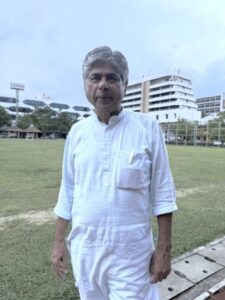
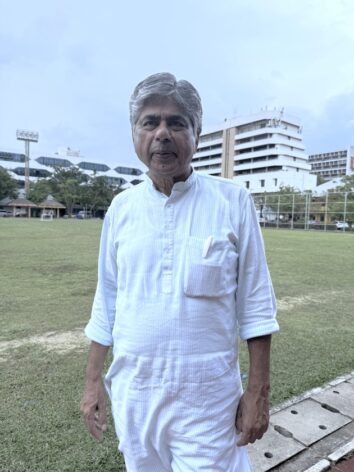
Rajagopal P.V. at the International Civil Society Week (ICSW2025) in Bangkok. Credit: Zofeen Ebrahim/IPS
BANGKOK, Nov 4 2025 (IPS) – “If nations can have defense ministries, why not peace ministries?” asks Rajagopal PV, the soft-spoken yet formidable founder of Ekta Parishad. “We are told to see issues through a gender lens—why not a peace lens? Why can’t we imagine a business model rooted in non-violence or an education system that teaches peace?”
Founded in 1989, Ekta Parishad—literally Forum for Unity—is a vast people’s movement of more than 250,000 landless poor, now recognized as one of India’s largest and most disciplined grassroots forces for justice.
To Rajagopal, these aren’t utopian dreams—they’re blueprints for a possible world.
Over the decades, Ekta Parishad has secured land rights for nearly half a million families, trained over 10,000 grassroots leaders, protected forests and water bodies, and helped shape key land reform laws and policies in India.
All this has been achieved not through anger, but through disciplined, nonviolent marches that stretch across hundreds of kilometers. Along the way, many leaders have walked beside him—among them, the current Prime Minister of Armenia.
In an age marked by deep disorder—where wealth concentrates in few hands, poverty spreads, and the planet itself trembles under human greed—the 77-year-old Gandhian remains unshaken in his belief that peace alone can redeem humanity.
“We must rescue peace from the clutches of poverty and all its evils,” he told IPS on the sidelines of the International Civil Society Week, standing on the football ground of Bangkok’s Thammasat University.
“And it can be done,” he insists—and his life is proof. In 1969, the centenary year of Mahatma Gandhi’s birth, the Government of India launched a unique exhibition on wheels, a ten-coach train carrying Gandhi’s life and message across the nation. Rajagopal was part of the team that curated and travelled with it.
“For an entire year, we journeyed from state to state. Thousands of schoolchildren would gather at railway platforms, their faces lit with curiosity, waiting to meet Gandhi through our displays,” he recalls.
Yet somewhere along those long railway tracks, Rajagopal began to feel that displaying Gandhi’s ideals wasn’t enough. “The exhibition was beautiful,” he says, “but what was the use of preaching non-violence if we couldn’t live it, breathe it, and bring it to life?”
That realization led him to one of the most daring experiments in peacebuilding India had ever seen—negotiating with the feared bandits of the Chambal valley. “It was 1970,” he recalls. “We moved cautiously, first meeting villagers on the periphery to build trust. Once we had their confidence, we sent word to the dacoits: we wanted to talk. With the government’s consent, we ventured into what we called a ‘peace zone’—often by night, walking for hours through deep ravines—to meet men the world only knew as outlaws.”
The dialogues continued for four years. Eventually, as many as 570 bandits laid down their arms before a photograph of Mahatma Gandhi—a sight India had never seen before. The government, in turn, promised they would not face the death penalty and would receive land and livestock to rebuild their lives. Rehabilitation took another four painstaking years, but it was a victory of conscience over fear.
“They didn’t just surrender their weapons—they surrendered their anger,” Rajagopal says quietly. “There was real repentance, and that takes time—but it lasts.” His commitment came at a cost. At his ashram—a spiritual retreat he had founded—he was threatened, beaten, and ordered to abandon his peace efforts. He talked them through to accepting his presence.
“Today that same region is heaven,” he smiles, his eyes crinkling with memory. “Fifty years ago, people trembled at sunset—terrified of the bandits. Today, you can travel at 2:00 pm in the night, where fear ruled once.”
The mass surrender may have looked like a triumph for the state, but Rajagopal urges people to look deeper. “It’s the invisible violence—poverty, injustice, and oppression—that breeds the visible one: dacoities, kidnappings, and killings,” he explains.
Though Rajagopal and his companions had ended one form of violence, the deeper, quieter kind—born of poverty and neglect—still festered. Until that was confronted, he knew, peace would remain incomplete.
Years of working alongside the poor had taught him one truth: non-violence needs structure. If India’s Indigenous and landless communities were to be heard, they had to be organized.
“We began training young people from dozens of villages,” he says. “They went door to door, teaching others not only about their rights—especially the right to land—but also how to claim them peacefully.”
With that foundation, a five-year plan took shape. Each village home chose one member to take part. Every day, the family set aside one rupee and a fistful of rice—a humble but powerful act of commitment.
They even created a “playbook” of possible scenarios—how to stay calm under provocation, how to respond to setbacks, and how to practice non-violence in thought and action. “In one of our marches, a truck ran over three of our people, killing them,” he recalls softly. “There was grief, but no retaliation. Instead, they sat in silence and meditated. That was our true test.”
In 2006, 500 marchers walked 350 kilometers from Gwalior to Delhi, demanding land rights. Nothing changed. But they didn’t stop.
A year later, in 2007, 25,000 people—many barefoot—set out again on the national highway. “Imagine that sight,” Rajagopal says, eyes gleaming. “Twenty-five thousand people walking for a month, powered only by hope.”
The march displayed not just India’s poverty but also its power—the quiet power of the poor united. It was among the most disciplined mobilizations the country had ever seen. “There was one leader for every hundred people,” Rajagopal explains. “We walked by day and slept on the highway by night. Those in charge of cooking went ahead each morning so that by sundown, a single meal was ready for all.”
In a later march, Rajagopal recalls, the government sent a large police force. “I was worried,” he admits. “I called the authorities to tell them this was a non-violent protest—we didn’t need protection. The officer replied, ‘They’re not there for you; they’re here to learn how disciplined movements should be.’”
Along the route, villages greeted them like family—offering bags of rice, water, and prayers. “There was never a shortage of food,” Rajagopal smiles. “When your cause is just, the world feeds you.”
By the time the march reached Delhi, the government announced a new land reform policy and housing rights and agreed to enact the Forest Rights Act.
The government dispersed the marchers with hollow promises and the reforms never happened.
So Ekta Parishad planned an even larger march—a Jan Satyagraha of 100,000 people in 2012.
“Halfway through, the government came running.”
Rajagopal’s face lights up as he recalls the event. “They agreed to our ten-point agenda and signed it in front of the people. That moment was historic—governments almost never do that; the Indian government certainly never does it!”
The agreement included land and housing rights, a national task force on land reform, the prime minister’s oversight of policy implementation, and fast-track courts to resolve land disputes.
Today, because of these long, barefoot marches, more than three million Indigenous people in India now have legal rights to land and housing. The struggle also gave birth to India’s Land Acquisition, Rehabilitation, and Resettlement Act—a landmark in people’s movements.
“The Act also safeguards fertile land,” Rajagopal explains. “Before the government can acquire any area, a social impact study must be done. And if farmland is taken, the owners receive four times its value in compensation.”
“The purpose of our marches,” Rajagopal says, “is not to fight the government, but to win it over. The government is not the enemy; injustice is. We must stand on the same side of the problem.”
For Rajagopal, peace is not a sentiment but a system—something that must be built, brick by brick, through dialogue and respect. “Non-violence,” he says, “isn’t passive. It’s active patience—listening, accepting differences, never policing thought.” The same principle, he believes, can heal families, neighborhoods, nations—and the world itself.
His next mission is to create a Youth Peace Force, ready to enter conflict zones and resolve disputes through dialogue. He has also launched the Peace Builders Forum, or Peace7, uniting seven countries—South Africa, Japan, Costa Rica, Switzerland, Canada, India, and Armenia. His dream is to expand it to Peace20, where, as he smiles, “wealth will never be a criterion for membership.”
President Trump’s Asia trip kicks off with peace deal between Cambodia and Thailand and a trade framework with China, before meeting with President Xi Jinping on Thursday. The massive U.S. military build up in the Caribbean waters off the coast of Venezuela is causing concern from Caracas to the U.S. Congress, Venezuelan troops conduct drills on their beaches this weekend. And federal workers face growing financial strain as the government shutdown threatens holiday travel and food benefits.
Want more comprehensive analysis of the most important news of the day, plus a little fun? Subscribe to the Up First newsletter.
<
p class=”readrate”>Today’s episode of Up First was edited by Dana Farrington, Tara Neil, Kelsey Snell, Mohamad ElBardicy and Alice Woelfle .
<
p class=”readrate”>
<
p class=”readrate”>It was produced by Ziad Buchh, Ben Abrams and Christopher Thomas
<
p class=”readrate”>
<
p class=”readrate”>We get engineering support from Neisha Heinis. And our technical director is Carleigh Strange.
Sarah Strack is Forus Director and Christelle Kalhoulé is Forus Chair and civil society leader in Burkina Faso
Credit: Forus – UN High-Level Political Forum 2025
NEW YORK, Sep 26 2025 (IPS) – This September the UN turns 80, but the lessons of peace, justice, and cooperation are still unfinished. The world today faces the flames of inequality, conflict, ecological collapse and growing digital threats. In short, the very problems the UN was created to solve are once again staring us in the face.
That’s why the UN’s latest reform push, “UN80,” matters. Launched this spring, it promises to make the multilateral system more inclusive and accountable. But here’s the real question: can it align with 21st century’s needs? Will it be remembered as a budget drill or the start of a renewal that truly delivers for people where they live?
If this moment is going to count, three things must happen.
First, reforms must put people at the center, and we must avoid a reform by spreadsheet.
The UN is under financial strain. Geopolitical tensions are sky-high, negotiations are gridlocked, Member States are late on dues and membership fees, arrears run into the billions, and the UN’s mandate, efficiency, and effectiveness are under question.
“In a polycrisis world, shrinking the UN’s capacity is like cutting the fire brigade during wildfire season,” warns Christelle Kalhoulé, Forus Chair and civil society leader in Burkina Faso. “Reform cannot be about cutting corners. It must be about giving people the protection, rights, and solidarity they are being denied today.”
On paper, these reforms could bring overdue coherence. But the process has too often felt opaque, with key documents surfacing via leaks and staff unions flagging limited transparency and consultation.
Increasing the use of tools like AI is among the “solutions” being floated to “flag potential duplication” and shorten resolutions — yet without clear guardrails, there’s a risk of automating cuts and reinforcing bias rather than empowering people-first innovation. And the debate has too often been framed around cash flow, back payments, and cuts. The United States alone owes $1.5 billion in dues. Major donors are cutting ODA, and several UN humanitarian agencies are planning double-digit reductions in 2025 in their budgets.
As Arjun Bhattarai, Executive Director of the NGO Federation of Nepal warns: “Reform cannot be a synonym for austerity. Cutting budgets may make spreadsheets look tidy in New York, but it leaves communities in Kathmandu, Kampala, Khartoum, or Kyiv without support when they need it most.”
The danger is a reform focused on management efficiencies instead of reimagining what the UN must be to meet today’s and tomorrow’s challenges.
Second, a better compass exists.
Despite its flaws, multilateralism remains indispensable. Without the UN, the world would be poorer when it comes to peace, cooperation, and collective problem-solving.
What makes the UN matter most, however, are not the halls of New York or Geneva, but the people and communities it exists to serve.
The UN was created “for the people and by the people”. Protecting, safeguarding and promoting healthy sustainable lives for communities must remain the core priority.
Our measure for reform is simple: a transformed UN must reduce inequalities, ensure fairer and more inclusive representation across its governance structures, deliver public goods fairly with accountability, and protect people better, faster, while safeguarding rights.
As Moses Isooba, Executive Director of the Uganda National NGO Forum, puts it: “A reformed UN must stand closer to the people than to the corridors of power. It must be measured not by the length of resolutions, but by the depth of hope it restores and the changes it makes for communities worldwide.”
If UN80 becomes a technocratic exercise in “doing less with less,” we will emerge with a smaller, weaker UN at precisely the moment we need it most.
If instead it becomes a justice-driven reimagining — linking architecture and finance to a clear vision of protection, equity, participation, and decentralization — it could renew the UN’s capacity to act as a backbone of international cooperation.
As Justina Kaluinaite, Policy and advocacy expert at the Lithuanian NGDO Platform, stresses: “The UN will survive another 80 years only if it learns to listen. True reform is not about doing more with less, but about doing better with those who have been left out.”
Third, put reforms through three simple tests.
When leaders meet in New York, we challenge them to have every reform proposal answering three questions:
1. The Inequality Question: Does this reform measurably narrow gaps — by income, gender, geography, or status — in who is protected and who benefits?
2. The Localisation Question: Does it move money, decisions, and accountability closer to communities, with transparent targets and timelines?
3. The Rights Question: Does it strengthen — not dilute — protection, gender equality, and human rights?
As Christelle Kalhoulé, sums it up: “The measure of UN80 should not be how much paper it saves, but how many lives it protects. History and the legacy we leave to future generations will not ask whether the UN balanced its budget in 2025; it will ask whether it stood with people.”
If leaders embrace this moment, the UN can emerge sharper, stronger, and more inclusive, with a justice-driven renewal of multilateralism, reclaiming its place as the backbone of global cooperation. If not, UN80 may go down in history as the moment when multilateralism chose retreat over renewal.
If UN80 is going to matter, it must prevent crises before they explode, deliver for both people and planet, give underrepresented countries and communities a real voice, keep civil society free and strong, and fix financing so money reaches those on the frontlines. The real test isn’t how tidy the org chart looks, it’s whether lives are saved, trust is rebuilt, and the UN proves it can still rise to the moment and be fit to serve this 21st century world.