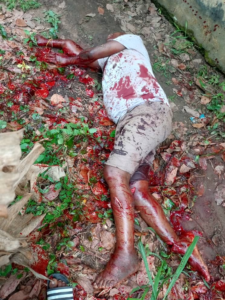
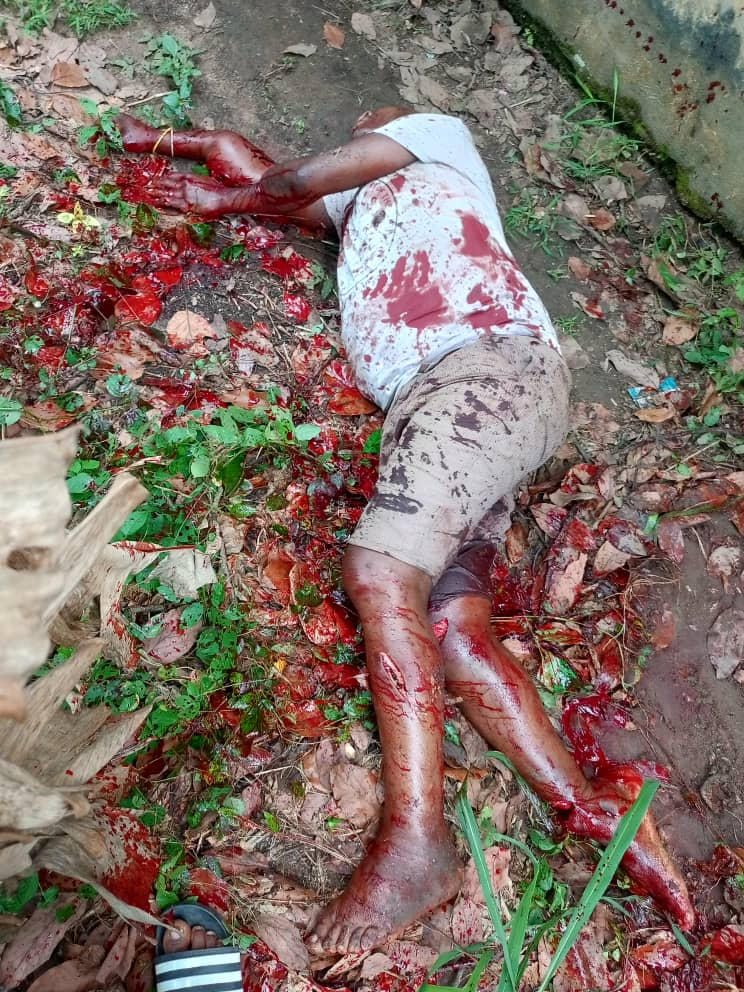
The Advocacy for Alleged Witches is saddened by the brutal murder of Chidiebere Isaiah by a relative, Nwalozie Chiwendu, following an accusation of witchcraft in Ofeh, Rivers State, in Southern Nigeria. The tragic news reached AfAW on February 15, 2026. AfAW contacted The Punch and Vanguard correspondents in Port Harcourt for the phone number of the youth president of the Ofeh community in Omuma Local Government Area. Through an advocate in the state, AfAW contacted a legal counsel from the community who confirmed the incident and has volunteered to facilitate any intervention. This legal counsel said he knew the victim and the suspected murderer very well. As reported, Chiwendu accused and murdered Isaiah for being responsible for his lack of progress. The legal counsel stated that Chiwendu dropped out of primary school. He never went to secondary school. “How did he expect to make significant progress and become rich if he was not educated?” He queried.
Chiwendu reportedly fled after the incident. The local police claimed that he was at large. As in previous cases in Rivers state, this matter will fizzle out after a while. The police stated that the investigation was ongoing, but that was all that would be heard about the case. There are no indications that the police are taking the case seriously, that they are tracking the suspect, or that they will bring him to justice soon. Witch persecution persists in the region due to impunity and lack of accountability, due to a failure of the police and the justice system. Last year, the police in Rivers state refused to prosecute pastors arrested for abusing children during exorcism and ritual cleansing in the state. All efforts and pressures on police authorities to bring these violators to justice came to nothing.
Meanwhile, advocates have been reacting and expressing their outrage following the horrific murder of Isaiah. One advocate stated, “See what ignorance has done: a tragedy for that community and the family. One brother is dead, and another brother is certainly going to be hanged for murder. Terrible!. Meanwhile, the pastors who preached this rubbish mentality into his ignorant head are walking about free, indoctrinating other ignorant people”. Another noted: “This is evil. So you claim to do something good by killing your brother because he is a witch, and you are running? You are not supposed to run away; rather, you should stay so we can tell you what a hero you are. Witchcraft does not exist. Say no to witch-hunts”. Furthermore, one advocate described the incident as: ” Absolutely tragic. No one should ever be killed over superstition or accusations of witchcraft. Education, awareness, and justice are the only answers. End the witch hunts now”.
Local sources informed AfAW that Isaiah had a wife and four children. His first child just finished secondary school. AfAW plans to visit the community and meet with family and community members to understand what happened and explore ways of supporting the family of the deceased during these difficult moments. Advocates will continue to pressure the police to bring the suspect to justice. Witchcraft accusations and jungle justice are against the law. The inability of the police to enforce the law drives these abuses.
In addition, AfAW will organize public awareness programs to reorient the minds of people in Rivers State. AfAW will educate the public to understand that nobody can harm, frustrate, or undermine the progress of others through magical or occult means.
That such a belief is superstitious and based on fear and ignorance!
Leo Igwe directs the Advocacy for Alleged Witches.
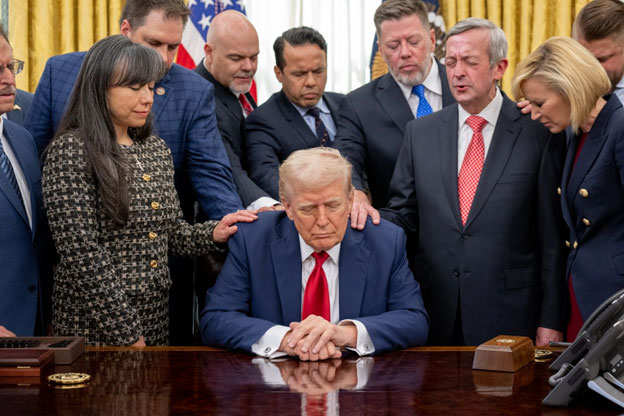
President Donald Trump Joins Faith Leaders in Prayer – Credit: The White House
According to the UN, Sunday marked the start of World Interfaith Harmony Week, a time to emphasize that mutual understanding and interreligious dialogue are essential to building a culture of peace. The week was established to promote harmony among all people, regardless of their faith.
NEW YORK, Feb 2 2026 (IPS) – Several events, meetings, consultations, initiatives, etc. taking place among faith-inspired, ‘faith-based’ and a variety of other similar efforts, over the past year, in the United States especially, concern me.
Coming from a background of human rights, international development, and humanitarian service, I have witnessed the arc of ‘none’ to increasing interest by Western governments in ‘religion’ – religious engagement, religion and development, religion and foreign policy, religious freedom, religious peacebuilding, or religion and peace, and more, including even religion and agriculture. Basically, religion and everything.
Non-Western governments within Africa and Asia, including areas overlapping with what we call (variably) “the Middle East”, have long been interested, and indeed actively engaging religious leaders and religious institutions.
As many scholars, observers, and foreign policy pundits have noted, the interest of such governments has often transcended any genuine fascination with faith, towards rather obvious instrumentalization of religious leaders, religious organisations and religious groups, in support of specific political agendas (e.g., making peace with Israel, legitimacy of corrupt – and violent – politically repressive leaders and regimes, etc.).
In fact, the marriage between select religious leaders/institutions/groups and some political actors goes back to the empires we have inherited pre-Westphalian states).
I recall some stories from my time serving as a staff member at the United Nations, and in other international fora. The first story revolves around one Arab and one Indian diplomat speaking with a European counterpart, during one of several UN Strategic Learning Exchanges on Religion, Development and Diplomacy, which I coordinated and facilitated, this one in 2014.
The discussion concerned how best to “benefit” from working with religious leaders to affirm a message of certain political parties, especially, albeit not only, around elections. The Arab patted the European on the back and said, with a smile and a wink: “you are finally catching up on how to use these religious leaders – congratulations my friend”. The Indian one, looking bemused, added “Yes. And be careful”.
Another story concerns another meeting I organised – in one of the basement meeting rooms of the UN – between UN officials and a diverse array of religious actors, around peace and mediation efforts, in select African and Asian conflict settings, early 2015.
A European Christian religious leader of a renowned multi-religious organisation made an intervention to address the concerns about “instrumentalization” of religious actors, which some faith-based NGO leaders were articulating.
While some faith representatives cautioned against religious actors being used to “rubber stamp decisions already made by governments and some intergovernmental organisations” (in the room were both UN and EU officials), this particular Western Christian religious leader spoke up and said, “I am not worried about that at all, in fact, I would like to say to my secular colleagues in this room, please use us… we can certainly benefit you… we are not common civil society actors, our mission makes us exceptional”.
My last story, is from my time serving as the secretary general of an international multireligious organisation which convenes religious leaders from diverse religious institutions around “deeply held and widely shared values”.
As soon as I became a member of the UN Secretary-General’s High Level Advisory Board on Effective Multilateralism, I arranged a meeting between some of my multi-religious Board members (religious leaders), and some members of this high Level UN SG’s Advisory Board.
The idea was to nurture a quiet but candid dialogue between pollical and religious leaders, around why and how multilateralism can be significantly strengthened by multireligious engagement.
I hasten to note that multireligious engagement, if served well, can be – as I have written and persistently argued – resistant to instrumentalization of select religious actors to serve any one particular governmental agenda. The latter is a feature I warn against, and small wonder, given developments from India to the United States, from Russia to Israel, and beyond.
Once again, I heard a religious leader invite the members of the SG’s Board to “use” their (religious) wisdom because of their “exceptional” mission (presumably the godly one). This time, later reflection among members of the UN SG Board led to noting that such multireligious engagement would be inadvisable, due to a concern about “Muslims” involved in such multireligious spaces.
Fast forward to 2026, one year after an increasingly belligerent US Presidential Administration’s record, which includes relatively ‘minor’ policy decisions such as transforming the name of the Ministry of Defence to the “Ministry of War”. And not so minor human rights abuses of citizens and immigrants, and some pointing to manipulation and outright disregard of the rule of law, both at home and abroad (I hope this is polite enough wording). Of course one dares not mention support to certain genocidal regimes killing thousands in the name of self-protection.
In this environment, I listen to conversations among some of the United States’ most esteemed faith-based organisations, all with a remarkable track record of serving humanity in all corners of the world. Who, apparently, are seeking to engage this Administration “constructively”, with some praising the “unprecedented” outreach of members of this Administration in engaging, largely (some would say exclusively), with certain Christian NGOs, certain Christian religious leaders, and certain Christian faith protagonists – no doubt to further noble objectives. Apparently, this is a form of strategic engagement of/with religion.
Even though there were likely some who felt uncomfortable with aspects of this rhetoric, the studiously diplomatic silences – including my own – about challenging anything said, was noteworthy. The bottom line is, “we need access to the White House… we need more resources to do our (good) work”.
Why was I silent? Because I am the quintessential ‘other’ whose outspokenness has already earned me the loss of a sense of ‘home’ and security, many times over. This is neither excuse nor justification, rather, an acknowledgement of cowardice.
Into this Kafkaesque reality, let me ask a few questions I am battling with: what will it take to speak truth to power publicly – the way Minnesotans and Palestinians are having to do with their own regimes? Is it strategic to be silent, or such consummate diplomats, especially when we work in the name of the ‘godly’ – being such “exceptional” actors?
Conversely, is this Administration which we endeavour to be so tactful with, being silent about it’s “divine mission”? Is being “nice and essentially a kind person with their heart in the right place”, and doing godly work, a good reason to work with those who are serving regimes which ignore the rule of law in their own nation and abroad? Does faith-based diplomacy mean we either collude, remain silent, or take the struggle to the streets?
If so, what difference is faith-based diplomacy and engagement actually making to civic engagement, to honoring human rights and the rule of law, or to serving principled leadership? Or do these simply not matter since it is the self-interests of the ruling and rich few, are what matters to determine the integrity of life, planet and leadership?
Perhaps we should ponder the advice of the Indian Diplomat, given to his Western counterpart 22 years ago: how can we “be careful”?
Professor Azza Karam serves as President of Lead Integrity; and Director of the Kahane UN Program, for Occidental College’s Diplomacy and World Affairs.
In December, I visited my hometown in southeastern Nigeria and, for the first time in decades, and spent over a week in the community where I was born. I was shocked by the pervasiveness of superstition and paranoia. I came face-to-face with the dark and toxic effects of irrational fears and anxieties. Upon arrival at the family compound, I noticed that the hand of our family’s housekeeper was swollen. I asked him what happened, and he said that he had picked up some poison while working on a farm. Picked up some poison? Does one drink or pick up poison? I asked him what he meant by that. He said that was what they said. Who said? He could not specifically say. The following day, I saw a motorcyclist in the compound praying for him and pressing the swollen part of his hand, which caused more inflammation. I was outraged, I told him to get ready, to visit the hospital.
The following day, we went to a hospital, where he is currently undergoing some treatment. Some community members confirmed that people could pick up or step on ‘poisons’ that some enemies or evil people kept. And that could cause diabetic sores, stroke, or death. A woman told me that one could buy them at local markets or from some occult experts. Nobody was able to explain to me the nature or components of these poisons, what they looked like, or how they worked. I asked and inquired for details to no avail. I met people who told me partial paralysis or stroke, diabetic sores were sent; they were not natural or some medical conditions. Some people told me that enemies used this poison to kill their parents or other relatives. And in most cases, they pointed accusing finger at other family members. In my community, no one dies a natural death. Anyone who passed away was killed. In most cases, people would say: “They have killed him” or “They have gotten him at last”. Who are ‘they’? Their neighbours, their brothers and sisters. Their relatives.
People live in constant fear of being ‘poisoned’ by others, their neighbours. These fears undermine development and community well-being. People suspect and worry that someone, usually their family or community members, was after them to make them sick or kill them through occult means. They claim these evil neighbours place spiritual poisons here and there which they could pick or step on. Though they claim to be Christians, people in my community go from one church to another, from one prophet or pastor to another, from one traditional priest to another. They ‘spiritually’ fortify or protect themselves. People pray in Christian and traditional ways. They call on Jesus. They also invoke the ancestors. People in my community hire prayer warriors and engage in ritual sacrifices to ward off evil people and their alleged harmful schemes. At the end of the day, the people are trapped in a vicious circle of fear, poverty, paranoia, and exploitation. They are held hostage by ignorance and superstitious nonsense.
Con artists, mischievous individuals, and other self-styled godmen and women fleece and scam them in the name of prayer, ministration, consultation, and appeasement of gods and spirits. These unscrupulous individuals extort money from community members for deliverance and exorcism. One day, I came back and saw this strange guy standing at a corner in the compound. I inquired whom he was, and I was told that he was an itinerant prayer man. He used to go from house to house to pray for people. After praying, he would ask partakers to go inside and get him some food or money. I ignored him and went into the house. Some days later, I went to visit a neighbour and saw him conducting a prayer. He collected some sand and put it in their hands, screaming and asking god to open doors for the family. Open doors? Which doors? He would scream: “Open doors. God, Open doors for this family”. And they would repeatedly chorus: Aaaamen. Aaaamen. He went on and on, commanding God to prosper the family. He asked one of them to open the door to the living room, in an attempt to physicalize the prosperity. I observed them for a while and turned back.
I was thinking and wondering how screaming and commanding an imaginary deity would transform the fortunes of a family. I wished those partaking in that prayer could pause and think. They should know that if god had opened doors for this prayerman, he wouldn’t be loitering around in the village, making this useless supplication. One incident that opened my eyes to the hostage and devastating effects of irrational beliefs was a case of dog stool in a neighbour’s compound. A week into my stay, I got a call from my agemate. He lives in Italy, and the family’s house was close to mine. He asked if I was in the village. I said, No. I was in a neighbouring state, Akwa Ibom, traveling for a meeting. He said he wanted me to go to his family’s house. The sister woke up that morning and saw some animal dropping, and they suspected some poop. He said, Look, they have come again. That was how they killed the parents. He said the poop was not ordinary, that someone invoked the dropping to kill or make someone in his family sick.
This friend sent me a video, where his sister, a catholic nun, recounted the incident, stating that she had poured some of Rev Ebuka’s olive oil on it and someone also urinated on it. These rituals were apparently meant to neutralize the evil magic and intent. I have been wondering how olive oil and urine could disable or neutralize evil magic. The matter was reported to the community head and tabled at the village meeting. I attended the meeting for the first time. I stayed till the issue was raised. I used the opportunity to caution attendees and the community. I warned them against the dangerous and toxic effects of baseless claims and accusations of occult harm. I drew their attention to cases of families and communities in the region damaged by such suspicions. I urged them to free their minds and consciences from irrational fears, paranoia, and superstitions.
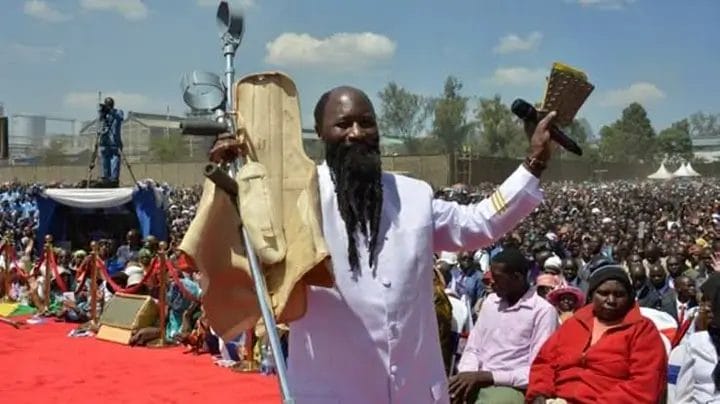
NAIROBI-(MaraviPost)-A sombre shadow was cast over Prophet David Owuor’s high-profile end-of-year crossover crusade in Nakuru after a woman attending the event died under circumstances that have raised questions about transparency and reporting.
The incident occurred on December 30, 2025, during a large gathering at Technology Farm, the venue for the celebrated Menengai 8 meeting, which drew thousands of worshippers from across Kenya and beyond.
According to sources within the congregation, the woman collapsed and later died amid the event, but rather than alerting authorities, church leaders allegedly moved her body discreetly to Egerton University Funeral Home in Njoro a location some insiders suggest was chosen to avoid public attention due to its distance from the main crusade venue.
A faithful who spoke on condition of anonymity described how “very few people knew she died.”
The Repentance and Holiness Church leaders are said to be trying to conceal the death.
What has fueled further controversy is the revelation that neither the church nor the woman’s family reported the death to the police.
Nakuru County’s Criminal Investigations Officer, Samuel Ngeiywa of the Directorate of Criminal Investigations (DCI), confirmed to the media that law enforcement had no official record of the woman’s death, because no formal notification was ever made.
“We have received information that one person died during Prophet Owuor’s crusade. We were not notified. No relatives went to any police station around to report the death and therefore the incident is not yet in any of our official records,” Ngeiywa said.
Sudden Relocation According to The Standard, the woman’s body, held at the Njoro facility for a day, was moved to Luanda in Kakamega County on December 31, 2025, shortly after media inquiries into her whereabouts intensified.
Some church members told reporters that Prophet Owuor and other church elders instructed the family to relocate the remains once questions began circulating.
Crusade Highlights Amid Controversy The Nakuru crusade, which began on December 29, 2025, was marked by packed gatherings and claimed testimonies of miraculous healings.
Prophet Owuor held a roadside outreach along Kenyatta Avenue that brought parts of the city to a standstill as large crowds thronged to hear his messages and witness alleged divine healings, including claims of cures for chronic illnesses.
Some church members told reporters that elders instructed the family to relocate the remains once questions began circulating.
While Owuor’s meetings often attract significant public attention and debate, especially around claims of miracles, the handling of this death has sparked fresh concern.
Critics argue that failing to notify authorities and moving the body without transparent documentation undermines public trust and could breach legal reporting requirements.
Prophet Owuor’s ministry has yet to issue a public statement addressing the woman’s death or the circumstances surrounding its reporting and relocation.
As the New Year begins, questions about accountability and oversight at large religious gatherings are likely to intensify, especially when events draw thousands and involve emotionally charged testimonies of healing and faith.
Source: nairobinews.co.ke
Share this:
Like this:
LikeLoading…
Discover more from The Maravi Post
Subscribe to get the latest posts sent to your email.
ALABMA-(MaraviPost)-A devastating incident has shaken the community of Elba Zion Missionary Baptist Church, where beloved Pastor DaQuarius Green was fatally shot by his wife, Quintaria Massey, in front of their children.
The tragic event occurred on December 30, leaving the congregation and the wider community in mourning.
According to authorities, the shooting was reportedly a result of a domestic incident, with Massey claiming self-defense.
However, the investigation is ongoing, and no charges have been filed against her as yet.
The couple had been experiencing marital problems, which may have contributed to the tragic event.
Pastor Green, 31, was a respected figure in the community, known for his dedication to his faith and family.
His death has sparked an outpouring of grief and tributes from fellow pastors, church members, and the community at large.
“We are heartbroken by the loss of our beloved pastor,” said Elba Zion Missionary Baptist Church in a statement. “We ask that you keep his family and our congregation in your prayers during this difficult time”
The incident has also raised concerns about domestic violence and the importance of seeking help when needed.
Share this:
Like this:
LikeLoading…
Discover more from The Maravi Post
Subscribe to get the latest posts sent to your email.
ACCRA-(MaraviPost)-Ghanaian police have arrested a man identified as Evans Eshun, also known as Ebo Noah, for allegedly spreading fear among the public with his apocalyptic prophecies.
The self-proclaimed prophet had been claiming that the world would come to an end on Christmas Day 2025, sparking widespread panic.
Eshun had been telling people that massive floods would occur on that day, killing anyone who refused to board one of his eight prepared ark-like vessels.
Prophet Ebo Noah arrested
However, as the predicted date passed without incident, it became clear that his prophecies were baseless.
The police say such false prophets cause unnecessary distress and confusion among the public.
Eshun’s actions had caused significant alarm, with many people likely affected by his claims.
The authorities are taking steps to address the issue, emphasizing the harm caused by spreading unfounded prophecies.
The incident highlights the need for critical thinking and verification of information, especially when it comes to sensational claims.
Share this:
Like this:
LikeLoading…
Discover more from The Maravi Post
Subscribe to get the latest posts sent to your email.