

Active Citizens, Africa, Civil Society, Crime & Justice, Democracy, Featured, Headlines, Human Rights, Press Freedom, TerraViva United Nations
Credit: Luc Gnago/Reuters via Gallo Images
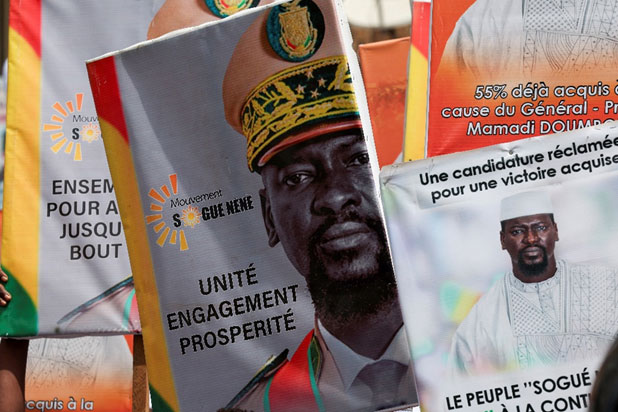
– In December, the dust settled on Guinea’s first presidential election since the military took control in a 2021 coup. General Mamady Doumbouya stayed in power after receiving 87 per cent of the vote. But the outcome was never in doubt: this was no a democratic milestone; it was the culmination of Guinea’s denied transition to civilian rule.
Doumbouya has successfully performed an act of political alchemy, turning a military autocracy into an electoral one. By systematically dismantling the opposition, silencing the press and rewriting laws to suit his ambitions, he has made sure to shield his grip on power with a thin veil of electoral legitimacy.
The architecture of autocracy
The path to this moment was paved with precision. In April 2025, Doumbouya announced a constitutional referendum, a move that may have looked like it would herald the beginning of the end of military rule. But it was something else entirely. By June, Doumbouya had further centralised control by creating a new General Directorate of Elections. This body, placed firmly under the thumb of the Ministry of Territorial Administration, reversed previous efforts to establish an independent electoral institution.
The constitution was drafted in the shadows by the National Council of the Transition, the junta-appointed legislative body. While early drafts reportedly contained safeguards against lifetime presidencies, these were stripped away before the final text reached the public. The result was a document that removed a ban on junta members running for office, extended presidential terms from five to seven years and granted the president the power to appoint a third of the newly created Senate.
When the referendum was held on 21 September, it rubber-stamped de facto rule. Official figures claimed 89 per cent support with an 86 per cent turnout, numbers that defied the reality of a widespread opposition boycott and a palpable lack of public enthusiasm.
A climate of fear
With a blanket ban on protests in effect since May 2022, those who’ve dared challenge the junta’s controlled transition have been met with security force violence. On 6 January 2025, security forces killed at least three people, including two children, during demonstrations called by the opposition coalition Forces Vives de Guinée.
The political landscape was further cleared through administrative and judicial means. In October 2024, the government dissolved over 50 political parties. By August 2025, major opposition groups such as the Rally of the People of Guinea had been suspended. Key challengers, including former Prime Minister Cellou Dalein Diallo, remain in exile, while others, among them Aliou Bah, have been sentenced to prison – in Bah’s case, for allegedly insulting Doumbouya.
The atmosphere of fear has been reinforced by a brutal crackdown on the media. Guinea plummeted 25 places in the 2025 World Press Freedom Index, the year’s largest fall. Independent outlets have had their licences revoked and journalists have been detained. Those still working have learned to practise strict self-censorship to avoid becoming the next target. This meant that as voters went to the polls, there was nobody to provide diverse perspectives, scrutinise the process, investigate irregularities or hold authorities accountable.
Coup contagion
Guinea is no outlier. Since 2020, a coup contagion has swept through Africa, with military takeovers in Burkina Faso, Chad, Gabon, Guinea-Bissau, Madagascar, Mali, Niger and Sudan. In each instance, the script has been similar: military leaders seize power promising to ‘correct’ the failures of the previous regime, only to break their promises of a return to civilian rule.
Guinea is now the third country among this recent wave to move from a military dictatorship to an electoral autocracy. It follows in the footsteps of Chad, where Mahamat Idriss Déby secured victory in May 2024 after the suspicious killing of his main opponent, and Gabon, where General Brice Oligui Nguema won a 2025 election with a reported 90 per cent of the vote.
The international community does little. Doumbouya routinely ignored deadlines and sanctions from the Economic Community of West African States, which once prided itself on a ‘zero-tolerance’ policy for coups, and no consequences ensued. The African Union and the United Nations offered rhetorical concern, but their warnings were not accompanied by tangible diplomatic or economic repercussions.
The world’s willingness to maintain business as usual while Doumbouya steered through a fake transition sends a dangerous message to other aspiring autocrats, in the region and beyond.
Democracy denied
When Doumbouya seized power in 2021, he was greeted with a degree of cautious optimism. His predecessor, Alpha Condé, had controversially amended the constitution to secure a third term amid violent protests and corruption and fraud allegations. Doumbouya promised to fix things, but instead became a mirror image of the man he ousted, using the same tactics of constitutional revision and repression to secure his power.
The statistics of the December election – an 87 per cent victory on a claimed 80 per cent turnout – do not reflect a genuine mandate but rather a vacuum: with no independent media to scrutinise the process and no viable opposition allowed to run, the election was a technicality.
The prospects for real democracy in Guinea appear remote. Doumbouya has secured a seven-year mandate through an election that eliminated the essential infrastructure needed for democracy. In the absence of stronger international pressure and tangible support for Guinean civil society, Guinea faces prolonged authoritarian rule behind a democratic facade, with dismal human rights prospects.
Inés M. Pousadela is CIVICUS Head of Research and Analysis, co-director and writer for CIVICUS Lens and co-author of the State of Civil Society Report. She is also a Professor of Comparative Politics at Universidad ORT Uruguay.
For interviews or more information, please contact research@civicus.org






