Wars Impose Lasting Economic Costs, While More Defense Spending Means Hard Choices

Armed Conflicts, Civil Society, Crime & Justice, Democracy, Global, Headlines, Human Rights, IPS UN: Inside the Glasshouse, TerraViva United Nations

Opinion

Wars Impose Lasting Economic Costs, While More Defense Spending Means Hard Choices

Credit: 279photo/iStock by Getty Images. Source: IMF

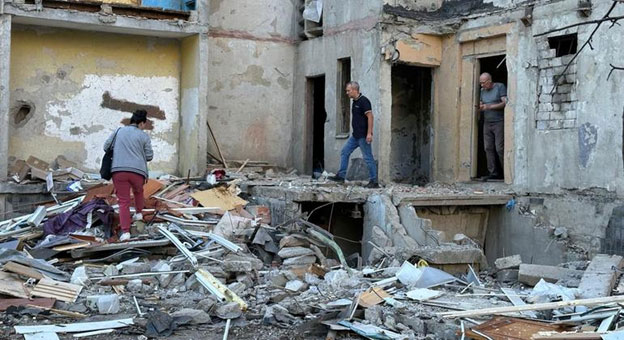
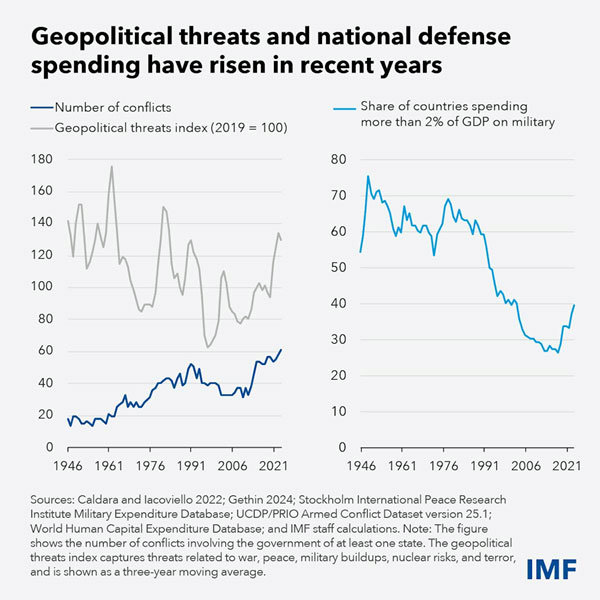
WASHINGTON DC, Apr 16 2026 (IPS) – War is again defining the global landscape. After decades of relative calm following the Cold War, the number of active conflicts has surged in recent years to levels not seen since the end of the Second World War.


Meanwhile, rising geopolitical tensions and heightened security concerns are prompting many governments to reassess their priorities and spend more on defense.

Beyond their devastating human toll, wars impose large and lasting economic costs, and pose difficult macroeconomic trade-offs, especially for those countries where the fighting is taking place.

Even without active conflicts, rising defense spending can raise economic vulnerabilities in the medium term. After the war, governments face the urgent post-conflict task of securing durable peace and sustaining recovery.

In an era of proliferating conflicts, our research in two analytical chapters of the latest World Economic Outlook highlights the deep and prolonged economic harm inflicted by war, which has particularly affected sub-Saharan Africa, Europe, and the Middle East.

We also show that rising defense spending—which can boost demand in the short term—imposes difficult budgetary trade offs that make good policy design and lasting peace more important than ever.
Wars Impose Lasting Economic Costs, While More Defense Spending Means Hard Choices

Economic losses

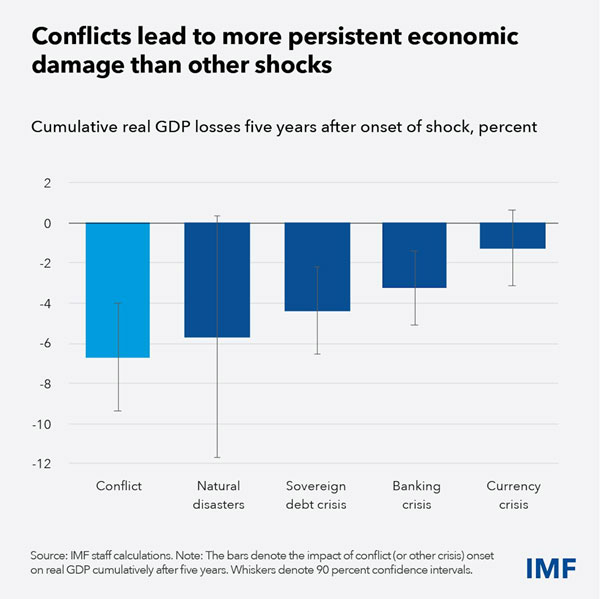
For countries where wars occur, economic activity drops sharply. On average, output in countries where fighting takes place falls by about 3 percent at the onset and continues falling for years, reaching cumulative losses of roughly 7 percent within five years.

Output losses from conflicts typically exceed those associated with financial crises or severe natural disasters. Economic scars also persist even a decade later.
Wars Impose Lasting Economic Costs, While More Defense Spending Means Hard Choices

Wars also tend to have significant spillover effects. Countries engaged in foreign conflicts may avoid large economic losses—partly because there is no physical destruction on their own soil.

Yet, neighboring economies or key trading partners with the country where the conflict is taking place will feel the shock. In the early years of a conflict, these countries often experience modest declines in output.

Major conflicts—those involving at least 1,000 battle-related deaths—force difficult trade-offs in economies where they occur. Government budgets deteriorate as spending shifts toward defense and debt increases, while output and tax collection collapse.

These countries may also face strains on their external balances. As imports contract sharply because of lower demand, exports decrease even more substantially, resulting in a temporary widening of the trade deficit.

Heightened uncertainty triggers capital outflows, with both foreign direct investment and portfolio flows declining. This forces wartime governments to rely more heavily on aid and, in some cases, remittances from citizens abroad to finance trade deficits.

Despite these measures, conflicts contribute to sustained exchange rate depreciation, reserve losses, and rising inflation, underscoring how widening external imbalances amplify macroeconomic stress during wartime. Prices tend to increase at a pace higher than most of central banks’ inflation targets, prompting monetary authorities to raise interest rates.

Taken together, our findings show that major conflicts impose substantial economic costs and difficult trade-offs on economies that experience conflicts within their borders, as well as hurting other countries. And these costs extend well beyond short-term disruption, with enduring consequences for both economic potential and human well-being.

Spending trade-offs

More frequent conflicts and rising geopolitical tensions have also prompted many countries to reassess their security priorities and increase defense spending. Others plan to do so. This situation presents policymakers with a crucial question about trade-offs involved with such a boost to spending.

Our analysis looks at episodes of large buildups in defense spending in 164 countries since the Second World War. We find that these booms typically last nearly three years and increase defense spending by 2.7 percentage points of gross domestic product.

That’s broadly similar to what is required by North Atlantic Treaty Organization (NATO) members to reach the 5 percent of GDP defense spending target by 2035.

Ramping up defense spending primarily acts as a positive demand shock, boosting private consumption and investment, especially in defense-related sectors. This can raise both economic output and prices in the short term, requiring close coordination with monetary policy to temper inflationary pressures.

Overall, the aggregate effects on output of scaling up defense spending are likely modest. Increases in defense spending typically translate almost one for one into higher economic output, rather than having a bigger multiplier effect on activity.

That said, the multiplier or ripple effects of such spending vary widely depending on how outlays are sustained, financed and allocated, and how much equipment is imported.

For instance, output gains are smaller and external balances deteriorate when the stimulus is partly spent to import foreign goods, which is especially the case for arms importers. By contrast, a buildup of defense spending that prioritizes public investment in equipment and infrastructure, together with less fragmented procurement and more common standards, would expand market size, support economies of scale, strengthen industrial capacity, limit import leakages, and support long-term productivity growth.

The choice of how to finance defense spending entails critical trade-offs. Defense spending booms are mostly deficit-financed in the near-term, while higher revenues play a larger role in later years of defense spending booms and when the defense spending buildup is expected to be permanent.
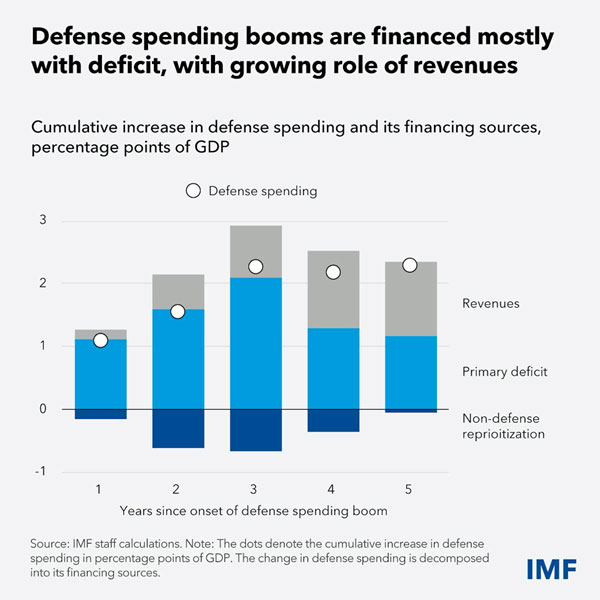
The reliance on deficit financing can stimulate the economy in the short term, but strain fiscal sustainability over the medium term, particularly in countries with limited room in government budgets.

Deficits worsen by about 2.6 percentage points of GDP, and public debt increases by about 7 percentage points within three years of the start of a boom (14 percentage points in wartime). The resulting increase in public debt can crowd out private investment and offset the initial expansionary effect of defense spending.

The buildup of fiscal vulnerabilities can be mitigated by durable financing arrangements, especially when the increase in defense spending is permanent. However, raising revenues come at the cost of reducing consumption and dampening the demand boost, while re-ordering budget priorities tends to come at the expense of government spending on social protection, health, and education.

Policies for recovery

Our analysis also shows that economic recoveries from war are often slow and uneven, and crucially depend on the durability of peace. When peace is sustained, output rebounds but often remains modest relative to wartime losses. By contrast, in fragile economies where conflict flares up again, recoveries frequently stall.

These modest recoveries are driven primarily by labor, as workers are reallocated from military to civilian activities and refugees gradually return, while capital stock and productivity remain subdued.

Early macroeconomic stabilization, decisive debt restructuring, and international support—including aid and capacity development—play a central role in restoring confidence and promoting recovery. Recovery efforts are most effective when complemented by domestic reforms to rebuild institutions and state capacity, promote inclusion and security, and address the lasting human costs of conflict, including lost learning, poorer health, and diminished economic opportunities.

Importantly, effective post-war recovery requires comprehensive and well-coordinated policy packages. Such an approach is far more effective than piecemeal measures. Policies that simultaneously reduce uncertainty and rebuild the capital stock can reinforce expectations, encourage capital inflows, and facilitate the return of displaced people.

Ultimately, successful post-war recovery lays the foundation for stability, renewed hope and improved livelihoods for communities affected by conflict.

This IMF blog is based on Ch. 2 of the April 2026 World Economic Outlook, “Defense Spending: Macroeconomic Consequences and Trade-Offs,” and Ch. 3, “The Macroeconomics of Conflicts and Recovery.” For more on fragile and conflict-affected states: How Fragile States Can Gain by Strengthening Institutions and Core Capacities.

IPS UN Bureau
  Source

Why the Rohingya Refugees in Bangladesh Need Work, Not Just Rations

Armed Conflicts, Asia-Pacific, Civil Society, Crime & Justice, Democracy, Featured, Headlines, Human Rights, Humanitarian Emergencies, IPS UN: Inside the Glasshouse, Migration & Refugees, TerraViva United Nations

Opinion

Why the Rohingya Refugees in Bangladesh Need Work, Not Just Rations

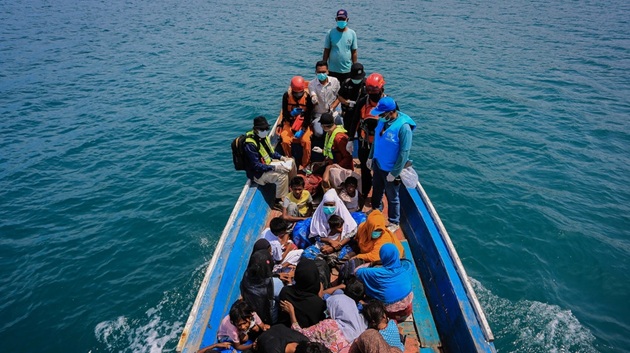
The Rohingya did not choose dependency on aid. It was created by the restrictions surrounding them. Credit: UNHCR/Amanda Jufrian

COX’S BAZAR, Bangladesh, Apr 14 2026 (IPS) – While global attention right now is on escalating geopolitical tensions involving the United States, Israel, and Iran, another crisis continues quietly in Bangladesh.


Beginning April 1, 2026, the World Food Programme (WFP) introduced a revised Targeting and Prioritisation Exercise (TPE) for Rohingya refugees living in camps in Cox’s Bazar and Bhasan Char, according to a statement released by the United Nations in Bangladesh on April 2.

Under the new system, refugee households will receive food assistance of $12, $10, or $7 per person per month, depending on their assessed level of food insecurity. Previously, all refugees received $12 per person.

On paper, vulnerability-based targeting appears reasonable. In many humanitarian crises, such systems help ensure that limited resources reach those most in need. However, the Rohingya context is different.

Nearly nine years after fleeing genocide and persecution in Myanmar, more than one million Rohingya refugees remain confined to camps in Bangladesh, according to the latest data from UNHCR Bangladesh including 144,456 biometrically identified new arrivals and 1,040,408 Registered refugees 1990s & post-2017. 78% them are Women and children.

Unlike refugees in many other countries, Rohingya in Bangladesh have extremely limited freedom of movement and cannot legally work or run small businesses within the camps. Refugees are also not formally employed by humanitarian organizations—except as volunteers receiving small daily allowances. As a result, they remain almost entirely dependent on humanitarian assistance.

Within this context, reducing aid raises serious concerns. When refugees are not permitted to engage in meaningful economic activity, food insecurity becomes less a household condition and more a structural outcome.

Humanitarian agencies have provided life-saving support for years, and their efforts should not be overlooked. But survival is not the same as stability. Instead of creating pathways toward self-reliance for Rohingya and local communities in Cox’s Bazar who are affected due to refugee statements, the current system has largely institutionalized dependency.

Many programs labeled as “livelihood initiatives” have not produced meaningful outcomes. Skills training programs—such as electrical repair or other technical courses—often fail to translate into real opportunities because refugees do not own motorbikes, electricity access is limited in many camp areas, refugees cannot legally move beyond the camps to seek work, and humanitarian organizations don’t employ trained refugees within their own operational structures.

This raises difficult questions: Why invest donor resources in skills that cannot realistically be applied? And what long-term strategy do these initiatives serve?

The new targeting model categorizes refugees as extremely food insecure, highly food insecure, or food insecure. Some vulnerable households—such as those led by elderly individuals, persons with disabilities, or children—will continue receiving the highest level of assistance.

Yet the broader reality remains unchanged: the entire Rohingya population in Bangladesh faces severe restrictions on economic participation.

Recent protests in the camps are often described as reactions to ration reductions. In reality, they reflect deeper concerns about uncertainty and the absence of long-term planning. Refugees are asking a simple question: What happens if funding declines further in the future? Where will we go? Well Bangladesh alone will be left dealing with the Rohingya crisis?

They want to send a message to the world: dependency on aid was designed around the Rohingya. It is time to think beyond relief and give them the tools to stand on their own feet.

Long-term strategic thinking is urgently needed. This includes serious discussions about ensuring safe and dignified lives in the camps until the Rohingya are able to return to Myanmar, expanding economic participation for refugees, and creating policies that allow them to contribute economically while remaining under appropriate regulation.

At the same time, Bangladesh itself is going through a transitional period after the election, and the new government and said it will work closely to make Rohingya repatriation possible and shared data on 8.29 lakh Rohingyas with Myanmar.

But the Rohingya crisis cannot be a lesser priority, the new government also needs to recognize that prolonged displacement cannot be managed indefinitely through restriction and relief alone—the same approach that largely characterized the policies of the previous government.

Carefully regulated work opportunities—such as camp-based enterprises, pilot employment schemes, or limited work authorization programs—could help reduce humanitarian dependency while preserving government oversight.

If even one or two members of each refugee household were allowed to work legally under controlled frameworks, humanitarian costs could gradually decline, camp economies could stabilize, and youth frustration could decrease.

Most importantly, dignity could begin to return.

After nearly nine years, international agencies have managed one of the world’s largest refugee operations with remarkable logistical capacity. Yet the central question remains: what durable systems have been created to help refugees stand on their own feet?

As global funding pressures increase and donor fatigue grows, humanitarian assistance is being recalibrated downward. Without structural reforms, this risks managing dependency more efficiently rather than reducing it.

The Rohingya did not choose dependency on aid. It was created by the restrictions surrounding them. Food assistance remains essential. But the future of an entire population cannot be defined solely by ration cards and vulnerability categories.

The Rohingya crisis requires more than improved targeting of aid. It requires policies that combine protection with participation and living with safety.

The world has learned how to feed the Rohingya.

The real test is whether it will allow them to stand—until the day they can safely return home to Myanmar with rights, safety, and dignity.

Otherwise, families quietly reduce meals. Young people seek unsafe informal labor. The risks of child labor, early marriage, unsafe migration. and involvement in illicit activities increase. When opportunity disappears, desperation fills the gap.

Mohammed Zonaid is a Rohingya SOPA 2025 honoree, freelance journalist, award-winning photographer, and fixer. He works with international agencies and has contributed to Myanmar Now, The Arakan Express News, The Diplomat Magazine, Frontier Myanmar, Inter Press Service, and the Myanmar Pressphoto Agency.

IPS UN Bureau

  Source

Regime Change – Sometimes It Works, Often It Doesn’t

Armed Conflicts, Civil Society, Crime & Justice, Democracy, Economy & Trade, Energy, Global, Global Geopolitics, Headlines, Human Rights, North America, TerraViva United Nations

Opinion

Credit: US Department of Defense / Wiki Commons

Apr 6 2026 (IPS) –  
Donald Trump ran on a platform of ending wars. After his success in Venezuela, he is intoxicated by his military achievements and is banking on regime change in several countries.


In a swift and decisive move, US forces abducted Venezuelan leader Nicolás Maduro and his wife to the United States. The current government in Caracas has little choice but to largely submit to Washington’s dictates. Trump’s motives for the war against Iran remain unclear, partly because the US president has cited various reasons: to finally destroy the Iranian nuclear program, to end the Iranian threat to the Middle East, to support the Iranian people, and to overthrow the terrible regime in Tehran. He remains vague about his reasoning and seems to make off the cuff suggestions for regime change. Trump had a lofty idea at how he envisions the end of this war. He has suggested “unconditional surrender,” followed by his personal involvement in the selection of a successor: I must be involved in picking Iran’s next leader.

The swift victory against Iran failed to materialize, an end to the war is not in sight, and a new leader has been chosen without Trump’s involvement. The structures of the mullah regime appear so entrenched that the anticipated regime change following the rapid decapitation of the leadership did not occur. Yet Donald Trump had proclaimed: “What we did in Venezuela is, in my opinion, the perfect, the perfect scenario.” The Atlantic calls this attitude a “hostile corporate takeover of an entire country”. Now the US government expects Cuba to surrender. “I think I could do anything I want” with Cuba, Trump declared, now that the island is virtually cut off from energy supplies and its economy is in ruins. He is demanding the removal of Cuban President Diaz-Canel.

In the business world hostile corporate takeovers sometimes work, sometimes they fail. Similarly with Trump’s idea of swift government surrenders. In the case of Iran, he was misguided by the Wall Street playbook. Irresponsibly, he called on Iranians to overthrow the government before the bombing campaign started. Regime change in Iran has now been forgotten and Trump is agnostic about democracy. He is interested to get the oil price down and the stock market up.

Lessons from the past

The concept of regime change—replacing the top of the government to install one more agreeable to the US—is not new to US foreign policy. Proponents of regime change usually point to Japan and Germany as positive examples of successful democratization. Often, however, the goal is not, or at least not primarily, democratization, but rather the installation of a government that is ideologically close to the US or amenable to them. But the “Trump Corollary”, as explicitly stated in the National Security Strategy to enforce the Monroe Doctrine, is not new either. In reality, it was already the Kennedy, Nixon, Reagan, and Bush doctrine.

Both Trump’s idea of regime change and his rigorously pursued territorial ambitions (Canada, Greenland, the Panama Canal) are reminiscent of the Monroe Doctrine of 1823, particularly the version of this doctrine expanded by President Roosevelt in 1904. This doctrine legitimized American interventions in Latin America. At the beginning of the 20th century, the US intervened in numerous Latin American countries in ‘its backyard’, using military and intelligence means: in Colombia, to support Panamanian separatists in controlling the Panama Canal; repeatedly in the Dominican Republic; they occupied Cuba from 1906 to 1909 and intervened there repeatedly afterward; in Nicaragua during the so-called ‘Banana War’, to protect the interests of the US company United Fruit; in Mexico, as well as in Haiti and Honduras.

The New York Times recently suggested that Trump’s current enthusiasm for regime change is most comparable to that of Dwight D. Eisenhower. During his two terms in office from 1953 to 1961, the once coldly calculating general allowed himself to be seduced into a downward spiral from one coup to the next. In 1953, the US succeeded in overthrowing the elected Iranian Prime Minister Mohammad Mossadegh with Operation Ajax. Mossadegh wanted to nationalize the British-owned oil industry. The coup succeeded with CIA support. The US installed the Shah as its puppet. He ruled with absolute power until the so-called Iranian Revolution and the dictatorship of Ayatollah Khomeini in 1979. After the successful overthrow of the government in Iran, Eisenhower decided to intervene in Guatemala. The elected president, Jacobo Árbenz Guzmán, who initiated far-reaching land reform laws, was overthrown in a coup d’état in 1954 and replaced by the pro-American colonel, Castillo Armas.

During this period, the US government also formulated the so-called domino theory, which aimed to prevent governments, particularly in Asia, from aligning themselves with the Soviet Union. The assumption was that if one domino fell, others would follow. It was during this time that the costly war in Korea ended in an armistice. Therefore, countries like Vietnam, Laos, Burma, Indonesia, and others were on Eisenhower’s domino list. However, the destabilization campaigns carried out by the CIA sometimes had the opposite effect. Governments in Indonesia and Syria emerged strengthened from the interventions. Eisenhower left Kennedy with the loss of American influence in Cuba. The failed Bay of Pigs invasion in April 1961, intended to overthrow Fidel Castro, was the starting point for the decades-long blockade of Cuba, which Trump is determined to end now through regime change.

The most dramatic example of failed regime change in recent history is undoubtedly the Iraq War, which began in 2003 under President George W. Bush. The stated goal was to remove Saddam Hussein from power and destroy his weapons of mass destruction. The war led to the overthrow of the regime. The United Nations and US teams found no weapons of mass destruction despite intensive on-site investigations. Attempts to establish an orderly state in Iraq failed. These experiences, and especially the disastrous outcome of two decades of military intervention in Afghanistan, discredited the concept of regime change.

What are the implications?

The most important lesson taught by efforts to affect externally forced regime change is that interventions often lead to crises that were ostensibly meant to be prevented or solved. The temptation was too great for Trump to miss the opportunity to depose the despised Maduro government.

Scholarly studies of the numerous attempted regime changes and democratization efforts reveal three key findings. First, simply removing the government from power (whether through assassination, as in the case of Saddam Hussein in Iraq or now in Iran, or through kidnapping as in Venezuela) is insufficient, as such actions often lead to chaos, state collapse, or even civil war. Thus, it will be interesting to watch further developments in Venezuela, Cuba, and Iran.

A second lesson from empirical studies of regime change is that democratization is more likely to succeed if democratic experience already existed in the country. However, this is often not the case.

Finally, if the real goal is democratization (and not just to secure spheres of influence or oil supplies etc.), it is far more promising not only to hold elections (as in Afghanistan, for example), but to renounce violence and initiate a long-term program with development aid and support for civil society.

Whether the US government will be impressed by these findings, or even acknowledge them, is doubtful. Currently, the American president is euphoric, despite the strong reaction from the Iranian government which he, surprisingly, did not expect. His promises to end the senseless wars and not start any new ones, however, seem to have been forgotten.

Related articles:
The US: Good at Starting but Bad at Ending Wars
Failure of US–Iran Talks Was All Too Predictable — But Turning to Military Strikes Creates Dangerous Unknowns
The ‘Donroe Doctrine’
The Return of the Ugly American

Herbert Wulf is a Professor of International Relations and former Director of the Bonn International Center for Conflict Studies (BICC). He is presently a Senior Fellow at BICC, an Adjunct Senior Researcher at the Institute for Development and Peace, University of Duisburg/Essen, Germany, and a Research Affiliate at the National Centre for Peace and Conflict Studies, University of Otago, New Zealand. He serves on the Scientific Council of SIPRI.

This article was issued by the Toda Peace Institute and is being republished from the original with their permission.

IPS UN Bureau

  Source

Tackling Political Exclusion is Central to Saving Democracy

Armed Conflicts, Civil Society, Crime & Justice, Democracy, Global, Headlines, Human Rights, IPS UN: Inside the Glasshouse, TerraViva United Nations

Opinion

Tackling Political Exclusion is Central to Saving Democracy

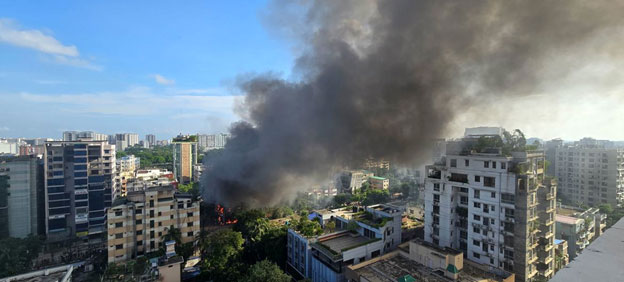
Smoke rises in downtown Dhaka, the capital of Capital, during the July-August 2024 youth-led anti-government protests. Credit: UN Bangladesh/Mithu

BRIGHTON, UK, Apr 6 2026 (IPS) – Urgent steps need to be taken to rebuild the relationship between citizens and state to stem the decline of democracy globally. Experts point to inequality and political exclusion as two of the biggest drivers for democratic backsliding, with the exclusion of citizens from a role in policy and decision-making spaces leading to ‘hollow citizenship’.


A report, published by the Institute of Development Studies, comes as Europe, Africa, Latin America, Asia and the US, have seen a rise in support for populist leaders on the left and right stoking division and weakening democratic safeguards, such as free and fair elections and free media.

This has led to key aspects of democracy declining during the last decade and now 74% of the
world’s population (6 billion) live in autocracies.

In response, the report authors call for an urgent rethink of democracy – which evidence shows delivers better social and economic outcomes than other regimes – to focus on people, power and inequality and less on institutions.

The experts say that past efforts to strengthen democracy globally focused too much on strengthening institutions, like legislature, judicial systems and electoral commissions and neglected the needs of people.

To sustain and strengthen democracies for the future, the reports call for urgent action to ensure people are included and engaged in democracy at local and national levels.

Shandana Khan Mohmand, Research Fellow, Institute of Development Studies, said: “After decades of unsuccessful efforts, and millions of dollars spent by Western powers to try and strengthen democracy globally, we need to learn the lessons about what does and doesn’t work.

“While supporting democratic institutions like electoral commissions, judicial systems and independent media are all critically important, evidence shows that the missing ingredient is people – and the extent that they can engage in democracy in meaningful ways. Whether in local council decisions about community parks or on a nation’s policy on green energy, or going to war, citizens need to be included and feel that they are heard in decision making.”

While there was optimism that digital technology, and particularly social media, would act as a force for democratisation and improving transparency and accountability, the research finds that has only led to limited gains.

Instead, the evidence shows that digital technology has been harnessed by regimes to support a descent into authoritarianism, using tactics like mass surveillance and internet shutdowns to suppress dissent and human rights.

The report also finds that the notable youth-led uprisings, such as in Bangladesh, Nepal and Madagascar attracted the headlines but that it is the more everyday acts of young people demonstrating inclusion and collective decision-making, rather than the mass protests, that are more significant for strengthening democracy and peace.

Marjoke Oosterom, Research Fellow, Institute of Development Studies, said: “The scale of democratic backsliding globally serves as a warning to leaders of high, middle and low-income democracies alike. They ignore inequality and political exclusion at their peril as both are being exploited by anti-democratic politicians to stoke division, and lead people to question whether democracy works for them.

“The evidence shows that democracy is still the best model for an inclusive and fair society and urgent action is needed to halt the current democratic decline we are seeing in continents around the world.”

Despite the budget cuts by governments across Europe and the USA which significantly reduced initiatives designed to strengthen democracy globally, the report includes several recommendations for ways that states, policymakers and philanthropist funders can help strengthen democracy.

Those include fixing the relationship between states and citizens via greater inclusion of people in governance and politics, making space for diverse opinions and ideological positions, and public policy to address the needs of marginalised groups and reduce inequality, which in turn builds trust in democracy.

IPS UN Bureau

  Source

An Ominous Reckoning for the Gulf States

Armed Conflicts, Civil Society, Crime & Justice, Democracy, Headlines, Human Rights, IPS UN: Inside the Glasshouse, Middle East & North Africa, TerraViva United Nations

Opinion

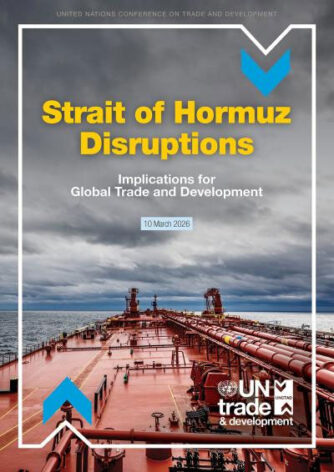
The Strait of Hormuz is one of the world’s most critical maritime chokepoints, carrying around a quarter of global seaborne oil trade and significant volumes of liquefied natural gas and fertilizers.

NEW YORK, Mar 31 2026 (IPS) – Trump’s Iran war has left the Gulf shattered: US bases turned into targets, economies battered, and the “oasis” myth destroyed. Gulf rulers now confront a harsh reckoning over their reliance on Washington and the uncertain search for a new, fragile security order.


As Trump assembled major US naval and air assets in the eastern Mediterranean and the Gulf, Saudi Arabia, the UAE, Qatar, and others quietly urged Washington to avoid a full-scale assault on Iran, fearing a direct blowback on their territory and energy infrastructure.

Nevertheless, the US–Israeli air campaign began on February 28, 2026, without a clearly defined and publicly articulated political endgame beyond “crippling” Iran’s capabilities. This disconnect between military escalation and strategic purpose now lies at the core of Gulf leaders’ anger and sense of betrayal toward Washington.

Trump’s Strategic Miscalculation

Trump’s decision to launch joint US–Israeli strikes on Iran has produced far higher strategic costs than his administration appears to have anticipated, from energy shock and disrupted shipping to heightened regional fragmentation and anti-American sentiment.

Even if Iranian capabilities are significantly degraded, the war has exposed vulnerabilities in US power projection, unsettled allies, and invited greater Russian and Chinese diplomatic activism in the Gulf. The long-term “price” for Washington will be measured less in battlefield metrics than in diminished trust and leverage among its traditional Arab partners.

US Bases Turned to Liabilities

From a Gulf perspective, US bases in Qatar, Bahrain, Kuwait, and the UAE were meant to deter Iran and guarantee regime security; instead, they became priority targets once the war began. Iran explicitly framed its strikes on these facilities as retaliation against Washington, but their location in densely populated and economically vital areas meant that nearby civilian infrastructure also suffered severe damage.

This experience is reinforcing a view in Gulf capitals that foreign basing arrangements draw fire without delivering the reliable protection they assumed for decades.

A Nightmare Realized

Gulf leaders long warned that a war with Iran would shatter their security and economies, a nightmare that has now materialized as Iranian missiles and drones hit oil facilities, ports, power plants, and cities across the region. They blame Washington for launching the campaign and Israel for pressing to “neutralize” Iran regardless of collateral damage in neighboring Arab states.

The sense in Gulf capitals is that their caution was dismissed, while they have paid a disproportionate price in physical destruction, economic setback, disrupted exports, and heightened domestic anxiety.

Shattered Oasis Narrative

The image of Gulf hubs like Dubai, Doha, and Riyadh as insulated “oases” open to business, tourism, and investment has been badly damaged by missile alerts, strikes on ports and airports, and the closure of key sea lanes.

Restoring confidence will require visible reconstruction, enhanced civil defense, improved air and missile defenses, and credible diplomacy that lowers the perceived risk of another sudden war. Investors and tourists will demand proof that the region can manage Iran-related tensions, not just high-end events and mega-projects.

Trump’s Misreading of Iranian Escalation

Trump publicly argued that overwhelming force would quickly coerce Iran and usher in regime change while keeping fighting “over there,” yet he appears not to have anticipated the breadth of Iranian retaliation against neighboring Gulf states or a prolonged closure of the Strait of Hormuz.

The IRGC’s effective shutdown of the strait, including attacks and threats against commercial shipping, has produced global energy shocks and exposed the fragility of US planning assumptions. For Gulf leaders, this underscores how inadequate Washington’s war planning was in accounting for second- and third-order consequences.

Calculated Decision Not to Retaliate

Despite heavy damage, Gulf rulers have so far avoided direct retaliation against Iran, calculating that further escalation would expose their cities and infrastructure to even more punishing strikes. Publicly, they stress restraint and international law, but privately, officials acknowledge their enduring geographic reality: they must coexist with a powerful and proximate Iran long after this US-led campaign ends.

By holding their fire, they hope to preserve space for postwar de-escalation and avoid being locked into a permanent state of open conflict.

Recasting Security Arrangements with Washington

Given their limited strategic alternatives, Gulf monarchies are unlikely to sever ties with Washington but will seek more conditional, transactional security arrangements. They are pressing for clearer US commitments on defense of their territory, better integration of regional missile defenses, and greater say over decisions that could trigger Iranian retaliation.

At the same time, they will hedge by deepening ties with China, Russia, Europe, and Asian energy importers, thereby reducing exclusive reliance on the US while keeping the American security umbrella in place.

Gulf Options to Prevent Future Conflagration

To prevent a repeat, Gulf states are also exploring limited de-escalation channels with Tehran, tighter regional crisis hotlines, and revived maritime security arrangements that include non-Western actors such as China and India. They may push for new rules of engagement around energy infrastructure and shipping lanes, seeking informal understandings that keep these off-limits even in crises.

Internally, they are reassessing missile defense, hardening critical facilities, and considering more diversified export routes that reduce dependence on Hormuz. None of these options are fully reassuring, but together they offer partial risk reduction.

Prospects for Normalization with Iran

Speculation about full normalization, including a non-belligerency pact between Iran and Gulf states, builds on prewar trends of cautious dialogue and economic engagement. Whether this is truly “in the cards” depends on war outcomes, Iran’s internal politics, and Gulf threat perceptions: if Tehran’s regime survives but remains hostile, Gulf states will likely revert to hedging—combining deterrence, limited engagement, and outreach to outside powers.

A more pragmatic Iranian leadership could make structured security arrangements and phased confidence-building measures more plausible over time.

No Return to Status Quo Ante

The Gulf States will not return to the prewar status quo; instead, they are likely to pursue a more diversified security architecture, combining a thinner US shield with expanded ties to China, Russia, and Asian importers. This shift will gradually dilute Washington’s centrality in Gulf security, complicating US force posture and Israel’s assumption of automatic Arab backing against Iran.

For Israel, a more cautious, risk-averse Gulf may limit overt strategic alignment, while for the US, enduring mistrust will make coalition-building for future crises far more difficult.

Trump’s Iran adventure is not an isolated blunder but the latest, and perhaps most explosive, expression of his assault on an already fragile global order. By discarding restraint, sidelining allies, and weaponizing American power for short-term political gain, he has accelerated the erosion of US credibility, fractured Western alliances, and opened new strategic space for Russia and China. The Gulf States are simply the newest casualties of this disorder: their cities struck, economies shaken, and security assumptions shattered.

Whatever emerges from this war, it will not be a restored status quo, but a more fragmented, volatile Middle East in which Israel and the United States confront a diminished margin for error and a far narrower circle of willing, trusting partners.

Dr. Alon Ben-Meir is a retired professor of international relations, most recently at the Center for Global Affairs at New York University (NYU). He taught courses on international negotiation and Middle Eastern studies.

alon@alonben-meir.com

IPS UN Bureau

  Source

Is WWIII here?

Armed Conflicts, Civil Society, Crime & Justice, Democracy, Europe, Global, Headlines, Human Rights, IPS UN: Inside the Glasshouse, TerraViva United Nations

Opinion

Is WWIII here?

The Russo-Ukrainian war, which began in February 2014, shows no signs of ending. Credit: UNOCHA/Dmytro Filipskyy

KYIV, Ukraine, Mar 19 2026 (IPS) – It is becoming increasingly difficult to ignore the tension, violence and uncertainty in the world in recent years. The number of wars is growing, more and more money is being spent on weapons, and the rhetoric of major powers is becoming increasingly decisive.


The latest escalation in the Middle East has reignited the debate about the start of World War III. The consequences of the Israeli and US strikes on Iran are being felt to varying degrees far beyond the region, at least by those who follow oil prices.

The interests of numerous great powers are at stake, and third parties are considering their next moves and making political statements. Opinions range widely, from the belief that there can be no Third World War because of the existence of nuclear weapons, to the conviction that it has already begun. So, what is really going on?

A journalistic and academic concept

When historians talk about world wars, they mean two unique events in the past. Their scale, the involvement of a wide range of states, the level of violence and the nature of the consequences put them in a league of their own.

To understand how these wars differed from any others, one need only glance at the diagram of human casualties, defence spending, or destruction in various armed conflicts of the 20th century.

However, historians also have different opinions. One of them, better known in his political capacity, Winston Churchill, once described the Seven Years’ War as a world war. This protracted 18th-century conflict drew most of the major powers of the time into direct combat; it spanned numerous battlefields in Europe, North America, the Atlantic and the Indian Ocean; and it had serious geopolitical consequences. How was this not a world war?

By the fact that it was not a total war between industrialised states, the scale of the clashes was rather limited, as were the number of armies; and the consequences, although serious, were not systemic — this may be the response of more conservative historians than the British Prime Minister.

The number of armed conflicts in the world has been growing over the past few years: 2024 has been a record year since World War II.

‘World War’ is both a journalistic and academic concept. To enhance the effect, attract attention or draw conditional analogies, it can be used to describe more events than just the First and Second World Wars. For example, the Thirty Years’ War of the 17th century, the Napoleonic Wars of the 19th century or even the Cold War are sometimes referred to as world wars.

Within this logic, individual elements of a world war can be seen even today. The number of armed conflicts in the world has been growing over the past few years: 2024 has been a record year since World War II. According to some estimates, 61 armed conflicts in 36 countries were recorded this year, which is significantly higher than the average for the previous three decades.

Global military spending is also on the rise: today it has reached 2.5 per cent of the global economy, the highest figure since 2011 and an upward trend since 2021. This is still significantly less than during the Cold War, when a range of 3 to 6 per cent was the norm. Analysing these figures, it is clear that global security has deteriorated in recent years, but how critically?

A more academic approach would be to define a world war as one in which most of the major powers are involved; which has global reach and is total in nature; leads to enormous loss and destruction; and significantly changes the world upon its conclusion. Direct and large-scale armed conflict between major powers is a mandatory criterion.

And this is the main argument against the idea that World War III has already begun. No matter how high the level of destabilisation in the modern world, no matter how far large-scale regional conflicts have escalated, and no matter how much money states spend on armaments, this is not enough for a world war. Large-scale military operations involving major powers are needed.

All just fears?

This has not happened in the world for a long time. The interval between the Second and Third World Wars turned out to be much longer than between the First and Second. Nuclear weapons played a central role in this, raising the price of war so high that major powers began to avoid it by any means possible. This safeguard has been in place for over 80 years and looks set to continue.

Peace, or rather the absence of war between major powers, remains one of the central elements of the current international order. International institutions and regimes may collapse or weaken, regional wars may break out, but the likelihood of war between major powers remains extremely low.

Proponents of the Third World War theory sometimes point out that even in the absence of full-scale war between major powers, other manifestations occur: hybrid wars, cyberattacks, or proxy wars. This is true, but all these outbreaks of conflict are several levels below a world war in terms of their destructive potential and are not total in nature.

Throughout history, states have fought through proxies or resorted to information, trade or religious wars, but we do not consider these wars to be world wars — except in a symbolic sense.

A systemic war does not necessarily have to be a world war

Unlike the 2003 war in Iraq, the strikes on Iran are taking place in a world where, instead of US hegemony, there is complex competition between at least two centres of power. This adds nuances and forces other states to respond, directly or indirectly, for example, by supplying weapons or intelligence data, supporting one side or the other.

But this does not make the war global. Arms supplies, for example, are a common practice found in most regional conflicts, as is diplomatic or financial support from allies or partners. Even if American troops use the technology or expertise of partners – such as Ukrainian drones – this does not mean that Ukraine is being drawn into the war. Just as American arms supplies to Ukraine during the Russian-Ukrainian war did not mean US involvement in the war.

For a world war, the key ingredient is still missing: direct confrontation between major powers. In addition to world wars, there are also systemic wars. In these conflicts, it is not so much the scale that is important as the change in the international order to which they lead.

The Thirty Years’ War, the Napoleonic Wars, and the First and Second World Wars mentioned above were systemic wars: after their completion, the rules of international politics were rewritten and new ones were adopted at peace conferences and congresses. A systemic war does not necessarily have to be a world war.

Moments of hegemonic crisis and the beginning of the struggle for hegemony always carry with them the danger of new wars, arms races and escalations.

The current destabilisation and growth of various risks are largely linked to the struggle for the future of the international order. The United States and China have almost fallen into the ‘Thucydides trap’ — a strategic logic similar to that which led to the Peloponnesian War in the 5th century BC. At that time, the narrowing of the power gap between the hegemon and the challenger forced the Spartans to start a preventive war.

Today, there are well-founded fears that the decline of American hegemony, the rise of China and the approach of a bipolar world will sharply increase the likelihood of direct armed conflict between the superpowers.

The decisive, to put it mildly, steps taken by the US administration can also be considered preventive actions aimed at strategically weakening China’s position while Washington still has the upper hand. Such moments of hegemonic crisis and the beginning of the struggle for hegemony always carry with them the danger of new wars, arms races and escalations.

We are in the midst of such a crisis. It is systemic in the sense that it is not just a collection of regional conflicts in different parts of the world, which have become more numerous, but a manifestation of a large-scale redistribution of influence and power on a global scale. This redistribution will entail changes in the international order, because the rules of the game are linked to the balance of power.

If, at some point, the leaders of major states decide that it is worth taking the risk of war and paying the price, the systemic crisis will turn into a world war. But this, as the Spartans themselves said, is ‘if’.

Nickolay Kapitonenko is an associate professor at the Institute of International Relations at Taras Shevchenko National University of Kyiv and director of the Centre for International Relations Studies.

Source: International Politics and Society, Brussels

IPS UN Bureau

  Source