The ongoing financial crisis in Sri Lanka has also triggered a sharp drop in the value of the country’s currency.
LONDON, Jul 6 2022 (IPS) – When Ceylon- now Sri Lanka- gained independence from Britain in 1948 after almost 450 years of colonial rule under three western powers, it was one Asia’s most stable and prosperous democracies.
Today, after years of misrule, rampant corruption by the ruling class and a politicised administration, the country is bankrupt, its economy on the verge of collapse, and society in disarray while a discredited president still clings to power and manipulating the political system, determined to serve the rest of his term.
While the original 18th century Beggar’s Opera was a satire on the injustice in London society of the day and Prime Minister Robert Walpole’s corrupt government, Sri Lanka has not turned to opera but to begging and possibly borrowing if any international lending institution is willing to lend to a country that has recently defaulted on debt repayment for the first time in its post-independence history.
That speaks volumes for the fiscal and monetary policies of President Gotabaya Rajapaksa’s government, and its unthinking and ill- considered actions in the last two and a half years, that has “collapsed” the country’s economy— as the prime minister told parliament the other day.
Under the 10-year rule of elder brother Mahinda Rajapaksa (2005-2015), the government borrowed heavily from China for massive infrastructure projects. That included a huge international airport at Mattala in nearby Rajapaksa territory in the deep south. Some of them continue to be white elephants.
A joke at the time and resonating now and then was that even herds of roaming wild elephants in the area spurn the airport because of the colour bar!
Since Gotabaya Rajapaksa came to power in November 2019 and a year later brother Mahinda led their Sri Lanka People’s Party (SLPP) to a parliamentary victory, the Rajapaksas, now at the helm of power, strengthened their already close relationship with Beijing at the expense of ties with the West and international lending institutions and alienating UN bodies such as the UN Human Rights Council.
But in the last few months it has been a begging-bowl ‘opera’ as Sri Lanka scoured the world for loans after its foreign reserves started dipping drastically and leading international rating agencies took to downgrading the country’s sovereign rating.
Eventually the Rajapaksa government reneged on its debt repayments, humiliating Sri Lanka which had never defaulted in its 74-year history.
Trapped by a plunging economy Sri Lanka turned to Bangladesh to save it from emerging bankruptcy. Nothing could be more ironic. In its early years Bangladesh was perceived as a recipient of financial support, not a lender.
At that time Sri Lanka’s economy seemed stable enough despite its near 30 years of war against Tamil Tiger separatists.
In early, June Bangladesh agreed in principle to another currency swap of US$ 200 million. This is in addition to last year’s currency swap of $200 million whose repayment date of three months was extended to one year at Sri Lanka’s request last August.
Today, the country’s 22 million people are almost without petrol, cooking gas, kerosene, food, medicines, powdered milk, and other essentials as the government has no foreign currency to import them.
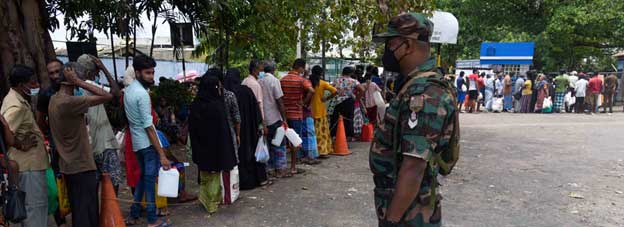
A common scenario in many parts of Sri Lanka are queues of people-men, women and even children- spending many hours and even days to buy the essentials that are scarce and a food shortage is predicted in the coming months.
As I sat down to write this, news reports said the 12th man died seated in his vehicle at a queue for fuel. A few days later the Sunday Times Political Editor upped the death toll to 16.
Meanwhile physical clashes are becoming common at filling station where thugs have muscled in. The other day a soldier was caught on video assaulting a policeman.
Such is the tension building up in society that the Sunday Times Political Editor reported of concerns among local intelligence services about national security.
While the long-drawn out covid pandemic did cripple the tourism industry, a major foreign currency earner, much of the blame rests on President Gotabaya Rajapaksa’s short-sighted policies as well as those of some of his ministers and close advisers whose arrogance and ignorance brushed aside warnings sounded a year or two ahead by reputed economists, former Central Bank professionals, academics and trade chambers.
Rajapaksa having denied any culpability for these errors of judgement ultimately conceded his responsibility but only when mass protests erupted in Colombo and elsewhere in the country with even the peasantry-a vital support base of the Rajapaksas- took to the streets castigating him and his government for creating shortages of essential fertilizers for agriculture.
After almost two months, thousands of anti-government protestors who set up camp on the seaside promenade opposite the presidential secretariat in the heart of Colombo, are still there raising their clarion call which has now spread across the country- “Gota Go Home”-demanding that the president return to whence he came.
While Sri Lanka struggles to survive and the Rajapaksas gradually reappear into public view, there has been a perceptible change in the government’s world view. Though Chinese leaders have often declared that Beijing is Colombo’s “all weather friend” it has been slow to come to Sri Lanka’s aid at a time of real crisis.
An appeal to China by the Rajapaksa government to restructure its loans as one of its biggest lenders had not produced the expected reaction from Beijing. Nor had there been a positive response at the time for another credit line of US$ 1.5 billion when Colombo’s foreign reserves were fast drying out.
Even President Xi Jinping’s birthday greeting to President Rajapaksa last month made no mention of any concrete assistance except references to the long-standing Sri Lanka-China relations.
Observers claimed that China was coaxing-if not actually pressuring- Sri Lanka to distance itself from India, its competitor for political positioning and an expanding stake in the strategically- located island.
While the immediate target was India, Beijing was also pointing its finger at Sri Lanka’s growing ties with the US and international institutions such as the IMF.
The fact that since January India has provided assistance to Sri Lanka with currency swaps, credit lines, loan deferments and humanitarian assistance to meet the mounting crisis and supported Colombo’s call for IMF aid, appeared unwelcome news to China which has been trying to persuade Sri Lanka to enter into a trade agreement with it.
In late June, a high-powered Indian delegation led by Foreign Secretary Vinay Kwatra made a quick few- hour visit to Colombo to meet President Rajapaksa and Prime Minister Ranil Wickremesinghe and discuss further strengthening of Indo-Lanka ties and bilateral investment partnerships including infrastructure and renewal energy.
New Delhi pointed out that this unprecedented recent economic, financial and humanitarian assistance including medicines and food valued at over US$ 3.5 b was guided by Prime Minister Narendra Modi’s “Neighbourhood First” policy.
Had it not been for the Indian central government and the Tamil Nadu state government responding fast with generous assistance Sri Lanka would have been struggling to find scarce food, fuel and medicines.
Meanwhile a nine-member team of senior IMF officials spent 10 days in Sri Lanka in late June to assess whether it could come up with a reform package to restore macroeconomic stability and debt sustainability.
Since Colombo approached the IMF for a bailout programme early this year the international lending institution has been monitoring the country’s economic and political situation, neither of which presented much confidence.
It is not only sustainable economic reforms that the IMF is after. It seeks substantial efforts to improve governance and a stable corruption-free government that the IMF and other lending institutions such as the World Bank and Asian Development Bank and donor nations could have confidence in.
The current government of bits and pieces could hardly provide evidence that it is fighting corruption when one of its stalwarts who was convicted the other day on extortion and sentenced to two years rigorous imprisonment but suspended for five years was reappointed to the cabinet by President Rajapaksa and made chief government whip in addition.
It is the need for clean government that causes concerns with President Rajapaksa reneging on promises he made to introduce constitutional amendments that will substantially prune the plethora of powers he grabbed on coming to power.
This is hardly likely as the world will see when the new 21st constitutional amendment is gazetted in a few days.
Neville de Silva is a veteran Sri Lankan journalist who held senior roles in Hong Kong at The Standard and worked in London for Gemini News Service. He has been a correspondent for the foreign media including the New York Times and Le Monde. More recently he was Sri Lanka’s Deputy High Commissioner in London
During one of the hearings in Buenos Aires, the court trying a 1924 indigenous massacre in the Chaco heard the testimony of historian Nicolás Iñigo Carrera, from the University of Buenos Aires, who has been studying indigenous history in Argentina for decades. The expert witness described in detail the conditions in the Napalpí indigenous “reducción” or camp where the massacre took place. CREDIT: Daniel Gutman/IPS
BUENOS AIRES, May 13 2022 (IPS) – It’s a strange trial, with no defendants. The purpose is not to hand down a conviction, but to bring visibility to an atrocious event that occurred almost a hundred years ago in northern Argentina and was concealed by the State for decades with singular success: the massacre by security forces of hundreds of indigenous people who were protesting labor mistreatment and discrimination.
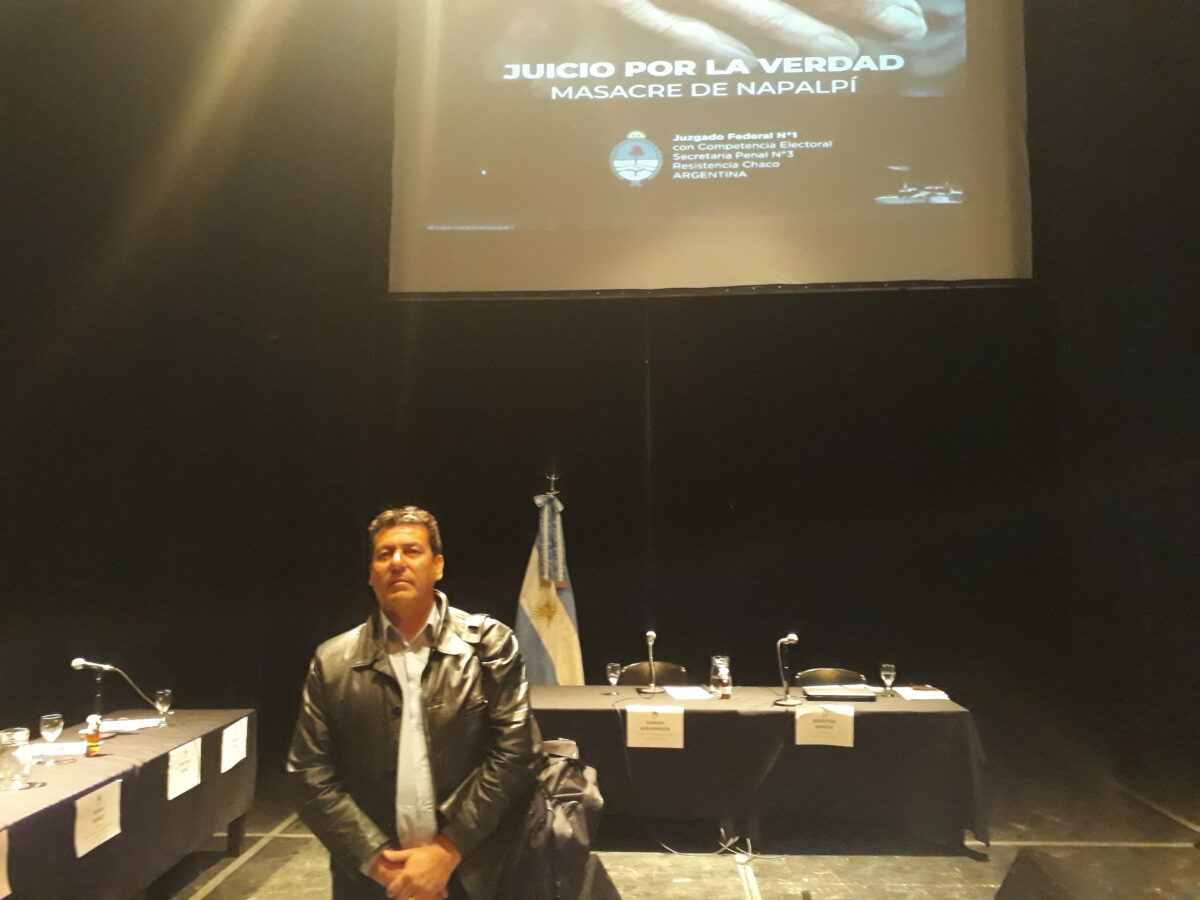
“We are seeking to heal the wounds and vindicate the memory of the (indigenous) peoples,” explained federal judge Zunilda Niremperger, as she opened the first hearing in Buenos Aires on May 10 in the trial for the truth of the so-called Napalpí Massacre, in which an undetermined number of indigenous people were shot to death on the morning of Jul. 19, 1924.
The trial began on Apr. 19 in the northern province of Chaco, one of the country’s poorest, near the border with Paraguay. But it was moved momentarily to the capital, home to approximately one third of the 45 million inhabitants of this South American country, to give it greater visibility.
In a highly symbolic decision, the venue chosen in Buenos Aires was the Space for Memory and Human Rights, created in the former Navy School of Mechanics (ESMA), where the most notorious clandestine torture and extermination center operated during the 1976-1983 military dictatorship, which kidnapped and murdered as many as 30,000 people for political reasons.
“What we hope is that the sentence will bring out the truth about an event that needs to be understood so that racism and xenophobia do not take hold in Argentina. People need to know about all the blood that has flowed because of contempt for indigenous people.” — Duilio Ramírez
The hearings in Buenos Aires ended Thursday May 12, and the court will reconvene in Resistencia, the capital of Chaco, on May 19, when the prosecutor’s office and the plaintiffs are to present their arguments before the sentence is handed down at an unspecified date.
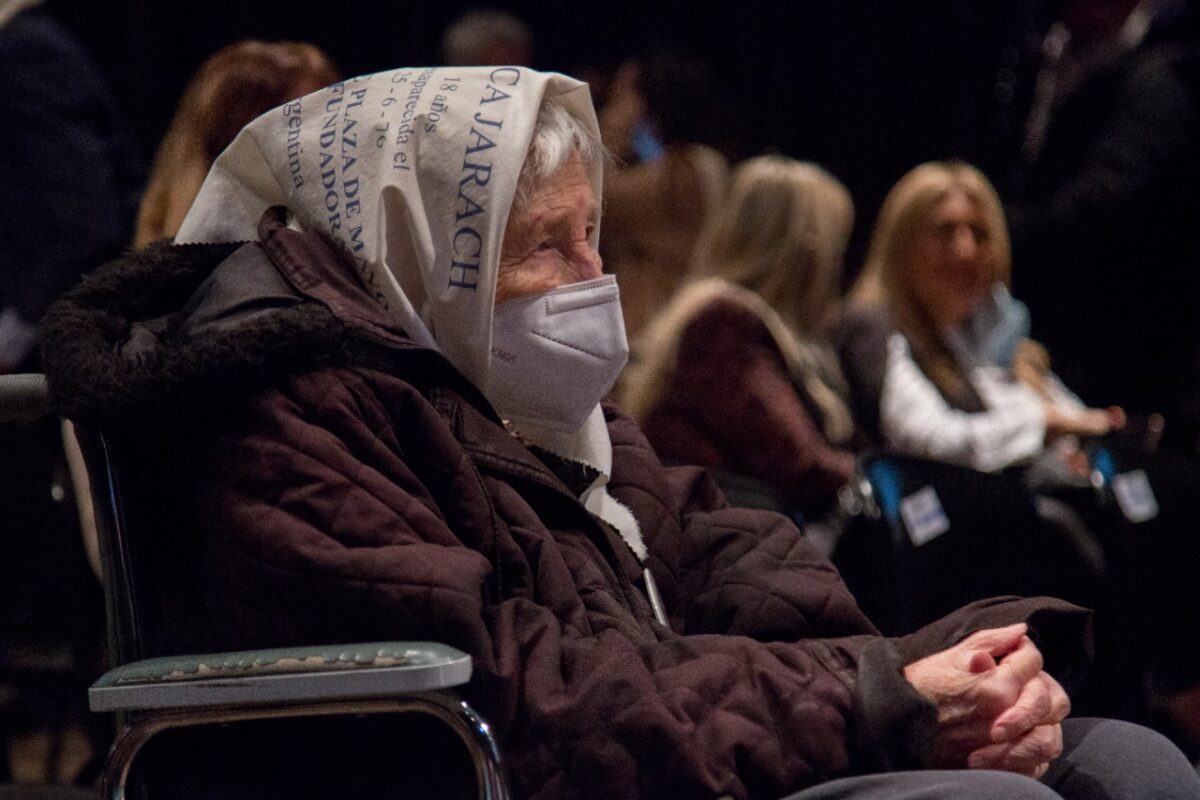
“This trial is aimed at bringing out the truth that we need, and that I come to support, in the place where they brought my daughter when they kidnapped her. This shows that genocides are repeated in history,” Vera Vigevani de Jarach, seated in the front row of the courtroom, her head covered by the white scarf that identifies the Mothers of Plaza de Mayo human rights group, told IPS.
Vera, 94, is Jewish and emigrated with her family to Argentina when she was 11 years old from Italy, due to the racial persecution unleashed by fascist leader Benito Mussolini in 1939. In 1976 her only daughter, Franca Jarach, then 18 years old, was forcibly disappeared.
“Truth trials” are not a novelty in Argentina. The term was used to refer to investigations of the crimes committed by the dictatorship, carried out after 1999, when amnesty laws passed after the conviction of the military regime’s top leaders blocked the prosecution of the rest of the perpetrators.
A petition filed by a member of the Mothers of Plaza de Mayo (made up of mothers of victims of forced disappearance) before the Inter-American Commission on Human Rights (IACHR) led later to an agreement with the Argentine State, which recognized the woman’s right to have the judiciary investigate the fate of her disappeared daughter, even though the amnesty laws made it impossible to punish those responsible.
Eventually, the amnesty laws were repealed, the trials resumed, and defendants were convicted and sent to prison.
Indigenous communities and human rights organizations held an Apr. 19, 2022 demonstration in Resistencia, capital of the Argentine province of Chaco, at the beginning of the trial for the truth about the Napalpí massacre. CREDIT: Chaco Secretariat of Human Rights and Gender
Historic reparations
“My grandmother was a survivor of the massacre and I grew up listening to the stories of labor exploitation in Napalpí and about what happened that day. For us this trial is a historic reparation,” Miguel Iya Gómez, a bilingual multicultural teacher who today presides over the Chaco Aboriginal Institute, a provincial agency whose mission is to improve the living conditions of native communities, told IPS.
The trial is built on the basis of official documents and journalistic coverage of the time and the videotaped testimonies of survivors of the massacre and their descendants, and of researchers of indigenous history in the Chaco.
The Argentine province of Chaco forms part of the ecoregion from which it takes its name: a vast, hot, dry, sparsely forested plain that was largely unsettled during the Spanish Conquest. Only at the end of the 19th century did the modern Argentine State launch military campaigns to subdue the indigenous people in the Chaco and impose its authority there.
Once the Chaco was conquered, many indigenous families were forced to settle in camps called “reducciones”, where they had to carry out agricultural work.
“The ‘reducciones’ operated in the Chaco between 1911 and 1956 and were concentration camps for indigenous people, who were disciplined through work,” said sociologist Marcelo Musante, a member of the Network of Researchers on Genocide and Indigenous Policies in Argentina, which brings together academics from different disciplines, at the hearing.
“When indigenous people entered the ‘reducción’, they were given clothes and farming tools, and this generated a debt that put them under great pressure. And they were not allowed to make purchases outside the stores of the ‘reducción’,” he explained.
David García, a member of the Napalpí Foundation, created in 2006 to gather information about and bring visibility to the 1924 massacre, took part in the trial in Buenos Aires. His organization was one of the driving forces behind the historic trial in Argentina. CREDIT: Daniel Gutman/IPS
Invaded by cotton
Historian Nicolás Iñigo Carrera said it was common for indigenous people in the Chaco to go to work temporarily in sugar mills in the neighboring provinces of Salta and Jujuy, but the scenario changed in the 1920s, when the Argentine government introduced cotton in the Chaco, to tap into the textile industry’s growing global demand.
“Then the criollo (white) settlers, who often had no laborers, demanded the guaranteed availability of indigenous labor to harvest the cotton crop, and in 1924 the government prohibited indigenous people, who refused to work on the cotton plantations, from leaving the Chaco, declaring any who left subversives,” Carrera said.
Anthropologist Lena Dávila Da Rosa said the Jul. 19, 1924 protest involved between 800 and 1000 indigenous people from Napalpí, and some 130 police officers who opened fired on them, with the support of an airplane that dropped candy so the children would go out to look for it and thus reveal the location of the protesters they were tracking down.
“It’s impossible to know exactly how many indigenous people were killed, but there were several hundred victims,” Alejandro Jasinski, a researcher with the Truth and Justice Program of the Ministry of Justice and Human Rights, told IPS.
“The official report mentioned four people killed in confrontations among themselves, and there was a judicial investigation that was quickly closed. All that was left were the buried memories of the communities,” he added.
The memories were revived and made public in recent years thanks in large part to the efforts of Juan Chico, an indigenous writer and researcher from the Chaco who died of COVID-19 in 2021.
“Juan started collecting oral accounts almost 20 years ago,” David García, a translator and interpreter of the language of the Qom, one of the main indigenous nations of the Chaco, told IPS. “I worked alongside him to bring the indigenous genocide to light, and in 2006 we founded an NGO that today is the Napalpí Foundation. It was a long struggle to reach this trial.”
Vera Vigevani de Jarach, a member of the human rights group Mothers of Plaza de Mayo, attended the hearing in Buenos Aires for the Napalpí indigenous massacre, held in the most notorious clandestine detention and torture center used by the 1976-1983 military dictatorship in Argentina. CREDIT: National Secretariat of Human Rights
Indigenous people in the Chaco today
Of the population of Chaco province, 3.9 percent, or 41,304 people, identified as indigenous in the last national census conducted in Argentina in 2010, which is higher than the national average of 2.4 percent.
Census data reflects the harsh living conditions of indigenous people in the Chaco and the disadvantages they face in relation to the rest of the population. More than 80 percent live in deficient housing while more than 25 percent live in critically overcrowded conditions, with more than three people per room. In addition, more than half of the households cook with firewood or charcoal.
Today, the site of the Napalpí massacre is called Colonia Aborigen Chaco and is a 20,000-hectare plot of land owned by the indigenous community where, according to official data, some 1,300 indigenous people live, from the Qom and Moqoit communities, the most numerous native groups in the Chaco along with the Wichi.
In 2019, mass graves were found there by the Argentine Forensic Anthropology Team, a prestigious organization that emerged in 1984 to identify remains of victims of the military dictatorship and that has worked all over the world.
“What we hope is that the sentence will bring out the truth about an event that needs to be understood so that racism and xenophobia do not take hold in Argentina,” Duilio Ramírez, a lawyer with the Chaco government’s Human Rights Secretariat, which is acting as plaintiff, told IPS. “People need to know about all the blood that has flowed because of contempt for indigenous people.”
“We hope that with the ruling, the Argentine State will take responsibility for what happened and that this will translate into public policies of reparations for the indigenous communities,” he said.
The protestors’ main rallying slogan is ‘GotaGoHome’
LONDON, May 4 2022 (IPS) – When I ended last month’s column hoping that April would not prove to be hapless Sri Lanka’s ‘cruellest month’ (in the words TS Eliot), I hardly anticipated the current turn of events.
In April, the country was to celebrate several ethno-religious festivals. The biggest among them was the Sinhala and Tamil New Year, celebrated by Sri Lanka’s majority community and its main minority. It was also the Muslim month of Ramadan and Easter, commemorated by the Christians.
For over one-and-a-half years Sri Lanka had been grappling with a fast-failing economy. The dwindling of foreign reserves and the consequent shortages of food, medicines, fuel, gas and kerosene for cooking were more recently compounded by power cuts, at times as long as 12hoursper day, bringing manufacturing industries to a standstill and forcing businesses to close down early.
With the country struggling to avert bankruptcy and an unprecedented rise in inflation and spiralling commodity prices, many working-class families, daily wage earners and farmers were facing penury and starvation.
Against this dire background Sri Lanka’s 22 million people were anxiously preparing for the April festivities, wondering whether there would be anything to celebrate.
Then it happened.
On March 31 the residents of Mirihana, a middle- class town on the outskirts of Colombo, held a candle-light protest to highlight the daily power cuts that disrupted their family activities. The protest, initially by women, attracted passers-by and huge crowds from neighbourhood towns and residential areas as President Gotabaya Rajapaksa lived in Mirihana in his private residence.
Swelling crowds shouting slogans later clashed with police firing tear gas and water cannons to break up the demonstration, but many of the protestors held their ground till the next day.
The Mirihana protest has sparked the island-wide conflagration that now has the once all-powerful Rajapaksa family-run government teetering on the wall like Humpty Dumpty awaiting a splintering fall. It will remain an important landmark in this uprising, which some have called, rather erroneously, Sri Lanka’s ‘Arab Spring’.
Mirihana began the assault against the Rajapaksa fiefdom that once seemed impregnable. Gotabaya Rajapaksa is president. Brother Mahinda, who served two terms as president, is currently prime minister. Another brother, Basil, a dual citizen with US citizenship and a home in Los Angeles, was until last month finance minister, and the eldest brother Chamal holds the post ofirrigation minister and state minister of security. Mahinda’s eldest son Namal, whom his father sees as heir apparent, was sports and youth affairs minister, among other portfolios.
It appears that the prime minister suspects he is going to be sacrificed on the altar of expediency
Together, the family reportedly controlled 72 per cent of government resources, free to use as they deemed fit, even to farm off to their acolytes and business friends in the way of government contracts and import monopolies, even during the Covid pandemic.
Today, however, that fortress of power and privilege appears as exposed as France’s Maginot Line, set to crumble against a German Blitzkrieg.
All the Rajapaksas, except Prime Minister Mahinda, lost their positions last month when President Gotabaya suddenly dissolved the cabinet in a desperate attempt to quell the mounting outrage against him. It seemed a weak moral sidestep, for the protesters’ cry was not only against the president but against the entire Rajapaksa family, which they claimed had dipped their hands into the country’s assets for personal gain.
Mirihana lit the fuse for the enormous protest that flared up at Colombo’s beach-front Galle Face Green, right opposite the Presidential Secretariat from where political power radiated. It was this that breached the Rajapaksa citadel.
Economists urged the government seek IMF assistance
At the time of writing, this protest – which shows signs of unifying the country’s multiracial, multi-religious society and has drawn crowds of all ages and a wide cross-section of the Sri Lankan community, including the professional classes – has entered its 17thcontinuous day, with hundreds of protesters camped there day and night despite the heat and rain.
Yet it is no Arab Spring. It is an orderly, non-violent protest, mainly of youth of all shades, with an inventive genius to keep themselves and their cause alive.
Never in Sri Lanka’s 74 years of post-independence history has the country seen anything like this, even though anti-government protests are nothing new to the country, which has seen Leftist political parties and associated trade unions functioning even under British colonial rule.
The main rallying slogan is ‘GotaGoHome’, telling Gotabaya to return to his home – also in Los Angeles –though he relinquished his US citizenship to be eligible to contest the presidential election in November 2019.
Built round that slogan are a myriad other satirical comments in song, verse, caricatures, cartoons and videos, the creative work of the protesters deriding the Rajapaksas, some demanding they return the country’s supposedly stolen assets and otherwise accumulated wealth in tax havens.
Although the protesters are now demanding that the whole Rajapaksa family pack their bags and quit, the main target quite rightly is President Gotabaya. It was his military arrogance – having played a role in the defeat of the separatist Liberation Tigers of Tamil Eelam(LTTE) in 2009, under the leadership of his president brother Mahinda – and his ignorance of politics and governance, and over-reliance on incompetent advisers that started the economic rot.
With a group of retired and serving military men appointed to key civilian positions and a coterie of so-called intellectuals and businessmen as advisers, he plunged head-first into economic policy decisions.
Within a few days of assuming office, he had slashed VAT from 15 per cent to 8per cent and abolished some other taxes that cost the state a whopping 28 per cent in revenue. It led the Central Bank to print money feverishly to meet budgetary commitments, causing inflation.
Also disastrous was the overnight decision to ban chemical fertilisers that drove farmers to burn effigies of ministers and demonstrate on the streets, demanding restitution of their fertiliser needs or face food insecurity in the months ahead, forcing a once adamant president to retract.
While economists had foreseen the impending danger in depleting foreign reserves and international debt repayments this year, and hence urged the government seek IMF assistance, the president clung steadfastly to the advice of the Central Bank Governor and the Treasury Secretary, among others, who dismissed the idea for more than one year even ignoring cabinet support for IMF help.
In a belated gesture, President Gotabaya sacked the two officials immediately after replacing his cabinet with younger, untested MPs. He sent his new finance minister to Washington to plead with the IMF for immediate relief.
The president is hoping for political concessions he has agreed to – including returning to parliament and the prime minister powers that he usurped on coming to office through the 20thconstitutional amendment. He has now agreed to form an interim All Party government.
But one sees a growing rift in the once close-knit family. Names proposed by Prime Minister Mahinda for the new cabinet were ignored by his brother, causing the prime minister to boycott the swearing-in of the new ministers.
If the president opts for an interim government, it means he has decided to stay put but call for the prime minister’s resignation. It would appear that the prime minister suspects he is going to be sacrificed on the altar of expediency.
In an interview the other day, Prime Minister Mahinda Rajapaksa insisted that he will not resign and any reconstituted government must be under his leadership. In the meantime, he has been trying to whip up support against his ouster by canvassing MPs to muster the required 113 votes.
How the protesting public will react to all these political manipulations will depend on what is on offer. Right now, they are determined to continue until President Gotabaya surrenders, which seems unlikely.
Source: Asian Affairs, London
Neville de Silva is a veteran Sri Lankan journalist who held senior roles in Hong Kong at The Standard and worked in London for Gemini News Service. He has been a correspondent for foreign media including the New York Times and Le Monde. More recently he was Sri Lanka’s Deputy High Commissioner in London.
There were widespread reports over the weekend of hundreds of demonstrators demanding the resignation of the family-run Rajapaksa government. Credit: Sunday Times, Sri Lanka
LONDON, Apr 4 2022 (IPS) – With the economy in freefall and basics such as food and fuel in dangerously short supply, there is mounting public anger against a failing and desperate government in Sri Lanka.
‘O tempora, O mores,’ said the Roman orator Cicero in a plaintive cry, denouncing the political and social norms of Rome in 70 BC.
Unlike the Romans, the people of Sri Lanka have not left it to politicians or orators to berate what they perceive as their rudderless rulers. They have taken on the task themselves, going into the streets to decry their government in words more telling and malignant than any Cicero might have employed.
They watch as their once ‘Resplendent Isle’ hurtles downhill while confused rulers try desperately to halt its economic and social collapse.
Never in the history of modern Sri Lanka have its citizens queued up for hours to purchase one or two cylinders of cooking gas or a few litres of petrol or kerosene, while a wide range of other shortages continue to plague the country.
If in Ukraine civilians are dying because of the indiscriminate and inconsiderate shelling and bombing by Russian forces, in Sri Lanka they are dying on their feet, some having waited for pre-dawn hours for gas or kerosene to cook what little food they could muster to feed hungry families.
As I write this in late March, reports are pouring in of four people from different parts of the country dying within 48 hours. That is not surprising at a time when the Covid pandemic still persists.
But these four died while waiting in gas or petrol queues, three of then possibly of exhaustion after standing for many hours, and the fourth of stab wounds during an altercation at a filling station.
Today, history is being made. But it is not in the manner the country’s rulers –the powerful Rajapaksa family from Sri Lanka’s south, whose political antecedents go back to the 1930s–ever expected.
Today, the wheel of political fortune has inexorably turned.
It was over a decade ago that two of the Rajapaksa brothers, Mahinda and Gotabaya, were hailed as national heroes for their roles in defeating the dreaded Tamil Tiger separatists in May 2009, after a war that lasted nearly three decades.
Mahinda was then Sri Lanka’s president and Gotabaya his defence secretary.
In April 2019, a couple of days after jihadist terrorists suicide-bombed three churches and three luxury hotels on Easter Sunday, killing some 270 locals and foreigners and wounding another 500, Gotabaya Rajapaksa announced his presidential ambitions.
Politically untested, the former military officer promised enhanced national security, peace, political stability, economic recovery and preservation of Sri Lanka’s 2500-year Buddhist heritage.
In November that year he won the presidential election with 6.9 million votes and in August 2020 Mahinda Rajapaksa led the Sri Lanka People’s Party (SLPP) to victory at the parliamentary election with a near two-thirds majority.
But today, the wheel of political fortune has inexorably turned. Last month in a Gallup-style opinion poll conducted by a local think tank, Veritḗ Research found that only 10 per cent of those queried said they approved of the current government.
Rudderless Rulers
Such is public antipathy that long queues of people spending hours to buy a packet or two of powdered milk booed the president as he passed by.
Some days later busloads of women, led by a former MP whose politician father was shot dead by a rival, who was convicted of murder, sentenced to death but then pardoned by President Gotabaya last year and given a state job, demonstrated outside the president’s private residence.
Teachers, health workers and other trade union-led employees have gone on strike at various times. Farmers have taken to the streets, protesting against the overnight ban last May of chemical fertiliser that saw some rice fields and other agricultural land abandoned and export-earning tea and rubber plantations affected.
Over the past months effigies of the Agriculture Minister have been burnt and posters of the Rajapaksas (four of the brothers are cabinet ministers and so is Mahinda’s eldest son) have been torn or otherwise defaced in blatant displays of public anger and lack of faith in a government that has failed to provide uninterrupted supplies of basics such as electricity, gas, petrol and kerosene, and essential foods and medicines.
It has been said that even the dead have no peace. Some crematoriums have stopped functioning unless they can be certain of continuous electricity.
Outages lasting several hours have often brought factories to a halt. Thermal power stations and other power providers cannot operate continuously for lack of fuel and coal.
Fast depleting foreign reserves have forced the government to slash imports of food, fuel, diesel and gas, compelling many restaurants, bakeries and wayside eateries, as well as other enterprises, to close or restrict their business.
Meanwhile, prices of food and domestic essentials and transport costs have skyrocketed, driving many families, particularly daily wage earners, into penury and starvation.
With foreign reserves at the end of February down to a perilous US$ 2.3 billion and some $7 billion in sovereign debt and loan repayments due this year – including a $1 billion repayment in July – the Rajapaksas turned from their traditional friend and ally China, which that has extended financial help over the years, to neighbouring nations.
A currency swap was arranged with Bangladesh, and last month Finance Minister Basil Rajapaksa flew to New Delhi for meetings with Prime Minister Narendra Modi, External Affairs Minister S. Jaishankar and Finance Minister Nirmala Sitharaman, urging help to rescue Colombo from its foreign exchange crisis.
Never in the history of modern Sri Lanka have its citizens queued for hours to buy fuel
New Delhi extended a $1 billion credit facility to enable the purchase of food, medicines and other essentials. This brought Indian assistance this year to $1.4 billion, which included a $400 million currency swap, besides another half a billion-dollar line of credit for essential fuel imports, and the deferring of a $500 million loan and.
Meanwhile China is considering another $2.5 billion in fresh assistance, China’s ambassador to Sri Lanka stated while turning down the deferment of a loan.
Even as Sri Lanka turns to Asia’s two leading powers, both vying for larger footprints in Sri Lanka, with its strategic location in the Indian Ocean, Colombo has finally turned to the IMF for belated assistance due to internal dissension in the ruling coalition.
President Rajapaksa recently sacked two ministers from minor coalition partners for criticising government policy and attacking Finance Minister Basil Rajapaksa, who has dual Sri Lankan-US citizenship, for bending backwards to satisfy American interests.
Some other state ministers have resigned or been removed as internal squabbles begin to take a toll on stability in the 11-party coalition.
With the economy in tatters and mounting public wrath against President Gotabaya Rajapaksa, with calls of ‘Gota Go Home’, he summoned an all-party conference late last month in the hope of showing a friendly face and seeking solutions to the country’s economic catastrophe.
While some minority Tamil parties which had long sought a meeting with the president and some other parties attended, two of the leading opposition parties, which recently launched anti-government demonstrations, boycotted the conference.
It started on a sour note, with many-time prime minister Ranil Wickremesinghe putting the Governor of the Central Bank Nivard Cabraal in his place for unwanted political remarks, for which President Rajapaksa apologised to Mr Wickremesinghe.
To the average Sri Lankan who has witnessed such conferences over the years, including ones to bring racial peace to a divided country, they are an exercise in political waffling and time-wasting.
With Sri Lanka’s biggest national celebration, the Sinhala and Tamil New Year, in mid-April, the working and middle-class families now struggling to survive wonder whether there will be anything to celebrate. Even if families can get together for the traditional meals, will they be able to cook them for lack of gas and kerosene?
Will this April be the cruellest month?
Source: Asian Affairs, London
Neville de Silva is a veteran Sri Lankan journalist who held senior roles in Hong Kong at The Standard and worked in London for Gemini News Service. He has been a correspondent for foreign media, including the New York Times and Le Monde. More recently, he was Sri Lanka’s deputy high commissioner in London
Sri Lankan Buddhist monks at the UN General Assembly session commemorating Vesak. Credit: Sri Lanka’s Permanent Mission to the United Nations
LONDON, Feb 3 2022 (IPS) – Driven by unprecedented hardship to pass round the begging bowl, Sri Lanka has become the centre of a tussle between Asia’s two superpowers.
There was a time in Asia’s predominantly Buddhist countries when saffron-robed monks walked from house to house in the mornings, standing outside in silence as lay people served up freshly cooked food into their ‘alms bowls’. The food was then taken to the temples, where it was shared among the monks.
That religious tradition has now largely given to other ways of serving alms to monks.
Today, governments and their aggrandising acolytes have converted this respected and virtuous tradition into one of begging richer nations to rescue them from economic deprivation, brought on largely by failed promises and disjointed and ill-conceived foreign and national policies.
This ‘begging bowl’ mentality in search of ‘alms’ is more likely to succeed if a nation is strategically-located in an area of big power contestation. Sri Lanka is just that, situated in the Indian Ocean and only a few nautical miles from the vital international sea lanes carrying goods from West to East and vice versa.
The country’s economy has been caught in a real bind. Buffeted by the Covid pandemic on the one hand and, on the other, ego-inflating economic and fiscal policies introduced by the new president Gotabaya Rajapaksa shortly before the country was pounded by the pandemic, Sri Lanka now has to beg or borrow to keep its head above water.
By December, Sri Lanka’s parlous foreign reserves situation had dropped to a perilous $1.2 billion – enough for three weeks of imports. The foreign debt obligation of $500 million that needed to be met last month was only the beginning. Another $1 billion is due in July. The total pay-off in 2022 will amount to some $7 billion.
Meanwhile the pandemic has virtually killed tourism, one of the country’s main foreign exchange earners, driving the hospitality industry into free-fall. If this was not bad enough, the Central Bank’s attempts to put a tight squeeze on incoming foreign currency led the country’s migrant labour remittances to drop drastically as overseas workers turned to the black market to earn real value for their money sent to families at home.
But nothing has had such widespread political repercussions as the government’s ill-advised policy of banning overnight chemical fertilisers last May, ahead of the country’s main agricultural season between October and April.
Its over-ambitious agenda of trying to turn Sri Lanka into the world’s first totally ‘green agriculture’ was laudable enough, but was botched when the sudden ban on chemical fertilisers and other agrochemicals – used by farmers for the last 50 years or so – left rice farming and other cultivations in disarray and farmers inevitably confused.
The government’s agenda of trying to turn Sri Lanka into the world’s first totally ‘green agriculture’ was botched.
While agricultural scientists and other experts warned of an impending food scarcity due to failed harvests and sparsely cultivated fields, the government ignored the warnings, sacking heads of the Agriculture Ministry and removing its qualified agricultural experts for spreading doom and gloom.
Against this backdrop of confused governance, probable food shortages due to poor harvests and slashing of imports and even essential medicines for lack of foreign currency, growing public unrest has seen even farmers take to the streets.
Consequently, a once-buoyant government confident of public popularity, especially among the Sinhala-Buddhist voters and the rural community, began to look beyond its faithful ally and ‘all weather’ friend China for ‘alms’ to pull it out of the morass.
China has already planted a large footprint in Sri Lanka, with massive infrastructure projects such as sea and airports in strategic areas, which allowed a monitoring of international sea lanes to make neighbouring India worry.
A major Chinese presence in Sri Lanka could endanger India’s security at a time when China continues to militarily pressurise India in the Himalayas.
From the early 1950s Sri Lanka, then called Ceylon, and China had established close ties. Despite threats of sanctions by the US, Colombo sold natural rubber to China – then involved in the Korean War –in exchange for rice, marking the beginning of the long standing ‘Rubber-Rice Pact’.
As long as China’s immediate concern was the Pacific theatre, where the US and its allies remained dominant, and China faced territorial disputes in the South China sea and elsewhere, India was not overly concerned with China-Sri Lanka bilateral ties.
But as soon as China began to expand into the Indian Ocean, challenging what India considered its sphere of influence, New Delhi’s concerns multiplied considerably, as did its disquiet over China’s growing influence over Colombo.
The 70th anniversary of that Sino-Ceylon agreement, which cemented bilateral relations at a time when the People’s Republic of China was not even a member of the UN, was commemorated last month when China’s Foreign Minister Wang Yi visited Colombo in early January during an influence-building visit to Africa, the Maldives and Sri Lanka.
This is the third high level visit by a Chinese official in little over a year, beginning with former foreign minister and Politburo member Yang Jiechi in October 2020, and followed last April by Chinese Defence Minister Gen. Wei Fenghe, a visible signal to India and US-led ‘Quad’ countries the importance that China attaches to its relations with Sri Lanka.
But Sri Lanka’s struggle against dwindling reserves, the need for foreign investment and expansion of trade relations at a time of economic hardship has shown the Rajapaksa regime that reliance on China alone will not suffice.
A more balanced foreign policy and an equidistant relationship between Asia’s two superpowers cannot remain at the level of diplomatic rhetoric. It is an imperative, given Sri Lanka’s geographical location in close proximity to India and the historical, cultural and ethnic ties with it huge neighbour.
Sri Lanka’s ambassador to Beijing, Dr Palitha Kohona, said recently that Colombo should not depend on China forever – a valid piece of advice Colombo should seriously consider.
India also cannot ignore that, security-wise, Sri Lanka lies in India’s underbelly, whose vulnerability was exposed during the Bangladesh Liberation War in 1971. So a major Chinese presence in Sri Lanka could endanger India’s own security at a time when China continues to militarily pressurise India in the Himalayas.
Last December Finance Minister Basil Rajapaksa’s hurried visit to New Delhi, even as his maiden budget was still being debated in parliament, was indicative of Sri Lanka’s anxiety to seek India’s economic and financial assistance, without depending solely on Beijing.
That visit led to the two countries agreeing on ‘four pillars’ of cooperation in the short term, including emergency support of a $1 billion line of credit for importing food and medicines and a currency swap to bolster Colombo’s dwindling foreign reserves.
Other assistance included investment in an oil tank farm for oil storage in northeastern Trincomalee, close to the vital natural harbour that served the British well during the Second World War.
An Indian company, the Adani Group, has already won a stake in the Colombo port, where it will engage in developing the western terminal while the Chinese build the eastern wing.
Meanwhile, Colombo is having talks with China for a new loan besides the $500 million loan and a $1.5 billion currency swap.
While the two major Indian Ocean powers tussle for supremacy in this vital maritime region, Sri Lanka is beginning to understand that it sometimes pays to dip one’s oars in troubled waters.
Source: Asian Affairs, a current affairs magazine.
Neville de Silva is a veteran Sri Lankan journalist who held senior roles in Hong Kong at The Standard and worked in London for Gemini News Service. He has been a correspondent for foreign media including the New York Times and Le Monde. More recently he was Sri Lanka’s deputy high commissioner in London
Muslims at a mosque in Sri Lanka. Credit: Financial Times, Sri Lanka
BRUSSELS, Jan 25 2022 (IPS) – On 28 October, President Gotabaya Rajapaksa appointed the militant Buddhist monk Galagoda Aththe Gnanasara to head a presidential task force on legal reforms, shocking many in Sri Lanka and beyond. Gnanasara is the public face of the country’s leading anti-Muslim campaign group, Bodu Bala Sena (Army of Buddhist Power, or BBS). He is widely accused of inciting inter-communal violence, including two deadly anti-Muslim pogroms in June 2014 and March 2018.
Convicted of contempt of court for a separate incident, Gnanasara was sentenced to six years in prison but received a presidential pardon from Rajapaksa’s predecessor, Maithripala Sirisena, in his final months in office. The act of clemency came after intensive lobbying by nationalist monks and an upsurge of anti-Muslim sentiment in the aftermath of the 2019 Easter bombings, a series of attacks on churches and tourist hotels carried out by a small group claiming allegiance to the Islamic State, or ISIS.
Observers across the Sri Lankan political spectrum, including some Buddhist nationalists, expressed dismay – at times, outrage – that the president could name someone whose disrespect for the law and hostility to non-Sinhala Buddhist minorities are a matter of public record to head a commission ostensibly designed to prevent “discrimination” and ensure “humanitarian values”. Critics have called the appointment “irrational” and even “incomprehensible”.
In fact, it is anything but. The Rajapaksa government is deeply unpopular, including among large sections of its core Sinhala Buddhist constituency, and desperate to divert public attention from its economic mismanagement.
There is thus a clear if deeply unfortunate logic for it to bring back to the fore the best-known proponent of a theme that was key to getting the president elected: fear of Muslims as a source of “religious extremism”.
While it was in one sense surprising to see the open affirmation of Rajapaksa’s active support for the controversial monk after many years of distancing himself from Gnanasara, tight links between Sri Lankan government officials and the Buddhist clergy are nothing new. The 1978 constitution gives Buddhism the “foremost place” in the country’s religious landscape and the state the duty to “protect” it.
There is nothing comforting in this history, however. The Sinhala Buddhist majoritarian nature of the Sri Lankan state – ie, the extent to which the state represents and enforces majority interests at the expense of the rights of other communities – has had disastrous effects on the country’s ethnic and religious minorities.
The state’s transition from being structurally discriminatory to openly hostile toward Tamils (who are Hindu or Christian) – a process fed by Sinhala politicians’ warnings about the threat the community allegedly posed – ultimately led to three decades of devastating civil war.
During that period, from 1983 to 2009, terrorist attacks by the Liberation Tigers of Tamil Eelam provided some objective grounds for Sinhalese fears, reinforcing the narrative that the majority community was under threat. Now, there is growing reason to fear that this pattern may be repeating itself in the Sri Lankan state’s interactions with its Muslim citizens.
Credit: Sunday Times, Sri Lanka
The Rise of Anti-Muslim Politics
In November 2019, Gotabaya Rajapaksa’s successful campaign for Sri Lanka’s presidency made much of the slogan “one country, one law”, which had gained popularity after the 2019 Easter bombings. Its ambiguity was useful: at one level, it could be interpreted as merely asking for uniform treatment of all citizens and resonated with voters angry at the impunity with which politicians and their powerful supporters are able to violate the law.
But its discriminatory implication was also obvious from the start, hinting at a need to “protect” the Buddhist nature of state and society by eliminating the separate rules and treatment that many Sinhalese believe Muslims use to gain economic and political advantages.
Many Sinhalese have for years held the view that Sri Lankan Muslims are more concerned with advancing their own interests than working for the larger national interest. Even during the civil war, when Muslims remained overwhelmingly loyal to the state and played a critical role in fighting the Tamil insurgency, one regularly heard complaints in Sinhalese (as well as Tamil) circles that they were exploiting the conflict for personal and collective economic benefit.
Because Muslim lawmakers held the balance of power in parliament between the two major Sinhala-dominated parties, they were commonly accused of using their “kingmaker” role to gain undue advantages for their co-religionists.
By the early 2000s, many Sinhalese had also begun to express discomfort at the increasing numbers of Muslims, especially women, wearing religious attire and the growing focus among Muslims on practices meant to demonstrate religious piety. Many interpreted this trend as Muslims deliberately distancing themselves from the majority.
With the arrival of BBS ultra-nationalists on the political scene in late 2012 – whose message was amplified by the smaller militant Sinhalese groups Sinhala Ravaya and Ravana Balakaya – the public portrayal of Sri Lankan Muslims rapidly took on more overtly hostile forms. (The decade earlier had seen organised Buddhist activism, at times violent, directed against the growing number of evangelical churches; pressure on Christian evangelicals continues today, though not on the scale of anti-Muslim campaigns.)
At the height of its influence, in 2013 and 2014, BBS dominated news coverage and helped set the political agenda through rallies, speeches and vigilante actions aimed at containing the threat Muslims’ alleged “extremism” posed to Sri Lanka’s Sinhala Buddhist character. The range of allegations promoted by BBS and like-minded organisations, often through online hate speech, was broad and shifting.
They claimed that population growth meant that Muslims would eventually overtake the Sinhalese majority; that Muslim-owned businesses were secretly distributing products to sterilise Sinhalese in order to keep their numbers down; and that the system of halal food labelling was encroaching on the religious rights of others and covertly funding Islamist militants.
More generally, conservative religious practices adopted by increasing numbers of Muslims in a quest for greater piety were read by ultra-nationalists as evidence of growing “extremism” that threatened other communities. These charges were based on either outright falsehoods or malicious misinterpretations of complex social and religious developments among Sri Lankan Muslims.
The anti-Muslim rhetoric helped set off inter-communal violence late in the presidency of Gotabaya’s brother Mahinda Rajapaksa (2005-2015). These years saw a series of attacks on Muslim-owned businesses (with many alleging that Sinhala business rivals were backing the attackers) and disruption of political meetings held by anyone daring to challenge the Buddhist militants, against the backdrop of mass rallies denouncing the alleged threat posed by Muslims’ “extremism”.
In a June 2014 speech in the town of Aluthgama, Gnanasara declared to a large crowd: “This country still has a Sinhala police. A Sinhala army. If a single Sinhalese is touched, that will be the end of them all [Muslims]”. Minutes later, hundreds of his supporters marched through a nearby Muslim neighbourhood, sparking two days of devastation that left three Muslims and one Tamil security guard dead. Sinhala rioters, many of them brought in from outside the area, targeted mosques and Muslim-owned shops and homes for arson and destruction. The police were widely accused of standing by or even assisting the rioters.
Despite government denials, many independent observers told Crisis Group at the time that the Mahinda Rajapaksa administration was actively supporting the BBS and other anti-Muslim campaigns. They suspected the government of executing an electoral strategy designed to consolidate the Sinhala vote behind the government, which projected itself as the defender of Sinhalese Buddhist identity. The appearance of Gotabaya Rajapaksa, then defence secretary, at a BBS event in March 2013, and his known connections with senior monks associated with the group, fuelled the speculation.
More tangible evidence of state backing lay in the fact that police gave BBS and like-minded groups permission to hold rallies at a time when government critics were not allowed to do so. Police took no apparent action, moreover, to prevent or investigate repeated vigilante raids on Muslim-owned shops or violent efforts to silence critics of militant Buddhist organisations.
Nor was anyone prosecuted for any of these crimes. Multiple sources told Crisis Group that Senior Deputy Inspector General of Police Anura Senanayake, who worked closely with Gotabaya at the time, led efforts to persuade victims not to press charges. Following Mahinda’s defeat in the January 2015 election, officials announced they had evidence of close ties between Buddhist militants and military intelligence units, confirming what Muslim community leaders had previously told Crisis Group.
With the 2015 election of President Maithripala Sirisena, representing a united opposition determined to end the Rajapaksas’ rule, the strategy of demonising Muslims for electoral ends seemed to have failed. Sirisena’s yahapaalanaya (good governance) coalition won in part through strong Muslim and Tamil backing based on its promises to end the BBS-led reign of terror.
But while the new administration stopped tacitly encouraging anti-Muslim violence and hate speech, it lacked the political courage – and possibly the necessary support within the police and intelligence agencies – to crack down on Buddhist militant groups.
After a brief lull in anti-Muslim activism, 2016 and 2017 saw a series of small attacks on Muslim businesses by unknown assailants, encouraged by sustained hate speech campaigns in traditional and social media, backed by effective local networks.
In February 2018, Buddhist militants in Ampara damaged a mosque and Muslim-owned shops as the police looked on, following social media rumours that a Muslim-owned restaurant had injected sterilising chemicals into Sinhala customers’ food. The following month, four days of anti-Muslim rioting shook the central hill district of Kandy, sparked by the death of a Sinhala man assaulted weeks earlier by four Muslim men.
Gnanasara visited the victim’s family and later joined other militant leaders to address a crowd of protesters just hours before the riots began. Videos later appeared to show local politicians from the Rajapaksa family’s party, the Sri Lanka Podujana Peramuna, taking part in the mayhem. Two people were killed, many injured, hundreds of Muslim-owned houses and shops destroyed, and at least a dozen mosques damaged. The violence was severe enough for President Sirisena to declare a state of emergency, during which the army eventually brought things under control.
President Sirisena, Prime Minister Ranil Wickremesinghe and senior ministers all condemned the violence and promised tough action in response. But despite hundreds of arrests, including of several prominent Buddhist activists, no one was held accountable for these incidents, which included well-documented attacks on Muslims by security forces, with eyewitnesses telling Crisis Group of numerous cases of complicity between the police and Buddhist rioters.
In August 2018, courts eventually convicted Gnanasara of contempt of court and criminal intimidation of a prominent Sinhala human rights activist. Many hailed his six-year sentence as a landmark, though Gnanasara has faced no jail time for attacks on or other actions against Muslims, and most of the slow-moving criminal cases against him in lower courts have now been dropped.
The partial victory over impunity was, however, short-lived. In 2019, in the aftermath of the horrific Easter Sunday suicide attacks, the Sri Lankan state for the first time adopted policies that directly discriminated against the Muslim minority. With tensions running high, President Sirisena’s government used the post-bombing state of emergency to prohibit the niqab, or full face covering, invoking national security concerns (the ban was rescinded in August 2019 when the emergency was lifted).
It also enacted new rules for government employees that, in effect, barred the full-length abaya, worn by many Muslim women teachers, especially in the Eastern Province (these were later withdrawn after being challenged by Sri Lanka’s Human Rights Commission). Anxious to salvage his sinking political fortunes as the November 2019 presidential election drew near, Sirisena then pardoned Gnanasara.
The nationalist monk immediately leapt into the political fray, joining his peers in protests demanding the resignation of Muslim ministers Rishad Bathiudeen and Azath Salley, accusing them – to date without convincing evidence – of involvement in the Easter attacks.
For many Sinhalese, especially Christians, as well as some Tamils, the Easter attacks seemed to confirm earlier warnings of a growing threat from “Islamic extremism”. Authorities responded to these fears in the attacks’ aftermath with what appeared to be the criminalisation of Muslims’ everyday practices.
Police arrested more than two thousand Muslims under emergency and terrorism laws, in all but a few cases with no evidence of links to the bombings or any threatening behaviour; they picked up many merely for having a Quran or other religious materials in Arabic script at home.
After the Easter bombings, the previously failed electoral strategy of shoring up Sinhala support through vilification of Muslims gained new traction. Gotabaya announced his candidacy just days after the attacks, promising to eradicate new forms of religiously motivated terrorism just as he had previously destroyed the Tamil Tigers when he was defence secretary.
At the polls, Gotabaya received overwhelming support from Sinhala voters, including many Catholics who had not previously backed him. The new president himself seemed to acknowledge the strategy’s success, declaring in his inaugural speech given in front of a Buddhist shrine: “I knew that I could win with only the votes of the Sinhala majority”.
Growing Tensions
Within months of taking office, Gotabaya deepened the state’s hostility toward Muslims on several fronts. His administration used COVID-19 lockdowns and ad hoc village-level quarantines to harass the community, which pro-government media outlets accused of spreading the virus. More damaging was the government’s decision on 1 April 2020 to ban burial of anyone even suspected of having died of the disease.
Announced the day after the first Muslim victim died, the decision was justified by a claim – quickly rejected by the World Health Organisation and Sri Lankan experts – that the virus could spread from interred remains through the groundwater. The policy, which stayed in place for nearly a year, had a profoundly cruel effect on Muslim families, who were forced to cremate their loved ones’ bodies against their religious convictions.
It was rescinded on 26 February, after a global advocacy campaign that sought to mobilise the Organisation of Islamic Cooperation and member states of the UN Human Rights Council, which was due to assess Sri Lanka’s human rights record weeks later. Even after the ban was lifted, however, Sri Lanka has allowed burials in only one remote location, heavily guarded by the military – a limitation that continues to impose hardships on Muslims, as well as the smaller number of Christians and Hindus who choose to bury their dead.
On 12 March, the government also announced new regulations for “deradicalisation” of those “holding violent extremist religious ideology”. Issued under the draconian Prevention of Terrorism Act, the rules allowed the defence ministry to detain anyone accused of causing “acts of violence or religious, racial or communal disharmony or feelings of ill will or hostility between different communities or racial or religious groups” for up to eighteen months, without any judicial process or oversight.
Human rights lawyers and Muslim leaders quickly filed suit in the Supreme Court, which in August put the measures on hold until it decides the case. Even if the court quashes the regulations, however, the government’s clear intention to establish a “deradicalisation” program leads some to believe it may enshrine similar powers in revisions to the counter-terrorism law it is presently preparing.
The regulations were issued without evidence that any significant number of Muslims in Sri Lanka posed a threat to security or would benefit from a program along the contemplated lines. They did, however, offer the government a face-saving way to release some of the hundreds of Muslims arrested after the Easter attacks who are still detained, in some cases without charge, by putting them into a “deradicalisation program”.
Holding large numbers of Muslims in special camps for another year or more, as the proposed deradicalisation program would do, however, would risk contributing to a collective sense of humiliation and anger that could itself push some toward “violent extremist religious ideology”. As Muslim activists regularly warn, the risk is particularly high as long as the government’s approach leaves no room for the possibility that Buddhists could promote their own forms of violent extremism.
Overlapping enquiries into the Easter bombings have, meanwhile, been politicised in ways that appear aimed at keeping alive fears of Muslims as a source of insecurity. As part of its broader attack on the independence of police and courts, Gotabaya’s government replaced the entire team looking into the bombings soon after coming to power, arrested the chief investigator, Shani Abeysekera, on what appear to be trumped-up charges, and demoted other officers. Another key investigator fled the country fearing arrest.
The administration has also refused to act on the key recommendations of a separate commission of enquiry – appointed by President Sirisena – into the bombings. These included, among others, prosecuting Sirisena, who is now a key government ally, and banning BBS, whose anti-Muslim incitement the commission found had contributed to the bombers’ turn to violence in a process of “reciprocal radicalisation”.
In what seems to be an attempt at maligning Muslim leaders, the Gotabaya administration also detained or charged a number of prominent Muslim personalities, seemingly without credible grounds. Ex-minister Bathiudeen faces terrorism and extremism charges – despite having been cleared of links to the Easter bombings by the presidential commission of enquiry.
On 2 December, a court released another Muslim lawmaker, Salley, after he had spent eight months in jail, citing lack of evidence. The prosecution of human rights lawyer and political activist Hejaaz Hizbullah for his supposed links to the Easter terrorist attacks also appears to be groundless, relying in part on coerced testimonies.
The government’s approach has angered Sri Lanka’s Catholic leadership, which has accused it, and the president himself, of covering up the “masterminds” behind the Easter bombings. Church leaders suggest that the government has been protecting Sirisena and refusing to follow up on evidence uncovered by the presidential commission that implies military intelligence officers had contact with some of the bombers before and on the day of the attack.
Backed by Pope Francis, Colombo’s archbishop Cardinal Malcolm Ranjith has called for an international investigation. Following an October online meeting that aired church criticisms, the police summoned one of the cardinal’s top advisers for three days of questioning.
A Dangerous Slogan
Stung by growing criticism of its handling of the Easter bombings investigation, and facing a grave economic crisis that has badly damaged its popular support, including among Sinhala Buddhists, the Rajapaksa government signalled with Gnanasara’s appointment that it is returning to the “one country, one law” agenda that helped get it elected.
Given the concept’s vagueness, however, and the deep contradiction between it and the explicit privileges that Buddhism enjoys under the constitution, no one is sure what Gnanasara’s task force will actually do. While it can, in principle, look into the practices of all religious and ethnic groups, few observers doubt that it will focus its attention on the Muslim minority.
It is expected to consider reforms to the madrasa education system – Muslim leaders have submitted proposals to the government – as well as government plans to regulate activities in mosques, monitor the import and translation of the Quran and other Arabic texts, ban the niqab and burqa, and outlaw cattle slaughter (an industry dominated by Muslims and often criticised by Buddhist activists).
Gnanasara’s task force also seems certain to weigh in on long-discussed changes to the Muslim Marriage and Divorce Act, a new version of which the cabinet approved in August. Over the past years, Muslims and others have bitterly debated possible reforms to the Act, with complicated overlap between human rights and feminist critiques of the legislation as patriarchal and oppressive and Buddhist nationalist criticisms of Muslims having their own marriage and family law.
Sri Lankan law enshrines distinct traditions of family law for Sinhalese in Kandy and Tamils in Jaffna, as well as for Muslims, but this Act has come in for particular criticism on account of allowing polygamy, setting no minimum age for marriage, requiring no explicit consent from the bride and establishing all-male courts to hear divorce cases.
It remains to be seen, however, how far the government will allow or encourage Gnanasara to go. On the one hand, Buddhist nationalists appear to see “one country, one law” as a call for “a single law” that gives pre-eminence to Buddhist institutions while denying those of other religions official recognition.
Some top officials clearly see things the same way: it was particularly revealing that Gnanasara’s appointment was followed three weeks later by a series of large-scale Buddhist religious ceremonies in the sacred city of Anuradhapura, featuring the president, cabinet and top military brass alongside the Mahanayakes, Sri Lanka’s most powerful Buddhist clerics.
The two days of ceremonies were grand displays of the government’s project of more fully integrating state, military and Buddhist clergy on the basis of an overtly Sinhala nationalist political vision. On the other hand, in a December meeting, Foreign Minister G.L. Peiris assured ambassadors from Muslim countries that Sri Lanka would “continue to retain” “personal laws specific to Muslim, Kandyan and Tamil communities”.
Moreover, to date, Colombo has carefully calibrated its anti-Muslim policies so as to keep the backing of its hardline Buddhist nationalist supporters and win a degree of international support for helping “counter violent extremism”, while maintaining good relations with economic and political allies in the Muslim world.
The government may as yet have no precise agenda for the task force, but given Gnanasara’s charisma and theatrical skills, he is a potentially powerful, and dangerous, asset for reframing political debate, deepening divisions between Tamils and Muslims and possibly even provoking a new round of anti-Muslim unrest. He has been central in propagating Buddhist nationalist ideology over the last decade.
There is little that those outside of Sri Lanka, concerned about the rule of law, religious harmony and political stability, can do directly to address these dynamics. Foreign partners of the Sri Lankan state, can, however, be more careful about not inadvertently strengthening them.
Following the Easter bombings, a range of new programming by foreign donors has focused on counter-terrorism, preventing “violent extremism” and building “social cohesion”. In the words of one activist, though, “There is a lot of foreign funding to the government for ‘countering violent extremism’ but it only targets one faith. … No one dares tell the government to ‘rehabilitate’ Gnanasara or other extremist monks”.
Until such programming finds – or creates – the space to name and challenge the violent history, rhetoric and exclusionary political projects of all communities, it is more likely to perpetuate, rather than resist, the anti-Muslim ideology that today poses the greatest risk of destabilising violence in a country that has yet to recover from decades of brutal civil war.