COP28: Climate Summit in Closed Civic Space

Civil Society, Climate Action, Climate Change, Crime & Justice, Energy, Environment, Featured, Global, Headlines, Human Rights, Press Freedom, TerraViva United Nations

Opinion

Credit: Bryan Bedder/Getty Images for Bloomberg Philanthropies

LONDON, Nov 17 2023 (IPS) – The need to act on the climate crisis has never been clearer. In 2023, heat records have been shattered around the world. Seemingly every day brings news of extreme weather, imperilling lives. In July, UN Secretary-General António Guterres grimly announced that ‘the era of global boiling has arrived’.


In short, there’s a lot at stake as the world heads into its next climate summit.

But there’s a big problem: COP28, the latest in the annual series of conferences of parties (COP) to the UN Framework Convention on Climate Change, will be held in the United Arab Emirates (UAE). This is a country with closed civic space, where dissent is criminalised and activists are routinely detained. It’s also a fossil fuel power bent on continuing extraction.

At multilateral summits where climate change decisions are made, it’s vital that civil society is able to mobilise to demand greater ambition, hold states and fossil fuel companies and financiers to account and ensure the views of people most affected by climate change are heard. But that can’t happen in conditions of closed civic space.

Concerning signs

In September, the UAE was added to the CIVICUS Monitor Watchlist, which highlights countries experiencing significant declines in respect for civic freedoms. Civic space in the UAE has long been closed: no dissent against the government or advocacy for human rights is allowed, and those who try to speak out risk criminalisation. In 2022, a Cybercrime Law introduced even stronger restrictions on online expression.

There’s widespread torture in jails and detention centres and at least 58 prisoners of conscience have been held in prison despite having completed their sentences. Many of them were part of a group known as the UAE 94, jailed for the crime of calling for democracy. Among the ranks of those incarcerated is Ahmed Mansoor, sentenced to 10 years in jail in 2018 for his work documenting the human rights situation, and held in solitary confinement for over five years and counting.

Ahead of COP28, civil society has worked to highlight the absurdity of holding such a vital summit in closed civic space conditions. Domestic civil society is unable to influence COP28 and its preparatory process, and it’s hard to see how civil society, both domestic and international, will be able to express itself freely during the summit.

Civil society is demanding that the UAE government demonstrate that it’s prepared to respect human rights, including by releasing political prisoners – something it’s so far failed to budge on.

An ominous sign came when the UAE hosted a climate and health summit in April. Participants were reportedly instructed not to criticise the government, corporations, individuals or Islam, and not to protest while in the UAE.

Civic space restrictions aren’t the only indication the UAE isn’t taking COP28 seriously. The president of the summit, Sultan Ahmed Al Jaber, also happens to be head of the state’s fossil fuel corporation ADNOC, the world’s 11th-biggest oil and gas producer. It’s like putting an arms manufacturer in charge of peace talks. Multiple other ADNOC staff members have roles in the summit. ADNOC is currently talking up its investments in renewable energies, all while planning one of the biggest expansions of oil and gas extraction of any fossil fuel corporation.

Instead of real action, all the signs are that the regime is instrumentalising its hosting of COP28 to try to launder its reputation, as indicated by its hiring of expensive international lobbying firms. An array of fake social media accounts were created to praise the UAE as host and defend it from criticism. A leaked list of key COP28 talking points prepared by the host made no mention of fossil fuels.

A summit that should be about tackling the climate crisis – and quickly – is instead being used to greenwash the image of the host government – something easiest achieved if civil society is kept at arm’s length.

Fossil fuel lobby to the fore

With civil society excluded, the voices of those actively standing in the way of climate action will continue to dominate negotiations. That’s what happened at COP27, also held in the closed civic space of Egypt, where 636 fossil fuel lobbyists took part – and left happy. Like every summit before it, its final statement made no commitment to reduce oil and gas use.

The only way to change this is to open the doors to civil society. Civil society has consistently sounded the alarm and raised public awareness of the need for climate action. It’s the source of practical solutions to cut emissions and adapt to climate impacts. It urges more ambitious commitments and more funding, including for the loss and damage caused by climate change. It defends communities against environmentally destructive impacts, resists extraction and promotes sustainability. It pressures states and the private sector to stop approving and financing further extraction and to transition more urgently to more renewable energies and more sustainable practices. These are the voices that must be heard if the cycle of runaway climate change is to be stopped.

COPs should be held in countries that offer an enabling civic space that allows strong domestic mobilisation, and summit hosts should be expected to abide by high standards when it comes to domestic and international access and participation. That should be part of the deal hosts make in return for the global prestige that comes with hosting high-level events. Civil society’s exclusion mustn’t be allowed to happen again.

Andrew Firmin is CIVICUS Editor-in-Chief, co-director and writer for CIVICUS Lens and co-author of the State of Civil Society Report.

  Source

Innovative Family Farm in Cuba Uses Mix of Clean Energies

Active Citizens, Civil Society, Climate Action, Development & Aid, Editors’ Choice, Energy, Environment, Food and Agriculture, Headlines, Innovation, Integration and Development Brazilian-style, Latin America & the Caribbean, Projects, Regional Categories, Water & Sanitation

Energy

Artist and farmer Chavely Casimiro and her daughter Leah Amanda Díaz feed one of the biodigesters at Finca del Medio, a farm in central Cuba. The biodigester produces about seven meters of biogas per day, enough energy for cooking, baking and dehydrating food. CREDIT: Jorge Luis Baños / IPS

Artist and farmer Chavely Casimiro and her daughter Leah Amanda Díaz feed one of the biodigesters at Finca del Medio, a farm in central Cuba. The biodigester produces about seven meters of biogas per day, enough energy for cooking, baking and dehydrating food. CREDIT: Jorge Luis Baños / IPS

TAGUASCO, Cuba, Oct 2 2023 (IPS) – Combining technologies and innovations to take advantage of solar, wind, hydro and biomass potential has made the Finca del Medio farm an example in Cuba in the use of clean energies, which are the basis of its agroecological and environmental sanitation practices.


Renewable energy sources are used in many everyday processes such as electricity generation, lighting, water supply, irrigation and water heating, as well as in cooking, dehydrating, drying, baking and refrigeration of foodstuffs.

“We started out with windmills on artesian wells and hydraulic rams to pump water. That gave us an awareness of the amount of energy we needed and of how to expand its use,” said farmer José Antonio Casimiro, 65, owner of this agroecological family farm located in the center of this long Caribbean island nation.

“More incentives, better policies and financial support are needed so that farming families have sufficient energy for their work and can improve the comfort of their homes and quality of life.” — José Antonio Casimiro

The farmer expressed his appreciation of the help of his son, 41, also named Antonio Casimiro, in the installation of the two mills at Finca del Medio, during the days in which IPS visited the farm and shared in activities with the family.

“There was no one to assemble or repair them. We both had to study a great deal, and we learned to do a lot of construction things as we went along and perfected the techniques,” said Casimiro junior, referring to the equipment that is now inactive, but is capable of extracting some 4,000 liters of water daily from the water table.

When rainfall is abundant and the volume of the 55,000-cubic-meter-capacity reservoir rises, the hydraulic ram comes to life. The device diverts about 20,000 liters of water to a 45,000-liter tank, 400 meters away and 18 meters above the level of the reservoir.

“The only energy the rams use is the water pressure itself. Placing it on the highest part of the land makes it easier to use the slope for gravity irrigation, or to fill the animals’ water troughs,” explained Chavely Casimiro, 28, the youngest daughter of José Antonio and Mileidy Rodríguez, also 65.

An artist who also inherited the family’s “farming gene”, Chavely highlighted some twenty innovations made by her father to the hydraulic ram, in order to optimize water collection.

Other inventions speed up the assembly and disassembly of the windmills for maintenance, or in the event of tropical cyclones.

“We have been replacing the water supply with solar panels, which are more efficient. They can be removed faster (than the windmill blades) if a hurricane is coming. You can incorporate batteries and store the energy,” said Casimiro.

“Let’s say a windmill costs about 2,000 dollars. With that amount you can buy four 350-watt panels. That would be more than a kilowatt hour (kWh) of power. You buy a couple of batteries for 250 dollars each, and with that amount of kWh you can pump the equivalent of the water of about 10 windmills,” he said.

But the farmer said the windmills are more important than the energy they generate. “It would be nice if every farm had at least one windmill. For me it is very symbolic to see them pumping up water,” he said.

Lorenzo Díaz, the husband of Chavely Casimiro, uses a solar oven to cook food. In the background can be seen a windmill and a solar heater, other technologies that take advantage of the potential for renewable energies on the Finca del Medio farm in central Cuba. CREDIT: Jorge Luis Baños / IPS

Lorenzo Díaz, the husband of Chavely Casimiro, uses a solar oven to cook food. In the background can be seen a windmill and a solar heater, other technologies that take advantage of the potential for renewable energies on the Finca del Medio farm in central Cuba. CREDIT: Jorge Luis Baños / IPS

Innovations

Located in the municipality of Taguasco, in the central province of Sancti Spíritus, some 350 kilometers east of Havana, Finca del Medio follows a family farm model including permaculture, agroecology and agricultural production based on the use of clean energy.

In 1993, Casimiro and Rodríguez with their children Leidy and José Antonio – a year later, Chavely was born – decided to settle on the 13-hectare farm of their paternal grandparents, with the aim of reversing its deterioration and soil erosion and installing perimeter fences.

The erosion of the land was due to the fact that in the past the farm was dedicated to the cultivation of tobacco, which depleted the soil, and later it had fallen into abandonment, as well as the house.

The older daughter is the only one who does not live and work on the farm, although she does spend time there, and a total of ten family members live there, including four grandchildren. All the adults either work on the farm or help out with different tasks.

With the help of technological innovations adapted to the local ecosystem, and empirical and scientific knowledge, the family has become self-sufficient in rice, beans, tubers, vegetables, milk, eggs, honey, meat, fish and more than 30 varieties of fruit. The only basic foodstuffs not produced on the farm are sugar and salt.

They sell all surplus production, including cow’s milk, for which they have specific contracts, and they are also promoting agrotourism, for which they are making further improvements to the facilities.

At Finca del Medio, a system of channels and ditches allows the infiltration of rainwater, reduces erosion of the topsoil and conserves as much water as possible for subsequent irrigation.

These innovations also benefit neighboring communities by mitigating flooding and replenishing the water table, which has brought water back to formerly dry wells.

The construction of the house is also an offshoot of technological solutions to the scarcity of resources such as steel, which led to the design of dome-shaped roofs made of mud bricks and cement.

The design aids in rainwater harvesting, improves hurricane protection, and boosts ventilation, creating cooler spaces, which reduces the need for air conditioning equipment and bolsters savings.

Along with food production, the new generations and members of the Casimiro-Rodriguez family engage in educational activities to raise awareness about good agricultural and environmental practices.

Students from nearby schools come to the farm to learn about these practices, as well as specialists in agroecology and people from different parts of the world, interested in sharing the experience. Meanwhile, several members of the family have traveled abroad to give workshops on agroecology and permaculture.

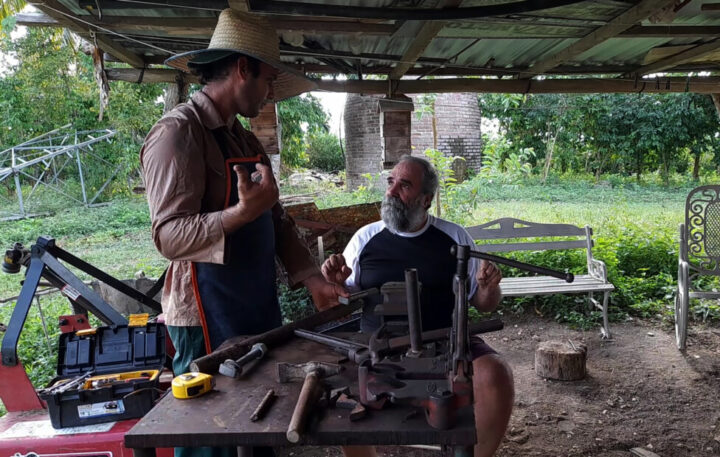
Farmers José Antonio Casimiro and his son of the same name talk in the mechanical workshop at their Finca del Medio farm. Both have come up with innovations for the use of windmills, the hydraulic ram and biodigesters, as well as agricultural tools. CREDIT: Jorge Luis Baños / IPS

Farmers José Antonio Casimiro (R) and his son of the same name talk in the mechanical workshop at their Finca del Medio farm. Both have come up with innovations for the use of windmills, the hydraulic ram and biodigesters, as well as agricultural tools. CREDIT: Jorge Luis Baños / IPS

Solar and biogas potential

On one of the side roofs of the house are 28 photovoltaic panels that provide about eight kWh, connected to batteries. The stored energy covers the household’s needs during power outages that affect the island due to fuel shortages and breakdowns and problems in maintenance of its aging thermoelectric plants.

In addition, the household has three solar water heaters with a capacity of 380 liters.

Next to the kitchen, two fixed-dome biodigesters produce another renewable fuel, biogas, composed mainly of methane and carbon dioxide from the anaerobic decomposition of animal manure, crop waste and “even sewage from the house, which we channel so that the waste does not contaminate the environment,” said Casimiro.

Due to the current shortage of manure as the number of cows has been reduced, only one of the biodigesters is now operational, producing about seven meters of biogas per day, sufficient for cooking, baking and dehydration of foodstuffs.

The innovative family devised a mechanism to extract – without emptying the pond of water or stopping biogas production – from the bottom the solids used as biofertilizers, as well as hundreds of liters of effluent for fertigation (a combination of organic fertilizers and water) of the crops, by gravity.

The installation of the biodigesters, the solar panels and one of the solar heaters was supported by the Swiss Agency for Development and Cooperation (Cosude) and the Indio Hatuey Experimental Station of Pastures and Forages through its Biomass-Cuba project, Casimiro said.

He also expressed gratitude for the link with other scientific institutions such as the Integrated Center for Appropriate Technologies, based in the central province of Camagüey, which is focused on offering solutions to the needs of water supply and environmental sanitation, and played an essential role in the installation of the hydraulic ram.

The farmer said the farm produces the equivalent of about 20 kWh from the combination of renewable energies, and if only conventional electricity were used, the cost would be around 83 dollars a month.

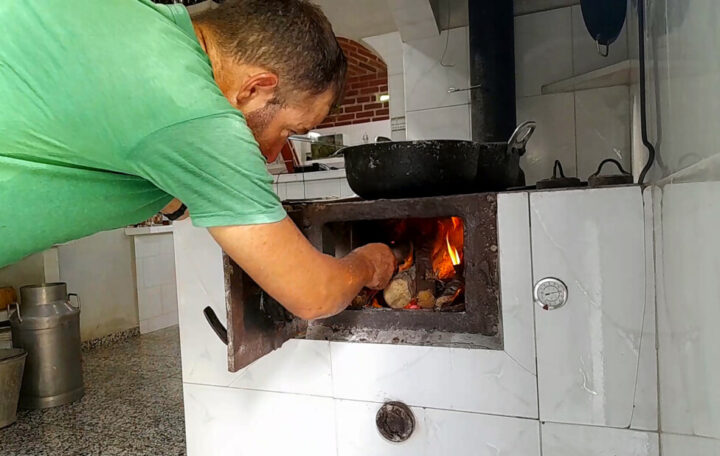
Lorenzo Díaz feeds firewood into an innovative stove that allows the Finca del Medio farm to efficiently cook food, dehydrate or dry fruits and spices, heat water and preserve meat, among other functions. CREDIT: Jorge Luis Baños / IPS

Lorenzo Díaz feeds firewood into an innovative stove that allows the Finca del Medio farm to efficiently cook food, dehydrate or dry fruits and spices, heat water and preserve meat, among other functions. CREDIT: Jorge Luis Baños / IPS

Efficient stove

In the large, functional kitchen, the stove covered with white tiles and a chimney has been remodeled 16 times to make it more efficient and turn it into another source of pride at the farm.

Fueled by firewood, coconut shells and other waste, “the stove makes it possible to cook food, dehydrate fruits and spices, heat water and preserve meat, among other tasks,” Rodríguez told IPS as she listed some of the advantages of this other offshoot of the family’s ingenuity that helps her as a skilled cook and pastry chef.

She pointed out that by extracting all the smoke, “the design makes better use of the heat, which will be used in a sauna” being built next to the kitchen, for the enjoyment of the family and potential tourists.

Casimiro is in favor of incorporating clean energy into agricultural processes, but he said that “more incentives, better policies and financial support are needed so that farming families have sufficient energy for their work and can improve the comfort of their homes and quality of life.”

Since 2014, Cuba has had a policy for the development of renewable energy sources and their efficient use.

A substantial modification of the national energy mix, which is highly dependent on the import of fossil fuels and hit by cyclical energy deficits, is a matter of national security

However, regulations with certain customs exemptions and other incentives to increase the production of solar, wind, biomass and hydroelectric energies in this Caribbean island nation still seem insufficient in view of the high prices of these technologies, the domestic economic crisis and the meager purchasing power of most Cuban families.

Clean sources account for only five percent of the island’s electricity generation, a scenario that the government wants to radically transform, with an ambitious goal of a 37 percent proportion by 2030, which is increasingly difficult to achieve.

  Source

Civil Society Organizations Unite to Urge Public Development Banks to Change the Way Development Is Done

Biodiversity, Civil Society, Climate Change, Development & Aid, Economy & Trade, Energy, Environment, Green Economy, Headlines, Human Rights, Latin America & the Caribbean, TerraViva United Nations

Opinion

CARTAGENA, Colombia, Sep 4 2023 (IPS) – In the midst of a complex web of crises, spanning climate change, biodiversity depletion, constraints on civic space and mounting debt burdens, civil society organizations and human rights defenders from over 50 countries have united their voices to call for immediate and impactful action from Public Development Banks (PDBs).


The global coalition’s message is clear: when it comes to financing for development, principles of rights, justice, sustainability, transparency, accountability and dignity for all cannot remain mere slogans. They must form the core of all projects undertaken by all Public Development Banks.

The Finance in Common Summit has become a pivotal platform for Public Development Banks from around the world. The fact that this year’s summit is taking place in Cartagena, Colombia, the deadliest country in the world in 2022 for human rights, envrionmental and indigenous activists, development banks must acknowledge and integrate the protection of human rights into their projects.

“Development banks are advocating to play an even bigger role in the global economy. But are they truly fit for this purpose? Unfortunately, the stories of communities around the world show us that development banks are failing to address the root causes of the very problems they claim to solve. We need to hold them accountable for this,” says Ivahanna Larrosa, Regional Coordinator for Latin America at the Coalition for Human Rights in Development.

“When PDB projects cause harm to people and the environment, PDBs must remedy these harms. All PDBs should implement an effective accountability mechanism to address concerns with projects and should commit to preventing and fully remediating any harm to communities,” adds Stephanie Amoako, Senior Policy Associate at Accountability Counsel.

The ongoing crises demand a transformation in the quality of financing and a power shift to include the voices of communities. The existing financial architecture not only impedes governments’ ability to safeguard both their citizens and the environment but also contributes to the escalating issue of chronic indebtedness. Policy-based lending and conditionalities enforced by International Financial Institutions have steered countries toward privatization of essential services, reduced social spending and preferential treatment for the private sector. This burdens the population with higher taxes, inflation, and weakened social safety nets.

“The same multinational companies that have polluted and violated human rights in Latin America are now obtaining financing from development banks for energy transition projects. Another example is the development of the green hydrogen industry in Chile, which carries a very high environmental and social risk,” says Maia Seeger, director of the Chilean civil society organization Sustentarse.

Addressing these issues requires a comprehensive and sustainable transformation of the financial architecture as well as holistic reforms and synergies with civil society and communities. Environmental and neo-colonial debts need to be a thing of the past and equitable reforms the thing of the present.

Global civil society, in response to these challenges, demands bold and decisive actions in a collective declaration signed by over 100 organisations. The demands are the result of a 4-year process in which a coalition of civil society organisations has come together to call on all PDBs at the Finance in Common Summit to embrace tangible actions that genuinely prioritize and protect people.

Just last month we have seen that change is possible when communities are involved, as the people of Ecuador voted to ban oil drilling in one of the most biodiverse places on the planet, the Yasuní National Park in the Amazon rainforest.

“The global financial system needs not just a rethink but a surgical operation, and that requires bold action. Governments and institutions such as the Public Development Banks must cancel the debt of the countries that require it and put in place concrete and immediate measures to put an end to public financing of fossil fuels, to have financing based on subsidies so as not to fall into the debt trap once again. It is time for the rich countries, the biggest polluters and creditors, to offer real solutions to the multiple crises we are currently experiencing,” says Gaïa Febvre, International Policy Coordinator at Réseau Action climat France.

“Public and Multilateral Development Banks must divest from funding false climate solutions and projects that harm forests, biodiversity and communities. Instead, they should redirect finance to support gender just, rights based and ecosystems approaches that contribute to transformative changes leading to real solutions that address climate change, loss of biodiversity and create sustainable livelihoods for Indigenous Peoples, women in all their diversities and local communities. Public funds must support community governed agroecological practices, small scale farming and traditional animal rearing practices instead of large scale agri-business which perpetuates highly polluting and emitting industrial agriculture and unsustainable livestock production, the root cause for deforestation and food insecurity,” adds Souparna Lahiri, Senior Climate and Biodiversity Policy Advisor at the Global Forest Coalition (GFC).

The call to action emphasizes that achieving the Sustainable Development Goals (SDGs), effective climate action aligned with the Paris Agreement and successful implementation of the Kunming-Montreal Global Biodiversity Framework require Public Development Banks to pivot from a top-down profit-driven approach to one that prioritizes community-led involvement and human rights-based approaches.

“It is important that civil society participation be strengthened at the Finance in Common Summit (FICS). In previous years, civil society has been sidelined. Clearly, there is still some room for improvement for civil society participation to become truly meaningful. The lack of civil society representative on the opening panel this year is just one example of that. PDBs should promote and support an enabling environment for civil society and systematically incorporate civic space, human rights and gender analysis. This year, we are working towards ensuring that civil society voices, including those from communities are heard at the FICS. In collaboration with the FICS Secretariat, Forus seeks to establish a formal mechanism between civil society and PDBs and to ensure that civil society is recognised as an official engagement group,” says Marianne Buenaventura Goldman, Project Coordinator, Finance for Development at the global civil society network Forus.

IPS UN Bureau

  Source

Biodigesters Light Up Clean Energy Stoves in Rural El Salvador

Marisol and Misael Menjívar pose next to the biodigester installed in March in the backyard of their home in El Corozal, a rural settlement located near Suchitoto in central El Salvador. With a biotoilet and stove, the couple produces biogas for cooking from feces, which saves them money. The biotoilet can be seen in the background. CREDIT: Edgardo Ayala / IPS

Marisol and Misael Menjívar pose next to the biodigester installed in March in the backyard of their home in El Corozal, a rural settlement located near Suchitoto in central El Salvador. With a biotoilet and stove, the couple produces biogas for cooking from feces, which saves them money. The biotoilet can be seen in the background. CREDIT: Edgardo Ayala / IPS

By Edgardo Ayala
SUCHITOTO, El Salvador , Jul 25 2023 (IPS)

A new technology that has arrived in rural villages in El Salvador makes it possible for small farming families to generate biogas with their feces and use it for cooking – something that at first sounded to them like science fiction and also a bit smelly.


In the countryside, composting latrines, which separate urine from feces to produce organic fertilizer, are very popular. But can they really produce gas for cooking?

“It seemed incredible to me,” Marisol Menjívar told IPS as she explained how her biodigester, which is part of a system that includes a toilet and a stove, was installed in the backyard of her house in the village of El Corozal, near Suchitoto, a municipality in the central Salvadoran department of Cuscatlán.”When the first ones were installed here, I was excited to see that they had stoves hooked up, and I asked if I could have one too.” — Marisol Menjívar

“When the first ones were installed here, I was excited to see that they had stoves hooked up, and I asked if I could have one too,” added Marisol, 48. Hers was installed in March.

El Corozal, population 200, is one of eight rural settlements that make up the Laura López Rural Water and Sanitation Association (Arall), a community organization responsible for providing water to 465 local families.

The families in the small villages, who are dedicated to the cultivation of corn and beans, had to flee the region during the country’s 1980-1992 civil war, due to the fighting.

After the armed conflict, they returned to rebuild their lives and work collectively to provide basic services, especially drinking water, as have many other community organizations, in the absence of government coverage.

In this Central American country of 6.7 million inhabitants, 78.4 percent of rural households have access to piped water, while 10.8 percent are supplied by wells and 10.7 percent by other means.

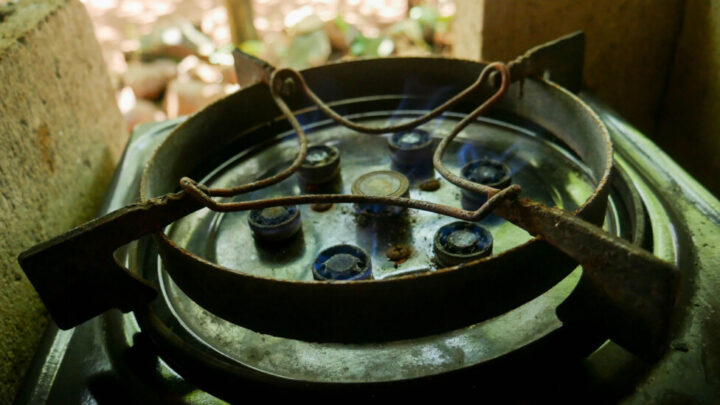
With small stoves like this one, a score of families in El Corozal in central El Salvador cook their food with biogas they produce themselves, thanks to a government program that has brought clean energy technology to these remote rural villages. CREDIT: Edgardo Ayala / IPS

With small stoves like this one, a score of families in El Corozal in central El Salvador cook their food with biogas they produce themselves, thanks to a government program that has brought clean energy technology to these remote rural villages. CREDIT: Edgardo Ayala / IPS

Simple green technology

The biodigester program in rural areas is being promoted by the Salvadoran Water Authority (Asa).

Since November 2022, the government agency has installed around 500 of these systems free of charge in several villages around the country.

The aim is to enable small farmers to produce sustainable energy, biogas at no cost, which boosts their income and living standards, while at the same time improving the environment.

The program provides each family with a kit that includes a biodigester, a biotoilet, and a small one-burner stove.

In El Corozal, five of these kits were installed by Asa in November 2022, to see if people would accept them or not. To date, 21 have been delivered, and there is a waiting list for more.

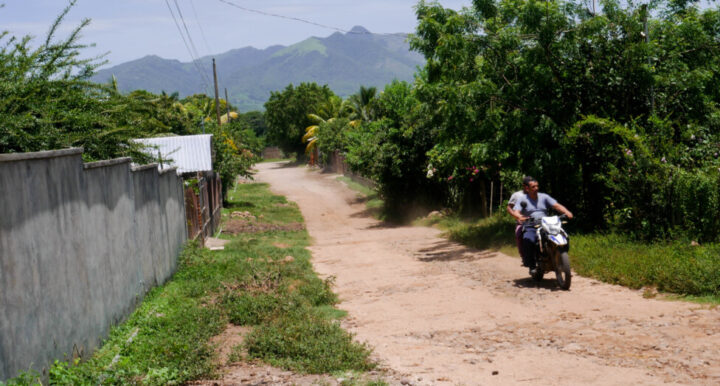
In El Corozal, a rural settlement in the municipality of Suchitoto in central El Salvador, the technology of family biodigesters arrived at the end of last year, and some families are now producing biogas to light up their stoves and cook their food at no cost. CREDIT: Edgardo Ayala / IPS

In El Corozal, a rural settlement in the municipality of Suchitoto in central El Salvador, the technology of family biodigesters arrived at the end of last year, and some families are now producing biogas to light up their stoves and cook their food at no cost. CREDIT: Edgardo Ayala / IPS

“With the first ones were set up, the idea was for people to see how they worked, because there was a lot of ignorance and even fear,” Arall’s president, Enrique Menjívar, told IPS.

In El Corozal there are many families with the surname Menjívar, because of the tradition of close relatives putting down roots in the same place.

“Here we’re almost all related,” Enrique added.

The biodigester is a hermetically sealed polyethylene bag, 2.10 meters long, 1.15 meters wide and 1.30 meters high, inside which bacteria decompose feces or other organic materials.

This process generates biogas, clean energy that is used to fuel the stoves.

The toilets are mounted on a one-meter-high cement slab in latrines in the backyard. They are made of porcelain and have a handle on one side that opens and closes the stool inlet hole.

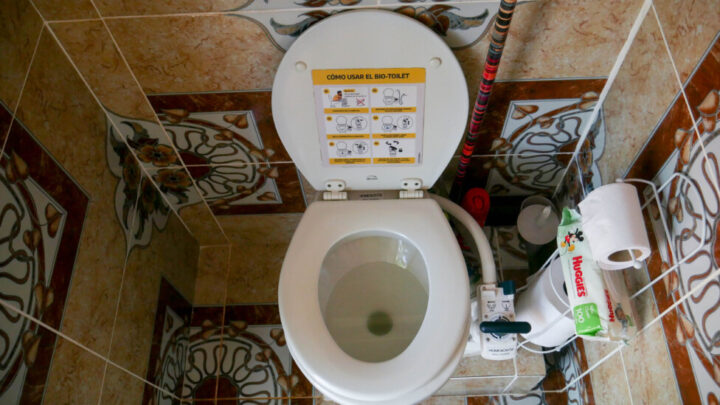
 One of the main advantages that family biodigesters have brought to the inhabitants of El Corozal, a small village in the Salvadoran department of Cuscatlán, is that the whole process begins with clean, hygienic toilets, like this one set up in Marleni Menjívar's backyard, as opposed to the older dry composting latrines, which drew flies and cockroaches. To the left of the toilet is the small handle used to pump water to flush the feces into the biodigester. CREDIT: Edgardo Ayala / IPS

One of the main advantages that family biodigesters have brought to the inhabitants of El Corozal, a small village in the Salvadoran department of Cuscatlán, is that the whole process begins with clean, hygienic toilets, like this one set up in Marleni Menjívar’s backyard, as opposed to the older dry composting latrines, which drew flies and cockroaches. To the left of the toilet is the small handle used to pump water to flush the feces into the biodigester. CREDIT: Edgardo Ayala / IPS

They also have a small hand pump, similar to the ones used to inflate bicycle tires, and when the handle is pushed, water is pumped from a bucket to flush the waste down the pipe.

The underground pipe carries the biomass by gravity to the biodigester, located about five meters away.

The system can also be fed with organic waste, by means of a tube with a hole at one end, which must be opened and closed.

Once it has been produced, the biogas is piped through a metal tube to the small stove mounted inside the house.

“I don’t even use matches, I just turn the knob and it lights up,” said Marisol, a homemaker and caregiver. Her husband Manuel Menjívar is a subsistence farmer, and they have a young daughter.

In El Corozal, biodigesters have been installed for families of four or five members, and the equipment generates 300 liters of biogas during the night, enough to use for two hours a day, according to the technical specifications of Coenergy, the company that imports and markets the devices.

But there are also kits that are used by two related families who live next to each other and share the equipment, which includes, in addition to the toilet, a larger biodigester and a two-burner stove.

With more sophisticated equipment, electricity could be generated from biogas produced from landfill waste or farm manure, although this is not yet being done in El Salvador.

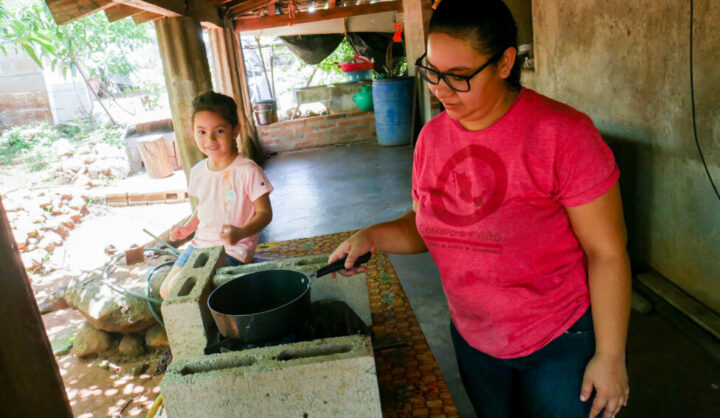
 Marleni Menjivar gets ready to heat water on her ecological stove, watched closely by her four-year-old daughter, in El Corozal in central El Salvador, where an innovative government program to produce biogas has arrived. With this technology, people save money by buying less liquefied gas while benefiting the environment. CREDIT: Edgardo Ayala / IPS

Marleni Menjivar gets ready to heat water on her ecological stove, watched closely by her four-year-old daughter, in El Corozal in central El Salvador, where an innovative government program to produce biogas has arrived. With this technology, people save money by buying less liquefied gas while benefiting the environment. CREDIT: Edgardo Ayala / IPS

Saving money while caring for the environment

The families of El Corozal who have the new latrines and stoves are happy with the results.

What they value the most is saving money by cooking with gas produced by themselves, at no cost.

They used to cook on wood-burning stoves, in the case of food that took longer to make, or on liquefied gas stoves, at a cost of 13 dollars per gas cylinder.

Marleni Menjívar, for example, used two cylinders a month, mainly because of the high level of consumption demanded by the family business of making artisanal cheeses, including a very popular local kind of cottage cheese.

Every day she has to cook 23 liters of whey, the liquid left after milk has been curdled. This consumes the biogas produced overnight.

For meals during the day Marleni still uses the liquefied gas stove, but now she only buys one cylinder a month instead of two, a savings of about 13 dollars per month.

“These savings are important for families here in the countryside,” said Marleni, 28, the mother of a four-year-old girl. The rest of her family is made up of her brother and grandfather.

“We also save water,” she added.

The biotoilet requires only 1.2 liters of water per flush, less than conventional toilets.

In addition, the soils are protected from contamination by septic tank latrines, which are widely used in rural areas, but are leaky and unhygienic.

The new technology avoids these problems.

The liquids resulting from the decomposition process flow through an underground pipe into a pit that functions as a filter, with several layers of gravel and sand. This prevents pollution of the soil and aquifers.

Also, as a by-product of the decomposition process, organic liquid fertilizer is produced for use on crops.

Most families in the rural community of El Corozal have benefited from one-burner stoves that run on biogas produced in family biodigesters. Larger two-burner stoves are also shared by two related families, where they cook on a griddle one of the favorite dishes of Salvadorans: pupusas, corn flour tortillas filled with beans, cheese and pork, among other ingredients. CREDIT: Coenergy El Salvador

Most families in the rural community of El Corozal have benefited from one-burner stoves that run on biogas produced in family biodigesters. Larger two-burner stoves are also shared by two related families, where they cook on a griddle one of the favorite dishes of Salvadorans: pupusas, corn flour tortillas filled with beans, cheese and pork, among other ingredients. CREDIT: Coenergy El Salvador

Checking on site: zero stench

Due to a lack of information, people were initially concerned that if the biogas used in the stoves came from the decomposition of the family’s feces, it would probably stink.

And, worst of all, perhaps the food would also smell.

But little by little these doubts and fears faded away as families saw how the first devices worked.

“That was the first thing they asked, if the gas smelled bad, or if what we were cooking smelled bad,” said Marleni, remembering how the neighbors came to her house to check for themselves when she got the latrine and stove installed in December 2022.

“That was because of the little information that was available, but then we found that this was not the case, our doubts were cleared up and we saw there were no odors,” she added.

She said that, like almost everyone in the village, her family used to have a dry composting toilet, but it stank and generated cockroaches and flies.

“All that has been eliminated, the bathrooms are completely hygienic and clean, and we even had them tiled to make them look nicer,” Marleni said.

She remarked that hygiene is important to her, as her little girl can now go to the bathroom by herself, without worrying about cockroaches and flies.

Source

Forus Civil Society Network Urges that Respect for Human Rights, Climate Justice and Accountability should be at the core of the New Global Financing Pact

Indigenous activist protesting in Colombia. Credit: Sebastian Barros

By Marianne Buenaventura
PARIS, Jun 23 2023 (IPS)

As the Summit for a New Global Financing Pact unfolds in Paris on 22-23 June, Forus, a global network representing over 22,000 civil society organisations across Africa, Latin America, Asia, Europe and the Pacific, calls for the respect of human rights and for meaningful inclusion of civil society in shaping financial systems and structures.


The summit, co-hosted by India, could help find common ground on finance that drives progress at key events later in 2023 and in 2024 – the G20 summit in New Delhi, the COP28 climate talks in Dubai, and the Finance in Common summit with public development banks in Cartagena.

As part of the summit, Sarah Strack, Forus Director, is amplifying civil society’s voices at the high-level Finance in Common event in the presence of French President Emmanuel Macron and other leaders, to discuss and leverage the role of Public Development Banks in financing the SDGs, scaling up sustainable finance, and supporting inclusion. Forus has been engaging in the Finance in Common initiative since its inception in 2020 with the aim to ensure that a people-based approach to development is pursued.

“If we want to have a chance to tackle the most pressing challenges and the multiple crises of our time in a way that really puts first the interests and needs of people, then a shift of mindset and a new financial framework are absolutely necessary. It is essential that civil society plays a central role in shaping this new paradigm at every stage. Let us not forget the wealth of knowledge and leadership present at the local level. By actively engaging and collaborating with communities, we can genuinely measure our progress and honor the commitments we have made to those most in need,” says Sarah Strack.

Harsh Jaitli, CEO of the Voluntary Action Network India (VANI), is representing Forus as an official respondent in the Summit Roundtable “Power Our Planet: Act today. Save tomorrow”, co-hosted by Global Citizen and CISCO. The event seeks to rally for immediate action on economic, social, and climate justice, engaging both public and private sectors to catalyze renewable energy investment in climate-vulnerable countries to reduce energy poverty and accelerate the low-carbon transition.

Harsh Jaitli of VANI states that the New Global Financial Pact will require improved partnerships and the building of trust.

“Double standards have negatively impacted our collective capacity to deliver on effective development and climate related programmes. In some countries, multinational corporations respect human rights, fiscal and climate regulations, but in other countries decisions are made to violate them. Not only does this send the wrong message that some countries and populations are more important than others, but also jeopardizes our collective efforts to affect change. Multinational corporations should commit to respecting human rights, fiscal and climate regulations in all countries and in a consistent manner. When no strong regulations exist, this is the opportunity for multinationals to be proactive and to apply strong rules, which are coherent with their policies,”says Harsh Jaitli.

Julien Comlan Agbessi, Coordinator of the Regional Coalition of West Africa (REPAOC) emphasizes the importance of multi-stakeholder cooperation. Agbessi explains that cooperation between the private sector and the civil society organisations is possible, since the private sector could leverage hugely on the experience and outreach of civil society. “Many poverty alleviation programs and projects with significant funding implemented over the past decades have failed to deliver for communities. Transformative investments in low-income countries and climate impacted countries require putting the needs of people first,” says Julien Comlan Agbessi.

Lina Paola Lara Negrette, Coordinator of the Confederación Colombiana de ONG (Ccong), states that the New Global Financial Pact must incorporate stronger and more meaningful engagement with civil society.

“Civil society has an important role to play in ensuring the accountability and transparency of both government and private sector actors. Civil society can work closely with governments and the private sector to ensure the delivery of social and environmental needs in all investments, which includes respect of human rights”.

Olivier Bruyeron, President of the French platform of CSOs Coordination SUD, equally emphasizes the importance of partnerships with the public and private sector, “CSOs hold valuable knowledge and expertise on international solidarity needed to construct sustainable global solutions and to link them with local development” adds Olivier Bruyeron.

Marianne Buenaventura is project coordinator at Forus.

IPS UN Bureau


!function(d,s,id){var js,fjs=d.getElementsByTagName(s)[0],p=/^http:/.test(d.location)?’http’:’https’;if(!d.getElementById(id)){js=d.createElement(s);js.id=id;js.src=p+’://platform.twitter.com/widgets.js’;fjs.parentNode.insertBefore(js,fjs);}}(document, ‘script’, ‘twitter-wjs’);  

Source

Solar Energy Useless Without Good Batteries in Brazil’s Amazon Jungle

Active Citizens, Civil Society, Climate Action, Climate Change, Development & Aid, Economy & Trade, Editors’ Choice, Energy, Environment, Green Economy, Headlines, Human Rights, Indigenous Rights, Integration and Development Brazilian-style, Latin America & the Caribbean, Projects, Regional Categories

Energy

Solar panels with a capacity to generate 30 kilowatts no longer work in the Darora Community of the Macuxi people, an indigenous group from Roraima, a state in the far north of Brazil. The batteries only worked for a month before they were damaged because they could not withstand the charge. CREDIT: Boa Vista City Hall

Solar panels with a capacity to generate 30 kilowatts no longer work in the Darora Community of the Macuxi people, an indigenous group from Roraima, a state in the far north of Brazil. The batteries only worked for a month before they were damaged because they could not withstand the charge. CREDIT: Boa Vista City Hall

BOA VISTA, Brazil, Jan 25 2023 (IPS) – “Our electric power is of bad quality, it ruins electrical appliances,” complained Jesus Mota, 63. “In other places it works well, not here. Just because we are indigenous,” protested his wife, Adélia Augusto da Silva, of the same age.


The Darora Community of the Macuxi indigenous people illustrates the struggle for electricity by towns and isolated villages in the Amazon rainforest. Most get it from generators that run on diesel, a fuel that is polluting and expensive since it is transported from far away, by boats that travel on rivers for days.

Located 88 kilometers from the city of Boa Vista, capital of the state of Roraima, in the far north of Brazil, Darora celebrated the inauguration of its solar power plant, installed by the municipal government, in March 2017. It represented modernity in the form of a clean, stable source of energy.

A 600-meter network of poles and cables made it possible to light up the “center” of the community and to distribute electricity to its 48 families.

But “it only lasted a month, the batteries broke down,” Tuxaua (chief) Lindomar da Silva Homero, 43, a school bus driver, told IPS during a visit to the community. The village had to go back to the noisy and unreliable diesel generator, which only supplies a few hours of electricity a day.

“The solar panels were left here, useless. We want to reactivate them, it would be really good. We need more powerful batteries, like the ones they put in the bus terminal in Boa Vista.” — Lindomar da Silva Homero

Fortunately, about four months later, the Boa Vista electricity distribution company laid its cables to Darora, making it part of its grid.

“The solar panels were left here, useless. We want to reactivate them, it would be really good. We need more powerful batteries, like the ones they put in the bus terminal in Boa Vista,” said Homero, referring to one of the many solar plants that the city government installed in the capital.

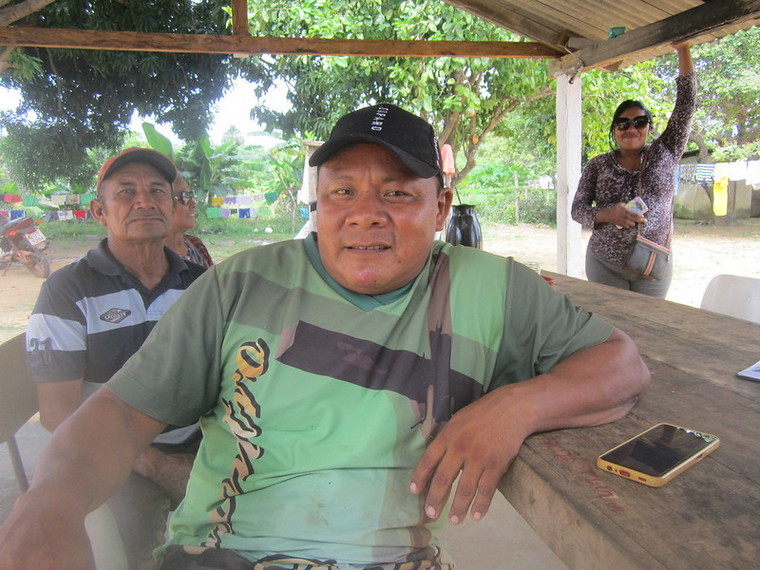
Tuxaua (chief) Lindomar Homero of the Darora Community is calling for new adequate batteries to reactivate the solar power plant, because the electricity they receive from the national grid is too expensive for the local indigenous people. Behind him stands his predecessor, former tuxaua Jesus Mota. CREDIT: Mario Osava/IPS

Tuxaua (chief) Lindomar Homero of the Darora Community is calling for new adequate batteries to reactivate the solar power plant, because the electricity they receive from the national grid is too expensive for the local indigenous people. Behind him stands his predecessor, former tuxaua Jesus Mota. CREDIT: Mario Osava/IPS

Expensive energy

But indigenous people can’t afford the electricity from the distributor Roraima Energía, he said. On average, each family pays between 100 and 150 reais (20 to 30 dollars) a month, he estimated.

Besides, there are unpleasant surprises. “My November bill climbed to 649 reais” (130 dollars), without any explanation,” Homero complained. The solar energy was free.

“If you don’t pay, they cut off your power,” said Mota, who was tuxaua from 1990 to 2020.”In addition, the electricity from the grid fails a lot,” which is why the equipment is damaged.

Apart from the unreliable supply and frequent blackouts, there is not enough energy for the irrigation of agriculture, the community’s main source of income. “We can do it with diesel pumps, but it’s expensive; selling watermelons at the current price does not cover the cost,” he said.

“In 2022, it rained a lot, but there are dry summers that require irrigation for our corn, bean, squash, potato, and cassava crops. The energy we receive is not enough to operate the pump,” said Mota.

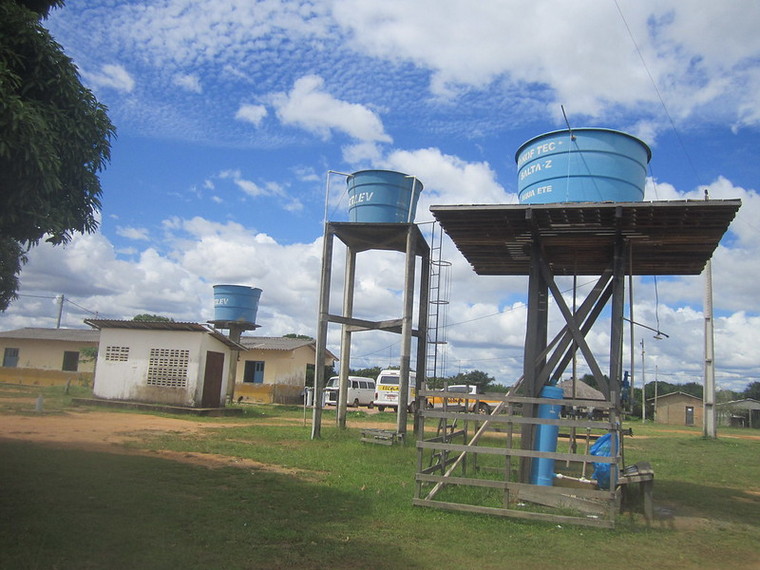
A photo of the three water tanks in the village of Darora, one of which holds water that is made potable by chemical treatment. The largest and longest building is the secondary school that serves the Macuxi indigenous community that lives in Roraima, in northern Brazil. CREDIT: Mario Osava/IPS

A photo of the three water tanks in the village of Darora, one of which holds water that is made potable by chemical treatment. The largest and longest building is the secondary school that serves the Macuxi indigenous community that lives in Roraima, in northern Brazil. CREDIT: Mario Osava/IPS

Achilles’ heel

Batteries still apparently limit the efficiency of solar energy in isolated or autonomous off-grid systems, with which the government and various private initiatives are attempting to make the supply of electricity universal and replace diesel generators.

Homero said that some of the Darora families who live outside the “center” of the village and have solar panels also had problems with the batteries.

Besides the 48 families in the village “center” there are 18 rural families, bringing the community’s total population to 265.

A solar plant was also installed in another community made up of 22 indigenous families of the Warao people, immigrants from Venezuela, called Warao a Janoko, 30 kilometers from Boa Vista.

But of the plant’s eight batteries, two have already stopped working after only a few months of use. And electricity is only guaranteed until 8:00 p.m.

“Batteries have gotten a lot better in the last decade, but they are still the weak link in solar power,” Aurelio Souza, a consultant who specializes in this question, told IPS from the city of São Paulo. “Poor sizing and the low quality of electronic charging control equipment aggravate this situation and reduce the useful life of the batteries.”

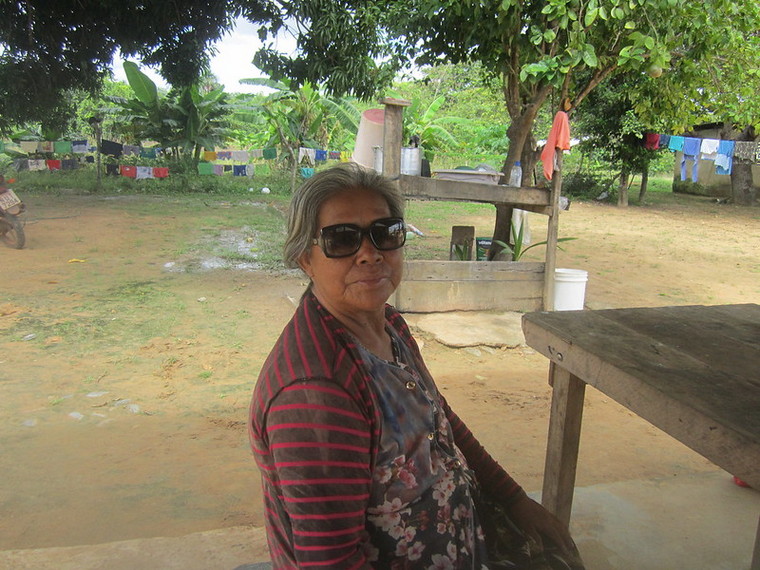
The low quality of the electricity supplied to Darora is due to the discrimination suffered by indigenous people, according to Adélia Augusto da Silva. The water they used to drink was also dirty and caused illnesses, especially in children, until the indigenous health service began to chemically treat their drinking water. CREDIT: Mario Osava/IPS

The low quality of the electricity supplied to Darora is due to the discrimination suffered by indigenous people, according to Adélia Augusto da Silva. The water they used to drink was also dirty and caused illnesses, especially in children, until the indigenous health service began to chemically treat their drinking water. CREDIT: Mario Osava/IPS

In Brazil’s Amazon jungle, close to a million people live without electricity, according to the Institute of Energy and the Environment, a non-governmental organization based in São Paulo. More precisely, its 2019 study identified 990,103 people in that situation.

Another three million inhabitants of the region, including the 650,000 people in Roraima, are outside the National Interconnected Electricity System. Their energy therefore depends mostly on diesel fuel transported from other regions, at a cost that affects all Brazilians.

The government decided to subsidize this fossil fuel so that the cost of electricity is not prohibitive in the Amazon region.

This subsidy is paid by other consumers, which contributes to making Brazilian electricity one of the most expensive in the world, despite the low cost of its main source, hydropower, which accounts for about 60 of the country’s electricity.

Solar energy became a viable alternative as the parts became cheaper. Initiatives to bring electricity to remote communities and reduce diesel consumption mushroomed.

But in remote plants outside the reach of the grid, good batteries are needed to store energy for the nighttime hours.

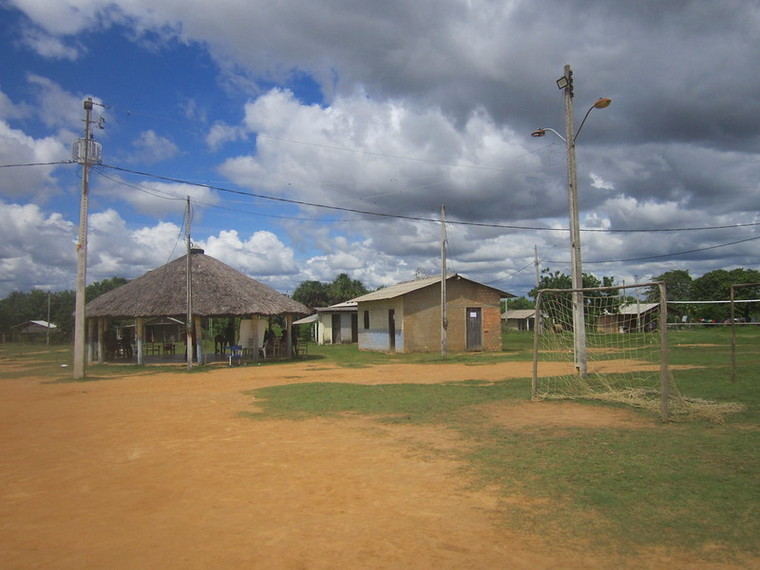
Part of the so-called "downtown" in Darora, which has lamp posts, houses, a soccer field and a shed where the community meets. A larger community center is needed, says the leader of the Macuxi village located near Boa Vista, the capital of the northern Brazilian state of Roraima. CREDIT: Mario Osava/IPS

Part of the so-called “downtown” in Darora, which has lamp posts, houses, a soccer field and a shed where the community meets. A larger community center is needed, says
the leader of the Macuxi village located near Boa Vista, the capital of the northern Brazilian state of Roraima. CREDIT: Mario Osava/IPS

A unique case

Darora is not a typical case. It is part of the municipality of Boa Vista, which has a population of 437,000 inhabitants and good resources, it is close to a paved road and is within a savannah ecosystem called “lavrado”.

It is at the southern end of the São Marcos indigenous territory, where many Macuxi indigenous people live but fewer than in Raposa Serra do Sol, Roraima’s other large native reserve. According to the Special Secretariat for Indigenous Health (Sesai), there were 33,603 Macuxi Indians living in Roraima in 2014.

The Macuxi people also live in the neighboring country of Guyana, where there are a similar number to that of Roraima. Their language is part of the Karib family.

Although there are no large forests in the surrounding area, Darora takes its name from a tree, which offers “very resistant wood that is good for building houses,” Homero explained.

The community emerged in 1944, founded by a patriarch who lived to be 93 years old and attracted other Macuxi people to the area.

The progress they have made especially stands out in the secondary school in the village “center”, which currently has 89 students and 32 employees, “all from Darora, except for three teachers from outside,” Homero said proudly.

A new, larger elementary and middle school for students in the first to ninth grades was built a few years ago about 500 meters from the community.

Water used to be a serious problem. “We drank dirty, red water, children died of diarrhea. But now we have good, treated water,” said Adélia da Silva.

“We dug three artesian wells, but the water was useless, it was salty. The solution was brought by a Sesai technician, who used a chemical substance to make the water from the lagoon drinkable,” Homero said.

The community has three elevated water tanks, two for water used for bathing and cleaning and one for drinking water. There are no more health problems caused by water, the tuxaua said.

His current concern is to find new sources of income for the community. Tourism is one alternative. “We have the Tacutu river beach 300 meters away, great fruit production, handicrafts and typical local gastronomy based on corn and cassava,” he said, listing attractions for visitors.

  Source