Knowledge is Power. Gaza War Supporters Don’t Want Students to Have Both

Civil Society, Democracy, Featured, Global Governance, Headlines, Human Rights, IPS UN: Inside the Glasshouse, Middle East & North Africa, TerraViva United Nations

Opinion

Student protesters at Columbia University, New York. Credit: IPS

SAN FRANCISCO, USA, Sep 6 2024 (IPS) – With nearly 18 million students on U.S. college campuses this fall, defenders of the war on Gaza don’t want to hear any backtalk. Silence is complicity, and that’s the way Israel’s allies like it.


For them, the new academic term restarts a threat to the status quo. But for supporters of human rights, it’s a renewed opportunity to turn higher education into something more than a comfort zone.

In the United States, the extent and arrogance of the emerging collegiate repression is, quite literally, breathtaking. Every day, people are dying due to their transgression of breathing while Palestinian.

The Gaza death toll adds up to more than one Kristallnacht per day — for upwards of 333 days and counting, with no end in sight. The shattering of a society’s entire infrastructure has been horrendous.

Months ago, citing data from the Palestinian Central Bureau of Statistics, ABC News reported that “25,000 buildings have been destroyed, 32 hospitals forced out of service, and three churches, 341 mosques and 100 universities and schools destroyed.”

Not that this should disturb the tranquility of campuses in the country whose taxpayers and elected leaders make it all possible. Top college officials wax eloquent about the sanctity of higher learning and academic freedom while they suppress protests against policies that have destroyed scores of universities in Palestine.

A key rationale for quashing dissent is that anti-Israel protests make some Jewish students uncomfortable. But the purposes of college education shouldn’t include always making people feel comfortable. How comfortable should students be in a nation enabling mass murder in Gaza?

What would we say about claims that students in the North with southern accents should not have been made uncomfortable by on-campus civil rights protests and denunciations of Jim Crow in the 1950s and 1960s? Or white students from South Africa, studying in the United States, made uncomfortable by anti-apartheid protests in the 1980s?

A bedrock for the edifice of speech suppression and virtual thought-policing is the old standby of equating criticism of Israel with antisemitism. Likewise, the ideology of Zionism that tries to justify Israeli policies is supposed to get a pass no matter what — while opponents, including many Jews, are liable to be denounced as antisemites.

But polling shows that more younger Americans are supportive of Palestinians than they are of Israelis. The ongoing atrocities by the Israel “Defense” Forces in Gaza, killing a daily average of more than 100 people — mostly children and women — have galvanized many young people to take action in the United States.

“Protests rocked American campuses toward the end of the last academic year,” a front-page New York Times story reported in late August, adding: “Many administrators remain shaken by the closing weeks of the spring semester, when encampments, building occupations and clashes with the police helped lead to thousands of arrests across the country.” (Overall, the phrase “clashes with the police” served as a euphemism for police violently attacking nonviolent protesters.)

From the hazy ivory towers and corporate suites inhabited by so many college presidents and boards of trustees, Palestinian people are scarcely more than abstractions compared to far more real priorities. An understated sentence from the Times sheds a bit of light: “The strategies that are coming into public view suggest that some administrators at schools large and small have concluded that permissiveness is perilous, and that a harder line may be the best option — or perhaps just the one least likely to invite blowback from elected officials and donors who have demanded that universities take stronger action against protesters.”

Much more clarity is available from a new Mondoweiss article by activist Carrie Zaremba, a researcher with training in anthropology. “University administrators across the United States have declared an indefinite state of emergency on college campuses,” she wrote. “Schools are rolling out policies in preparation for quashing pro-Palestine student activism this fall semester, and reshaping regulations and even campuses in the process to suit this new normal.

“Many of these policies being instituted share a common formula: more militarization, more law enforcement, more criminalization, and more consolidation of institutional power. But where do these policies originate and why are they so similar across all campuses? The answer lies in the fact that they have been provided by the ‘risk and crisis management’ consulting industries, with the tacit support of trustees, Zionist advocacy groups, and federal agencies. Together, they deploy the language of safety to disguise a deeper logic of control and securitization.”

Countering such top-down moves will require intensive grassroots organizing. Sustained pushback against campus repression will be essential, to continually assert the right to speak out and protest as guaranteed by the First Amendment.

Insistence on acquiring knowledge while gaining power for progressive forces will be vital. That’s why the national Teach-In Network was launched this week by the RootsAction Education Fund (which I help lead), under the banner “Knowledge Is Power — and Our Grassroots Movements Need Both.”

The elites that were appalled by the moral uprising on college campuses against Israel’s slaughter in Gaza are now doing all they can to prevent a resurgence of that uprising. But the mass murder continues, subsidized by the U.S. government. When students insist that true knowledge and ethical action need each other, they can help make history and not just study it.

Norman Solomon is the national director of RootsAction.org and executive director of the Institute for Public Accuracy. His latest book, War Made Invisible: How America Hides the Human Toll of Its Military Machine, was published in paperback this month with a new afterword about the Gaza war.

IPS UN Bureau
  Source

Nicaragua, China, India among 55 Nations Restricting Freedom of Movement

Civil Society, Democracy, Featured, Global, Global Governance, Headlines, Human Rights, IPS UN: Inside the Glasshouse, Latin America & the Caribbean, Press Freedom, TerraViva United Nations

Opinion

Credit: Freedom House

WASHINGTON, Aug 27 2024 (IPS) – At least 55 governments in the past decade have restricted the freedom of movement for people they deem as threats, including journalists, according to a Freedom House report published last Thursday.


Governments control freedom of movement via travel bans, revoking citizenship, document control and denial of consular services, the report found. All the tactics are designed to coerce and punish government critics, according to Jessica White, the report’s London-based co-author.

“This is a type of tactic that really shows the vindictive and punitive nature of some countries,” White said. This form of repression “is an attempt to really stifle peoples’ ability to speak out freely from wherever they are.”

Belarus, China, India, Nicaragua, Russia, Rwanda and Saudi Arabia are among the countries that engage in this form of repression, the report found. Freedom House based its findings in part on interviews with more than 30 people affected by mobility controls.

Travel bans are the most common tactic, according to White, with Freedom House identifying at least 40 governments who prevent citizens leaving or returning to the country.

Revoking citizenship is another strategy, despite being prohibited by international law. The Nicaraguan government in 2023 stripped more than 200 political prisoners of their citizenship shortly after deporting them to the United States.

Among them were Juan Lorenzo Holmann, head of Nicaragua’s oldest newspaper, La Prensa. “It is as if I do not exist anymore. It is another attack on my human rights,” he told VOA after being freed. “But you cannot do away with the person’s personality. In the Nicaraguan constitution, it says that you cannot wipe out a person’s personal records or take away their nationality. I feel Nicaraguan, and they cannot take that away from me.”

Before being expelled from his own country, Lorenzo had spent 545 days in prison, in what was widely viewed as a politically motivated case.

Blocking access to passports and other travel documents is another tactic. In one example, Hong Kong in June canceled the passports of six pro-democracy activists who were living in exile in Britain.

In some cases, governments refuse to issue people passports to trap them in the country. And in cases where the individual is already abroad, embassies deny passport renewals to block the individual from traveling anywhere, including back home.

Myanmar’s embassy in Berlin, for instance, has refused to renew the passport of Ma Thida, a Burmese writer in exile in Germany. Ma Thida told VOA earlier this year she believes the refusal is in retaliation for her writing.

White said Ma Thida’s case was a classic example of mobility restrictions. For now, the German government has issued a passport reserved for people who are unable to obtain a passport from their home country — which White applauded but said is still rare.

“Our ability to freely leave and return to our home country is something that in democratic societies, people often take for granted. It’s one of our fundamental human rights, but it’s one that is being undermined and violated across many parts of the world,” White said.

Mobility restrictions can have devastating consequences, including making it difficult to work, travel and visit family. What makes matters even worse is the emotional toll, according to White.

“There is a huge psychological impact,” White said. “A lot of our interviewees mention especially the pain of being separated from family members and not being able to return to their country.”

In the report, Freedom House called on democratic governments to impose sanctions on actors that engage in mobility controls.

White said that democratic governments should do more to help dissidents, including by providing them with alternative travel documents if they can’t obtain them from their home countries.

https://freedomhouse.org/sites/default/files/2024-02/FIW_2024_DigitalBooklet.pdf

Source: Voice of America (VOA)

IPS UN Bureau

  Source

Biden’s Convention Speech Made Absurd Claims About His Gaza Policy

Armed Conflicts, Civil Society, Global Governance, Headlines, Human Rights, IPS UN: Inside the Glasshouse, Middle East & North Africa, TerraViva United Nations

Opinion

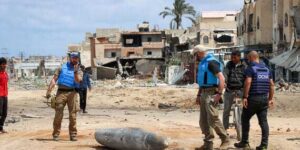
A UN team inspects an unexploded 1,000-pound bomb lying on a main road in Khan Younis. Credit: OCHA/Themba Linden

SAN FRANCISCO, USA, Aug 21 2024 (IPS) – An observation from George Orwell — “those who control the present, control the past and those who control the past control the future” — is acutely relevant to how President Biden talked about Gaza during his speech at the Democratic convention Monday night.


His words fit into a messaging template now in its eleventh month, depicting the U.S. government as tirelessly seeking peace, while supplying the weapons and bombs that have enabled Israel’s continual slaughter of civilians.

“We’ll keep working, to bring hostages home, and end the war in Gaza, and bring peace and security to the Middle East,” Biden told the cheering delegates. “As you know, I wrote a peace treaty for Gaza. A few days ago, I put forward a proposal that brought us closer to doing that than we’ve done since October 7th.”

It was a journey into an alternative universe of political guile from a president who just six days earlier had approved sending $20 billion worth of more weapons to Israel. Yet the Biden delegates in the convention hall responded with a crescendo of roaring admiration.

Applause swelled as Biden continued: “We’re working around-the-clock, my secretary of state, to prevent a wider war and reunite hostages with their families, and surge humanitarian health and food assistance into Gaza now, to end the civilian suffering of the Palestinian people and finally, finally, finally deliver a ceasefire and end this war.”

In Chicago’s United Center, the president basked in adulation while claiming to be a peacemaker despite a record of literally making possible the methodical massacres of tens of thousands of Palestinian civilians.

Orwell would have understood. A political reflex has been in motion from top U.S. leaders, claiming to be peace seekers while aiding and abetting the slaughter. Normalizing deception about the past sets a pattern for perpetrating such deception in the future.

And so, working inside the paradigm that Orwell described, Biden exerts control over the present, strives to control narratives about the past, and seeks to make it all seem normal, prefiguring the future.

The eagerness of delegates to cheer for Biden’s mendaciously absurd narrative about his administration’s policies toward Gaza was in a broader context — the convention’s lovefest for the lame-duck president.

Hours before the convention opened, Peter Beinart released a short video essay anticipating the fervent adulation. “I just don’t think when you’re analyzing a presidency or a person, you sequester what’s happened in Gaza,” he said.

“I mean, if you’re a liberal-minded person, you believe that genocide is just about the worst thing that a country can do, and it’s just about the worst thing that your country can do if your country is arming a genocide.”

Beinart continued: “And it’s really not that controversial anymore that this qualifies as a genocide. I read the academic writing on this. I don’t see any genuine scholars of human rights international law who are saying it’s not indeed there. . . . If you’re gonna say something about Joe Biden, the president, Joe Biden, the man, you have to factor in what Joe Biden, the president, Joe Biden, the man, has done, vis-a-vis Gaza.

It’s central to his legacy. It’s central to his character. And if you don’t, then you’re saying that Palestinian lives just don’t matter, or at least they don’t matter this particular day, and I think that’s inhumane. I don’t think we can ever say that some group of people’s lives simply don’t matter because it’s inconvenient for us to talk about them at a particular moment.”

Underscoring the grotesque moral obtuseness from the convention stage was the joyful display of generations as the president praised and embraced his offspring. Joe Biden walked off stage holding the hand of his cute little grandson, a precious child no more precious than any one of the many thousands of children the president has helped Israel to kill.

Norman Solomon is the national director of RootsAction.org and executive director of the Institute for Public Accuracy. He is the author of many books including War Made Easy. His latest book, War Made Invisible: How America Hides the Human Toll of Its Military Machine, was published in 2023 by The New Press.

IPS UN Bureau

  Source

2023 Deadliest Year for Aid Workers– & 2024 Could be Even Worse, Predicts UN

Armed Conflicts, Civil Society, Featured, Global Governance, Headlines, Human Rights, Humanitarian Emergencies, IPS UN: Inside the Glasshouse, Middle East & North Africa, TerraViva United Nations

UNITED NATIONS, Aug 19 2024 (IPS) – Back in August 2003, the United Nations faced one of its violent tragedies when a terrorist attack on the UN headquarters in the Iraqi capital of Baghdad claimed the lives of 22 people.

Among those killed was Sergio Vieira de Mello of Brazil, the UN envoy in Iraq and High Commissioner for Human Rights, who had a long and distinguished UN career stretching over 30 years.


As the UN commemorated World Humanitarian Day on August 19, it continues to be confronted with rising death tolls among both its humanitarian workers and peacekeepers worldwide.

The commemorative day was established by the General Assembly in 2008 after the 2003 bomb attack in Baghdad.

At last count, at least 254 aid workers have been killed since the current 10-month-old war began in Gaza on Oct. 7 last year, and about 188 worked for UNRWA, the UN agency for Palestinian refugees.

According to the UN, “2023 was the deadliest year on record for humanitarian workers and 2024 is on track to be even worse”.

In a statement ahead of World Humanitarian Day, Dennis Francis, President of the193-member General Assembly said aid organizations – from all over the world – have united to call for the protection of civilians and humanitarian personnel, as well as to ensure their safe and unhindered access, including across conflict lines.

Footage of destruction of Al-Shifa hospital in Gaza, following an Israeli siege. The World Health Organization (WHO) reiterated that hospitals must be respected and protected; they must not be used as battlefields. Credit: UN News

Attacks on humanitarian workers and humanitarian assets must stop, as well as on civilians and civilian infrastructure, he said.

Besides the UN and its agencies, some of the world’s humanitarian organizations in war zones include Doctors Without Borders, CARE International, Save the Children and the International Committee of the Red Cross and the Red Crescent.

Last April, seven members from World Central Kitchen (WCK) were killed in an Israeli air strike in Gaza. The WCK said its team was traveling in a deconflicted zone in two armored cars branded with the WCK logo and a soft skin vehicle.

Despite coordinating movements with the Israeli Defense Force (IDF), the convoy was hit as it was leaving the Deir al-Balah warehouse, where the team had unloaded more than 100 tons of humanitarian food aid brought to Gaza on the maritime route.

“This is not only an attack against WCK, this is an attack on humanitarian organizations showing up in most dire situations where food is being used as a weapon of war. This is unforgivable,” said WCK CEO Erin Gore.

The seven killed were from Australia, Poland, United Kingdom, a dual citizen of the U.S. and Canada, and Palestine.

“I am heartbroken and appalled that we—World Central Kitchen and the world—lost beautiful lives because of a targeted attack by the IDF. The love they had for feeding people, the determination they embodied to show that humanity rises above all, and the impact they made in countless lives will forever be remembered and cherished,” said Gore.

According to the UN Office for the Coordination of Humanitarian Affairs (OCHA), more than half of the 2023 deaths were recorded in the first three months – October to December – of the hostilities in Gaza, mostly as a result of airstrikes.

Extreme levels of violence in Sudan and South Sudan have also contributed to the tragic death toll, both in 2023 and in 2024. In all these conflicts, most of the casualties are among national staff. Many humanitarian workers also continue to be detained in Yemen.

“The normalization of violence against aid workers and the lack of accountability are unacceptable, unconscionable and enormously harmful for aid operations everywhere,” said Joyce Msuya, Acting Under-Secretary-General for Humanitarian Affairs and Emergency Relief Coordinator.

“Today, we reiterate our demand that people in power act to end violations against civilians and the impunity with which these heinous attacks are committed.”

On this World Humanitarian Day, aid workers and those supporting their efforts around the globe have organized events to stand in solidarity and spotlight the horrifying toll of armed conflicts, including on humanitarian staff, she said.

In addition, a joint letter from leaders of humanitarian organizations will be sent to the Member States of the UN General Assembly asking the international community to end attacks on civilians, protect all aid workers, and hold perpetrators to account.

Everyone can add their voice by joining and amplifying the digital campaign using the hashtag #ActforHumanity.

Meanwhile, UN peacekeeping is considered virtually humanitarian—but with a military angle– in conflict ridden countries and war zones where they are also vulnerable to attacks.

At least 11 United Nations personnel — seven military personnel and four civilians — were killed in deliberate attacks in 2023, the United Nations Staff Union Standing Committee on the Security and Independence of the International Civil Service pointed out.

And 32 UN peacekeeping personnel — 28 military and four police, including one woman police officer — were killed in deliberate attacks in 2022, the United Nations Staff Union said.

For the ninth year in a row, the United Nations Multidimensional Integrated Stabilization Mission in Mali (MINUSMA) was the deadliest for peacekeepers with 14 fatalities, followed by 13 fatalities in the United Nations Organization Stabilization Mission in the Democratic Republic of the Congo (MONUSCO), four fatalities in the United Nations Multidimensional Integrated Stabilization Mission in the Central African Republic (MINUSCA) and one fatality in the United Nations Interim Force in Lebanon (UNIFIL).

The figures for preceding years are as follows: 2021 (25 killed); 2020 (15 killed); 2019 (28 killed); 2018 (34 killed); 2017 (71 killed); 2016 (32 killed); 2015 (51 killed); 2014 (61 killed); 2013 (58 killed); 2012 (37 killed); 2011 (35 killed); and 2010 (15 killed).

Roderic Grigson, who was with the UN Emergency Force (UNEF II) on the Egyptian- Israeli border, told IPS the duties of a peacekeeper are extremely hazardous.

“Our job as peacekeepers was to insert ourselves between two warring forces and keep them apart while peace negotiations were conducted at the UN HQ in New York or elsewhere”

Sometimes, he said, those negotiations took years to happen. “The environment we worked in was often a recent warzone, scattered with unexploded shells and mines and the detritus of war.”

“The opposing forces always considered the UN peacekeepers suspicious, and we had to work hard to earn their trust. When travelling through the front lines into the buffer zone, you had to keep your wits about you”.

“We were never alone and were always in touch with headquarters over UHF radios in the clearly marked UN vehicles,” said Grigson, currently a book coach based in Melbourne, who teaches, mentors and supports writers. while running a publishing house for authors who wish to self-publish their stories.

From personal experience, he said, “I can state that I have been shot at several times, had to wear a helmet and body armour while I was working, and have experienced shelling by the two opposing forces who wished to make a point during the ongoing negotiations.”

One of my colleagues was killed while driving the daily mail truck when the road was mined overnight, said Grigson,

https://www.rodericgrigson.com/shorts/

IPS UN Bureau Report

  Source

WFP in Gaza: ‘We Need a Long Ceasefire That Leads to Peace so We Can Operate’

Armed Conflicts, Civil Society, Global Governance, Headlines, Human Rights, Humanitarian Emergencies, IPS UN: Inside the Glasshouse, Middle East & North Africa, TerraViva United Nations

Opinion

Credit: WFP/Ali Jadallah/2024

ROME, Aug 15 2024 (IPS) – Corinne Fleischer, WFP’s regional director for the Middle East, North Africa and Eastern Europe, describes Gaza as “a terrible situation getting worse.” Over the past two weeks, 21 United Nations World Food Programme (WFP) food distribution points have been closed under evacuation orders.


“UNRWA says that 86% of the Strip is under an evacuation order,” she says on a video call from her office in Cairo. Fleischer visited the enclave in July.“ 2 million people are crammed into 14% of the territory.”

Despite Immense Challenges, WFP Continues to Assist Gazans

With continuous evacuation orders forcing WFP to uproot food distribution sites, precise targeting of the most vulnerable groups becomes challenging. We provide ready-to-eat food, hot meals and nutrition support to breastfeeding women and small children.

Mohammed was severely injured in the conflict but all efforts to evacuate him for medical treatment failed. His family fully depends on food from WFP to survive.

“We support partners in almost 80 kitchens, where they cook meals, pack and distribute them to people in camps,” Fleischer explains. She previously visited Gaza last December. “Then, it was really about how do we bring food in – that’s still very much the case,” she says. “Now, at least we have a dedicated WFP operation on the ground.” Our main accomplishment? “We have helped prevent full-scale famine from happening,” she says.

There are currently nearly 500,000 people at IPC5/Catastrophe, the highest grade of food insecurity on the global standard for measuring food insecurity – down from 1.1 million people earlier this year.

Fleischer is keen to highlight the positive impacts of humanitarian supplies making it through.“Right now, we don’t bring enough food into Gaza,” she says. “We don’t bring in what we plan for the month because we don’t have enough crossing points open. We need all the crossings open and at full capacity.”

“Operations are super complicated,” Fleischer says. “We work in a war zone. Roads are destroyed. We are waiting hours at checkpoints for green lights to move.”

WFP, she stresses, also works to support the wider humanitarian community. “We are leading the Logistics Cluster (the interagency coordination mechanism) and supporting partners to bring in their goods through the Jordan corridor. We are receiving their goods in the north at the Zikim crossing point. We’re helping them in Kerem Shalom. So, of course, we’re helping with fuel supplies too.”

Nowhere Is Safe in Gaza

“Gazans cannot get out, and they’re asking to get out,” Fleischer says. “They’re beyond exhausted. There is no space – one makeshift tent after the other up to the sea. Streets are teeming with people.” Meanwhile, the breakdown of sewage systems, lack of water and waste management means diseases, such as Hepatitis A which is spreading among children, are allowed to fester.

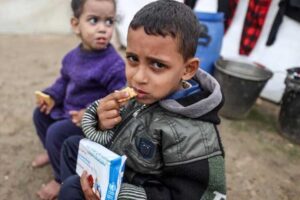
Children eat fortified biscuits from WFP at a makeshift camp in southern Gaza.

“We are lucky that nothing has happened to our amazing staff – more than 200 UNRWA staff have been killed,” she says. “That is not acceptable.” She adds: “We have amazing security officers who advise management on which risks to avoid, so that we can stay and do our work safely and families can access our assistance safely. But the risks are high. Very high. We have bullets close to our convoys. We’re there repairing roads. We’re there moving with our trucks. We’re there reaching people. And it’s very dangerous.”

On the path to recovery, the private sector has a role to play, says Fleischer – take the reopening of shops. “If you think of a lifeline, of hope, or a sense of normalcy, it’s surely when the staple bread is back in the market,” she says of bakeries that have reopened with WFP support. “Bakeries need wheat flour, they need yeast, and diesel too – and that’s where we come in.”

High Prices Keep Basic Foods Out of Reach for Most Gazans

In the south of Gaza, “basic food items are slowly re-emerging in food markets. You can actually find vegetables, fruits in the markets but because prices are high, they remain out of reach for most,” she says “And in any case, people don’t have cash. There are no jobs. Even our own staff tell us, ‘We have a salary, but we can’t access cash’.”

Fleischer is keen for humanitarian efforts to reach a stage where people “stop eating things they have been eating for the past nine months” – to diversify diets heavily dependent on canned food (provided by WFP) and whatever people can get their hands on.

“This level of destruction I’ve never seen.”

Fleischer’s biggest fear for Gaza is “that there is no end to this [war]. That we continue with ever less space for the people who already have nowhere to go back to. Even if they moved back to the north, where could they go?”

“Everything is flattened. There are no homes, it’s all destroyed. We need a long ceasefire that leads to peace so we can operate.”

After the Rafah incursion, many people returned to Khan Younis but there’s no means of living in the area. There are no homes left. Credit: WFP

Fleischer, who has served with WFP in Syria and Sudan’s Darfur Region, adds: “This level of destruction I’ve never seen. Hospitals and clinics are destroyed, food processing plants are destroyed. Everything is destroyed.”

Yet, “There is this never-give-up attitude from the people, from the families we serve,“ she says. “I can’t believe children still run to you and laugh with you. They probably see in us hope that there will be an end to all this – a sign they are not forgotten.”

This story originally appeared on WFP’s Stories on August 8, 2024 and was written by the WFP Editorial Team.

IPS UN Bureau

  Source

South Sudan: World’s Youngest Nation at a Crossroads

Africa, Armed Conflicts, Civil Society, Global Governance, Headlines, Human Rights, Humanitarian Emergencies, IPS UN: Inside the Glasshouse, TerraViva United Nations

Opinion

United Nations Assistant Secretary-General and UNDP Crisis Bureau Director, Shoko Noda

UNITED NATIONS, Aug 13 2024 (IPS) – Thirteen years since becoming an independent state, South Sudan faces profound humanitarian challenges. South Sudan’s first Independence Day was imbued with a great sense of hope.


I remember crowds cheering in the streets, waving the country’s new flag high. Thirteen years later, the youngest nation in the world, barely into its adolescence, faces profound challenges.

At the heart of South Sudan’s challenges lies a humanitarian crisis of staggering proportions. Given seven million of the country’s 12.4 million people are projected to experience crisis-level hunger this year, and nine million are in dire need of humanitarian assistance, the gravity of the situation cannot be overstated.

One in ten lack access to electricity. Seventy percent can’t access basic healthcare. These are fundamental human rights that the vast majority of people are deprived of.

I saw South Sudan’s dire humanitarian situation firsthand when I visited the country in March. I met women and children displaced by conflict – some for the second time in their lives – in a transit centre in Malakal, the capital of Upper Nile state. They had nothing and were fully reliant on aid. Their plight still lingers in my mind and heart.

As it marks its 13th independence anniversary, South Sudan finds itself at a pivotal moment in its nation-building journey.

Humanitarian aid alone cannot untangle the intricate web of challenges facing South Sudan. A holistic approach is required—one that lays the groundwork for self-sufficiency, peace and sustainable development.

With the constitutional-making process underway and elections on the horizon, the efforts we make today will shape the trajectory of the country for generations to come. We must bolster institutions, foster stability and empower the youth—the driving force behind the nation’s aspirations for progress and prosperity.

Humanitarian aid alone cannot untangle the intricate web of challenges facing South Sudan. A holistic approach is required—one that lays the groundwork for self-sufficiency, peace and sustainable development.

Central to this is the empowerment of women and girls, who face disproportionate challenges and vulnerabilities in the face of conflict, displacement and climate change. Gender-based violence (GBV), child marriage and maternal mortality rates are alarmingly high, underscoring the urgent need for targeted interventions that prioritize the rights and dignity of women and girls.

When I visited Malakal, I met with young women whose stories painted a vivid story to me on the barriers they face on a daily basis—from fearing for their safety to feeling unable to speak out about their hopes and aspirations, or being denied work opportunities.

It should not be this way.

Our team on the ground is working hard to improve the lives of women and girls in South Sudan. I was impressed by courts in Juba, set up with UNDP support, that focus on addressing violence against women. We are also working to ensure women’s inclusion in peacebuilding processes, promote gender equality and create opportunities for women and youth to thrive.

But so much more needs to be done.

With 75 percent of the population comprising young people, they represent both South Sudan’s greatest challenge and its most promising asset. Neglecting to invest in the youth equates to neglecting the future of the country itself—a risk we cannot afford to take.

Their voices must be heard, their aspirations nurtured and their potential unleashed.

South Sudan is at a crossroads.

With the right support, the country has the potential to create a future defined by hope, greater prosperity and stability for all. The alternative is a deepening of an already profound and protracted crisis.

South Sudan cannot navigate this path alone. It requires the support that transcends its borders to overcome the myriad challenges it faces. Increased development cooperation—the kind that helps people break the cycle of crisis and build safer, more stable, resilient, and sustainable lives—is urgently needed.

My hope is to return in 10 years and see the families I met at the Malakal transit centre peacefully settled, their children grown and thriving, with stable livelihoods and access to all the services they need to sustain them and nurture their hopes and aspirations for the future.

This is what development looks like.

Shoko Noda is United Nations Assistant Secretary-General and UNDP Crisis Bureau Director

Source: Africa Renewal, a United Nations digital magazine that covers Africa’s economic, social and political developments—plus the challenges the continent faces and the solutions to these by Africans themselves, including with the support of the United Nations and international community.

IPS UN Bureau

  Source