What Is the Cost of Phasing Out Fossil Fuels in Latin America?

Civil Society, Climate Action, Climate Change, Climate Change Finance, Conferences, COP28, Development & Aid, Editors’ Choice, Energy, Environment, Featured, Global, Global Governance, Headlines, Integration and Development Brazilian-style, IPS UN: Inside the Glasshouse, Latin America & the Caribbean, Projects, Regional Categories, Sustainable Development Goals, TerraViva United Nations

Climate Change

Colombian President Gustavo Petro presented his environmental plans at COP28 in Dubai and added his country to the small group of nations that support the negotiation of a binding treaty to prevent the proliferation of fossil fuels, despite his country being an oil producer. CREDIT: Emilio Godoy / IPS

Colombian President Gustavo Petro presented his environmental plans at COP28 in Dubai and added his country to the small group of nations that support the negotiation of a binding treaty to prevent the proliferation of fossil fuels, despite his country being an oil producer. CREDIT: Emilio Godoy / IPS

DUBAI, Dec 12 2023 (IPS) – One of the most heated debates at the annual climate summit coming to a conclusion in this United Arab Emirates city revolved around the phrasing of the final declaration, regarding the “phase-out” or “phase-down” of fossil fuels within a given time frame.


This is an essential calculation on the decommissioning of refineries, pipelines, power plants and other infrastructure that, in some cases, have been in operation for years, as discussed at the 28th Conference of the Parties (COP28) to the United Nations Framework Convention on Climate Change (UNFCCC).

Experts who talked to IPS at the summit agreed on the magnitude of the bill, which for some Latin American nations could be unaffordable.

“Financial support will be needed. There must be a differentiated approach, differentiated timing, and developed countries must come up with the resources.” — Fernanda Carvalho

Fernanda Carvalho of Brazil, global leader for Energy and Climate Policy at the non-governmental World Wildlife Fund (WWF), referred to the amount without specifying a figure.

“Financial support will be needed. There must be a differentiated approach, differentiated timing, and developed countries must come up with the resources,” the expert, who was present at COP28, held at Expo City on the outskirts of Dubai, told IPS.

COP28 engaged in an acrimonious debate between phase-out and phase-down, with a definite date, of oil, gas and coal, which has already anticipated a disappointing end in Dubai, that in line with the tradition at these summits extended its negotiations one more day, to conclude on Wednesday, Dec. 13.

The “phase-down” concept has been in the climate-energy jargon for years, but it really took off at the 2021 COP26 in the Scottish city of Glasgow, whose Climate Pact alludes to the reduction of coal still being produced and the elimination of inefficient fossil fuel subsidies.

Throughout the climate summits since 1995, developing countries have insisted on differentiated measures for them, in accordance with their own situation, the need for financing from developed nations and the transfer of technology, especially energy alternatives.

Enrique Maurtúa of Argentina, senior diplomacy advisor to the Independent Global Stocktake (iGST) – an umbrella data and advocacy initiative – said they hoped for a political signal to determine regulations or market measures regarding a phase-down or phase-out.

“If a target date is not set, there is no signal. If you set a phase-out for 2050, that is a pathway for the transition. With a deadline, the market can react. And then each country must evaluate its specific context,” the expert told IPS in the COP28 Green Zone, which hosted civil society organizations at the summit.

Available scientific knowledge indicates that the majority of proven hydrocarbon reserves must remain unextracted by 2030 to keep the planetary temperature rise below 2 degrees Celsius, the threshold agreed in the 2015 Paris Climate Change Agreement to avoid massive disasters.

On Sunday, Dec. 10 the non-governmental Climate Action Network (CAN) delivered at COP28 a dishonorable mention to the United States for its role in Israel's carnage in Gaza, in the traditional Fossil of the Day award for “doing the most to achieve the least” in terms of progress on climate change at the summits. CREDIT: Emilio Godoy / IPS

On Sunday, Dec. 10 the non-governmental Climate Action Network (CAN) delivered at COP28 a dishonorable mention to the United States for its role in Israel’s carnage in Gaza, in the traditional Fossil of the Day award for “doing the most to achieve the least” in terms of progress on climate change at the summits. CREDIT: Emilio Godoy / IPS

Failed attempts

In the Latin American region there are unsuccessful precedents of fossil fuel phase-outs.

In 2007, the then president of Ecuador, Rafael Correa (2007-2017), launched the Yasuní-Ishpingo Tambococha Tiputini initiative, which sought the care of the Yasuní National Park in the Ecuadorian Amazon rainforest, in exchange for funds from governments, foundations, companies and individuals of about 3.6 billion dollars by 2024 to leave the oil in the ground.

The aim was to leave 846 million barrels of oil untouched underground. But a special fund created by Ecuador and the United Nations Environment Fund only raised 13 million dollars, according to the Ecuadorian government. So Correa decided to cancel the initiative in 2013, at a time when renewable energies had not yet really taken off.

In a referendum held in August, Ecuadorians decided to halt oil extraction in a block in Yasuní that would provide 57,000 barrels per day in 2022 – the same result sought by Correa, but without foreign funds.

The result of the referendum is to be implemented within a year, although the position of the government of the current president, banana tycoon Daniel Noboa, who took office on Nov. 23, is still unclear.

Meanwhile, in Colombia, President Gustavo Petro has put the brakes on new oil and coal exploration contracts, a promise from his 2022 election campaign.

In addition, the president announced on Dec. 2 in Dubai that his country was joining nine other nations that are promoting the formal initiation of the negotiation of a Fossil Fuel Non-Proliferation Treaty.

Colombia will thus become the first Latin American nation and the largest oil and coal producer to join the initiative that first emerged in 2015 when several Pacific Island leaders and NGOs raised the urgent need for an international mechanism to phase out fossil fuels.

For the undertaking of a just energy transition to cleaner fuels, Petro estimates an initial bill of 14 billion dollars, to come from governments of the developed North, multilateral organizations and international funds.

The latest summit of hope for the climate kicked off on Nov. 30 in this Arab city under the slogan “Unite. Act. Deliver” – the least successful in the history of COPs since the first one, held in Berlin in 1995.

The hopes included commitments and voluntary declarations on renewable energy and energy efficiency; agriculture, food and climate; health and climate; climate finance; refrigeration; and just transitions with a gender focus.

In addition, there were financial pledges of some 86 billion dollars, without specifying whether it is all new money, to be allocated to these issues.
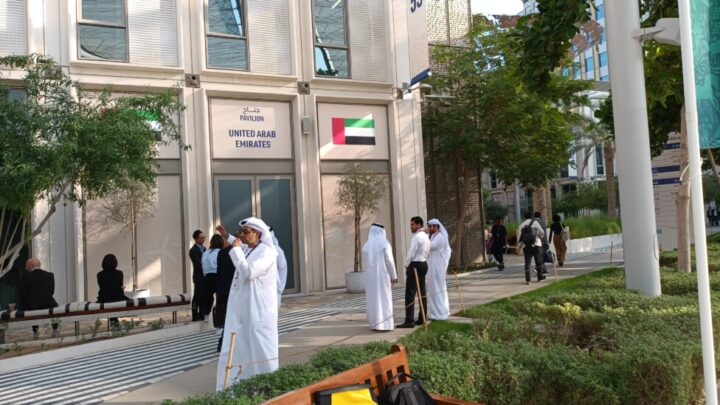
Like many countries, the host of COP28, the United Arab Emirates, has had a pavilion in the so-called Green Zone, which hosts non-governmental organizations, companies and other institutions. The Emirati government bet a lot on the climate summit to deliver results, but without directly targeting the fossil fuels on which its economy depends. CREDIT: Emilio Godoy / IPS

Like many countries, the host of COP28, the United Arab Emirates, has had a pavilion in the so-called Green Zone, which hosts non-governmental organizations, companies and other institutions. The Emirati government bet a lot on the climate summit to deliver results, but without directly targeting the fossil fuels on which its economy depends. CREDIT: Emilio Godoy / IPS

Billions

Given the production and exploration plans of the main hydrocarbon producing countries in the region, the magnitude of the challenge in the medium and long term is enormous.

In October, Brazil, the largest economy in the region and the 11th largest in the world, extracted 3.543 billion barrels of oil and 152 million cubic meters (m3) of gas per day.

This represented approximately two percent of the domestic economy that month.

Mexico, the region’s second largest economy, extracted 1.64 million barrels and 4.971 billion m3 of gas per day in October, equivalent to 52 million dollars in revenues.

Meanwhile, Colombia produced 780,487 barrels of oil in the first eight months of 2023 and 1,568 cubic feet per day of gas, equivalent to 12 percent of public revenues.

“We have to think about decarbonization measures. We want Latin America to be a clean energy powerhouse,” said Carvalho.

As of September, Brazil’s state-owned oil giant Petrobras was working on obtaining 9.571 billion barrels of oil equivalent, according to the Global Oil & Gas Exit List produced by the German non-governmental organization Urgewald.

This represents an excess of 94 percent above the limit set by the 2015 Paris Agreement to keep global warming below two degrees Celsius.

Meanwhile, Mexico’s state-owned oil company Pemex is producing 1.444 billion barrels of oil equivalent, 56 percent above the threshold set by the Paris Agreement.

Finally, the public company Ecopetrol, mostly owned by the Colombian state, is working to obtain 447 million barrels, 98 percent above the Paris Agreement limit, according to Urgewald.

In addition, the cost of action against the climate crisis is far from affordable for any Latin American nation.

For example, Mexico estimated that the implementation of 35 measures, including in the power, gas and oil generation sector, would cost 137 billion dollars in 2030, but the benefits would total 295 billion dollars.

But Maurtúa says the budget question is only relative. “There is a lot of public money with which many things can be done,” complemented by international resources, he argued.


Fair taxation for All

Civil Society, Economy & Trade, Featured, Global, Headlines, IPS UN: Inside the Glasshouse, TerraViva United Nations

Opinion

Canva/ IPS. Known for its expensive villas and numerous letterbox companies: the Cayman Islands.
 
The Global South wants to strengthen the role of the UN in global tax policy. But the North is united in its opposition

 
Artikel auf Deutsch lesen

BERLIN, Dec 11 2023 (IPS) – Champagne corks popped in New York after the majority voted in favour of a UN tax convention. The clear result paved the way for a stronger role of the United Nations in shaping more inclusive and effective international tax cooperation. This fulfils a decades-long demand by the G77 group and the international civil society.


Public Services International (PSI), the international trade union of public service providers, is also an important champion of fair international tax rules. Its General Secretary, Daniel Bertossa, commented that the UN vote stood as a confirmation of the tireless campaigning work of the trade union movement and its partners and the fact that ‘tax rules that affect us all should involve us all’.

For international tax policy is ultimately a global distribution policy that touches on issues of national sovereignty. As far back as the American Revolution, the slogan ‘no taxation without representation’ was aimed at the British Crown.

However, it’s a shame that the historic vote turned into a battle between the Global South and the Global North. On the online platform X, Kenya’s Permanent Representative to the United Nations commented on the result as the most clear-cut North-South vote he had seen in recent years.

In view of the increasing state of crisis and conflict in international relations, people often talk about the formation of global alliances and the need for partnerships on equal terms. But the refusal to release patents for vaccines during the Covid-19 pandemic, as well as the industrialised countries shrugging their shoulders in the face of the existential threat of the international debt crisis for many middle- and low-income countries, have long since undermined trust in the reliability of such partnerships.

A dangerous signal

The vote on the UN tax convention has become the next crucial test, with a clear result: 125 countries voted for and only 48 against the resolution introduced by the group of African countries to the Second Committee of the General Assembly. Opposing votes came from the US, Canada, Australia, all EU countries and EU accession candidates, as well as Switzerland. With the exception of Norway’s abstention, the Global North voted unanimously against the initiative.

In an open letter prior to the vote, the Independent Commission for the Reform of International Corporate Taxation (ICRICT) had appealed to the EU and the US. In the letter, members of the commission, which is made up of high-ranking economists from the North and South, warned of a ‘dangerous signal’ that ‘blocking the Resolution on Promotion of Inclusive and Effective International Tax Cooperation at the United Nations’ would send.

According to the experts, the suspicion would be that ‘those who most loudly tout the benefits of a rules-based international order don’t actually believe in one.’

Taxes are one of the most important sources for financing public goods and services. In the last 10 years, there has finally been some movement in the discussion about reforming the international tax system. But despite all the talks and negotiations, multinational companies are still able to avoid taxes on a large scale.

Given the ever-increasing concentration of wealth in the hands of a few and the fact that only four per cent of global tax revenue comes from wealth-related taxes, it is obvious who bears the main financial burden of financing – working people and ordinary citizens, not billionaires. Labour is taxed, not wealth and financial assets.

The call to make the United Nations the central venue for international tax cooperation is as old as the debate about reforming the international tax system itself. So far, the Organisation for Economic Cooperation and Development (OECD), the club of industrialised countries, has taken a leading role in the reform process of the international tax system. On behalf of the G20, the OECD is developing proposals to curb base erosion and profit shifting (BEPS).

The Group of 77 and civil society organisations such as the Global Alliance for Tax Justice have long called for the United Nations to take a stronger role in shaping an international tax system aligned with the goals of the sustainable development agenda that will ensure greater international tax justice.

With the slogan ‘if you are not at the table, you are on the menu’, they criticise the fact that developing countries do not have an equal seat at the table in OECD negotiations.

Proponents are expecting the UN tax convention to not only lead to a more inclusive international tax policy but also more transparency in the process, thanks to the greater involvement of civil society. Critics, however, fear a parallel event to existing reform efforts and a dilution of the negotiation successes achieved so far at the OECD.

The need to work together

In the ICRICT Commission’s press release following the vote, former Colombian Finance Minister José Antonio Ocampo struck a conciliatory tone. He called the resolution ‘one step further towards global social justice’ and sees it as a ‘strengthening of institutions, democracy and international stability’. He asks that all ‘learn from all the efforts of the past and build this process not on antagonism but on real cooperation between countries and between global institutions’.

Against the backdrop of the enormous financing challenges of our time, it is crucial that common solutions be quickly found for better international taxation of multinational corporations, without getting lost in institutional disputes. A UN tax convention offers the opportunity to give the negotiation successes of the OECD process a universal basis of legitimacy and also to build on important preparatory work by the United Nations Committee of Experts on international tax matters, such as the framework on double taxation developed by the UN.

The OECD’s Inclusive Framework on BEPS has undoubtedly achieved a historic negotiation success with the agreement on a global minimum tax. The minimum rate is intended to put a stop to international competition between locations for ever-lower taxes.

Nevertheless, from the perspective of the Global South, the rate of 15 per cent is clearly set far too low to achieve the hoped-for positive revenue effects. There is even concern that countries with higher tax rates will have an incentive to adjust them downwards. For this reason, the ICRICT Commission has been long calling for a rate of 22–25 per cent.

Structural injustices, such as the distribution of taxation rights, are hardly addressed in the OECD’s two-pillar approach. Critics see the linking of taxation rights to the registered domicile of the parent company as posing a disadvantage for the countries in which the actual value creation takes place along production networks. Therefore, criticism is being levelled that the OECD-led reform process has little to offer the countries of the Global South, while at the same time preventing them from taking their own initiatives, for example in the taxation of the digital economy.

It is hoped that the United Nations could facilitate a more effective reconciliation of interests, while at the same time placing taxation issues in the larger context of financing the transformation towards a sustainable global development model. Along those lines, preparations for the Fourth International Conference on Financing for Development (FfD4), which will take place in Madrid in 2025, are set to begin in early 2024.

Ten years after the last major conference in Addis Ababa, the FfD4 conference is to provide the much-needed framework to create coherence between the various reform agendas, especially in the areas of taxes, debt and investment.

The demand for the creation of a universal and intergovernmental tax institution under the auspices of the United Nations was already on the agenda in Addis Ababa but was rejected by industrialised countries.

In the final statement of the accompanying Civil Society Forum, more than 600 non-governmental organisations from around the world expressed their disappointment at the lost opportunity. With the new vote on the UN tax convention behind it, the Global South is now in a significantly better negotiating position for FfD4 in Madrid 2025

Sarah Ganter is a political scientist and heads the Globalisation Project of the Global and European Politics Department of the Friedrich-Ebert-Stiftung.

Source: International Politics and Society (IPS) is published by the Global and European Policy Unit of the Friedrich-Ebert-Stiftung, Hiroshimastrasse 28, D-10785 Berlin.

IPS UN Bureau

  Source

Global Civil Society Launches Manifesto for Ethical AI

Civil Society, Climate Change, Environment, Global, Headlines, Human Rights, Indigenous Rights, Inequality, Labour, TerraViva United Nations

Opinion

Credit: Forus

NEW DELHI, India, Dec 6 2023 (IPS) – We, a global coalition of over 50 civil society and human rights organizations from over 30 countries have co-developed the “Civil Society Manifesto for Ethical AI”, a groundbreaking initiative aiming to steer AI policies towards safeguarding rights and deconolonising AI discourse. We question, and we are not the only ones: whose voices, ideas and values matter in AI ?


“If Silicon Valley was a country it would probably be the richest in the world. So how genuinely committed is Big Tech and AI to funding and fostering human rights over profits? The barebones truth is that if democracy was profitable, human rights lawyers and defenders including techtivists from civil society organizations wouldn’t be sitting around multistakeholder engagement tables demanding accountability from Big Tech and AI. How invested are they in real social impact centred on rights despite glaring evidence to the contrary?,” asks Nina Sangma, of the Asia Indigenous Peoples Pact, a regional organization founded in 1992 by Indigenous Peoples’ movements with over 40 members across 14 countries in the Asia-Pacific region.

We are currently at a critical juncture where most countries lack a comprehensive AI policy or regulatory framework. The sudden reliance on AI and other digital technologies has introduced new – and often “invisible” – vulnerabilities, and we have just seen the tip of the iceberg, literally melting from the effects of climate change.

Some things we have already seen though: AI is still a product of historical data representing inequities and inequalities. A study analyzing 100+ AI-generated images using Midjourney’s diffusion models revealed consistent biases, including depicting older men for specialized jobs, binary gender representations, featuring urban settings regardless of location, and generating images predominantly reinforcing “ageism, sexism and classism”, with a bias toward a Western perspective.

Data sources continue to be “toxic”. AI tools learn from vast amounts of training data, often consisting of billions of inputs scraped from the internet. This data risks to perpetuate harmful stereotypes and often contains toxic content like pornography, misogyny, violence, and bigotry. Furthermore, researchers found bias in up to 38.6% of ‘facts’ used by AI.

Despite increased awareness, the discourse surrounding AI, like the technology itself, has predominantly been shaped by “Western, whiteness, and wealth”. The discrimination that we see today is the result of a cocktail of “things gone wrong” – ranging from discriminatory hiring practices based on gender and race, to the prevalence of algorithms biases.

“Biases are not a coincidence. Artificial intelligence is a machine that draws conclusions from data based on statistical models, therefore, the first thing it eliminates is variations. And in the social sphere that means not giving visibility to the margins,” declares Judith Membrives i Llorens, head of digital policies at Lafede.cat – Organitzacions per la Justícia Global.

“AI development isn’t the sole concern here. The real issue stems from keeping citizens in the dark, restricting civic freedoms and the prevalence of polarisation and prejudice on several dimensions of our societies. This results in unequal access, prevalent discrimination, and a lack of transparency in technological processes and beyond. Despite acknowledging the potential and power of these technologies, it is clear that many are still excluded and left at the margins due to systemic flaws. Without addressing this, the global development of AI and other emerging technologies won’t be inclusive. Failure to act now and to create spaces of discussion for new visions to emerge, will mean these technologies continue to reflect and exacerbate these disparities,” says Mavalow Christelle Kalhoule, civil society leader in Burkina Faso and across the Sahel region, and Chair of the global civil society network Forus.

The Civil Society Manifesto for Ethical AI asks, what are the potential pitfalls of using current AI systems to inform future decisions, particularly in terms of reinforcing prevailing disparities?

Today, as EU policymakers are expected to close a political agreement for the AI Act, we ask, do international standards for regulating machine learning include the voice of the people? With the Manifesto we explore, challenge, disrupt, and reimagine the underlying assumptions within this discourse but also to broaden the discussion to incorporate communities beyond the traditional “experts.” Nothing about us, without us.

“We want Artificial Intelligence, but created by and for everyone, not only for a few,” adds Judith Membrives i Llorens.

From the “Internet of Cows” to the impact of AI on workers’ rights and on civic space, developed by over 50 civil society organisations, the Manifesto includes 17 case studies on their experiences, visions and stories around AI. With each story, we want to weave a different path to build new visions on AI systems that expand rather than restrict freedoms worldwide.

“The current development of AI is by no means an inevitable path. It is shaped by Big Tech companies because we let them. It is time for the civil society to stand up for their data rights,” says Camilla Lohenoja, of SASK, the workers’ rights organisation of the trade unions of Finland.

“Focusing on ethical and transparent technology also means giving equal attention to the fairness and inclusivity of its design and decision-making processes. The integrity of AI is shaped as much by its development as by its application,” says Hanna Pishchyk of the youth group Digital Grassroots.

Ultimately, the Manifesto aims to trigger a global – and not just sectorial and Western-dominated dialogue – on AI development and application.

Civil society is here not just as a mere token in multistakeholder spaces, we bring forward what others often dismiss, and we actively participate worldwide in shaping a technological future that embraces inclusivity, accountability, and ethical advancements.

Bibbi Abruzzini, Forus and Nina Sangma, Asia Indigenous Peoples Pact (AIPP)

IPS UN Bureau

  Source

The Intergenerational Impact of Nuclear Testing in Polynesian States

Asia-Pacific, Civil Society, Environment, Global, Headlines, Health, Human Rights, Nuclear Energy – Nuclear Weapons, TerraViva United Nations

Communities affected by nuclear testing, many originating from island nations in the South Pacific, share their experiences at the Nuclear Survivors Forum. Credit: ICAN / Haruka Sakaguchi

UNITED NATIONS, Dec 5 2023 (IPS) – The language used in the Treaty of the Prohibition of Nuclear Weapons (TPNW) is unambiguous on its focus of the grave humanitarian impact of nuclear weapons. The TPNW also recognizes the influence of the public conscience “in the furthering of the principles of humanity as evidenced by the call for total elimination of nuclear weapons”.


This public conscience has been shaped by what we know already of the consequences of nuclear testing. Hiroshima and Nagasaki are the historic reasons to argue for nuclear disarmament. Decades later, the hibakusha – the term used to refer to survivors of the Japanese nuclear bombings – continue to be vocal in their pleas to world leaders to end nuclear weapon proliferation. Beyond Hiroshima and Nagasaki, the experiences in other affected regions – as represented by second- and third- generation survivors – stand as clear reminders of the intergenerational impact of nuclear testing.

While the Second Meeting of State Parties was an opportunity for member states and NGOs to support the Treaty and express solidarity with affected communities, it has been through a side-events hosted by civil society that those affected can directly testify to their own experiences. It has been through holding such events that the narratives built around nuclear survivors can be expanded, be made more inclusive.

On November 30, the International Campaign for Abolishing Nuclear Weapons (ICAN), along with partner organizations such as Peace Boat and Nuclear Age Peace Foundation, convened the Nuclear Survivors Forum. Hosted at the Church Center for the United Nations, the event saw people from communities around the world commiserate over their experiences with nuclear testing and their impact on their homes and communities.

Taraem Taukaro, nuclear survivors forum. Credit: Katsuhiro Asagiri

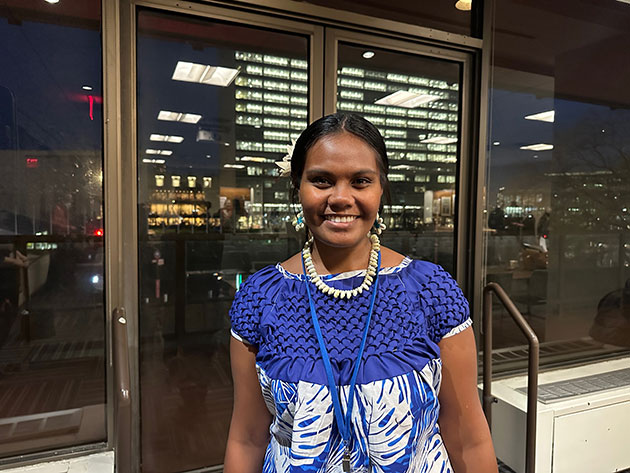
The forum created a space where views, ideas, and common experiences were shared, especially for communities that “rarely have such opportunities”, according to Taraem Taukaro, a youth delegate who came to the event with the Kiribati government representatives. The Republic of Kiribati has been one of several island nations in the Pacific that were impacted by nuclear tests, notably conducted by British and American military forces in the mid-20th century. The Kiritimari island, which is part of the Republic, was previously the site of multiple nuclear bombing tests between 1956 and 1962.

Taukaro’s mother, who lived through the testing, suffers from health issues which is believed to have been caused by exposure to radiation from the fallout. This exposure also resulted in health complications for the next generation, like with Taukaro’s sister, who was born deaf. It is a challenge for this family to have been impacted this way. One of the direct impacts has been that the indigenous Kiribati people that lived through the tests are afflicted with health problems and have suffered losses in their environment and biodiversity. Their descendants now contend with the same issues.

Bedi Racule, nuclear survivors forum. Credit: Katsuhiro Asagiri

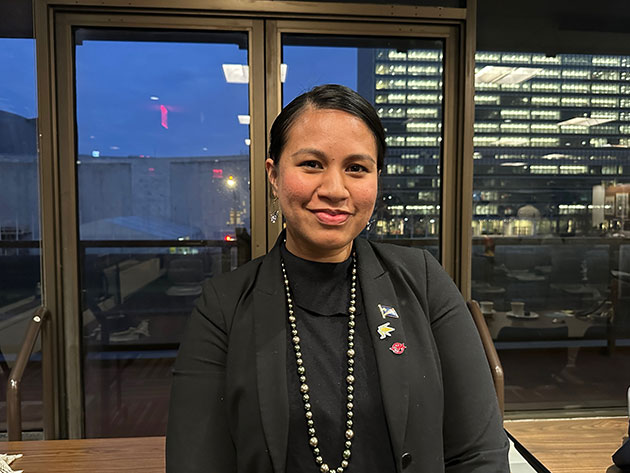
Bedi Racule, an activist with the Pacific Conference of Churches, provided perspective on the impact of nuclear testing on the Marshall Islands and the greater South Pacific region. The US military conducted nuclear tests in the region, notably on Bikini Atoll between 1946 and 1958. As Racule noted, many Pacific communities continue to feel the impact of nuclear testing, which encompass cancer, displacement, and ecological contamination.

“There is a loss of our wellbeing and our quality of life and our connection to land and ancestors and culture,” she said. “…There is a lot of pain and trauma.”

When speaking of the nuclear survivors who attended the forum, she added: “I really feel for this community, and for my people. I also want to highlight their resilience, their strength. Having vulnerability is not weakness. It is strength… I just want to commend all of these people that have stood up now and in the past for a better world that’s free of nuclear weapons. And specifically, have a nuclear-free zone, and the first nuclear-free constitution.”

For young people, there is a greater responsibility to them to educate them on the impact of nuclear testing; to contextualize the history and the way their connection to culture has shifted, including what has been lost.

Racule remarked that during the forum, there was a call from the affected communities to establish an advisory group. “The core of [the TPNW] is the humanitarian response to nuclear weapons, knowing what has happened in the past and seeking justice for that and preventing these experiences from ever being felt again by anyone.”

Taukaro remarked that the international community, including the British government, could do more to provide funding and support for medical resources and environmental clean-up, as part of the compensation towards the affected communities in Kiritimari and its neighboring islands.

Racule expressed a different view. “Among our network of nuclear justice advocates, it is very well-acknowledged that nuclear issues are intrinsically linked to issues of colonization, of self-determination,” she said. “Even our countries in the Pacific that are free and independent and sovereign, they still have trouble voicing their wants… because of geopolitical interests, because of aid donor funding. We also see this development aid as a way to come in and influence what is happening, to take away our freedom not only politically but economically, financially, socially.”

With real life testimonies from survivors and their descendants, the event was a reminder that nuclear disarmament must be effective sooner rather than later to ensure that our future generations can live in peace and pursue decent lives. The public conscience must be respectful and elevate the voices of the indigenous communities who have been disproportionately affected by nuclear testing and live through its fallout, well into the new millennium.

IPS UN Bureau

  Source

A Climate Scientist’s View of COP 28

Civil Society, Climate Action, Climate Change, Conferences, COP28, Energy, Environment, Global, Headlines, Indigenous Rights, TerraViva United Nations

Opinion

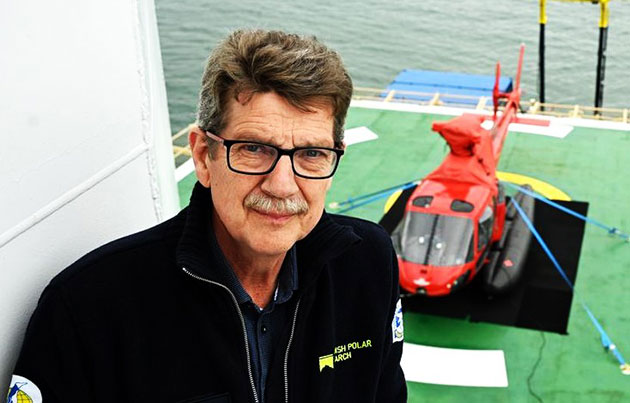
Research team in the Arctic. Professor Tjernström is standing on the left.

STOCKHOLM, Sweden, Dec 4 2023 (IPS) – This year’s UN Climate Change Conference is taking place in Dubai from 30 November to 12 December. The so-called COP summits are organised every year and constitute a means for the global community to agree on ways to address the climate crisis, such as limiting global temperature rise to 1.5 degrees Celsius, supporting vulnerable communities to adapt to the effects of climate change, and achieving net-zero emissions by 2050.


More than 70,000 delegates are attending the COP28 in Dubai. Main delegates are the 47 representatives of the member states (called Parties), which constitute the UN Framework Convention on Climate Change (UNFCCC). Business leaders, young people, climate scientists, Indigenous Peoples, journalists, and various other experts and stakeholders are also among the participants. Officially, COP 28 stands for the 28th meeting of the Conference of the Parties to the UNFCCC.

UNFCCC was established in 1992 to combat “dangerous human interference with the climate system”, in part by limiting the greenhouse gas emissions that compromise Earth’s entire ecosystem, a prerequisite for human existence. Among other items on its agenda COP 28 will address progress made in accordance with the Paris Agreement of 2015, when 195 Parties of the UNFCCC agreed to keep the rise of global temperature to well below 2 °C (3.6 °F), compared to pre-industrial levels, and preferably limit the increase to 1.5 °C (2.7 °F).

To gain a scientific perspective of the meaning and influence of COP28, IPS asked Professor Tjernström about his views on climate change and what he assumes might be done to amend it. Michael Tjernström is since 2001 professor of Meteorology at Stockholm University. He has spent several periods at institutions such as CIRES, The Cooperative Institute for Research in Environmental Sciences (CIRES) and The Earth System Research Laboratory (ESRL) and National Center for Atmospheric Research (NCAR), all in Boulder, Colorado, USA. Professor Tjernström’s main research interests concern climate change in the Arctic. He has participated in several scientific expeditions to Arctic areas and is since 2011 a member of the International Arctic Science Committee.

Michael Tjernström

IPS: Professor Tjernström, can the outcomes of COP28 drastically affect current climate changes?

Michael Tjernström: The COPs are a necessary and essential factor when it comes to addressing climate change. A COP summit might be likened to a regular check-up visit to the dentist. It can be painful, but is necessary for good dental hygiene. The dentist might find that your teeth are in a very bad state and to save them, urgent measures have to be taken – caries has to be amended, maybe a bad tooth has to be extracted, dental bridges inserted, etc . The point is that the dentist is an expert and you have to trust him. However, the decision to save your teeth is all yours. In a similar fashion the COPs intend to amend already present damages to the climate, determine their causes and try to prevent a negative development. But it is up to the members to act.

IPS: How do you perceive the UN’s role in this endeavour?

Michael Tjernström: There is absolutely no other global organization other than the UN which would be able to organize and be in charge of such a process. No other national, international, political or private, organisation would be able to establish a global consensus and general awareness, as well as maintaining the perseverance, stamina, objectivity and legal strength to do so. An endurance against all odds, but nevertheless made possible through the UN’s established rules, combined with its global and local outreach. Of course, there are cracks and concerns, but the administrative structure and operations of the UN are firmly based on the commitment of its member states.

People, who in general are prone to criticize the UN system are often only perceiving the actions of the Security Council and how its commitment is crippled by the veto power of its five permanent members. However, this does not apply to the UNFCCC and its scientific support organisation, ICCP. As a scientist and propagator for awareness about climate change, I perceive the lack of understanding the great importance of the UN as a marketing problem. People are not aware of what this global organisation stands for, and even less so – its support of the global scientific community.

IPS: Will you attend the COP summit in Dubai?

Michael Tjernström: No, most scientists have through their research already made their fair contribution to efforts to combat climate change. The current state of research, results and warnings are comprehensively explained and diffused through the ICCP reports and scientists have thus no need to attend the COPs. Whether or not politicians listen to science or not is not determined by my presence at a COP.

COP summits are more politically than scientifically motivated. However, they are based on the factual basis provided by ICCP reports. The COPs mainly attract other stakeholders than scientists, such as government representatives, spokespersons for environmentalist pressure groups and lobbyists representing the interests of fossil fuel-based industries, as well as oil and coal producing companies. Many such lobbyists try to find a place among decision makers, while environmentalists might be looking for political scapegoats.

People and organisations are trying to highlight their own, often specific interests, some of them being based on doubtful assumptions and moral priorities. Environmentalists have often demanded that certain interest groups be excluded from COP summits, like those lobbying for the use of fossil fuels, interests of oil producers, as well as industrialists who, for the sake of their own profit, try to minimize the threat from global warming.

Nevertheless, it is important that influential stakeholders are present . The global outreach demands this. Everyone has to be allowed to have their voice and concerns heard, as well as being provided with an opportunity to be informed about scientific achievements, new environmentally friendly technologies, and the threats of global warming.

Industrialization based on non-polluting and zero emissions of greenhouse gases, as well as new eco-friendly technology, are essential for change and improvement. Environmentalism’s contributions are also important. Like most revolutionary movements radical environmentalists highlight political and capitalist motivational reasons and misconduct, while they demand change and sacrifice. Historically did socialists and suffragettes contribute to emancipation and justice. However, some revolutionaries have turned into fanatics, and some have concentrated on relatively minor but easily targeted issues while ignoring an overall picture. For example, opponents to air travel are maybe not fully aware of the fact that it actually contributes to only three percent of global greenhouse emissions, while private cars and other fossil-fuel based transportation means account for much more of carbon dioxide emissions . It might be stated that it would be more beneficial for the environment to limit the use of your car, than avoid travelling by air. Veganism may be considered as beneficial when it comes to emission of greenhouse gases, though methane emissions from ruminating animals constitutes less than five percent of greenhouse gas emissions. If we could stop throwing away a third of all the food we produce, this would be much more efficient and would also have other benefits. However, every effort to limit greenhouse emissions is worthy of attention, though decisive and comprehensive political actions are particularly crucial for achieving zero greenhouse gas emissions as quickly as possible. It is not enough to limit them; they must be eliminated.

IPS: But can COPs really have the impact you could wish for?

Michael Tjernström: In several respects, development is moving in the wrong direction, especially when it comes to acquiring knowledge. Many confide in badly informed, or even deceitful, social media and populist politicians. In certain circles a negative attitude to research and science is thriving. Science might by such groups be perceived as an essentially separate activity, practiced by an intellectual elite devoting itself to mutual admiration.

The COPs make participants aware of the fatal threat of global warming. But more than that, it also makes the general public aware and therefore participants can be held accountable for their actions, or lack thereof, and are through legally binding agreements forced to take social and economic measures to amend the ongoing destruction of natural resources, and the atmosphere.

IPS: What exactly is ICCP and what is its connection with the COPs

Michael Tjernström: Generally speaking, people are not knowledgeable, most don’t know what ICCP is. The task of ICCP, i.e. The Intergovernmental Panel on Climate Change, is to advance scientific knowledge about climate change caused by human activities and it does so by examining all relevant scientific literature on the subject. This comprehensive review and dissemination of scientific insights and research results include natural, economic and social impacts and risks. ICCP also covers possible responsive options. IPCC does not conduct its own original research, its mandate is to survey the research situation, while aiming at being objective and comprehensive, and only openly published results that have already been reviewed by experts can be used. Thousands of scientists and other experts then volunteer to review the findings and publications of ICCP, before its key findings are compiled into a Synthesis Report intended for policymakers and the general public. Experts have described the work of ICCP as the biggest peer review of the global scientific community. COP28 will discuss the 6th ICCP Synthesis Report, issued in March 2023.

Most climate-related risks assessed in the Fifth Synthesis Report, issued in 2014, are in the Sixth Report deemed to be higher than earlier predicted and projected long-term impacts are worse than they were assumed to be in 2014. The Sixth Synthesis Report highlights that climatic and non-climatic risks will increasingly interact, creating compound and cascading risks, which will be extremely difficult to manage. The confidence of the conclusions has also been gradually increasing across the reports.

The development of climatological research is quite fast, the lag in actual efforts to halt global warming is mainly to be found in decisive decision-making. The original ICCP reports contain tens of thousands of pages that few decision-makers can assimilate. The summary for policy makers is reviewed and edited by several stakeholders. Efforts may thus be made to mitigate alarming findings and adapt them to political concerns. However, changes and adaptions are carefully wetted in order to secure that none of them contradict actual and fact-based research results, predictions and warnings.

IPS: Do you perceive yourself as a pessimist, or as an optimist?

Michael Tjernström: I am both hopeful and worried. As a researcher I cannot allow myself to fall victim to paralyzing dystopias. As a scientist I contribute to the measurement of climatological processes, while taking the pulse of the current situation, but also looking for trends and measures to mitigate, and perhaps even hinder, a worrisome development. Accordingly, a scientist has to be a kind of optimist even in the face of despair. Furthermore, I consider that my role as a researcher has to involve the popularization and dissemination of research results. A role I appreciate and feel comfortable with.

It is reasonable that we in the West, who so far have contributed by far the most to the ongoing climatological damage, also take our responsibility when it comes to mitigation and adaptation. We have the technological, historical and scientific prerequisites to make amends for all the damage we have caused and should therefore also go into the breach for the realisation of necessary improvements, while contributing to the economic means to do so.

But the picture is complicated. China is making great progress in climate research, but is at the same time contributing to the world’s largest emissions of greenhouse gases in total, and is number two in the world in per capita emissions, yet is still claiming they should still be treated as a developing country and indeed has a large poor population in the face of a rapidly growing middle class. Africa is lagging behind in its industrial development and consequently have limited emissions, but must nevertheless already now end its dependence on fossil fuels.

We in the West live well and safely and could without any major problems dismiss a lot of the gratuitous comfort we currently are enjoying. The drama is undeniable, even when the Paris Agreement was signed it was by some researchers pointed out that the 1.5 target was unattainable in reality. There is much talk about tipping points, when much of the existing ecological balance suddenly collapses, and that this might happen at a two degree rise in global temperature. But contributing factors are manifold and I don’t believe it will be happening in the near future. There is no really compelling evidence for most of these suggested tipping points. The most important thing is to immediately stop the burning of fossil fuels. In spite of all, I assume that much can and will be done to stop the worrisome development.

IPS interchange with Professor Tjernström was quite extensive and informative. In a following article we will return to Professor Tjernström describing his own research and thoughts about current, and future climatological changes.

IPS UN Bureau


UN Volunteers – and Their Over Reaching Mission

Civil Society, Democracy, Featured, Global, Headlines, Human Rights, IPS UN: Inside the Glasshouse, TerraViva United Nations

Opinion

UN Volunteers Day is commemorated annually on December 5.

KATHMANDU, Nepal, Dec 4 2023 (IPS) – If there is an agency or program within the UN that I really admire and wish the best for, this is the United Nation Volunteers or UNV. Its overarching mission, mandate and key objectives are paramount for humanity.


Unfortunately, volunteerism is neglected worldwide and its transformative importance never fully understood. There are no single issues affecting our planet and the whole humanity that does not require volunteerism.

That’s why UNV that is technically part of UNDP, has a big role to play. Yet, to some extents, UNV is missing into action as it has been unable to raise to the challenges. It can be an issue of lack of availability of resources or it could be the complex red tape system bogging down the whole UN System.

It can be simply the fact that each agency and program within this galaxy of UN entities is simply not too adept at mainstreaming and embed volunteerism in their operations. For sure, UNV does not lack expertise nor very passionate and capable persons, some of whom I have been able to collaborate with in the past.

They really believe in the cause, in the promotion of volunteerism and they really want to push hard so that development can fully leverage its power. But somehow, considering its expertise, UNV is underperforming.

Probably one of the biggest challenges for an organization like UNV is the difficulty in engaging and involving stakeholders on continuous basis. There are actually some big success stories for UNV on this regard.

For example, the Global Technical Meeting held in July 2020 after months of preparations was a truly, groundbreaking initiative.

The end result was an important blueprint to embed volunteerism in the global development agenda, ensuring that volunteerism could really placed at the center of the pursuing the Agenda 2030 and the Sustainable Development Goals.

Getting the Global Technical Meeting in place took months of preparation and several online discussion groups were created where stakeholders, practitioners and citizens passionate about volunteerism, could contribute. Enabling such forums was remarkable and a true achievement for UNV.

Yet after more than three years since then, no real follow up mechanism has been established. The initial excitement that a new level of global discussion on volunteerism had been achieved, then rapidly declined.

Now I am wondering why in the recently held SDG Summit, to my best knowledge, there was no serious debate on what volunteerism can do to support the implementation of the Agenda 2030.

It is not surprising, therefore, that there has not any apparent and inclusive exercise to revise the implementation of The Plan of Action to Integrate Volunteering into the 2030 Agenda.

Another example is the organization of the International Volunteer Day (IVD) that is celebrated December 5. This can be a great opportunity not only to raise awareness but should also be seen as a key platform to engage and mobilize people throughout the year.

So far, the practice, at countries level, has been to have a sort of coordination mechanism one or at the most two months before the celebrations. While it is important to bring practitioners and stakeholders together for IVD and while I always considered these engagements meaningful, I always felt that we were missing an opportunity.

I always believed that IVD should be not only a big carnival, a moment of joys where local volunteering champions are recognized and duly acknowledged. This component is essential and always needs to be on the front.

At the same time, the day should be used to talk about the less glorious and yet important nitty gritty of policy making. Many might not think of this aspect as strategic.

Yet, if we really want to elevate volunteerism at the center of the Agenda 2030, it is essential to discuss about policies and legislations that can truly empower volunteering efforts for social change.

Think for example about the process of localizing the SDGs? Can’t it be a phenomenal way of engaging and involving citizens? Participation is also a key aspect of volunteerism and a key tenant of the broader concept of civic engagement.

Yet the most important function for IVD is to rally together the whole “movement”, all those love volunteerism: academicians, practitioners, experts, representative of national and international NGOs, donors but also students and any citizens passionate about it.

This means coming forward with extensive planning and collective capacity to execute them, a process that requires months and months of preparation. By my own observation, it was way too late, towards the end of November, when UNV started sharing information about today’s main message.

Even deciding on the theme of IVD could become an exercise of participation with rounds of consultations, ideas contests to provide the best and more meaningful ideas for it. In a way, IVD, in the way I see it, should be seen as the pinnacle of a whole year coordination exercise, not only an end into itself but a catalytic event that stirs the movement to action throughout the year.

UNV has a unique role to help shape this whole dynamic. Conducive to it would be the creation of coordination mechanisms that bring together all the stakeholders. These could take different shapes and forms, from informal working groups to more formal networks and forums.

Based on my own experience, it is wise to start small and then build momentum gradually, step by step. These mechanisms would not only work as info sharing and coordinating platforms but also as groups that plan and execute joint events and activities all year long.

For example, running two or three of such activities, like discussion forums, or awareness trainings at school levels could precede and build excitement around the final big event, IVD. There is no other player that has the mandate and convening power like UNV to bring together such collaborations.

At the same time, I am fully aware that resources at disposal for UNV are not endless especially in times of crises and UNV local country offices have to balance many competing priorities.

That’s why better and more strategic coordination at local level could tremendously help UNV pursue its mission. Another one that deserves attention is the mobilization of UNV Volunteers.

I always felt something odd about such programs. In reality, the program, even if admirable, is basically a full-time paid job. If you compare its stipends or allowances with formal UN jobs, it is clear that a member of UNV just receives a decent remuneration.

Yet the reality is different and more complex. Compared with many local jobs offered by local NGOs, that same package disbursed to an UNV volunteer looks like an awesome salary.

But the compensation aspect is only one problematic side of the equation. The other is the fact that this form of full-time volunteerism promoted by UNV risks to create further confusion about some of the key tenants that are enshrined into it.

I am referring to the cooperative, solidarity driven and generosity filled self-conscious decision of helping, even in very organized forms, others. By no means, I am implying that full time volunteering is intrinsically and necessarily wrong.

It is one of the many ways to support a cause and act selflessly. Yet there are several other experiences of it that are better enabling positive change at grassroots levels, closer to the beneficiaries that can, more easily, become true partners in advancing social justice.

In these examples, international full-time volunteers do get some allowances that provide for their basic expenses and live safely and with dignity. Yet these “privileges” are not too detached from the reality of the hosting countries.

National and International UNV Volunteers are on many ways promoters of positive development outcomes and should be praised for their commitment. Yet there is something wrong when many join the UNV volunteer program, either nationally and internationally, because they know that this is a great launchpad to full fledged careers with the UN.

I have no doubt that UNV is uniquely positioned to enable systemic social and economic progress.Its mandate and mission are more important than ever. Yet from engaging in the global discussions to achieve the Agenda 2030 to rethinking the role of citizens in the delivery of essential services, including ways people can participate in the decision making, volunteerism is the hidden gem of the global development agenda.

In this International Volunteer Day, let’s praise the accomplishments so far realized by UNV. At the same time, let’s work together to ensure that a more agile, proactive organization can turn itself into a much stronger hub of activism, social change and dynamic discussions.

Volunteerism is a too important aspect of our humanity.Only a revamped UNV can leverage it and help it truly become indispensable dimension of our lives, not only in the South but also the North as well.

Simone Galimberti is the Co-Founder of ENGAGE and The Good Leadership. He is based in Kathmandu, Nepal.

IPS UN Bureau

  Source