Predicting COVID-19 Infection Fatality Rates Around the World

Civil Society, Development & Aid, Editors’ Choice, Featured, Global, Global Governance, Headlines, IPS UN: Inside the Glasshouse, Poverty & SDGs, TerraViva United Nations
Opinion

WASHINGTON DC, Jun 16 2020 (IPS) – The world saw more new confirmed COVID-19 cases last week than any week to date. And as the pandemic grows, its epicenter is moving from advanced economies to more developing countries, including Brazil, India, and South Africa.


How is the pandemic likely to evolve as it spreads to poorer countries?

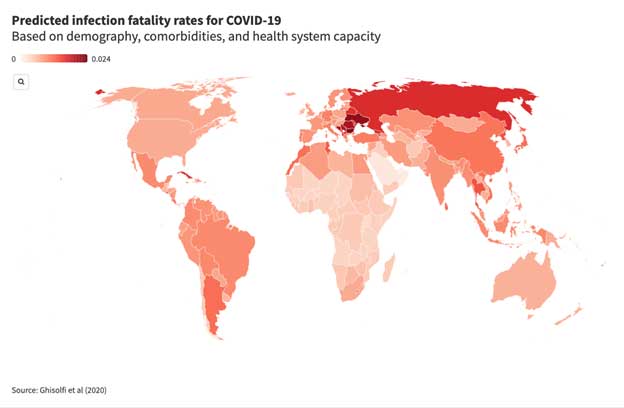
In a new working paper, we attempt to answer one piece of that question, predicting the infection fatality rate, or IFR, for COVID-19 for 187 countries based on demography, comorbidities, and the strength of health systems.

The IFR numbers we report are somewhat higher—sometimes dramatically so—than the figures given for many developing countries in earlier influential studies, including the Imperial College team’s scenarios for the global pandemic and a recent report by the WHO Africa bureau.

That difference can be chalked up to how we incorporate two factors: pre-existing health conditions, and the relative strength of health systems.

For many developing countries, comorbidities partially offset the advantages of youth

A recent study in Science by Salje et al., for instance, finds that with French-level healthcare, the probability of dying with COVID-19 rises roughly eight-fold when moving from the 60-69 age group to the 70 and above range. This is good news for developing countries, which generally have a much younger population than France.

Most previous forecasts of the COVID-19 infection fatality rate have incorporated this demographic advantage. However, they have generally not included the offsetting effect of cross-country differences in comorbidities.

Those comorbidities—such as diabetes, hypertension, and ischemic cardiovascular diseases— matter a lot. Data from Italy show that roughly 96 percent of COVID-19 fatalities report one or more relevant comorbidities.

Inverting that probability using Bayes’ rule and data on France’s IFR and comorbidity distribution, we find that the probability of dying from a COVID-19 infection for patients under 40 is roughly 134-times higher with a relevant comorbidity than without.

Developing countries generally have lower rates of relevant comorbidities compared to high-income countries (where the best measures of infection fatality rates come from). But whereas comorbidities are concentrated among the elderly in rich countries, some developing countries—such as South Africa—report a considerably higher share of these conditions among middle-aged people.

Future work would benefit from more careful treatment of comorbidities like HIV/AIDS that have higher prevalence in lower-income countries. But even a simple adjustment for comorbidities partially undermines many developing countries’ demographic advantages.

Evidence from other viral respiratory infections suggests a much bleaker scenario for COVID-19 in the developing world

So far, our estimates assume that an individual infected with COVID-19 in, say, Uganda has the same probability of dying as someone with the same sex, age, and number of comorbidities in France. Clearly that’s optimistic, given the overall capacity of Uganda’s health system relative to France’s. But exactly how optimistic?

To gauge how much fatality rates might vary with health system capacity, we draw on estimates of the infection fatality rate for another viral respiratory infection, namely influenza. We focus on children under five years old, to purge variation in age and comorbidities that typically begin later in life, and scale the odds ratio of dying from COVID-19 by the ratio of child influenza death rates across countries by income group.

Adjusting for health-system capacity in this way yields COVID-19 infection fatality rates that are considerably higher than previous estimates for the developing world. For the five countries in Sub-Saharan Africa with the largest confirmed COVID-19 epidemics to date, our results are roughly twice as high as those from Imperial College, which does not factor in comorbidities or health system strength beyond a simple capacity constraint on hospital beds.

And they are roughly eight times higher than forecasts from the WHO Africa, which do not adjust for health system capacity and only scale the IFR downward (never upward) due to comorbidities.

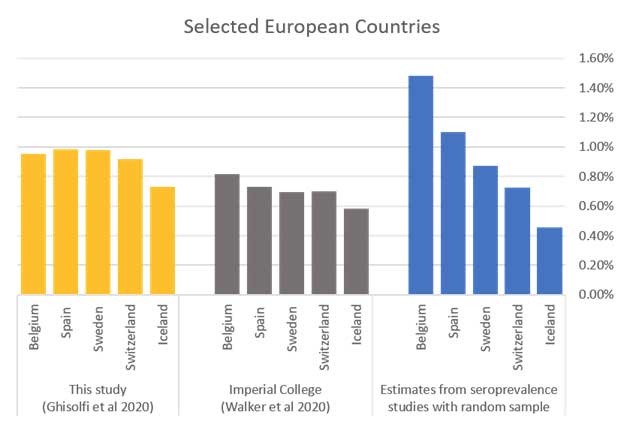
Comparing predicted COVID-19 infection fatality rates across studies
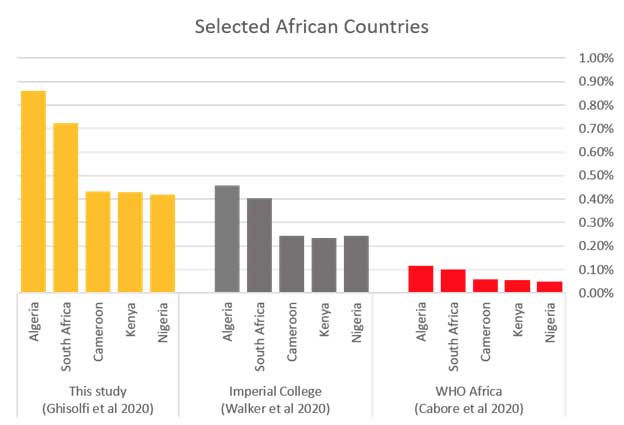
Our results are more in line with the Imperial College predictions for Europe, as shown in the bottom panel above. For the five European countries shown, we can also compare to a more “gold standard” benchmark, i.e., infection fatality rates calculated on the basis of seroprevalence studies of a random sample of the population (blue bars).

Both our results and the Imperial college results match these seroprevalence studies fairly well on average, but fail to explain much of the intra-European variance (some of which may be due to variance in how deaths are counted, e.g., Belgium’s fairly liberal definition of a COVID-19 death to include all unexplained nursing home deaths).

In short, our IFR estimates seem fairly plausible for Europe, where we have an independent reference point, and our results suggest that earlier predictions for developing countries that ignore health system capacity may be far too optimistic.

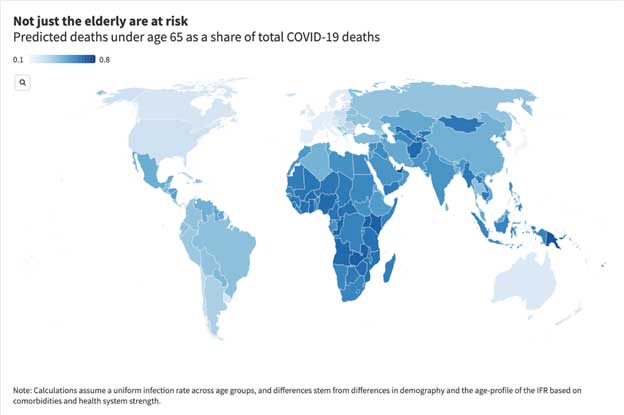
In line with recent news reports, it’s likely young people will make up a larger share of COVID-19 deaths in the developing world

In the United States to date, patients over 75 years old represent over 60 percent of COVID-19 deaths. In Italy, the number of fatalities above 70 is 85 percent.

Both demography and weak health systems explain why COVID-19 deaths are more concentrated among younger people in the developing world

Although predicted IFRs display a steep age gradient in all contexts, due to demographic differences the bulk of deaths in low- and lower-middle income countries is predicted to come from middle-aged patients (40-70).

Less obviously, differences in health system capacity are also likely to flatten the age gradient of COVID-19 deaths in developing countries. In Europe, data is consistent with the hypothesis that intensive care saves the lives of a higher proportion of young than elderly COVID-19 patients. Thus, when high-quality intensive care is lacking, the advantages of youth are more muted.
These estimates are far from the final word on this question. But we hope that our calculations provide an important cautionary note about developing countries’ demographic advantages in facing down COVID-19.

Planning for the ongoing pandemic response and calibration of containment policies should factor in the wide variation in predicted IFRs across contexts. Specifically, policymakers in low-income countries should be cognizant that any demographic advantages with respect to COVID-19 fatality rates are likely to be partially offset by disadvantages in terms of the age-distribution of comorbidities, and even more so by gaps in health system capacity.

*Justin Sandefur is a senior fellow at the Center for Global Development (CGD) ; Selene Ghisolfi is an economics post-doc at the Laboratory for Effective Anti-poverty Policies Bocconi, and a PhD student at the Institute for International Economic Studies, Stockholm University; Ingvild Almås is a professor of economics at the Institute for International Economic Studies, Stockholm University; Tillmann von Carnap is a PhD student at the Institute for International Economic Studies, Stockholm University; Jesse Heitner is a health economist at Aceso Global; and Tessa Bold is an associate professor at the Institute for International Economic Studies, Stockholm University.
  Source

How Cities Can Turn COVID-19 Crisis into an Opportunity to Build Better

Civil Society, Development & Aid, Editors’ Choice, Featured, Global, Global Governance, Headlines, IPS UN: Inside the Glasshouse, Poverty & SDGs, TerraViva United Nations

Opinion

Johnny Miller is a photographer, documentary maker and UN-Habitat Champion based in Cape Town South Africa.

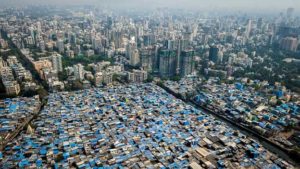
High rise apartments & green spaces contrast with the adjacent sprawling slum area in Mumbai, India. Credit: Johnny Miller

CAPE TOWN, South Africa, Jun 12 2020 (IPS) – From shocking death tolls to widespread job losses, there is no understating the severity of the COVID-19 pandemic’s impact on the world’s cities.

Health care systems, economies, and social lives have been upended by a virus for which the world was totally unprepared.


But even as cities struggle with basic needs like providing a safe environment for all, there is as an opportunity for long-lasting changes to make our cities both more prosperous and equitable and less vulnerable to future shocks such as highly contagious diseases.

Cities and local governments should be recognized for steps they are already taking to build public health, social, and economic resilience during this crisis. They are disinfecting public transport and are keeping public spaces clean.

They are mobilizing both professional and volunteer networks to source, make, and distribute personal protective equipment for frontline workers. They are making sure food reaches older persons who are self-isolating for their own safety and struggling families with children who are no longer going to school, being challenged equally by new ways of working such as home schooling and home office.

This unprecedented moment requires emergency action and social solidarity. We can seize on this brief window to “retro-fit” and make permanent improvements by both delivering the fundamentals of sustainable cities from the pre-pandemic era and adopting the measures that are likely to be necessary in the post-pandemic era.

Our future cities need to be resilient, sustainable, inclusive and equitable. They need to be forward-thinking, able to innovate and better positioned to withstand shocks and catastrophes like the Covid-19 pandemic.

To do this they will need to respect core human values of dignity and care, and invest in citizens’ health along with decent shelter, clean water, and free education. They will recognize that diversity is a strength, and that achieving equality of outcomes for all means safeguarding the rights of expression and culture.

Future cities must rethink and reorganize their built environment using the lenses of equity and access. COVID-19 has exposed the reality of profoundly divided populations. Regenerating neglected urban areas can bring healthy, sustainable benefits to local communities, which in turn increases city resilience as a whole.

Connecting communities with people-friendly parks, green spaces, and community-aligned infrastructure allows neighborhoods to prosper and thrive once more.

We see some cities embrace the “new normal’. Lyon has a plan to more permanently house 1,500 homeless people who were offered temporary shelter during France’s lockdown. Cities around the world have closed streets to cars in order to provide more space for pedestrians and cyclists.

Already, Seattle and Paris have said some of those changes will be made permanent. Bogota, one of South America’s most cycle-friendly cities and already a leader in sustainable transport, just dedicated over 70 more kilometers of bike lanes on top of the 550 that already exist.

With the disruption of global supply chains and long-distance air travel, it is possible that future cities will look and act more locally, with localized and self-sustaining networks of food production, green spaces, and even power generation.

By moving away from a reliance on overseas producers, we can unlock the true value of neglected assets and resources within communities which currently lie dormant.

At the same time, the cities of the future will be more reliant on digital technology and the wide utilization of the internet even as children learning from home eventually go back to school and knowledge workers connecting remotely will eventually return to spending more time in the offices again.

Even in the poorest regions of the world, city dwellers are beginning to rely on the internet for education, business, banking, and social relationships. COVID-19 has already opened our eyes to a world where only those with the freedom and privilege to be able to access the online world are the ones able to access all society has to offer.

The current crisis provides an opportunity for cities to ensure that digital services are available to everyone, but they need to take a proactive approach to digital technologies.

This could include investing in community broadband and free public wi-fi, providing digital literacy and skills to older people and marginalized communities and making websites and online platforms accessible to people with disabilities. Bridging the digital divide, already a pre-pandemic challenge, will be essential to building back better neighborhoods.

The good news is that many cities already see the benefits of resilient, inclusive societies, and some areas like Kerala state in India are weathering the COVID-19 storm well even without massive financial resources.

This is showing that focusing on public health delivery in a compassionate, equitable way, is just as important as economic stimulus to the recovery of a region once the pandemic is over.

The choices we make in the next year will define our societies for an entire generation and perhaps beyond. Let’s use this opportunity as a fulcrum to leverage the future that we know we can build together.

  Source

COVID-19 & its Impact on Textile & Garment Supply Chains in Developing Nations

Civil Society, Development & Aid, Editors’ Choice, Featured, Global, Global Governance, Headlines, IPS UN: Inside the Glasshouse, Poverty & SDGs, TerraViva United Nations

Opinion

Antonella Teodoro is Senior Consultant at the UN Conference on Trade and Development (UNCTAD) & Luisa Rodriguez is Economic Affairs Officer, UNCTAD

GENEVA, Jun 11 2020 (IPS) In the first quarter of 2020, the coronavirus pandemic led to a 3% drop in global trade values. COVID-19 could trigger the biggest economic contraction since World War II, affecting all industries from finance to hospitality.


As there is significant uncertainty about how the epidemiological and economic situation will evolve, assessing the duration and the gravity of the pandemic seems like an impossible task.

However, recent forecasts suggest: trade volumes decreasing between 13% and 32% in 2020 (WTO, 2020), global growth falling to -3% (IMF, 2020) and different maritime seaborne scenarios ranging from a return to sector average (around 3% p.a.) after 2022 to growth rates falling by 17% by 2024 (Stopford,2020)[i].

Industries whose operations are more globalized (and particularly those that rely on Chinese inputs for production) were most exposed to initial supply chain disruption due to COVID-19. This was the case for precision instruments, machinery, automotive and communication equipment (UNCTAD, 2020).

Given its non-essential nature, the fashion industry faces significant risks. Indeed, in times of COVID-19, as consumers around the world remain in lockdown, they no longer need new products. This industry is characterised by a highly integrated global supply chain.

In it, many developing countries play the role of the supplier of low-cost inputs. This article highlights some of challenges and concerns that some of these countries face, many of which are dependent on textile and garment exports.

The textile industry supply chains, trade logistics and developing countries

The accession of China to the WTO (2001) and the expiry of the WTO Agreement on Textiles and Clothing (which ended a 10-year trade regime managed through quotas) on 1st January 2005 contributed to making China an important centre of textile and clothing global value chains (GVCs).

These two developments led to shift apparel production and sourcing (by globalized retailers and producers) to China and other Asian countries because of low labour costs (UNCTAD, 2005), following the cost-reducing logic of GVCs.

As wages gradually rose in China and Chinese plants moved to produce higher-value goods, countries like Bangladesh, Pakistan and Vietnam, with lower wages costs started attracting factories to relocate their production from China.

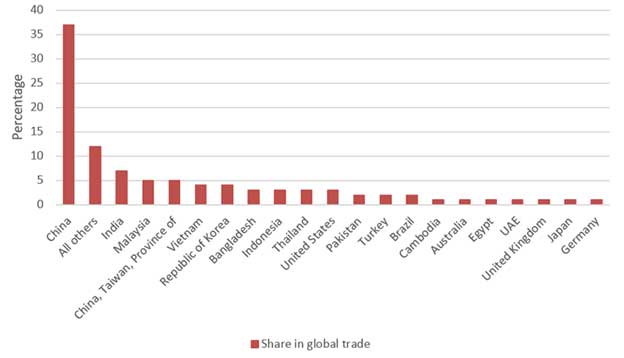
At the global level, China remains an important supplier of fashion goods (as shown in Figure 1) but has also become an important consumer of this industry.

Figure 1: Top 20 exporting countries of fashion goods*
(share in global exports), estimated TEU 2019

* SITC, 2-digit categories including: Textile fibres, Textiles & made-up articles, Clothing & accessories. (Source: MDS Transmodal, March 2020)

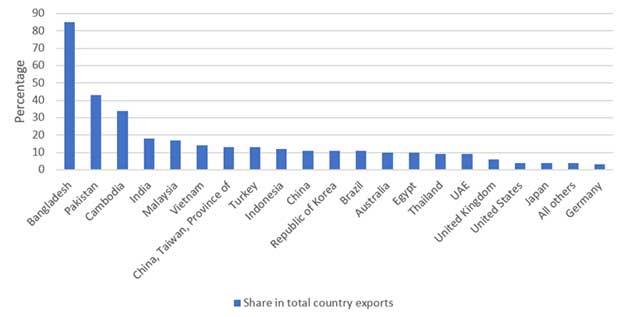
Major exporters of fashion goods for whom exports in the sector represent a significant share of export earnings are shown in Figure 2. Consequently, the Asian country most badly affected by the disease outbreak could be Bangladesh where circa 85% of its exports include fashion goods, as shown in Figure 2.

Figure 2: Top 20 exporting countries of fashion goods*
(share in total country exports), estimated TEU 2019

* SITC, 2-digit categories including: Textile fibres, Textiles & made-up articles, Clothing & accessories. (Source: MDS Transmodal, March 2020)

Given the globalized nature of the industry, companies and retailers must transport their goods and raw materials across many countries. Besides China, other countries play an important role as key hubs around which trade of fashion products takes place.

This is the case for the United States (as the most important retail market), and some European countries (such as Belgium, Germany, France and UK), with ports such as Rotterdam and Antwerp featuring prominently in this trade. (CO, 2018).

From a logistics point of view, the textile, apparel and garments industry is considered a time-sensitive industry. Irregularities in making goods reach a particular place at a specified location on time can lead to reduced (or no) profits for the textile owner.

In addition, clothing collections change quickly: their lifecycle is short (as perishable products) and their commercialization is characterized by strong seasonal peaks. In this sense, textile logistics are characterized by small stocks and short delivery times.

These goods and raw materials are usually transported using a combination of land, sea, and air. Within this trade logistics context, strong multimodal interlinkages are key to ensure Just in Time delivery.

E-commerce developments have further accentuated time-related logistics requirements, such as next day delivery, as well as the capacity of handling a large volume of returns and offering the possibility for manufacturers and dealers to check the location of their articles at any time.

Emerging concerns related to COVID19 from the perspective of developing countries

The COVID-19 outbreak led to production stops in China first, followed by closures of shops elsewhere around the world.

For the moment, European and American retailers, the two destination markets for this sector, are still cancelling their orders. Cancelled orders are a cause for concern in many sourcing countries.

As shippers are increasingly invoking ‘force majeure’ clauses within their contracts to halt their payments, on 8 April, the Sustainable Textile of Asian Region (STAR) Network, the body, which brings together representatives of the producing associations from Bangladesh, Cambodia, China, Myanmar, Pakistan and Vietnam, released a joint statement on the issue.

It urged brands and retailers to consider the impact that their purchasing decisions during the coronavirus pandemic could have on workers and small businesses in the supply chain and, therefore, to honour their contracts with their suppliers.

In their statement, the STAR Network invited global businesses to “support business partners in the supply chain as much as possible, and aim at a long-term strategy of business continuity, supply chain unity and social sustainability.”

Supply chain disruption: the reduced production perspective

The evolution of local epidemiologic situation in key sourcing countries, has impacted workforce availability and production, as well as multimodal logistics underpinning global value chains.

One of the concerns in this respect is that production of fashion goods could be moved away to other sourcing countries that are resuming activities faster in the Asian region or that are closer to retailers to diversify their supply chain risk.

Governments in developed countries around the world are implementing unprecedented actions to ease the effect on their economies from measures put in place to limit the spread of the pandemic.

Most developing countries do not have similar financial means, health systems or social safety nets to respond to the COVID-19 pandemic crisis and its economic impacts.

In this context, various assistance packages have been announced by IMF, the World Bank and others with a view to supporting economies, including emerging market economies.

Transport connectivity impact

Observable changes derived from the pandemic concerning maritime transport networks include, for example a reduction in service frequency (blank sailings and idle fleet) and changes in routing affecting particularly Asia-Northern Europe services, a key axis in the trade of fashion goods.

Shipping lines are reducing the number of port calls in the maritime services they offer to adapt to declining demand and cargo imbalances (JOC, 2020).

This is likely to affect the liner shipping connectivity of sourcing countries both in terms of intercontinental as well as intra-regional feeder calls and, if this situation persists, could make economic recovery even harder.

The fashion industry is undoubtedly under pressure in these uncertain times. Depending on the role that countries play in the supply chain, building resilience could entail different needs and approaches.

Prospects appear particularly bleak for low-cost sourcing countries that are highly dependent on textile and garments exports for revenues, concurrently faced with the challenge of limited financial means and less developed health systems and social safety nets to cope with the socio-economic effects of the pandemic.

In the short-term, lockdowns around the world have thrown a spotlight on risks associated with high supply chain interconnectedness and challenges associated with global sourcing.

This has also had an impact on trade logistics, as the glue that holds global value chains together. Observable changes introduced in maritime transport services to cope with reduced demand and cargo imbalances illustrate this.

The key question is what will this mean in the longer term, after surviving this unplanned humanitarian and financial crisis, particularly for the weakest links of the chain?

Driven by growing pressure towards more environmentally friendly lifestyles, the fashion industry was already confronted, before the pandemic, with increased concerns regarding its sustainability footprint, particularly consumption patterns associated with ‘fast fashion’ (increasing levels of expenditures and waste disposal) and associated production patterns (workplace conditions, environmental impact of textiles processing).

Will the current crisis accelerate a transformation in consumption patterns, inducing structural changes to the industry supply chain?

For example, could it lead to generalize new models such as ‘seasonless designs’ or lead to shorter value chains (i.e. increased local or regional sourcing)? Certainly, moving away from the “just in time” or “made- to- order” business models will have an impact on trading and transport patterns.

  Source

Global Solidarity & Effective Cooperation in the Face of COVID-19

Aid, Civil Society, Development & Aid, Economy & Trade, Featured, Global, Headlines, Human Rights, Poverty & SDGs, TerraViva United Nations

Opinion

Charlotte Petri Gornitzka is Assistant Secretary-General and UNICEF Deputy Executive Director, Partnerships; Robert Piper is Assistant Secretary-General, Director of Development Coordination Office; and Ulrika Modéer is Assistant Administrator of UNDP & Director of Bureau of External Relations and Advocacy.

Coronavirus pandemic threatens crises-ravaged communities as UN appeals for global support. Credit: United Nations

UNITED NATIONS, Jun 9 2020 (IPS) – The COVID-19 pandemic upended almost every aspects of life as we know it. Even those countries that are supposed to have the means to manage the spread and mitigate the effects are struggling.


Besides the $5 trillion stimulus package that the G20 economies agreed to deal with the pandemic, individual countries are also devising various measures to shore up their health care systems, stabilize their economies, and assist affected workers and businesses.

Even before the full brunt of the coronavirus outbreak reached some of the poorest countries, the economic impacts are already being felt. With declining global demand for raw materials, breakdown of global supply chain, and mounting debt burden, the economic impact of the COVID-19 pandemic is estimated to exceed $220 billion.

The urgent shouldn’t crowd out the important

With greater uncertainty and fear of global recession looming large, governments are looking for resources needed to lessen the socio-economic pains of the crisis. In this process, official development assistance (ODA) won’t be spared and could come under increased scrutiny.

Decisions made now will have potentially devastating – or transformative – impact for years to come. Despite the economic and political pressure, we must protect ODA, which is needed more than ever.

The spread of COVID-19, especially in places with weak governance and health infrastructures, is expected to be overwhelming if the international community does not act now.

For example, in Sub-Saharan Africa, many countries have the lowest number of physicians per capita in the world while some experience ongoing conflicts, making it difficult to fight the virus.

Credit: UNFPA

The collateral impact of COVID-19 on health, education and nutrition systems will be extremely damaging, and in many cases irreversible, for children and society at large. And when the world opens up again, the resilience of the weakest health systems will dictate how well we do against future threats.

The UN Secretary General argued that “this human crisis demands coordinated, decisive, inclusive and innovative policy action—and maximum financial and technical support for the poorest and most vulnerable people and countries.”

It is critical for the international community to fulfil the humanitarian appeal for COVID-19 response while protecting existing commitments to long-term development and other ‘silent’ emergencies.

Doing so will help protect the most vulnerable people from being exposed to the effects of COVID-19 and preserve hard-earned development gains in fighting global poverty and expanding basic services.

Left to their own devises, fragile nations may risk the breakdown of socio-political order, civil unrest and state collapse, further exacerbating the dire situation.

Flexible funding key to tackling COVID-19

COVID-19 is not only a humanitarian crisis, but also a development crisis. Development agencies are supporting countries to prepare for, respond to, and recover from the crisis.

The effectiveness of their response to certain degree depends on the flexibility afforded to them in funding and operational procedures.

To tackle this uniquely complex health and development crisis, the adequacy and flexibility of funding to development agencies are pivotal. Flexible “core” funding is already making a difference in the COVID-19 response to reach people in need faster, empower local actors, deploy essential supplies to the frontline, and protect the most vulnerable – children, refugees, women.

This enabled the affected communities to practice due diligence and self-driven discretion to immediately respond to threats of the pandemic, while waiting for the pledged assistance to arrive. For instance, in Nigeria, funding flexibility allowed UNICEF to come up with an innovative solution to fight misinformation around COVID-19 while UNDP was able to support the government double the ventilator capacity in the country.

Collaboration, not competition

The COVID-19 pandemic is a devastating crisis in history. But it also posits an opportunity to remind the global community why multilateralism is vital to securing the world’s peace, security, and prosperity.

We witness how the health crisis of today’s globalized world interlinks global economy, geopolitics, and social values. Our effective response to the public health crisis should be seen as key to resolving the ensuing economic, humanitarian, and development challenges.

Understanding this interlinked and complex reality of COVID-19, governments need to work together closely to take coordinated actions and share scientific information, resources and expertise.

It is this strong motion for collaboration that underpins the UN agencies commitment to reinforce the humanitarian-development nexus to jointly respond to the COVID-19 crisis, working closely through the UN Crisis team, humanitarian response plan, UN Response and Recovery Fund for COVID-19.

For example, in Guinea-Bissau, WHO, UNICEF, UNDP, and IOM joined hands to help build isolation facilities and triage space, and procure necessary equipment for COVID-19, both for the national hospital as well as for the re-modelling of the UN clinic.

With strong solidarity and effective cooperation, the international community will not only arrest COVID-19, but also use the emergency to build back better health systems and a more inclusive and sustainable economy.

  Source

Water, Climate, Conflict & Migration: Coping with 1 Billion People on the Move by 2050

Aid, Civil Society, Development & Aid, Economy & Trade, Featured, Global, Headlines, Human Rights, Labour, Migration & Refugees, Poverty & SDGs, TerraViva United Nations

Opinion

Nidhi Nagabhatla is Principal Researcher, Water Security at the UN University’s Institute for Water, Environment and Health, funded by the Government of Canada and hosted by McMaster University in Hamilton, Canada

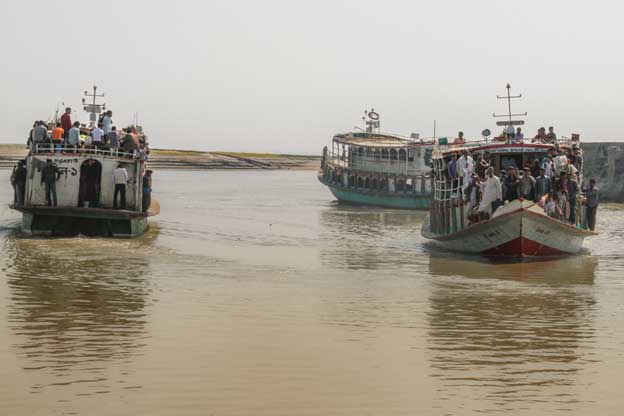
Padma River Basin, Bangladesh Credit: Nidhi Nagabhatla

HAMILTON, Canada, Jun 8 2020 (IPS) – Do migrants willingly choose to flee their homes, or is migration the only option available?

There is no clear, one-size-fits-all explanation for a decision to migrate — a choice that will be made today by many people worldwide, and by an ever-rising number in years to come because of a lack of access to water, climate disasters, a health crisis and other problems.


Data are scarce on the multiple causes, or “push factors,” limiting our understanding of migration. What we can say, though, is that context is everything.

UN University researchers and others far beyond have been looking for direct and indirect links between migration and the water crisis, which has different faces — unsafe water in many places, chronic flooding or drought in others.

The challenge is separating those push factors from the social, economic, and political conditions that contribute to the multi-dimensional realities of vulnerable migrant populations, all of them simply striving for dignity, safety, stability, and sustainably in their lives.

A new report, ‘Water and Migration: A Global Overview,’ (https://bit.ly/3gxDgE7) from UNU’s Institute for Water, Environment and Health, offers insights into water and migration interlinkages, and suggests how to tackle existing gaps and needs.

Its information can be understood easily by stakeholders and proposes ideas for better informed migration-related policymaking, including a three-dimensional framework applicable by scholars and planners at multiple scales and in various settings.

The Report also describes some discomforting patterns and trends, among them:

    • By 2050, a combination of water and climate-driven problems and conflicts will force 1 billion people to migrate, not by choice but as their only option;
    • Links to the climate change and water crises are becoming more evident in a dominant trend: rural-urban migration;
    • That said, there is a severe lack of quantitative information and understanding re. direct and indirect water and climate-related drivers of migration, limiting effective management options at local, national, regional, and global scales
    • Global agreements, institutions, and policies on migration are concerned mostly with response mechanisms. Needed is a balanced approach that addresses water, climate, and other environmental drivers of migration
    • Unregulated migration can lead to rapid, unplanned, and unsustainable settlements and urbanization, causing pressure on water demand and increasing the health risks and burdens for migrants as well as hosting states and communities
    • Migration should be formally recognized as an adaptation strategy for water and climate crises. While it is viewed as a ‘problem,’ in fact it forms part of a ‘solution’
    • Migration reflects the systemic inequalities and social justice issues pertaining to water rights and climate change adaptation. Lack of access to water, bad water quality, and a lack of support for those impacted by extreme water-related situations constitute barriers to a sustainable future for humankind.

Case studies in the report provide concrete examples of the migration consequences in water and climate troubled situations:

    • The shrinking of Lake Chad in Africa and the Aral Sea in Central Asia
    • The saga of Honduran refugees
    • The rapid urbanization of the Nile delta, and
    • The plight of island nations facing both rising seas and more frequent, more intense extreme weather events.

In addition, the added health burdens imposed on people and communities by water pollution and contamination create vicious cycles of poverty, inequality and forced mobility.

While the Sustainable Development Goals (SDGs) agenda does not include an explicit migration target, its mitigation should be considered in the context of SDGs that aim to strengthen capacities related to water, gender, climate, and institutions. These issues resonate even as the world deals with the COVID-19 pandemic.

Recent news stories have chronicled the plight of desperate migrant workers trapped in the COVID-19 crisis in India, and of displaced people in refugee camps where social distancing is unachievable, as is access to soap and water, the most basic preventive measure against the disease.

Add to that the stigma, discrimination, and xenophobia endured by migrants that continue to rise during the pandemic.

Even at this moment, with the world fixated on the pandemic crisis, we cannot afford to put migration’s long-term causes on the back burner.

While the cost of responses may cause concerns, the cost of no decisions will certainly surpass that. There may be no clear, simple solution but having up-to-date evidence and data will surely help.

On World Environment Day ( https://bit.ly/3dnKkks) last week (June 5), we were all encouraged to consider human interdependencies with nature.

Let us also acknowledge that water and climate-related disasters, ecological degradation and other environmental burdens causes economic, health and wellbeing disparities for migrants and populations living in vulnerable settings.

  Source

Crisis Hits Oil Industry and Energy Transition Alike

Civil Society, Climate Change, Conferences, Development & Aid, Economy & Trade, Editors’ Choice, Energy, Environment, Featured, Global Governance, Headlines, Integration and Development Brazilian-style, Latin America & the Caribbean, Projects, Regional Categories

Energy

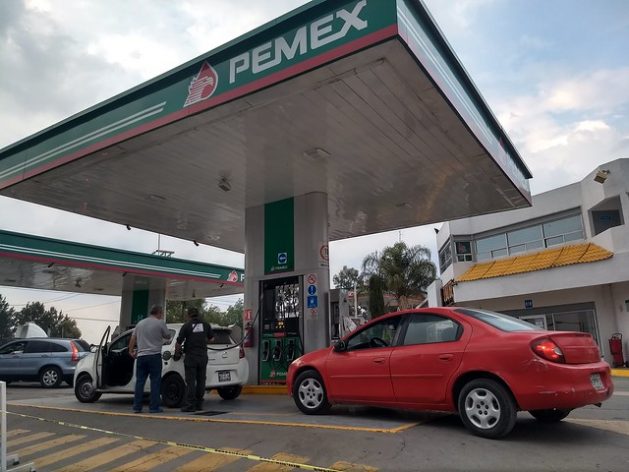
Mexico's state-run oil giant Pemex faces a difficult outlook due to the fall in international oil prices and the crisis resulting from the coronavirus pandemic, which threatens its production and finances, in a situation analysed during the 29th La Jolla Energy Conference, organised online by the Institute of the Americas. CREDIT: Emilio Godoy/IPS

Mexico’s state-run oil giant Pemex faces a difficult outlook due to the fall in international oil prices and the crisis resulting from the coronavirus pandemic, which threatens its production and finances, in a situation analysed during the 29th La Jolla Energy Conference, organised online by the Institute of the Americas. CREDIT: Emilio Godoy/IPS

MEXICO CITY, May 22 2020 (IPS) – While it attempts to cushion the effects of the coronavirus pandemic, the Latin American and Caribbean region also faces concerns about the future of the energy transition and state-owned oil companies.


These questions were discussed at the 29th La Jolla Energy Conference, organised by the Institute of the Americas. It was held online May 18-22, rather than bringing together more than 50 speakers at the institute’s headquarters in the coastal district of San Diego, in the U.S. state of California, in the midst of the COVID-19 pandemic.

Alfonso Blanco of Uruguay, executive secretary of the Latin American Energy Organisation (OLADE), said during a session on global trends and the regional energy industry that the changes seen during the pandemic will spread after the crisis and will be long-lasting.

“There will be structural transformations and we are convinced that most consumer behaviors will change after the pandemic. Demand will vary due to changes in the main areas of transportation and other energy areas. The effects on fossil fuel consumption will be strong and there will be a greater impact on renewable energies,” he said.

OLADE, a 27-member regional intergovernmental organisation for energy coordination, estimates that electricity demand has fallen by 29 percent in Bolivia compared to 2019, as a result of the severe acute respiratory syndrome coronavirus 2 (SARS-CoV-2), which causes COVID-19, and by 26 percent in Argentina, 22 percent in Brazil and 11 percent in Chile.

“There will be structural transformations and we are convinced that most consumer behaviors will change after the pandemic. Demand will vary due to changes in the main areas of transportation and other energy areas. The effects on fossil fuel consumption will be strong and there will be a greater impact on renewable energies.” — Alfonso Blanco

Likewise, final energy demand plummeted 14 percent in Brazil compared to 2019, 11 percent in both the Andean and Southern Cone regions, nine percent in Mexico, seven percent in Central America and five percent in the Caribbean.

As countries went into lockdown to curb the spread of COVID-19, electricity consumption by businesses and factories declined, due to the suspension of activities.

Leonardo Sempertegui, legal advisor to the Organisation of Petroleum Exporting Countries (OPEC), said the pandemic may be a wake-up call for countries lagging behind in the energy transition.

“This may be the new normal. The structure and governance of the energy architecture to cope with the next phase are changing dramatically. Energy poverty and the energy transition cannot be solved regardless of who controls a resource; these challenges cannot wait,” he said in the same session.

In Latin America, nations like Argentina, Bolivia, the Dominican Republic, Ecuador, Honduras and Uruguay have made progress in the energy transition since 2015, while Brazil has slid backwards and countries like Mexico are stuck in the same place, according to the World Economic Forum’s Energy Transition Index, released May 13.

As the region heads into the fourth month of the pandemic, countries are assessing their electricity markets, which have been shaken by the crisis.

Nations like Argentina, Chile, Colombia and Peru have resorted to long-term electricity auctions, which have generated low prices for renewables, while Mexico suspended such schemes in 2019.

In Argentina, as Andrés Chambouleyron, a non-resident fellow at the Institute of the Americas, explained, industrial consumption fell by 50 percent and electricity distributors have not been able to obtain sufficient revenues to cover fixed costs or electricity purchases.

The government has thus provided financing to Cammesa – the electricity wholesale market administration company – to pay the generators, since it is bound by contracts to buy the energy.

“There will be a permanent change in electricity consumption in Argentina. We have cheaper gas than before; the models say that you have to use more gas because it is cheaper than other sources. We won’t see much change in Argentina’s energy mix, and that could extend to all of Latin America,” said Chambouleyron, who warned of breach of and renegotiation of contracts for energy purchases.

Low oil prices threaten to slow down the energy transition in Latin America, although renewable energies already compete with the costs of fossil fuels, agreed experts at the 29th La Jolla Energy Conference, organised online by the Institute of the Americas. The photo shows solar panels on a house in Ajijic, in the western Mexican state of Jalisco. CREDIT: Emilio Godoy/IPS

Low oil prices threaten to slow down the energy transition in Latin America, although renewable energies already compete with the costs of fossil fuels, agreed experts at the 29th La Jolla Energy Conference, organised online by the Institute of the Americas. The photo shows solar panels on a house in Ajijic, in the western Mexican state of Jalisco. CREDIT: Emilio Godoy/IPS

While renewables are already competing in price with conventional sources, low oil and gas prices undermine their expansion, a predicament that alternative energy sources have been facing in recent years.

In addition, the rise in the cost of international credit and the fluctuations of the dollar against local currencies may make generation more expensive.

In another session on the outlook for state-owned oil companies, Marta Jara, former president of Uruguay’s public oil company ANCAP, said the current crisis could accelerate the transition, but called it a “major challenge”.

“The temptation is to be opportunistic and forget the roadmap of the energy transition. We must invest in sustainable energy systems, decarbonise transport. It is important to secure funding and create jobs. I hope the crisis opens the door to be more innovative,” she said.

Viable or not?

The plunge in fossil fuel prices is damaging the finances of the region’s oil producing countries, such as Argentina, Bolivia, Brazil, Colombia, Ecuador, Mexico, Peru and Venezuela, and state companies in the sector are facing problems with regard to planning and operations.

But it benefits net importers, like the countries of Central America or Chile, whose oil bills have shrunk, while for consumers in both oil producing and importing countries the cost of electricity could go down.

“The most competitive will be the countries with lower oil extraction costs. Some projects will not be economically viable. We will see greater economic problems than in 2019,” predicted Lisa Viscidi, director of the Energy, Climate Change and Extractive Industries Programme at the non-governmental Inter-American Dialogue, during a panel on the situation in several Caribbean nations.

The pandemic and a rise in Saudi production announced on Mar. 10 led to a collapse in oil prices and the consequent risk of bankruptcies in the industry. State-owned oil companies have fared better than others so far in the crisis.

In another session on the outlook for state-owned oil companies, John Padilla, managing director of the private consulting firm IPD Latin America, stated that “it will take time to get out of this situation, with effects for the region, and the need for great efficiency.

“Most nations have been exporters, efficiency will be the key. What has not been done is to cultivate domestic and regional markets, state enterprises are not going to play the same role as they always have,” he said.

Public companies such as Brazil’s Petrobras and Colombia’s Ecopetrol entered the crisis in a better position than Mexico’s Pemex, Venezuela’s PDVSA and Argentina’s YPF, according to experts.

“These are difficult times, even for the best prepared. We can hope that if the country and its company are in trouble, if governments need money, they can get more out of the companies,” said Francisco Monaldi, interim director of the Baker Institute for Public Policy’s Latin America Initiative at the private Rice University in the U.S. state of Texas.

In his view, “Mexico is in better fiscal conditions, it should not be a problem. But Pemex can drag Mexico down. If the government doesn’t change direction, it could become a serious problem,” he said as an example.

Although Pemex will increase its investment in 2020, the oil company reported losses of 20 billion dollars in the first quarter of this year. Due to the crisis, Petrobras limited its investment to 3.5 billion dollars and its daily production to 200,000 barrels, and postponed the sale of eight refineries.

For Lucas Aristizábal, a senior director in Fitch Ratings’ Latin American corporates group, some state-owned oil companies are viable and others are not.

“In 2021, the financial contribution of oil will be lower for governments. If they want the companies to play a key role, they will put more pressure on their financial structure. The current situation illustrates the economics of these corporations,” he said during the forum.

Pemex and YPF were already losing money per barrel in 2019, while Petrobras has more balanced production costs.

On the oil horizon, and in the midst of the COVID-19 crisis, Guyana has become the rising star, although there is still political uncertainty, as the result of the Mar. 2 presidential elections is still unclear.

“It’s hard to predict what will happen. There is a risk of U.S. sanctions that would not affect investment in the sector, but would pose a political risk to the country,” said Thomas Singh, in the Department of Economics at the public University of Guyana.

The country expects to extract 600,000 barrels per day by 2024 and take in revenues of five billion dollars, with reserves exceeding five billion barrels.

  Source