WFP in Gaza: ‘We Need a Long Ceasefire That Leads to Peace so We Can Operate’

Armed Conflicts, Civil Society, Global Governance, Headlines, Human Rights, Humanitarian Emergencies, IPS UN: Inside the Glasshouse, Middle East & North Africa, TerraViva United Nations

Opinion

Credit: WFP/Ali Jadallah/2024

ROME, Aug 15 2024 (IPS) – Corinne Fleischer, WFP’s regional director for the Middle East, North Africa and Eastern Europe, describes Gaza as “a terrible situation getting worse.” Over the past two weeks, 21 United Nations World Food Programme (WFP) food distribution points have been closed under evacuation orders.


“UNRWA says that 86% of the Strip is under an evacuation order,” she says on a video call from her office in Cairo. Fleischer visited the enclave in July.“ 2 million people are crammed into 14% of the territory.”

Despite Immense Challenges, WFP Continues to Assist Gazans

With continuous evacuation orders forcing WFP to uproot food distribution sites, precise targeting of the most vulnerable groups becomes challenging. We provide ready-to-eat food, hot meals and nutrition support to breastfeeding women and small children.

Mohammed was severely injured in the conflict but all efforts to evacuate him for medical treatment failed. His family fully depends on food from WFP to survive.

“We support partners in almost 80 kitchens, where they cook meals, pack and distribute them to people in camps,” Fleischer explains. She previously visited Gaza last December. “Then, it was really about how do we bring food in – that’s still very much the case,” she says. “Now, at least we have a dedicated WFP operation on the ground.” Our main accomplishment? “We have helped prevent full-scale famine from happening,” she says.

There are currently nearly 500,000 people at IPC5/Catastrophe, the highest grade of food insecurity on the global standard for measuring food insecurity – down from 1.1 million people earlier this year.

Fleischer is keen to highlight the positive impacts of humanitarian supplies making it through.“Right now, we don’t bring enough food into Gaza,” she says. “We don’t bring in what we plan for the month because we don’t have enough crossing points open. We need all the crossings open and at full capacity.”

“Operations are super complicated,” Fleischer says. “We work in a war zone. Roads are destroyed. We are waiting hours at checkpoints for green lights to move.”

WFP, she stresses, also works to support the wider humanitarian community. “We are leading the Logistics Cluster (the interagency coordination mechanism) and supporting partners to bring in their goods through the Jordan corridor. We are receiving their goods in the north at the Zikim crossing point. We’re helping them in Kerem Shalom. So, of course, we’re helping with fuel supplies too.”

Nowhere Is Safe in Gaza

“Gazans cannot get out, and they’re asking to get out,” Fleischer says. “They’re beyond exhausted. There is no space – one makeshift tent after the other up to the sea. Streets are teeming with people.” Meanwhile, the breakdown of sewage systems, lack of water and waste management means diseases, such as Hepatitis A which is spreading among children, are allowed to fester.

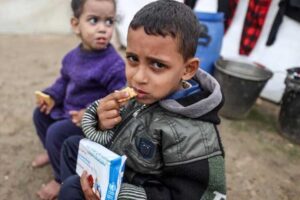
Children eat fortified biscuits from WFP at a makeshift camp in southern Gaza.

“We are lucky that nothing has happened to our amazing staff – more than 200 UNRWA staff have been killed,” she says. “That is not acceptable.” She adds: “We have amazing security officers who advise management on which risks to avoid, so that we can stay and do our work safely and families can access our assistance safely. But the risks are high. Very high. We have bullets close to our convoys. We’re there repairing roads. We’re there moving with our trucks. We’re there reaching people. And it’s very dangerous.”

On the path to recovery, the private sector has a role to play, says Fleischer – take the reopening of shops. “If you think of a lifeline, of hope, or a sense of normalcy, it’s surely when the staple bread is back in the market,” she says of bakeries that have reopened with WFP support. “Bakeries need wheat flour, they need yeast, and diesel too – and that’s where we come in.”

High Prices Keep Basic Foods Out of Reach for Most Gazans

In the south of Gaza, “basic food items are slowly re-emerging in food markets. You can actually find vegetables, fruits in the markets but because prices are high, they remain out of reach for most,” she says “And in any case, people don’t have cash. There are no jobs. Even our own staff tell us, ‘We have a salary, but we can’t access cash’.”

Fleischer is keen for humanitarian efforts to reach a stage where people “stop eating things they have been eating for the past nine months” – to diversify diets heavily dependent on canned food (provided by WFP) and whatever people can get their hands on.

“This level of destruction I’ve never seen.”

Fleischer’s biggest fear for Gaza is “that there is no end to this [war]. That we continue with ever less space for the people who already have nowhere to go back to. Even if they moved back to the north, where could they go?”

“Everything is flattened. There are no homes, it’s all destroyed. We need a long ceasefire that leads to peace so we can operate.”

After the Rafah incursion, many people returned to Khan Younis but there’s no means of living in the area. There are no homes left. Credit: WFP

Fleischer, who has served with WFP in Syria and Sudan’s Darfur Region, adds: “This level of destruction I’ve never seen. Hospitals and clinics are destroyed, food processing plants are destroyed. Everything is destroyed.”

Yet, “There is this never-give-up attitude from the people, from the families we serve,“ she says. “I can’t believe children still run to you and laugh with you. They probably see in us hope that there will be an end to all this – a sign they are not forgotten.”

This story originally appeared on WFP’s Stories on August 8, 2024 and was written by the WFP Editorial Team.

IPS UN Bureau

  Source

South Sudan: World’s Youngest Nation at a Crossroads

Africa, Armed Conflicts, Civil Society, Global Governance, Headlines, Human Rights, Humanitarian Emergencies, IPS UN: Inside the Glasshouse, TerraViva United Nations

Opinion

United Nations Assistant Secretary-General and UNDP Crisis Bureau Director, Shoko Noda

UNITED NATIONS, Aug 13 2024 (IPS) – Thirteen years since becoming an independent state, South Sudan faces profound humanitarian challenges. South Sudan’s first Independence Day was imbued with a great sense of hope.


I remember crowds cheering in the streets, waving the country’s new flag high. Thirteen years later, the youngest nation in the world, barely into its adolescence, faces profound challenges.

At the heart of South Sudan’s challenges lies a humanitarian crisis of staggering proportions. Given seven million of the country’s 12.4 million people are projected to experience crisis-level hunger this year, and nine million are in dire need of humanitarian assistance, the gravity of the situation cannot be overstated.

One in ten lack access to electricity. Seventy percent can’t access basic healthcare. These are fundamental human rights that the vast majority of people are deprived of.

I saw South Sudan’s dire humanitarian situation firsthand when I visited the country in March. I met women and children displaced by conflict – some for the second time in their lives – in a transit centre in Malakal, the capital of Upper Nile state. They had nothing and were fully reliant on aid. Their plight still lingers in my mind and heart.

As it marks its 13th independence anniversary, South Sudan finds itself at a pivotal moment in its nation-building journey.

Humanitarian aid alone cannot untangle the intricate web of challenges facing South Sudan. A holistic approach is required—one that lays the groundwork for self-sufficiency, peace and sustainable development.

With the constitutional-making process underway and elections on the horizon, the efforts we make today will shape the trajectory of the country for generations to come. We must bolster institutions, foster stability and empower the youth—the driving force behind the nation’s aspirations for progress and prosperity.

Humanitarian aid alone cannot untangle the intricate web of challenges facing South Sudan. A holistic approach is required—one that lays the groundwork for self-sufficiency, peace and sustainable development.

Central to this is the empowerment of women and girls, who face disproportionate challenges and vulnerabilities in the face of conflict, displacement and climate change. Gender-based violence (GBV), child marriage and maternal mortality rates are alarmingly high, underscoring the urgent need for targeted interventions that prioritize the rights and dignity of women and girls.

When I visited Malakal, I met with young women whose stories painted a vivid story to me on the barriers they face on a daily basis—from fearing for their safety to feeling unable to speak out about their hopes and aspirations, or being denied work opportunities.

It should not be this way.

Our team on the ground is working hard to improve the lives of women and girls in South Sudan. I was impressed by courts in Juba, set up with UNDP support, that focus on addressing violence against women. We are also working to ensure women’s inclusion in peacebuilding processes, promote gender equality and create opportunities for women and youth to thrive.

But so much more needs to be done.

With 75 percent of the population comprising young people, they represent both South Sudan’s greatest challenge and its most promising asset. Neglecting to invest in the youth equates to neglecting the future of the country itself—a risk we cannot afford to take.

Their voices must be heard, their aspirations nurtured and their potential unleashed.

South Sudan is at a crossroads.

With the right support, the country has the potential to create a future defined by hope, greater prosperity and stability for all. The alternative is a deepening of an already profound and protracted crisis.

South Sudan cannot navigate this path alone. It requires the support that transcends its borders to overcome the myriad challenges it faces. Increased development cooperation—the kind that helps people break the cycle of crisis and build safer, more stable, resilient, and sustainable lives—is urgently needed.

My hope is to return in 10 years and see the families I met at the Malakal transit centre peacefully settled, their children grown and thriving, with stable livelihoods and access to all the services they need to sustain them and nurture their hopes and aspirations for the future.

This is what development looks like.

Shoko Noda is United Nations Assistant Secretary-General and UNDP Crisis Bureau Director

Source: Africa Renewal, a United Nations digital magazine that covers Africa’s economic, social and political developments—plus the challenges the continent faces and the solutions to these by Africans themselves, including with the support of the United Nations and international community.

IPS UN Bureau

  Source

Digital Trade & the Sustainable Development Goals: A Dynamic Agenda

Civil Society, Climate Action, Climate Change, Environment, Featured, Global, Headlines, Human Rights, Humanitarian Emergencies, Sustainable Development Goals, TerraViva United Nations

Opinion

Online transactions and E-commerce have become a key part of people’s life in Asia and the Pacific. Credit: Unsplash/Rupixen

BANGKOK, Thailand, Aug 12 2024 (IPS) – The rapid growth of digitalization has fundamentally altered commerce, impacting production and facilitating the movement of goods. The 2023 Asia-Pacific Trade and Investment Report (APTIR), has pointed out that although digital trade revenues of Asia and the Pacific account for a significant share of global trade, this growth is uneven, with trade concentrated in a few areas, leading to disparities across the region.


Studies show a positive relationship between digital trade and progress on the Sustainable Development Goals (SDGs). These linkages among digital trade policy and the social and economic pillars of the SDGs may appear more indirect, but they do manifest through economic channels.

Various facets of the relationship between sustainable development and digital trade are evident, such as the impact of digital trade on wealth inequality in the region, the role of the Internet in export expansion, how e-commerce facilitates small and medium-sized enterprises (SMEs), and how digital trade can help achieve the ambitious agenda behind the SDGs.

However, better digital infrastructure does not necessarily engender competition and instead requires active measures from the government to promote linkages between export superstars and domestic suppliers.

Additionally, robust regulatory frameworks on digital trade can help eliminate “monopolistic and restrictive” trade policies, contributing significantly to a more equitable distribution of wealth.

Examples of good practices

Different policy measures to establish an inclusive digital trade and e-commerce landscape have been used across the region. For example, research on internet courts in China showed how such public and digitized judicial systems benefit smaller and medium-sized firms compared to private dispute resolution mechanisms, which are highly costly.

Similarly, research on the Pacific Alliance’s trade policies, particularly its binding agreements and work instruments, provided a framework to incorporate net neutrality in the promotion of equitable digital development.

Indonesia’s introduction of single submission for freight transport applications and its impact on sustainability in supply chains was another case study. This policy instrument has had significant impacts across multiple domains, such as increasing time effectiveness, reducing costs, and increasing transparency in shipping and port clearances.

Lessons learned and the way forward

There is a need to understand the specific digital trade policy instruments that promote sustainable development. It is critical to acknowledge key differences and similarities between trade and digital trade policy to strategically leverage their interlinkage to achieve the SDGs. Social development works in tandem with economic progress.

A key concern is the lack of data on cross-border e-commerce in the Asia-Pacific and Latin America regions, which hinders the implementation and evaluation of programs designed to promote the participation and productivity of small and medium enterprises (SMEs).

More concerted efforts to improve data measurement through private-public partnerships could be a possible policy intervention to address this issue. States should establish effective monitoring systems by improving the availability of economic statistics and third-party evaluations for measuring the progress and impact of SME support programs.

However, given the diversity in operations of SMEs across sectors, it is essential to devise and tailor policies that cater to their specific needs and realities.

There is also a need for sharing real-world examples of successful government initiatives and SME support programs so neighboring countries can draw lessons from them. There are doubts about the long-term usefulness of stand-alone Digital Economy Agreements (DEAs) due to the lack of stringent legal provisions for possible breaches, unlike market-access free trade agreements (FTAs).

Lastly, the United States, which has played a pivotal role in advocating for an open global trade environment, gradually step back from its position, it is time to rethink the leadership that would guide the establishment of digital trade provisions in the future.

This involves showcasing how digital trade rules will be established and enforced moving forward. Who will provide such public goods for digital trade is a major question facing the global economy.

Given its rapid digital-economy growth, significant market size, and increasing influence in global digital trade, should that leadership come from the Asia-Pacific region?

Witada Anukoonwattaka is Economic Affairs Officer, Trade Investment and Innovation Division, ESCAP; Preety Bhogal is Consultant, Trade Investment and Innovation Division, ESCAP.

IPS UN Bureau

  Source

UN Calls for ‘Peaceful, Orderly and Democratic Transition’ Following Protests in Bangladesh

Active Citizens, Asia-Pacific, Civil Society, Democracy, Development & Aid, Featured, Global Governance, Headlines, Human Rights, Humanitarian Emergencies, Inequality, IPS UN: Inside the Glasshouse, Population, TerraViva United Nations

Human Rights

Sheikh Hasina, Prime Minister of the People’s Republic of Bangladesh resigned her post and fled the country after weeks of violent protests. Credit: UN Photo/Laura Jarriel

Sheikh Hasina, Prime Minister of the People’s Republic of Bangladesh resigned her post and fled the country after weeks of violent protests. Credit: UN Photo/Laura Jarriel

UNITED NATIONS, Aug 6 2024 (IPS) – After weeks of violent clashes against protestors, Bangladesh Prime Minister Sheikh Hasina resigned from her position and fled the country on Monday. Preparations are underway for an interim government to take over with the backing of the military, political parties, student leaders of the protest movement and all other groups involved in the transition. A UN spokesperson has urged that all parties involved in the current transition should work together to ensure a peaceful and democratic transition.


UN Secretary-General António Guterres is closely following developments, according to his deputy spokesperson, Farhan Haq. In a statement issued on Monday, Guterres condemned and deplored “further loss of life” during protests over the weekend, referencing protests held in the capital of Dhaka on Sunday. More than 100 people were reported dead, including at least 14 police officers. This has been the highest recorded death toll for a single day during a protest in the country’s recent history, according to Reuters.

During the daily press briefing at UN Headquarters, Haq said that the United Nations stands in full solidarity with the people of Bangladesh and has called for the full respect of their human rights. Haq added: “For us, the important things are for the parties to remain calm, and we want to emphasize a peaceful, orderly and democratic transition.”

“Ultimately, regarding what’s happened so far, there’s a need for a full, independent, impartial and transparent investigation into the violence that has happened so far,” he said.

As the situation continues to unfold, Haq added, the UN and its office in Bangladesh are keeping in contact with the authorities on the ground. “The situation is moving very swiftly. We will have to see what happens once the dust settles.”

What began as a movement to protest civil service recruitment practices has since evolved into a greater movement protesting the government’s crackdown, which was seen to have cracked down on human rights, such as freedom of expression and the right to peaceful demonstration. On August 4, protestors were calling for Hasina’s resignation in the wake of her government’s response to the month-long protests. In recent weeks, police and military units shot at protestors and civilians, enacted a curfew, and shut down internet and communications networks for several days.

In an address to the country on Monday, Chief of Army Staff General Waker-uz-Zaman announced Hasina’s resignation and the formation of the interim government. He also asked the people of Bangladesh to “keep trust in the army” during this period.

As multiple reports emerged of public vandalism and arson of government buildings and residences, Zaman said in a later statement that the public should refrain from causing damage to public property or harm to lives.

Senior officials in the UN system have publicly condemned the loss of life during this period. UNESCO Director-General Audrey Azoulay issued public statements condemning the killings of two journalists and calling on the authorities to hold those responsible accountable.

Sanjay Wijisekera, UNICEF Regional Director for South Asia, condemned the reported deaths of 32 children as of August 2, along with reports of children being detained. “In line with international human rights and the UN Convention on the Rights of the Child, to which Bangladesh is a signatory, and based on research into the effects of detention on children, UNICEF urges an end to the detention of children in all its forms,” he said.

UN High Commissioner on Human Rights Volker Türk issued a statement on Monday in which he called for the peaceful transition of power, guided by human rights and the country’s international obligations.

“The transition must be conducted in a transparent and accountable way, and be inclusive and open to the meaningful participation of all Bangladeshis,” he said. “There must be no further violence or reprisals.”

Türk called for those who had been arbitrarily detained to be released. He stressed that those who committed human rights violations need to be held accountable, while also reiterating that his office would support any independent investigation into these violations.

“This is a time for national healing, including through an immediate end to violence, as well as accountability that ensures the rights of victims to truth and reparations, and a truly inclusive process that brings the country together on the way forward.”

IPS UN Bureau Report

  Source

Activists Challenge Pharma Company Gilead Over HIV Medication

Active Citizens, Africa, Civil Society, Development & Aid, Editors’ Choice, Featured, Global, Headlines, Health, Human Rights, Humanitarian Emergencies, Sustainable Development Goals, TerraViva United Nations

Health

Activists protest during the 25th International AIDS Conference (AIDS2024) in Munich over a affordable pricing for a drug currently sold by pharmaceutical firm Gilead. Credit: Ed Holt/IPS

Activists protest during the 25th International AIDS Conference (AIDS2024) in Munich over a affordable pricing for a drug currently sold by pharmaceutical firm Gilead. Credit: Ed Holt/IPS

MUNICH, Aug 2 2024 (IPS) – Campaigners and experts have demanded a breakthrough HIV intervention hailed as “the closest thing to an HIV vaccine” must be made available as soon and as cheaply as possible to all who need it as its manufacturer faces protests over its pricing.

Activists led a massive protest during the 25th International AIDS Conference (AIDS2024) in Munich last week as a study was presented showing lenacapavir—a drug currently sold by pharmaceutical firm Gilead for more than USD 40,000 per year as an HIV treatment—could be sold for USD 40 per year as a form of pre-exposure prophylaxis (PrEP) to help prevent HIV infection.


Community groups working in prevention, as well as experts and senior figures at international organizations fighting HIV, called on the company to ensure it will be priced so it is affordable for low- and middle-income countries (LMICs), which account for 95 percent of HIV infections.

“It is no exaggeration to call lenacapavir a game changer. It could be life-changing for some populations. We need to see it produced generically and supplied to all low- and middle-income countries to the people who need it,” said Dr. Helen Bygrave, chronic disease advisor at Medecins sans Frontiere’s (MSF) Access Campaign.

During the event, data from a trial of lenacapavir, a twice-yearly injectable, were presented. The results of the trial were announced by pharmaceutical firm Gilead last month and showed the drug offered 100% protection to more than 5,000 women in South Africa and Uganda.

Many experts and community leaders helping deliver HIV interventions who spoke to IPS described the drug as a real “game changer,” offering not just spectacular efficacy but relative ease and discretion in delivery—the latter key in combating stigma connected with HIV prevention intervention in some societies—compared to other interventions, such as oral PrEP.

But they warned there were likely to be challenges to access, with cost expected to be the main barrier.

Lenacapavir is currently approved only as a form of HIV treatment at a price of USD 42,000 per person per year.

While as a PrEP intervention it would be expected to be sold at a much lower price, an abstract presented at the conference showed that it could cost just USD 40 a year for every patient.

In a statement put out following the protests, Gilead said it was developing “a strategy to enable broad, sustainable access globally” but that it was too early to give details on pricing.

Critics claimed Gilead was not being transparent in its statement—the company talked of being committed to access pricing for high-incidence, resource-limited countries rather than specifically low- and middle-income countries—and there are fears that the price at which it is eventually made available as PrEP will be so high as to put it out of reach of the countries that are struggling most with the HIV epidemic.

“Cabotegravir, a two-month injectable form of PrEP, is currently being procured by MSF for low-income countries for USD 210 per person per year. We would not expect [the price for lenacapavir] to be higher than that, and we would hope it would be more ‘in the ballpark’ of  USD 100 per person per year,” said Bygrave.

She added that “questions have been asked of Gilead about its pricing for lenacapavir, and the company has been pretty vague in its answers.”

“Civil society needs to put continued pressure on Gilead about this issue because, without that pressure, I do not trust Gilead to do the right thing,” Bygrave, who took part in protests at the conference against Gilead’s pricing, said.

Some speakers at the conference set out a series of demands for the firm.

Winnie Byanyima, Executive Director of UNAIDS, called on Gilead to license generic manufacturers to produce it more affordably through mechanisms such as the Medicines Patent Pool (MPP), a UN-backed programme negotiating generics agreements between originators and generic pharmaceutical companies.

Others, such as keynote speaker Helen Clark, Chair of the Global Commission on Drug Policy, said such interventions must be seen as “common global goods, and ways must be found to make them accessible to all.”

“The pharmaceutical industry has been the beneficiary of much public research investment. With respect to HIV/AIDS, it has benefited from the mobilization of scientists and engaged communities who have advocated for investment in R&D and treatments. Prima facie, the notion that the companies can then make great profits from and not share the intellectual property created is wrong,” she said.

Others went even further, accusing some pharmaceutical firms of being parties to the creation of a de facto global two-tier system for medicine supply.

“Companies must share their medicines. We cannot accept an apartheid in access to medicine in which the lives of those living in the Global South are not regarded as having the same value as the lives in the North,” Archbishop Dr Thabo Makgoba, Archbishop of the Anglican Church of Cape Town and HIV advocate, said at a UNAIDS press event during the conference.

Some of those who work with key populations stressed the need to push through all necessary approvals and set lenacapavir’s price at an accessible level as quickly as possible to save lives.

“It’s great to have innovation and get important new tools in the fight against HIV. But the question is: how long will it take to get them to the people who need them? Until then, they are just a great announcement—like a beautiful picture hanging up there that you can see but cannot actually touch. We need to give communities the funding and the tools they need to do their vital work,” Anton Basenko, Chair of the Board of the International Network of People who Use Drugs (INPUD), told IPS.

The calls came as campaigners stressed the exceptional potential of lenacapavir. It is not only its astonishing efficacy, but also its relative ease and discretion of delivery, which experts are excited about.

Stigma around HIV prevention, such as oral PrEP, which involves taking daily tablets, has been identified as a major barrier to the uptake of HIV interventions in some regions.

Some HIV healthcare specialists at the conference told IPS they had seen cases of women leaving clinics with bottles of tablets and, as soon as they heard them rattling in the bottle, threw them into the bin outside the clinic because the noise would tell others they were taking the tablets and leave them open to potential discrimination, or even gender-based violence.

“The lack of oral PrEP uptake and adherence among women and girls is due to a number of factors, such as stigma and worries about being seen with a huge bottle of pills. What about if you are in a relationship and your partner sees the bottle and starts asking whether you are cheating on them or something?

“A woman could go and get a lenacapavir injection a couple of times a year and no one would have to even know and she wouldn’t have to think about taking pills every day and just get on with her life. This drug could change lives completely. I would definitely take it if it was available,” Sinetlantla Gogela, an HIV prevention advocate from Cape Town, South Africa, told IPS.

The concerns around access to lenacapavir at an affordable price for low and middle income countries come against a background of record debt levels among poor countries, which experts say could have a severe negative impact on the HIV epidemic.

A recent report from the campaign group Debt Relief International showed that more than 100 countries are struggling to service their debts, resulting in them cutting back on investment in health, education, social protection and climate change measures.

Speakers at the conference repeatedly warned these debts had to be addressed to ensure HIV programmes, whether they include lenacapavir or not, continue. Many called for immediate debt relief in countries.

“African debt needs to be restructured to let countries get hold of the medicines they need,” said Byanyima.

“Drop the debt; it is choking global south countries, denying us what we need for health. Please let us breathe,” said Makgoba.

IPS UN Bureau Report

  Source

79 Years After Hiroshima & Nagasaki: A Grim Reminder of Nuclear Annihilation

Asia-Pacific, Civil Society, Editors’ Choice, Featured, Global, Headlines, Human Rights, Humanitarian Emergencies, IPS UN: Inside the Glasshouse, Nuclear Disarmament, Nuclear Energy – Nuclear Weapons, TerraViva United Nations

Nuclear Disarmament

Erico Platt looks at the disarmament exhibition that she staged, “Three Quarters of a Century After Hiroshima and Nagasaki: The Hibakusha—Brave Survivors Working for a Nuclear-Free World.” Credit: UNODA/Diane Barnes

UNITED NATIONS, Aug 1 2024 (IPS) – The upcoming 79th anniversary of the atomic bombings of Hiroshima and Nagasaki, which took place on August 6 and 9, 1945, remains a grim reminder of the destructive consequences of nuclear weapons.


The US bombings killed an estimated 90,000 to 210,000, with roughly half of the deaths occurring on the first day in Hiroshima.

But despite an intense global campaign for nuclear disarmament, the world has witnessed an increase in the number of nuclear powers from five—the US, UK, France, China and Russia—to nine, including India, Pakistan, North Korea and Israel.

Is the continued worldwide anti-nuclear campaign an exercise in futility? And will the rising trend continue—with countries such as Iran, Egypt, Saudi Arabia and South Korea—as potential nuclear powers of the future?

South Africa is the only country that has voluntarily given up nuclear weapons after developing them. In the 1980s, South Africa produced six nuclear weapons, but dismantled them between 1989 and 1993. A number of factors may have influenced South Africa’s decision, including national security, international relations, and a desire to avoid becoming a pariah state.

But there is an equally valid argument that there have been no nuclear wars—only threats—largely because of the success of the world-wide anti-nuclear campaign, the role of the United Nations and the collective action by most of the 193 member states in adopting several anti-nuclear treaties.

According to the UN Office for Disarmament Affairs (UNODA), the United Nations has sought to eliminate weapons  of mass destruction (WMDs) ever since the establishment of the world body. The first resolution adopted by the UN General Assembly in 1946 established a commission to deal with problems related to the discovery of atomic energy, among others.

The commission was to make proposals for, inter alia, the control of atomic energy to the extent necessary to ensure its use only for peaceful purposes.

Several multilateral treaties have since been established with the aim of preventing nuclear proliferation and testing, while promoting progress in nuclear disarmament.

These include the Treaty on the Non-Proliferation of Nuclear Weapons (NPT), the Treaty Banning Nuclear Weapon Tests in the Atmosphere, in Outer Space and Under Water, also known as the Comprehensive Nuclear-Test-Ban Treaty (CTBT), which was signed in 1996 but has yet to enter into force, and the Treaty on the Prohibition of Nuclear Weapons (TPNW).

Jackie Cabasso, Executive Director, Western States Legal Foundation in Oakland, California, which monitors and analyzes US nuclear weapons programs and policies, told IPS: “As we approach the 79th anniversary of the U.S. atomic bombings of Hiroshima and Nagasaki, the world is facing a greater danger of nuclear war than at any time since 1945.”

“The terrifying doctrine of “nuclear deterrence,” which should long ago have been delegitimized and relegated to the dustbin of history and replaced with multilateral, non-militarized common security, has metastasized into a pathological ideology brandished by nuclear-armed states and their allies to justify the perpetual possession and threatened use—including first use—of nuclear weapons,” she pointed out.

“It is more important than ever that we heed the warnings of the aging hibakusha (A-bomb survivors): What happened to us must never be allowed to happen to anyone again; nuclear weapons and human beings cannot co-exist; no more Hiroshimas, no more Nagasakis!”

This demands an irreversible process of nuclear disarmament. But to the contrary, all nuclear armed states are qualitatively and, in some cases, quantitatively upgrading their nuclear arsenals and a new multipolar arms race is underway, she noted.

“To achieve the elimination of nuclear weapons and a global society that is more fair, peaceful, and ecologically sustainable, we will need to move from the irrational fear-based ideology of deterrence to the rational fear of an eventual nuclear weapon use, whether by accident, miscalculation, or design.”

“We will also need to stimulate a rational hope that security can be redefined in humanitarian and ecologically sustainable terms that will lead to the elimination of nuclear weapons and dramatic demilitarization, freeing up tremendous resources desperately needed to address universal human needs and protect the environment.”

In this time of multiple global crises, “our work for the elimination of nuclear weapons must take place in a much broader framework, taking into account the interface between nuclear and conventional weapons and militarism in general, the humanitarian and long-term environmental consequences of nuclear war, and the fundamental incompatibility of nuclear weapons with democracy, the rule of law, and human wellbeing,” declared Cabasso.

Dr. M.V. Ramana, Professor and Simons Chair in Disarmament, Global and Human Security School of Public Policy and Global Affairs and Graduate Program Director, MPPGA at the University of British Columbia, Vancouver, told IPS, “The glass is half-full or half-empty depending on how one looks at it.”

“The fact that we have avoided nuclear war since 1945 is also partly due to the persistence of the anti-nuclear movement. Historians like Lawrence Wittner have pointed to the many instances when governments have chosen nuclear restraint instead of unrestrained expansion.”

While South Africa is the only country that dismantled its entire nuclear weapons program, many countries—Sweden, for example—have chosen not to develop nuclear weapons even though they had the technical capacity to do so. They did so in part because of strong public opposition to nuclear weapons, which in turn is due to social movements supporting nuclear disarmament, he pointed out.

Thus, organizing for nuclear disarmament is not futile. Especially as we move into another era of conflicts between major powers, such movements will be critical to our survival, declared Ramana.

According to the UN, a group of elderly hibakusha, called Nihon Hidankyo, have dedicated their lives to achieving a non-proliferation treaty, which they hope will ultimately lead to a total ban on nuclear weapons.

“On an overcrowded train on the Hakushima line, I fainted for a while, holding in my arms my eldest daughter of one year and six months. I regained my senses at her cries and found no one else was on the train,” a 34-year-old woman testifies in the booklet. She was located just two kilometres from the Hiroshima epicenter.

Fleeing to her relatives in Hesaka, at age 24, another woman remembers that “people, with the skin dangling down, were stumbling along. They fell down with a thud and died one after another,” adding, “still now I often have nightmares about this, and people say, ‘it’s neurosis’.”

One man who entered Hiroshima after the bomb recalled in the exhibition “that dreadful scene—I cannot forget even after many decades.”

At a disarmament exhibition in UN Headquarters in New York, a visitor reads text about a young boy bringing his little brother to a cremation site in Nagasaki, Japan. Credit: UNODA/Erico Platt

At a disarmament exhibition in UN Headquarters in New York, a visitor reads text about a young boy bringing his little brother to a cremation site in Nagasaki, Japan. Credit: UNODA/Erico Platt

A woman who was 25 years old at the time said, “When I went outside, it was dark as night. Then it got brighter and brighter, and I could see burnt people crying and running about in utter confusion. It was hell…I found my neighbor trapped under a fallen concrete wall… Only half of his face was showing. He was burned alive”.

The steadfast conviction of the Hidankyo remains: “Nuclear weapons are absolute evil that cannot coexist with humans. There is no choice but to abolish them.”

Addressing the UN Security Council last March, Secretary-General Antonio Guterres warned that with geopolitical tensions escalating the risk of nuclear warfare to its highest point in decades, reducing and abolishing nuclear weapons is the only viable path to saving humanity.

“There is one path—and one path only—that will vanquish this senseless and suicidal shadow once and for all.  We need disarmament now,” he said, urging nuclear-weapon States to re-engage to prevent any use of a nuclear weapon, re-affirm moratoria on nuclear testing and “urgently agree that none of them will be the first to use nuclear weapons.”

He called for reductions in the number of nuclear weapons led by the holders of the largest arsenals—the United States and the Russian Federation—to “find a way back to the negotiating table” to fully implement the New Measures for the Further Reduction and Limitation of Strategic Offensive Arms, or START Treaty, and agree on its successor.

“When each country pursues its own security without regard for others, we create global insecurity that threatens us all,” he observed.  Almost eight decades after the incineration of Hiroshima and Nagasaki, nuclear weapons still represent a clear danger to global peace and security, growing in power, range and stealth.”

“States possessing them are absent from the negotiating table, and some statements have raised the prospect of unleashing nuclear hell—threats that we must all denounce with clarity and force,” he said.  Moreover, emerging technologies such as artificial intelligence and cyber and outer space domains have created new risks.”

From Pope Francis, who calls the possession of nuclear arms “immoral”, to the hibakusha, the brave survivors of Hiroshima and Nagasaki, to Hollywood, where Oppenheimer brought the harsh reality of nuclear doomsday to vivid life for millions around the world, people are calling for an end to the nuclear madness.  “Humanity cannot survive a sequel to Oppenheimer,” he warned.

When Nagasaki marked the 78th anniversary of the U.S. atomic bombing of the city last year, the mayor Shiro Suzuki, urged world powers to abolish nuclear weapons, saying nuclear deterrence also increases risks of nuclear war, according to an Associated Press (AP) report.

He called on the Group of Seven (G7) industrial powers to adopt a separate document on nuclear disarmament that called for using nuclear weapons as deterrence.

“Now is the time to show courage and make the decision to break free from dependence on nuclear deterrence,” Suzuki said in his peace declaration. “As long as states are dependent on nuclear deterrence, we cannot realize a world without nuclear weapons.”

Russia’s nuclear threat has encouraged other nuclear states to accelerate their dependence on nuclear weapons or enhance capabilities, further increasing the risk of nuclear war, and that Russia is not the only one representing the risk of nuclear deterrence, Suzuki said.

Suzuki, whose parents were hibakusha, or survivors of the Nagasaki attack, said knowing the reality of the atomic bombings is the starting point for achieving a world without nuclear weapons. He said the survivors’ testimonies are a true deterrent against nuclear weapons use, the AP report said.

This article is brought to you by IPS Noram, in collaboration with INPS Japan and Soka Gakkai International, in consultative status with UN ECOSOC.

IPS UN Bureau Report

  Source



