Rock Glaciers Supply Water to Highlands Communities in Argentina

Civil Society, Combating Desertification and Drought, Development & Aid, Editors’ Choice, Environment, Featured, Food & Agriculture, Human Rights, Indigenous Rights, Integration and Development Brazilian-style, Latin America & the Caribbean, Projects, Regional Categories, Water & Sanitation
Water & Sanitation

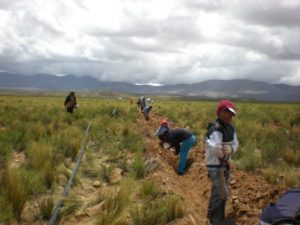
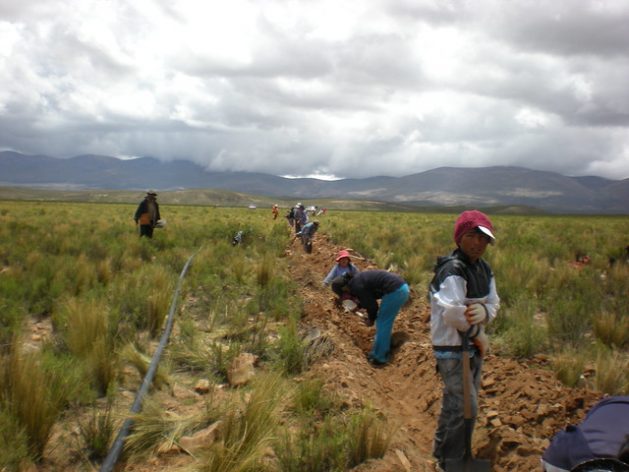
Long months of community work to install pipes to bring water from rock glaciers to indigenous villages in the Puna region in northwest Argentina served to strengthen collective organisation and community ties in an inhospitable ecoregion, where solidarity and joint efforts are essential to daily survival. Credit: Courtesy of Julio Sardina

Long months of community work to install pipes to bring water from rock glaciers to indigenous villages in the Puna region in northwest Argentina served to strengthen collective organisation and community ties in an inhospitable ecoregion, where solidarity and joint efforts are essential to daily survival. Credit: Courtesy of Julio Sardina

EL CÓNDOR, Argentina, Nov 14 2019 (IPS) – In Argentina’s Puna region, at 4,000 metres above sea level, the color green is rare in the arid landscape, which is dominated by different shades of brown and yellow. In this inhospitable environment, daily life has improved thanks to a system of piping water downhill from rock glaciers to local communities.


“When I was a girl we would walk an hour or two to fetch water from the hills. Since we didn’t have jerry cans or buckets, we carried it in sheepskin bags,” Viviana Gerónimo, a 50-year-old Kolla indigenous woman, tells IPS.

“We also built dams, to retain rainwater. We used it for ourselves and for our animals,” she adds. Gerónimo, a married mother of five, lives in Hornaditas de la Cordillera, an indigenous hamlet of just 15 families in the province of Jujuy in northwest Argentina, a few kilometres from the Bolivian border.

The Puna highlands region is a desert where only a few shrubs grow to less than half a metre in height and where it hardly ever rains – the average is around 200 millimetres a year, almost all of which falls in the southern hemisphere summer: December to March.

These high plateaus located above 3,000 metres altitude in the Andes mountains cover not only northwest Argentina but also northern Chile and southern Bolivia and Peru.

Local inhabitants in the Puna region depend mainly on livestock, although they cannot raise cows due to the poor quality of the pastures.

Geronimo’s family has 80 llamas and 120 sheep – the domestic species that best adapt to the climate of the Puna, although the profit margins are slim. In fact, the local indigenous people rarely shear them anymore because the wool fetches such low prices. They raise them for their own consumption and to sell the surplus meat.
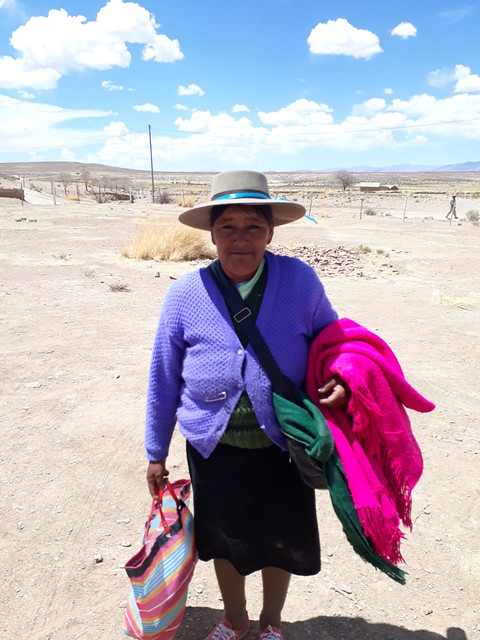
Viviana Gerónimo adds color to the yellow and brown arid landscape of Hornaditas de la Cordillera, one of the Kolla indigenous communities that now have water for the consumption of the 15 local families and for their sheep, llamas and vicuñas, as well as subsistence crops, in this Andean highlands region in the northwest Argentine province of Jujuy. Credit: Daniel Gutman/IPS

Viviana Gerónimo adds color to the yellow and brown arid landscape of Hornaditas de la Cordillera, one of the Kolla indigenous communities that now have water for the consumption of the 15 local families and for their sheep, llamas and vicuñas, as well as subsistence crops, in this Andean highlands region in the northwest Argentine province of Jujuy. Credit: Daniel Gutman/IPS

The Kolla are the largest of the dozen or so indigenous peoples in Jujuy, where 7.8 percent of the population was recognised as native in the last national census in 2010 – more than three times the national figure of only 2.4 percent. Officially, there are 27,631 members of the Kolla people, although the real number is probably much higher, as there are more than 100 Kolla communities in the Puna.

Water brings change

The water collection system benefits the indigenous communities of Hornaditas de la Cordillera, Escobar Tres Cerritos and Cholacor, and the town of El Condor, the municipal seat, which has a primary and secondary school and first aid clinic.

El Cóndor is an hour’s drive from La Quiaca, the main Argentine city on the border with Bolivia. It has about 400 inhabitants, while the communities of the rest of the municipality number less than 100 people in all.

Climate change also seems to be playing its part in exacerbating the scarcity of water. “Although the biggest problem here has always been water, our grandparents said it used to rain more,” says 53-year-old Ricardo Tolaba, another resident of Hornaditas.

“In the past, the ponds, where underground water comes to the surface, dried up in June or July, after the summer rains. Now they dry up in March or April,” he told IPS.

The most important resource are the so-called rock glaciers: moving ice in the mountains covered in rocks and debris which keep them from melting; invisible but strategic water reserves.

The province of Jujuy has 255 rock glaciers, according to the National Glacier Inventory published by the Argentine government in 2018.

With government support, the local communities built a system of underground pipes that run down the slopes for 33 kilometres, using the force of gravity to pipe water to different villages.

“Back in 2007 we began to talk to the communities about how we could build a solution to the lack of water,” says agronomist Julio Sardina, a technician with the Secretariat of Family Agriculture who has worked with the indigenous settlements of Jujuy for more than 20 years.
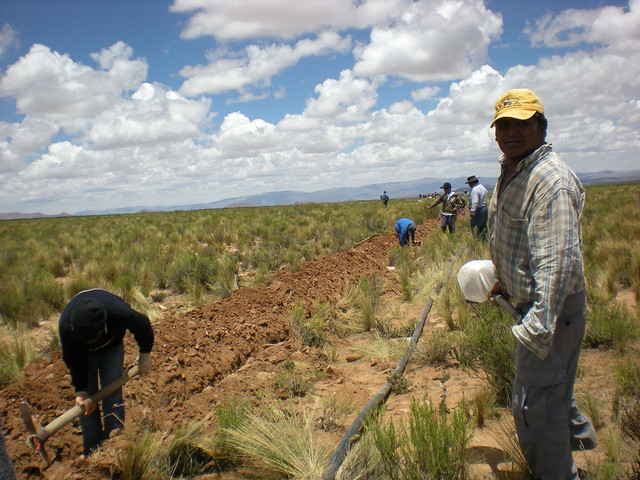
Long months of community work to install pipes to bring water from rock glaciers to indigenous villages in the Puna region in northwest Argentina served to strengthen collective organisation and community ties in an inhospitable ecoregion, where solidarity and joint efforts are essential to daily survival. Credit: Courtesy of Julio Sardina

Long months of community work to install pipes to bring water from rock glaciers to indigenous villages in the Puna region in northwest Argentina served to strengthen collective organisation and community ties in an inhospitable ecoregion, where solidarity and joint efforts are essential to daily survival. Credit: Courtesy of Julio Sardina

“The problem was that people in the lower-lying areas didn’t have water for their animals. And some wanted to plant crops but couldn’t because of the lack of water,” he adds during his tour with IPS through the different communities participating in the project, which are precariously connected by dirt roads in poor condition.

Sardina explains that the Secretariat of Family Agriculture provided the materials to build the system, thanks to funding from the Socioeconomic Inclusion in Rural Areas Project (Pisear), a national government programme.

From the outset, it was stipulated that the work had to be carried out by the members of the beneficiary communities.

“The project, besides bringing water to the villages, helped the communities organise and forge closer ties, since the families were isolated from each other,” says Sardina.

The system benefits some 600 people in an area where families are often nomadic, moving around to find the best pastures. Many Kolla Indians have communal land titles, which is not common among native peoples in Argentina.

When it reaches the communities, the water is stored in a tank. It is also piped to some of the houses and to water troughs for livestock.

But the greatest impact of the project was on agriculture, which has always been limited in the Puna region by the lack of water.
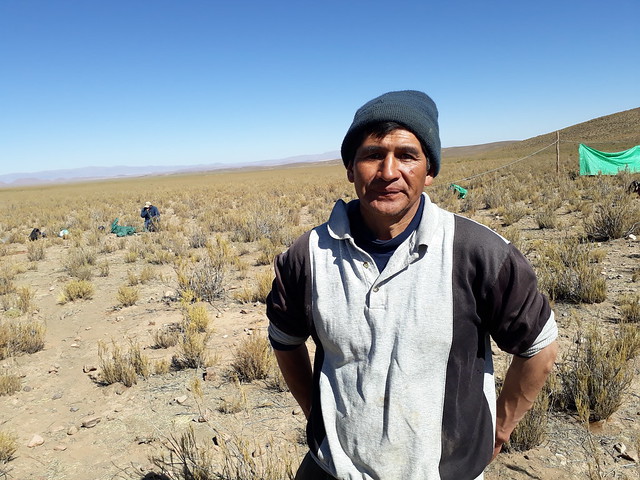
In the high Andean plateau of the Puna, in northwest Argentina, the biggest need was always water, says Ricardo Tolaba. People walked for hours to find it and carry it back in small containers, for human and animal consumption. With the new community-built system that pipes it from rock glaciers, "things began to change," he adds. Credit: Daniel Gutman/IPS

In the high Andean plateau of the Puna, in northwest Argentina, the biggest need was always water, says Ricardo Tolaba. People walked for hours to find it and carry it back in small containers, for human and animal consumption. With the new community-built system that pipes it from rock glaciers, “things began to change,” he adds. Credit: Daniel Gutman/IPS

David Quiquinte, also from Hornaditas, proudly relates that “a 40-centimetre-deep ditch was dug, where the pipe was buried to prevent freezing,” since in the wintertime temperatures in the Puna region can drop to 25 degrees Celsius below zero.

“For nearly six months, the entire community threw its effort into this work… except for one or two people,” the 40-year-old local resident told IPS, without concealing his irritation with those who didn’t help out.

During meetings with technicians from the Secretariat of Family Agriculture, the indigenous communities in Jujuy’s Puna region raised their concern about the growth of the population of vicuñas, a wild South American camelid native to the Andean highlands.

The vicuña came close to extinction in the 1960s, but recovered thanks to protection measures agreed by the countries of the Puna ecoregion.

“We needed water, especially because there wasn’t enough for the animals. And in the meetings about the water system project, many people complained that the vicuñas were eating the grass needed by the llamas and sheep,” Luis Gerónimo, 30, who lives in the community of Escobar Tres Cerritos, told IPS.

That is how the idea arose for training for the “chaccu”, an ancestral practice that the Kolla Indians have taken up again, as have other indigenous communities in Bolivia and Peru, which consists of capturing, shearing and releasing wild vicuñas.

“We’ve been practicing the chaccu for five years and people no longer see vicuñas as a problem. Today they are taken care of. The llamas and sheep graze in the lowlands and the hills are left to the vicuñas,” says Luis Gerónimo.

The chaccu and the water project pursue the same ultimate goal: to enable people from the communities to stay in Jujuy’s Puna region instead of migrating to the cities.

“I am one of the people who went to work in different parts of Argentina and came back. And I’m convinced that we have the resources to keep young people in the Puna,” says Tolaba.

He points out that “the main need in the Puna has always been water. Walking for hours to fetch water or to take the animals to drink are things we’ve been used to since we were kids here.”

But “with this project, things have begun to change,” he adds.
  Source

Indigenous Rights Approach a Solution to Climate Change Crisis

Biodiversity, Civil Society, Climate Change, Conferences, Development & Aid, Environment, Featured, Global, Headlines, Human Rights, Indigenous Rights, Sustainability, TerraViva United Nations

Indigenous Rights

The Global Landscapes Forum (GLF) was held in Bonn, Germany and focused on how to give land rights the visibility needed to showcase that a rights approach, particularly when it comes to indigenous people, is a solution to the climate change crisis. Courtesy: Pilar Valbuena/GLF

Jun 29 2019 (IPS) – The Global Landscapes Forum (GLF) was held in Bonn, Germany to rally behind a new approach to achieving a future that is more inclusive and sustainable than the present – through the establishment of secure and proper rights for all.


On Jun. 22 and 23, experts, political leaders, NGOs and indigenous peoples and communities gathered to deliberate on a methodology that emphasises rights for indigenous peoples and local communities in the management and perseveration of landscapes. The forum took place alongside the  United Nations Framework Convention on Climate Change Bonn Climate Change Conference.

The forum focused giving land rights the visibility needed to showcase that a rights approach is a solution to the climate change crisis, and to develop a ‘gold standard’ for rights.

Indigenous peoples, local communities, women and youth, are believed to be the world’s most important environmental stewards but they are also among the most threatened and criminalised groups with little access to rights.

“We’re defending the world, for every single one of us,” said Geovaldis Gonzalez Jimenez, an indigenous peasant leader from Montes de María, Colombia.

But industries such as fossil fuels, large-scale agriculture, mining and others are not only endangering landscapes but also the lives of the people therein.

Already this year, said Gonzalez, his region witnessed 135 murders, adding that the day before the start of the GLF a local leader was killed in front of a 9-year-old boy.

According to the United Nations, the land belonging to the 350 million indigenous peoples across the globe is one of the most powerful shields against climate change as it holds 80 percent of the world’s biodiversity and sequesters nearly 300 billion metric tons of carbon

It is for this reason that amid the urgency to meet Sustainable Development Goals (SDGs) under pressure from the climate threat, dialogues about the global future have begun to wake up to the fact that indigenous peoples’ relationships with the natural world are not only crucial to preserve for their own sakes, but for everyone’s.

The drafting of the document of rights was led by Indigenous Peoples Major Group (IPMG) for Sustainable Development and the Rights and Resources Initiative in the months leading up to the GLF.

Wider discussions and workshops over the two days served as a consultation on the draft (which is expected to be finalised by the end of the year) as a concrete guide for organisations, institutions, governments and the private sector on how to apply different principles of rights. This includes the rights to free, prior and informed consent; gender equality; respect to cultural heritage; and education.

U.N. Special Rapporteur on the Rights of Indigenous Peoples Vicky Tauli-Corpuz said lands managed by indigenous peoples with secure rights have lower deforestation rates, higher biodiversity levels and higher carbon storage than lands in government-protected areas.

But Diel Mochire Mwenge, who leads the Initiative Programme for the Development of the Pygme in the Democratic Republic of Congo (DRC), one of the largest indigenous forest communities in Central Africa, said he has witnessed more than one million people being evicted from the national parkland where they have long lived. He explained that they had not been given benefits from the ecotourism industries brought in to replace them and were left struggling to find new income sources.

“Our identity is being threatened, and we need to avoid being completely eradicated,” said Mwenge.

In Jharkhand, India, activist Gladson Dungdung, whose parents were murdered in 1990 for attending a court case over a local land dispute, said an amendment to India’s Forest Rights Act currently being reviewed by the Supreme Court could see 7.5 million indigenous peoples evicted from their native forest landscapes. The act can impact a further 90 million people who depend on these forests’ resources for their survival, he said.

The amendment, Dungdung said, would also give absolute power to the national forest guard; if a guard were to see someone using the forest for hunting or timber collection, they could legally shoot the person on-sight.

“Indigenous peoples are right on the frontline of the very real and dangerous fight for the world’s forests,” said actor and indigenous rights activist Alec Baldwin in a video address.

“Granted that indigenous peoples are the superheroes of the environmental movement,” Jennifer Morris, president of Conservation International wondered why they are not heard until they become victims. “Why do we not hear about these leaders until they’ve become martyrs for this cause?”

The examples of intimidation, criminalisation, eviction and hardship shared throughout the first day clearly showcased what indigenous peoples and local communities go through to preserve the forests or ‘lungs of the earth’.

The rights approach, according to conveners of the GLF, aims to strengthen respect, recognition and protection of the rights of indigenous peoples and local communities as stewards and bearers of solutions to landscape restoration, conservation, and sustainable use. It also aims to end persecution of land and environment defenders; build partnerships to enhance engagement and support for rights-based approaches to sustainable landscapes across scales and sectors; and, scale up efforts to legally recognise and secure collective land and resource rights across landscapes.

“By implementing a gold standard, we can both uphold and protect human rights and develop conservation, restoration and sustainable development initiatives that embrace the key role Indigenous peoples and local communities are already playing to protect our planet,” said Joan Carling, co-convener of IPMG.

IPMG recognises that indigenous and local communities are bearers of rights and solutions to common challenges.

“This will enable the partnership that we need to pave the way for a more sustainable, equitable and just future,” added Carling.

And the Center for International Forestry Research (CIFOR) Director General, Robert Nasi, said when rights of local communities and indigenous peoples are recognised, there are significant benefits for the fight against climate change and environmental degradation.

“Whoever controls the rights over these landscapes has a very important part to play in fighting climate change,” he said.

In the climate and development arenas, the most current alarm being sounded is for rights–securing the land rights and freedoms of indigenous peoples, local communities and the marginalised members therein.

How can these custodians of a quarter of the world’s terrestrial surface be expected to care for their traditional lands if the lands don’t, in fact, belong to them? Or, worse, if they’re criminalised and endangered for doing so?

The basic principles of a ‘gold standard’ already exist, such as free, prior and informed consent, according to Alain Frechette of the Rights and Resources Initiative (RRI). What has been lacking, he said, is the application of principles that could be boosted by high-level statements that could “spur a race to the top”.


UN’s Empty Promises to World’s Indigenous Peoples

Tupac Enrique Acosta is a member of the Nahuatl Nation and serves as firekeeper for the Nahuacalli, Embassy of Indigenous Peoples in Phoenix, Arizona.

The 18th Session of the United Nations Permanent Forum on Indigenous Issues (UNPFII) will take place 22 April 3 May 2019. The theme of the session will be: “Traditional knowledge: Generation, Transmission and Protection”

PHOENIX, Arizona, Apr 19 2019 (IPS) – The United Nations, as in so many other areas, gives lip service in support of Indigenous issues while lacking the political will and enforcement power over individual member states to comply with the protection of fundamental human rights for the Original Nations of Indigenous Peoples of the world.


It took 47 years since the 1960’s UN declaration in support of the right of “all peoples” to self-determination to be extended to Indigenous Peoples, with the adoption of the 2007 UN Declaration on the Rights of Indigenous Peoples.

But twelve years later, those words have not moved far off the paper on which they are written. Indigenous issues are still being subsumed under the individual domestic rubric of the member states of the UN Nations General Assembly, in defiance of the commitment to universal human rights that self-determination invokes and professes for all humanity.

It is no accident that the last four nation states to support the Declaration – Australia, New Zealand, Canada and the United States – were precisely those nations where the Anglo-European colonizers of the British Empire globally entrenched their colonial relationship with the Indigenous Peoples subsequent to the decline of Great Britain as a world power.

The devastation and genocide of Indigenous Nations and territories continues till today, but under a new mantle of progress called “Development”

For the Original Nations of Indigenous Peoples of the Great Turtle Island Abya Yala [Americas], we know that the subjugation of Indigenous Peoples started 526 years ago with the sword and the cross are now perpetrated with trade agreements and the empty promises of dead letters from the United Nations.

It is all a reflection of the continuing pernicious influence of the Doctrine of Discovery, the series of 15th century papal bulls in which a succession of popes authorized European explorers “discovering” lands in the New World that were not occupied by Christians to consider those lands vacant – terra nullius, in the words of the Doctrine – and to seize those lands in the names of their sovereign and enslave those people who lived there.

Pope Francis, the first pontiff from the Americas, in a 2015 speech in Bolivia went so far as to apologize for the sins of the Church – not individual conquistadores, but the Church itself – in the subjugation and colonization of Indigenous peoples during the conquest of the Americas.

But even as the Pope denounced the “new colonialism” of global capital oppressing Indigenous peoples, he ignores the pleas by a wide array of Christian denominations, including the World Council of Churches, for the Church to renounce the Doctrine. It is ancient history; the Papal Nuncio at the United Nations has said.

But it is not ancient history. It remains the basis of all Indigenous land law in the United States, and across the continent. In Mexico, the entire legal infrastructure since independence from Spain in 1836 is also based on the dictates of the Doctrine, known as the legaloid concept of Original Property of the State.

That is why Indigenous peoples take Mexican President Andres Manuel Lopez Obrador’s recent letter to the Spanish king and the Pope asking for apologies for those genocidal colonial campaigns with little more than a grain of salt.

We know the Doctrine of Discovery’s impact is still pernicious. We see it in the Trump Administration’s racist immigration and refugee policies in the United States, which refuses to even recognize the historical reality of the descendants of those Indigenous peoples who have traveled freely across the US-Mexican border region before it even existed.

We see it in Brazil, where President Jair Bolsinairo has emboldened racist attacks on Indigenous Amazonian communities in the name of promoting even more destruction of ancient forest and waterways that sustain the entire planet.

We see it in Mexico, where President Lopez Obrador has pushed ahead with the tourism-promoting “Maya Train” across the Yucatan peninsula, tearing through the jungles and rivers in Indigenous homelands without even legitimately consulting the indigenous peoples who have lived there since time immemorial.

And we see it in the continuing devastation that a capital-centered economy, with its extractive industries that destroy the air and water we all rely on for survival, threatens the very future of global humanity. The stakes could not be higher.

We had hoped the UN’s creation of the Permanent Forum and passage of the Declaration on the Rights of Indigenous Peoples had started to turn the battleship of oppression at long last, but we have been disappointed. Instead of extending the universal human rights enshrined in those actions to include protection for Indigenous Peoples, the UN member states have subsumed them to the interests of the nation states that wield the most power with the UN’s halls.

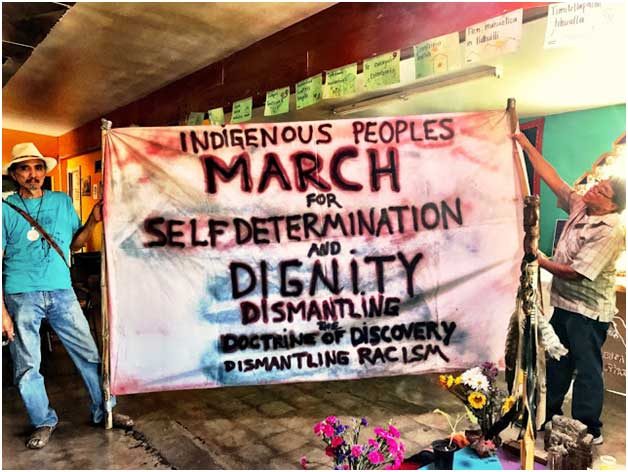
That is why we will take to the streets on Monday, April 22, in New York across from the UN on the first day of this year’s session of the Permanent Forum on Indigenous Issues to let delegates know that we will not be quiet, and we will not ignore the continuing impact of the racist and white-supremacist policies let loose on the Western Hemisphere by the Doctrine of Discovery.

And we will continue to call on the United Nations to live up to the commitments it has made to ensuring that the universal human rights it professes to champion before the world extends to the Indigenous peoples as it has, at least in word, committed. We call for world peace, and peace with Mother Earth.

We know the United Nations is far better at its words than at its deeds. We are here to say that is not enough.


The Amazon Seeks Alternatives that Could Revolutionise Energy Production

Civil Society, Conferences, Development & Aid, Economy & Trade, Editors’ Choice, Energy, Environment, Featured, Green Economy, Headlines, Human Rights, Indigenous Rights, Integration and Development Brazilian-style, Latin America & the Caribbean, Projects, Regional Categories, TerraViva United Nations

Energy

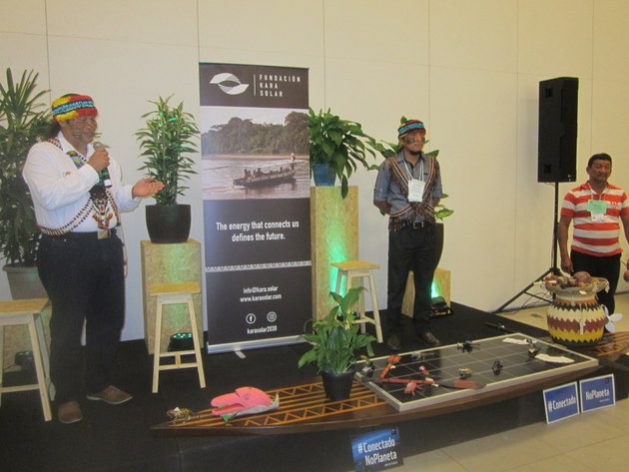
Milton Callera (holding the microphone) and Nantu Canelos, members of the indigenous Achuar community, explain how the two solar boats built to transport their people on the Amazon rivers of Ecuador work. The project is from the Kara Solar Foundation, which is promoting an alliance to "solarise" river transport in the Amazon rainforest. Credit: Mario Osava/IPS

Milton Callera (holding the microphone) and Nantu Canelos, members of the indigenous Achuar community, explain how the two solar boats built to transport their people on the Amazon rivers of Ecuador work. The project is from the Kara Solar Foundation, which is promoting an alliance to “solarise” river transport in the Amazon rainforest. Credit: Mario Osava/IPS

MANAUS, Brazil, Apr 5 2019 (IPS) – A large steel wheel, 14 meters in diameter and 1.3 meters wide, could be the energy solution of the near future, generating 3.5 megawatts – enough to supply a city of 30,000 people, according to a company in the capital city of the state of Amazonas in northwest Brazil.


An internal fluid, which expands through a chemical reaction in contact with an ink, drives the rotation that produces electricity without interruption for at least five years, say executives at Eletro Roda, a company in the city of Manaus that is marketing the invention and is building its first demonstration unit.

“Installation of the unit costs less than half that of an equivalent solar power plant and occupies an area of just 200 square meters, compared to 50,000 square meters for solar and 5,000 square meters for wind power,” Fernando Lindoso, the director of the company in which he is a partner, told IPS.

In other words, in the space occupied by a wind power plant that generates 3.5 megawatts (MW), 25 electro-wheels could be installed, multiplying the generating capacity by a factor of 25.

In addition, it has the advantage of stable generation, “free of the intermittency of other sources,” said Lindoso, who estimated the cost of each 3.5 MW unit at around five million dollars, a price that is reduced for social projects.

There are interested parties in Japan, India and other countries in Asia, as well as in European and Middle Eastern countries, based on earlier prototypes that never made it to market, he said.

There will be a smaller version, generating one MW, “30 percent cheaper”, of identical dimensions, but with three tons of the fluid that is biodegradable, instead of the four used in the other model.

This was one of the alternatives presented at the Fair and Symposium on Energy Solutions for Communities in the Amazon, which brought together more than 500 participants and 39 companies and institutions in Manaus Mar. 25-28.

“My favorite is the solar boat, a good example of how to find solutions,” said Sam Passmore, director of the Environmental Programme at the U.S.-based Charles Stewart Mott Foundation, one of the meeting’s eight international sponsors.

A large metal wheel that can be taken apart in order to facilitate transport produces electricity by rotating driven by an internal fluid, which is expanded by a chemical reaction. Producing 3.5 megawatts, the generator to be sold by Eletro Roda could produce a steady supply of electricity on just 200 square meters of space. Credit: Courtesy of Eletro Roda

A large metal wheel that can be taken apart in order to facilitate transport produces electricity by rotating driven by an internal fluid, which is expanded by a chemical reaction. Producing 3.5 megawatts, the generator to be sold by Eletro Roda could produce a steady supply of electricity on just 200 square meters of space. Credit: Courtesy of Eletro Roda

An alliance for solar-powered transportation in the Amazon is propose by the Kara Solar Foundation, of the indigenous Achuar people of Ecuador, who since 2017 have built two 18-passenger boats powered by electricity from a rooftop made of photovoltaic panels.

Kara means dream in the Achuar language and it is about maintaining the sustainable culture of river transport, as opposed to “the roads that threaten our territory, presented as if they represented development,” project coordinator Nantu Canelos told IPS during the fair.

“We want to build 300, 400 solar boats,” said Milton Callera, technical director of the Coordinating Committee of Indigenous Organisations of the Amazon Basin (Coica).

Riverside dwellers and indigenous people in Brazil are also seeking to “solarise” their boats, especially the small ones, dedicated to fishing and the transportation of a few people. The problem is where to put the solar panels on the so-called “flying boats”, without slowing them down.

The discussions at the symposium, however, focused on the need to universalise energy. “There are still 500,000 people, or 100,000 families, without access to electricity in Brazil’s Amazon region,” according to Paulo Cerqueira, coordinator of Social Policies at the Ministry of Mines and Energy.

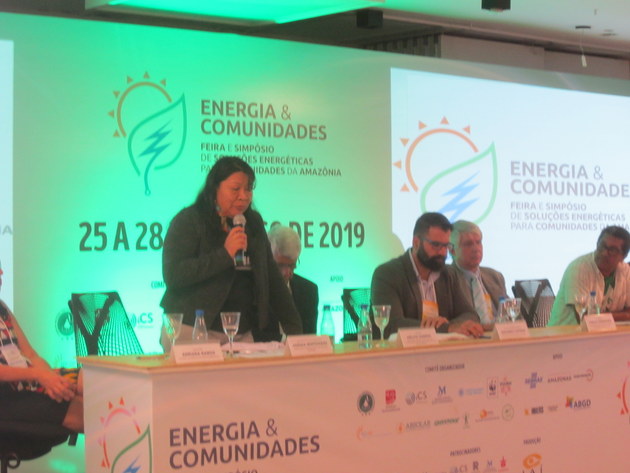
Attorney Joenia Wapichana, the first indigenous woman to hold a seat in Brazil's Chamber of Deputies, speaks at the opening of the Symposium on Energy Solutions for Communities in the Amazon, in the city of Manaus. She is from Roraima, the state with a high indigenous population in northwest Brazil that is suffering a serious energy crisis due to the interruption of supplies from neighboring Venezuela. Credit: Mario Osava/IPS

Attorney Joenia Wapichana, the first indigenous woman to hold a seat in Brazil’s Chamber of Deputies, speaks at the opening of the Symposium on Energy Solutions for Communities in the Amazon, in the city of Manaus. She is from Roraima, the state with a high indigenous population in northwest Brazil that is suffering a serious energy crisis due to the interruption of supplies from neighboring Venezuela. Credit: Mario Osava/IPS

The Light for All Programme, launched in 2003, benefited more than 16 million people, according to the ministry, in this country of 208 million people. But so far, isolated and remote communities, not reached by the power grid, have been excluded.

There are also millions of families who do have electricity, but are outside the National Integrated System, including the entire state of Roraima, in the northeast, with 580,000 inhabitants, on the border with Venezuela, from where it received most of its electricity until the supply crisis that erupted in March in the neighboring country.

Isolated communities in the state receive electricity mainly from diesel- or other petroleum-fueled generators.

The slogan for such cases is to replace costly, slow and unreliable transportation fueled by fossil fuels on the Amazon rainforest rivers, and to prioritise clean sources of energy. Solar power is presented as the most feasible solution, since the Amazon rainforest is not windy.

The exception is Roraima, where the state´s numerous indigenous people are studying the adoption of wind farms to help defend themselves from the impacts of the Venezuelan crisis.

Autonomous solar generation projects are mushrooming in the Amazon, in indigenous villages and riverbank settlements, sometimes funded by non-governmental institutions and international assistance, such as the German Agency for International Cooperation (GIZ) and the Rainforest Foundation of Norway.

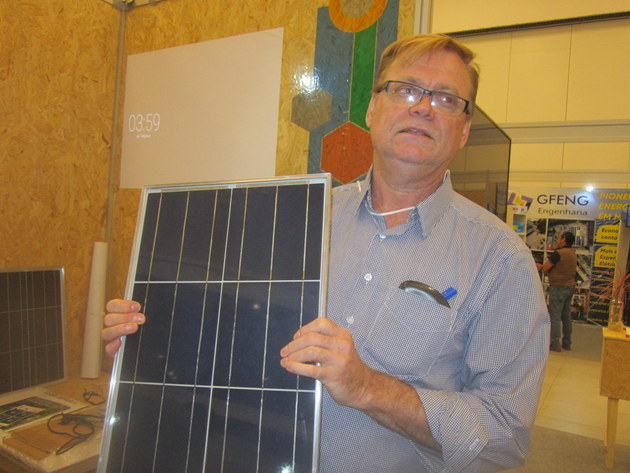
Willi Seilert, from the I9SOL Institute, explains how his solar panels are manufactured, during the Fair and Symposium on Energy Solutions for Amazonia, held in Manaus. He has a project to disseminate a thousand small solar panel factories in Brazil, in order to make photovoltaic generation cheaper in poor communities. Credit: Mario Osava/IPS

Willi Seilert, from the I9SOL Institute, explains how his solar panels are manufactured, during the Fair and Symposium on Energy Solutions for Amazonia, held in Manaus. He has a project to disseminate a thousand small solar panel factories in Brazil, in order to make photovoltaic generation cheaper in poor communities. Credit: Mario Osava/IPS

As a result, companies such as Fabortec Solar, which installs photovoltaic systems and sells equipment, focused on designing and offering off-grid projects, incorporating batteries and equipment that ensure operation and maintenance by the users themselves.

“The Amazon is a great market for those who don’t mind long trips and can work in places that are difficult to access,” a company technician told IPS.

The expansion of solar energy in many parts of Brazil, not only in the Amazon, prompted Willi Seilert to design a plan to promote 1,000 solar panel micro-factories throughout the country.

This could make the product cheaper and facilitate access by poor families and communities to solar energy, in addition to training, employing and generating income for nearly 20,000 people in the country, he estimated.

That’s why he founded the I9SOL Institute, where the “9” stands for innovation.

A 50-square-meter office, at least 10 people trained by two instructors, a glass-top table, an oven and a few tools are enough to produce small solar panels, he told IPS.

“The main obstacle is the import of photovoltaic cells, which Brazil does not produce and which has to pay too high a tariff, because of a strange legal measure adopted in 2012,” he lamented.

In addition to this, there are two industrial processes for processing silicon, and “the rest is packaging work that trained people can do without difficulty,” he said, before pointing out that this continues to be the case in China and India, which provides employment for millions of workers, especially women.

The project is to be launched in Teófilo Otoni, a city of 140,000 people in the southeastern state of Minas Gerais, whose mayor plans to employ prisoners nearing release in the solar industry, Seilert said.

There are more energy alternatives in the Amazonian region. Experiments with the use of oil from the babassu (Attalea speciosa) palm tree abundant in the Amazon and neighboring areas, and from andiroba (Carapa guianensis), a tree with oilseeds, for electricity generation were presented at the symposium.

Railton de Lima, the inventor of the Eletro Roda, which he called a “voluntary engine for mechanical energy generation,” also developed a system for converting urban waste into charcoal briquettes to generate electricity, making it easier to recycle metals.

This technology is already used in several Brazilian cities, including Manaus. Of Lima’s 28 inventions, more than half are already being used in the market, and others are being developed for energy purposes.

Creativity, which helps to seek more suitable alternatives, is also found in poor communities.

“The idea of the right to energy is powerful” and stimulates solutions, said Passmore of the Mott Foundation. In the same sense, the diversity of peoples and communities represented at the Manaus meeting was “a very positive factor,” he concluded.