UNITED NATIONS, Jul 3 2019 (IPS) – How effective is the global war on drugs?
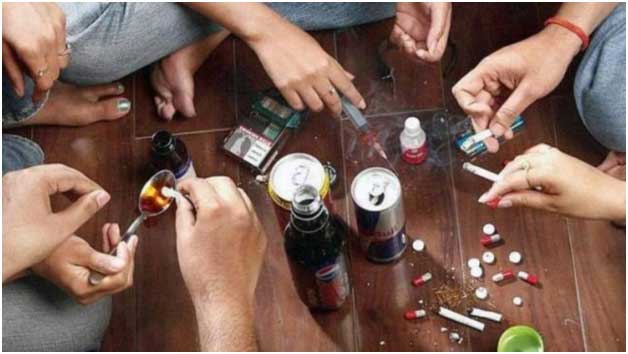
The latest statistics released by the UN Office on Drugs and Crime (UNODC) are staggering: 35 million people across the globe currently have a substance use disorder, and as of 2017, 585,000 people have died worldwide as a result of drug use.
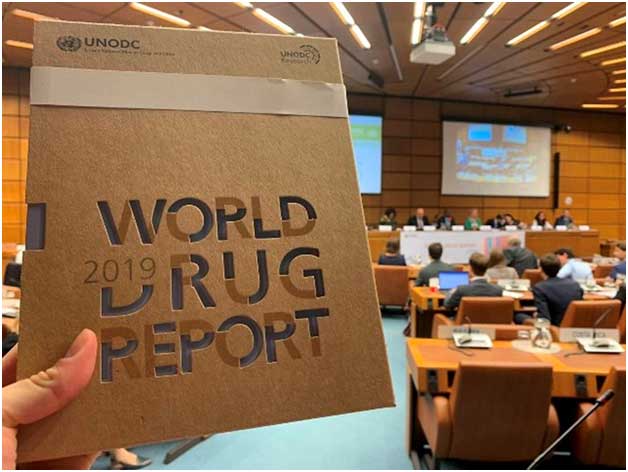
According to a recently-released UNODC report, the lack of proficient drug treatment and facilities for those that need it is impacting mortality rates at alarming levels.
Hence, it stands to reason that treatment and prevention are immensely falling short of the mark on a global scale.
Prisons are also no exception to these shortcomings. In fact, the Report unmasked that those incarcerated for drugs are more likely to continue being exposed to drugs.
The Report also highlighted that out of the 149 countries that were surveyed, about 1 in 3 people reported that they consumed drugs in prison at least once while incarcerated, and 1 in 5 people who are currently incarcerated reported that they have used drugs within the past month.
“In terms of data, we did some data collection, always trying to get as much as possible, in terms of socio-economic characteristics, we would have this type of data, I imagine, and this is also something that will run throughout the new report, and is being discussed now.” Chloé Carpentier, Chief of the Drug Research Section told IPS.
The issue between drugs and human rights is on Secretary General António Guterres’ radar as well.
“Together, we must honour the unanimous commitments made to reduce drug abuse, illicit trafficking and the harm that drugs cause, and to ensure that our approach promotes equality, human rights, sustainable development, and greater peace and security.” Secretary General António Guterres stated on the International Day Against Drug Use and Illicit Trafficking.
“We will make sure that no one with a drug problem is left behind” Dr. Miwa Kato assured, during the official launch of the Report on June 26.
Dr. Kato continued to push this message throughout her speech and cited that “Health and justice need to work hand in hand.”
Beyond the UN, this is a topic of interest for the academia world as well, since young people are heavily susceptible to a substance use disorder.
“It is important that we say people— not user or addicts, that language itself is stigmatizing.” Dr. Danielle Ompad, Associate Professor, College of Global Public Health and Deputy Director, Center for Drug Use and HIV Research at New York University (NYU) told IPS.
Dr. Ompad highlighted the importance of person-first language, citing that “It is important how we refer to people, and view them as humans, and not just the behavior (the substance use).
In terms of the World Drug Report, she noted that “The war on drugs, if you look at it, hasn’t really been an effective war”, and elaborated that the focus should not be supply- side intervention, because in the long run, drugs are going to be produced and sold no matter what, which leads to mass incarceration, which doesn’t benefit any party.
It is also important to recognize that “not everyone needs treatment, and those that do should absolutely have access to it. But just because you use marijuana does not mean you are an addict”.
She went on to suggest a harm- reduction approach. The harm-reduction approach blends a plethora of strategies from safer use to managed use to abstinence- it meets the need of the person.
Meanwhile, tracing back to the issue of treatment, the Report affirmed that over 80% of the world’s population lack access to adequate treatment with only 1 out of 7 people with a substance use disorder receiving treatment each year.
The Report showcased that women cited a strong sense of fear that kept them from seeking the help that they needed for a variety of reasons that ranged from possible legal issues to the lack of childcare while in treatment.
Another issue is several countries, particularly in Asia, is the death penalty for any person found guilty of a drug ‘offense.’
Last month, Sri Lanka’s President, Maithripala Sirisena signed death warrants for four convicts- thus pushing the notion that those who have a substance use disorder are ‘dirty’ and should be disposed of.
Similarly, in a 2014 study conducted by Johns Hopkins Bloomberg School of Public Health, it was shown that having a substance use disorder was viewed more negatively than mental illness. Ironically, however, the two are all but intertwined.
This is also evidenced by the Report- about half of the world’s population that develop a mental disorder will also experience a substance use disorder in their lifetime.
However, it is to be noted, that despite all of the above, the Report only cited the “lack of effective treatment interventions based on scientific evidence and in line with human rights obligations.” but made no further elaborations on the what’s and how’s and was only discussed briefly at the official Report launch.
That said, the issue of ensuring those that do have a substance use disorder are provided for while figuring out more beneficial and healthier initiatives to reduce drug rates across the globe are currently being discussed among the United Nations (UN) and United Nations Office on Drugs and Crime (UNODC).
Dr. Ompad said for better or worse, licit, and illicit drug use is part of our world.
“Focus a little bit more on harm reduction,” Dr. Ompad stated, and above all “We need to stop the war on the people who use drugs,” she declared.
UNITED NATIONS, Jun 26 2019 (IPS) – The feeling in the air at a recent meeting of the United Nations Office on Drugs and Crime (UNODC) was one of compassion and benevolence.
The focus was on children as Foreign Terrorist Fighters (FTFs), a subject that everyone at the panel discussion argued is delicate and politically sensitive.
Alexandra Martins, the Crime Prevention and Criminal Justice Officer at the UNODC, pointed out that “”Nobody is a lost cause, and there is always a possibility to rehabilitate and reintegrate children from these groups.”
Two of her words were repeated by almost every speaker: “rehabilitate and reintegrate”.
The meeting was meant to discuss the release of the UNODC Handbook on Children Recruited and Exploited by Terrorist and Violent Extremist Groups.
The roadmap’s main goal is to provide UN’s 193 Member States with guidance on how to treat children associated with terrorist and violent extremist groups. It argues for an approach to rehabilitate those associated with or accused of being FTFs, and to reintegrate them back into their communities.
Though many of the children accused have taken part in terrorism, the UNODC advocates for a change in the way Member States handle the children.
Speaking during the release of the handbook, Dr. Jehangir Khan, Director at the UN Office of Counter-Terrorism/Counter Terrorism Centre (UN OCT/CCT), said “children must be seen first and foremost as victims.”
The roadmap was released alongside 4 technical assistance tools: UNODC Handbook on Children Recruited and Exploited by Terrorist and Violent Extremist Groups: The Role of the Justice System (2018); the UNODC Training Manual on Prevention of Child Recruitment by Terrorist and Violent Extremist Groups (May 2019); the UNODC Training Manual on Rehabilitation and Reintegration of Child Victims of Recruitment by Terrorist and Violent Extremist Groups (to be released in July 2019); the UNODC Training Manual on Justice for Children in the Context of Counter-Terrorism (May 2019).
The documents are based on three years of technical assistance work conducted by the UNODC to Member States that have found children as FTFs.
One country already advocating its support for the Roadmap is Lebanon. Until 2013, children accused of being or associated with terrorist fighters were kept in adult prisons and tried as such.
“It is in prison that I learned the meaning of life” one of the boys, aged 19, remarked in a video played by the representative from Lebanon stated.
A step in the direction of treating children as victims came in 2013, when they were moved to a juvenile prison.
Lebanon’s Head of the Prison Administration at the Ministry of Justice of Lebanon, Judge Raja AbiNader, said: “By showing them the same respect we showed the rest of the children, things started to change.”
Martins told IPS that there are many such countries, like Lebanon, whose children and communities have already benefited from the guidance offered in the Roadmap.
“As a result of the protocol, children deprived of liberty for association with Boko Haram were released and transferred to child protection authorities to begin a process of reintegration in their communities,” she said.
Martins stated that more than 30 countries have received guidance on child FTFs from the UNODC’s, from 6 different regions (West Africa, East Africa, Middle East and North Africa, South Asia, Southeast Asia and Central Asia).
Despite the Roadmap offering guidance, at the panel discussion, Martins clarified that “there is no one size fits all approach” on handling children.
There have been different approaches offered on handling the children in general, and specifically when dealing with different genders.
There will be a second event during the United Nations General Assembly (UNGA) in September that Martins hopes will “promote the guidance further.”
Gender and the Roadmap
But there appears to be some disagreement still on the treatment of boys and girls during the rehabilitation and reintegration processes.
Under international law (Havana Rule 87.d., Bangkok Rules), boys and girls must be held in separate detention facilities. But the Roadmap encourages them to still engage together, to foster development.
The Roadmap also advocates for targeted approaches on the treatment of girls.
Martins told IPS that girls are “considerably more vulnerable to both physical and sexual abuse and require special attention in this regard.”
She noted that “girls deprived of liberty are exposed to other forms of sexual violence such as threats of rape, touching, ‘virginity testing’, being stripped naked, invasive body searches, insults and humiliations of a sexual nature.”
Given these sensitive issues, and the fact that girls are different physiologically and often psychologically from boys at certain development stages, the Roadmap advocates for an awareness of gender and for specific targeted approaches.
“A section in the manual alludes that girl victims of recruitment and exploitation by terrorist and violent extremist groups require specific approaches to reintegration, because of their increased exposure to violence at multiple levels and from different actors,” Martins said.
But it is not clear yet that this section on gender differences has been implemented.
While Martins says the Roadmap takes seriously the different approaches for girls and boys, Judge AbiNader told IPS that in Lebanon “Very honestly, we’re not working specifically with girls concerning rehabilitation.”
As of June 7th, Lebanon has 10 boys and 2 girls in prison for being associated with or accused of being FTFs.
When asked why there were not specific programs that tackle children of divergent genders differently, he argued that they girls “should be treated the same” during rehabilitation.
“And it hasn’t been discussed because the number [of girls in prison for accusations of being FTFs] is so low,” he added.
Despite the low numbers of accused girls in detention facilities, Martins believes that targeted women’s health education should be provided, and that “Access to age- and gender-specific programmes and services, such as counselling for sexual abuse or violence, has to be given to girls.”
Though the UNODC has advocated a change in outlook on children involved with terrorist organizations, the Roadmap’s release is just the beginning of that change being implemented.
Tisaranee Gunasekara is a political commentator based in Colombo*
“Unmindful are the walking dead The known way is an impasse.” Heraclitus (The Fragments)
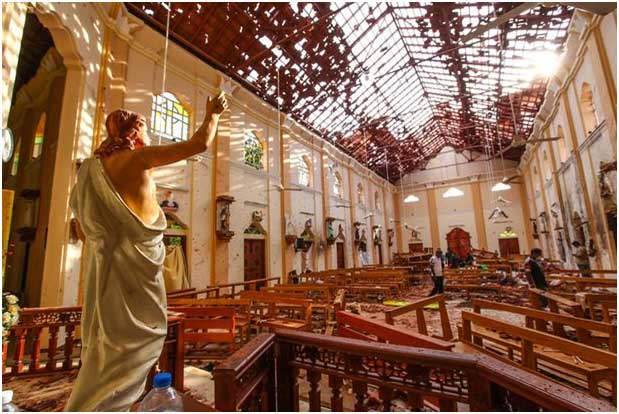
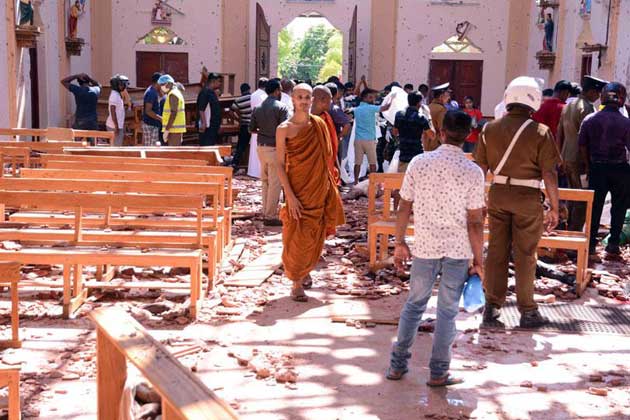
COLOMBO, Sri Lanka, Apr 30 2019 (IPS) – We have been here before. This blooded precipice is familiar, this looming abyss. What is unfamiliar, what renders the Easter Sunday massacre most vile and truly nightmarish is the total absence of any knowable rationality.
There is no context to this horror, no back-story; it cannot be framed, politically or historically. Other massacres were presaged; this one fell on an unsuspecting people, a killer-bolt on a clear Sunday morning. It is the most heinous and the most incomprehensible act of violence in our violence-ridden history.
Every massacre of innocents leaves behind a heap of questions. The larger why, the philosophical, existential why might be unanswerable, but the smaller whys almost always are.
Whether it was Black July, the Anuradhapura massacre, or any of the civilian bloodletting that came afterwards, there was a discernible path to the outrage paved with a history of real or imagined wrongs.
Not so this massacre of innocents.
That the massacre is the work of an Islamic terror group is now certain, a conclusion made inescapable by the involvement of several suicide bombers. The attacks on the hotels are barbaric, but part of a comprehensible, global pattern. You want to hurt an economy dependent on tourism; you attack places where tourists congregate, from beaches and ancient ruins to hotels.
Not so the targeting of Catholic churches in Sri Lanka. That is where the utter incomprehension stems from. In Sri Lanka, there has been no history of violent animosity between Muslims and Christians/Catholics. Both communities have been targeted by Sinhala-Buddhists on multiple occasions. They were both victims of majoritarian violence, but never responded in kind.
Had the suicide bombers targeted state institutions, places of entertainment, Buddhist temples or even Hindu kovils, it would have made sense in terms of vengeance for a real or imagined wrong.
Why churches? Why only Catholic churches?
Churches have been targeted by Islamic terrorists elsewhere in the world, including Asia; the Surabaya bombings in Indonesia and the Jolo church attacks in the Philippines are cases in point. But every one of those attacks could be placed within a national politico-historical context. There is no such context here in Sri Lanka.
Attacks by a lone gunman or a lone bomber might have been comprehensible, the work of a clinically deranged man. But an operation of this complexity and magnitude, involving the willing and knowing cooperation of hundreds of people, is unfathomable. The killers, the human bombs, are believed to be Lankan Muslim men.
For any terror organisation, suicide killers would be a valuable possession, something you don’t expend in vain. A suicide killer must be trained and groomed right up to the moment of murder, handled with meticulous care, kept on the pre-prepared path, shielded from every human emotion. Why use such valuable and not easily replaceable weapons on targeting a community that had not done you or your local co-religionists any harm?
Were the churches targets of opportunity? In Sri Lanka, churches (along with mosques and kovils) are relatively unprotected and vulnerable. But so are many other institutions and structures, both secular and religious. Was it to gain maximum publicity – bombing churches on Easter Sunday? That would have been a credible explanation had the authors rushed to claim responsibility.
** But so far, no organisation has claimed responsibility, another unusual occurrence. Generally, after a successful operation, the claim to own it is a race. Terrorists love publicity. That is how they gain new recruits and new resources.
So here we are, in a hell both familiar and unfamiliar. How not to plunge from this to a worse hell is the hardest challenge ahead, much harder than identifying, apprehending and punishing the guilty.
An Unforgivable Failure
There is one haunting truth about the Easter Sunday massacre – with a little more vigilance, it might have been prevented. A section of the security establishment seems to have known that an Islamic terror group was planning to target Catholic churches. According to reports, they even knew the names and other details of some of the attackers, possibly ten days ahead.
The speed with which the first arrests were made gives credence to these reports. Such speed by our police can be explained only by prior-knowledge. Greater the speed, greater the prior-knowledge. And the speed was great, unprecedentedly so. That begs two critical questions.
Who knew? Why did those in the know do nothing with their knowledge?
If the known attackers had been arrested, the massacre wouldn’t have happened. And it could have been done under normal law. The Defence Secretary is lying if he claims that the information was vague and the absence of emergency regulations was a handicap.
If the churches were informed about their peril, they could have taken some precautions. That certainly didn’t require emergency regulations.
With either of those two measures, three hundred innocent lives could have been saved.
We, as a nation, need to know why those lives were wantonly sacrificed. The SLPP had predictably accused the government of not supporting the intelligence agencies, of persecuting and discouraging them. That is incorrect. The intelligence agencies are not the victims of this story. They received the information, and opted not to do anything with it. That was a severe dereliction of duty.
President Maithripala Sirisena must shoulder much of the blame. As the Minister of Defence, protecting the people was his responsibility. He failed abysmally. And he has not apologised for that failure. That doesn’t mean the UNP can exculpate itself from all responsibility, all blame.
The ‘we were not told’ excuse cannot hold water since one of the letters warning about impending terror attacks seems to have been circulating in the social media for days. If Minister Harin Fernando’s father knew about the danger, then the Minister, his cabinet and non-cabinet colleagues and his prime minister cannot plead ignorance.
The government’s failure to stop the massacre fits into a general pattern of indifference towards all forms of extremism. One week before the Easter Sunday massacre, on Palm Sunday, a Methodist church in Anuradhapura was attacked, reportedly by a Sinhala-Buddhist mob. The police refused either to apprehend the attackers or to protect the victims. The government didn’t condemn the attack, didn’t order the police to catch the culprits. All it did was to promise the church protection for Easter.
The promise reportedly came from the Prime Minister. There was not a hum from the President. Political leaders on all sides of the divide, including the minister in charge of Christian Affairs, acted blind, deaf, and mute.
Perhaps this blasé attitude of the political class percolated to the intelligence establishment. Perhaps those in the know thought that there was no need to act if the intended target was a church, or some other minority religious establishment. After all, thirteen months have passed since the anti-Muslim riots of Digana. Time enough for the main suspects to be tried in a court of law. Yet no one has been formally charged and every suspect is out on bail.
Had the government honoured its promise to end impunity and ensure justice, had it honoured the promise to combat extremism and promote moderation, the Easter Sunday massacre might have been avoided. This government did not promote extremism, like its predecessor. But it didn’t resist extremism either. It turned itself into a bystander. Three hundred innocent people paid for that cowardice, that indifference, with their lives.
The next vicious spiral
A new fault line has been created in Sri Lanka’s already seriously compromised societal fabric. A new enmity has been birthed. This is not the moment for anodyne slogans about unity and peace. The peril cannot be resisted, if its existence is unacknowledged.
Sri Lanka’s blood-soaked history provides us with ample warning of the dangers ahead.
Will the targeting of Catholics by Islamic terrorists create an endless blood feud between Lankan Catholics and Lankan Muslims? Will the wronged Catholics themselves do wrong by targeting innocent Muslims?
The fear that the Easter Sunday massacre will lead to a round of attacks on Muslim properties and religious establishments has so far not materialised. For this, the government, especially the UNP, deserves the credit. When the first attack on a mosque was reported, immediate action was taken, including the imposition of a curfew. That probably saved the country from another round of bloodletting. But the danger will not be over in a day, or even a year. Only constant vigilance can prevent another tragedy.
Terrorists of all kinds have two targets – one the purported enemy; the other, one’s own community. The authors of the Easter Sunday’s massacre of innocents would have known that they were placing their own innocent coreligionists in peril. They would have known that retaliatory attacks could happen, if not in the immediate aftermath, then someday.
And they wouldn’t have cared. That is a function of extremism. They not only hate their enemies. They don’t care about their own community. The cancer of extremism that is affecting Lankan religions must be combated, perhaps primarily from within.
The first step is to start criticising one’s own extremists. It is only by taking an unequivocal stand against extremists of our own community do we earn the moral right to criticise extremists of other communities.
Sinhalese and Tamils failed to take a stand against their own extremists; each community raged against the other’s tribalism while justifying one’s own. That failure caused both communities incalculable harm, and incalculable self-harm. Black July turned a marginal insurgency into a full scale war. The LTTE’s countless atrocities eventually contributed to its own shameful defeat.
When Sinhala-Buddhists attacked Muslims in Digana in the name of Buddhism, the absolute majority of Buddhist leaders remained mute. The Muslim leaders will hopefully set a different example, not just in the immediate aftermath, but continuously. The task would be long and hard.
Though Lankan Muslims have been the victims of both Sinhala-Buddhist and LTTE violence, the atrocities committed by Muslims elsewhere in the world have rebounded on them unjustly, enveloping them in a miasma of fear and suspicion. Easter Sunday’s massacre will worsen their plight.
There is a danger of Muslims being considered as enemies by all other communities. Extremists within the Sinhala-Buddhist fold will work towards such an outcome. One can almost hear the likes of Galagoda-Atte Gnanasara crowing. Forgotten will be the role played by anti-Muslim violence in fostering Muslim extremism.
But that too would be in accordance with the intent of the attackers. As Moroccan editor Ahmed Benchemsi opined, “…..spreading hate is the terrorists’ job. Hating you is not enough; they also need you to hate them, so the struggle goes unchallenged” (Newsweek – 20.11.2008).
Terrorists revel in hate, and they want that hate to be extended to their racial/religious community as well. They want their crime to become the crime of their entire community, falling even unto unborn children. When such hatred seeps into a national bloodstream, the terrorists achieve their final victory. That happened between Sinhalese and Tamils. It mustn’t happen between Lankan Catholics and Lankan Muslims.
Sadly, hate is easy to cultivate. It can flourish anywhere. All it needs is an inch, a second, a thought, a glance, one unguarded moment. And a destructive atom can always survive, waiting with endless patience until the next time.
So, we stand on a familiar precipice, staring at a familiar abyss. This time, the task of guiding us away from it, towards the plains of moderation and stability belongs to Muslims and Catholics. This is their moment to be what Sinhalese and Tamils were not at comparable moments in their histories.
This is their moment to place their humanity above every other consideration, in a way we, Sinhalese and Tamils, failed to. And it is for us, especially Sinhala-Buddhists, to prevent our own extremists from intervening to sow hate, to prevent healing, to peddle vengeance in the guise of justice.
As Aristotle said, “For the things we have to learn before we do them, we learn by doing them… We become just by just acts, temperate by doing temperate acts…” (Necomachean Ethics). In this moment, grand gestures are necessary; but every little act of ordinary decency and kindness counts. If our leaders, elected and self-appointed, fail to stand against extremism, fail to build an alliance of moderates, perhaps we, the people, who are outraged by Easter Sunday’s massacre of innocents can.
*This analysis was written on April 23, two days following the Easter Sunday terrorist attacks in Sri Lanka. ** Since then, there have been reports that ISIS has claimed responsibility for inspiring the attacks.
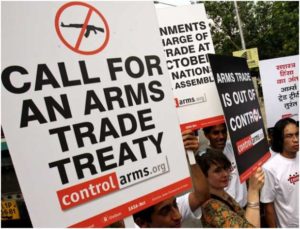
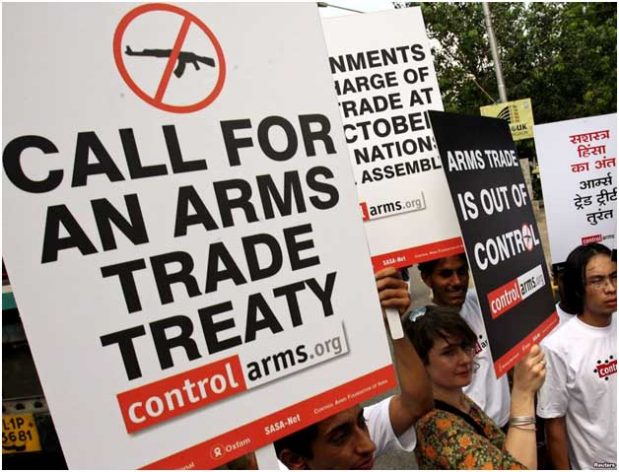
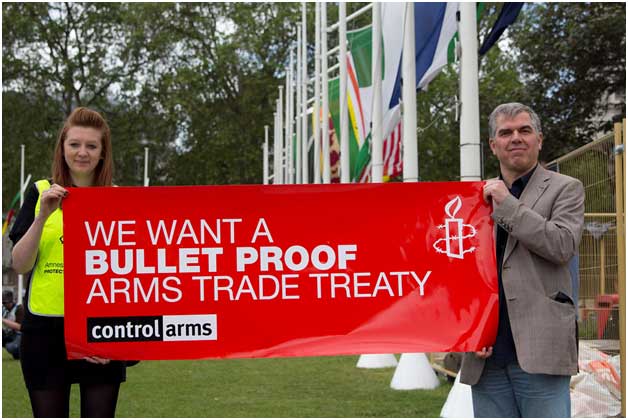
UNITED NATIONS, Apr 29 2019 (IPS) – The United States dropped a political bombshell when President Donald Trump announced his administration would withdraw from the historic Arms Trade Treaty (ATT) which the former Obama administration signed in September 2013.
“We are taking our signature back”, said Trump April 26, addressing a meeting of the National Rifle Association (NRA), one of the most powerful gun lobbies in the US.
The US, in effect, joins three other “rogue states” – North Korea, Iran and Syria – who voted against the treaty at the UN General Assembly back in April 2013, along with 23 countries that abstained on the voting, including China, Russia, India, Indonesia and Saudi Arabia.
Jayantha Dhanapala, a former UN Under-Secretary-General for Disarmament Affairs and ex-President of the Pugwash, told IPS that President Trump “continues to create mayhem in the field of disarmament by wrecking the legal regime created by the international community at the behest of vested interests in the gun lobby sacrificing the humanitarian norms of the world to which the US has contributed.”
The US, which has increasingly shown virtual contempt for multilateralism, has already scuttled the 2015 multilateral nuclear agreement with Iran, refused to participate in the global migration compact, pulled out of the 2015 Paris climate change agreement, abandoned the 12-nation Trans Pacific Partnership (TPP) agreement, and revoked the 1987 Intermediate-Range Nuclear Forces Treaty with Russia.
Dr. Natalie J. Goldring, a Senior Fellow and Adjunct Full Professor with the Security Studies Program in the Edmund A. Walsh School of Foreign Service at Georgetown University, told IPS President Trump is pandering to the National Rifle Association yet again.
She said his announcement that the United States is “un-signing” the Arms Trade Treaty is yet another example of this administration’s abdication of responsibility in the arms control sphere.
In the fact sheet announcing this decision, the Trump Administration stated, “The ATT is simply not needed for the United States to engage in responsible arms trade.”
“The Trump Administration has not been engaged in responsible arms trade in any way, shape, or form. There is indisputable evidence that Saudi Arabia, for example, consistently violates international human rights and humanitarian law”.
“But the Trump Administration continues to pursue arms sales agreements with the Saudi regime,” said Dr Goldring, who is also a Visiting Professor of the Practice in the Duke University Washington DC program.
She pointed out that the United States is the world’s largest arms dealer. It’s long past time for the United States to show leadership on the global arms trade, rather than merely treating arms sales as economic transactions, she added.
The ATT, which was adopted by the United Nations in April 2013 and entered into force in December 2014, was initiated by the UK, a NATO ally of the US.
As of last week, the Treaty has 101 state parties with ratifications, and 45 countries which have signed but not ratified.
Responding to questions at a press briefing April 26, UN spokesperson Stephane Dujarric told reporters that the Arms Trade Treaty is the only global instrument aimed at improving transparency and accountability in the international arms trade.
“It is a landmark achievement in the efforts to ensure responsibility in international arms transfers. This is particularly important in present times, when we witness growing international tensions and renewed interest in expanding and modernizing arsenals,” he added.
Credit: Sarah Myers
Rachel Stohl, Managing Director at the Stimson Center and a consultant who helped draft the text of the treaty, said that President Trump has “once again walked away from America’s leadership role in the world and undermined international efforts to reduce human suffering caused by irresponsible and illegal arms transfers”.
In statement released here, Stohl said “Un-signing the Arms Trade Treaty will undermine international peace and security, increase irresponsible and illegal sales of conventional weapons, and harm the American economy”.
A transparent, responsible arms trade fundamentally serves U.S. national security, promotes U.S. foreign policy objectives, and supports American values.
The ATT facilitates transparency and accountability in a global arms trade worth nearly $90 billion a year, building confidence among governments and ending decades of impunity, she declared.
Dr Goldring said the US government regularly claims to have the strongest global standards for arms transfers. Yet it seeks to abandon the only legally binding treaty that addresses these issues.
“This may seem like a symbolic step, because the Trump Administration had already made clear its lack of support for the treaty,” she added.
But this act has substantive implications as well.
It’s in the US interest to be part of the ATT and to work with other countries to increase their standards for importing and exporting weapons, she noted.
‘Unsigning’ the ATT decreases our leverage with these countries. ‘Do as I say, not as I do’ is a cynical and unpersuasive policy approach,” said Dr Goldring who also represents the Acronym Institute at the United Nations on conventional weapons and arms trade issues.
Abby Maxman, President of Oxfam America, said Trump’s decision to un-sign the Arms Trade Treaty “is a reckless, self-inflicted wound that continues to demonstrate the Administration’s desire to turn its back on global norms, standards and US leadership. It is one more misguided step to dismantle the international partnerships that keep us all safe.”
Just last week, the Administration held hostage a UN Security Council resolution to address sexual violence in conflict– until language about the need for sexual & reproductive health services was removed.
And, it’s no coincidence that this comes on the heels of President Trump’s veto of the Yemen War Powers Resolution and continued military support for Saudi Arabia in the war in Yemen, said Maxman.
President Trump is sending a clear message to civilians caught in the crossfire: “we don’t care.”
The United States will now lock arms with Iran, North Korea and Syria as non-signatories to this historic treaty whose sole purpose is to protect innocent people from deadly weapons.
“The Arms Trade Treaty was developed and signed by the US and others to keep deadly weapons out of the hands of those who may use them to commit genocide, crimes against humanity and war crimes. The treaty has the power to save millions from death, rape, assault and displacement. Each year an estimated 500,000 people are killed as a result of the unregulated and under-regulated arms trade,” said Maxman.
“The Treaty does not infringe on Americans’ right to bear arms or hamper the country’s ability to defend itself or its allies, despite what groups like the NRA, and the Trump Administration may claim.”
Last week’s announcement, he said, “is an empty play to pander to those who resisted this Treaty from the beginning.”
Meanwhile, in a report released April 29, the Stockholm International Peace Research Institute (SIPRI) said total world military expenditure rose to $1,822 billion in 2018, representing an increase of 2.6 per cent from 2017.
The five biggest spenders in 2018 were the United States, China, Saudi Arabia, India and France, which together accounted for 60 per cent of global military spending.
Military spending by the US increased for the first time since 2010, while spending by China grew for the 24th consecutive year. The comprehensive annual update of the SIPRI Military Expenditure Database is accessible from at www.sipri.org.
The report also said that US military spending grew—for the first time since 2010—by 4.6 per cent, to reach $649 billion in 2018.
The US remained by far the largest spender in the world, and spent almost as much on its military in 2018 as the next eight largest-spending countries combined.
‘The increase in US spending was driven by the implementation from 2017 of new arms procurement programmes under the Trump administration,’ said Dr Aude Fleurant, the director of the SIPRI AMEX programme.
H.L.D. Mahindapala is a Sri Lankan journalist who was Editor, Sunday Observer (1990-1994), President, Sri Lanka Working Journalists’ Association (1991-1993) and Secretary-General, South Asia Media Association (1994).
MELBOURNE, Apr 26 2019 (IPS) – The history of terrorism in Sri Lanka reveals a clear pattern. The first to take up arms in the post-Independent era were the misguided Sinhala youth. They were educated youth desperately running in search of a quick solution to establish their classless paradise. Their violence did not take them anywhere.
The Tamil youth were the second to take up arms. Most of their cadres too consisted of educated Tamil youth running in search of a speedy route to establish their mono-ethnic paradise. At the end of a three-decade war they sank to the bottom of the Nandikadal Lagoon.
Now the Muslim youth have bombed their way into the global headlines. They shot into the limelight on the morning of Easter Sunday taking everyone by surprise. Unlike the two preceding terrorist groups the local Muslim terrorists who carried backpacks loaded with explosives seems to be dummies carrying out the orders and agenda of a hidden hand directing them from abroad.
H.L.D. Mahindapala
To begin with they were echoing the imported hate politics fed to them by the extremist local agents running fragmented jihadist cells. Nor have they produced a calculated, well-defined ideology against the state, like the other two terrorist organisations, arguing that it should be destroyed and replaced with their political models.
However, it is known that the preachers in their cells and madrassas have been indoctrinating the youth with violent interpretations of the Koran with the aim of converting Sri Lanka into an Islamic Caliphate. That constitutes a part of the larger agenda of ISIS, without any local content in it.
Running through all three violent movements of the youth is a manufactured ideology tailored to radicalise and convert them into violent politics as the solution to their indoctrinated, imagined and real problems.
The Sinhala youth took to Marxists revolutionary ideology reduced to five lectures. The Tamil youth took to the ideology of the Saivite Jaffna Vellala supremacists to create Eelam – the paradise of mono-ethnic extremism. And the Muslim youth seems to have jumped into a similar ideology believing that they could achieve their Islamic salvation at the end of violence.
If history is any guide then the preceding two violent movements point to a bitter end. Like the other two preceding terrorist groups the Muslim terrorists too are doomed to end up achieving nothing. Besides, the odds are tilted heavily against the Muslim terrorists, both internationally and locally.
They have begun with a big bang which had echoed round the world. That is about all they could achieve: making big noises if they are to continue down this path of violence. Whether they have the capacity to sustain the violence of the Easter Massacre on a mass scale for a prolong period is questionable.
Based more on the historical evidence of the past two youth revolts than on the skimpy details available on the Muslim youth, my conclusion is quite simple: neither the prevailing hostile international climate against every kind of Muslim violence, nor the national ethos of a thriving and conservative Muslim trading community dependent on peace and stability, is conducive for the Muslim youth to sustain their campaign of violence for long.
Besides the wobbly Yahapalanaya Sri Lankan government, which was going softly– softly on rising Muslim radicalisation and violence– has at last woken up to the grim and destabilising realities that had blown their tops off. It is the magnitude of the simultaneous explosions hitting three points of the compass – east, west and the immediate north – that shook the foundations of Sri Lankan establishment
The Easter Sunday blast is likely to change – at least in the short run — the conventional image of the Muslims. They were seen as the more emancipated and liberal Muslims not committed to radical Islam. But after the East Sunday Massacre it is likely that they will be bundled with the rest of the ideologically driven Muslim fanatics abroad committed to irrational violence.
The latest Reuter’s report which reveals the ISIS hand behind the Easter Massacre can only reinforce the image of being ruthless religious fanatics.
Radicalisation takes sense and sensibility out of the minds of the impatient youth looking for instant solutions. And politicised religion is packed with hate. Both are incendiary forces that can drive the impulsive youth into insane fits of violence.
Of course, the initial blast that shook Easter Sunday was massive and impressive. The (1) precision timing that went off like clockwork, (2) the gigantic scale of the blasts hitting targets in east, west and the near north simultaneously,(3) the selected targets of Christian Churches and hotels packed with Western tourists (4) the organisation capacity to piece together the various arms of the military-style operation that exploded on Easter Sunday (5) the blind faith of the suicide bombers that walked the lethal distance to their fatal end and that of 350 other victims, point clearly to hidden brains beyond the borders of the local Muslims.
There is, no doubt, that the suicide bombers were on a political mission. But what was it? Also, terrorist acts are executed to convey a political message. What is the message behind the biggest ever terrorist operation on Sri Lanka soil?
This explosion which hit like a bolt from the blue makes no sense in the Sri Lankan context. Apart from sporadic tensions – some of which have been caused by National Thowheeth Jamaat (NTJ) – the Sinhala-Muslim relations had not stretched to breaking point to provoke an attack of this magnitude.
Mainstream Muslim politics was for co-existence without resorting to extremist violence. Interventions at the highest levels from both sides have succeeded in snuffing out any communal conflagration and containing the violence.
In fact, Muslim leaders have been complaining to the authorities that the NTJ is a serious threat to their lives too. Nor has there been a mass following for Islamic extremism either at the top or at the bottom layers of Muslim society.
As of now Muslim violence has been confined to a minority. But it is a minority that has crept up, sedulously and surreptitiously, to parts of the higher layers of the Muslim hierarchy. If allowed to go unchecked it can become the majority.
The description of this group given by Ruwan Wijewardene, State Minister of Defence, is revealing and alarming, to say the least. He said: “What I can also say about this group of suicide bombers is that most of them were well-educated and come from middle or upper middle class, so they are financially independent and their families are quite stable financially. That is a worrying factor in this. Some of them studied in other countries, they hold degrees and were quite well-educated people.”
This explains the background and the potential threat to the future but not the cause behind the stunning Easter Sunday massacre. Invariably political protests and violence target the state. But the Muslim suicide bombers did not target the state per se.
They went straight to two non-state, non-Sinhala-Buddhist targets: 1. Christian churches packed with Easter Sunday devotees and 2. hotels packed with Western holiday-makers lining up for their Sunday breakfast. Both targets were selected to make global headlines in the Christian West.
Any harm to the Christian worshippers inside churches in one of the holiest days in the Christian calendar and Western holiday-makers would instinctively tug the heart strings and the conscience of the West.
It is the selection of these two targets that do not make sense. Why should local suicide bombers target the Churches and the hotels when their grievances are supposed to be against the Sinhala-Buddhists with whom they have been having some sporadic sparring in recent times?
Besides, none of these two institutions has rubbed against the local Muslims. So why did the strategists behind Operation Easter Massacre target the Churches and the hotels? Isn’t the message coded in these two targets?
It is at this point that Ruwan Wijewardene’s explanation gains credibility. He said that the targets were chosen as retaliation for the massacre of the Muslims at Christchurch by the Australian white-supremacist Brenton Hanson Terrant. But is the local Muslim that concerned about what happened in far-away New Zealand to blow up Churches and hotels? No.
But the vindictive politics of their masters in the failed Islamic State, pursuing anti-American, anti-Christian agenda, are bent on targeting the sacred symbols of the West. Since the Sri Lankan Muslims are committed ideologically to follow the political line laid down by their Islamic masters abroad, they became the latest suicidal messengers of death to the West. They even went as far as imitating their counterparts abroad by videoing their martyrdom, a la the jihadists in the Middle East.
Second, the Easter Massacre was to deliver a political message to Donald Trump. He was boasting that the ISIS is dead. On the morning of Easter Sunday, they told him that they are still alive and kicking. The ideology behind the Easter Massacre is clearly expressed in the two main targets allied to Western interests. It also contains a direct message to Trumpian braggadocio and arrogance.
They picked Sri Lanka because it was fast turning into a base for American expansion in the Indian Ocean. The signals radiated by the bombs have already hit the American radar. They have now cancelled the joint naval exercises scheduled to be held in the east.
Like all terrorists they have picked the most iconic targets for maximum impact in the minds of the West. Targeting them selectively on one of the holiest days of the Christian world delivers an unambiguous political message to the West saying: If we can’t get you in the West we can get you in soft spots prepared by incompetent, complacent and back-biting rulers in the East who, incidentally, are cozying up to the West.
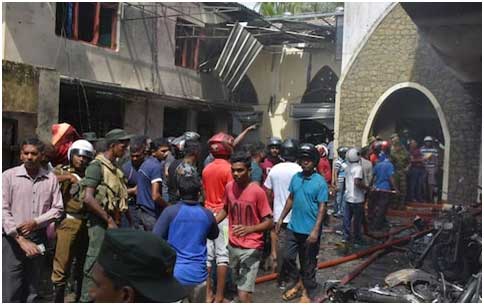
The tattered remnants standing as sad ruins of churches and hotels and the 350 victims debunk the usual fiction spun by some local political pundits who continue to blame the Sinhala-Buddhists. Their spin is to white-wash the Muslim terrorists saying that the suicide bombers were on a mission to get even with the Sinhala-Buddhists for sporadic attacks that had occurred in recent time.
This line of attack on the Sinhala-Buddhist runs against the evidence of the bloody ruins staring in their face. If the Easter Massacre was to teach the Sinhala-Buddhist a lesson why did they attack the Christian Churches and hotels packed with Westerners? This is the most notable facet of the Easter Sunday attack.
The suicide bombers skipped the Sinhala-Buddhists, they skipped the Hindu Tamils and they went straight for the Christians in churches and the Westerners holidaying in hotels.
If the Easter Sunday massacre was to send a clear message to the West then the international and local agents have succeeded beyond their expectations. This initial message is now reverberating globally. It says un-mistakeably that the Jihadist power, packed with religious fanaticism, has found a new base to attack the West. But what is going to be their next step? Will they turn inward and intensify their attacks against the other religionists?
Violence of any sort will not take the Muslim terrorist anywhere. If the other two varieties of terrorism (Sinhala and Tamil youth) failed to win against the state what are the chances of the Muslim variety winning?
The state is sufficiently prepared and experienced now to meet challenges of terrorists having beaten the world’s deadliest terrorist, the LTTE. Most of all, it has the tacit support of the majority of the Muslims in the mainstream.
ISIS and its local agents have had some beginners luck by taking the state by surprise. But the chances of Muslim terrorists becoming a formidable challenge to the state are very remote. Besides, before they take on the state they will have to grab power from the established Muslim hierarchy. They will also have to combat the anti-Muslim counter-terror forces of the West and also India.
The upshot of the Easter Massacre has been to increase and reinforce Islamophobia. Until Easter Sunday the Muslims in the democratic mainstream have been a formidable force negotiating craftily behind the scene, with both main parties, bargaining with the non-violent votes.
But the exploding bombs have devastated their image and reduced the power of bargaining with both major parties. They cannot be seen to be honeymooning, or playing footsy with the Muslims after the backlash of Easter Sunday sweeping the nation. The government, in particular, will have to face the charge of putting Bodu Bala Sena in jail and letting NTJ run amok without any restraint.
The state is now in a favourable political climate to crack down on Muslim extremism with hardly any pressure from international or national interventionists. Besides, the Muslim terrorists can never reach the militarised power of the Tamil Tigers and challenge the state to yield to their demands, whatever they may be. Of the three varieties of terrorism the Muslims will be the weakest, purely on demographic counts.
When the dust settles down, the democratic state of Sri Lanka will rise again triumphantly, hoping that the last remaining Indian Tamil youth will not decide to go the way of the other three failed terrorists
Dr. Purnaka L. (“PL”) de Silva is Director, Institute for Strategic Studies and Democracy (ISSD) Malta
“If we believe in absurdities we shall commit atrocities” – Voltaire
NEW YORK, Apr 22 2019 (IPS) – I returned from attending a three-hour Easter Sunday mass at the Fordham University Church around midnight New York time on May 20, 2019, when my phone rang and a colleague asked me what’s going on in Sri Lanka? I said what is going on?
He said there were a series of coordinated terrorist bombings with multiple fatalities and scores of injuries in my native country. For the next four and a half hours I was on the phone trying to piece together what happened, including reaching out to Sri Lanka’s Secretary of Defence Hemasiri Fernando.
The toll as of Monday, April 22 is 290 dead and 500 injured. Sri Lanka’s Ministry of Foreign Affairs confirmed that 36 foreigners died, with 20 still unidentified; and those identified include: 5 British (2 with dual US nationality), 3 Danes, 1 Dutch, 1 Portuguese, 2 Turks, 3 Indians and 1 Japanese.
This is the second time in history that the Indian Ocean island of Sri Lanka has been bombed on an Easter Sunday morning when the faithful were at prayer. The first was a coordinated air attack on the capital Colombo, launched from aircraft carriers of the Imperial Japanese Navy at 7:30 a.m. on Easter Sunday, April 5, 1942 – the same date that the U.S. Pacific Fleet in Pearl Harbor was also attacked in a different time zone.
Timeline in infamy – April 21, 2019
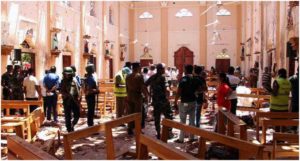
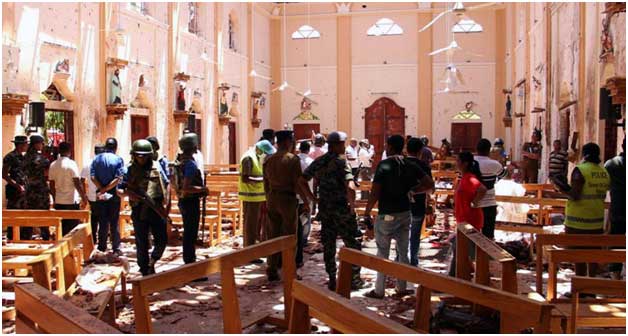
Around 8:45 a.m. on Easter Sunday morning five massive explosions simultaneously rocked Colombo, western Sri Lanka:
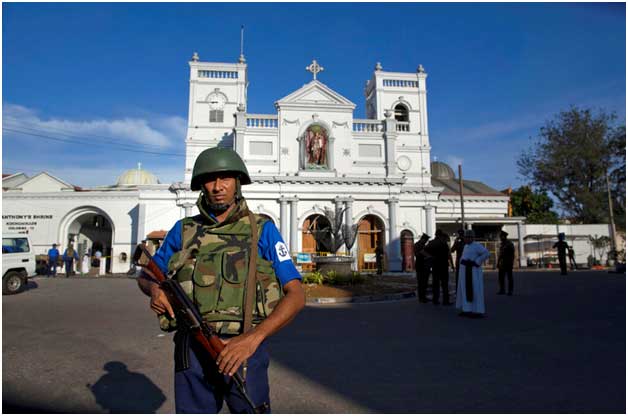
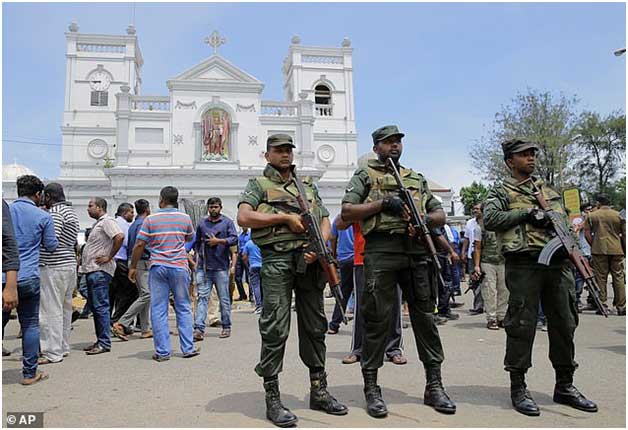
• 18th century St. Anthony’s Shrine Roman Catholic Church in Kochchikade, near Colombo harbor, 3.4 km from Colombo. • St. Sebastian’s Roman Catholic Church in Katuwapitiya, Negombo, 10.2 km north of Sri Lanka’s Bandaranaike International Airport (32.4 km north of the capital). • Shangri-La 500 room 5-star hotel downtown Colombo • Kingsbury 229 room 5-star hotel downtown Colombo • Cinnamon Grand 483 room 5-star hotel downtown Colombo
9:05 a.m.
• Zion Protestant Christian Church in Batticaloa on the eastern seaboard of Sri Lanka, 318.1 km from Colombo.
1:45 p.m.
• Tropical Inn Guest House in Dehiwala near the zoo, 10.2 km south of Colombo.
2:15 p.m.
• Two explosions at suspected safe house in Dematagoda on the northwestern outskirts 3.1 km from Colombo, owned by a spice trader, allegedly the father of one of the suicide bombers. At least three police officers died in the blasts including Special Task Force (STF) police commandos, with seven suspects arrested.
Late Sunday night
• A 6-foot pipe bomb was located and destroyed near Bandaranaike International Airport by the Sri Lanka Air Force.
Perpetrators
An internal Sri Lanka Police circular dated April 11, 2019 issued by Deputy Inspector General Srilal Dassanayake noted: “warning of plan to launch a campaign of suicide attacks led by Mohammed Zahran of National Thawheed Jama’ath (NTJ) has been received by intelligence sources, and request extreme precautions be taken.”
A fact commented on in the aftermath of the first wave of bombings by Defence Secretary Hemasiri Fernando, who confirmed that some of the attacks were carried out by suicide bombers.
Sri Lankan authorities have arrested 24 suspects and at least 1 woman as of Monday in an ongoing investigation to root out all the terrorists, who may number 30 with 20-30 targets, according to a suspect arrested down Ramakrishna Road, Wellawatte, 8.0 km south of Colombo.
At least three of the suicide terrorist bombers have been identified, all local Sri Lankan Muslims allegedly from eastern Sri Lanka:
• Mohamed Azzam Mohamed registered as a guest the previous night and blew himself up during the Easter breakfast buffet in Taprobane Restaurant – Cinnamon Grand Hotel. Apparently he queued patiently before triggering his explosives. • Zahran Hashim – Shangri-La hotel. • Abu Mohammad – Zion Protestant Christian Church, Batticaloa.
Active measures taken
• 3:00 p.m. curfew lifted at 6:00 a.m. Monday morning to enable security forces to apprehend wanted terror suspects in ongoing hunt and stop escapees. • Blocking all major social media platforms and messaging Apps to prevent spread of misinformation and rumors. • Maintaining law and order to stop any retaliation (e.g. Mosque petrol bombed in Putlam, 132.9 km north of Colombo; arson attacks on two Muslim owned shops in Kalutara, 43.5 km south of Colombo). • U.S. Federal Bureau of Investigation (FBI) and Australian police teams in place to help with forensic investigations.
National Thawheed Jama’ath (NTJ)
Five years ago on March 24, 2014 the Peace Loving Moderate Muslims in Sri Lanka (PLMMSL) urged the Government of Sri Lanka to ban without delay an Islamic religious movement calling itself the (National) Thawheed Jama’ath “because it was fast becoming a cancer within Sri Lanka’s Muslim community.”
It is alleged that NTJ headed by Moulavi Zahran had holed up in Kattankudi, 327 km east of Colombo, and recruited impressionable Muslim high school students to travel to Syria via Turkey. The hypothesis is that following military defeat at the hands of multinational forces, these Daesh or so-called Islamic State (IS) associated recruits had returned to Sri Lanka.
These allegations are yet to be proven beyond reasonable doubt in a court of law. Having said that I would argue that the spectacular terrorist bombings on Easter Sunday perpetrated on wholly unsuspecting Christians, tourists and citizens could be a last hurrah from Daesh to demonstrate to their supporters and the world at large that they are not defeated. Every suicide bombing though is a defeat for Daesh as they are losing cadres on each occasion.
Quo Vadis?
So where do we all go from here? Sri Lanka will recover, as it has done commendably from the decades long brutal civil wars and bloodletting that ended ten years ago. What of the human spirit and fragile inter-communal harmony between minority Christians, Muslims and majority Buddhists in Sri Lanka, and beyond?
That is the greatest challenge moving forward and Sri Lanka’s fractious political leaders have to demonstrate true statesmanship, and invest the required time, effort and resources in partnership with all faith leaders to make a difference.
Thereby, defeating the forces of darkness, ignorance and evil, and bringing enlightenment, peace and harmony to a beleaguered land. Similar actions must be taken by world leaders to overcome growing dystopia and unchecked authoritarianism that is haunting the 21st century, putting the planet and liberal democracy in dire peril.



 The documents are based on three years of technical assistance work conducted by the UNODC to Member States that have found children as FTFs.