Climate Crisis Disrupts Sundarbans Community Festival, Prosperity

Asia-Pacific, Civil Society, Climate Action, Climate Change, Climate Change Finance, Climate Change Justice, COP30, Environment, Featured, Headlines, Indigenous Rights, Population, Sustainable Development Goals, TerraViva United Nations
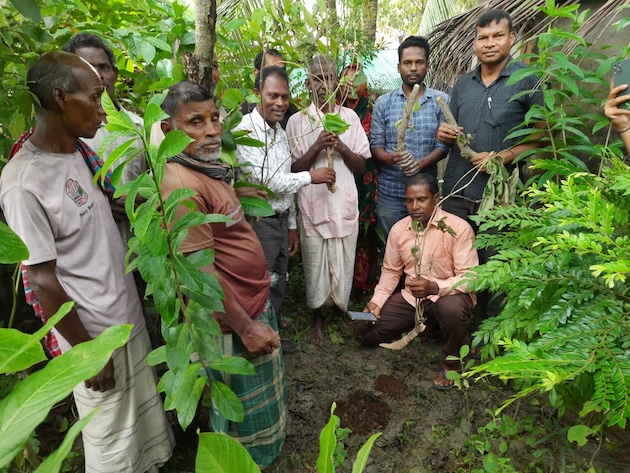
Two years ago, a Karam tree branch brought from another district was being planted in the SAMS office premises along the Shyamnagar-Munshiganj road, but it didn't survive. Credit: Rafiqul Islam Montu/IPS

Two years ago, a Karam tree branch brought from another district was being planted in the SAMS office premises along the Shyamnagar-Munshiganj road, but it didn’t survive. Credit: Rafiqul Islam Montu/IPS

SATKHIRA, Bangladesh, Dec 9 2025 (IPS) – A dried karam tree branch stands on the bank of a pond in a field in Datinakhali village adjacent to the Sundarbans. Despite many efforts, the tree could not be saved.


For two years, the Munda community in Bangladesh’s Sundarbans had been fighting to save the Karam tree so that they could bring back their traditional Karam festival—once the biggest festival in their community. Many trees are unable to survive due to the effects of salinity—this list includes the Karam tree, which is the main ingredient in celebrating the festival.

Bhakta Sardar, a priest from the Munda community, says the festival of the indigenous Munda community would be incomplete without the branches of the Karam tree

“We believe that our prosperity and well-being are hidden in the branches of the Karam tree. We pray to God to achieve our prosperity around this festival. But frequent cyclones and salinity have killed the Karam trees.”

“Now we celebrate this festival in its name only for the prosperity of the community. We cannot leave the festival for the next generation,” added Bhakta Sardar, referring to a smaller festival where the community uses fig tree branches as an alternative.

While the debate about how to integrate non-economic losses and damages due to the impact of climate change continued during the 30th Conference of the Parties to the UNFCCC (COP30) in Belém, Brazil, the Munda community is looking for ways to revive the Karam festival, a symbol of their prosperity. A recent study emphasized that these non-economic losses and damages included the loss of religious and cultural practices.

The study says that climate risks are increasing on the coast of Bangladesh. The risk is even higher in the southwest. If this situation continues in the future, small communities like the indigenous Munda community will be in even greater crisis. The study called for policy and financial reform to assist communities like this to adapt to the impacts of climate change.

In Search of the Karam Tree

The scientific name of the Karam tree is Mitragyna parvifolia. This tree in the Asian region is also known as Kelikadam. It mainly blooms before the monsoon. As the Karam tree has disappeared, the indigenous Munda community of Bangladesh now celebrates a similar festival on a smaller scale, with branches of a fig tree. The scientific name of this tree is Ficus religiosa.

There were once many Karam trees in the villages of southwestern Bangladesh. Datinakhali, adjacent to the Sundarbans in the Shyamnagar upazila (subdistrict) of Satkhira district, is one such village. This village celebrated the Karam festival with a grand event, with people from the Munda community from different areas joining in.

In addition to their time-honored religious tradition, the community in this village on the banks of the Chuna River faces economic difficulties.

The indigenous Munda community lives in several villages adjacent to the Sundarbans in Koyra upazila (sub-district) of Khulna district in southwestern Bangladesh.

Shukkuri Rani Munda used to attend the Karam festival organized in the courtyard of Fulsingh Munda’s house in Uttar Haztakhali village.

“To everyone now, the festival feels like a myth. A storm has swept away the entire festival. The next generation will forget the name of the Karam festival,” she says.

Munda Young Balai Krishna Sardar (38), president of the Sundarban Adivasi Unnayan Sangstha of that village, cannot recall attending the festival. Rangalal Munda’s 60-year-old father, Fulsingh Munda, witnessed a small-scale celebration five years ago. After Fulsingh’s death a year ago, no one in the village now knows how to initiate the Karam festival.
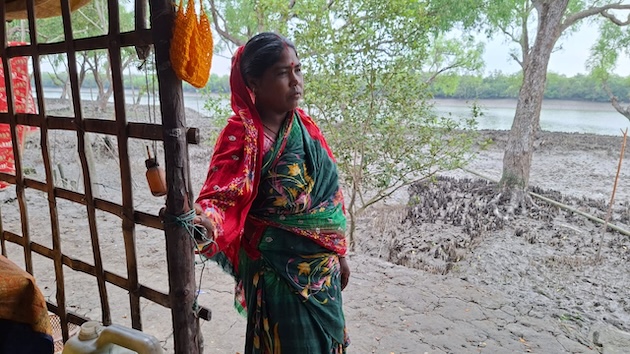
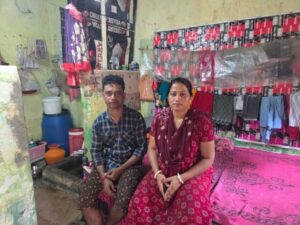
Geeta Rani Munda, 42, lives precariously in Datinakhali village, adjacent to the Sundarbans. She wants the Karam festival to return for her prosperity. Credit: Rafiqul Islam Montu/IPS

Geeta Rani Munda, 42, lives precariously in Datinakhali village, adjacent to the Sundarbans. She wants the Karam festival to return for her prosperity. Credit: Rafiqul Islam Montu/IPS

‘A Symbol of Our Faith’

The Munda community holds the belief that the branches of this tree conceal prosperity and well-being. They believe that the Karam festival ensures their good health and the well-being of future generations. Various tribal communities in Jharkhand, West Bengal, and Bihar, India, celebrate this festival with the same beliefs. Indigenous communities like Munda, Mahato, Kurmi, Matato, Santal, Orao, Baraik, Singh, Pahan, Mahali, Bhumij, etc., all celebrate the Karam festival.

“The Karam festival is our faith. Perhaps our economic condition is gradually deteriorating because we cannot follow our religious instructions,” said Anandini Rani Munda of Datinakhali village, articulating the belief that religious and economic wellbeing are intrinsically interlinked.

Nilkant Pahan, a priest of Burigoalini village in Shyamnagar upazila (sub-district), had been conducting the puja (religious ceremony) of the Munda community for eight years. He has organized the Karam festival several times following the ancestral tradition. But they were small events.

“Celebrating the Karam festival is our religious tradition. Our ancestors observed this tradition. We are trying to maintain its continuity. We are facing a much greater socio-economic and cultural crisis than before. We do not know what this crisis is because we cannot observe religious traditions,” Pahan says.

Impact of salinity

During Cyclone Aila in 2009, the entire area was submerged in the wave of salt water that broke the dam. The land was submerged in salt water for a long time, and the Karam trees could no longer survive. Many elderly Munda citizens believe that not only Aila but also other cyclones, especially a strong cyclone that hit the region in 1988, helped reduce the number of Karam trees.

GM Mostafizur Rahman, Chief Scientific Officer of Khulna Soil Resources Institute, said, “Both the intensity and extent of salinity in soil and water are increasing due to climate change; 81 percent of land in Shyamnagar is affected by varying degrees of salinity.”

Professor Saleh Ahmed Khan, Department of Botany, Jahangirnagar University, said, “The tree that the Munda community calls the ‘Karam’ tree is ‘Kelikadam.’ We did not find it among the 528 species under our research. The tree may not have survived due to the spread of salinity.”

Fight To Bring Back the Karam Festival

The Sundarbans Adivasi Munda Sangstha (SAMS) and leading members of the Munda community are working to bring back the Karam tree. They are trying to bring back the Karam festival by bringing branches of the Karam tree from other districts.

Two years ago, a branch of the Karam tree was planted in the SAMS office premises on the Shyamnagar-Munshiganj road, and another branch was planted in the Munda-dominated Datinakhali village. But it was not possible to save the tree. They will try again next year.

“We celebrate the Karam festival for our prosperity. We are trying to save the Karam trees for the festival. But due to salinity in the soil, the Karam trees cannot be saved. As an alternative, we use the branches of the fig (Ficus religiosa) tree,” said Geeta Rani Munda of Datinakhali village.

Krishnapada Sardar, Executive Director of SAMS, said it wasn’t enough that this festival only survives in the stories of elders.

“It was a major event in the rural culture of this community, which is proud of its identity. Climate change has changed the food habits of the Munda community, and the opportunities for livelihood have narrowed. The families of the community are facing an extreme economic crisis.

“Our lost festivals can be brought back by restoring the Karam tree. We want to return to our lost traditions. We want to return to our roots.”

IPS UN Bureau Report
  Source

Vanishing Wisdom of the Sundarbans–How climate change erodes centuries of ecological knowledge

Asia-Pacific, Civil Society, Climate Change, Climate Change Finance, COP30, Development & Aid, Editors’ Choice, Environment, Featured, Headlines, Human Rights, Migration & Refugees, Natural Resources, Sustainable Development Goals, TerraViva United Nations

Climate Change

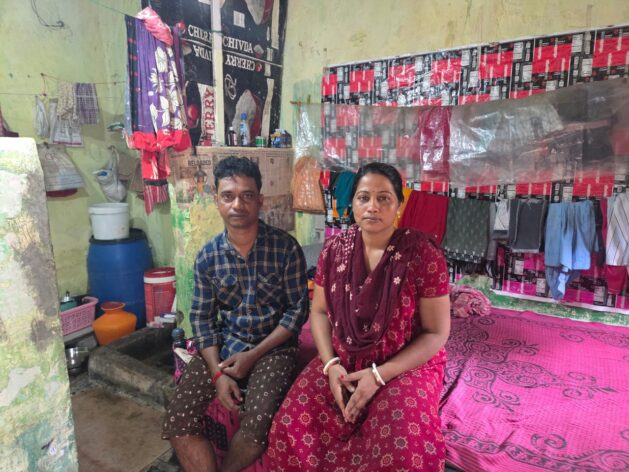
Bapi Mondal and his wife Shanti in Bangalore. Climate change has forced the couple from their traditional livelihoods in the Sundarbans. Credit: Diwash Gahatraj/IPS

Bapi Mondal and his wife Shanti in Bangalore. Climate change has forced the couple from their traditional livelihoods in the Sundarbans. Credit: Diwash Gahatraj/IPS

BANGALORE & PAKHIRALAY, India, Oct 15 2025 (IPS) – Bapi Mondal’s morning routine in Bangalore is a world away from his ancestral village, Pakhiralay, in the Sundarbans, West Bengal. He wakes before dawn, navigates heavy traffic, and spends eight long hours molding plastic battery casings. It’s not the life his honey-gathering forefathers knew, but factors like extreme storms, rising seas, and deadly soil salinity forced the 40-year-old to abandon centuries of family tradition and travel miles away to work in a concrete suburban factory.


Bapi still remembers his traditional skills—walking through a mangrove forest to find a tree with a honeycomb, mending boats and fishing nets, and singing and acting in the traditional plays. His 19-year-old son, Subhodeep—working alongside in the factory—has lost the heritage.

Bapi’s home, the Sundarbans—the world’s largest mangrove forest—is on the frontlines of climate change, and local livelihoods are taking the hit. In this watery maze where land and sea meet, villagers who once relied on fishing, honey collection and farming are now grappling with rising tides, saltier water, and more frequent storms. For many, life is becoming a struggle to hold on to centuries-old ways.

Sea levels in the Sundarbans are rising nearly twice the global rate, flooding villages and forcing families out. Saltwater ruins rice fields and ponds, making farming and fishing harder. Mawalis, the honey gatherers, also struggle as climate change disrupts flowering and damages mangroves, reducing wild bee populations.

A fisherman in Sundarbans. Credit: Diwash Gahatraj/IPS

A fisherman in the Sundarbans. Credit: Diwash Gahatraj/IPS

The crisis doesn’t end with the water. Salinity, once held at bay by freshwater flows, is climbing year after year, disrupting both fishing and farming. Pollution, ill-managed embankments, and overexploitation of resources add to the challenge. As incomes shrink and lands disappear, thousands leave for nearby cities, hoping for work but often finding only life in urban slums.

City life is unforgiving for migrants like Mondal. He spends eight grueling hours on his feet, molding battery casings six days a week in harsh factory conditions. At the end of each day, he returns to a small one-room apartment. He shares this space with his wife Shanti and son, Subhodeep. The family struggles financially. Bapi earns ₹19,000 per month (about USD 215)—barely enough to get by. Despite the hardships, he says the work is still his choice.

“A hard choice, but a choice,” he explains.

Morning rush is hectic for the Mondal family. He points to the wall clock and asks his wife to pack lunch quickly. “All three of us work in different factories in the area,” Mondal says. “We all have to reach work by 8 am.”

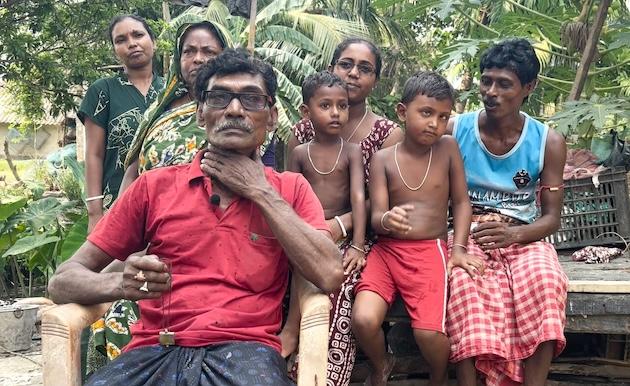
Gopal Mondal and his family in the Sundarbans. Credit: Diwash Gahatraj/IPS

Gopal Mondal and his family in the Sundarbans. Gopal still ventures into the forests to collect wild honey. Credit: Diwash Gahatraj/IPS

Shanti, Bapi’s wife, spends her days at a garment factory pressing clothes with a hot iron. She works eight-hour shifts with just one weekly break, earning ₹15,000 per month (about USD 169). Their 19-year-old son, Subhodeep, has also joined his father at the plastic factory. All three now work in Bommasandra, Bangalore’s industrial belt, pooling their wages to survive.

The migration has split their family apart.

“We have an 11-year-old daughter who lives with my in-laws in the Sundarbans,” Shanti explains. The cost of city life forced them to leave their youngest child behind. “It breaks my heart to be apart from my daughter, but we want her to have a good education and life—that’s why we sacrifice,” says Shanti. Her daughter attends school back in the village.

Her job gave her economic independence and a voice in family decisions, like building their new house. Bapi’s family, rooted in the village for centuries, were Mawalis, honey gatherers who knew the forest through knowledge passed down generations.

Still Rooted

Bapi’s father, Gopal Mondal, still ventures into the dangerous forests of Sunderbans. He risks tiger attacks and deadly cyclones to collect wild honey. But the forest that once fed families is now failing them.

Climate change has disrupted everything. Cyclones strike more often and with greater force. The natural flowering cycle has gone haywire. Fish populations in the waters have crashed.

“The honey harvest keeps shrinking and prices keep falling,” Gopal explains.

As Gopal tried to hold on to tradition, his son Bapi could no longer see a future in the same waters and forests.

“The forest no longer provides enough honey or fish,” Bapi shares. The rhythms his ancestors lived by for centuries suddenly made no sense. Faced with shrinking opportunities, Bapi tried other work back home. Besides going to the jungle for honey with his father during the season (April-May), he operated a van gaari—a battery-powered three-wheeler with a wooden platform for passengers. But even that barely paid enough to survive. “There was a time when I struggled to buy a saree for my wife,” he recalls. Migration was the only choice left.

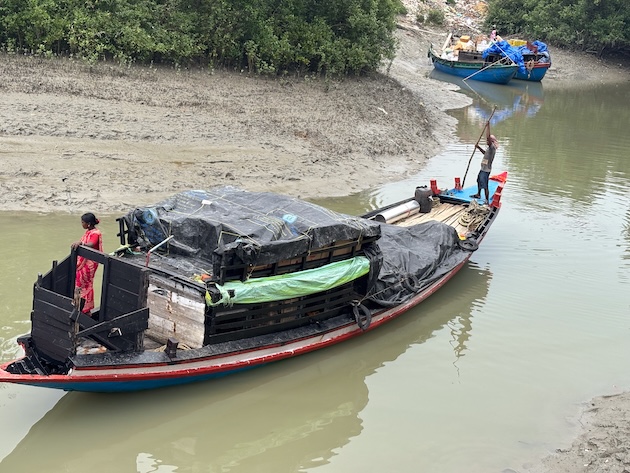
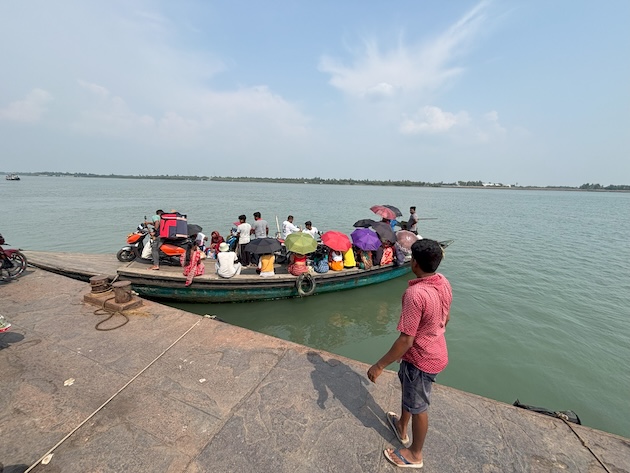
A boat ferries passengers in Sundarbans. Credit: Diwash Gahatraj/IPS

A boat ferries passengers in Sundarbans. Credit: Diwash Gahatraj/IPS

From Forests to Factories

Apart from forced migration, climate change erodes memory, identity, and ancestral knowledge. Leaving the Sundarbans has cost the family more than a homeland.

Bapi still carries traditional skills—navigating treacherous waters by boat and collecting honey deep in the forest.

“I know how to catch shrimp and crabs from the river and sea,” he says. “My father and uncles taught me these skills when I was young.”

His wife, Shanti, nods, adding that she was an expert crab and shrimp collector back in the Sundarbans. “I think I still have it in me,” she says with quiet pride.

But the chain of knowledge is breaking. “I could not pass on that wisdom to my son,” Bapi admits with regret.

Subhodeep represents this lost generation. He finished tenth grade and left his village to join his parents in Bangalore. He has not learned the skills that defined his family for generations. “I have never entered the forest to collect honey or fish back in the village,” Subhodeep explains. “My parents were against it.”

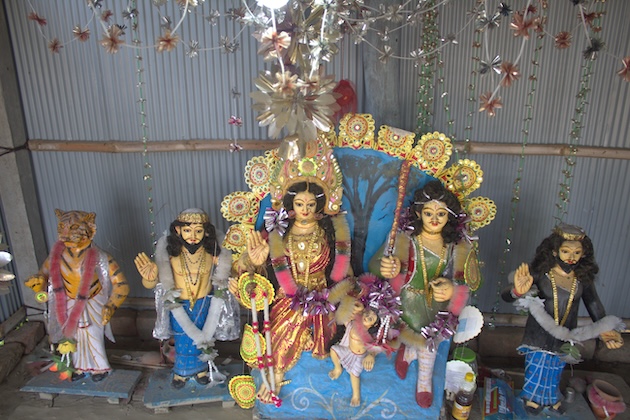
Bon bibi temple in Pakhiralay village. Along with losing traditional livelihoods, religion and cultural life are also in jeopardy. Credit: Diwash Gahatraj/IPS

Bon bibi temple in Pakhiralay village. Along with losing traditional livelihoods, religion and cultural life are also in jeopardy. Credit: Diwash Gahatraj/IPS

The irony is stark. Bapi’s parents encouraged him to learn these ancestral skills. But when environmental collapse made these traditions dangerous and unprofitable, Bapi chose to shield his son from them.

For the Mondals, the forest has become too dangerous and unreliable.

“Going to collect honey or catch fish is very unpredictable now,” Bapi explains. Catch volumes have fallen, and tiger attacks have grown. Bapi’s family knows the risk; his grandfather was killed while gathering honey in the forest.

Years earlier, a tiger also attacked Gopal Mondal. He was luckier—he escaped alive but still carries scars on his hand.

These brutal realities shaped Bapi’s decision about his son’s future. “I don’t want my next generation to have such a risky occupation,” he says. The choice is clear. Families can either cling to dangerous traditions that no longer pay enough to survive or abandon their ancestral practices for safer work in distant cities.

Are there other reasons behind the changes in the Sundarbans?

“We can’t just blame climate change and ignore human activities making things worse,” says Professor Tuhin Ghosh of Jadavpur University’s School of Oceanographic Studies. Human activity and climate change create a deadly combination.

People cleared mangroves for farms and fish ponds and built embankments that blocked tidal flows. The result is salt contamination, poisoned soil and water, vanishing species, and a broken landscape.

Uninhabitable Home

About 4.5 million people live across the Sundarbans region in Bangladesh and India. A recent survey reveals the massive scale of climate migration: nearly 59% of households have at least one family member who has moved away for work.

Some studies report 60,000 people migrated from parts of the Sundarbans by 2018. But household surveys show much higher rates because they measure affected families, not just individuals.

These local figures reflect a much bigger crisis. Across Bangladesh, weather-related disasters displaced 7.1 million people in 2022 alone, showing how climate change drives mass movement.

On the Indian side in West Bengal, researchers document large seasonal and permanent migration flows to cities and other states. Families routinely send members to work elsewhere, though official counts are scarce.

Loss Beyond Dollars

Over the past two decades, the Sundarbans has been hit by cyclones made stronger by climate change. They uprooted thousands and caused millions in losses. But beyond disaster relief and migration, a quieter crisis unfolds: the erosion of centuries-old ecological wisdom, culture, and tradition.

Gopal Mondal, in his early sixties, sits outside his modest home in Pakhiralay. When asked about protective equipment for his dangerous work collecting honey in the Sundarbans forest, he holds up a small amulet—a tabeej.

“This and my prayers to Bon Bibi are my protection,” says Mondal, who leads a team of honey collectors into the mangrove forests. “They shield us from storms and babu (tigers).”

The elderly collector recites mantras passed down through generations—teachings from his father or cousins, though he cannot recall exactly who taught him.

“The whole community worships Bon Bibi,” he explains simply

For Sundarbans communities like Mondal’s, Bon Bibi—the “Lady of the Forest”—is a guardian of the mangroves. For centuries, fishermen, honey collectors, and wood gatherers have sought her protection in tiger territory and cyclone-prone waters. Her worship is more than faith; it reflects the people’s bond with a dangerous yet life-sustaining environment, offering both comfort and identity where safety tools are scarce.

When asked about traditional knowledge slipping away from his family, Mondal’s weathered face shows a faint smile.

“Earlier, every fisherman’s family had someone —a son or grandson—who knew how to repair torn nets or mend boats,” he explains. “But in my family, things are slowly changing. My grandsons and sons live too far away, and their visits home are too short to learn these skills.”

The honey collector pauses, watching the distant mangroves. “The younger generation shows very little interest in our profession,” he adds quietly.

Climate migration expert M. Zakir Hossain Khan of Change Initiative, a Bangladesh-based think tank focused on solving critical global challenges, warns that climate-driven displacement from the Sundarbans is destroying centuries-old ways of life that depend entirely on deep knowledge of the forest and rivers.

Fishermen carry rare knowledge of tides, breeding cycles, and mangrove routes, passed down through years of practice. With youth leaving for city jobs, few inherit it. Honey gatherers know how to find hives, protect bees, and survive in tiger territory. As young people turn away, honey collection is fading from the Sundarbans.

A Vanishing Heritage

This generational shift reflects a broader transformation across the Sundarbans. Traditional skills that once defined coastal communities—net weaving, boat building, reading weather patterns, and forest navigation—are disappearing as young people migrate to cities primarily  for employment and a few for education.

“Similarly, mangrove-based handicrafts and boat-making using leaves, bamboo, and mangrove wood to make mats, roofing materials, and small boats demand both ecological understanding and artisanal skill, which are now rarely passed down,” comments Khan from Change Initiative.

He adds that herbal medicine and spiritual rituals practiced by local healers using plants like sundari bark and hental are also at risk, as migration and urbanization erode the cultural setting that sustains them.

Culture at Crossroads

Ghosh, who has spent over 30 years working in the Sundarbans, points to a troubling pattern.

“Migration is killing our folk arts,” he says. “Bonbibi stories, jatra pala theater, fishermen’s songs—they’re all disappearing. The people who used to perform during festivals are getting old. And there’s no one to replace them.”

The Sundarbans face a cultural crisis. Traditional performances that once brought villages together during religious festivals now struggle to find performers. Young people who might have learned these arts from their elders are instead leaving for cities for a better life

Once central to life in the Sundarbans, folk traditions like Jatra Pala, Bonbibi tales, and fishermen’s songs now fade with their aging performers. With few young apprentices, a rich cultural heritage risks disappearing—leaving behind a region not just economically changed, but culturally empty.

Note: This story was produced with support from Internews’ Earth Journalism Network

IPS UN Bureau Report

  Source