As Cape Town’s Muslim community welcomes the holy month of Ramadan, the city’s halal restaurants open their doors for specially curated iftar experiences, from buffets to set menus and everything in between.
This year, Ramadan in South Africa is expected to begin on the evening of Tuesday, 18 February 2026, with the first day of fasting on Wednesday, 19 February. The holy month will last 29 or 30 days, ending on or around 18 March 2026. Eid al-Fitr, the celebration marking the end of Ramadan, will take place between 19 and 20 March 2026.
Iftar, or Boeka (the Cape Malay term commonly used in Cape Town), marks the time when Muslims are allowed to eat and drink after a long day of fasting from dawn until sunset.
If you are looking for halal restaurants to break your fast or experience this tradition, here are some options:
126 Cape Kitchen & Cafe, Hyatt Regency Cape Town
Located on the ground floor of the Hyatt Regency Cape Town, 126 Cape Kitchen & Cafe is inspired by the rich traditions of Bo-Kaap. The restaurant offers a fusion of Malay and Indian flavours. Enjoy their iftar buffet from 6-10pm, featuring traditional dhaltjies and samoosas, an array of salads and sides, and mains like bobotie, butter chicken, Penang lamb curry, and briyani.
Prayer facilities are available at the hotel.
Location: 126 Buitengracht St, Cape Town City Centre Price: R350 for adults, kids under 12 pay half price. The à la carte menu will not be available. Contact: Visit www.hyattrestaurants.com
Barakat at Time Out Market Cape Town
Barakat at Time Out Market will be offering complimentary water and dates to all guests to break their fast-during the month of Ramadan. The special includes butter chicken, served with a choice of samoosa and traditional Boeber for dessert.
Location: The Old Power Station, Dock Rd, Victoria & Alfred Waterfront Price: R160 for the butter chicken, including a samoosa and boeber. Contact: Visit www.instagram.com/barakat_tm
Cardamom Kitchen
If you’re on the go and want nourishing halal meals, Cardamom Kitchen has a selection of frozen meals, perfect for an easy iftar and suhoor. See the menu here.
Location: 14 Sergeant St, Rondebosch East, Cape Town Price: Various. Contact: 087 265 2262 or email info@cardamomkitchen.co.za
Bo-Kaap Deli, Bo-Kaap
Bo-Kaap Deli will be hosting iftar every Friday and Saturday from 5:30 pm to 10 pm. Guests can order from the menu and enjoy complimentary savouries and soup. A dedicated prayer area is available inside the restaurant.
Nouveau Coffee and Grill’s buffet experience is perfect for gathering with family and friends. Expect a generous spread featuring your choice of soups, a fresh salad selection, grilled queen prawns, a South Indian butter chicken, a Durban-inspired masala breyani, the pasta of the day,
and a variety of desserts to end on a sweet note. There is a dedicated prayer area at the restaurants for guests to use.
Location: Shop 3, Century Village Centre, Century City Price: R330 for guests over the age of 12, and R195 for children under 12. The à la carte menu will not be available. Contact: Visit nouveau.co.za
Cova Cafe, Sea Point
Get your matcha and coffee fix after you break your fast at Cova Cafe. The cafe has introduced their Ramadan Seasonal late-night hours from Thursday to Saturday, from 9.30pm-11.30pm. Falooda and Karak Tea will also be available.
Indulge in a traditional Syrian meal at Aladdin during iftar. The curated set menu offers a choice of signature dishes, including chicken kofta, beef shish kebab and ribs, tender lamb shank served with rice or mashed potatoes, succulent lamb chops, and a variety of flavorful chicken specialties. Your meal begins with complimentary soup, fresh dates, and water. The Coowatool Islam Mosque is located across the road, making it convenient for guests to perform their evening prayers after their meal.
Location: 210 Loop St, Cape Town City Centre Price: R210pp. Contact: Call +27 63 065 7064
Alhambra Restaurant, Lansdowne
Indulge in a three-course dinner every Friday and Saturday during Ramadan at Alhambra. Start by choosing from a variety of delicious starters, then move on to hearty mains like creamy Alfredo pasta, tender sirloin, flavourful chicken and prawn dishes, juicy lamb chops, or a
generous seafood paella. Be sure to leave room for something sweet to round it all off. You’ll also be treated to a samoosa, a halfmoon, a koeksister, a date, and a refreshing falooda shot. The Masjid Al-Furqaan Mosque is within close vicinity. Booking is essential.
Location: 409 Imam Haron Rd, Lansdowne Price: From R220pp. A kiddies’ menu will be available. Contact: Call +27 21 697 1214 or visit: al-hambra.co.za/
On The Square at The Capetonian
On The Square at The Capetonian is going all out with a daily Ramadan Iftaar Buffet. Break your fast the traditional way with dates, followed by the chef’s soup of the day served with freshly baked breads and a cold buffet. When it’s time for mains, enjoy the chef’s curry of the day (beef or mutton) with basmati rice, flavourful Kabsa Mandi, grilled spicy chicken shiwaya, comforting roasts, pasta dishes, and fish. Finish off with decadent desserts, fresh fruit, and bottomless tea and coffee.
Location: Pier Place, Heerengracht St, Foreshore Price: R275 per person for adults and half price for children under 12. Website:capetonian.co.za/dining-on-the-square/
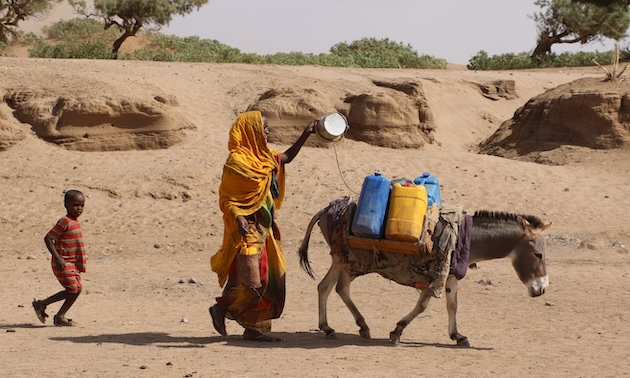
Collecting water in Ethiopia. A new report, ‘Global Water Bankruptcy: Living Beyond Our Hydrological Means in the Post Crisis Era’ warns that many of the earth’s water resources have been pushed to a point of permanent failure. Credit: EU/ECHO/Anouk Delafortrie/IPS
UNITED NATIONS & SRINAGAR, India, Jan 20 2026 (IPS) – The world has entered what United Nations researchers now describe as an era of Global Water Bankruptcy, a condition where humanity has irreversibly overspent the planet’s water resources, leaving ecosystems, economies, and communities unable to recover to previous levels.
The new report, released by the United Nations University Institute for Water, Environment and Health, titled Global Water Bankruptcy: Living Beyond Our Hydrological Means in the Post-Crisis Era. The report argues that decades of overextraction, pollution, land degradation, and climate stress have pushed large parts of the global water system into a permanent state of failure.
“The world has entered the era of Global Water Bankruptcy,” the report reads, adding that “in many regions, human water systems are already in a post-crisis state of failure.”
According to the report, the language of “water crisis” is no longer sufficient to explain what is happening. A crisis implies a shock followed by recovery. Water bankruptcy, by contrast, describes a condition where recovery is no longer realistically possible because natural water capital has been permanently damaged.
In an exclusive interview with Inter Press Service, former Deputy Head of Iran’s Department of EnvironmentProf. Kaveh Madani, who currently is the Director at United Nations University, Institute for Water, Environment and Health, said that declaring that the planet has entered the era of water bankruptcy must not be interpreted as universal water bankruptcy, as not all basins, aquifers, and systems are water bankrupt.
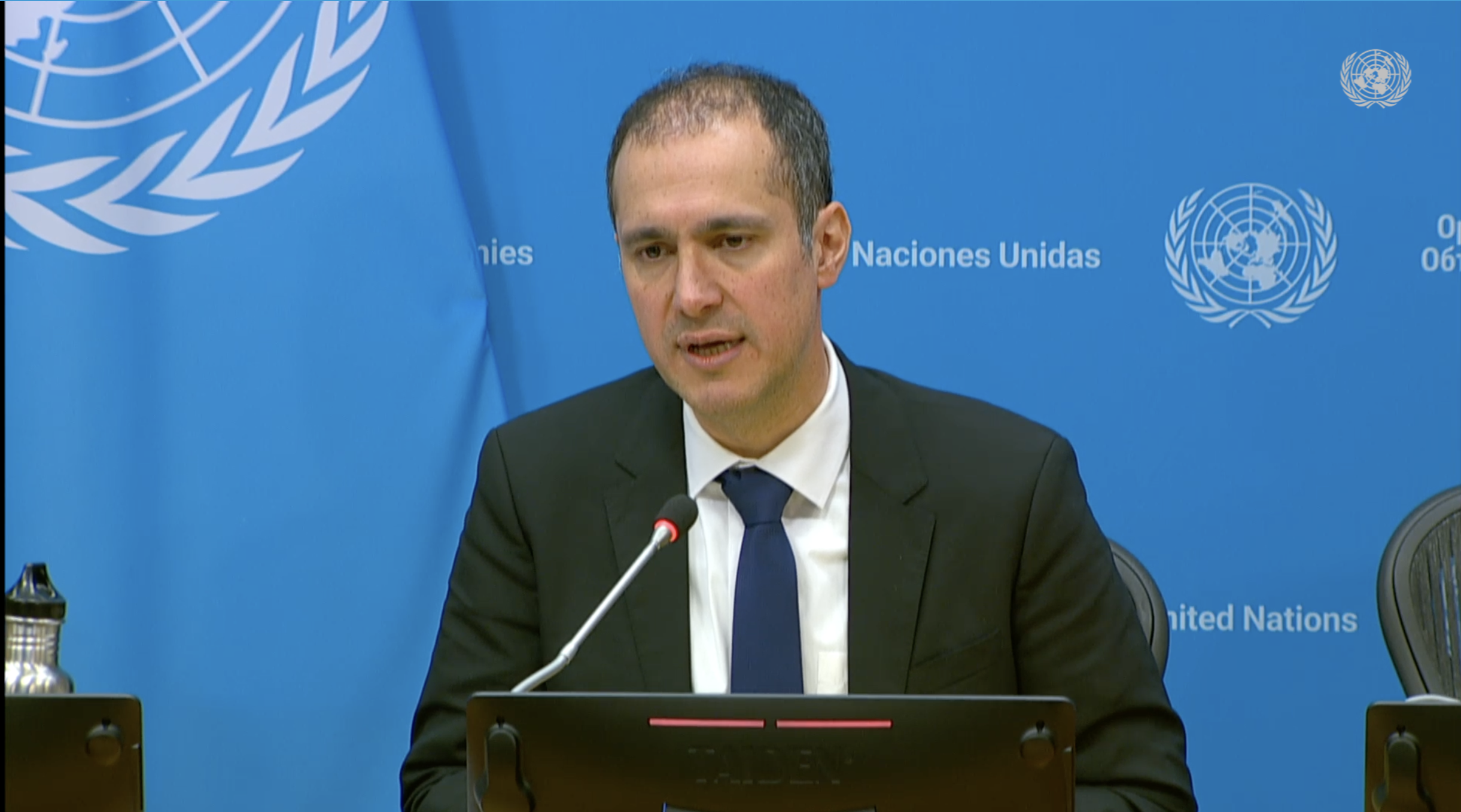
Prof. Kaveh Madani, Director at the United Nations University, Institute for Water, Environment and Health, addresses the UN midday press briefing. Credit: IPS
“But we now have enough critical basins and aquifers in chronic decline and showing clear signs of irreversibility that the global risk landscape is already being reshaped. Scientifically, we know recovery is no longer realistic in many systems when we see persistent overshoot (using more than renewable supply) combined with clear markers of irreversibility—for example aquifer compaction and land subsidence that permanently reduce storage, wetland and lake loss, salinization and pollution that shrink usable water, and glacier retreat that removes a long-term seasonal buffer. When these signals persist over time, the old “bounce back” assumption stops being credible,” Madani said.
“Over decades, societies have withdrawn more water than climate and hydrology can reliably provide, drawing down not only the annual income of renewable flows but also the savings stored in aquifers, glaciers, soils, wetlands, and river ecosystems,” the report says.
The scale of the problem, as per the report, is global. Nearly three-quarters of the world’s population now lives in countries classified as water insecure or critically water insecure.
Madani said, adding that water bankruptcy is best assessed basin by basin and aquifer by aquifer, not by country.
“Please note that, based on the water security definition used by the UN system, water insecurity and water bankruptcy are not equivalent. Water bankruptcy can drive water insecurity, but water insecurity can also stem from limited financial and institutional capacity to build and operate infrastructure for safe water supply and sanitation, even where physical water is available,” he explained.
Madani added that the regions most consistently closest to irreversible decline cluster in the Middle East and North Africa, Central and South Asia, parts of northern China, the Mediterranean and southern Europe, the southwestern United States and northern Mexico (including the Colorado River system), parts of southern Africa, and parts of Australia.
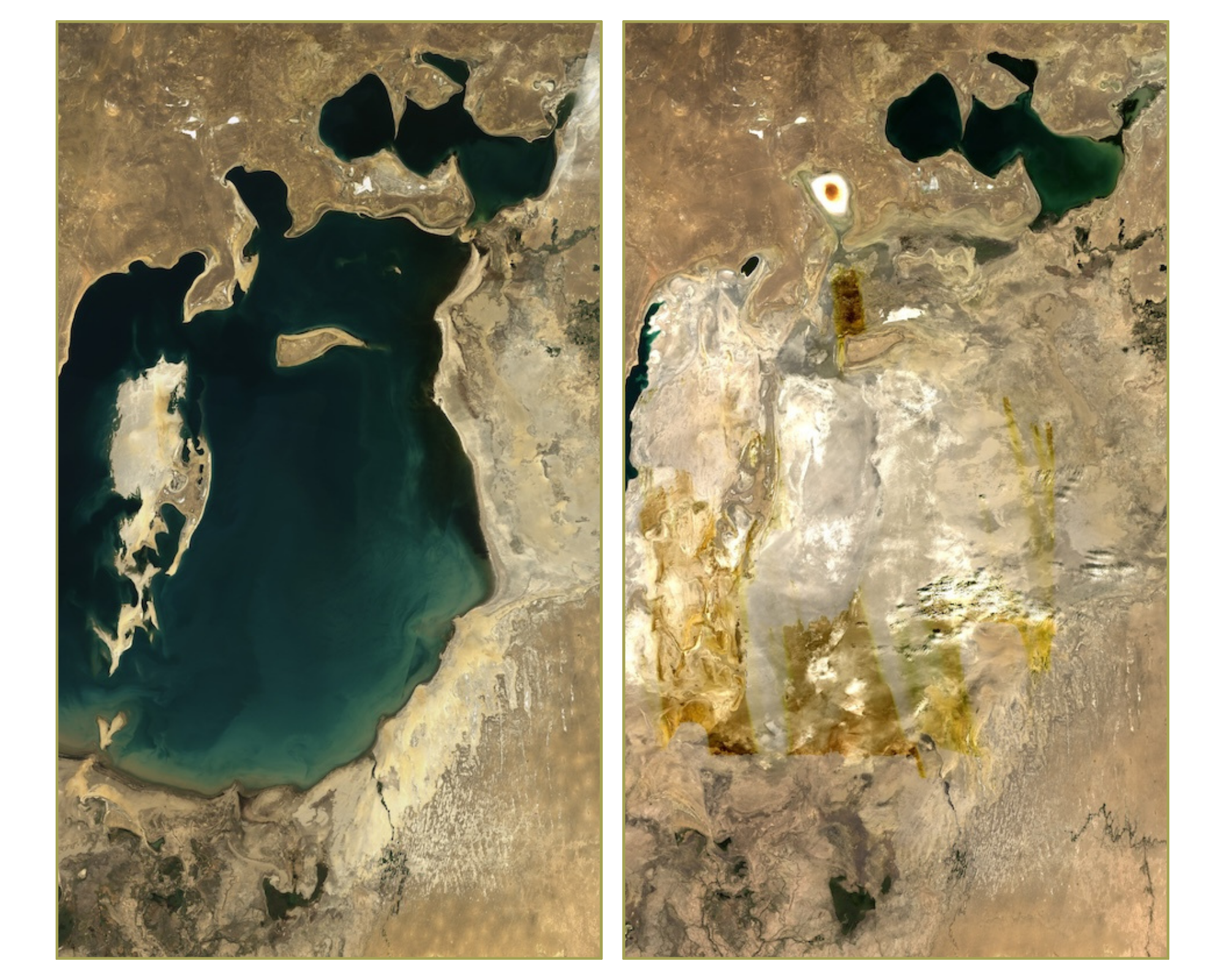
The Aral Sea, which lies between Kazakhstan and Uzbekistan, shows dramatic water loss between 1989 and 2025. Credit: UNU-INWEH
Surface Water Systems Are Shrinking Rapidly
The report shows how more than half of the world’s large lakes have lost water since the early 1990s, affecting nearly one quarter of the global population that depends directly on them. Many major rivers now fail to reach the sea for parts of the year or fall below environmental flow needs.
Massive losses have occurred in wetlands, which serve as natural buffers against floods and droughts. Over the past five decades, the report claims that the world has lost roughly 410 million hectares of natural wetlands, almost the size of the European Union. The economic value of lost ecosystem services from these wetlands exceeds 5.1 trillion US dollars.
Groundwater depletion is one of the clearest signs of water bankruptcy. Groundwater, says the report, now supplies about 50 percent of global domestic water use and over 40 percent of irrigation water. Yet around 70 percent of the world’s major aquifers show long-term declining trends.
“Excessive groundwater extraction has already contributed to significant land subsidence over more than 6 million square kilometers,” the report says, warning that in some locations land is sinking by up to 25 centimeters per year, permanently reducing storage capacity and increasing flood risk.
In coastal areas, overpumping has allowed seawater to intrude into aquifers, rendering groundwater unusable for generations. In inland agricultural regions, falling water tables have triggered sinkholes, soil collapse, and the loss of fertile land.
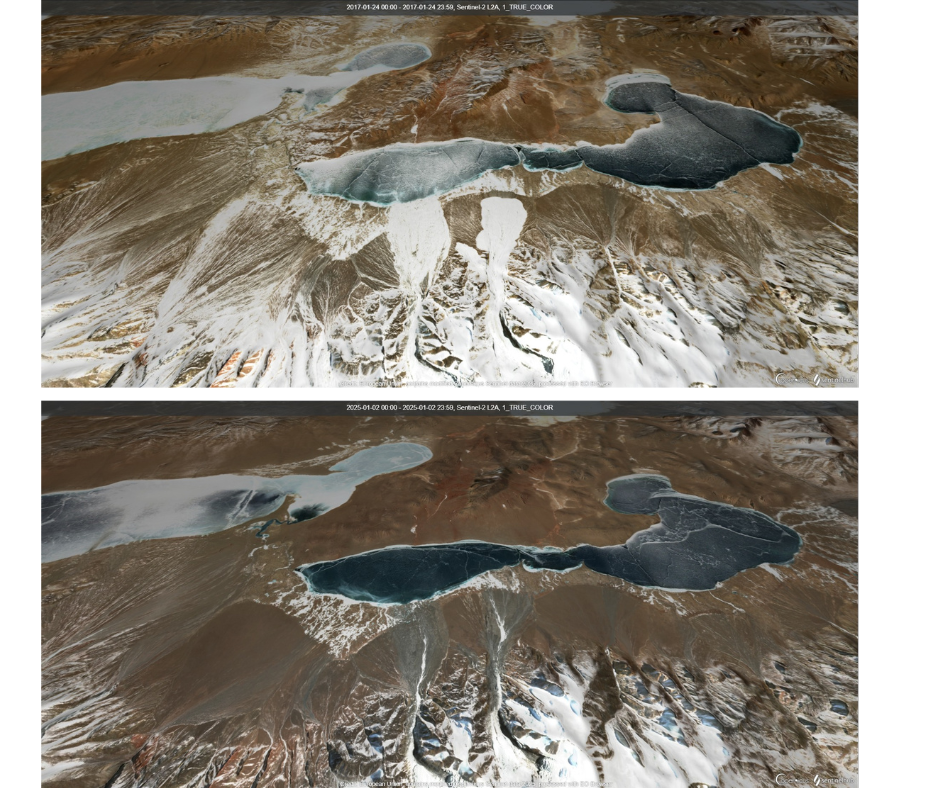
These satellite images show a dramatic impact of the Aru glacier collapses in western Tibet. First image was taken in 2017 and the second in 2025. Credit: UNU-INWEH
The cryosphere, glaciers and snowpacks that act as natural water storage systems are also being rapidly liquidated. The world has already lost more than 30 percent of its glacier mass since 1970. Several low- and mid-latitude mountain ranges could lose functional glaciers within decades.
“The liquidation of this frozen savings account interacts with groundwater depletion and surface water over-allocation to lock many basins into a permanent worsening water deficit state,” says the report.
This loss, as per the report, threatens the long-term water security of hundreds of millions of people who depend on glacier- and snowmelt-fed rivers for drinking water, irrigation, and hydropower, particularly in Asia and the Andes.
Madani said the biggest failure was treating groundwater as an unlimited safety net instead of a strategic reserve.
He says that when surface water tightened, many systems defaulted to “drill deeper” without enforceable caps.
“Authorities often recognize the consequences when it is already late, and meaningful action then faces major political barriers. For example, reducing groundwater use in farming can trigger unemployment, food insecurity, and even instability unless farmers are supported through short-term compensation and a longer-term transition to alternative livelihoods,” he added.
According to Madani, that kind of transition cannot be implemented overnight.
“So, business as usual continues. The result is predictable: groundwater gets “liquidated” to postpone hard choices, and by the time the damage is obvious, recovery is no longer realistic,” he told IPS news.
Agriculture Lies at the Heart of the Crisis
According to the report, farming accounts for approximately 70 percent of global freshwater withdrawals. About 3 billion people and more than half of the world’s food production are located in regions where total water storage is already declining or unstable.
The report states that more than 170 million hectares of irrigated cropland are under high or very high water stress. Land and soil degradation are making matters worse by reducing the ability of soils to retain moisture. The degradation of more than half of the global agricultural land is now moderate or severe.
Drought, once considered a natural hazard, is increasingly driven by human activity. Overallocation, groundwater depletion, deforestation, land degradation, and climate change have turned drought into a chronic condition in many regions.
“Drought-related damages, intensified by land degradation, groundwater depletion and climate change rather than rainfall deficits alone, already amount to about 307 billion US dollars per year worldwide,” the report states.
Water quality degradation further shrinks the usable resource base. Pollution from untreated wastewater, agricultural runoff, industrial effluents, and salinization means that even where water volumes appear stable, much of that water is unsafe or too costly to treat.
The report adds that the planetary freshwater boundary has already been crossed. Both blue water, surface and groundwater, and green water, soil moisture, have been pushed beyond a safe operating space.
Current governance systems, the authors argue, are not fit for this reality. Many legal water rights and development promises far exceed degraded hydrological capacity. Existing global agendas, focused largely on drinking water access, sanitation, and incremental efficiency gains, are inadequate for managing irreversible loss.
“Water bankruptcy must be recognized as a distinct post-crisis state, where accumulated damage and overshoot have undermined the system’s capacity to recover,” the report says.
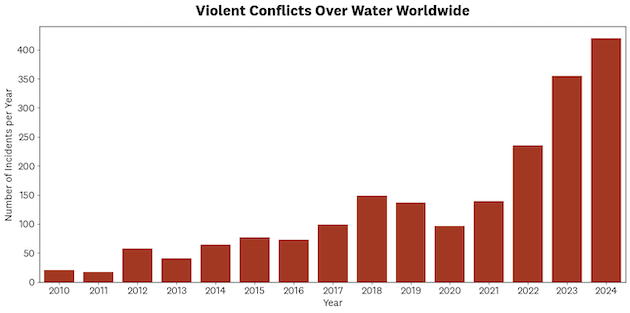
Water bankruptcy could result in a further increase in conflicts. Credit: UNU-INWEH
It warns that the implications of water bankruptcy are dire.
UN Under-Secretary-General Tshilidzi Marwala, Rector of UNU explains, “Waterbankruptcy is becoming a driver of fragility, displacement, and conflict. Managing it fairly—ensuring that vulnerable communities are protected and that unavoidable losses are shared equitably—is now central to maintaining peace, stability, and social cohesion.”
Policy Implications
Instead of crisis management aimed at restoring the past, the report actually pitches for bankruptcy management. That means acknowledging insolvency, accepting irreversibility, and restructuring water use, rights, and institutions to prevent further damage.
The authors lay stress on the fact that water bankruptcy is also a justice and security issue. The costs of overshoot fall disproportionately on small farmers, rural communities, women, Indigenous peoples, and downstream users, while benefits have often accrued to more powerful actors.
“How societies manage water bankruptcy will shape social cohesion, political stability, and peace,” the report warns.
Furthermore, it urges governments and international institutions to use upcoming UN Water Conferences in 2026 and 2028 as milestones to reset the global water agenda, calling for water to be treated as an upstream sector central to climate action, biodiversity protection, food security, and peace.
“This is about a crisis that might arrive in the future. The world is already living beyond its hydrological means,” reads the report.
When asked why the report frames water bankruptcy as a justice and security issue and how governments can implement painful demand reductions without triggering social unrest or conflict, Madani said the demand reduction becomes dangerous when it is treated as a technical exercise instead of a political economy reform. In many water-bankrupt regions, according to him, water is effectively a jobs policy: it keeps low-productivity farming and local economies afloat.
“If you cut water without an economic transition, you create unemployment, food insecurity, and unrest. So the practical pathway is to decouple livelihoods and growth from water consumption. In many economies, water and other natural resources are used to keep low-efficiency systems alive. In most places, it is possible to produce more strategic food with less water and less land, and with fewer farmers—provided that farmers are supported through a transition and offered alternative livelihoods.”
According to Madani, governments should protect basic needs but target the big reductions where most water is used, especially agriculture and besides that, pair caps with a just transition package for farmers—compensation, insurance, buy-down or retirement of water entitlements where relevant, and real income alternatives.
He further suggests that the governments should invest in diversification, including services, industry, value-added agri-processing, and urban jobs, so communities can earn a living without expanding water withdrawals.
“In short, you avoid conflict by making demand reduction part of a broader economic transition, not a standalone water policy.”
Anaconda viewers were in for a surprise when Jennifer Lopez popped up in a scene with the new movie’s star Jack Black.
“Are you Doug McAllister? You directed the unauthorized version of Anaconda even though you didn’t have the rights?” Lopez, 56, said in social media footage of the film, playing an exaggerated version of herself. “I saw your little movie, and I loved it. That’s why I’m here.”
She continued, “I’m here because we’re doing another Anaconda, and I want you to direct it. Are you in?”
Black’s character, Doug, fainted before he could respond.
Lopez famously starred in 1997’s Anaconda opposite Jon Voight, Ice Cube and Owen Wilson. The horror flick followed a documentary crew’s adventure in the Amazon after they were forced to help a snake hunter (played by Voight, now 86) hunt a giant anaconda.
In Black’s recently released version of Anaconda, two friends (played by Black, 56, and Paul Rudd) attempt to remake J. Lo’s movie. Their filmmaking journey, however, takes an unexpected turn when they encounter an actual snake.
“I had some slight snake trauma in my teen years,” Black told USA Today earlier this month of overcoming his fears to star in the new film. “A snake got loose in my house, and we found it hours later, slithering out of my mattress. It snuck into a hole in the mattress, and ever since then, they haunt my dreams.”
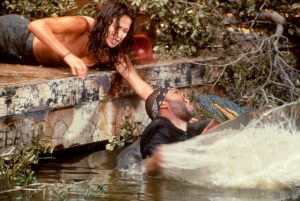
Jennifer Lopez and Ice Cube in 1997’s ‘Anaconda.’Courtesy of Everett Collection
“That’s a complicated scene. There’s a lot of different angles and movement and energy,” Black recalled to the outlet. “The running through the grass on uneven terrain, that’s all hard, but the hardest part is none of those things. Pretending to be terrified for long stretches of time is so exhausting. That’s really the hardest part, weirdly.”
He added, “This is going to sound dumb, and I’m going to wish I didn’t say this, but people don’t understand how difficult acting can be. If you’re acting [with] extreme emotion, it’s frigging exhausting.”
Lopez’s OG version of the movie was also filmed in the jungle.
“You notice how there’s always a rat scene in movies? I hate that,” Lopez said in a 1997 interview for Anaconda, noting other film scenes were much easier than if she worked with mice. “It was my first time [in the Amazon] and I can’t say I’ll be going back to film. It was a tough thing to film, being on water all day.”
“You get water-logged, and you’re in your shower and you feel like you’re on the boat,” she quipped. “You’re, like, ‘Is the floor moving or is it me?’ … It wasn’t an easy job, but it was fun and we had a good time. We had a great cast.”
Lopez even praised Voight for managing to pull off “being entertaining and funny while still being threatening.”
“I really like the character,” she added.
Anaconda is currently in theaters.
Share this:
Like this:
LikeLoading…
Discover more from The Maravi Post
Subscribe to get the latest posts sent to your email.
Puka Nacua is in a ton of hot water after his appearance on Adin Ross’ recent stream … with a well-known California politician ripping the Rams star as an “a***hole” for vowing to do an antisemitic touchdown dance on “Thursday Night Football.”…
Share this:
Like this:
LikeLoading…
Discover more from The Maravi Post
Subscribe to get the latest posts sent to your email.
Gisele Bündchen and Joaquim Valente aren’t sipping cocoa and warming by the fire this holiday season … they’re enjoying the sun and surf off the coast of Florida. The happy couple hopped on jet skis and carved up the clear water near their home…
Share this:
Like this:
LikeLoading…
Discover more from The Maravi Post
Subscribe to get the latest posts sent to your email.
My boyfriend is my personal life-size Ken doll. Whenever he asks me for styling assistance, I jump at the opportunity to dress him in dapper outfits — just like Ken’s job is beach, my job is wardrobe.
We may have different taste in television (sports for him, reality TV for me), but we do have the same taste in fashion. Our favorite men’s clothing brand? Vuori.
Known for the softest activewear and loungewear, Vuori delivers coastal style, high quality and premium comfort. As founder Joe Kudla told Us, “At the end of the day, it’s all about feeling good.” With Vuori, your man will feel good and look good! Win-win.
My handsome boyfriend in head-to-toe Vuori.Hannah Kahn
Not only did my boyfriend wear Vuori Meta pants on our first date, but he also rocks those same slacks to the office and the golf course! That’s the versatility of Vuori. You can take these comfortable designs from day to night. And unlike some activewear, these styles are always sleek and never sloppy.
Below are 11 men’s pieces from Vuori that get my stamp of approval as a shopping editor. From joggers to jackets, each of these styles deserves a spot on your hubby’s holiday wish list.
Seaside Half-Zip Sweatshirt
Vuori
Made from brushed-back fleece, this half-zip feels like a vintage sweatshirt in brand-new condition. Super soft with a relaxed fit, this classic pullover is perfect for weekend plans or post-workout comfort.