

200 girls, six countries, one trophy and one big goal: kick out HPV

Girls soccer
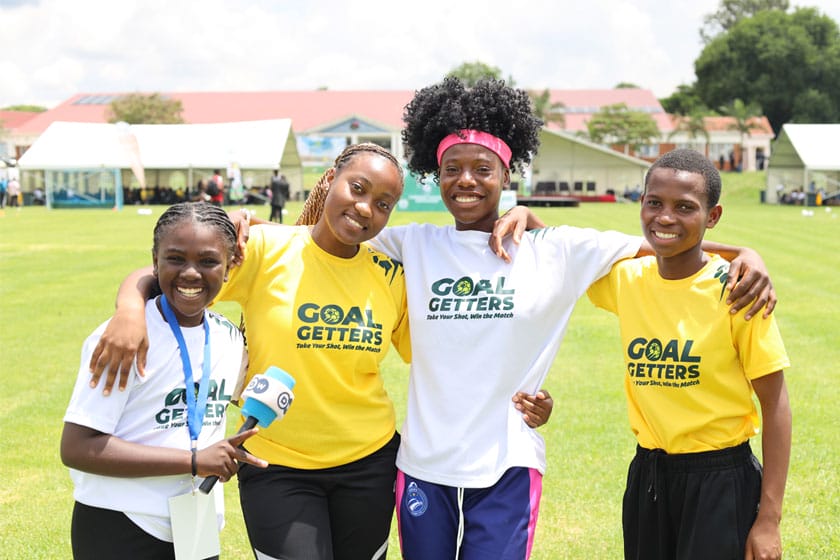
The Goal Getters workshop at The Heritage School in Harare, Zimbabwe. Credit: Gavi/2025/Charmaine Chitate

On the sidelines of a CAF girls football tournament in Zimbabwe this month, 200 talented young players gathered to take a shot at one major goal: ending cervical cancer.

byDerick Matsengarwodzi

At a glance

  1. As eight teams from six African nations vie for the trophy at the CAF Under-17 Girls Integrated Football Tournament in Zimbabwe this month, Goal Getters, a campaign run by UEFA, CAF and Gavi, brought the players together at a workshop on the sidelines to teach them about the human papillomavirus, cervical cancer and the vaccine that’s the best defence.
  2. “When you train, when you pass the ball. When you work as a team, you are already practising the discipline that builds strong bodies and strong futures. Part of the strength comes from making healthy choices, such as getting the HPV vaccine,” said Zimbabwe’s First Lady, Dr Auxilia Mnangagwa.
  3. Former England and Chelsea star Eniola Aluko said football had the power to inspire confidence in HPV vaccination in Africa.

At only 15, Negumbo Shekupe, a Namibian footballer, is already playing to inspire change.

One of about 200 young female players representing six countries at the CAF Under-17 Girls Integrated Football Tournament (GIFT) Zimbabwe 2025, which is running between the 8th and 18th of this month, Shekupe’s ambitions are not confined to the pitch.

As every touch, dribble and loss thrusts her closer to her dream of football fame, the shy teenager is using her nimble footwork to influence other young Africans to shoot for health. On 10 December, she swapped out her kit for blue track bottoms and white T-shirt, and joined her peers and a few famous faces at a game-changing workshop.

Goal Getters, a campaign run by the Confederation of African Football (CAF), UEFA and Gavi, the Vaccine Alliance, is using the energy of youth football to empower young girls to understand the importance of vaccines in securing their futures.

“Before I become professional, I am encouraging other girls of my age to get vaccinated against the human papillomavirus – which causes cervical cancer – in order to reach their dreams,” Shekupe told VaccinesWork.

A lifestyle, and the road to a better life

Known as the ‘beautiful game’, football is a lifestyle in Africa. At any given moment, in often unforgiving heat, on spare lots, potholed streets, and well-groomed pitches, hundreds of thousands of games are ongoing. Players, gleaming with sweat and alive with reckless energy, hammer home the ball – and excitedly call out top footballer’s names, as a homage or a boast, after a goal or a skilful dribble.

When you train, when you pass the ball. When you work as a team, you are already practising the discipline that builds strong bodies and strong futures. Part of the strength comes from making healthy choices, such as getting the HPV vaccine.

– Dr Auxilia Mnangagwa, Zimbabwe’s First Lady

The game’s popularity captivates billions on the continent – and that makes it a great vehicle for change.

Shekupe, a promising player, is in her own small way slowly learning that. “By getting vaccinated, young girls will live healthier, better lives and reach greater, professional heights,” she said. It’s a message she intends to carry back home.

Previous Goal Getters workshops have been hosted in Eswatini and Tanzania. Like this month’s event in Harare, the aim on those occasions was to educate girls about the human papillomavirus (HPV), the leading cause of cervical cancer worldwide, a disease that kills finds a disproportionate number of its victims in low- and middle-income countries.

Zimbabwe’s Acting Minister of Health and Child Care, Dr Anxious Masuka, told the gathering that Zimbabwe first introduced the HPV vaccine in 2014, scaling the programme to the national level in 2018, mainly through school-based delivery, and recording high coverage.

But COVID-19 brought both logistical disruption and appeared to trigger a spike in misinformation, which has hampered the programme. Uptake currently hovers at just over 50%. The Ministry has embarked on an HPV vaccination revitalisation programme, while also increasing cancer screening and addressing misinformation.

Have you read?

Zimbabwe’s First Lady, Dr Auxilia Mnangagwa, a health ambassador, who officially launched the HPV vaccine in 2018, has taken a personal interest in supporting the government’s efforts.

“This tournament is not just about football; it is about your future and your health,” Dr Mnangagwa said, in a speech read out by Minister of Women’s Affairs, Community, Small and Medium Enterprise Development Monica Mutsvangwa. “When you train, when you pass the ball. When you work as a team, you are already practising the discipline that builds strong bodies and strong futures. Part of the strength comes from making healthy choices, such as getting the HPV vaccine.” 

Kick out HPV and misinformation

Prior to the event, the majority of the girls in attendance admitted to having known very little about the HPV virus, cervical cancer or the available vaccine.

But at the workshop, sessions held by various health workers left them with answers to their many questions – answers they could pass on to peers and football rivals.

Some of the information came as a surprise – a ripple of shock ran through the group as speakers explained that by age 45, an estimated four in five men and women will have had at least one HPV infection. While the body naturally clears the virus in 90% of people, in some, it can cause cancers, including cervical cancer, which kills 2,300 Zimbabwean women each year.

Football is one of the biggest unifiers: it brings people together. The fact that cervical cancer is the biggest killer of women in Africa means that it is important to correct the misinformation, to give confidence about the high HPV vaccination success rate.

– Eniola Aluko, the UEFA Together Goal Getters Ambassador and former England and Chelsea player

Crucially, they learned that there’s a shield. A single dose of HPV vaccine is recommended to girls aged 9 to 14 – in other words, before exposure – and can protect them for life.

CAF legend Amanda Dlamini, who played for South Africa’s Banyana Banyana from 2007 to 2018, spoke at the event, addressing vaccine hesitancy. “Vaccination in Africa is something that has been frowned upon [in some communities], but we encourage young girls, and equip them with enough knowledge, where health and awareness is concerned – and this is a good platform to start,” she said. “The information gained here will be shared across families, friends, and then the rest of communities are informed and inspired.” 

Eniola Aluko, a star former England and Chelsea player originally from Nigeria, and the UEFA Together Goal Getters Ambassador is convinced that football can effectively address such misinformation to save lives. “Football is one of the biggest unifiers: it brings people together. The fact that cervical cancer is the biggest killer of women in Africa means that it is important to correct the misinformation, to give confidence about the high HPV vaccination success rate,” she told VaccinesWork.        

Future pledge

Away from the workshop’s lively discussions, the CAF Under-17 Girls Integrated Football Tournament (GIFT) Zimbabwe 2025 roared to life.

Eight teams from six nations fielded young players – a chance for them to gain international experience and deepen their investment in women’s football. On the pitch, pouring rain paused for the occasional burst of sunshine, which beamed down on a crop of potential champions.

“Empowering young girls through football goes beyond just the game; it’s about developing their leadership skills and helping them make informed decisions that will shape their futures,” said Meskerem Tadesse, CAF Head of Women’s Football Development. “By investing in young girls through these initiatives, CAF – under the leadership of President Dr Patrice Motsepe – demonstrates a commitment to expanding opportunity and well-being.”

In Africa, Zimbabwe ranks fourth globally and regionally in cervical cancer mortality. In 2029, local screening services reached only 20% of the population.

For former top player Aluko, Goal Getters is personal. It’s about giving back to Africa, she says – and being part of an overdue turn from exploitative foreign interest, towards international investment in the continent and its people. “It’s important to see various organisations investing in Africa, and in our future. For me, for a long time, the culture has been about extracting from Africa, and now this is about investing in the future of Africa,” said Aluko.

After the tournament’s final whistle on 18 December, Shekupe and her peers will not only carry back home winning medals, new skills and memories, but also health messages to benefit future generations and nations. “The governments should look out for young girls that need to get vaccinations,” she wrote on the public Champions’ Pledge Wall. “They must also tell them about how HPV works and how they should prevent themselves against this virus.”


Discover more from The Maravi Post

Subscribe to get the latest posts sent to your email.

The Maravi Post

Kyle Chrisley’s Ups and Downs Through the Years: Multiple Arrests and More

Kyle Chrisley has dealt with many ups and downs through the years.

Kyle’s famous family — including stepmom Julie Chrisley, whom dad Todd Chrisley wed in 1996, and half-siblings Chase Chrisley, Savannah Chrisley and Grayson Chrisley — rose to fame on their Chrisley Knows Best reality TV show, which premiered on USA Network in 2014. While Todd and Julie, alongside their youngest three children, starred on the docuseries, Kyle was often absent amid family drama. In 2013, Todd and Julie received custody of Kyle’s daughter, Chloe, after he was arrested for assault.

While Chloe grew up with her paternal grandparents, aunts and uncles, Kyle eventually mended fences with his family after he was hospitalized following his 2019 suicide attempt.

Kyle, who married wife Ashleigh Nelson in April 2021, made headlines nearly two years later when he was arrested and charged with aggravated assault. Us confirmed in March 2023 that the reality TV alum was booked by the Smyrna Police Department in Tennessee, where he was eventually released on a $3,000 bond.

Scroll below to revisit Kyle’s ups and downs through the years:


Discover more from The Maravi Post

Subscribe to get the latest posts sent to your email.

The Maravi Post

FIFA World Cup™ Trophy Tour by Coca-Cola: Celebrating Two Decades of Connection

coca cola and FIFA
Coca-Cola and FIFA celebrate 20 years of FIFA World Cup™ Trophy Tour by Coca-Cola

Coca-Cola and FIFA celebrate 20 years of FIFA World Cup™ Trophy Tour by Coca-Cola

JOHANNESBURG, South Africa, December 19, 2025/ — The Coca-Cola Company (www.Coca-ColaCompany.com) and FIFA are kicking off the sixth FIFA World Cup™ Trophy Tour by Coca-Cola, giving thousands of fans across the globe the opportunity to see the original FIFA World Cup™ Trophy ahead of FIFA World Cup 2026™. FIFA World Cup 2026 is set to be the biggest yet – spanning three host nations, Canada, Mexico and the United States, with more teams, more matches and more celebrations than ever before. 

As a long-standing partner of FIFA, Coca-Cola has the exclusive rights to the FIFA World Cup Trophy Tour by Coca-Cola. Beginning Jan. 3, 2026, in Riyadh, Saudi Arabia, the original FIFA World Cup Trophy will visit 30 FIFA Member Associations across 75 stops and more than 150 tour days, giving fans around the world a once-in-a-lifetime chance to see football’s most coveted prize.

“Football has an unmatched ability to bring people together, no matter where they’re from or what language they speak,” said Mickael Vinet, vice president, global assets, influencers and partnerships, The Coca-Cola Company. “For two decades, the FIFA World Cup Trophy Tour by Coca-Cola has been a journey that connects fans to the magic of the game. As the Trophy travels toward the biggest FIFA World Cup in history, we’re celebrating the passion, pride and unity that make football the world’s favorite sport.”

The FIFA World Cup Trophy Tour by Coca-Cola will visit all three FIFA World Cup 2026 host countries and future FIFA World Cup and FIFA Women’s World Cup™ host nations including Morocco, Portugal, Spain, Saudi Arabia and Brazil. At each stop, local communities will have access to unique fan engagement opportunities, from immersive brand experiences and interactive football challenges to exclusive content with FIFA Legends. 

The 2026 tour marks 20 years of the FIFA World Cup Trophy Tour by Coca-Cola. Over this period, more than 4 million fans across more than 182 markets worldwide have participated. 

“The FIFA World Cup Trophy is recognized around the world as the greatest symbol in sport, and Coca-Cola is one of the world’s most recognized brands,” said Romy Gai, FIFA’s Chief Business Officer. “For two decades, our partnership with Coca-Cola has united fans and brought them the magic of the FIFA World Cup through the FIFA World Cup Trophy Tour by Coca-Cola. Over five editions, the iconic trophy has visited 182 of our 211 Member Associations, and this tour will be particularly special—not only are we marking the 20th anniversary of the FIFA World Cup Trophy Tour by Coca-Cola, but we are also preparing for the biggest FIFA World Cup in history, with three host nations: Canada, Mexico and the United States.”

For more than a century, Coca-Cola has been more than just a beverage; it has been a symbol of optimism and a refreshing presence in countless memorable experiences. As the world comes together to experience the FIFA World Cup, the Coca-Cola team—spanning local bottlers, manufacturers, distributors, as well as retail partners—will refresh fans throughout the tournament. From cherished local favorites to iconic drinks like Coca-Cola and Powerade, the company is proud to serve refreshment across moments of celebration that unite fans everywhere.

FIFA World Cup Trophy Tour by Coca-Cola is also a platform to promote positive impact in local communities. For the FIFA World Cup Trophy Tour, The Coca-Cola Company will work with local teams and bottling partners to support its sustainability initiatives, including packaging collection and recycling efforts.  

Distributed by APO Group on behalf of Coca-Cola.


Discover more from The Maravi Post

Subscribe to get the latest posts sent to your email.

The Maravi Post

Waymo Cars Dangerously Halted During San Francisco Power Outage

San Francisco was hit with a major power outage Saturday night, turning the whole city into darkness and dangerously stalling a ton of self-driving Waymo taxis. The citywide outage forced Waymo to halt its driverless car service, stranding the…


Discover more from The Maravi Post

Subscribe to get the latest posts sent to your email.

The Maravi Post

“I will not remarry after my husband’s death”—Former Nigerian First Lady Aisha Buhari at 35, find out why?

LAGOS-(MaraviPost)-Former First Lady, Aisha Buhari, has revealed that she has no plans to remarry, describing the decision as pragmatic rather than moralistic.

“She will not remarry, she says, almost with a shrug,” she told Dr Charles Omole, author of the new 600-page biography titled From Soldier to Statesman: The Legacy of Muhammadu Buhari, which was unveiled at the State House, Abuja, on Monday.

“It is not a moral pronouncement so much as a pragmatic one: she has grandchildren; one husband was enough,” the book added.

The 22-chapter biography traces Buhari’s life from his early years in Daura, Katsina State, to his final hours in a London hospital in mid-July 2025.

It presents Mrs. Buhari’s stance on remarriage as a refusal to conform to cultural binaries that often portray widows as either betrayers or saints.

“In a culture that sometimes reads remarriage as betrayal or saintliness, her answer refuses both scripts. It is simply a woman naming the contours of her future,” the book explained.

“Looking ahead, Mrs. Buhari plans a quieter public life, dividing her time between family, philanthropy, and travel.

“Her plans are domestic and cosmopolitan at once. She will holiday with friends and associates. She will dote on grandchildren so they will remember her not as a moving figure behind tinted glass but as a presence in their childhood rooms.

“She will run her foundation, the Aisha Buhari Foundation, and the cardiovascular and medical centre in Kano that has already completed over two hundred procedures.

“She will host, collaborate, and extend the same ethic of care that animated her politics into a quieter, more sustainable hospitality,” the book noted.

Omole described Mrs. Buhari’s decision as a personal reset after years in the political spotlight.

“If the republic expects a politics of eternal return, she offers a politics of departure instead: let others take the stage; let the house heal,” he said.

“For Aisha Buhari, her marriage served as both a refuge and a trial.

“It gave her a platform to voice her opinions, only to punish her for doing so. It opened doors to the decision-making spaces, but those spaces became unwelcoming.

“In 2014, she was entrusted with meeting the nation’s expectations; by 2014, she was excluded from acknowledgement,” it further read.

After his divorce in 1988, Muhammadu Buhari married Aisha Buhari on 2 December 1989.

Born in 1971 in Adamawa State, she became First Lady when Buhari returned to power in 2015.

The couple were married for 35 years and had five children.

Source: tribuneonlineng.com


Discover more from The Maravi Post

Subscribe to get the latest posts sent to your email.

The Maravi Post

Old habits die hard! Chakwera’s post-elections travel sparks fresh outrage

By Kenneth Bwanali

LILONGWE(MaraviPost)–Barely three months after Malawians went to the polls and decisively voted to remove the Malawi Congress Party (MCP) administration, former President Lazarus Chakwera is once again under fire for the very behavior many believe cost him the presidency: a relentless appetite for international travel.

Political analysts and ordinary citizens alike have expressed dismay as news emerged that the former leader has already visited Tanzania and is currently in Dubai, United Arab Emirates. For many, these trips signify a “tone-deaf” approach to the concerns that led to his crushing defeat in the September 16, 2025, general elections.

A Campaign Defined by the “Globetrotter” Label

During his five years in office, Chakwera was frequently criticized for his frequent foreign trips, often accompanied by large entourages.

Critics nicknamed him the “Globetrotter-in-Chief,” arguing that while the country’s economy was in a tailspin—marked by 33% inflation, chronic fuel shortages, and a lack of foreign exchange—the President was busy collecting per diems in foreign capitals.

“The election was a referendum on his lifestyle and his detachment from the suffering of the common man,” said Lilongwe-based political commentator, Kondwani Phiri. “Malawians expected that after losing, he would take a period of quiet reflection at home. Instead, he is back at the airport. It seems he has learned nothing and forgotten nothing.”

Tanzania and Dubai: The Post-Presidency Itinerary

While Chakwera was recently appointed as a Commonwealth Special Envoy to Tanzania to assist with mediation efforts following their own disputed elections—a role that technically justifies his travel—it is the subsequent trip to Dubai that has raised eyebrows.

Social media platforms have been flooded with comments from Malawians who feel that the former president should have prioritized “image repair” by staying grounded in Malawi.

“We voted him out because he loved the sky more than the soil of Malawi,” wrote one user on X (formerly Twitter). “To see him in Dubai now just proves he never really cared about our concerns. He is addicted to the jet-set life.”

The “Changed Man” Opportunity Missed

Political strategists argue that the post-election period offered Chakwera a unique opportunity to prove his critics wrong. By staying at home, engaging with his party’s grassroots, and showing solidarity with Malawians still struggling with the economic mess his administration left behind, he could have built a narrative of a “reformed statesman.”

Instead, the sight of him in international lounges has reinforced the perception of a leader who is more comfortable in the company of foreign dignitaries than in the markets of Area 25 or Limbe.

The Road Ahead for MCP

As the Malawi Congress Party begins the painful process of soul-searching and preparing for life in the opposition, the actions of its leader continue to cast a long shadow.

With Peter Mutharika now back at the helm and promising a “tough and painful” return to economic stability, the MCP needs to convince the electorate that it can be a responsible alternative.

However, as long as its leader continues to prioritize international travel over domestic presence, that remains a difficult sell.

For now, it appears that for Lazarus Chakwera, the world is still his stage—even if the Malawian people have already pulled the curtain on his performance.

Disclaimer: The views expressed in the article are those of the author not necessarily of The Maravi Post or Editor


Discover more from The Maravi Post

Subscribe to get the latest posts sent to your email.

The Maravi Post