
SHOBHA SHUKLA – CNS
As 2025 wraps up, let us remind ourselves of the prominent promises (and some legally binding ones) which our governments have made since 1945 to advance progress on gender equality and human rights. The Preamble of the United Nations Charter adopted by all governments in 1945 begins with the three words: “We the peoples…” and not “We the men…” Equal rights of men and women are further reaffirmed in the UN Charter Preamble 1945.

Shortly after 1945, gender equality was also enshrined in Universal Declaration of Human Rights 1948. Gender equality became the core driver of legally binding UN Treaty (formally called as UN Convention on the Elimination of all forms of Discrimination Against Women or CEDAW 1979). CEDAW also promised to address gender-based violence, reminded Dr Pam Rajput, a noted feminist and gender justice leader and former Chairperson of Government of India’s High-Level Committee on the Status of Women. Then, at the UN General Assembly 1993, World Leaders passed a resolution to eliminate gender-based violence.
In 1994, International Conference on Population and Development (ICPD) and its Programme for Action also stressed on ending gender-based violence as a matter of human rights.
In 1995, UN World Conference on Women in Beijing and its landmark Beijing Declaration 1995 and Platform for Action committed governments to address violence against women too.
UN Sustainable Development Goals adopted by all world leaders in 2015 promise to achieve gender equality “where no one is left behind” by 2030. But are we on track? or are we struggling to deliver on the goals – or sliding back?
And a very long-list of declarations, agreements, and promises are chronicling the struggle for gender equality in last century.
Let us not forget centuries of feminist struggles
Let us remember – unsung heroes – our feminist leaders in communities, regions and globally that have strived so hard and so passionately and fiercely to counter harmful gender norms, stereotypes and narratives – and advance gender equality despite and inspite of anti-rights pushbacks. Salutes to them. We owe it to feminist leaders over decades and centuries.
What is holding us back from keeping the promise?
Despite considerable and at times, historic, progress on gender equality, progress is miles away from being acceptable. Rather in recent times, anti-rights and anti-gender pushbacks have not only threatened the fragile gains made on gender equality but also undoing the good that had happened after quite a fierce community-led feminist struggle.
For example, should not we all be asking that why is there almost no change in violence against women and girls since 2000? In last 26 years – since the year 2000 onwards, annual decline in intimate partner and sexual violence is abysmally low at 0.2%. This is so very unacceptable, says Shobha Shukla, SHE & Rights (Sexual Health with Equity & Rights) Coordinator and Host. “If we are to walk the talk on ending sexual and all other forms of gender-based violence, we have to translate words into stronger actions – dismantle patriarchy, and rethink, and rebuild feminist health and development systems.”
It is high time for accountability
“Despite so many agreements and declarations to end violence against women and girls, the question remains – why the rates have not declined. Violence against women and girls is a violation of human rights, rooted in gender inequality and an impediment to sustainable development,” said Dr Pam Rajput. She was the opening keynote speaker at SHE & Rights session this month, co-hosted by Global Center for Health Diplomacy and Inclusion (CeHDI), Women Deliver Conference 2026, International Planned Parenthood Federation (IPPF), Asian-Pacific Resource and Research Centre for Women (ARROW), Women’s Global Network for Reproductive Rights (WGNRR), Asia Pacific Media Alliance for Health, Gender and Development Justice (APCAT Media) and CNS. “Despite all the efforts over decades to end gender-based violence, the painful reality or truth is that we are far behind from the goal of ending all forms of violence against women and girls.”
“Over 840 million women have faced violence globally. Number of women who faced violence in conflict settings is double. In the past 12 months, 316 million women have faced physical violence or sexual abuse by the intimate partner and 263 million women have faced it by non-intimate partner. Over 51,000 cases of femicide have been reported,” added Dr Rajput, who also serves now as Emeritus Professor, Panjab University.
Even women Parliamentarians are not free of violence, says Dr Rajput. 73% of women journalists reported facing online violence, and 20% of them have even suffered offline attack by anti-gender groups.
Earlier this year, Commonwealth Parliamentary Association published a study that revealed 60% of women MPs from Asia-Pacific reported online gender-based violence. Main findings included:
– 60% of women Parliamentarians surveyed have been targeted by hate speech, disinformation, image-based abuse or unwanted disclosure of personal data (doxing) online. This is the highest rate for this type of abuse (compared to other IPU regional studies).
– 76% of women Parliamentarians and 63% of parliamentary staff have experienced psychological violence.
– Sexual violence is also prevalent, with 25% of women Parliamentarians and 36% of parliamentary staff reporting such incidents.
– Economic violence or damage to women’s belongings has affected 24% of women Parliamentarians and 27% of parliamentary staff, while physical violence was reported by 13% and 5% respectively.
– Certain groups – women under 40, women from minority backgrounds and unmarried women – face disproportionately higher rates of violence. Opposition women MPs also report higher rates of psychological and sexual violence.
High time to dismantle barriers that fail us on gender justice
“We need to address structural inequalities, patriarchal norms, ‘normalisation’ of gender-based violence, consumerist neoliberal models of development, gender insensitivity of the enforcement agencies (such as police or judiciary), and under-investment in gender equality, if we are to address violence against women and girls,” said Dr Rajput.
“The agreed conclusions of UN Commission on the Status of Women every year and its Political Declarations every four years must get fully implemented by the countries. Promises made at the global level must translate into local realities,” she stressed.
“How can we talk about sustainable development where no one is left behind, when millions of women and girls are not free of economic violence, social violence, sexual violence and other forms of gender-based violence?” said Dr Pam Rajput.
“We demand zero tolerance for violence against women and girls, both in policy and practice. Violence against women and girls is not something where governments can get away by saying ‘oh it is inevitable,’ because it is NOT inevitable” she emphasised. “Alongside global campaigns to end violence, we also need local campaigns to end violence against women and girls. We need accountability from global to local and local to global for a safe healthy environment for each human being on this Earth.”
Gender-based violence also fails us on HIV
“Gender-based violence not only violates human rights of women and girls but also exposes them to risk of acquiring HIV and other infections. Gender-based violence and HIV creates a nexus or a cycle of violence, stigma and discrimination. Unequal power and harmful gender norms further ups the risks and vulnerabilities for women and girls for suffering violence as well as HIV,” said Esther Asuquo, gender and peace advocate of African Girls Empowerment Network, Nigeria.
“Gender-based violence increases risk for women and girls of forced sex, physical trauma, sexual violence, including intimate partner violence, rape and physical trauma. Gender-based violence also increases the inability to negotiate safer sex among young women and girls,” added Esther while addressing SHE & Rights session.
Why is ending period poverty elusive?
Period poverty is the lack of access to menstrual products, sanitation facilities, and hygiene education, forcing people to use inadequate substitutes (rags, leaves) or miss school/work, impacting health, dignity, and education due to stigma and cost. It affects millions globally, including in developed nations, leading to missed classes, poor health, and hindering women’s rights and economic independence.
“Ending period poverty and stigma is important if adolescent girls and young women need to live a dignified life with rights. Period poverty and stigma are affecting so many girls across Africa. Many of them are lacking safe absorbent materials – essential for menstrual hygiene, and are thus forced to use unsafe absorbent materials, for example soil, sand and in extreme cases cow dung. These absorbent materials end up increasing their susceptibility to reproductive tract infections. Sometimes they are forced to go for transactional sex which increases the risk of sexual violence which increases their risk of HIV, teenage pregnancies and sexually transmitted infections (STIs),” said Angel Babirye, Emerging Women Deliver leader from Uganda and President of the African Youth and Adolescent Network East and Southern Africa (AfriYAN ESA).
“Menstruation is largely shrouded in myths and misconceptions. We must normalise conversations around menstruation because it is normal. Girls need to have safe spaces to speak up about menstruation, and also need to have access to clean water, sanitation and hygiene too. Girls and women must have safe and private facilities to change absorbent materials as and when required as well as spaces to dispose off the used absorbent materials,” she added. “In Uganda, 1 in 4 girls drops out of school once they begin menstruating. Absenteeism triples during their periods. Let us address menstrual hygiene, period poverty and stigma in a comprehensive way so that girls can have safe and dignified lives.”
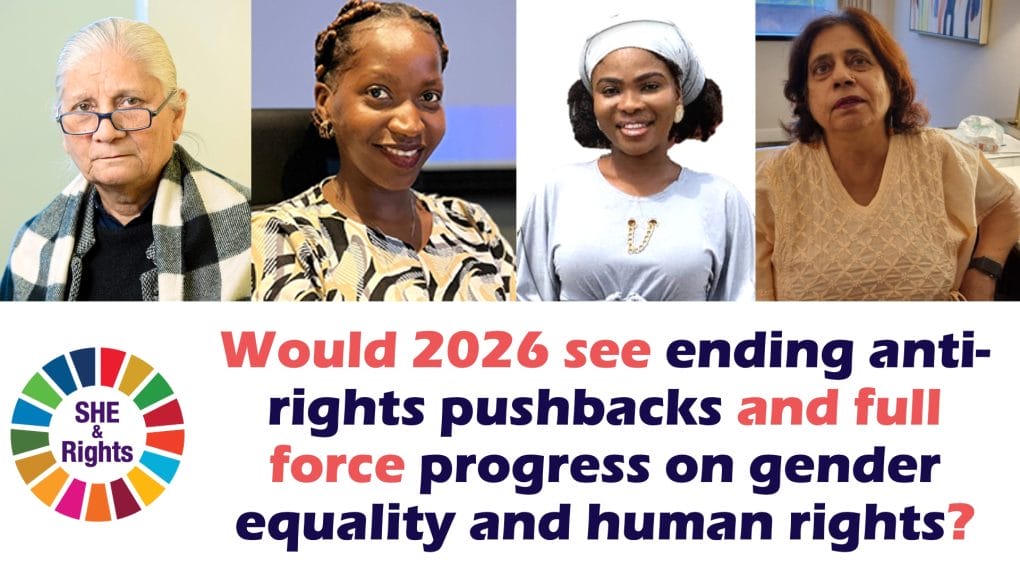
Would 2026 see ending anti-rights pushbacks and full force progress on gender equality and human rights?
Let us hope that 2026 dawns on all of us why gender inequality is in nexus (by design) with patriarchy, capitalism, fundamentalism, militarisation, debt, and shaky progress against a lot of SDG goals and targets – and sparks united action to deliver on SDG-5, SDG-3 and all other goals, targets and promises made by our governments for a better tomorrow.
The only possible socially just and ecologically sustainable world order is a feminist world order where health, gender, social, economic, climate and redistributive justices along with accountability to peoples take centre-stage. That is the rainbow highway to SDGs, so do we believe. #RethinkRebuildRise should be our mantra.
Shobha Shukla – CNS (Citizen News Service)
(Shobha Shukla is a feminist, health and development justice advocate, and an award-winning founding Managing Editor and Executive Director of CNS (Citizen News Service). She was also the Lead Discussant for SDG-3 at United Nations inter-governmental High Level Political Forum (HLPF 2025). She is a former senior Physics faculty of prestigious Loreto Convent College; current President of Asia Pacific Regional Media Alliance for Health, Gender and Development Justice (APCAT Media); Chairperson of Global AMR Media Alliance (GAMA received the inter-ministerial AMR One Health Emerging Leaders and Outstanding Talents Award 2024); and Host of SHE & Rights (Sexual Health with Equity & Rights). Follow her on Twitter/X @shobha1shukla or read her writings here www.bit.ly/ShobhaShukla)
– Shared under Creative Commons (CC)
Discover more from The Maravi Post
Subscribe to get the latest posts sent to your email.