

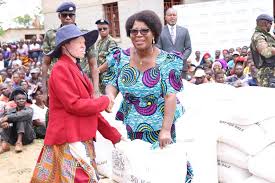

The vice president, Jane Ansah, has sparked mixed reactions among concerned Malawians due to her frequent food distribution trips.
To begin with, supporters of the Democratic Progressive Party (DPP) maintain that it falls within her duties as the leader of the Department of Disaster Management Affairs (DoDMA) to evaluate the extent of food crisis, engage with impacted communities, and facilitate prompt aid initiatives.

They contend that these actions play a vital role in disaster management by ensuring that the response is suitable and prompt.
It is indeed true that her presence on the ground can easily facilitate a better understanding of the situation and the specific needs of the communities affected by disasters.
Additionally, the community’s confidence in government initiatives can be strengthened by her involvement, as it reassures Malawians that their concerns are directly being acknowledged and resolved.
It is therefore believed that this Ansah’s approach can improve the overall efficiency of disaster relief efforts and promote a feeling of cooperation between the government and local communities.
However, distributing food items as a vice president comes with additional expenses.
Firstly, the transportation of food items requires vehicles, which incur fuel expenses. Obviously, vice president’s frequent trips lead to significant fuel consumption.
In fact, regular use of state vehicles for food distribution often leads to increased wear and tear, necessitating repairs and maintenance that can strain state budgets.
Additionally, the travel of the vice-president results in the mobilization of security personnel, provision of accommodations and daily allowances for protection teams and other emergency personnel, as well as coordination with local law enforcement for logistics.
Obviously, these expenses astronomically accumulate over multiple trips.
In conclusion, while food distribution initiatives are vital for community support, they can also lead to significant expenditures that oftentimes drain state resources.
It is essential to evaluate the efficiency and effectiveness of these trips to ensure that they are providing the intended benefits without imposing excessive costs on the state.
It is strongly advised that during this time of strict economic measures, one way to decrease the overall cost of Vice President’s frequent travel is to assign food assessments and distribution tasks to local and regional authorities.
Lastly, it is believed that excessive expenditures on Ansah’s travel should be redirected towards providing direct assistance or constructing necessary infrastructure.
Discover more from The Maravi Post
Subscribe to get the latest posts sent to your email.






