Hoping my WhatsApp message finds you in good spirits and health. I am a very good follower of your articles, and indeed I’ve learnt a lot from them.
My name is Finley Mbella. I live here in the UK. I came here in 2002 after retiring from the army, having worked for 25 years.
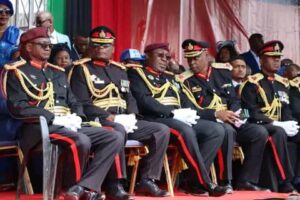
I thought I should comment about this issue concerning the secondments of those 5 military officers. It is really a shame that the ‘judiciary’ has turned itself into a bullying institution in Malawi. Actually, their responsibilities requires them to work hand in hand with the other 2 arms of government and possibly provide an advisory role to both the Executive and the Legislature. Being antagonistic, and know-it-all merely defeats the purposes of having those 3 institutions in a government.
Those who crafted the ‘Law’ knew what they were doing. In any democratic country there are demarcations when it comes to the application of both the ‘Civil Law’ on one hand, and the ‘Military Law’ on the other. Military law has to be applied within the context and atmosphere of the military (barracks).
A serving military personnel is answerable to both civil and military law. It depends on the circumstances under which a crime is committed. Minor civil infringements can summarily be dealt with within the barracks’ setup but if the charge is severe and involves issues outside of the barracks, the culprit, though a military person, has to answer charges in a civilian court. In the military they have ‘Court Martials’. An officer/soldier has to abide to both civil/military laws; while as a civilian is covered by the civil law only. It is therefore, disingenuous for Justice Kenyatta Nyirenda to bulldoze his judiciary muscle wholesale, in the process throw out the window the gravity and real essence of the ‘MILITARY LAW’. In developed countries, that practice can not be condoned. Malawi being a democracy in transition, anything goes!!
During my time in the military I saw General Matewere (late), General Namwali (late), and General Simwaka, being appointed as directors of security at ESCOM, RESERVE BANK, and MALAWI HOUSING CORPORATIONS. A few years ago we witnessed some generals seconded into various institutions, and these were Generals Msonthi, Odillo, Maulana, Supuni, Namathanga, Nundwe etc, etc and nobody ran to the judiciary to lodge a complaint. Why this time with these 5 people, how special are they?
You are right in your judgement that the militaty is an institution that is governed and upheld by military ethics and discipline. Insubordination, refusing to accept an order, mutiny or disorderly of any sort is punishable by a court martial. There is no justification for the judges to start throwing spanners in the military machinery. That on its own sets up a wrong precedence that will compromise the operations of the military, for simply to satisfy someone’s ego and misdirected ambitions.
In reality, these men should have read the writing on the wall that loudly says “their services in the military is no longer required” – period. Others have been kicked out of the system without any secondment at all. They are lucky that they have politely been asked to shift in order to create room for competent, seasoned and trustworthy mlitary personnel. Well, I thought I needed to amplify your observations concerning this and the other areas you talked about. It is hightime these corrupt judges were told the truth concerning their delivery of the expected services to the nation.
As 2025 draws to a close, it is fitting to reflect candidly on the political landscape that has shaped Malawi this year.
The democratic spirit was vividly on display on September 16, 2025, when Malawians exercised their right to vote, reaffirming their commitment to participatory governance.
The hard truth is that despite significant challenges, the electorate’s engagement was commendable and a testament to Malawi’s resilient democracy. Yet, beneath this celebratory surface lies a complex interplay of political dynamics and judicial interventions that warrant sober examination.
The 2025 election campaign period was far from a level playing field.
The main opposition, the Democratic Progressive Party (DPP), faced notable obstacles, particularly concerning access to the Malawi Broadcasting Corporation (MBC), the public broadcaster. The hard truth is that the DPP’s restricted access to MBC underscored persistent imbalances in media freedom and political pluralism.
Public broadcasters, ideally neutral, often become arenas of contestation, and in this instance, the DPP had to navigate significant hurdles to communicate its manifestos to the populace effectively.
This unevenness in campaign conditions poses broader questions about the fairness of electoral processes, which remain critical to democratic consolidation.
Despite these constraints, all political contenders presented their manifestos to the electorate, offering visions for Malawi’s future.
The hard truth is that the manifesto of the DPP, under the leadership of Professor Arthur Peter Mutharika, resonated deeply with many Malawians, capturing their hopes and aspirations. The DPP’s message, promising robust service delivery and nationwide development, evidently struck a chord, propelling the party to the forefront of governance.
This outcome reflects the electorate’s trust in the party’s capacity to translate promises into tangible improvements in their daily lives.
With the DPP now in the driver’s seat, laying the foundations for service delivery as outlined in its manifesto, the stakes are high.
The hard truth is that political promises must be matched by effective governance, which requires internal cohesion and a commitment to meritocracy within the party and government structures.
For the DPP to succeed, it is imperative to prune “bad apples” and ensure that those in strategic positions share the party’s vision and dedication to fulfilling the manifesto’s objectives. Without such alignment, the risk of inefficiency and corruption could undermine progress and erode public trust.
However, as the year closes, a significant impediment to the DPP’s governance efforts has emerged from an unexpected quarter: the judiciary.
The hard truth is that unnecessary injunctions and stay orders granted by courts have increasingly hampered the party’s ability to implement its strategies.
Since assuming power, the DPP has not engaged in wholesale firings within statutory corporations but has instead opted for transfers and redeployments, a common administrative practice across Malawi’s political administrations.
These personnel changes span critical institutions such as the military, police, Electricity Supply Corporation of Malawi (ESCOM), and water boards.
It is important to recognize that such administrative redeployments are not novel or unique to the current government.
The hard truth is that successive Malawian governments—from the Malawi Congress Party (MCP) under the late Hastings Kamuzu Banda, to the United Democratic Front (UDF) under Bakili Muluzi, the DPP under the late Professor Bingu wa Mutharika, the People’s Party (PP) under Dr. Joyce Banda, the MCP under Dr. Lazarus Chakwera, and now the DPP once again—have all engaged in similar practices. These redeployments serve as tools for aligning key positions with the government’s strategic priorities and ensuring efficient service delivery.
Yet, the judicial system’s intervention has complicated this administrative prerogative.
The hard truth is that individuals affected by these transfers are increasingly seeking refuge in the courts, obtaining injunctions that stall the implementation of the government’s redeployment plans. Consequently, many entrusted with vital roles remain unable to assume their responsibilities, leaving critical institutions in a state of limbo.
This judicial obstruction places the DPP in an awkward position, caught between honoring its manifesto commitments and respecting court orders that delay progress.
This situation presents a paradox between the branches of government.
The hard truth is that while the judiciary operates within the framework of the law and upholds the rights of individuals, its decisions in these cases inadvertently impede the executive’s ability to govern effectively.
The courts’ role in delivering justice is indispensable; however, prolonged injunctions and the slow pace of judicial reviews, often dragging on for months or even years, create bottlenecks that stall national development initiatives.
The phrase “pending judicial review” has become a recurrent refrain accompanying the granting of these injunctions, signaling lengthy legal processes ahead.
The hard truth is that such delays are detrimental not only to the government’s operational capacity but also to the broader public interest.
When strategic appointments and redeployments are frozen by protracted court cases, the delivery of essential services—from electricity and water provision to security and public administration—suffers.
As Malawi transitions into 2026, the imperative for a balanced approach between judicial independence and governance efficiency becomes ever more pressing.
The hard truth is that the judiciary, staffed by individuals endowed with intellect and empathy, must recognize the broader implications of its rulings on national progress.
This column calls upon the judiciary to exercise prudence in granting injunctions, reserving them for cases where genuine legal grievances exist and avoiding those that serve to obstruct legitimate governmental functions unnecessarily.
Furthermore, the hard truth is that expediting judicial reviews is critical. Delays in concluding these reviews undermine public confidence in the justice system and stall administrative action.
Streamlining judicial processes, enhancing case management, and deploying adequate resources to handle judicial reviews promptly would go a long way in harmonizing the relationship between the judiciary and the executive.
For Malawians, it is essential to understand the complexities underlying these judicial-executive tensions.
The hard truth is that the courts are not antagonists to progress but guardians of legal rights. Yet, the judiciary’s decisions, though lawful, can sometimes inadvertently slow down the momentum of development.
Appreciating this duality allows citizens to advocate for reforms that uphold justice while fostering effective governance.
In reflecting on the year 2025, this column acknowledges the resilience of Malawi’s democratic institutions and the vibrancy of its political discourse.
The hard truth is that democracy is a continuous journey marked by challenges and opportunities.
The peaceful exercise of voting rights by Malawians in September is a milestone worth celebrating, but it must be complemented by a governance environment where political will, administrative action, and judicial oversight coalesce harmoniously.
Looking ahead, the DPP’s success in delivering on its manifesto will hinge on its ability to manage internal party cohesion, uphold meritocracy, and navigate the judicial landscape effectively.
The hard truth is that political leadership entails balancing competing interests and overcoming institutional hurdles without compromising democratic principles or the rule of law.
As Malawi steps into 2026, the nation stands at a crossroads. The hard truth is that for Malawi to realize its developmental aspirations, all arms of government—the executive, legislature, and judiciary—must engage in constructive dialogue and cooperation.
Each institution has a vital role to play, and only through mutual respect and understanding can Malawi advance towards sustainable progress and improved service delivery for its citizens.
This column remains hopeful that 2026 will witness a more synchronized approach to governance, where judicial prudence supports rather than stalls national development, political leaders deliver on their promises, and Malawians continue to exercise their democratic rights with wisdom and vigilance.
The hard truth is that democracy demands patience, resilience, and above all, a shared commitment to the nation’s welfare.
May Malawi meet these challenges head-on in the coming year.
Feedback:0992082424 jonesgadama@gmail.com
Share this:
Like this:
LikeLoading…
Discover more from The Maravi Post
Subscribe to get the latest posts sent to your email.