

Sudanese Army captures key areas in South Kordofan after intense fighting

KHARTOUM-(MaraviPost)-The Sudanese army on Sunday seized several strategic areas west of Abbasiya Tagali in South Kordofan after fierce clashes with the Rapid Support Forces (RSF) and their ally, the Sudan People’s Liberation Movement-North (SPLM-N).

Witnesses reported that the fighting lasted several hours as both sides deployed heavy weapons in a battle that has intensified tensions in the disputed region.

Local residents described scenes of chaos as artillery fire and gunshots echoed across villages, forcing many families to flee their homes for safety.

Military sources indicated that the captured areas are considered critical supply routes previously controlled by RSF-affiliated forces.

Analysts say the Sudanese army’s latest gains mark a significant shift in momentum as government forces attempt to reclaim territories lost in recent months.

Humanitarian groups have raised concerns over the growing displacement, noting that renewed fighting in South Kordofan is worsening an already dire humanitarian situation.

Witnesses also reported that both the RSF and SPLM-N have been regrouping in nearby areas, suggesting that further clashes are likely in the coming days.

The situation remains fluid, with regional observers calling for urgent diplomatic intervention to prevent the conflict from escalating further.


Discover more from The Maravi Post

Subscribe to get the latest posts sent to your email.

The Maravi Post

The final hours of Malawi’s music icon Evison Matafale: A tragic account

On Monday afternoon, 26 November 2001, Evison Matafale was being held at Area 3 Police Station in Lilongwe.

He had been arrested at his home in Chileka, Blantyre, on Saturday, 24 November 2001, while already in poor health and appeared visibly frail.

During his detention, Matafale repeatedly requested to be taken to a medical facility for urgent treatment, but the police refused.

His father arrived at the station and pleaded for him to be allowed to go to a private clinic, but the request was again denied.

The police eventually relented, allowing Matafale to be taken to a public hospital—Kamuzu Central Hospital (KCH) in Lilongwe—but still refused private medical care.

He was transported in a police Land Cruiser, accompanied by two Rastafarians, Natty Prince and Ras David Chikomeni Chirwa, members of a newly formed band preparing to perform with him in Lilongwe.

At KCH, Matafale was wheeled into a consultation room, where the attending doctor recommended admission and close observation.

While admitted, Matafale requested porridge, which was initially brought by Congo Justice but was too hard for him to swallow, prompting arrangements for softer porridge the next morning.

Later that night, he was administered three drips, but his condition worsened dramatically, leading Congo Justice to try cooling him with a wet cloth, although his health continued to deteriorate.

In the early hours of Tuesday, 27 November 2001, Congo Justice returned to Ras Walusako’s home with Matafale’s clothes and delivered the tragic news that Evison Matafale had passed away.


Discover more from The Maravi Post

Subscribe to get the latest posts sent to your email.
The Maravi Post

Who assassinated Saulos Chilima?

Saulos Chilima dies in Plane Crash
Saulos Chilima dies in plane crash

The fatal plane crash that killed Malawi’s Vice President Saulos Chilima and nine others on June 10, 2024, has been officially attributed to a combination of human error and poor weather conditions, specifically the crew’s decision to fly despite limited visibility.

However, the official findings have been met with widespread public suspicion and a “secret tale” of conspiracy theories in Malawi, largely due to political tensions and significant operational failures highlighted in independent investigations.

A government-appointed Commission of Inquiry and a subsequent report by German investigators (BFU) concluded that the primary cause was the flight crew’s decision to proceed in bad weather, leading to the plane clipping a tree and crashing in the Chikangawa Forest.

Despite the official reports, many Malawians, including Chilima’s wife, do not accept the official narrative, leading to a persistent “secret tale” of political foul play.

The skepticism is fueled by several factors.

Chilima was a popular politician, especially among the youth, and a potential rival to President Lazarus Chakwera in the upcoming 2025 presidential election.

Tensions between their political parties (the Tonse Alliance) were public knowledge.

President Chakwera initially stated the plane was told to turn back from Mzuzu Airport due to bad weather; however, German investigators later reported the plane never reached Mzuzu and no such orders were recorded.

The German investigation revealed shocking negligence by the Malawi Defence Forces (MDF), which operated the military aircraft.

Key safety concerns included:
An inoperable Emergency Locator Transmitter (ELT) with an expired battery from 2004.

The absence of crucial flight recorders (Cockpit Voice Recorder and Flight Data Recorder).

Unrecorded radar data and radio communications.

An allegedly medically unfit pilot.

The aircraft’s certification was reportedly expired or had unresolved mechanical issues.

In the absence of a fully trusted and transparent official account, rumors and calls for an independent, non-military inquiry continue among the Malawian public.

The perception of a “secret tale” stems from the belief that the government and military are not being fully accountable or transparent about the preventable nature of the crash and the potential political dimensions surrounding the death of the popular Vice President.


Discover more from The Maravi Post

Subscribe to get the latest posts sent to your email.

The Maravi Post

Former State House deputy chief of staff Godfrey Jalale out of bail over dogs theft charges

LILONGWE-(MaraviPost)-The Lilongwe Senior Resident Magistrate Robert Botha on Friday granted bail to former Deputy Chief of Staff for State Residences, Godfrey Arthur Jalale, who is facing theft charges.

In his ruling, Magistrate Botha noted that the seven days requested by the State to keep Jalale in custody to finalize investigations had already elapsed.

This was despite an earlier bail application by Jalale’s lawyers, who argued that their client was suffering from high blood pressure.

As part of the bail conditions, Jalale has been ordered to report to the National Police Headquarters in Lilongwe every second Monday, pay a MK50,000 bail bond, and provide a surety bonded at MK50,000.

Jalale is accused of stealing four security dogs from Kamuzu Palace during the power transition, allegations he denies.

The court has also given the State two weeks to file disclosures.

Meanwhile, former President Lazarus Chakwera obtained court injunction stopping Malawi Police search his private residence on the same dogs thefts.


Discover more from The Maravi Post

Subscribe to get the latest posts sent to your email.

The Maravi Post

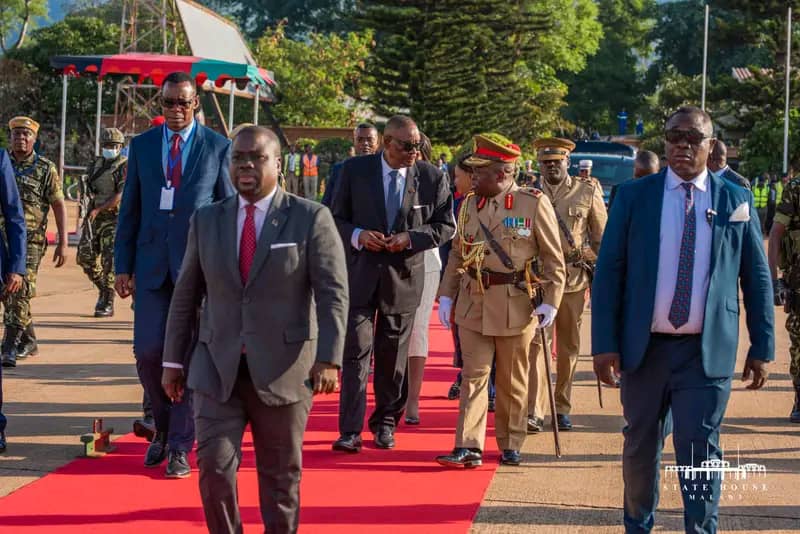
Norman Chisale’s loyalty on full display: Bodyguard keeps word to Mutharika

BLANTYRE-(MaraviPost)-In a striking display of loyalty, Norman Chisale, former head of President Arthur Peter Mutharika’s security detail, was spotted bodyguarding the president at the Malawi Armed Forces College in Salima, despite being replaced by Brigadier Thomas Kwitanda. This comes after Chisale’s bold declaration to protect Mutharika “till death”.

At the commissioning ceremony for 122 Malawi Defence Force officers, Chisale was seen directing security, a role typically reserved for assigned personnel.

This has sparked debate about protocol and potential conflicts of interest, given Chisale’s new role as a Member of Parliament.

Mutharika, who appointed Kwitanda as his new bodyguard, hasn’t publicly addressed Chisale’s actions.

The incident highlights the complexities of loyalty, power, and accountability in Malawi’s political landscape.

Chisale’s presence underscores the strong bond between him and Mutharika, with some critics arguing it blurs lines between personal loyalty and official duty.

As investigations into Chisale’s activities continue, his commitment to Mutharika’s safety remains unshaken.


Discover more from The Maravi Post

Subscribe to get the latest posts sent to your email.

The Maravi Post

Jani Grey Kasunda announces 2030 presidential bid

BLANTYRE-(MaraviPost)-Malawian scholar and political aspirant Jani Grey Kasunda has declared his intention to contest in the 2030 presidential election, pledging to spearhead what he calls a ‘People’s Revolution’ aimed at restoring dignity, economic empowerment, and genuine political participation to the nation’s citizens.

In an interview with Maravi Post, Kasunda described himself as a revolutionary, a nationalist, and a patriot, deeply influenced by indigenous knowledge and the values passed down by Malawi’s ancestors.

He said he is driven by what he termed the ‘systemic betrayal’ of ordinary Malawians.

Kasunda highlighted widespread poverty, high youth unemployment, and the continued struggles of farmers as some of the country’s most pressing challenges.

He expressed belief that these issues have persisted because politicians neglect the people once they assume power.

Said Kasunda:“Over 70 percent of our people live in abject poverty. Our youth are jobless, and farmers remain stranded despite Malawi being an agro-based economy.I have watched politicians use, abuse, and dump Malawians for years. I can’t stand this anymore. I m fighting for the dignity of our people.”

He said his experiences as a journalist, teacher, and public servant at the Parliament of Malawi have shaped his understanding of the country’s structural challenges.

Kasunda said his goal is to place citizens at the centre of governance and ensure that political power truly belongs to the people.

He said he envisions a Malawi free of corruption, hunger, ethnic discrimination, and man-made poverty.

Kasunda said his leadership would work to eliminate social inequalities and guarantee that every Malawian has equal opportunities to contribute to national development.

“I want to change the story of our people. Power belongs to them.My aspiration is to create a Malawi that prioritizes the welfare and dignity of its citizens,” he said.

Kasunda accused past and current leaders of failing to resolve the country’s challenges because they benefit from a disempowered population.

He said his administration would be logical, tactical, and intentional in addressing long-standing issues, focusing on root causes rather than symptoms.

The presidential aspirant said his strategy includes a disciplined and problem-focused approach to economic development.

He emphasized a strict zero-tolerance stance on corruption, with uncompromised lifestyle audits and severe consequences for public officials found abusing office.

Kasunda also outlined plans to overhaul the education system to equip young people for current and future demands.

Additionally, he expressed interest to promote national unity through celebrations of Malawi’s cultural and historical heritage, which he believes will help unlock potential in arts, sports, and innovation.

Kasunda express belief that he has the unique blend of grassroots understanding, professional experience, and genuine love for the country that distinguishes him from other candidates.

“I am the only leader who knows who and what it means to be Malawian.I have a clean record, a strong mind to make tough decisions, and a heart dedicated to our people’s well-being,” he said.

He promised to end what he described as a long-standing ‘cycle of betrayal’ and asserts that corruption will have no place in his government.

Kasunda urged Malawians to recognize their power in determining the future of their nation.

“The power to change Malawi does not lie with the person eating our taxes at Kamuzu Palace; it lies with the people,” he said.

He encouraged citizens tired of political manipulation to join his People’s Revolution.

He described the 2030 elections as a defining moment in which Malawians must choose between genuine freedom and continued oppression under recycled leadership.

Kasunda emphasized the importance of indigenous knowledge in national development.

Using the proverb ‘khoswe sitimuika mu mbiya ya mtedza’ he argued that Malawi has for years entrusted national resources to leaders with a history of mismanaging public funds.

“For how long shall we entrust our taxes, mining contracts, and our children’s future to the same old politicians.The People’s Revolution is here to guard our national coffers with integrity,” he said.

Kasunda concluded by thanking Malawians for the opportunity to share his vision and expressed hope for further engagements as the country moves toward the 2030 election.


Discover more from The Maravi Post

Subscribe to get the latest posts sent to your email.

The Maravi Post