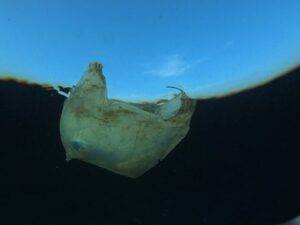
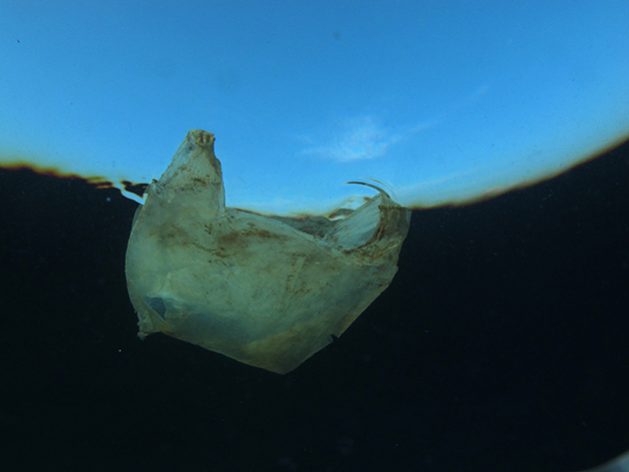
Plastic bags may remain intact for years in the marine environment. Plastic products certified to be industrially compostable are no solution for littering, as they do not degrade efficiently in the environment and continue to pose a threat to wildlife as they break down. Credit: Eleonora de Sabata / Clean Sea LIFE
St David’s, Wales, Jul 1 2021 (IPS) – Documented images of albatross chicks and marine turtles dying slow deaths from eating plastic bags and other waste are being seared into our consciences. And yet our mass pollution of Earth’s seas and oceans, fuelled by single-use plastics and throw-away consumerism, just gets worse.
Plastic debris is estimated to kill more than a million seabirds, 100,000 marine mammals and countless sea turtles every year. Plastics, with all their benefits and promises, have revolutionised societies and economies since their development in the 1950s, but now some 8 million tonnes end up in the oceans every year.
Waste plastic, making up to 80% of all marine debris from surface waters to deep-sea sediments, breaks down into micro-plastics which enter the digestive systems of sea and land animals and humans. Invisible plastic is in the water we drink, the salt we eat and the air we breathe. Experts are still working out the long-term impacts, such as cancer and impaired reproductive systems.
The fishing industry, nautical activities and aquaculture also leave a massive legacy in terms of ocean waste, poisoning and ensnaring sea life.
Hasna Moudud heads a small NGO in Bangladesh, working to protect coastal areas where vast rivers pour into the Indian Ocean, providing livelihoods and food for millions.
Her NGO, Coastal Area Resource Development and Management Association (Cardma), plants coastal trees, protects olive ridley sea turtles in a conservation hatchery in the Bay of Bengal, and helps women in cottage industries, using cane grass to make mats instead of plastic.
“Oceans are always neglected,” she tells IPS. “Small NGOs like myself take risks to save whatever we can of the fragile ecosystem that is left for our future generations.”
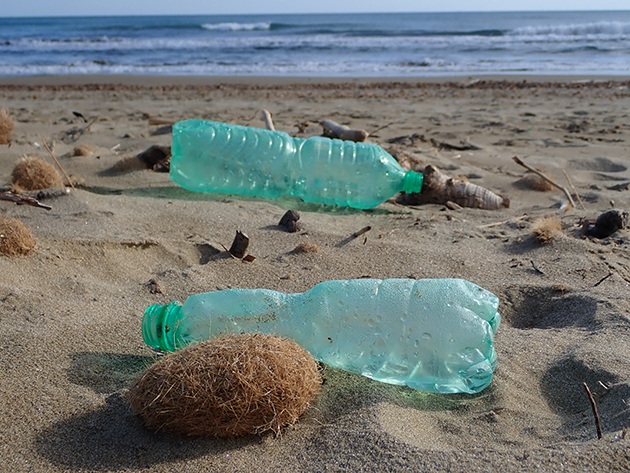
Plastic bottles and bottle caps are among the most frequent items found along Mediterranean shores. Credit: Eleonora de Sabata / Clean Sea LIFE
But to combine her NGO’s efforts with those of others, Moudud says she is “praying” to attend the IUCN World Conservation Congress 2020 in Marseille this September where government, civil society and indigenous peoples’ organisations from around the world will join discussions to set priorities and drive conservation and sustainable development action.
Meeting every four years – with this Congress delayed by the Covid pandemic – member organisations of the International Union for Conservation of Nature, vote on major issues to shape humanity’s response to the planet’s conservation crises. This particular Congress in Marseille is offering both in-person and virtual participation options, allowing those unable to make the trip to Marseille for the full Congress the opportunity to join discussions and provide their feedback.
Moudud’s NGO is a co-sponsor of Congress Motion 022: “Stopping the global plastic pollution crisis in marine environments by 2030.”
The broad resolution goes to the heart of the waste plastics issue. It notes that global production is due to increase by 40% over the next 15 years from current levels of around 300 million tonnes and that the world’s “predominant throwaway model” means that over 75% of the plastics ever produced to date are waste, “notably because the price of plastic on the market does not represent all of the costs of its lifecycle to nature or society”.
Recalling previous international efforts to set goals for ending marine plastic litter, the motion calls on the international community to reach a wide-ranging global agreement to combat marine plastic pollution. This would entail, among other measures, eliminating unnecessary plastic production, in particular single-use plastic waste; recycling and proper prevention of leakage into the environment; and public awareness campaigns.
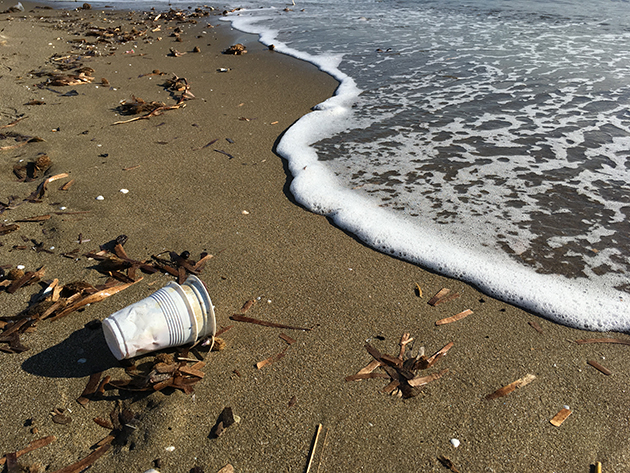
Sunlight, salt and pounding waves grind marine litter down to plastic grains. Credit: Eleonora de Sabata / Clean Sea LIFE
Activists say previous international efforts to curb plastic pollution have been toothless. Moudud is among many who want mandatory and enforceable measures, accusing big business of what she calls “manipulative practices through sponsorship and malpractice without helping build the natural world”.
“No one is looking or holding the polluters responsible,” she says, calling for a toughening up of the resolution. “I am deeply involved in everything IUCN does to help save the natural world and sustainable living.”
Steve Trott, project manager for IUCN-member Watamu Marine Association which is tackling plastic pollution in their Marine Protected Area in Kenya, says Motion 022 clearly sets out the threats posed by plastic waste to marine and coastal environments, economies and human health and well-being.
“Watamu Marine Association and EcoWorld Recycling based on the Kenya coast embrace the IUCN call for action,” Trott told IPS.
Pushing circular economy initiatives, their NGO has created dynamic plastic value chains through partnerships between the hotels industry and local communities, sponsoring beach clean-ups and collecting plastic waste for recycling. This provides a second source of income for community waste collectors while local artists are also up-cycling plastic waste.
Reflecting one of the main themes of IUCN’s membership structure bringing together civil society and indigenous peoples and government authorities, Trott says Watamu is following a “win-win model which can be replicated and up-scaled, sending out an ‘Act Local, Think Global’ message to inspire others”. He hopes to attend the Congress in Marseille if all goes well.
Single Use items are littering the world’s oceans. Credit: Eleonora de Sabata / Clean Sea LIFE
The Plastic Waste Makers index, a study by Australia’s Minderoo Foundation, identifies 20 companies producing more than half of all single-use plastic waste in the world. Some are state-owned and multinational corporations, whose plastic production is financed by major banks. The report notes that nearly 98% of single-use plastic is made from what is called virgin fossil fuels — plastic created without any recycled materials.
Single-use plastics explain why fossil fuel companies are ramping up their production as their two main markets of transport and electricity generation are being decarbonised. By 2050 plastic is expected to account for 5%-10% of global greenhouse gas emissions.
Humankind possesses unprecedented levels of knowledge but also the accompanying responsibility, knowing that oceans are in the poorest health since humans started exploiting them.
Single use plastics – and the estimated 130 million tonnes that are dumped each year around the world – have dominated studies and discussions on waste. Plastic bottles, food containers and wrappers, and single-use bags are the four most widespread items polluting the seas.
One element woven into similar narratives of how to tackle the world’s burning environmental issues – such as carbon emissions, species loss, and plastic waste – is the potential fix offered by technology. Motion 022 refers to the need for more investment in environmentally sound plastic waste collection, recycling and disposal systems as well as forms of recovery.
A study led by biologist Nikoleta Bellou at the Helmholtz-Zentrum Hereon institute focuses on inventive sea-cleaning solutions to date, including floating drones. But her paper suggests that it could take about a century to remove just 5% of plastics currently in the oceans using clean-up devices because plastic production and waste are accumulating so fast.
Activists welcome IUCN’s intervention on plastic waste pollution and the strong mandate a successful and unanimous motion can convey to governments and international institutions. But they also caution against taking too narrow an approach towards tackling marine pollution at the September 3-11 Congress.
Eleonora de Sabata, spokesperson for the Clean Sea Life project, co-funded by the European Union’s LIFE programme, told IPS that the narrative needs to shift away from single-use plastic to single-use everything. “Technology” has come up with so-called ‘bio’ plastics as a replacement for some plastics but only to create a whole suite of problems of their own.
“It’s the throwaway culture that creates problems, whether plastic or not. Green washing and sloppy leadership are filling our world of single use,” she argues. Washing our consciences by simply substituting single-use plastics with other single-use items, such as supposedly biodegradable bags and cutlery, are not the answer.
ROME, Jan 11 2021 (IPS) – For 2021, Italy has been given chairmanship of the Group of 20, which brings together the world’s 20 most important countries. On paper, they represent 60% of the world’s population and 80% of its Gross Domestic Product (GDP). While the shaky Italian government will somehow perform this task (in the general indifference of the political system), the fact remains that this apparently prestigious position is in fact very deceiving: the G20 is now a very weak institution that brings no kudos to the rotating chairman. Besides, it is actually the institution which bears the greatest part of responsibility for the decline of the UN as the body responsible for global governance, a task that the G20 has very seldom been able to face up to.
Roberto Savio
Let us reconstruct how we arrive at the creation of the G20. It is a long story, that begins in 1975, when France invited the representatives of Germany, Italy, Japan, the United Kingdom and the United States, leading to the name Group of Six, or G6. The idea was to create a space where to discuss the international situation, not for decision making. Then it became the Group of Seven, with the addition of Canada in 1997. Russia was added in 1998, so the summit became known as the G8. And then, in 1980, the European Union was invited as a “nonenumerated participant”. In 2005 the UK government initiated the practice of inviting five leading emergency markets – Brazil, China, India, Mexico and South Africa. Finally, in Washington, in 2005, the world leaders from the group recognized the growth of more emerging countries, and they decided that a meeting of the 20 most important countries of the world would replace the G8 and become the G20.
At the meetings the United Nations, the European Union, and the major international monetary and financial institutions are also invited. Spain is a permanent invitee, together with leaders of the Asian, African Union, of the New Partnership for Africa’s Development, the Financial Stability Board, the International Labor Organization, the International Monetary Fund, the Organization for Economic Cooperation and Development, the World Bank Group, and the World Trade Organization.
Plus. The host country can invite some countries that it feels particularly associated with its foreign policy, at its year of presidency. Until now, 38 countries have been invited, from Azerbaijan to Chad, from Denmark to Laos, from Sweden to Zimbabwe. To complete, it is important to mention that Russia was suspended by the G8 in 2014, because of its annexation of Crimea. And was never readmitted. Trump, in his inexplicable deference to Putin, asked for its readmission to the G8, and this was refused by the other countries. The G7 has kept meeting, as “a steering group of the West”. At the same time, the G20 meets regularly, with Russia as part of his members.
So, Italy has the task to invite all those different actors, establish the agenda and planning and hosting a series of ministerial-level meetings, leading up to summit of head of governments. Italy has decided as agenda “The three P”: People, Planet and Prosperity. This imaginative and original agenda will be structured in 10 specialized meetings, like Finance (Venice July 9-10th); Innovation and Research (Trieste Aug. 5-8th); Environment, Climate, Energy (Naples, July 22nd), just to give a few examples. Beside these 10 specialized meetings, there will be 8 “engagement’s groups”, which will go from business to civil society, youth, etc.
The G20 is formed by countries that are involved in different and often contradictory groups. For instance, after Trump killed the TTP, (the Transatlantic Pacific Partnership), that Obama was able to put together excluding China, with a vast range of counters going from Australia to Mexico, from Canada to Malaysia, China was able to reciprocate, and crate the Regional Comprehensive Economic Partnership, which puts together the same countries plus some others and leave outside completely the United States. This commercial bloc is the largest ever created and has 30% of the world’s population, and 30% of the world GDP. But the European Union, (to which Italy belongs) has explicitly taken a path of European nationalism, to make the EU able to survive in the coming competition between China and the United States. European Union (and therefore Italy) are also members of NATO, where the United States is the indispensable and fundamental partner. And in the G20 China seats with India, which is the only country that has refused to join RCEP, and who is clearly taking an alternative path to China’s expansion in Asia. But this is also Japan’s policy, who is very active in G7, in the G20, and has entered RCEP, and considers, like South Korea, a priority to limit the Chinese expansionism.
Of course, there are a number of other pacts, agreements, treaties and alliances, that would be now boring and useless to enumerate. One country, like Italy, would therefore wear several hats at the same time. The point to make is, that since the arrival of Ronald Reagan as President of the United States in 1981, the multilateral system started to be under attack. Reagan, in Cancun’s Summit for the North-South dialogue, a few months after his election, questioned the idea of democracy and participation as the basis for international relations. Until then, the General Assembly resolutions were considered the basis for global governance. In 1973, the GA passed unanimously a resolution, calling for the reduction of the economic gap between the North and the South of the world, calling rich countries to their duties to establish a New International Economic Order, more just and based on the faster development of the poorer countries. Reagan denounced this as an anti-American maneuver. The US is not the same as Montecarlo, as he famously said (probably he intended Monaco, as Montecarlo is no state), and yet they have a vote each. So, this democracy coming from the UN, was in fact a straitjacket, and the US would proceed on the basis of bilateral relations, and not to be strained by multilateral mechanisms. Reagan was the first to talk of America first, He, together with Margaret Thatcher in Europe, dismantled all the social progress made in the world after the end of the Second World War. The market, with his invisible hand, would be the sole engine of society (that Thatcher said does not exist, only individuals). The State, that he called “the beast”, was the first enemy of the citizen. He declared: the most terrifying words in English are: I am from the Government, and I am here to help”. Any public or social cost was just a brake to the market. Reagan wanted to privatize even the ministry of Education: he and Thatcher left UNESCO, as a symbol of disengagement from the UN. Both he and Thatcher curtailed trade unions, privatized whatever possible, and started the era of neoliberal globalization, whose effect is now widely evident, and that Trump, Bolsonaro and Co. bless every day, because it has created a very large swath of disaffected citizens, who believe they will readdress their destiny.
Is important to note that Reagan did not have any real opposition, from the other rich countries. So, all this fragmentation of the world, with the creation of G7, G8, G20, and other exclusive clubs, was not an exclusive responsibility of Reagan and Thatcher. For forty years, the process of divesting the UN from its responsibility for the world’s peace, development, and democracy went on. Neoliberal globalization was based on finance and trade. Even before the end of the war, finance was delegated to the System of Bretton Wood, by the name of the site where it was founded. Let us just constate a fact: the Financial System was established in a such way, that Finance is the only sector of human activity that has no regulatory body. Today it has clearly separated by the general economy when its original function was to be at its service. And political institutions are not able to control its global structure.
The other engine of globalization was trading. United Nations had the UN Commission on Trade and Development, UNCTAD, which looked to trade as an instrument of development. The creation in 1995 of the World Trade Organization, as an independent organization, envisaging trade as an economic engine, divested the UN from trade too. And more the UN weakens, the easier is to decry its shortcomings.
The stroke of grace to multilateralism has been the arrival of Trump, the heir and an updated version of Ronald Reagan. But with a totally different agenda and vision. His basic idea is not “America First”, but “America Alone”. He pushes Regan’s idea of bilateralism versus multilateralism to the extreme of ignoring the concept of alliances. So, he declared, Europe is even worse than China. But there is a fundamental difference between them: Trump never pretended to be the President of all Americans. On the contrary, he tried immediately to divide and polarize the United States, and he leaves as a legacy the US that will take a very long time to become again a united and pacified country. And his strategy has been taken by several other leaders, from Bolsonaro to Orban, from Erdogan to Salvini.
It will be, therefore, difficult, for the UN to recover its function of the meeting place, to express plans of global governance, based on democracy and participation. It was a vision based on the lessons learned in the Second World War: let us avoid millions of deaths, terrible destruction, and to do so we need to work together. That lesson has been now forgotten. Just compare the kind of political leaders from that time, and the present one, to see the enormous change. Therefore, the expression of national egoisms will continue, with the richest countries in exclusives clubs, like OECD or the G20.
But there is a problem: those clubs are not efficient, because they gather together countries with very different agendas and priorities. Let us take a good example from the last G20, held last November under the very discredited chairmanship of Saudi Arabia. One of the points was the cancellation of the debt from poor countries, evidently urgent, because of the additional burden of the pandemic that is going to bring disproportionate damage. The Pope, the Secretary-General of the UN, Gutierres, pressed for that decision. All that the G20 was able to do, was to freeze the payment of the interest of the debt, for six months. And here, let us divagate for a useful learning exercise of the Third World Debt, and on the nobility of the rich countries.
If you take a loan that you repay over 20 years at 5%, or a mortgage, of 100, at the end you will have repaid 200. And during the first ten years, all you pay are the interest, and only in the second decade, you start to pay back, progressively, the capital. The result is that the poor countries several times renegotiated their debt and every time what they paid where the interest, to start again. And those interests were cumulative. During that process, they paid several times the amount of the capital that they received. But all that they paid went to the interests… At the university, you learn one good example of the perversity of cumulative interests. The old story is that a Dutch settler, Peter Minuit, bought the island of Manhattan from the Algonquin tribe. The price paid was $24 worth of beads, trinkets, a jar of Mayonnaise, two pairs of wooden clogs, a loaf of wonder bread and a carton of Quaker oats. If that amount was put in a loan at 5%with composite interest, it would be by now more than the estimated value of all of Manhattan, which exceeds three trillion dollars. So, the decision of the G20 to freeze interests for six months, amount to nothing. It is interesting to listen to insiders’ voices. The loans of the rich countries are computed in the DAC, Development Assistance Committee, established by OECD (the organizations that gathers all rich countries). The OECD engaged itself, in the old good day of multilateralism, to dedicated 1% of the members’ GDP to the development of the underdeveloped countries. This engagement was never kept, except for the Nordic Countries and Nederland. The US never went over 0,3%. Anyhow, any debt condonation goes into the official statistics of the DAC committee. But new loans are made, by countries that are not in the DAC committee, like China, which has made a very extensive number of loans, especially in Asia and Africa in not public conditions. For the OECD countries (basically the West), to cancel their loans could mean to unleash resources that could go to pay China loans, becoming so China funders. This is a good example of how competing interests, block the G20 from concerted actions.
Decisions on this issue are now expected from the next G20 Summit in Rome, in November. But before, the Global Health Summit, called from the G20 together with the EU in May, will be the occasion to verify what will happen. with vaccinations. But in the same month, Portugal has called for the very important Social Summit of the European Union. Portugal has taken the much more substantial chairmanship of the EU, and this is a very positive contribution to a positive 2021. Portugal is today probably the most civilized country of Europe, a place of tolerance, harmony and civic engagement, much like Sweden in the 80s. And is the only credible country on the issue of immigration. In the Social Summit Lisbon will push to strengthen social Europe, after so many decades of a solely economic Europe. The outgoing German chairmanship was fundamental in abandoning the austerity dogma and move to an unprecedented plan of solidarity and institutional strengthening, made also possible by the blessed departure of England, and its anti-European historical bias. The fact that vaccination is a European plan, and not a hotchpotch of national attempts, is great progress in term of vaccination. And if it will continue on the same path, on the issue of climate control, and technological development, it will recover much trust from the citizens, who felt Brussels an unaccountable institution, far from their priorities. Now the EU deals with unemployment, with the economic and social disaster brought by the virus. It is a tribute to the virtues of multilateralism, solidarity and development. And Portugal will try to complete what the German Presidency was unable to conclude.
But if we look to the obvious need for a world’s vaccination, the reality is much dimmer. Until now the rich countries have bought as many as possible vaccines. f. Europe, with 13% of the world population, has bought 51% of the total production. Israel is a case study. With a population of 9 million people, highly registered and organized in the health system, Netanyahu (who will do everything to stay in power), has bought the vaccines at an extra cost but is fast reaching all the population. Certainly, this cannot be the case of India, with nearly 1.4 billion people, and a very primitive system of health… Even the Pope has launched an appeal for distributing a free vaccine in the poor countries, and India and South Africa (which are a member of the G20), have asked the General Assembly of the World Health Organization for free distribution in poor countries. There has been strong opposition from the rich countries, that have financed at the tune of 10 billion dollars the development of the Pfizer and Moderna vaccines, which now they buy at market prices, several times higher than those of AstraZeneca… And then those two vaccines use a new technology, whose side effects are still unknown, unlike AstraZeneca, which uses a well-experimented technique.
But even if we take the cheaper vaccines, there is a very basic issue: under which ethical and human logic, patents and money can be made over public goods, as the Pope has repeatedly asked? The patent industry has been patenting seeds, rice, plants, which have been existing for hundreds of years, and those new peasants cannot use them without paying a royalty to the company who patented them. And then the pharmaceuticals tried to patent, parts of the human body… Citizens from several parts of the world have been setting up an association, Agorà for Humankind, that is conducting a campaign, for the elimination of patents and profits over public goods, as they belong to humankind. Also, an international alliance has been set up between the public and private sectors, the General Alliance for Vaccine Initiative, GAVI, which has the task to finance vaccination in 93 middle and poor countries. But funding is still far from coming. As things are now, at the end of 2021, only 30% of humankind will be vaccinated, basically from rich countries.
Yet, if there is something that should make all of us aware that we are in the same boat, is this pandemic. Until at least 70% of all humans will be vaccinated, the virus will continue to strike and kill. The British mutation, much more contagious, is a good example. The country with more cases is now Spain, which has no physical contact with the UK. But it went to Gibraltar, the British colony since 1713 in the South of Spain. And from there spread to the surrounding Spanish villages and towns. Did the realization that viruses does not know borders help to make the new treaty for relations between Gibraltar and Spain? The answer is not really: it is trade. Yet, it does not require a virologist to assume that trade spreads the virus…
So, after this long ride among different subjects, its thread should be clear. We have gone from an era when the lessons of the Second World War created a generation of politicians who made of peace and development the common ground for international relations, even during a very dangerous Cold War. Would Trump, Johnson and Putin be at Yalta, instead of Roosevelt, Churchill and Stalin, the outcome would have been very different. Most probably, we would have had no United Nations, no international organizations. Just think that the US, to push for the creation of the UN, agreed in its founding engagement, to pay 25% of its costs.
Then, beginning with Reagan and Thatcher, a profound change came. The interests of my country are more important than international cooperation, and the stronger I am, the more so. Multilateralism, cooperation, went under attack, and so the role of the State, its function of guarantor of social progress, equity and participation. Other organizations started to sprout, and weaken the UN, and the instruments of a social pact, like trade unions. From the spirit of the fall if the Berlin’ Wall, in 1989, a number of clubs of rich countries, like the G7, the G8, the G20, started to substitute the UN, and private clubs, like the World Economic Forum of Davos, attracted more important personalities than the General Assembly of the United Nations.
We are now in a third phase, whose symbol abounds: nationalism, xenophobia, and the illusion that sovereignty is more important than cooperation. Brexit is a notable example. But Trump sets up an unprecedented level of legitimacy to what was once considered the betrayal of civism and democracy: exploit and exasperate the divides of a country, racial, cultural, gender, and run without any compliance to rules and traditions. He is accompanied by a variegated assortment of autocratic, populist, and narcists kind of new political generation: Bolsonaro, Orban, Kacynski, Putin, Modi, Sissi, Nehayanu, Duterte, just to cite the most known, while others, like Salvini, are poised to take the power. The virus, instead of uniting citizens, has further divided them. To wear the mask, is a left-wing declaration, like to worry about the climate, which is a survival’ concern. Military expenses are on a continuous increase. In 2019 they have reached an unprecedented amount of 1917 billion dollars. Enough to solve all problems of food, health and education worldwide. The UN is still the only organization able to provide the world with plans of global significance. Its Agenda 2030 gives a plan for the solution of our most significant problems. It costs a fraction of the military expenses. The G20 has paid some lip services, to Agenda 30, but never anything significant. The new generations of politicians are under general scrutiny, and it is not positive at all… I would say that is representative of our crisis, books still get published on a world of conspiracy, like that the virus is used by Bill Gates to inoculate nanoparticles that will make it possible to control all human bodies, Or myths like the one on Bilderberg Club, one of the private’s clubs meeting, as the place where decisions are taken by a small elite on how to run the world. This, when more than ever is clear that the system has lost its compass, and even the tragedy of climate and soon two million deaths are not able to bring back cooperation and multilateralism… but the explosions of conspiracies is a good sign of the decline of democracy…
So, Italy enters now the chairmanship of the G20. It is a position without any significant weight, with the task to realize a coming Summit, of the head of States, from which nobody expects much. If Trump’s defeat has any significant meaning, by November the political situation could have improved, but we will have a Germany without Merkel, probably more nationalist, and the miraculous social engagement of the European Union, could come to a halt. Italy has a very fragile government, and the dubious distinction of having a very young minister of Foreign Affairs, whose only working experience was to be a steward at Naples’ stadium. On the Health Summit, he does not look particularly commanding respect and authority. This will be Italy’s first test. In May, it will be clear that without vaccination in the world, rich countries will not be out of danger. It should be easy to rally the 20 most important countries of the world, which include India and South Africa, to such obvious actions. But in those times, where interests and selfishness are the reality, it is legitimate to nourish many doubts… Anyhow, if 2021 will not be a year of regeneration and creation, we will be on an irreversible slipping decline… time is running out…
But it looks now like the solution to the problems is beyond the reach of the system…
Publisher of OtherNews, Italian-Argentine Roberto Savio is an economist, journalist, communication expert, political commentator, activist for social and climate justice and advocate of an anti-neoliberal global governance. Director for international relations of the European Center for Peace and Development. Adviser to INPS-IDN and to the Global Cooperation Council. He is co-founder of Inter Press Service (IPS) news agency and its President Emeritus.
SYDNEY and KUALA LUMPUR, Jun 30 2020 (IPS) – Seventy-five years ago, on 26 June 1945, before the Japanese surrender ending the Second World War, fifty nations gathered at San Francisco’s Opera House to sign the United Nations (UN) Charter.
UN Charter Nations pledged “to practice tolerance and live together in peace …, and to ensure … that armed force shall not be used, save in the common interest, and to employ international machinery for the promotion of the economic and social advancement of all peoples”.
Anis Chowdhury
They sought “to save succeeding generations from the scourge of war, … and to reaffirm faith in fundamental human rights, in the dignity and worth of the human person, in the equal rights of men and women and of nations large and small, and to … promote social progress and better standards of life in larger freedom”.
The Charter’s contents reflected some contradictions inherent in framing an international organization recognizing national sovereignty as its organizing principle, and various other compromises, often influenced by the convening host nation.
Although the conduct of Member States often falls short of the UN’s lofty goals, its Charter was nonetheless a monumental achievement, providing the foundation for a rules-based international order.
San Francisco Conference Forty-six Allied countries, including the four sponsors – the United States, the United Kingdom, the Soviet Union and China – were originally invited to the San Francisco Conference.
The conference itself invited four other States – the Byelorussian and Ukrainian Soviet Socialist Republics, newly-liberated Denmark and Argentina. Poland did not send a representative as its new government was still uncertain.
Of the fifty participating states, only four were African and nine Asian. Latin American countries, independent since the mid-19th century, were present and active in deliberations.
The Conference was not only one of the most significant international gatherings in history, but perhaps the longest ever. The two month long Conference was attended by 3,500 people, including 850 delegates, their advisers, staff and the secretariat, plus more than 2,500 from the media and other observers.
Jomo Kwame Sundaram
The Conference opened on April 25, 1945 with great fanfare, despite the sudden death of its principal architect and presumed host, US President Franklin Delano Roosevelt, on 12 April. The task of carrying on fell to his Vice-President Harry Truman who had become President.
Truman often quoted English poet Alfred Lord Tennyson’s Locksley Hall, carried in his wallet, bewildering colleagues, senators and staffers who doubted his commitment to international peace. Tennyson foresaw that nations, realizing they could destroy one another, might agree to form “the Parliament of Man”, to resolve disputes peacefully.
Clashes and compromises Many serious differences of opinion triggered crises, even at the preparatory stage. For example, the Soviet Union proposed that all 16 Soviet republics should have UN membership to balance the influence of US allies: the US countered by proposing membership for all its 50 states!
A compromise was struck, allowing membership for the Soviet republics of Belarus and Ukraine; the Soviet Union then withdrew its opposition to Argentina, which had supported the Axis powers.
The most important deliberations concerned the UN Security Council (UNSC), initially composed of five permanent members (US, UK, USSR, China, France) and six elected members. The P5’s right to veto provoked a long and heated debate.
Others feared that when one of the P5 threatens the peace, the UNSC would be ineffectual. But the P5 collectively insisted that as the main responsibility for maintaining world peace would fall most heavily on them, the veto provision was vital.
Australia proposed that no permanent member should be allowed to veto when involved in a Chapter VII dispute over threats to peace. The US delegation blocked this and a Soviet proposal allowing P5 vetoes on procedural matters, e.g., discussion of disputes in which it may be involved.
While US officials saw the UN General Assembly (UNGA) primarily as a ‘talk shop’, the USSR tried to limit it from discussing sensitive political matters. However, recognizing its importance for legitimacy, the compromise reached permits the UNGA to discuss any issues “within the scope of the Charter”.
Colonialism was not supposed to be discussed at the Conference to avoid alienating the European imperial powers, whom the US needed to isolate the Soviet Union. But the handful of Asian and African countries attending wanted countries still under the colonial yoke to attain freedom and independence as soon as possible.
Although not on the original Conference agenda, after much debate, Chapters XI, XII and XIII provided some norms for colonial administration and pathways for decolonization. Nonetheless, these ambiguous, at best, pronouncements greatly disappointed anti-colonialists around the world.
US hegemonic from outset Despite some compromises inherent in framing such an agreement, the UN Charter favoured the US. It promised to protect freedom of action and national sovereignty, as desired by the US, but contained no open-ended commitment to preserve other countries’ territorial integrity, like the League of Nations Covenant’s Article 10.
Article 2(7) placated American sovereigntists and nationalists, declaring: “Nothing contained in the present Charter shall authorize the United Nations to intervene in matters essentially within the domestic jurisdiction of any state.”
The US and the UK also got what they wanted for existing and new regional and plurilateral arrangements, including defence and mutual assistance organizations.
Some US officials were concerned the UN might threaten the Monroe Doctrine privileging the US in the Western hemisphere, while limiting its ability to intervene elsewhere. Some clever drafting of Chapter VIII provided blanket endorsement to regional organizations, also seen as reflecting the principle of subsidiarity.
Article 51 enshrined the principle of “self-defense against armed attack, either individual or collective”. Although not fully appreciated in 1945, such provisions later helped legitimize various US and other post-colonial security pacts in Europe, Asia and the Americas against the Soviet Union during the Cold War.
Conference participants also considered a proposal for compulsory jurisdiction for a World Court, but the US Secretary of State recognized this would jeopardize Senate ratification. Delegates compromised, agreeing to let countries decide whether to accept the International Court of Justice (ICJ)’s jurisdiction.
Unsurprisingly, the US has had an uneasy relationship with the ICJ from the outset, never submitting to its authority, and reacting negatively to Court decisions seen as adverse to the US.
From Truman to Trump Presiding at the closing ceremony, Truman cautioned that the success of the new world body would depend on collective self-restraint. “We all have to recognize – no matter how great our strength – that we must deny ourselves the license to do as we please. This is the price each nation will have to pay for world peace.”
Truman is probably turning in his grave watching Trump’s jingoist ‘America First’ policy undermine the UN and multilateralism. Are multilateralism and the UN now doomed as Trump belies Tennyson’s hope and leads the US to up-end the Roosevelt-Truman legacy?
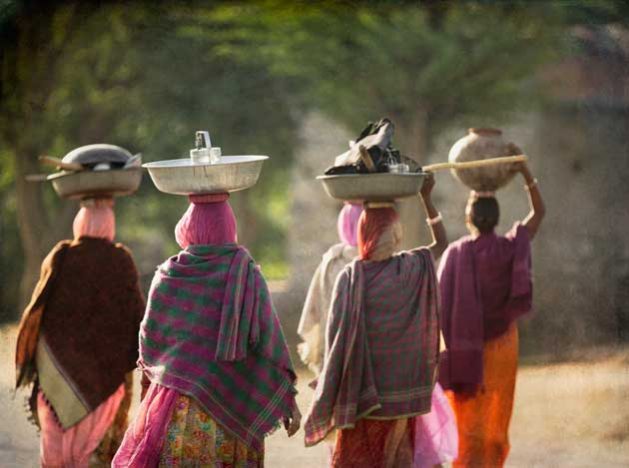
Women bear the brunt of climate change disasters. Credit: Women Deliver
NEW YORK, Mar 31 2020 (IPS) – Vanessa Nakate of Uganda may have been cropped out of a photograph taken at the World Economic Forum, but she along with Swedish activist Greta Thunberg have made the climate crisis centre stage.
Women Deliver Young Leader Jyotir Nisha discusses with Costa Rican President Carlos Alvarado Quesada on how to harness young people to overcome gender inequality and address climate change in a recent wide-ranging interview.
Quesada says key strategies to designing policy to fight climate change require unconventional decision-making to address challenges like climate change, biodiversity loss, the fourth industrial revolution, and inequality.
“These are intertwined factors that can hinder development if unattended but, if tackled, they could potentially accelerate progress and wellbeing for all,” he says.
“And, of course, this is a task that young leaders are able to handle and produce the timely answers that are necessary.”
Bringing in her experience in the non-profit sector, Nisha says training girls and women in up-cycling plastic waste to produce handmade goods has assisted them to contribute to their family income and their empowerment in the community. The question is, how can this be broadened.
Quesada says women, in particular young women, are leading the way.
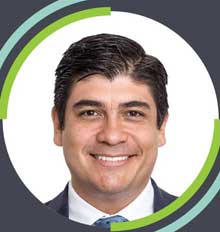
Costa Rican President Carlos Alvarado Quesada. Credit: Women Deliver
“From cooperative seed banks, to early warning networks, from solar engineers to women politicians carving a path of sustainable policymaking. They are at the forefront of forest conservation, sustainable use of resources, and community enhancement, and restoration of landscapes and forest ecosystems,” he says.
However, women’s roles are often underestimated, unrecognised, and unpaid.
“Women and girls with access to technology have already begun developing innovative tools to reduce emissions by targeting sustainable consumption and production practices, including food waste, community waste management, energy efficiency, and sustainable fashion.”
The solutions exist, but much more is needed.
“It takes a whole-of-society approach for collaboration and cooperation on a bigger and enhanced scale.”
The President suggests that the way investments are made could be fundamental to ensure a flow of finance to the communities, including women, and youth. This will, he believes, provide “a stable source of funding for businesses and services that contribute to the solution of social or environmental challenges.”
The impact of this will be partnerships between traditional sources of finance, like international cooperation and development banks, and new partners, like philanthropy, hedge funds, or pension funds.
“And what better than young people giving the thrust that all this requires?”
Nisha says she was pleased to see the massive mobilisation of young people at the inaugural Climate Action Summit last year. The summit had little good news for climate change with concerns raised that the accelerating rise in sea level, melting ice would have on socio-economic development, health, displacement, food security and ecosystems. However, beyond taking to the streets, they also need to hold decision-makers accountable.
“In the last months we have witnessed the irruption of massive mobilisations in different parts of the world, lead mostly by young people. This would seem surprising for a generation that has been accused several times of passivity, indifference, and individualism,” Quesada says. “I truly believe that, as long as these demands are channelled through democratic and pacifist means, they are extremely important to set a bar and a standard of responsibility for us, decision-makers — who are, by the way, more and more often, young people.”
He adds that world leaders owe them explanations of the decisions made.
“We must also have the wisdom to pay attention to these demands and take into account their opinions and proposals to reach agreements that have the legitimacy of consensus-building.”
However, Nisha notes, while campaigns like the Deliver for Good campaign is working across sectors reports at COP25, and the recent World Economic Forum (Davos), “climate change continues to threaten progress made toward gender equality across every measure of development.”
At WEF Global Gender Gap Report 2020 showed that it would take more than a lifetime, 99.5 years in 2019 for gender parity across health, education, work and politics to be achieved.
Quesada says the climate catastrophe “demands that policymakers and practitioners renew commitments to sustainable development — at the heart of which is, and must continue to be, advancing gender equality and women’s empowerment, and realising women’s rights as a pre-requisite for sustainable development.”
Costa Rica, he says, has been recognised internationally on two significant areas: the respect of human rights and environmental protection.
“The present Administration has taken these objectives a step further by paying particular attention to women’s rights, inclusion, and diversity, and including them as part of our core policy principles and our everyday practices,” he says. “We expect to increase women’s integration into productive processes and achieve women’s economic empowerment through specific policies linked to our long-term development strategy — the Decarbonization Plan — allowing the transformational changes our society needs.
However, the critical question, Nisha says, is: “What can world leaders and governments do today to ensure young people have a seat at the decision-making table?”
Quesada is confident that young people will be part of the solution.
“The challenges we are facing today are unprecedented precisely because previous generations did not have to face situations such as biodiversity loss, global warming, or the emergence of artificial intelligence and technology. Thus, we need new answers and solutions from Twenty-First Century people, and those should and will be put forward by the youth,” he says.
The importance of youth involvement was recently highlighted too at the meeting of African Leaders for Nutrition in Addis Ababa. African Development Bank (AfDB) President Akinwumi Adesina said Africa should invest in skills development for the youth so the continent’s entrepreneurs can leverage emerging technologies to transform Africa’s food system to generate new jobs. This is especially urgent as the population on the continent is expected to double to 2.5 billion people in 40 years putting pressure on governments to deliver more food and jobs in addition to better livelihoods.
In a recent interview with IPS International Institute for Tropical Agriculture (IITA) Director General, Nteranya Sanginga, explained that this change is neither easy or necessarily something all leadership has taken on board.
“Our legacy is starting a programme to change the mindset of the youth in agriculture. Unfortunately (with) our governments that is where you have to go and change mindsets completely. Most probably 90 per cent of our leaders consider agriculture as a social activity basically for them its (seen as a) pain, penury. They proclaim that agriculture is a priority in resolving our problems, but we are not investing in it. We need that mindset completely changed.”
Quesada is unequivocal that this attitude needs to change.
“My advice to world leaders is to have the humility to listen to the people and to allow more inclusive and participatory decision-making. And to the young people, I can only encourage them to own their future, and to act accordingly, with vision, courage, and determination.”
Experts from around the world to discuss factors behind the crisis and the steps needed to mitigate its negative effects worldwide
ABU DHABI, Mar 26 2020 – TRENDS Research & Advisory is organizing its first-ever E-Symposium to discuss the global impacts of the COVID-19 crisis and offer insights on the steps needed to mitigate its negative effects worldwide. This will be the first online symposium of its kind to be organized since the outbreak of the coronavirus in the Gulf and Middle East region.
To be held on March 31, 2020, at 7 pm UAE time, the E-Symposium – Confronting the Challenges of COVID-19: A New Global Outlook – will provide a unique and innovative online platform for international experts covering medical, geostrategic and economic perspectives.
Panelists will offer insights on the factors behind the emergence of the crisis and will also include a special perspective on how China coped with the initial outbreak of the pandemic and adopted measures and solutions that could offer valuable lessons for other countries.
Dr. Mohamed Al-Ali, the Director General of TRENDS Research & Advisory lauded the Center and its staff for their contributions under these exceptional circumstances. “Harnessing modern technology to hold this E-Symposium will feed into the Center’s ambitious goals of strengthening scientific research and providing policy and decision-makers in the region and around the world,” he said.
The Director General said that ideas and recommendations are needed to deal with the challenge of Covid-19, which has become an existential threat to humanity. Dr. Muhammad Al-Ali expressed his confidence that this international E-Symposium, the first of its kind in the Middle East, will come up with recommendations that enhance the current regional and international efforts to curb the rapid spread of this pandemic.
“The pandemic has so far claimed the lives of more than 12,000 people and infected more than 300,000, in addition to having a calamitous economic and strategic impact on the entire world. Nearly 600 million people in around 22 countries are under forced social quarantine and 400 million under curfew,” he said.
Dr. Mohamed Al-Ali said that think-tanks and research institutes should play their role in supporting governments and countries in today’s circumstances so that we collectively stop this human tragedy by providing workable ideas, recommendations, and solutions.
With the COVID-19 crisis representing a historical milestone for the global community, this symposium performs a critical function in helping its participants identify the continuities and changes expected in the months and years to come.
Due to the recent precautionary measures to combat the spread of the COVID19 taken by the Italian government, which will affect the movement of people in the whole country in the coming weeks, Seeds&Chips cannot take place as scheduled on May 18-20, 2020.
MILAN, Italy, Mar 12 2020 – In light of the ongoing public health emergency and in observance of the decree signed by the Italian Prime Minister, Giuseppe Conte, on Monday, March 9th – enacting forced quarantine for the whole Italian country, while banning all public events until April, 3 – we have taken the tough decision to postpone the Sixth Edition of Seeds&Chips – The Global Food Innovation Summit which would have been taking place on May 18-20, 2020 at MiCo, Milano Congressi.
“This is an announcement that we would never have wished to write but, sadly, as a consequence of the ongoing public health risks caused by COVID19 and according to what is laid down in decree of The Presidency of the Council of Ministers, on March 9th, 2020 – imposing restrictions on people’s movements and banning all public events and initiatives to prevent the outbreak of the COVID2019 – we have decided to postpone our Summit” said Marco Gualtieri, Founder of Seeds&Chips.
As an organization working tirelessly to advance sustainable, healthy and prosperous societies around the world, the safety of all attendees, speakers, startups, companies and everyone else involved, is and must remain our top priority at the basis of our decision.
We are a global community of ChangeMakers, growing up in a fast-changing, complex and unpredictable world. This has allowed us to overcome all difficult challenges we meet on our way.
“The scenario has changed significantly over the past two weeks. Until the end of last week, we were cautiously optimistic that the Summit would go ahead, as planned. The rapid deteriorating public health situation in Italy, in particular in Milan and in our Region, has obliged us to concretely think about an alternative plan” Marco Gualtieri added.
“We would like to take this opportunity to thank all the people who are working at Seeds&Chips to make our Summit possible every year, all moderators and speakers who put together their sessions with us, all attendees, journalists, sponsors and partners who have been with us to craft our event and helped us grow in the last years”.
Today is a sad day for Seeds&Chips – The Global Food Innovation Summit – Milan Edition, but we hope to be back soon with good news. In fact, we are evaluating the opportunity of the upcoming pre-COP26 in Milan at the end of September, to build a new exciting event, filled, as usual, with creativity, innovation and great passion.
***
Seeds&Chips – The Global Food Innovation Summit, founded by entrepreneur Marco Gualtieri, is the world’s flagship food innovation event. An exceptional platform to promote technologically advanced solutions and talents from all over the world. An exhibition area and conference schedule to present, tell and discuss themes, models and innovations that are changing the way food is produced, transformed, distributed, consumed and talked about.