Thailand’s ‘Humanitarian Corridor’ for Myanmar Faces Pushback

Armed Conflicts, Asia-Pacific, Civil Society, Development & Aid, Editors’ Choice, Featured, Headlines, Human Rights, Humanitarian Emergencies, Migration & Refugees, Sustainable Development Goals, TerraViva United Nations

Migration & Refugees

A Myanmar girl, displaced by war, sells cigarettes through the razor-wired border with Thailand near the frontier town of Mae Sot. Thailand is bracing for another influx of refugees. Credit: William Webb/lPS

A Myanmar girl, displaced by war, sells cigarettes through the razor-wired border with Thailand near the frontier town of Mae Sot. Thailand is bracing for another influx of refugees. Credit: William Webb/lPS

MAE SOT, Thailand, Mar 13 2024 (IPS) – The Maung family is rebuilding their lives in a foreign land. A freshly painted signboard with a play on the word Revolution declares their small restaurant is open for business, and breakfast features traditional Myanmar mohinga—rice noodles and fish soup.


Three years ago, the family of four was prospering in the central Myanmar city of Mandalay but suddenly everything changed. The military seized back power from the newly elected government, and thousands of people took to the streets in protest, including the Maungs. A brutal crackdown ensued across Myanmar, the father was arrested and their two restaurants seized.

Since the 2021 coup, the UN estimates some 2.4 million more people have been displaced by conflict across Myanmar, while 78,000 civilian properties, including homes, hospitals, schools, and places of worship, have been burnt or destroyed by the military.

The Maung family was wise to leave Myanmar when they could, and fortunate to survive the hazardous journey eastwards towards the border with Thailand. After spending a year in a border camp for IDPs run by the military wing of the Karen National Union (KNU) in eastern Kayin State, the family managed to cross into the Thai frontier town of Mae Sot to start afresh, even if they exist in a grey zone of legality alongside tens of thousands of others.

More waves of refugees are following in their footsteps.

“We have 750,000 IDPs in our territory,” said a senior official of the KNU, which has been waging the world’s longest civil war against successive Myanmar regimes since 1949. “A year ago, there were 500,000 to 600,000. Numbers are rising because the military is deliberately targeting civilians,” he told IPS in Mae Sot, asking not to be named.

Myanmar refugees in Thailand pick out clothes piled in the street that have been donated in the border town of Mae Sot. Credit: William Webb/IPS

Myanmar refugees in Thailand pick out clothes piled in the street that have been donated in the border town of Mae Sot. Credit: William Webb/IPS

Against this background and wanting to preempt an influx, Thailand’s new coalition government announced its intention last month to open up a ‘humanitarian corridor’ into Myanmar to funnel aid to IDPs and keep them well away from the border.

Thailand’s military—the real arbiter of power in these border regions and holding sway over two parties in the coalition—is haunted by the spectre of past and present examples of chaos through conflict. In the 1980s, Thailand reluctantly hosted several hundred thousand Cambodian refugees, including remnants of the genocidal Khmer Rouge regime, on its eastern borders. Today it looks west and sees Bangladesh struggling to contain in camps some one million Rohingya refugees forced out of Myanmar in what the UN special rapporteur on human rights called a genocidal campaign by the Myanmar military.

But beyond the ‘humanitarian’ aspect, what has caused anger within the various groups fighting the Myanmar military as well as rights activists, is Thailand’s own admission that its humanitarian corridor proposal is aimed at drawing the regime’s State Administration Council (SAC) into a dialogue that would lead to a negotiated settlement with Myanmar’s diverse resistance forces.

Neither the KNU nor the parallel National Unity Government set up by ousted Myanmar lawmakers after the coup were consulted by Thailand, which received a green light from the Association of Southeast Asian Nations (ASEAN).

Under Thailand’s initiative, aid would be delivered initially to 20,000 IDPs by the Thai Red Cross and the Myanmar Red Cross (whose senior administrators are former military officers) and monitored by ASEAN’s Coordinating Centre for Humanitarian Assistance on Disaster Management, where the Myanmar junta also has a presence.

“Aid is used everywhere in the world as a political entry point,” the KNU official commented. “This is not a pure humanitarian issue. They want to bring the SAC out of isolation. This is very problematic for us.”

A senior NUG official, also based in Thailand, was similarly concerned by the political intentions behind the proposal.  “It’s a desperate measure by ASEAN seeking a semblance of negotiated peace and dialogue,” he told IPS.

The official doubted it would get off the ground in its present form without the support of the Karen forces that control large areas of Kayin State, nor without the full backing of the US.

The US values its long-held strategic ties with Thailand and its military, and Thai Foreign Minister Parnpree Bahiddha-Nukara returned from Washington last month, declaring that he had secured complete US support for the initiative, although the US public statement appeared more cautious.

Human rights activists and humanitarian workers on the Thai-Myanmar border remain highly sceptical of the initiative, denouncing it as a “weaponization of aid”.

Thailand, they note, has never officially recognized the refugee status of nearly 100,000 people living in nine UNHCR camps along the Thai-Myanmar border since the 1990s.

“This is not about providing humanitarian aid to the people of Myanmar. It is about giving a new lifeline to the junta to re-engage with ASEAN and everybody else,” commented Paul Greening, a former UN senior staff officer and now independent consultant in Mae Sot.

“Neighbours and other international actors, including the US and China, do not want the junta to fall. They do not want the junta to win but they do not want it to fall either. This is why they all want a ‘negotiated settlement’,” he said.

Igor Blazevic, a senior adviser at the Prague Civil Society Centre who previously worked in Myanmar, said a “carrot” was being held out to the Myanmar regime at a time when it was “seriously weakened and shaken” after losing large areas of territory to resistance forces both in Rakhine State in the west and in Shan State close to China.

“A political aim behind the ‘humanitarian initiative’ is the intention to treat genocidal power-usurpers in uniform as the inevitable and unavoidable key factor in Myanmar’s ‘stability’ and with combination of soft pressure and humanitarian incentives, try to force everybody else to surrender, in a soft way, to ongoing military dominance in politics and the economy,” Blazevic wrote in a commentary.

With the UN warning that nearly two million people in Myanmar are expected to fall into the “highest category of needs severity (catastrophic)” this year, the resistance is aware that they will come under intense international pressure not to reject the Thai initiative.

Recent developments indicate Thailand may rethink its proposal, however. It has opened channels with the KNU and the NUG to discuss their involvement in facilitating aid deliveries through Myanmar civil society organisations independent of the regime. Word has it that the Myanmar Red Cross is not that keen to be directly involved, knowing it is too close to the regime to be able to safely deliver aid to those who have suffered atrocities at its hands.

For the Maung family and their small eatery in Mae Sot, a dream would be to return to Mandalay and Myanmar in peace. But they have little hope of such an outcome, nor do they really want to remain in Thailand, along with over two million other Myanmar workers, classified as migrants, not refugees.

For the moment, life revolves around navigating Thailand’s complex and often corrupt system to secure papers that would give them a degree of legitimacy and enable them to move beyond Mae Sot and surrounding Tak Province. A possible lifeline is an ethnic Chinese branch of their family with members in Taiwan.

“Taiwan could be our future,” says the elder of two daughters, who still dreams of going to university. “I can learn Chinese,” she says, in excellent English.

IPS UN Bureau Report

  Source

Bearing Witness: No Safety for Children in Gaza

Armed Conflicts, Civil Society, Featured, Global Governance, Headlines, Human Rights, Middle East & North Africa, TerraViva United Nations

Opinion

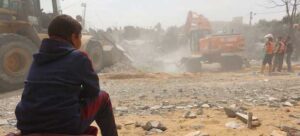
Children look at their destroyed homes in Rafah city, in the southern Gaza Strip. Credit: UNICEF/Eyad El Baba

GAZA STRIP, Feb 29 2024 (IPS) – Nothing could prepare me for my recently concluded mission into the Gaza Strip, where children face catastrophic conditions.

In my twenty years with UNICEF, traveling from one humanitarian crisis to the next – from famines to floods and war zones to refugee camps – I’ve simply never seen such devastation and despair as is happening in Gaza.


The intensity of the attacks, the massive number of child casualties, the desperation and panic of the people on the move – people who already have nothing – is palpable. It is humanitarian disaster on top of humanitarian disaster.

Near the start of the recent brief pause in fighting, we set out early in the morning at Rafah on the border with Egypt. Our convoy of trucks carrying vital humanitarian aid made its way slowly in a punishing journey north to Gaza City, which hadn’t seen aid in weeks.

The two cities are just 35 kilometres apart, but travelling through a war zone always makes distances seem more daunting. Along the way, I saw apartment building after apartment building, home after home, flattened by the bombings, a dystopian scene that stretched for miles.

In Gaza City I got out to look more closely at a building that had been reduced to rubble. Inside, I noticed bloodstains, but it’s impossible to know whether the people who were pulled out of this mass of concrete survived.

I will never forget how a man in his 60s walked out from the ruins of a recently bombed apartment building. At first, I thought he was indicating the number 10, as in 10 people had been killed. But he corrected this, using a stick to write in the dirt: 30. It wasn’t the number of people killed. It was the number of his extended family members killed in the blast.

This man had lost everyone, his whole extended family, everyone he loved. At the start of this war, UNICEF said Gaza was a “graveyard for children and a living hell for everyone else.” It has only gotten worse as the bombing and fighting have continued.

There was a hope that the devastation seen before the pause would not be repeated should the fighting resume. But after hearing hundreds and hundreds of rounds of artillery and more explosions, I could tell that it’s happening.

Within hours, the humanitarian pause felt too long ago.

I walked across the wreckage of what I was told was once a tight-knit community that is now broken glass, rubble and steel crunching under my feet. Homes sliced open, their contents exposed like doll houses, the inside of lives laid bare.

Against the grey rubble, eerie remnants of normalcy cropped up, like a sofa on a third-floor apartment with no walls, or a painting on the only wall left standing after a blast.

I looked at what was once a child’s bedroom, with pink blankets, a cupboard, shelves full of books, fluffy stuffed toys. It looked like the room of any 12-year-old girl, from any middle-class family, anywhere in the world. It was largely untouched. The little girl would have been safe if she wasn’t in another room with her family when the home was struck.

Driving through Gaza there’s never much time for reflection. The aid convoy needs to keep moving.

Along the route we saw the same theme repeated in neighborhood after neighborhood: basic needs are not being met. People need water and nourishment. Hospitals need medicine. This convoy has all those things. But despite our efforts and those of our UN colleagues, I know it’s not enough. It’s not nearly enough.

As one of my UNICEF colleagues noted just a couple of weeks into the war, the killing and maiming of children, abduction of children, attacks on hospitals and schools, and the denial of humanitarian access are a stain on our collective conscience. It was true then, it remains true now.

From Gaza City we pushed further north, to Jabaliya. The first thing I noticed were the piles of rotting garbage outside hospitals, offices and schools. Sanitation and rubbish collection services have broken down completely, of course, as trucks have no fuel to collect it and the conflict has displaced most of the workers who do these jobs anyway.

One hospital we visited, Al-Ahli Arab Hospital, was utterly chaotic. It was overcrowded, loud, intense. Our trucks were delivering medical supplies while wounded people were being rushed in bleeding.

We eventually made it back to the south of Gaza, to what we call the Joint Operation Centre. That’s where dozens of UN workers meet to discuss the next mission. The mood was sombre. We all know what Palestinian families need: they need more of everything, especially medicines, water, fuel, food.

But genuine safety for Gaza’s children depends on parties to the conflict ensuring that humanitarians have unimpeded access to civilians wherever they are… on our ability to bring water, essential food, nutrition supplements, fuel and other humanitarian supplies into the territory… and on parties implementing an immediate humanitarian ceasefire.

Unless those conditions are met, children in Gaza are now in danger from the sky, disease on the ground, and death from hunger and thirst. Nowhere is safe.

The children of Gaza have suffered enough. We need a humanitarian ceasefire, and peace, now.

James Elder is UNICEF’s spokesperson. Follow him @1james_elder

Source: UNICEF BLOG

IPS UN Bureau

  Source

Russia: Moments of Dissent after Two Years of War

Armed Conflicts, Civil Society, Crime & Justice, Europe, Featured, Headlines, Human Rights, Press Freedom, TerraViva United Nations

Opinion

Credit: Horacio Villalobos/Corbis via Getty Images

LONDON, Feb 26 2024 (IPS) – Russia’s full-scale invasion of Ukraine marked its second anniversary on 24 February. And while civil society is offering an immense voluntary effort in Ukraine, in Russia activists have faced intense constraints. The suspicious death of opposition leader Alexei Navalny is part of a great wave of repression. He’s the latest in a long list of people who’ve come to a sudden end after falling out with Vladmir Putin.


Putin is paying a backhanded compliment to the importance of civil society by suppressing it through every possible means. State-directed murder is the most extreme form of repression, but Putin has many more tricks up his sleeve. One is criminalisation of protests, seen when people showed up at improvised vigils to commemorate Navalny, laying flowers at informal memorials, knowing what would happen. Police arrested hundreds and the flowers quickly vanished.

An unrelenting assault

Human rights organisation OVD-Info reports that since the start of the full-scale invasion, the authorities have detained 19,855 people at anti-war protests, brought 894 criminal cases against anti-war activists and introduced 51 new repressive laws.

Among many other Russians jailed for symbolic acts of protest, Crimean artist Bohdan Zizu was handed a 15-year sentence last June for spray-painting a building in the colours of the Ukrainian flag. In November, artist Alexandra Skochilenko was sentenced to seven years for placing information about the war on supermarket price tags. Now people helping Ukrainian refugees living in Russia are being criminalised.

The government is also making it impossible for civil society and independent media organisations to keep working. Last August, the authorities declared independent TV channel Dozhd an ‘undesirable organisation’, in effect banning it from operating in Russia and criminalising anyone who shares its content. In August, courts ordered the closure of the Sakharov Center, a human rights organisation. Through similar means the authorities have forced several other organisations out of existence or into exile.

The state has also designated numerous people and organisations as ‘foreign agents’, a classification intended to stigmatise them as associated with espionage. In November, it added the Moscow Times to the list. The government has also doubled down on its attacks on LGBTQI+ people as part of its strategy to inflame narrow nationalist sentiments. And it keeps passing laws to further tighten civic space. Putin recently approved a law that allows the government to confiscate money and other assets from people who criticise the war.

The state is criminalising journalists as well. In March, it detained Wall Street Journal reporter Evan Gershkovich on spying charges, sending a signal that international journalists aren’t safe. The authorities are also holding Russian-US journalist Alsu Kurmasheva of Radio Free Europe, detained while paying a family visit to Russia. Putin is likely planning to use them as leverage for a prisoner swap. State authorities have put other journalists based outside Russia on wanted lists or charged them in absentia.

Meanwhile, Putin has pardoned real criminals for joining the fight. They include one of the people jailed for organising the 2006 assassination of pioneering investigative journalist Anna Politkovskaya.

It’s hard to hope for any let-up in the crackdown, at least as long as the war lasts. A non-competitive election will approve another term for Putin in March. No credible candidates are allowed to oppose him, and recently an anti-war politician who’d unexpectedly emerged to provide a focus for dissent was banned from standing. Last year the government amended laws to further restrict media coverage of the election, making it very hard to report on electoral fraud.

Weak or strong?

For a time last year Putin seemed weakened when his former ally Yevgeny Prigozhin rebelled, marching his Wagner Group mercenaries on Moscow. The two sides agreed a deal to end the dispute, and sure enough, two months later, Prigozhin died in a suspicious plane crash.

Putin has reasserted his authority. He may be gaining the upper hand in the war. Russia has greater firepower and is largely surviving attempts to isolate it financially, with repressive regimes such as China, India and Turkey picking up the slack in demand for its fossil fuels. It’s turned itself into a Soviet-style war economy, with state spending strongly focused on the military effort, although that can’t be long-term sustainable. Some of the world’s most authoritarian governments – Iran and North Korea – are also supplying weapons.

In comparison, Ukrainian forces are running out of ammunition. Support for Ukraine’s effort has come under greater strain due to political shifts in Europe and the breaking of political consensus in the USA, with Trump-affiliated Republicans working to block further military aid.

Putin may be riding high, but such is the level of state control it’s hard to get an accurate picture of how popular he is, and the election will offer no evidence. Given repression, protest levels may not tell the full story either – but some have still broken out, including those in response to Navalny’s death.

A vital current of dissent has formed around unhappiness with war losses. Last September, an independent poll suggested that support for the war was at a record low. Morale among Russian troops is reportedly poor and deserters have called on others to quit. Families of men serving in the military have held protests demanding the fighting ends.

Protesters have offered other recent moments of opposition. In November, people held a demonstration in Siberia against a local initiative to further restrict protests. In January, in Baymak in southern Russia, hundreds protested at the jailing of an activist. There’s also domestic unhappiness at high inflation.

Moments don’t make a movement, but they can offer inspiration that turns into one, and that often happens unexpectedly. Putin’s story is far from over. As with tyrants before, he’ll likely look invincible until just before he falls.

Andrew Firmin is CIVICUS Editor-in-Chief, co-director and writer for CIVICUS Lens and co-author of the State of Civil Society Report.

  Source

The World Social Forum: The counterweight to the World Economic Forum

Armed Conflicts, Civil Society, Climate Action, Climate Change, Democracy, Economy & Trade, Global, Headlines, Human Rights, Inequality, Press Freedom, TerraViva United Nations

Opinion

Opening of the World Social Forum 2024 in Kathmandu

KATHMANDU, Nepal, Feb 23 2024 (IPS) – This week the 2024 annual meeting of the World Social Forum (WSF) was held in Nepal. There were fifty thousand participants from over 90 countries, exchanging strategies to address the multiple global crises, from climate catastrophes to unfettered capitalism, inequality, social injustice, wars and conflict.


The WSF was created in 2001 as a counterbalance to the elitism of the World Economic Forum (WEF). The WEF, founded and chaired by a private financial sector foundation, fosters the influence of the corporate world among governments in the luxury ski resort of Davos (Switzerland).

Isabel Ortiz

By contrast, the WSF was created as an arena for alternative thinking, where the grassroots and social avant-garde could gain a voice, challenging the neoliberal idea that “there is no alternative” (TINA); instead affirming that “another world is possible” built upon peace, human rights, real democracy, equity, and justice.

While Davos is the meeting for the 1%, the wealthiest people in the planet, Kathmandu is the meeting for the rest of us. The UN Secretary-General extended his best wishes for WSF 2024 for “restoring hope and finding innovative solutions for people and the planet.”

Indeed, the WSF 2024 was hotbed of ideas, alternative experiences and strategies. There is no concluding summary or annual declaration because the WSF organizers seek to maintain a plurality and diversity of messages. The following points reflect my personal overview of the key topics discussed:

    • Denouncing the genocide in Gaza, a demand for an immediate ceasefire and the establishment of a free state of Palestine.

    • Refuse militarization and wars: Cut military spending and power, promote peace and democracy. Defense spending is increasing while austerity policies cut social spending, this trend must be reversed.

    • Organize against the rise of the far right: Radical right governments around the world have eroded democracy, human rights and civil society. Reports were made of censorship, repression, abuses of justice, unjustified raids and unfair imprisonment of progressive citizens, by the governments of Modi in India, Duterte in Philippines, Orban in Hungary, Duda in Poland, Al-Sisi in Egypt, Trump in the US, Bolsonaro in Brazil, among others There were also many reports of abusive litigation by corporations and politicians against journalists, activist researchers and CSOs, that are silencing critical voices.

    Fight inequality to counter the excessive concentration of power and wealth in the hands of a small elite. Inequality is the result of deliberate political and economic choices, and it can be reversed to build a just, equal and sustainable world.

    End Austerity, illegitimate debt and neoliberal economic policies that have failed citizens resoundingly. These outdated policies, imposed by international financial institutions (IFIs) like the IMF and the World Bank through the Ministries of Finance and G20, mostly benefit corporations and investors in the US and in a few Northen countries, result in real and lasting harm to the lives of ordinary people. There are alternative economic policies, such as the adequate taxation of wealthy millionaires and corporations, that can finance prosperity for people and planet.

    • Redress violations of human rights for women, Dalits (the ‘untouchables’) and lower castes, LGBT, persons with disabilities and different ethnicities; demanding enactment and implementation of inclusive policies and strategies to eliminate class, caste, gender and race-based disparities.

    • The 2024 Feminist Forum focused on addressing systemic barriers that impede women’s rights, from patriarchy to macroeconomic policies, through transformative feminist action that leads to change.

    • Ensure public services, universal social security or social protection, and labor rights for all, including informal workers and migrants, instead of the current austerity driven trend to privatize or corporatize public services, to reduce welfare benefits and to deregulate the labor market.

    • Peasant protests and movements: La Via Campesina is the largest movement today with two hundred million peasant members fighting for food security, against agribusiness and GMOs. It is very active, has alliances with unions, indigenous peoples’ movements and it is a good model for other movements.

    Climate Justice: A number of sessions discussed climate catastrophes, the IFIs support for fossil fuels, just transitions, habitat, and sustainable development.

The lack of will of the world’s political and economic elites to resolve today’s multiple crisis fuels discontent among citizens and disillusionment with conventional parties. People everywhere are losing faith in governments, institutions, and economic and political systems. Governments and world leaders would do well to listen and to act upon the ideas coming from the World Social Forum.

Isabel Ortiz, Director of the think-tank Global Social Justice, was Director of the International Labor Organization and UNICEF, and a senior official at the United Nations and the Asian Development Bank.

IPS UN Bureau

  Source

Children’s Futures at a Crossroads

Armed Conflicts, Civil Society, COVID-19, Featured, Global, Global Governance, Headlines, Human Rights, TerraViva United Nations

Opinion

Credit: UNICEF/Abdulazeem Mohamed

 
War in Sudan is putting the future of its 24 million youngest citizens at risk, the Representative of the UN Children’s Fund (UNICEF) warned. January 2024

 
Meanwhile geopolitical and geoeconomic fragmentation threaten the development and survival of children across the globe. But a more hopeful path exists.

UNITED NATIONS, Feb 23 2024 (IPS) – At the start of 2024, we stand at a critical juncture: Geopolitical tensions are escalating, economic integration is unravelling, and multilateral cooperation is faltering. This global fragmentation threatens to undermine decades of progress made for children worldwide.


The choices we make today – whether to continue on this path or whether we should bolster global cooperation – will have a profound impact on generations to come.

Children are always the most vulnerable in times of crisis – a reality highlighted by the COVID-19 pandemic, when school closures, economic hardship and disrupted health services jeopardized children’s rights and wellbeing.

Almost four years since that pandemic was declared, our new report, Prospects for Children in 2024: Cooperation in a Fragmented World, paints a concerning picture for children’s future development and welfare.

Tensions among major powers are rising and the threat of new conflicts emerging is high. Beyond the immediate physical dangers, children can experience lasting psychological trauma and violations of their basic rights.

If military spending continues increasing at the expense of investments in healthcare, education and social protections, children’s development will be further compromised.

Meanwhile, economic fragmentation is widening disparities between countries. Restrictive trade policies and supply chain disruptions are leading to rising energy and food prices, reducing access to essential goods and negatively impacting child nutrition and household incomes.

Competition for critical minerals essential for the green economy is increasing the risks of trade fragmentation while threatening the pace of the green energy transition. At the same time, the drive to expand mining for minerals puts mining communities and children at risk of exploitative practices.

Despite continued global economic growth, the lukewarm and uneven recovery is diminishing prospects for reducing child poverty. From now until 2030, 15 million more children a year will be living in poverty than would have otherwise, due to the unequal post-COVID recovery.

This gloomy picture is compounded by the weakening of multilateral institutions, which is further undermining the potential for progress for children. Why?

Because a fragmented multilateral system that is hamstrung by competing interests will struggle to deliver on conflict prevention, climate change, effective digital governance, debt relief and enforcing child rights standards, fuelling dissatisfaction in the Global South with rising inequalities.

Children in the poorest nations also face continued barriers to financing for basic services. Crippling debt, high remittance fees and lack of voice in global economic governance restrict investments in healthcare, education and social protections – investments vital to children’s survival and development.

But amid all these concerning trends, we see still signs of hope. Alternative alliances are emerging in the developing world to advance cooperation, bringing novel policy solutions, more nimble policymaking and effective results.

Despite expressing discontent with current democratic political structures, young people remain optimistic that opportunities exist to reform and resolve deficiencies in the political system, whether at the national or international level. They are engaging as change-makers, breathing new life into civic participation and democratic renewal.

In addition, technological innovations are unlocking new opportunities to empower children and enhance their rights. Green transition, if carried out in a just and sustainable way – one that prioritizes young people’s needs, skills and access to jobs in emerging sectors (such as the digital and green economy) – can benefit younger generations.

Reforms and modernization of global governance and financing arrangements could still deliver greater justice for developing countries. This more hopeful path will not unfold on its own. It requires global leaders to make an active choice – to double down on solidarity, inclusion and cooperation despite tensions and instability.

Prioritizing children and their rights must be at the centre of this choice.

Jasmina Byrne is Chief, Foresight & Policy, UNICEF Innocenti – Global Office of Research and Foresight.

IPS UN Bureau

  Source

World Social Forum Activists Unravel Roots of Israel’s Occupation of Gaza

Armed Conflicts, Asia-Pacific, Civil Society, Global Governance, Headlines, Human Rights, Middle East & North Africa

Armed Conflicts

Protesting against Israel's attacks on Gaza, at the opening day march of the World Social Forum in Kathmandu. Credit: Marty Logan/IPS

Protesting against Israel’s attacks on Gaza, at the opening day march of the World Social Forum in Kathmandu. Credit: Marty Logan/IPS

KATHMANDU, Feb 17 2024 (IPS) – Romi Ghimire has a busy life running a non-profit organization dedicated to Nepal’s rural people, but she also feels driven to do something about Gaza. “There are a lot of issues happening in the world, but right now the genocide in Gaza is the most urgent one,” she said inside the Palestine tent at the World Social Forum (WSF) in Kathmandu on Saturday.


“We’re watching it live…. we’re seeing it on a daily basis: every morning and evening I’m consuming it and I just can’t stop thinking about it. I can’t pretend that it isn’t happening,” Ghimire told IPS. “We have to raise awareness about it around the world because we are all the (Palestinians) have. They don’t have any arms or ammunition, any military — it’s just people like us that they have.”

“People like us” include the roughly 30,000 activists expected to attend the WSF, the annual global gathering of social activists, happening this year in Nepal’s capital Kathmandu until Monday. This block of the city centre is bustling with activists, rushing to reach a scheduled workshop or bumping shoulders with peers from 90+ countries amid white tents set up as temporary classrooms in a fairground.

Israel’s ongoing assault on Gaza, in response to an attack on Israel by Hamas on Oct. 7, 2023, is one of the most discussed issues.

“Israel has refined the art of colonization through what I call the best business practice of colonialism, which invites multinational actors and corporations to invest in their colonial project. And that provides an economic incentive to ensure that political positions are supportive of Israel”

On Friday, Dr Varsen Aghabekian spoke to 30 activists from Nepal, South Asia and beyond. The former Commissioner General for the Palestinian Independent Commission for Human Rights, Aghabekian detailed the history that has culminated in Israel’s occupation of Palestine, stressing the deep roots of the current assaults.

Demographic strategy

For example, in Mandate Palestine (as it was known in 1947), Palestinians made up 93% of the population and Jewish people were 7%. By 2023 the make-up had changed dramatically, with Palestinians at 51% and the Jewish population equal to 49%, said Aghabekian, labelling the process part of Israel’s “erasure”.

Historical “annexation” includes takeover of public and private property. In 1947, 90% of such property was owned by Palestinians; by 2023 they had been relegated to 22% of historic Palestine.

Israeli laws and policies “institutionalize the superiority and privilege the status of Jews,” added Aghabekian. They reserve the right of self-determination in Israel exclusively for the Jewish people, and declare Hebrew as the official state language, demoting Arabic, which had been the country’s official second language.

“We rightfully call (the situation) apartheid but when we do that many western countries frown and say: ‘It can’t be!’… Israel is trying to project that an occupier state is a victim of our resistance and our violence (but) we have the right to resist as an occupied people who want to be liberated.”

Eventually Israel must make peace with the Palestinians, added Aghabekian. “If they are prospering and we are in pain there will not be peace. The Gaza genocide, despite its disasters, is an opportunity… even the US said seriously ‘maybe we should think about the two-state solution’. I think we’re moving toward that.”

Not only is Israel misrepresenting its occupation and current attack on Gaza, the situation has revealed the hypocrisy of western legal, religious and cultural tradition, argued Mitri Raheb, the first president of Dar-al-Kalima University in Bethlehem, who spoke after Aghabekian.

Israel’s response to the Hamas attack has revealed the “warrior God,” not the God of peace, said Raheb, citing a personal example. A German bishop he met counselled Palestinians to remain non-violent. But just weeks later Raheb, who also served as the pastor of the Christmas Lutheran Church in Bethlehem from 1987 until 2017, saw the bishop on TV calling for western countries to provide Ukraine with tanks to counter Russia’s invasion.

Palestinians, he added, used to “believe in and fight for human rights because we thought they were international, they were for everyone. But I’m starting to question that. I think that human rights were meant for white Europeans, so they won’t kill each other any more, but it’s OK if the rest of the world is killed by the empire.”

“Business of colonialism”

Legal expert Wasem Ahmad dissected the economic structure that props up Israel’s occupation. “Israel has refined the art of colonization through what I call the best business practice of colonialism, which invites multinational actors and corporations to invest in their colonial project. And that provides an economic incentive to ensure that political positions are supportive of Israel.”

A human rights scholar, Ahmad told IPS he recognizes the limitations of the human rights system. “The more you do this work the more cynical you become of the system as it’s proposed. (Human rights) look very nice on paper but when you try to put them into practice you realize that there are a lot of political obstacles to that realization and it has to do with the broader imperial interests at play.”

“Our role,” he continued, “is to push that system and engage it, and force the wheels of justice to turn. Either it works in our benefit or we expose it and over time that system will change, even if it requires a breakdown to rebuild.”

But opposing Israel’s colonization through the legal system is only one approach, added Ahmad. “The idea that I’m only going to rely on the legal mechanisms, ignoring that the law is a social construct connected to economic, political and cultural interests and beliefs in society ignores that reality.”

Despite his critique of the West’s legal and cultural traditions, Raheb said he was invigorated by the throngs of people worldwide, and at the WSF, protesting Israel’s attacks. “Gaza was the wake-up call for all of us. And I think in the future this will just get stronger and stronger… Gaza galvanized the global South because it was the magnifying glass: suddenly we could see clearly. That was the turning point.”

  Source