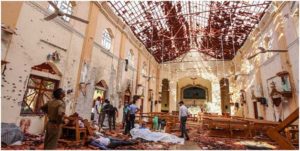
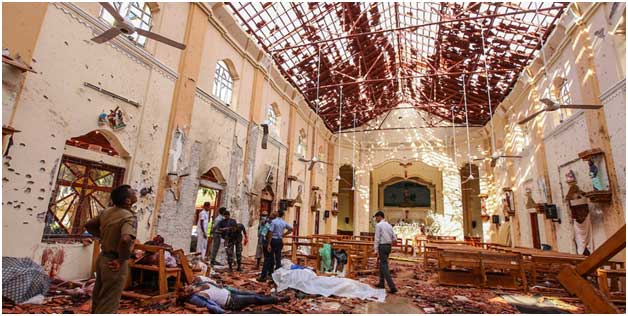
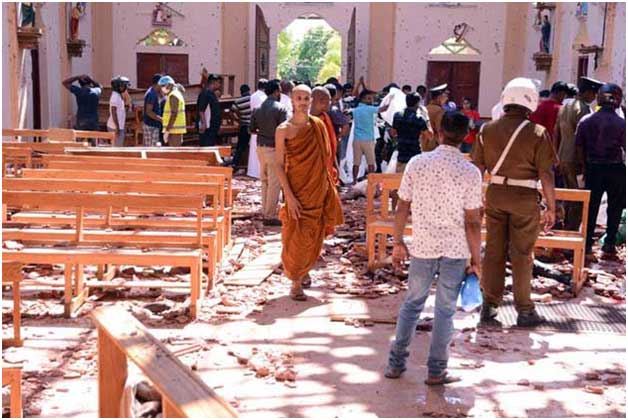
NEW YORK, Jul 3 2019 (IPS) – Sri Lanka continues to be on a security alert long after the devastation caused by a string of bombings on Easter Sunday this year.
Raisa Wickrematunge, Editor of Groundviews, told IPS: “There has been a tightening of security. There are now security checks being carried out outside hotels and shopping malls – either through scanners or bag and body searches”.
“At the St Anthony’s Church, where the first blast occurred, there are bag and body searches conducted before worshippers can go inside, and bags are left outside the Church premises. Many churches and some schools have also increased their security.”
Curfews were put into place and a social media ban was enacted temporarily, in order to prevent the graphic nature of the tragedies from being broadcast publicly. There has been much damage of the emotional and physical varieties in the once war ridden nation.
For one thing, this attack was not expected by the Christian minority in Sri Lanka. Despite this, they have persevered.
Father Rohan Dominic of the Claretian NGO told IPS: “For quite some time, there were attacks on the Muslim and Christian minorities by extremist Buddhists. In places, where the Buddhists were the majority, Christians lived in fear.”
However, in a turn of events that left many in shock, one of the minority groups seemed to be the ones that initiated the attacks that occurred on Easter.
All seven of the perpetrators allegedly belonged to a local Islamist group, National Thowheeth Jama’ath, according to government officials from the country.
In response to this, there have been bans put in place for burqas and niqabs, traditional facial coverings worn by Muslims and people have been denied entrance into establishments, even while wearing hijabs.
There were smaller bombings in Dematagoda and Dehiwala later on that same day. With a death toll of 290 people and 500 injured, domestic measures to protect the citizens were taken.
After its 26 year long civil war between the Tamil and Sinhalese ethnic groups came to an end in 2009, conditions in Sri Lanka were mostly calm.
However, on 21 April, 2019, the country erupted into violence. Three churches in the cities of Negombo, Batticaloa and Colombo, along with three hotels in the city of Colombo, were targeted in bombings by a group of seven Sri Lankan citizens.
The churches were St. Sebastian’s Church, Shrine of St. Anthony Church and Zion Church and the hotels were Cinnamon Grand, Kingsbury Hotel and Shangri-La Hotel.
Sri Lanka is a country that is primarily Buddhist with a large Hindu population and Christian and Muslim minorities.
Father Dominic said that, “The Catholic Church in Sri Lanka was able to recover from the attack quickly and aided the survivors and the families of the victims by consoling and caring for them. The Church also has guided the Christian community at moments of anger and frustration in controlling their emotions and not to blame the Muslims. This position of the Church has helped to prevent violence and created common understanding and religious harmony.”
According to Wickrematunge, there has been much help in helping the community adjust to life after the attacks and in restoring what has been lost.
Other efforts have been led by organisations such as the Red Cross, Kind-hearted Lankans, the Archbishop of Colombo and the Church of the American Ceylon Mission in Batticaloa. There have also been crowdfunding efforts on popular websites like GoFundMe.
Since the attacks have affected lives in a physical and emotional way, the state has given financial support to the affected as of 21 June.
There has also been a trust fund set up for children who have lost family members to the attacks.
Some of the industries affected, such as tourism, have been offered subsidized loans in order to help with paying employees. Psychological support and educational resources are being provided to citizens as well.
While it has only been three months since the attacks affected the lives of many, steps towards rebuilding have been made and the future appears to be promising.
Gulnoza Said* is Program Coordinator, Committee to Protect Journalists (CPJ), Europe and Central Asia
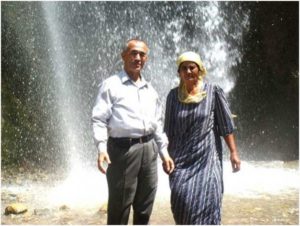
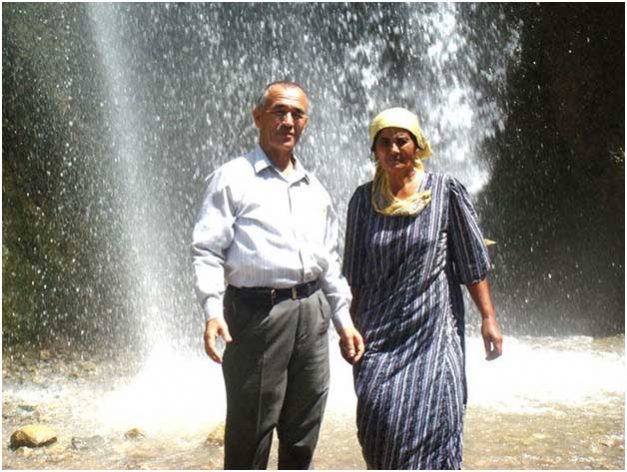
Kyrgyzstan journalist Azimjon Askarov and his wife, Khadicha, pictured during a family vacation in Arslanbob in the summer of 2009. ‘This was Azimjon’s last summer of freedom,’ Khadicha told CPJ. (Askarov family)
NEW YORK, Jun 10 2019 (IPS) – On a recent morning in Bazar-Korgon, southern Kyrgyzstan, Khadicha Askarova was giving hasty instructions to her daughter about what needed to be packed.
They were about to set off: first for the capital Bishkek, some 600km from where they live, and then another 70km to a prison colony where her husband, Azimjon Askarov, was transferred in March.
But Askarov, a 68-year-old independent journalist and rights activist, shouldn’t be in jail at all. The U.N. Human Rights Committee ruled in 2016 that Askarov was subject to torture and mistreatment from the moment of his detention on June 15, 2010 to his speedy trial and subsequent imprisonment, and that he should be released immediately.
CPJ’s research into his case found that the original trial was marred by irregularities and allegations of torture, mistreatment and harassment of defendants, including Askarov, and their witnesses. But Kyrgyz authorities defied the U.N. resolution and in 2017, amid international outcry, upheld his life sentence.
Conditions in the new prison are harsh. In letters home, the journalist wrote that he had run ins with the guards and that prison officials punish detainees after visiting days. His health is also deteriorating and he has limited access to medication, the journalist’s wife, Askarova, said.
“What breaks my heart is to see how much he aged since being imprisoned. He used to be a man full of energy and vigor. Now, he is old, sickly, skinny, and there’s no way out of this situation for him,” she said, fighting back the tears when we spoke via a video messaging app earlier this month.
The couple, who have been married for over 40 years, now have limited contact: just six family visits and two phone calls a year. As Askarov wrote in a recent letter to his wife, “They like keeping us under a tight lid here. Communication with the outside world is banned.”
The letter, which his wife shared with CPJ, also gave a glimpse of the harsh prison conditions: “After family visits, inmates are punished by being forced to eat raw onions and carrots for several days.”
“On regular days, they give us pea soup that contains nothing but watery peas. On public holidays, we get what the prison administration calls plov [pilaf] but it is not more than 150g of rice cooked with some carrots, per person.”
Since Askarov’s transfer to a prison outside Bishkek in March, he wrote that he has had three “incidents” with prison guards. The journalist did not specify the nature of incidents, but wrote that guards were known for their mistreatment of and conflicts with inmates.
“There are few good ones among them”, he added, almost as if he was preventing possible punishment should the content of the letter became known to the guards.
One of the incidents was connected to the journalist’s poor health. He has the heart condition tachycardia, hypotension, and gets dizzy and nauseated if he stands for too long.
Under prison rules, if a guard enters a cell, the inmate must stand. “That’s the rule. Twice a day, guards enter cells. An inmate has to cite his full name and an article of the criminal code he was convicted of violating. But Azimjon was not able to stand straight for too long. His knees bend, he had to sit down. That was the ‘incident’,” the journalist’s wife, Askarova, told me.
Soon after the transfer, Askarov complained about his health to prison administration, and said that low blood pressure and a cold was diagnosed. “But they did not have any medication to give me,” he wrote.
Askarova told CPJ that doctors at the prison ask families to bring medication. “They rely on us for something that they ought to provide,” she said.
She added that the few visits they are allowed are emotional, and the travel hard and costly. She makes sure that one visit falls on her husband’s birthday, May 17. This year, the couple’s daughter and their three grandchildren also visited on his birthday, their first visit to a new jail.
‘I’m afraid they will forget how he looks’ Askarov’s wife says
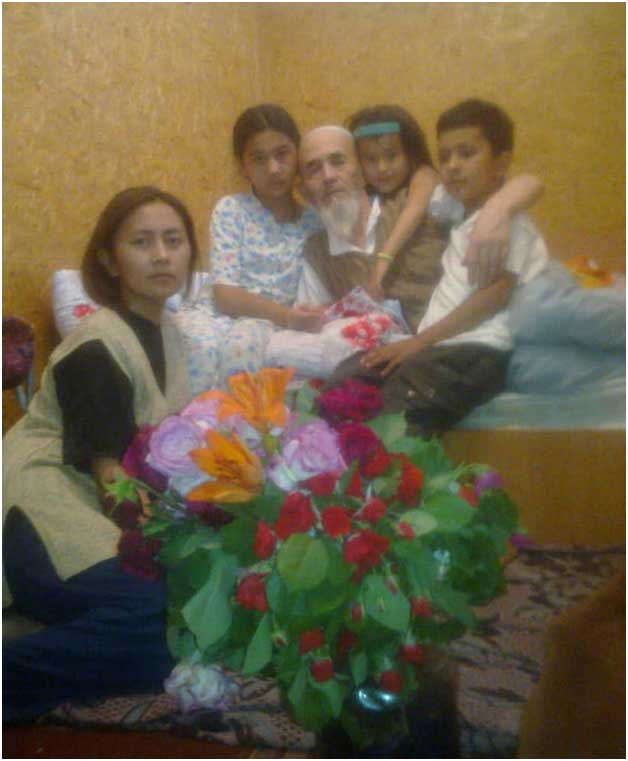
Azimjon Askarov, pictured with his daughter Navruza and grandchildren, during a May 2018 visit in Bishek prison. The journalist was moved to a new prison in 2019 that bans families from taking photographs during visits. (Askarova family)
“The new prison is much farther from Bishkek. After a nearly 14-hour drive to Bishkek, we took another taxi to the prison, but then had to walk about seven kilometers in the heat and dust. It was especially hard for the little ones, although they were excited to see their grandfather. They are still little, and I am afraid they can forget how he looks like, how he sounds,” Askarova said.
Adding to that concern is a rule at the prison banning families from taking photographs during visits. “Now, I have to look at old pictures of Azimjon. They deprived me even of the photos of my husband,” she said.
Askarova said she would move to Bishkek to be closer to the prison, but she cannot sell the house that her husband has owned for decades. The authorities seized the journalist’s property after he was charged in 2010.
In 2015, the journalist’s lawyer successfully appealed against the seizure, but before Askarova had overcome a legal quagmire of changing the ownership, authorities placed a new lien on the house in February. She said she has started another appeal process.
Askarova said that before they visit each year on his birthday, the couple’s daughter Navruza, who lives in Uzbekistan, usually comes to Bazar-Korgon to help pack personal items, food, medicine and books. But it is Askarova who picks flowers from her garden and buys bouquets at a florist for her husband.
“He is an artist, you know. He loves flowers. I get the most beautiful ones for him. Many kinds, sometimes several bouquets,” she said.
Azimjon and Khadicha met at art college in the Uzbek capital Tashkent in 1974. They have been married for 42 years and raised four children, who live in Uzbekistan. He used to work as an artist. But every time he heard a neighbor complain of injustice, he felt the urge to help, Askarova said.
In the late 1990s, he started documenting the cases, mediating between his community members and law enforcement, and researching legal books. He eventually became a go-to person in Bazar-Korgon if the rights of a member of his community had been violated.
He was known for taking up the cases on police brutality. It was this reputation that led many people to come to him for help when violence against ethnic Uzbeks erupted in June 2010, she said.
In prison, Askarov started to paint again. In 2014, international and local activists organized an exhibition of Askarov’s work to raise awareness of his case. In 2018, he wrote a book, “I am happy,” which includes a dedication to his late mother, “who lost me, her son, during her and my life, and left this world, shocked by the greatest injustice.” Copies of the book are still available online.
During his imprisonment, Askarov studied English and is able to read the many cards sent to him from around the world, his wife said. She added that he has been studying Japanese from the books and dictionaries she brought him, and that he has become interested in herbal medicine because conventional medication was not available in prison.
Askarov has also kept a diary since 2010. “He writes down everything. I keep reading them in between prison visits. One word that he uses most frequently is freedom. When he sees rain through the cell window, he writes ‘I wish I was free to feel rain drops on my skin. When he sees snow, he writes ‘I wish I was free to be outside and enjoy the snow now’. Freedom is his main wish and goal. He lives for it,” Askarova said.
* Gulnoza Said is a journalist and communications professional with over 15 years of experience in New York, Prague, Bratislava, and Tashkent. She has covered issues including politics, media, religion, and human rights with a focus on Central Asia, Russia, and Turkey.
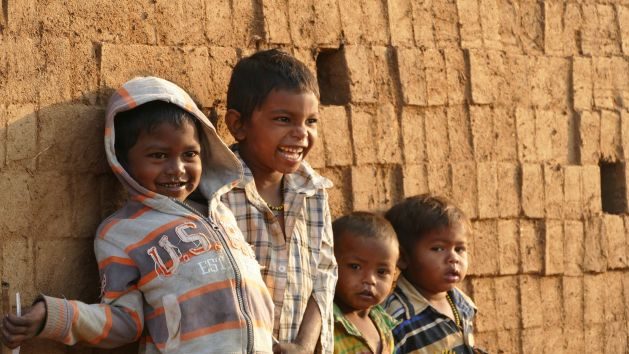
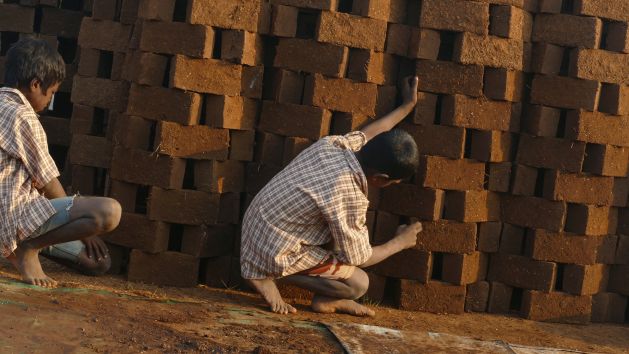
When we say that children aren’t learning, what we mean is that they are not fitting into our assessment of their learning outcomes | Picture courtesy: Nilesh Nimkar
THANE, MAHARASHTRA, India, Jun 6 2019 (IPS) – When we look at learning outcomes for children, we only look at standardised tests, ignoring any indigenous knowledge, language, or problem solving strategies they might have.
The brick kilns of Sonale were bustling with activity—children running around, indigenous technology being used, and lots of mathematics being done. I recently went there after a teacher from the nearby primary school approached our nonprofit, Quest, because the children living there were simply not learning. The concern was, if they didn’t even know their multiplication tables, how would they cope in classes V, VI, and VII?
So I went to see for myself. I asked these children, “To make the mortar for the bricks, how many pits have been dug?
“On one side 11; another side 12”
They also told me they would put three containers of raw material in each pit. So I asked them how many containers they would need in total, and after running off to count them, they came back with the right answers. They could also explain how they arrived at those numbers. What I found was that they were counting in threes. Not the way one recites the tables in the schools, but visualising it in their mind.
Clearly, these children knew how to multiply. That they failed to memorise their tables was beside the point. They had understood the concept and had demonstrated a strong meta-cognitive ability when they explained how they arrived at the answer
Clearly, these children knew how to multiply. That they failed to memorise their tables was beside the point. They had understood the concept and had demonstrated a strong meta-cognitive ability when they explained how they arrived at the answer. In my further conversations, I was amazed to see the kinds of calculations the children at the brick kilns did. For instance, 13 multiplied by 11 was done mentally because they were able to understand it within their own context (that of the brick kiln).
Standardised testing disadvantages marginalised children
This example illustrates one of the biggest challenges of our schools today—standardised assessment—which further disadvantages marginalised children. These children have a different type of cultural capital that schools and tests hardly recognise.
Western research in the field of math pedagogy points to the importance of children’s indigenous knowledge and strategies in solving problems and considers them to be the starting point for sound understanding of elementary mathematics. But what are those indigenous strategies in the Indian context? We still don’t know much about them. And our lack of knowledge results in us asking these children to run an unfair race.
Today, when we say that children from marginalised communities aren’t learning, what we mean is that they are not fitting into our assessment of their learning outcomes. By completely ignoring their indigenous knowledge, language, and problem-solving strategies, we have so far continued to focus on what they don’t know, and never paid attention to what they do know.
The process tells us more than just the outcomes
I do not deny the necessity of having some common indicators to understand the status of education in a given cluster, block, district, or state. But setting and chasing these indicators mindlessly could be dangerous.
Take for example, an encounter I had at an SSC exam centre in a rural school a few years ago. While I was visiting, I saw that the teachers were openly giving students answers to questions while they wrote their exams. When I asked why this was happening, a teacher said to me, “These children are weak from the beginning. It is almost impossible that they pass the exam on their own. If they fail, it will affect the result of our school and this would create a lot of trouble for us.”
This encounter is a classic example of what will happen if we neglect the process of learning and just focus on the numerical indicators of success. Our belief tends to be that if we can control learning outcomes, the quality of education will improve. But children can rote learn, or use unfair ways to pass their exams—we have no system that can check it at scale. What’s more, we are forgetting to track whether or not these children truly understand what they’ve been taught.
Ever since the ASER and other such reports have been published, we’ve been talking about how poor the learning outcomes are. But what have we really done to change things? We have been experimenting with examinations more than the actual process of learning, finding newer and newer ways to test the learning outcomes. But, if a pipe is choked, no matter what bowl you put under the opening, no water will drip into it. Similarly, no matter what exams, standard tests, and evaluation tool we use, only a little will change if we fail to address the core issues related to the process of learning.
“What I found was that they were counting in threes. Not the way one recites the tables in the schools, but visualising it in their mind” | Picture courtesy: Nilesh Nimkar
What needs to be done
1. Strengthen the process, invest in teachers
One of the positive outcomes of the Right to Education (RTE) Act is that it improved enrolment rates. But we know that it’s not enough to get children into schools. We need to alter our schools to meet children’s needs. If we want to set the process of education right, we have to strengthen its most impacting factor, the teacher.
Teacher education and ongoing teacher professional development are areas where we haven’t paid much attention. Instead of offering our teachers quick fixes to the challenges they face, we need to begin working with, and for our teachers.
One example of how to do this could be through a technology based distant mentoring system for teachers working across geographies. Quest, the nonprofit I run, has a system like this on a much smaller scale—here, teachers send audio recordings of their classroom activity to mentors (experienced teachers, teacher-educators, or researchers in the field of pedagogy), who then provide them with ongoing feedback to help them fine-tune their skills. This type of support system needs to be created on a larger scale.
2. Change the way we test
We need to alter the tools and parameters we use to assess success. We had a chance to do this when the idea of continuous comprehensive evaluations was introduced. However, the teachers and education community at large could not free themselves from the idea of examinations, and we lost a golden opportunity to bring our focus on to the process.
In a country as diverse as India, the assessment framework could be common for all. But the actual tests should be local and culturally appropriate. For example, I have seen assessment tests that show a picture of a well-maintained French garden or a city park, expecting a rural child to talk about it. In this situation it is obvious that the child will show poor oral expression.
Or yet another example is that of asking children to write words only from the ‘standard’ language—when in reality, Marathi spoken in different parts of Maharashtra is not the same. But normally the assessments are not sensitive to this regional variation, which means that children with a home language that is different than the standard variant of Marathi will always perform poorly.
The question we must ask ourselves is, do we want to make the education system more inclusive, or do we want to use it as a sieve to weed out the ‘weaker’ children? We need to design an overarching framework and build a bank of regionally, culturally appropriate testing items. Unless we do this our focus will always remain on what children don’t know.
Nilesh Nimkar has over 20 years’ experience in the field of early childhood education, elementary education, teacher education and curriculum development. He has initiated several innovative programs for teachers and children, specially in the rural and tribal areas. He has received the Maharashtra Foundation Award for ‘Outstanding social work in the field of education’.
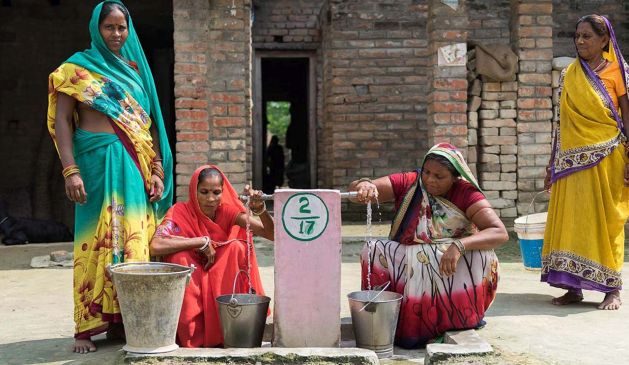
Handpumps, participatory rural appraisals, wadi programmes, and so on, all came from an innovation or technology developed by civil society | Picture courtesy: Aga Khan Rural Support Programme (India)
AHMEDABAD, GUJARAT, India, Jun 4 2019 (IPS) – When we look at some of the things we take for granted in India today, there is a common thread to all of them. Every single one. They all originated from civil society.
People hear the word civil society and react differently; and it depends on where they come from. For the business leader, social and environmental concerns are impediments to business. “Environment ke liye poora project band hojata hai, what about growth, what about the economy?” (Entire projects have to be shut down for the sake of the environment).
I’ve also been in conversations with some government officers who say, “woh kaam chhota karte hain aur credit bahut le lete hain. Kaam toh hum karte hain paisa toh hamara hai.” (The nonprofits hardly do any work but take all the credit. We are the ones who do the work, the ones who put in the money).
But nothing is farther from the truth. When we look at rural India, and look at some of the things we take for granted today—be it women self-help groups (SHGs), ASHA workers, biogas plants, RTI applications, and so on—there is a common thread to all of them. Every single one. They all originated as innovations in civil society.
Our largest government programmes were born in civil society
1. National Rural Livelihoods Mission (NRLM) and Self Help Groups (SHGs)
When we look at rural India, and look at some of the things we take for granted today—be it women self-help groups (SHGs), ASHA workers, biogas plants, RTI applications, and so on—there is a common thread to all of them. Every single one. They all originated as innovations in civil society.
One of the largest programmes of the government—the National Rural Livelihood Mission (NRLM)—is based on women self help groups (SHGs). And the concept of an SHG was developed by Aloysius Fernandes and his team at MYRADA.
In the 1970s, MYRADA was working with large primary agriculture cooperative societies (PACS), all of whom seemed to be failing. In some of the geographies however, while the cooperatives had collapsed, there were some villages where small groups were saving and giving credit to each other.
Aloysius and the MYRADA team saw this, identified them as empowered groups that the banks could lend to, gave it form and structure, and took it to NABARD.
NABARD realised the value of what MYRADA was helping build, because they themselves were trying to reach out to the poor and their existing institutional portfolio was failing because the cooperatives weren’t functioning. They supported MYRADA and then pushed the banks to lend to these groups of poor women who saved regularly.
So, in a sense the SHG movement was started by MYRADA and to some extent, NABARD. The state was not in the picture at that time.
Then the first SERP programme came up in Andhra Pradesh. They used the base created by NABARD and MYRADA and they promoted the SHGs. And because the SERP programme worked, and because the World Bank was funding SERP, when the government created the NRLM, they used the same principles and structures.
Today the NRLM, which rides almost entirely on the SHG infrastructure, is the only large-scale institutional arrangement that the government has to reach out to poor. Every government uses it, regardless of what end of the political spectrum they occupy. It is pro-poor and still has elements of the market—the state can extend its entitlements directly to the people, while also enabling them to be self-reliant by promoting enterprises. But if there hadn’t been MYRADA, we probably wouldn’t have had NRLM today.
2. Mahatma Gandhi National Rural Employment Guarantee Act (MGNREGA)
India’s most talked about government programme MGNREGA came about because Jean Drèze and others in civil society drafted it, and advocated for it.
The idea of MGNREGA did borrow from an earlier employment guarantee programme that was started in Maharashtra by Mr Vitthal Sakharam Page—chair of the Maharashtra State Legislative Council, and a social activist—who wrote the first draft in 1965. But it was only when several civil society activists fought for it in the early 2000s, that it became something that the Central government took seriously and passed into national law.
3. Integrated Water Management Programme (IWMP)
The early work around watershed management was done in Sukhomajri in Haryana. A more integrated approach was later piloted at Ralegan Siddhi by Anna Hazare. This, and the Hiware Bazar model by Popatrao Pawar became models to emulate, and the IWMP guidelines that are in place today are a result of contributions from many nonprofits.
These are just few examples but the story repeats itself again and again regardless of the sector. Consider these two others examples; one old and one relatively recent:
ASHA workers: The concept of ASHA workers was born in Jamkhed. The Aroles—Dr Mabelle and Dr Raj—started a programme in 1970 which involved semi-literate women delivering home-based care to mothers and newborns. It was taken to scale by the government, and our country now has over six lakh ASHA workers.
108 Service: The 108 service that everyone lauds as a model of efficiency and scale was started as a service by EMRI—a nonprofit in Andhra Pradesh under the aegis of Satyam Foundation (EMRI was later taken over by the GVK Foundation). It was handed over to the Andhra Pradesh government, and later, other state governments implemented it. Today it runs across 15 states and two union territories.
The list continues—handpumps, participatory rural appraisals, wadi programmes, and so on. Essentially, almost any government programme worth its salt came from an innovation or technology developed by civil society. This is not to belittle the role of the state, which is by far the major development actor, but to emphasise the role of civil society in nation building.
Despite this, we are seeing a marginalisation of the civil society sector by markets and the government because we haven’t told our story well enough.
Civil society is too self-effacing
What is the philosophy of a civil society? We believe that we will develop solutions which over time the community will own and the state or market will support. When that happens, we believe our work is done.
In a way, it’s a very phoenix-like approach—you create and you disband. And you start all over again on some other problem. We don’t patent anything; we don’t take credit for anything.
And perhaps this is because we know that something as complex as social change requires the contribution of many people—communities, grassroots organisations, the state, funders, and so on. But we have gone to the other extreme. We don’t even acknowledge our role in the change; in fact, we undermine it.
When people ask us if we have successfully run a programme, we say “Nahi humne toh kuch kiya nahi hai, ye toh sab gaonwalon ne kiya hai” (No, we didn’t do anything, it was the villagers who did everything). And while it might be politically correct to say that we are only the catalysts, and the real work is done the community; it’s not always an accurate representation.
Civil society is more than the catalyst; we are innovators—technical innovators and idea innovators. We take really complex problems and come up with new ways to address them. We do effective work but refuse to take credit for it. And our refusal to take credit only feeds into the government’s view point—if the community is doing everything and civil society isn’t doing anything, then we will deal with the community directly.
People don’t understand our unique proposition
Because we have undermined ourselves, our unique proposition is not known. Our value to society is not only what we do or how we do it, but also at what cost we do what we do.
Many of us work at ridiculously low costs but we don’t document it, and we don’t measure it. So, some corporates, who want to work on social programmes, believe that they don’t need nonprofits. All they have to do is take the nonprofit’s staff and implement it on their own because it seems easy and cheap to do so.
The reality is different. Running a programme is complex. It takes years to build trust. And it requires humility, rigour, and persistence. It requires training, all-weather support, and hand-holding—all things that lead to an enabling ecosystem that a good nonprofit creates.
But some corporates don’t know this; they just want to take on the programmes because they believe they can do it better on their own rather than share space with nonprofits. It’s we who are at fault because we allowed this to happen.
The assumption is that nonprofits cannot scale
Scale is the new measure of ‘success’, where others find civil society wanting. Small, local and specialised civil society organisations are disappearing, and are not considered relevant in this new India which is in a hurry.
If one studies what has worked in the past, one realises that many, relatively small organisations have transformed the country. Consider MKSS, which started its work in a small village in Rajasthan, and even at its peak, worked largely in Rajasthan for the citizens’ right to information. That the RTI Act eventually became one of the most effective legislations by the state to hold itself accountable to its citizens, is a story of how impact is not necessarily a function of size.
We are constantly told by corporates and governments that we can’t scale. But then I reflect on what is it that a large corporate that has scaled typically does? They pick one slice of a human being’s life, for instance, the fact that people might like to drink cold sweet water in summer. It is one need—one would think a very unhealthy need but nevertheless a need. And then a multi-billion-dollar soft drink industry gets created around this need. You serve nothing; in fact, you take a poor man’s good water and convert it into this sweet water and charge him INR 20 for it. That is your net value addition to society. So that is all you know. To understand one very small slice of a human being’s need and address it.
Now compare that to what civil society is trying to do. We are trying to transform the conditions in which human beings live. This is dramatically different from creating a market for one small need of an individual.
It’s easy to scale a product that is uni-dimensional, serves a very specific micro-need, to which you can throw a ton of resources—money, talent, technology. But can you do it when it involves changing entrenched social norms across all aspects of a person’s life and livelihood?
The problem is while we in the sector might know how to do some of this, we don’t know how to articulate it and how to measure it.
And because we haven’t articulated it, we cannot argue for resources, for space, for anything really.
Even if the state hasn’t failed, we will always need civil society
Civil society is that critical third pillar of the samaj-sarkar-bazaar (society-government-market) triangle. Without it, no society can function. Even in most successful countries across the world there will always be people who are marginalised, and issues that are not on government or company radars.
There will always be a human problem which the market will never take up and the state will not realise either, because it is too buried, or too out there in the future. Even in its best form, the government is not designed to look at these things. And countries that have a majoritarian democracy will ignore those who are not a part of their majority. It’s a design problem.
So, who will look out for these people, who will help change entrenched social norms, who will build awareness of issues that matter?
Apoorva Oza is the chief executive officer of Aga Khan Rural Support Programme (India). He is also actively involved in founding and supporting nonprofits and nonprofit networks, as well as influencing government policy. A mechanical engineer with a diploma in rural management from the Institute of Rural Management, Anand, he has also completed courses from Cranford University, United Kingdom, and Cornell University, USA.
NEW DELHI, May 6 2019 (IPS) – Communities are treated as passive recipients, giving them no say in the functioning of their schools. Here’s why this needs to change.
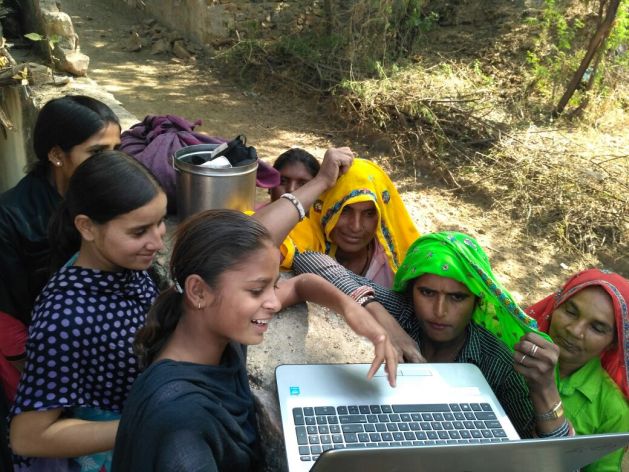
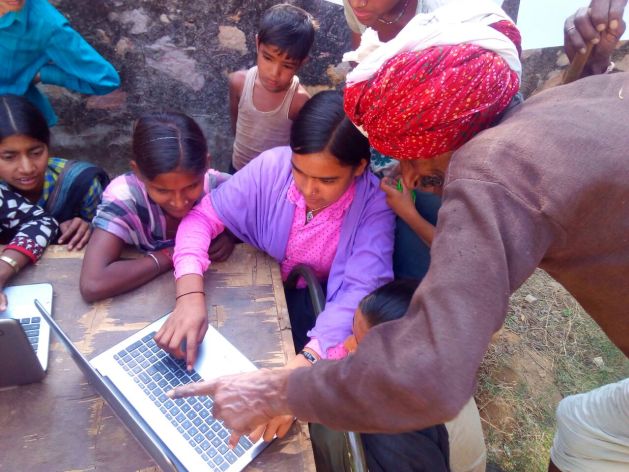
During our work with people living around the Ranthambhor National Park on issues of conservation, livelihoods, and eco-development, a constant question we were asked was how long we thought we could continue helping them. And then, an accompanying question — would their children never be in a position to help themselves? To advocate for and implement the change they wanted to see?
People had been led to believe that sending children to school was a precondition for a better future. Despite this, what they kept seeing was that the education system accessible to them was not equipping their children with the skills and abilities that they required to negotiate better futures for themselves.
Poor solutions for poor people
Working in Sawai Madhopur made us painfully aware of the community’s past experiences with education. Over time they had experienced the Shiksha Karmi Programme (which trained daughters-in-law to run schools), and the Rajiv Gandhi Pathshalas (which trained a young person who had passed Class 10, to run schools), not counting their countless experiences with government schools in the larger villages, most of which were sub-optimal.
When we look at the pitfalls of the government schooling system — be it teacher absenteeism, quality of textbooks, a lack of adequate infrastructure, constrained budgets and human resources — and the plans or schemes that have been created to address them, we realise that most of them could be categorised as ‘poor solutions for poor people’.
People often believe that the problems in the education space have more to do with curricula or pedagogy, or with the capacity of teachers. We disagree. The main issue is that today, communities are missing from the school ecosystem.
The current school system has made communities passive recipients of whatever the government tosses at them, giving them no say in the functioning of the school. It does not work with the community to help them actively engage with the process.
People don’t understand the gap between their aspirations and reality
The idea that any kind of education should lead to a job (preferably a government one) is prevalent amongst the communities we work with. However, what is less clear is how exactly that will happen, and what the probability is of it happening at all.
People had begun to realise that their education system was leaving children under prepared – they may have completed class 10 or 12, but their capacities and skill sets were far lower than they should have been – making it impossible for them to find the job they dreamed of, or continue on an educational path that would get them there.
What’s worse, by dedicating most of their time and resources to school, these children were sometimes unable to take up their traditional occupations – be it in agriculture or livestock rearing – making them incapable of earning a substantial income.
In such a situation, with huge gaps between their reality and aspirations, young people often found themselves helpless. There was scarcely anyone in the village who could have told them what needed to be done to become a doctor, engineer, bureaucrat, lawyer, entrepreneur – or what it entailed.
Despite this, children would go through their schools and come to urban centres looking for opportunities – be it that elusive government job or being a professional. It was only upon reaching the cities that they would realise how under-prepared they were, and as a result end up taking whatever work they could get–as waiters, drivers, cleaners, helpers, construction workers and similar positions in the informal sector.
It is no surprise then, that when it came to education, people in the community were losing faith in government schools.
Communities are the main stakeholder in their education
People often believe that the problems in the education space have more to do with curricula or pedagogy, or with the capacity of teachers. We disagree. The main issue is that today, communities are missing from the school ecosystem.
The community is the biggest stakeholder in the education space, and they need to be treated as such. People need to have a real idea of what they can expect from the system, and they need the system to be accountable to them. This has never happened.
So while there is plenty of work being done to train teachers, help principals, build the skills of School Management Committees (SMCs), design curriculum and change pedagogy, there is not enough being done with parents and community members. Even though parents make up the bulk of the SMC, they tend to be involved only in issues related to infrastructure or for instance, looking at teacher attendance or organising events – essentially any activity that is easy to monitor and does not demand engagement in processes.
It is time that we understood that education is about creating the right ecosystem for learning to happen, and that a village and its community are part of that process. When families have a better understanding of learning processes, they will also ensure that the home environment provides the right encouragement. When community members are able to offer their knowledge—as farmers, mechanics or officers in government—to students, they are teaching children about different possibilities in their future. It is only through involvement of the community that people will learn to ask the right questions, to seek accountability from the system. SMCs, being a subset of the community, offer a channel to do this. And if the community is aware, the SMCs will also function well.
For change to occur, communities must be more aware, and in charge of their education.
Photo Courtesy: Sachin Sachdeva
Working with communities to improve the education system
Having said that, we have to keep in mind that today, most communities, having been passive recipients of education thus far, are unprepared to challenge the system. It is therefore essential that we work to change this.
Based on our work at Gramin Shiksha Kendra (GSK) – an organisation which works with communities to enhance the quality of education in government schools – over the last 14 years, here are some suggestions on how this can be done:
1. Give them positions of seniority/power
Include members of the local community in your organisation board and involve them in the decision making. For example, at GSK we have people from the community on our board – some of them are parents who missed the opportunities of a quality education for their children, and two of them have never been to school but bring in their insights, wisdom and understanding of the local context.
These community members have guided and helped the organisation evolve its strategies, brought concerns and aspirations of the people to the board, and cautioned us against taking decisions that might not have the right impact.
2. Change your metrics of success
For example, we have kept the strength and management capacities of the school management committees as our apex indicator of success/failure, rather than only focussing on learning outcomes. We believe that when the schools and government-appointed school teachers become accountable to the SMC, and the SMC is in a position to guide and manage, the initiative will have succeeded.
3. Involve them in the work being done
Members from the community are invited to teach in the schools as guest teachers. Their experiences add to the curriculum of the school and are adapted for the schools. To be a teacher is still a valued profession, which gives parents a sense of importance and respect in the area.
Additionally, in an attempt to create a community-led ecosystem for education, we have an annual education festival called Kilol in our villages. The village community takes responsibility to organise Kilol’s and GSK shares, through exhibits and processes, our ways of teaching science, language, math, as well as the importance of components like pottery, sport and carpentry. The festival gives everyone in the community an opportunity to celebrate learning and understand what happens in school.
4. Give the initiative that is for them, to them
Our latest attempt is in handing over one of the schools that GSK set up back to the community to manage. That is when the school will become truly community-owned and community-managed.
We made this possible by, over the last 14 years, giving different members from the community a chance to be a part of the SMC. This has resulted in over 35 members in the community who have at one point or another been members of the SMC.
Because of their experience, the SMCs will soon be able to take over the management of the school and run it. GSK plans to facilitate this process and will help the SMC and the community evolve a future course of action – whether that leads to a science education initiative in the area, a comprehensive school, or an outreach programme.
This is important, as it defines our education initiative in the area. We don’t intend running the schools for ever, we want the community to take over. This will be our biggest success and we will continue providing them the technical support – or any other support that they may require. Most importantly, by giving the school back to the community, we are giving power back to the people – which is where it should be.
Sachin Sachdeva is a Co-Founder of Gramin Shiksha Kendra, www.graminshiksha.org.in , an organisation which works with communities to enhance the quality of education in government schools. Sachin has worked with development initiatives over the past 25 years and has been working with communities to help them look at their futures from a position of strength. GSK works with over 70 schools around the Ranthambhor National Park and along with the community runs three schools, one of which has been set up in a rehabilitated village. He is currently Director of the Paul Hamlyn Foundation’s India programme.
DEWAS, India, May 3 2019 (IPS) – No external force can bring about real change in society. Only the community itself can.
There are 650 districts in India. However, most nonprofits work only in a few districts. Given how large our country is, there are only two types of people that can work towards creating change at scale – the communities that are facing the issues first hand, and the government.
The government has not been able to work on issues related to social justice in the last 60 years. Perhaps they think that this is not important enough, or there is no political will to do it. So, we at Jan Sahas, chose to involve the community.
We realised that if issues around social justice had to be taken to scale, and if we wanted to create deeper impact,we needed to involve the communities affected. If it didn’t become the community’s own initiative, or if they kept thinking that some civil society organisation or government agency would come and work on their issues, it would never be sustainable.
That’s why in 2001, we started a national campaign named Rashtriya Garima Abhiyan. Centred around the idea of dignity, this campaign was aimed at mobilising Dalit manual scavengers, all of whom were women. We wanted to empower them to move out of this work and enable them to scale up the programme on their own. We thought that working with manual scavengers would be a good entry point to work on ending exclusion.
Caste-based marginalised communities in our country have faced historical injustice — not just for the last five-six generations, but for the last 2,500 years
But caste-based marginalised communities in our country have faced historical injustice — not just for the last five-six generations, but for the last 2,500 years. Even if they earn money and stop doing caste-based work, the social stigma never goes away. Even if the person becomes a collector, or starts an enterprise, the discrimination continues.
We need three types of rehabilitation
If people have to come out of caste-based work, they need three types of rehabilitation:
1. Economic or livelihood rehabilitation
In the caste-based work of manual scavenging, the biggest issue is that the oppressor or employer provides them food, clothing and shelter. In rural India, they get two rotis every day, clothes twice a year — during Holi and Diwali, and the panchayat gives them a place to stay, So, in essence, their basic needs of roti-kapda-makaan are taken care of by the person or the institution that employs them. What this means though is that they are unable to negotiate with their employers.
If you are going to get paid in cash for work, you can negotiate. For instance, if the employer says ‘I will give you INR 20’, you can say, ‘No, I will charge INR 50’. But if your life itself is dependent on what they give you, then you can never negotiate.
Therefore, if we have to start changing the way caste is viewed and reinforced, we have to start with economic rehabilitation. If marginalised caste groups get work which pays them in cash, they can negotiate the terms for their wages, working conditions, dignity and relationships at the workplace.
However, this is only step one. The second, and more important one, is social rehabilitation.
2. Social rehabilitation
The government never thinks about this aspect. Under social rehabilitation, if someone gives up their (caste-based) work, they should be given work that factors in the social aspect as well.
For instance in 2013, we appealed to several state governments; we said that when you appoint ICDS workers and helpers — positions that do not require an educational background, offer INR 3,000-4,000 monthly salary and where the employee has to be a woman, give priority to the women from the manual scavenging community.These women could prepare the meals provided under the ICDS scheme, and all children regardless of their caste would eat that food.
This process was started in Uttar Pradesh but many powerful groups forced the state to rescind the order; today it is no longer compulsory. In Madhya Pradesh on the other hand, while there was some struggle to start with, it has now been firmly established in many districts.
The discrimination extends across several government schemes. In many villages, where the PMAY is being implemented, Dalit communities are given homes in a separate place. They call it a ‘colony’ and it is commonly understood to be land outside the village. However, all the resources such as electricity, water, anganwadis are available only inside the village.
If you want to stop caste-based practices, you cannot work with the excluded people alone. Other related stakeholders have to be held accountable. Like they say in the gender discourse — if you want to end sexual violence, you have to get the male members of the community involved.
3. Political rehabilitation
Being political is not about party politics. It is about the power of representation. If women from excluded communities want to be part of the local panchayat, they should have the space to do so. The problem is, that today, they don’t have this space.
For example, we started a campaign with rape survivors, that they should contest elections for the panchayat. As a result of this campaign, 104 women participated in panchayat elections. Almost 50 percent of them won. Many of them contested on unreserved seats. They fought and they won. The idea was for them to challenge the power structure.
In some places we had to work with their family members as well, in some with the society at large. When these excluded women gain power, then at some level, the discrimination stops.
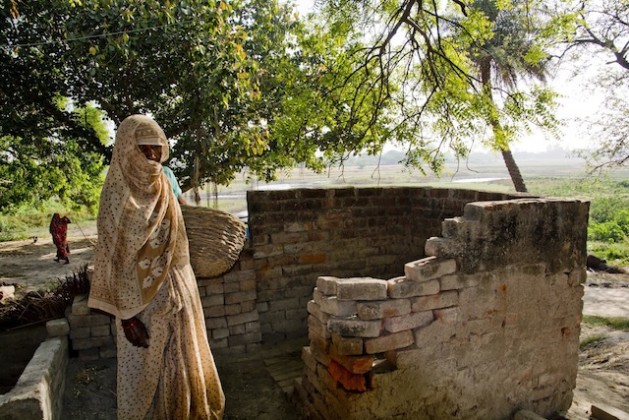
A Dalit woman stands outside a dry toilet located in an upper caste villager’s home in Mainpuri, in the northern Indian state of Uttar Pradesh. Credit: Shai Venkatraman/IPS
It takes years to break social barriers, even among the marginalised
Jan Sahas works with manual scavengers, rape survivors and young girls who have been forced into commercial sexual exploitation. One of the biggest challenges we face is that it is very difficult to make these communities come together. Getting ‘outsiders’ to change their social behaviour requires work at a different level. But even within these disadvantaged groups, people follow discrimination and untouchability practices.
For example, in Bhaurasa, a village in Madhya Pradesh, we had women who had managed to stop doing caste-based work. There were 17 women from the Valmiki community, and 10 from the Hela community. Valmiki is a Dalit Hindu community, while Hela is a Muslim community. It took us three years to bring them together in one place for a meeting.
For two and a half years, we conducted meetings with adults in the community to convince them. Despite that we failed to change their beliefs. But when we started working with the young — using games and activities — it took almost no time.
One of the games we played was taking one child from the Valmiki community and the other from the Hela — one a Dalit and the other a non-Dalit. We told them that the Dalit child would become non-Dalit for a day, and vice versa.
We observed a big change in behaviour. The children soon realised that what one was doing with another human being was not based on any rationale. There is no rationale for caste discrimination, and that it didn’t make sense to follow this nonsensical practice.
The activities brought about a change in the children; they then started convincing their families and the families changed because of the children’s intervention.
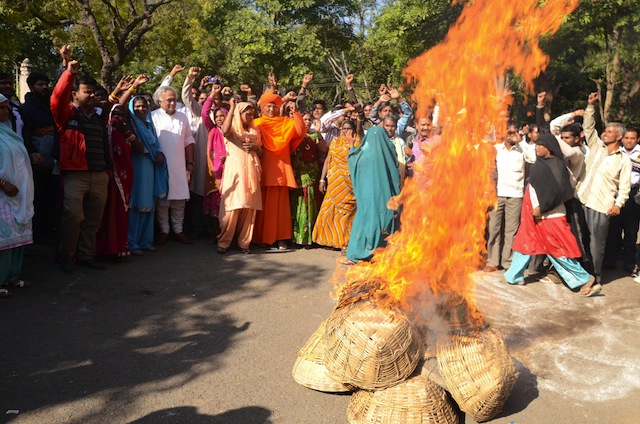
At a rally in New Delhi, Dalit women burn baskets used to collect human waste as a sign of protest against the caste-based practice of ‘manual scavenging’. Credit: Shai Venkatraman/IPS
Communities can solve their own problems. All they need are platforms.
Most of us in civil society who work with marginalised communities feel that ‘we are going to give them something’, ‘deliver’ something. In reality though, no one really is in a position to deliver anything to the community. What do we really know about the communities? How can we assume leadership on their behalf when we don’t know enough?
Consider the Dignity March where 25,000 rape survivors travelled over 10,000 kms and spoke openly in public forums about being raped. Jan Sahas might have coordinated the march, but the idea was not ours.
We were conducting a meeting in a village. There were four rape survivors along with their family members. One of the women said that there had been a conviction in her case, while a second women said that she was still struggling with her case and was facing many problems. The families were fighting among themselves, and demanding answers from us, saying if one woman’s case was solved, why wasn’t there a judgement yet in the second case?
One of the rape survivors told us: “You don’t explain what the problems are; let the woman who got the conviction explain to the others what steps need to be taken and how they can bring their own case to a closure”.
When she started explaining, the idea clicked in our minds; that instead of us doing this work — going to each village and talking to all the families about how to fight their cases — what if 1,000 rape survivors came together in one place and travelled all over the country and explained how to get a conviction to other survivors.
Nonprofits should only play the role of facilitators
We can’t be leaders of the manual scavengers, or rape survivors, or communities who are involved caste-based commercial sexual exploitation. They are their own leaders because they know what that pain has meant in how they live their lives. We cannot even imagine how much power or courage is required to change this situation.
No one else can do it — no Chief Minister or Prime Minister can work on it as effectively as a rape survivor can work on rape, or manual scavengers can work on their own issues. We need to understand this.
The role of the government or nonprofits is limited in this. We can help create appropriate forums for them; but it is they who will come up with the strategies. During the march, we observed this very clearly: people who’ve been facing oppression and discrimination, were ready to take up the struggle; they were ready to find solutions. What they needed was a platform to talk about their issues.
The current strategies which are made by the government or other institutions, rarely involve the affected communities. But no external force can bring about real change in society. Only the community itself can.
Translations from Hindi to English by Anupamaa Joshi.
Ashif Shaikh is an Indian social activist, known for his role in Rashtriya Garima Abhiyan, a campaign for the eradication of manual scavenging. He is also a co-founder of Jan Sahas, a human rights organisation. Since 2000, Jan Sahas has been working to end caste- and gender-based slavery and violence through the eradication of manual scavenging, caste-based sex work, forced labour, and trafficking. He has won several awards for this work, including the Sadbhavana Award and the Times of India Social Impact Award.