International Humanitarian Law is at Breaking Point – but not Beyond Repair

Armed Conflicts, Civil Society, Crime & Justice, Democracy, Global, Headlines, Human Rights, IPS UN: Inside the Glasshouse, TerraViva United Nations

Opinion

Credit: UNICEF/Eyad El Baba

 
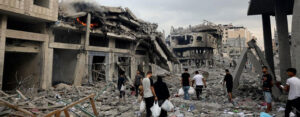
What is international humanitarian law? Families flee their shattered homes in Tal al-Hawa neighbourhood in Gaza city. While aid workers serving conflict-affected civilian populations depend on a set of laws to protect them, some warring parties violate these global agreements, from targeting hospitals and schools to blocking aid workers from reaching civilians with lifesaving goods and services. Source: UN News

GENEVA, Feb 17 2026 (IPS) – International humanitarian law is at a breaking point, as rampant impunity for serious violations is enabling even greater abuses against civilians and detainees.


Across today’s wars, violations are no longer concealed or exceptional. They are increasingly open, systematic, and unpunished, with catastrophic consequences for those whom the law is supposed to protect.

New analysis of 23 situations of armed conflict between July 2024 and the end of 2025 reveals a consistent pattern: civilians are being killed, abused and starved at scale, while accountability mechanisms either falter or are actively undermined. Genocidal violence in Gaza, a renewed risk of genocide in Sudan, and mass atrocities elsewhere are not isolated horrors. Taken together, they point to a deeper failure – the collapse of meaningful restraint in the conduct of hostilities.

Conflict-related sexual violence has reached epidemic levels. Rape, sexual slavery, and sexual violence used as punishment or as a tool of territorial control have been documented across multiple conflicts, including in Colombia, the Democratic Republic of Congo, Myanmar, and Sudan. Particularly alarming is the growing number of cases involving attacks children, including victims as young as one.

These are not by-products of war, but violations long prohibited under international humanitarian law, now committed with near-total impunity. This occurs with the complicity of many other States, which have a duty to respect and ensure respect international humanitarian law.

This erosion of civilian protection is not primarily the result of gaps in legal knowledge. The rules exist. The problem is political choice – and a persistent failure to enforce, clarify and update the law where it no longer offers meaningful restraint.

Nowhere is this clearer than in the global arms trade. The United Nations Arms Trade Treaty has been widely ratified, including by major exporters such as China, France, and the United Kingdom. In theory, it requires its member States to deny arms transfers where there is a clear risk that weapons will be used to commit serious violations of international law. In practice, legal risk assessments are all too often overridden by strategic and political considerations.

Continued arms exports to Israel, Russia, and others, despite overwhelming evidence of civilian harm, have had devastating consequences on the ground.

Closing this gap does not require a raft of new rules in the short term. It requires the consistent application of existing ones: enforceable, evidence-based export controls; independent scrutiny of licensing decisions; and real accountability where transfers are authorised despite a clear risk that the law will be breached by the recipient.

Certain categories of weapons are though incompatible with the protection of civilians, but do not necessarily violate the already permissive standards. Repeated firing into populated areas of gravity ordnance from the air and inaccurate long-range artillery from the ground has been a major driver of civilian casualties across multiple conflicts.

There is a fundamental lack of clarity on two key rules: first, how close an attack may be launched to a military target while still complying with the law; and second, how much incidental civilian harm is permissible when targeting a military objective.

On both issues, the law urgently requires clarification. Restricting air-delivered weapons to precision-guided munitions alone would already make a measurable difference to civilian survival. Achieving this, however, requires States to clarify and update the rules of international humanitarian law that were drafted in the 1970s.

In State-on-State conflicts such as in Kherson province in Ukraine, drones have been used by Russian forces – and others – to target civilians, sometimes with real-time video footage disseminated online by the perpetrators.

At the same time, armed drones are no longer the preserve of States. Their use by non-State armed groups is increasing rapidly, including by JNIM in the Sahel, Islamic State in Somalia, and the Arakan Army in Myanmar. There is an urgent need for stronger mechanisms to attribute, investigate, and prosecute unlawful drone and autonomous weapon attacks.

Impunity on this scale is not inevitable. It is the product of sustained political and financial neglect. Institutions designed to promote compliance with international humanitarian law – including domestic courts and international tribunals – are under severe strain, with some facing paralysis or closure due to lack of resources.

Judges at bodies such as the International Criminal Court have even been sanctioned simply for carrying out their mandates. If States are serious about protecting civilians, political and financial support for these institutions must be treated as a core obligation and a policy priority, not an optional gesture.

The current moment represents a critical test for international humanitarian law itself. The international lawyer Hersch Lauterpacht once warned that the law existed at the “vanishing point” of international law. That warning is no longer theoretical.

Whether humanitarian law continues to function as a real constraint on warfare, or recedes into symbolic rhetoric, will depend on the political choices states make now – and on whether civilian protection is treated as a legal duty rather than a discretionary one.

Stuart Casey-Maslen is an international lawyer and lead author of War Watch: International Humanitarian Law in Focus at the Geneva Academy of International Humanitarian Law and Human Rights

IPS UN Bureau
  Source

The Veto May be the Weapon of Elimination in the Election of Next UN Chief

Civil Society, Featured, Global, Global Governance, Headlines, IPS UN: Inside the Glasshouse, TerraViva United Nations

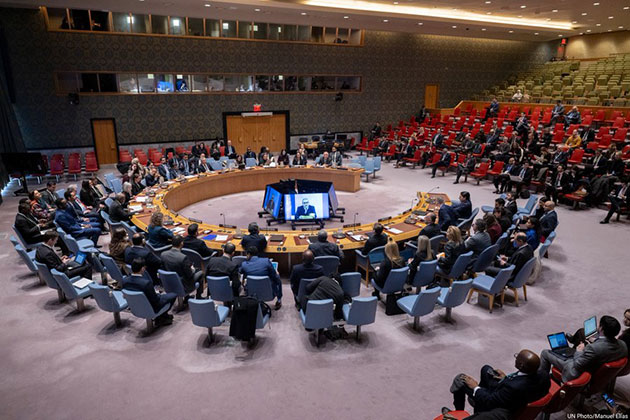
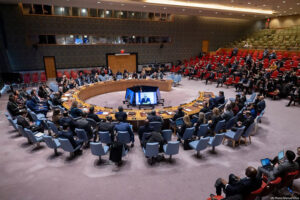
The Security Council armed with veto powers. Credit: UN Photo/Manuel Elías

UNITED NATIONS, Feb 17 2026 (IPS) – As the campaign for the next Secretary-General gathers momentum – at a relatively slow pace – there is widespread speculation that any candidate running for the post of UN chief will have to abide by the dictates of a politically hostile White House or face a veto in the Security Council.


So far, there are only two declared candidates: former Chilean President Michelle Bachelet and former Director-General of the International Atomic Energy Agency (IAEA) Rafael Grossi from Argentina—with more candidates expected to join the race.

The winning candidate, who will take office in January 2027, will be elected by the 15-member Security Council and subsequently ratified by the 193-member General Assembly (UNGA).

Annalena Baerbock, the president of UNGA, said the selection process is already underway, and the interactive dialogues with candidates have been scheduled for the week of 20 April, where they will present their “vision statements”.

Meanwhile, the US has publicly declared its opposition to some of the basic goals in the UN’s socio-economic agenda, including gender empowerment and policies relating to diversity, equity and inclusion (DEI), while dismissing climate change as “a hoax” and a “giant scam.”
The Trump administration has also downplayed human rights and adherence to international laws—two concepts ingrained in the UN system.

In an interview with the New York Times last January, President Trump said he does not “need international law” to guide his actions, arguing that only his own “morality” and “mind” will constrain his global powers.

So, what would be the fate of any candidate— male or female—who advocates these UN goals? Will there be a battle of the vetoes – as it happened in a bygone era?

Richard Gowan, Program Director, Global Issues and Institutions, International Crisis Group (ICG), who oversees ICG’s work on geopolitics, global trends in conflict and multilateralism, told IPS nobody knows how this race will end.

Obviously UN-watchers will be tracking the initial candidates’ vision statements and public appearances over the coming months, he pointed out.

“But diplomats in New York have a suspicion that the veto powers in the Security Council may suddenly announce support for a new candidate at the last minute to circumvent the entire public process. There is a strong sense that the U.S., China and Russia don’t want to be boxed in by the General Assembly.”

There is also a scenario, he said, where the veto powers cannot agree on a candidate, and the Council ends up grinding out discussions of a candidate right through to December.

“UN officials have even done some contingency planning for what happens if there is not an agreed candidate on 1 January 2027. It is possible that the Security Council might ask Guterres to hang on for a few months, although I don’t think either diplomats or Guterres want that outcome.”

There are definitely a few senior UN officials and ambassadors in New York who wonder if the Council could call on them at the very last minute, said Gowan.

Thomas G. Weiss, Presidential Professor Emeritus, Political Science, and Director Emeritus, Ralph Bunche Institute for International Studies at the CUNY Graduate Center, told IPS it is hard to imagine anyone running for UNSG who would not run into a veto from Washington in a candidacy necessarily addressing the values of cooperation (multilateralism of any shape) as well as honestly discussing such issues as climate, gender (male or female), nuclear proliferation, Palestine, and sovereignty—all “hoaxes” or “con jobs” according to DJT (President Trump) and his junta.

Both the 1996 and 1981 elections, he said, provide “models.”

“The Chinese vetoes probably are the most relevant precedent for Washington going to the mat indefinitely until an “acceptable” candidate emerges. Let’s hope that person is as competent as the compromise of 1996, Kofi Annan”, he declared.

In 1981, Salim Ahmed Salim of Tanzania, was backed by the Organization of African Unity, the Non-Aligned Movement and China. But his bid was blocked by a US veto.

In 1996, a second five-year term for Boutros Boutros-Ghali of Egypt was vetoed by the US – even though he received the support of 14 of 15 members in the Security Council.

In 1981, China cast a record 16 vetoes against Kurt Waldheim to prevent a third term, leading to his withdrawal and the selection of Javier Pérez de Cuéllar.

Meanwhile, there has been an intense campaign for a female UN chief, the first in the 81-year history of the UN. But the US has remained tight-lipped on the widely supported proposal.

The last 9 secretaries-general, all males, include:

António Guterres (Portugal), who took office in January 2017;
Ban Ki-moon (Republic of Korea), from January 2007 to December 2016;
Kofi A. Annan (Ghana), January 1997 to December 2006;
Boutros Boutros-Ghali (Egypt), January 1992 to December 1996;
Javier Pérez de Cuéllar (Peru), January 1982 to December 1991;
Kurt Waldheim (Austria), January 1972 to December 1981;
U Thant (Burma, now Myanmar), who served from November 1961, when he was appointed acting Secretary-General (he was formally appointed Secretary-General in November 1962), to December 1971;
Dag Hammarskjöld (Sweden), from April 1953 until his death in a plane crash in Africa in September 1961; and
Trygve Lie (Norway), who held office from February 1946 to his resignation in November 1952.

As for the U.S., said Gowan, “I don’t believe that Washington has settled on a candidate yet. But the Trump administration is definitely conscious that they have the power to reshape the political culture of the organization if they find someone who aligns with their views”.

He said U.S. diplomats have told other veto powers that they will hold back on various reform proposals and cuts until they have their own candidate as Secretary-General.

A lot of UN members assume that the U.S. won’t accept a female Secretary-General but I think that Washington could back a woman if she was a strong social conservative and willing to make large cuts to the UN system, he argued.

“Right now, there is not an obvious female candidate meeting those criteria, though. I think some candidates who could never align with the U.S. on things like development and diversity are already stepping out of the race.”

Meanwhile, there is a reason that Mia Mottley has gone from being the putative front runner to refocusing on domestic politics.

“I also think that all candidates recognize that they are going to have to talk a lot more about how they will advance the UN’s work on peace and security, which is a priority not only for the U.S. but a lot of member states.”

“That said, one senior UN diplomat recently told me that they cannot see Global South countries accepting another Western candidate after Guterres, regardless of gender. The non-Western members of the Security Council could create a blocking minority in the Security Council to keep candidates from U.S. allies out,” declared Gowan.

IPS UN Bureau Report

  Source

IRAN: ‘Sustainable Change Will Depend on Domestic Organisational Capacity, Not External Force’

Active Citizens, Civil Society, Crime & Justice, Economy & Trade, Featured, Headlines, Human Rights, Middle East & North Africa, Migration & Refugees, Press Freedom, TerraViva United Nations

Feb 16 2026 (IPS) –  
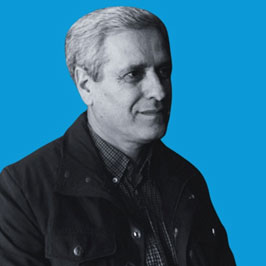
CIVICUS discusses the recent protests in Iran with Sohrab Razaghi, executive director of Volunteer Activists, a Netherlands-based diaspora organisation empowering Iranian civil society.


IRAN: ‘Sustainable Change Will Depend on Domestic Organisational Capacity, Not External Force’

Sohrab Razaghi

Protests triggered by economic grievances erupted across Iran on 28 December, quickly evolving into broader anti-regime protests. The crackdown that followed resulted in what may be the largest massacre in modern Iranian history.

What sparked the protests, and in what ways were they different from previous ones?

Rising prices and the collapse of the national currency initially sparked the protests, but these quickly expanded beyond economic grievances. At least in part, this is because the economy is no longer seen as a purely technical issue but as a measure of the state’s ability to govern. A central question among social groups now is whether the government can manage crises and provide sustainable solutions.

Anger has built up, reflecting broken promises and lost futures. Over the past three decades, four major protest waves – in 2009, 2017, 2019 and 2022 – were met with repression, denial or superficial reforms. This pattern has produced a strong sense of humiliation and political voicelessness.

But perhaps the most decisive factor in the latest wave of protests has been the role of Generation Z, a generation that did not experience the 1979 revolution or the war with Iraq and does not have the ideological attachments of earlier generations. The dividing line is not just age but also expectations, lifestyles and values. While previous generations used to hope for gradual reform within the system, now many young people see no viable future within the current framework. For them, the most rational responses to what they perceive as a structural dead end are disengagement, migration or radical protest.

Recent protests, particularly those of 8 and 9 January, also reflected shifts in protest dynamics, with higher levels of violence visible in both rhetoric and practice. This escalation likely reflects accumulated frustration and political deadlock, but doesn’t necessarily indicate that the state has weakened. Security forces so far appear cohesive and operationally effective, and there are no clear signs of fragmentation inside the coercive apparatus.

But the rise in violence is troubling for democratic forces and civil society. When violent tactics become prominent, organised civic initiatives are marginalised and security-driven narratives prevail, weakening sustained civic action.

Additionally, Israeli and US statements expressing support for protesters and threatening military action had contradictory and largely negative effects.

While such rhetoric initially generated hope among some protesters, the lack of follow-up produced disillusionment and scepticism. Most importantly, statements by foreign governments, including Israel and the USA, strengthened the regime’s narrative. They enabled the authorities to frame protests as the products of foreign interference and protesters as instruments of external powers, including claims of involvement by Mossad agents. This narrative was very useful to justify securitisation and repression.

How have civil society and the media documented human rights violations amid internet shutdowns?

During near-total internet blackouts, local and community-based groups played crucial roles. They recorded the time and location of incidents, collected testimonies from multiple sources and preserved legal, medical and visual documentation while observing basic digital security principles.

When limited internet access became available, information was shared securely with international partners and diaspora networks. These networks helped archive data, liaise with human rights organisations and media and reduce pressure on activists operating inside Iran. International human rights organisations then cross-checked and verified reports before incorporating them into official documentation. Because communication shutdowns, security risks and restricted access to evidence prevented full documentation, they typically presented casualty figures and details of repression conservatively. At the same time, fake news and baseless casualty figures are also prevalent in diaspora and international media reports. It is essential to interrogate such reporting to preserve the credibility of fact-checked, evidence-based reports.

Under severe restrictions, independent and evidence-based documentation has been essential to preserve truth, counter denial and lay the groundwork for future accountability.

What’s limiting sustained pressure for change?

Recent protests have not expanded into broader forms of social organisation. Participation by labour unions, local networks and professional associations has been limited, restricting the potential for sustained institutionalised pressure. Without stronger organisational structures, documentation of abuses won’t necessarily translate into coordinated civic action. Social media-based coordination and mobilisation are effective for the start and first phase of protests, but on-the-ground leadership, networks and organising capacity are instrumental for sustaining protests and increasing pressure for change.

At the discursive level, significant attention has focused on appeals for foreign pressure rather than on building internal coalitions among social groups. In some cases, rhetoric has centred on state collapse rather than democratic transition, a framework that risks instability and further social fragmentation. The use of profanity and violent language – both inside Iran and among the diaspora community – has also alienated families and moderate groups, narrowing rather than broadening support.

Ultimately, for protests to evolve into movements capable of exerting sustained pressure for change, what’s needed is inclusive organisation, coalition-building and a unifying narrative.

What should the international community do to strengthen Iranian civil society?

Sustainable change will depend on domestic organisational capacity, leadership and representation, not external force. So international leaders should avoid war rhetoric and avoid engaging in any form of military intervention. Historical experience suggests that even limited foreign military intervention is unlikely to weaken domestic repression. Instead, it may well increase regime cohesion, at least in the short term, intensify nationalist sentiment and raise the costs faced by civil society activists, who can be easily portrayed as collaborators and traitors.

When supporting Iranian civil society, international allies should prioritise independent, nonviolent civil society organisations rather than opposition groups advocating violence. Narratives of ‘collapse at any cost’ marginalise civic initiatives and undermine the prospects of democratisation.

Long-term investment in capacity strengthening is essential. This includes supporting civic organising skills, digital security, democratic advocacy, nonviolent action and secure communication tools. Over recent decades, resources and repertoires for change within civil society have been weakened. Sustained engagement is required to rebuild these capacities, with up-to-date resources, techniques and tools.

Monitoring, documentation and evidence-based reporting grounded in credible local sources are among the most effective forms of support. Accurate reporting strengthens prospects for accountability and limits the space for propaganda.

Ultimately, sustainable democratic change in Iran will depend on civil society acting independently, rooted in domestic capacities and supported by context-aware, non-interventionist international engagement.

CIVICUS interviews a wide range of civil society activists, experts and leaders to gather diverse perspectives on civil society action and current issues for publication on its CIVICUS Lens platform. The views expressed in interviews are the interviewees’ and do not necessarily reflect those of CIVICUS. Publication does not imply endorsement of interviewees or the organisations they represent.

GET IN TOUCH
Website
LinkedIn
Sohrab Razzaghi/LinkedIn

SEE ALSO
‘The unprecedented level of violence points to a deep crisis of legitimacy’ CIVICUS Lens | Interview with Feminists for Freedom 09.Feb.2026
‘When international attention decreases, state violence often intensifies’ CIVICUS Lens | Interview with Hengaw Organization for Human Rights 27.Jan.2026
Israel vs Iran: new war begins while Gaza suffering continues CIVICUS Lens 19.Jun.2025

  Source

Multilateralism Reaching Breaking Point

Active Citizens, Armed Conflicts, Civil Society, Democracy, Featured, Global, Headlines, Health, Human Rights, TerraViva United Nations

Opinion

Multilateralism Reaching Breaking Point

Credit: Jonathan Ernst/Reuters via Gallo Images

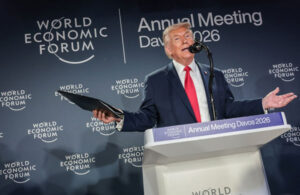
BRUSSELS, Belgium, Feb 13 2026 (IPS) – The latest World Economic Forum made clear the current crisis of multilateralism. Over 60 heads of state and 800 corporate executives assembled in Davos under a ‘Spirit of Dialogue’ theme aimed at strengthening global cooperation, but it was preceded by a series of events pointing to a further unravelling of the international system.


On 3 January, Donald Trump launched an illegal military strike on Venezuela to abduct President Nicolás Maduro, which was widely condemned as a violation of international law. On 7 January, he signed an executive order withdrawing the USA from 66 international bodies and processes, including 31 UN entities, such as the UN Democracy Fund, the UN Framework Convention on Climate Change and UN Women. Then came the launch of Trump’s Board of Peace, evidently an attempt to supplant the UN Security Council. The country that helped build the multilateral system is walking away from the parts it doesn’t like and seeking to reshape the rest in its interests.

Trump’s approach to multilateralism is nakedly transactional. His administration engages with international processes only when they advance immediate US interests and withdraws from those that impose obligations. This disassociates multilateralism from its core principles: accountability over shared standards, equality among nations and universality. It encourages other states to follow suit.

This approach brings devastating financial impacts. US threats to defund international bodies have left institutions scrambling. UN development, human rights and peacekeeping programmes all depended heavily on US financial contributions. The World Health Organization faces shortfalls that threaten its ability to respond to health emergencies because the US government quit without paying its overdue contributions.

The USA’s closest allies aren’t safe. Trump threatened NATO member Denmark with 25 per cent tariffs unless it agreed to the USA’s purchase of Greenland, and suggested he might seize the territory by force. NATO’s Article 5 on collective defence – invoked only once, by the USA after 9/11 – lies in doubt. European states are reacting by seeking strategic autonomy, slashing development aid and reducing UN contributions while finding extra billions for military spending.

Problematic alternatives are looking to capitalise on crisis. At Davos, China positioned itself as the grown-up alternative to Trump, promoting its Friends of Global Governance initiative, a group of 43 mostly authoritarian states including Belarus, Nicaragua and North Korea.

The queue of heads of government meeting China’s leader Xi Jinping shows many states are pivoting this way. But it comes at a cost: in China’s vision of international cooperation, state sovereignty is paramount and there’s no room for international scrutiny of human rights or cooperation to promote democratic freedoms.

It’s the same story with the new Board of Peace. The body originated in a controversial November 2025 Security Council resolution establishing external governance for Gaza, but Trump clearly envisions a permanent, wider role for it. He chairs it in a personal capacity, with full power to veto decisions, set agendas and invite or dismiss members. Permanent membership costs US$1 billion, with the money’s destination unclear.

The Board’s draft charter makes no mention of human rights protections, contains no provisions for civil society participation and establishes no accountability mechanisms. Most members so far are autocratic states such as Belarus, Egypt and Saudi Arabia. Its credibility is further undermined by the fact that Israel has just joined, despite having made a mockery of international humanitarian law. More democratic states have declined invitations, mostly due to concerns about the body’s unclear relationship with the UN. Trump’s response was to threaten increased tariffs against France and withdraw Canada’s invitation. He has made clear he considers himself above international law, casting himself as a de facto world president able to resolve conflicts through personal power and pressure.

As the old order dissolves, civil society must play a critical role in defining what comes next. While the UN – particularly its Security Council, hamstrung by the use of veto powers by China, Russia and the USA – needs reform, it remains the only global framework built on formal equality and universal human rights. As the UN faces assault from those abandoning it or seeking to dilute its human rights mandate, civil society must mobilise to keep it anchored to its founding principles and challenge the hierarchies that exclude global south voices.

It falls on civil society to organise across borders to uphold international law, document violations of international humanitarian and human rights law and demand accountability. Not for the first time, civil society needs to win the argument that might doesn’t make right.

Samuel King is a researcher with the Horizon Europe-funded research project ENSURED: Shaping Cooperation for a World in Transition at CIVICUS: World Alliance for Citizen Participation.

For interviews or more information, please contact research@civicus.org

  Source

‘After Decades of Denial and Silence, the Suffering of Rohingya People Is Being Heard at the World’s Highest Court’

Active Citizens, Armed Conflicts, Asia-Pacific, Civil Society, Crime & Justice, Featured, Gender Violence, Headlines, Human Rights, Migration & Refugees, TerraViva United Nations

Feb 9 2026 (IPS) –  
CIVICUS discusses the genocide case against Myanmar at the International Court of Justice (ICJ) with Mohammed Nowkhim of the Arakan Rohingya Society for Peace & Human Rights (ARSPHR), a civil society organisation led by Rohingya people born out of refugee camps in Bangladesh to document atrocities, preserve survivor testimony and advocate for accountability and justice.


‘After Decades of Denial and Silence, the Suffering of Rohingya People Is Being Heard at the World’s Highest Court’

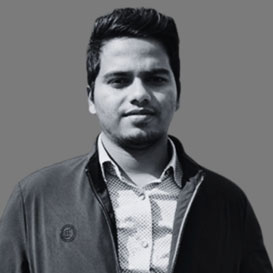
Mohammed Nowkhim

On 12 January, the ICJ began hearings in the genocide case brought by The Gambia against Myanmar over the military’s treatment of the Rohingya Muslim minority. The Gambia, representing the Organisation of Islamic Cooperation’s 57 members, accuses Myanmar of breaching the Genocide Convention. The Gambia’s justice minister presented evidence of mass killings, sexual violence and village destruction during a government crackdown in 2017 that forced over 700,000 Rohingya people to flee to Bangladesh. Rohingya survivors testified in closed sessions. Myanmar denies genocidal intent, characterising its actions as counterterrorism. A final judgment is expected before the end of the year.

What atrocities were committed against Rohingya people and what is being examined in court?

During what were called ‘clearance operations’ in 2017, Myanmar security forces burned entire villages, raped women, killed children and threw them into fires and wells. According to documented reports, over 10,000 people were killed and around 700,000, including me, were forced to flee Myanmar. These were not random acts of violence; they were systematic and targeted attacks aimed at erasing our community.

In 2019, The Gambia, supported by 11 other states, filed a case against Myanmar at the ICJ, accusing it of genocide. Judges are now examining evidence of mass killings, sexual violence, village destruction and forced displacement. They are also reviewing official policies and actions that show intent to destroy Rohingya people as a group, including patterns of violence, coordination by state forces and the systematic denial of basic rights.

This case shows that genocide claims can be examined through law rather than dismissed for political convenience. But for the Rohingya, this is not just a legal process. It represents acknowledgment and a source of hope for present and future generations. After decades of denial and silence, our suffering is being heard at the world’s highest court and recognised in a legal space where truth matters. The hearings can’t erase our wounds, but they can offer some solace and a path towards justice.

What evidence supports the case against Myanmar?

The case was built on years of evidence-gathering. The Gambia relied on extensive material from the Independent Investigative Mechanism for Myanmar and United Nations (UN) fact-finding missions, as well as documentation collected over many years by human rights organisations, including Fortify Rights, Human Rights Watch and Rohingya-led groups.

Civil society played a key role when states failed to act. Even when the world looked away, organisations continued to document the truth and refused to let these crimes be erased or rewritten. Long before any court agreed to listen, groups including the ARSPHR were collecting survivor testimonies, documenting violations and carefully preserving evidence, knowing it might one day be used in court. Without that work, much of what happened would have been lost and perpetrators couldn’t have been challenged.

In a way, civil society became the memory of the Rohingya people. Today, this evidence forms part of the case before the ICJ.

Why is accountability so difficult?

Politics often protects perpetrators. Those with power choose stability over justice and shield those responsible for crimes. Myanmar’s authorities continue to deny wrongdoing and refuse to cooperate, which delays justice.

International law also has its limits. Justice moves slowly because ICJ rulings do not automatically lead to consequences. International courts can establish the truth, but they can’t force states to act. Enforcement depends on political will, often through the UN Security Council, where countries such as China and Russia can block action, even when crimes are clear and well documented.

What must happen to ensure justice?

There must be real action. Perpetrators must be held accountable, Rohingya citizenship must be restored and discriminatory laws that enabled genocide must be removed. Any return of refugees must be voluntary, safe and dignified. It can’t happen without international monitoring and guarantees of protection. People can’t be sent back to the same conditions that forced them to flee.

Ultimately, justice is not only about the past, but also about ensuring that future generations of Rohingya can live with rights, safety and dignity. This case is only the beginning. What happens after the judgment will decide whether justice is real or only symbolic.

CIVICUS interviews a wide range of civil society activists, experts and leaders to gather diverse perspectives on civil society action and current issues for publication on its CIVICUS Lens platform. The views expressed in interviews are the interviewees’ and do not necessarily reflect those of CIVICUS. Publication does not imply endorsement of interviewees or the organisations they represent.

GET IN TOUCH
Website
Facebook
Instagram
LinkedIn
Threads
Twitter
Mohammed Nowkhim/Facebook
Mohammed Nowkhim/LinkedIn

SEE ALSO
Myanmar’s junta tightens its grip CIVICUS Lens 12.Dec.2025
International Court of Justice offers hope of rules-based order CIVICUS Lens 19.May.2025
Myanmar at a crossroads CIVICUS Lens 28.Oct.2024

  Source

‘When Rains Come, Our Hearts Beat Faster’

Aid, Asia-Pacific, Civil Society, Climate Change, Climate Change Justice, Development & Aid, Disaster Management, Economy & Trade, Editors’ Choice, Environment, Featured, Headlines, Human Rights, Humanitarian Emergencies, Sustainable Development Goals, TerraViva United Nations

Disaster Management

A recent report reveals that Asia faces about 100 natural disasters every year, affecting 80 million people. Beyond the statistics are the disrupted lives, damaged homes, and a cycle of repair that drains communities.

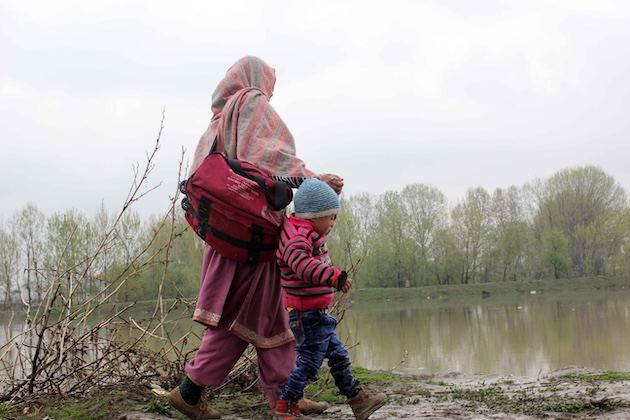
A woman in a remote hamlet in Kashmir, India, migrates to a safer location with her child as floodwater inundates her hometown. Credit: Umar Manzoor Shah/IPS

A woman in a remote hamlet in Kashmir, India, migrates to a safer location with her child as floodwater inundates her hometown. Credit: Umar Manzoor Shah/IPS

SRINAGAR & NEW DELHI, Feb 9 2026 (IPS) – When the rain begins in Kashmir’s capital Srinagar, Ghulam Nabi Bhat does not watch the clouds with relief anymore. He watches them with calculation. How much can the gutters take? How fast will the river rise? Which corner of the house will leak first? Where should the children sleep if the floor turns damp?


“Earlier, rain meant comfort,” said Bhat, a resident of a low-lying neighbourhood close to the city’s waterways. “Now it feels like a warning.”

On many days, the rain does not need to become a flood to change life. Streets fill up within hours. Shops shut early. The school van turns back. A phone call spreads across families, asking the same question, “How is your area?”

For millions across India and the wider region of emerging Asia (a group of rapidly developing countries in the region, including China, India, Indonesia, Malaysia, the Philippines, Thailand, and Vietnam), this is the new normal. Disasters no longer arrive as rare, once-in-a-generation ruptures. They come as repeated shocks, each one leaving behind repair bills, lost wages, and a deeper sense that recovery has become a permanent routine.

A recent analysis from the OECD Development Centre shows that emerging Asia has been facing an average of around 100 disasters a year over the past decade, affecting roughly 80 million people annually. The rising trend is powered by floods, storms, and droughts. The report estimates that natural disasters have cost India an average of 0.4 percent of GDP every year between 1990 and 2024.

Behind the national figure lies a quieter, more poignant story. It is the story of how repeated climate and weather shocks get absorbed by households and not just spreadsheets. By the savings a family built for a daughter’s education. By a shopkeeper’s stock bought on credit. By a farmer’s seed money saved from the last season.

In the north Indian state of Bihar’s flood-prone belt, Sunita Devi, a mother of three, says she has stopped storing anything valuable on the floor. Clothes sit on higher shelves. The grain container has moved to a safer corner. The family’s documents stay wrapped in plastic.

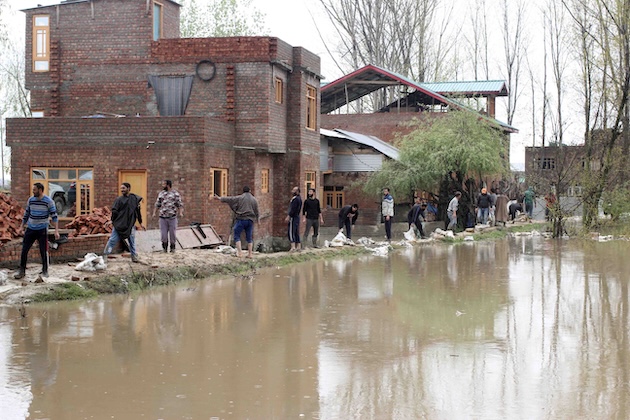
Local residents in Kashmir's capital, Srinagar, stack sandbags to safeguard their homes from floods in 2025. Credit: Umar Manzoor Shah/IPS

Local residents in Kashmir’s capital, Srinagar, stack sandbags to safeguard their homes from floods in 2025. Credit: Umar Manzoor Shah/IPS

“When water comes, you run with children,” she said. “The rest is left to fate. You can rebuild a wall. You cannot bring back the days you lost.”

Her village has lived with floods for decades, but she says what has changed is frequency, uncertainty, and cost. It is not only about big river floods that make headlines. It is also about sudden waterlogging, damaged roads, broken embankments, and illnesses that rise after the water recedes.

“Earlier we could predict. Now we cannot. Sometimes the water comes fast. Sometimes it stays. Sometimes it leaves and then comes again,” Devi told IPS.

Professor Kaveh Madani, director of the United Nations University’s Institute for Water, Environment, and Health, told IPS that water bankruptcy in Asia should be treated as a national security issue, not a sector issue.

“The priority is shifting from crisis response to bankruptcy management: honest accounting, enforceable limits, protection of natural capital, and a just transition that protects farmers and vulnerable communities,” said Madani.

Across emerging Asia, floods have emerged as one of the strongest rising trends since the early 2000s, the OECD Development Centre report notes. The reasons vary from place to place, but the result looks familiar: disrupted lives, damaged homes, and a cycle of repair that drains communities.

In Kashmir’s capital Srinagar, small shop owner Bashir Ahmad keeps an old wooden rack near the entrance. It is not for display. It is for emergencies. When rain intensifies, he quickly moves cartons of goods off the floor.

“My shop is small; my margin is smaller. One day of water is enough to destroy many things. Customers do not come. Deliveries stop. You just wait and watch,” Ahmad said.

He says the biggest loss is not always the damaged stock. It is the days without work. For families that live week to week, even a short shutdown becomes a long crisis. Rent does not pause. School fees do not pause. Loans do not pause.

The OECD analysis, while regional in scope, points to a hard truth that communities already know. It claims that disasters have economic aftershocks that last long after television cameras leave. When repeated losses occur every year, they reduce growth and reshape choices. Families postpone building stronger houses. They avoid investing in small businesses. They spend more time recovering than progressing.

“Disasters are no longer exceptional events. They have become recurring economic shocks. The problem is not only the immediate damage. It is the repetition. Repetition breaks household resilience,” Dr Ritu Sharma, a climate risk researcher based in Delhi, said.

Sharma says India’s disaster losses should not be viewed as a headline percentage alone.

They should be viewed as accumulated pressure on ordinary life.

“A flood does not only damage a bridge. It delays healthcare visits. It interrupts immunisation drives. It breaks supply chains for food and medicines. It can push vulnerable families into debt traps. What looks like a climate event becomes a social event. It becomes a health event. It becomes an education event.”

In the report’s regional comparisons, the burden is uneven. Some countries face higher average annual losses as a share of GDP, especially those exposed to cyclones and floods. India’s size allows it to absorb shocks on paper, but that size also means more people remain exposed. From Himalayan slopes vulnerable to landslides to coastal districts bracing for cyclones to plains dealing with floods and heat, risk is spread across geography and across livelihoods.

Prof. Nasar Ali, an economist who studies climate impacts, says the real damage is often hidden in the informal economy.

“A formal sector company can claim insurance, borrow on better terms, and restart faster. A vegetable vendor cannot. A small grocery shop cannot. A family with a single daily wage earner cannot. Their loss is immediate and personal. They also take the longest to recover,” Ali said.

He believes disaster impacts also deepen inequality because the poorest households lose what they cannot replace.

“A damaged roof for a rich family is a renovation problem. A damaged roof for a poor family can mean sleeping in damp rooms for weeks, infections, missed work and children dropping out temporarily.”

The report also turns attention toward a policy question that has become urgent across Asia: how should governments pay for disasters in a way that does not repeatedly divert development funds?

The analysis highlights disaster risk finance, tools that help governments prepare money in advance rather than relying mainly on post-disaster relief. This includes dedicated disaster funds, insurance mechanisms, and rapid financing that can be triggered quickly after a shock.

For communities, the debate may sound distant. But the outcomes are visible in the speed of recovery and the dignity of response.

“When a disaster happens, help should come fast,” said Meena Devi, who runs a small grocery shop in Jammu’s RS Pura area and has seen repeated waterlogging during intense rains. “We close our shop. Milk spoils. People cannot buy things. Then we borrow money to restart. If support is slow, we fall behind.”

She said her biggest fear is not a single disaster but the feeling that another one is always near.

“If it happens once, you survive. If it happens again and again, you get tired from inside,” she said.

For Sharma, preparedness must be more than emergency drills. It must include planning that reduces exposure in the first place.

“Some risks are unavoidable, but many are amplified by where and how we build,” she said. “If cities expand without drainage capacity, or if construction spreads into floodplains, then disasters become predictable. That is not nature alone. That is policy.”

In Srinagar, Bhat says residents often feel they fight the same battle every year. Cleaning drains. Stacking sandbags. Moving belongings. Calling relatives. Watching the river level updates. The work looks small, but it is exhausting because it never ends.

He pointed to marks on a wall that show where water once reached.

“We always think, maybe this year it will be better,” he said. “Then rain comes, and your heart starts beating faster.”

Asked what would make him feel safe, he did not talk about big promises. He spoke about basics. A drain that works. A road that does not collapse. A warning that comes early. Help that comes on time.

For Sunita Devi in Bihar, the dream is even simpler: a season where the family can plan without fear.

“We want to live like normal people. We want to save money, not spend it on repairing what the water broke,” she said.

IPS UN Bureau Report

  Source