CGIAR Developing Farmers’ Resilience in the Face of Climate Shocks

Civil Society, Climate Action, Climate Change, COP29, Editors’ Choice, Featured, Food Security and Nutrition, Food Sustainability, Global, Headlines, TerraViva United Nations

COP29

Ismahane Elouafi, Executive Managing Director of the Consortium of International Agricultural Research Centers (CGIAR). Credit: CGIAR

Ismahane Elouafi, Executive Managing Director of the Consortium of International Agricultural Research Centers (CGIAR). Credit: CGIAR

BAKU, Nov 16 2024 (IPS) – As COP29 negotiations continue in Baku, agricultural leaders are pitching the need for climate-resilient and data-driven solutions to support marginalized farmers and low-income communities.


In an exclusive interview with Inter Press Service (IPS), Ismahane Elouafi, Executive Managing Director of the Consortium of International Agricultural Research Centers (CGIAR), discusses the impact of digital tools, precision agriculture, and low-emission food systems on achieving a sustainable and equitable food future. 

Inter Press Service: How helpful are digital tools in supporting marginalized farmers?

Ismahane Elouafi: Digital tools offer immense potential, especially in bridging the knowledge gap between agricultural experts and rural farmers who often lack access to information. Over the past few decades, funding for traditional extension services has dwindled, so digital solutions in local languages can fill this void. Imagine a farmer receiving real-time advice on managing water, soil fertility, or disease in a language they understand—this could revolutionize small-scale farming. Additionally, precision agriculture, which tailors input needs to specific locations and soil compositions, allows for highly customized farming strategies that optimize both resources and yields.

IPS: Can you explain how precision agriculture works in practical terms?

Elouafi: Precision agriculture allows us to deliver exact inputs—water, nutrients, or fertilizers—needed for a specific plot. This approach minimizes waste and environmental impact, and it’s especially useful in regions where resources are scarce. For instance, if a plant needs 20 milliliters of water in one square meter but only 10 milliliters a few kilometers away, precision agriculture ensures we don’t overuse resources. Ultimately, the goal is to increase productivity sustainably, producing more output per hectare with fewer inputs, especially in a time where climate pressures demand we be mindful of environmental impacts.

IPS: How essential is biodiversity to resilient farming systems?

Elouafi: Resilience means that after a shock—a drought, flood, or even conflict—farmers can bounce back and continue production. CGIAR’s focus is to provide tools, technology, and genetic resources that make this possible. We’ve developed rice varieties that survive flooding and maize that tolerates drought, helping farmers maintain productivity despite climatic stressors. Another key factor is small-scale irrigation, which allows farmers to respond to drought by providing supplemental water, ensuring resilience and food security.

IPS: You mentioned low-emission food systems. How can agriculture contribute to climate goals?

Elouafi: Agriculture is responsible for about 33 percent of global greenhouse gases. By shifting to low-emission practices, we can greatly reduce methane and other emissions. For example, traditional rice paddies release large amounts of methane. However, alternative wetting and drying practices can cut methane emissions by 30 percent while boosting productivity by 33 percent. In livestock, using specific forages and studying animal gut microbiomes can reduce methane emissions by up to 60 percent. Agriculture is uniquely positioned to sequester carbon through practices like cover cropping and biodiversity, which is crucial in mitigating climate change.

IPS: Could internet and data use enhance climate security?

Elouafi: Absolutely. Digital access and internet coverage in rural areas can provide timely climate information, like rainfall predictions, which empowers farmers to make better planting decisions. With projects like Elon Musk’s nanosatellite network expanding internet access, marginalized farmers can increasingly leverage climate data. CGIAR also focuses on producing accurate data for the Global South, as existing climate models often rely on data from the Global North, which doesn’t reflect realities in places like Sub-Saharan Africa or South Asia. Our data can inform region-specific, actionable climate strategies.

IPS: How does CGIAR support innovations and resilience in vulnerable regions?

Elouafi: CGIAR operates the largest publicly funded international agricultural research network, with a strong focus on least-income countries. Our goal is to close the yield gap between high- and low-income nations by providing bundles of innovations: drought-resistant varieties, small-scale irrigation, processing improvements, and access to markets. By helping farmers integrate these innovations, we ensure they’re more resilient and have a steady income. Additionally, our research helps policymakers design better frameworks to support smallholders and incentivize sustainable agri-food systems.

IPS: What do you hope COP29 will achieve in advancing agricultural and climate agendas?

Elouafi: COP29 must carry forward the momentum from COP28, where the UAE’s Declaration on Sustainable Agri-Food Systems was endorsed by 160 countries. Agriculture, food, and water systems need to be central to climate discussions. As we look to COP30 in Brazil, with its expertise in regenerative and climate-smart agriculture, I hope we continue viewing agriculture not as part of the climate problem but as an essential solution to it. Climate adaptation in agriculture is non-negotiable—lives and livelihoods depend on it.

IPS UN Bureau Report

  Source

Walking with Wisdom: Whaia’s Mission to Bring Indigenous Knowledge to COP 29

Active Citizens, Asia-Pacific, Civil Society, COP28, COP29, COP29 Blog, COP29 Blog, Editors’ Choice, Featured, Gender, Global, Headlines, Human Rights, Indigenous Rights, Sustainable Development Goals, TerraViva United Nations

COP29

Whaia with her daughter Moana at COP29. Credit: Aishwarya Bajpai/IPS

Whaia with her daughter Moana at COP29. Credit: Aishwarya Bajpai/IPS

BAKU, Nov 15 2024 (IPS) Kaitiaki! Whaia says she is at COP29 to bring indigenous wisdom to influence policy and to provide guardianship (kaitiaki) of the climate negotiations.


Whaia, who now lives in Aotearoa, New Zealand, was raised as an Indigenous Aboriginal in Australia, where through her community she led a life of cultural practices that protect the environment.

“Our cultural practices, our cultural ways, and the environment have always been our teacher and our classroom. To recognize our ‘Kaitiaki’ responsibilities is to be with the environment in the way that we have always lived.”

She came here with the Wisdom Keeper delegation and non-profit Indigenous Global Eldership, expressing a preference for saying, “That we are walking with them.” There are 16 members in the delegation with people from all across the globe—Hopi nation, Totemic Mexican, Māori, Palestinian, African, Canadian, Australian, U.S. and Amazonian.

Advocating for people from diverse backgrounds in the policy space, she said, “People are from different places here but united by a common goal. Some of us have been working in this policy space and some of us are new to the policy world. So we are about bridging the gaps between these spaces.”

With regard to promoting Indigenous knowledge, Whaia said, “Sometimes we feel that we don’t know policy. However, if we know our rights of passage, our ancient practices and our protocols, then we know policy. It just gets lost in translation within the language. So we are here to cross the bridge.”

Whaia came to the COP29 with her daughter. Moana beamed when she told IPS that it was Moana’s second COP.
“Moana also walked with the Wisdom Keeper delegation in Dubai last year when she was just seven years old.”

On bringing Moana to COP 29, she said, “I take her to all important meetings. I believe that we should actually bring the wisdom into our younger generation. They are the ones who will inherit the choices that we make.”

Whaia, beautifully playing multiple roles as an indigenous person, policy advocate, feminist, and mother, says, “Time taken to take care of our children is never a burden. Taking care of family are the rights and responsibilities that we all must step into. It starts at home, within our communities and extends globally.”

IPS UN Bureau Report

  Source

Middle East: Ceasefires are the Only Answer

Armed Conflicts, Civil Society, Global Governance, Headlines, Human Rights, IPS UN: Inside the Glasshouse, Middle East & North Africa, TerraViva United Nations

Opinion

A family collecting hygiene kits from Maliha, in Eastern Ghouta, Rural Damascus, Syria. The distribution provided essential items to mostly Syrian and Lebanese families who had fled from the south of Lebanon. Credit: Norwegian Refugee Council

OSLO, Norway, Nov 13 2024 (IPS) – “The shockwaves from Israel’s ongoing and indiscriminate warfare on Gaza and Lebanon are reverberating across this entire region. Neither the horrific assault on Israeli civilians on 7 October 2023, nor the indiscriminate missiles launched by militant groups from Lebanon, can justify the degree of destruction on civilian lives and infrastructure in the region that I have witnessed in recent days.


We cannot wait another day for an end to this senseless violence. For the sake of children across the entire region, diplomacy must result in a sustainable ceasefire.

The people I have met in recent days–from those in Gaza City, to the displaced in eastern Lebanon, to those crossing into Syria–longed for peace so they could return home. Children spoke of how much they missed school and their friends, and parents wished for an end to the precarity and suffering that displacement has brought. The suffering of millions cannot begin to end until those in power push for peace and take action to end the violence.

What I witnessed in Gaza was a society shattered by advanced weaponry, with ongoing military strikes relentlessly impacting the civilian population. War has rules, and it is clear that the Israeli campaign has been conducted with utter disregard for international humanitarian law.

As Gaza has been reduced to rubble, Western leaders have largely stood by unwilling to apply the necessary pressure on the stronger party, Israel, to stop starving the population that they are besieging and bombarding.

In Lebanon, I met people who in just a couple of weeks have lost their homes, jobs and everything in between. They are now staying in almost bare shelters that offer neither protection nor privacy, in fear that the worst is yet to come. The temperature has dropped substantially. People are ill-prepared for what promises to be the coldest winter season for the hundreds of thousands displaced.

Travelling into Syria from Lebanon via the Masnaa border crossing, I saw the huge challenges facing those fleeing violence in Lebanon, exacerbated by vast craters in the road caused by Israeli strikes. Displaced people must be provided with safe passage, shelter, and services.

Those fleeing into Syria arrive in a country with deep, pre-existing economic and humanitarian crises. NRC is providing support to those arriving in Syria, people who took the impossible decision to leave their homes while facing bombardment, and left with only what they could carry.

The aid we and others are currently able to provide is totally insufficient for the needs our staff are seeing. We must be given the right to independently monitor how those who flee from Lebanon to Syria are treated. There must be robust international support to meet people forced to flee, and there must be a genuine, re-energised diplomatic effort from all sides, to halt violence against civilians.

My visit started in Gaza, continued in Lebanon, and finished in Syria, tracing the fallout of this now regional conflict. At each point, the people I met said they wished for only one thing: peace.

Jan Egeland is Secretary General of the Norwegian Refugee Council (NRC). This article follows his visit to Gaza, Lebanon, and Syria.

NRC teams are operating across Gaza, Lebanon and Syria providing essential services to displaced people. This includes items such as mattresses, blankets and hygiene kits as well as cash. We are also providing clean water and sanitation facilities as well as education to children.

IPS UN Bureau

  Source

Scorched Earth Colonizing of Gaza is a Horrible Idea

Armed Conflicts, Civil Society, Democracy, Global Governance, Headlines, Human Rights, IPS UN: Inside the Glasshouse, Middle East & North Africa, TerraViva United Nations

Opinion

Credit: UNRWA

ATLANTA, USA, Nov 11 2024 (IPS) – For religious, humanitarian, and scientific reasons, Israel’s increasingly apparent plan for the de facto colonization of the Northern Gaza Strip is a bad idea. When that program was rejected recently by Israel’s own Defense Minister Yoav Galant, he was summarily fired by Prime Minister Netanyahu.


However, the founding document of the worldwide Jewish community, the Torah, and especially the Decalogue, states plainly, “Thou shalt not covet thy neighbor’s wife…or anything that is thy neighbors.” If religion still means anything to people in the modern nation of Israel, it should be clear that whatever belongs to others should be left alone and neither coveted nor stolen.

For obvious humanitarian reasons the one-sided bombing of Gaza must stop. After more than a year of an ongoing holocaust in Gaza, Israel’s relentless bombing has produced casualties totaling nearly 150,000 dead and wounded people, mostly civilians.

Now with UN sources reporting that starvation is setting in, people everywhere must demand that this racist, inhumane bloodshed stop immediately. Otherwise, international law has no force and the word “humane” has no meaning.

In scientific terms, the contamination of the water, soil, and air in northern Gaza from explosive dust, including Depleted Uranium, will clearly persist for decades, if not generations. That is neither good for the inhabitants if they manage to return to their homes, nor for the Jewish colonists if they should return to their previous colonies in the strip.

US bombing of Iraq two decades ago, especially in and around Basra, as much scientific and eyewitness testimony—including my own on the scene report—proves, has produced a plethora of birth defects.

The idea of some capitalists that Gaza will become a future Dubai—a wealthy trade zone that will be a veritable Las Vegas on the Mediterranean shore—is actually a good one. Geographically and commercially, Gaza is a potential Hong Kong.

The only thing wrong with the plan is the question of who will control this mighty future entrepot, the Palestinians, investors from the Gulf States and the West, or Israel? Answering that will take another century of bloodletting.

Far better that the United States, NATO, the United Nations, the International Court of Justice in the Hague or somebody other than HAMAS or the extreme right wing and increasingly bloodthirsty Likud government now in power in Jerusalem should deal with that issue and guarantee justice.

The ICJ/International Court of Justice, responsible governments everywhere, and especially the campus protesters and those on the streets of cities around the world, must keep chanting, “NO JUSTICE, NO PEACE!” “NO JUSTICE, NO PEACE!”

James E. Jennings, PhD is President of Conscience International and Executive Director of US Academics for Peace

IPS UN Bureau

  Source

When the Truth Becomes a Lie: What Trump’s Election Means for the World as we Know it

Civil Society, Democracy, Global, Global Governance, Headlines, Human Rights, IPS UN: Inside the Glasshouse, TerraViva United Nations

Opinion

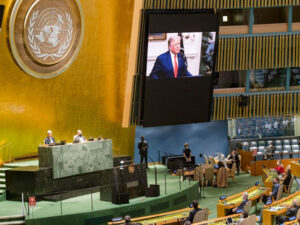
Donald J. Trump, President of the United States of America, addresses the General Debate of the General Assembly’s 75th session September 2020. Credit: UN Photo/Rick Bajornas

NEW YORK, Nov 8 2024 (IPS) – On the day following the US election, UN Secretary General, Antonio Guterres issued a brief statement commending the people of the United States for their active participation in the democratic process. He wisely omitted to mention that the election of Donald J. Trump – who attempted to overturn the people’s mandate by inciting an insurrection in 2020 – is a major setback for the UN’s worldwide quest to advance human rights and the rule of law.


Trump is a self-avowed admirer of authoritarian strongmen like Russia’s Vladimir Putin and Hungary’s Viktor Orban who disdain international norms that the UN seeks to uphold. Unsurprisingly, questions posed to the UN Secretary General’s spokesperson, Stéphane Dujarric, in a press conference on November 6, ranged from what will be Trump’s response to the war in Ukraine to potential funding cuts that might come with the new US administration to whether the UN has contingency plans ready for when Trump takes office.

The US plays an outsized role in global affairs. Therefore, any changes in policy in Washington impact the whole world. As someone who bears responsibility for stewarding a global civil society alliance, it worries me what a second Trump presidency will unleash.

Even without Trump in power we are living in a world where wars are being conducted with complete disregard for the rules; corrupt billionaires are dictating public policy for their benefit; and greed induced environmental degradation is putting us on a path to climate catastrophe. Hard fought gains on gender justice are in danger of being rolled back.

The first Trump administration showed disdain for the UN Human Rights Council and pulled the US out of vital global commitments such as the Paris Agreement to combat climate change. It restricted support for civil society groups around the world and targeted those that sought to promote sexual and reproductive rights of women. Promotion of democracy and human rights are key pillars of US foreign policy.

It’s deeply concerning that when disinformation and misinformation have assumed pandemic level proportions, the majority of the US electorate have cast their vote in favour of a candidate who ran his campaign on divisive dog whistles, half-truths and outright lies. These tactics have deepened fissures in an already polarized United States.

Families countrywide were left devastated by Trump’s negligence and COVID denialism as president which resulted in tens of thousands of Americans dying of avoidable infections. His administration’s immigration detention and deportation policies instilled fear in minority communities. This time Trump has vowed to deport millions of people.

Trump’s stances on abortion rights have caused women immeasurable suffering in several US states that have introduced laws to ban the procedure. He has promised to accelerate harmful fossil fuel extraction and undoubtedly views gender justice advocates, environmental defenders and migrant rights activists as a threat his power.

Given the stated predilections of Trump and his advisors, opposition politicians, activists and journalists exposing corruption and rights violations are likely to be at risk of enhanced surveillance, intimidation and persecution by the new administration.

At the international level, Trump’s election casts a pall over efforts to ensure accountability for war crimes, crimes against humanity and genocidal actions in the Occupied Palestinian Territories, Sudan and Ukraine due to his tacit support for authoritarian leaders in Israel, Russia and the United Arab Emirates, all of whom are fueling conflicts and causing havoc abroad. A future Trump administration could try to starve the UN of funding to erode the rules based international order, emboldening autocrats.

Even if things appear bleak today, it’s important to remember that there are hundreds and thousands of civil society activists and organisations around the world who remain steadfast in their resolve to celebrate diversity and promote justice and equality. To imagine the future we sometimes have to take heart from the past.

India’s freedom struggle, South Africa’s struggle against apartheid and the civil rights movement in the United States wasn’t won by authoritarian leaders but by brave and determined individuals united in solidarity and determined to resist oppression for as long as it takes.

There is a lesson here for civil society in the US that higher American ideals are worth standing up for and will outlive any sitting president.

Mandeep S. Tiwana is Interim Co-Secretary General of CIVICUS, the global civil society alliance. He also serves as CIVICUS representative to the United Nations.

IPS UN Bureau

  Source

UN Arms Embargo on Israel: Dead on Arrival

Armed Conflicts, Civil Society, Featured, Global Governance, Headlines, Human Rights, IPS UN: Inside the Glasshouse, Middle East & North Africa, TerraViva United Nations

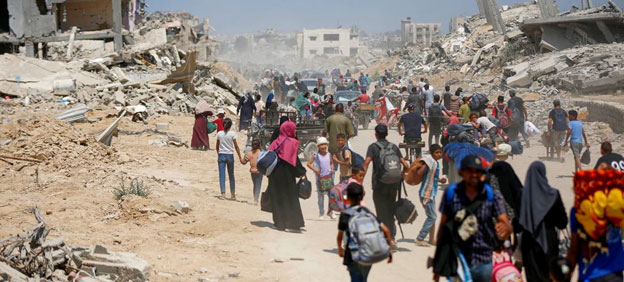
In Khan Younis, thousands of people are fleeing for their lives again. Credit: UNRWA

UNITED NATIONS, Nov 8 2024 (IPS) – When the United Nations imposes sanctions or penalizes a member state – be it the General Assembly or the Human Rights Council – the resolutions are “non-binding” and often remain unimplemented.

But the Security Council resolutions are “binding” – and still openly violated by countries such as North Korea—because all these UN bodies have no means of implementing these resolutions, nor a standing army to forcibly enforce them. But they only carry moral weight.


The Council can also impose its own sanctions, mostly in economic, financial and trade sectors, against violators of its decisions.

And last week there was a move to impose arms sanctions against Israel – and rightly so, judging by the 43,000 plus, mostly Palestinian civilians, killed in Gaza largely with US-supplied weapons since October last year.

But how effective will this be since the strongest opposition will come from the US, an unyielding supporter of Israel, which will unhesitatingly use its veto power if the resolution comes before the Security Council?

Ambassador Anwarul K. Chowdhury, a former UN Under-Secretary-General and one-time Permanent Representative of Bangladesh to the United Nations, told IPS anything short of a real, permanent ceasefire would not create a pathway to end the perpetration of the ongoing genocidal aggression by Israel.

In this context, he said, the joint letter calling on all countries to stop the sale of arms and ammunition to Israel, signed by 52 countries and two UN-recognized multilateral organizations, is meaningfully forward-looking, and contains a purposeful objective of contributing to that “pathway”.

In fact, the Foreign Minister of Turkiye, whose country initiated the letter, asserted that “We must repeat at every opportunity that selling arms to Israel means participating in its genocide.”

“It would be argued rightfully that the United Nations and its apex body, the General Assembly have no powers to enforce such an arms embargo. The Security Council, the sole UN entity which can authorize an arms embargo and obligate the arms suppliers desist from sending arms to the areas of conflict, also becomes powerless if one of the P-5 uses the notorious veto”.

“However, I strongly believe that a General Assembly resolution following the call for the arms embargo to Israel would have a moral value which has its own merit. Despite the politics and power-play which is destroying the UN’s credibility and marginalizing its operational capacity to resolve conflicts, the arms embargo would highlight the principled position taken by the UN,” said Ambassador Chowdhury.

In a way, he pointed out, that would strengthen the Secretary-General’s efforts to promote the much-needed ceasefire.

In the aftermath of Israel’s declaration of the Secretary General as persona non-grata (PNG) and its extension of the attacks on UNIFIL in Lebanon, the General Assembly needs to show that its moral and normative role as envisaged in the UN Charter has not been cowed down by the politics of the frequently-used threat of veto, he declared.

Stephen Zunes, Professor of Politics and International Studies at the University of San Francisco, who has written extensively on the politics of the Security Council, told IPS: “This initiative reflects the view of the vast majority of the world’s governments and peoples and is consistent with imperatives of international humanitarian law, but given that the major arms supplier of Israel is a veto-wielding permanent member of the Security Council, it is unlikely to have much of an impact.”

Also problematic, he pointed out, is that some of the countries sponsoring the initiative, such as Russia and Saudi Arabia, have been guilty not only of similarly providing weapons to those engaging in war crimes but engaging in war crimes themselves.

Turkiye’s foreign minister Hakan Fidan said last week his country had submitted a letter to the United Nations, signed by 52 countries and two inter-governmental organizations, calling for a halt in arms deliveries to Israel.

“We have written a joint letter calling on all countries to stop the sale of arms and ammunition to Israel. We delivered this letter, which has 54 signatories, to the UN on November 1,” said Fidan, according to the Times of Israel.

“We must repeat at every opportunity that selling arms to Israel means participating in its genocide,” said Fidan, adding that the letter is “an initiative launched by Turkiye.”

Among the signatories were Saudi Arabia, Brazil, Algeria, China, Iran and Russia, plus the Arab League and the Organization of Islamic Cooperation (OIC),

Elaborating further, Ambassador Chowdhury said the UN should not forget that the UN’s International Court of Justice which determined that Israel’s occupation of the Gaza Strip and West Bank is illegal under international law. The judgment was followed by a General Assembly resolution last September, demanding Israel leave the occupied territories within a year.

“I am encouraged by the UN’s own 45 Human Rights Experts and Special Rapporteurs, who, driven by their conscience, forcefully called for a ‘permanent ceasefire, … an ‘arms embargo on all warring parties,’ and ‘the deployment of an international protective presence in the occupied Palestinian territory under the supervision of the UN.’ All these well-thought-out measures would only promote dialogue and diplomacy over death and destruction”.

The UN Secretary-General needs to endorse and welcome this call by his in-house experts and recommend to the General Assembly to do the same without any delay, he declared.

Back in April 2024, in a resolution adopted by 28 votes in favour, six against and 13 abstentions, the 47-member Human Rights Council backed a call “to cease the sale, transfer and diversion of arms, munitions and other military equipment to Israel, the occupying Power…to prevent further violations of international humanitarian law and violations and abuses of human rights”.

Presented by Pakistan on behalf of the Organization of Islamic Cooperation, delegates heard that the resolution had also been motivated by the need to stop “egregious” human rights violations in the Occupied Palestinian Territory.

Co-sponsors of the text included Bolivia, Cuba and the State of Palestine, ahead of the vote which saw support from more than two dozen countries including Brazil, China, Luxembourg, Malaysia and South Africa, according to UN News.

Unlike the UN Security Council, Human Rights Council resolutions are not legally binding on States but carry significant moral weight, and in this instance is intended to increase diplomatic pressure on Israel as well as potentially influence national policy decisions.

Israel’s two largest arms sources, the United States and Germany, have resisted calls for an embargo on Israel, though each has been accused of withholding certain arms during the war.

In an October 2024 report, the Stockholm International Peace Institute (SIPRI) said in the past decade, Israel has greatly increased its imports of arms. SIPRI estimates that in the five-year period 2019–23, Israel was the world’s 15th largest importer of major arms, accounting for 2.1 per cent of global arms imports in the period. In 2009–13 it ranked only 47th.

Although only three countries supplied major arms to Israel in 2019–23, the United States, Germany and Italy, many others supplied military components, ammunition or services. The three other global major arms exporters among the top 10: the United Kingdom, France and Spain.

IPS UN Bureau Report

  Source