Children’s Futures at a Crossroads

Armed Conflicts, Civil Society, COVID-19, Featured, Global, Global Governance, Headlines, Human Rights, TerraViva United Nations

Opinion

Credit: UNICEF/Abdulazeem Mohamed

 
War in Sudan is putting the future of its 24 million youngest citizens at risk, the Representative of the UN Children’s Fund (UNICEF) warned. January 2024

 
Meanwhile geopolitical and geoeconomic fragmentation threaten the development and survival of children across the globe. But a more hopeful path exists.

UNITED NATIONS, Feb 23 2024 (IPS) – At the start of 2024, we stand at a critical juncture: Geopolitical tensions are escalating, economic integration is unravelling, and multilateral cooperation is faltering. This global fragmentation threatens to undermine decades of progress made for children worldwide.


The choices we make today – whether to continue on this path or whether we should bolster global cooperation – will have a profound impact on generations to come.

Children are always the most vulnerable in times of crisis – a reality highlighted by the COVID-19 pandemic, when school closures, economic hardship and disrupted health services jeopardized children’s rights and wellbeing.

Almost four years since that pandemic was declared, our new report, Prospects for Children in 2024: Cooperation in a Fragmented World, paints a concerning picture for children’s future development and welfare.

Tensions among major powers are rising and the threat of new conflicts emerging is high. Beyond the immediate physical dangers, children can experience lasting psychological trauma and violations of their basic rights.

If military spending continues increasing at the expense of investments in healthcare, education and social protections, children’s development will be further compromised.

Meanwhile, economic fragmentation is widening disparities between countries. Restrictive trade policies and supply chain disruptions are leading to rising energy and food prices, reducing access to essential goods and negatively impacting child nutrition and household incomes.

Competition for critical minerals essential for the green economy is increasing the risks of trade fragmentation while threatening the pace of the green energy transition. At the same time, the drive to expand mining for minerals puts mining communities and children at risk of exploitative practices.

Despite continued global economic growth, the lukewarm and uneven recovery is diminishing prospects for reducing child poverty. From now until 2030, 15 million more children a year will be living in poverty than would have otherwise, due to the unequal post-COVID recovery.

This gloomy picture is compounded by the weakening of multilateral institutions, which is further undermining the potential for progress for children. Why?

Because a fragmented multilateral system that is hamstrung by competing interests will struggle to deliver on conflict prevention, climate change, effective digital governance, debt relief and enforcing child rights standards, fuelling dissatisfaction in the Global South with rising inequalities.

Children in the poorest nations also face continued barriers to financing for basic services. Crippling debt, high remittance fees and lack of voice in global economic governance restrict investments in healthcare, education and social protections – investments vital to children’s survival and development.

But amid all these concerning trends, we see still signs of hope. Alternative alliances are emerging in the developing world to advance cooperation, bringing novel policy solutions, more nimble policymaking and effective results.

Despite expressing discontent with current democratic political structures, young people remain optimistic that opportunities exist to reform and resolve deficiencies in the political system, whether at the national or international level. They are engaging as change-makers, breathing new life into civic participation and democratic renewal.

In addition, technological innovations are unlocking new opportunities to empower children and enhance their rights. Green transition, if carried out in a just and sustainable way – one that prioritizes young people’s needs, skills and access to jobs in emerging sectors (such as the digital and green economy) – can benefit younger generations.

Reforms and modernization of global governance and financing arrangements could still deliver greater justice for developing countries. This more hopeful path will not unfold on its own. It requires global leaders to make an active choice – to double down on solidarity, inclusion and cooperation despite tensions and instability.

Prioritizing children and their rights must be at the centre of this choice.

Jasmina Byrne is Chief, Foresight & Policy, UNICEF Innocenti – Global Office of Research and Foresight.

IPS UN Bureau

  Source

Pakistan’s Election Outcomes Leave Many Unhappy

Asia-Pacific, Civil Society, Crime & Justice, Economy & Trade, Featured, Headlines, Human Rights, Press Freedom, TerraViva United Nations

Opinion

Credit: Rebecca Conway/Getty Images

LONDON, Feb 22 2024 (IPS) – Pakistan’s 8 February election has resulted in an uneasy compromise that few wanted or expected. There’s little indication the outcome is going to reverse recent regression in civic freedoms.


Army calls the shots

Around 128 million people can vote in Pakistan, but it’s the army, the sixth-biggest in the world, that’s always had the upper hand. In recent decades, it’s preferred to exert its power by strongly influencing the civilian government rather than outright military rule. Prime ministers have allied with the military to win power and been forced out when disagreements set in. No prime minister has ever served a full term.

In April 2022, Prime Minister Imran Khan was ousted through a parliamentary vote of no-confidence. But it was common knowledge this was the military’s will. Khan, having cosied up to the generals to come to power in 2018, had publicly and vocally fallen out with them over economic and foreign policy. He had to go.

Khan’s fall from grace was swift. He survived an assassination attempt in November 2022. In December 2023, he was barred from running in the election. Just ahead of voting he was found guilty in three separate trials, with the longest sentence being 14 years. Bushara Bibi, Khan’s wife, was jailed too.

The army turned to a former foe, Nawaz Sharif, three times previously prime minister. After he last fell out of favour in 2017, he was forced out and found guilty of corruption. Yet for this election he’d evidently patched things up enough to become the army’s favoured anti-Khan candidate.

A catalogue of restrictions

But voters didn’t go along with the army’s choice. Candidates running as independents but affiliated with Khan’s Pakistan Tehreek-e-Insaf (PTI) party won the most seats, albeit short of an outright majority. Sharif’s Pakistan Muslim League-Nawaz (PML-N) came second, with the Pakistan People’s Party (PPP), its partner in the 2022 coalition of convenience that replaced Khan, third.

This was a shock result, given the obstacles placed in the PTI’s way. The government postponed the election from November to February so, it said, it could hold a census. The suspicion was that the move was to allow more time to prosecute Khan and lean on his party’s politicians to swap allegiances.

Sure enough, some PTI representatives were banned from standing and others faced harassment and violence seeking to persuade them to distance themselves from Khan. In the biggest blow, PTI candidates were banned from using Khan’s cricket bat symbol on ballot papers. Symbols are crucial for mobilising party support, since over 40 per cent of people are unable to read. PTI candidates were forced to run as independents.

There was never any prospect of equal space for campaigning. Last year, the media regulator applied a de facto ban on mentioning Khan’s name on TV. In August 2023, it directed TV channels not to give airtime to 11 people, among them Khan and journalists considered sympathetic towards him. As the election neared, the military interfered in the media on a daily basis, telling them which stories to run.

Given these constraints, and the near impossibility of holding physical rallies, PTI used online opportunities. Khan kept up a virtual presence through AI-generated videos. WhatsApp was used to inform PTI supporters which independent candidates to vote for.

But constraints came here too. When the PTI organised an online rally in December, authorities blocked access to major social media platforms and slowed the internet down. On election day, they imposed a full internet and mobile data shutdown for the first time in Pakistan’s electoral history. The authorities claimed they’d done so on security grounds – the Islamic State terrorist group carried out two deadly bombings the day before – but it made independent oversight of voting and counting much harder. Further restrictions on Twitter followed after the results were out.

This pressure on the PTI and its supporters came on top of the ongoing repression of civic freedoms by successive governments. Pakistani authorities have continued to criminalise, threaten and harass human rights activists, restrict online freedoms, intimidate journalists, censor media and violently repress peaceful protests, particularly by women’s rights activists and people from the Baloch and Pashtun ethnic groups.

Uncertainty ahead

Despite the highly unlevel playing field, results show that many took the opportunity the election offered to communicate discontent with military influence, a political establishment dominated by two families and the dire economic conditions. A youthful population has found something appealing in Khan’s fiery populist rhetoric.

But what’s resulted is something few voters likely wanted. The PML-N and PPP quickly announced a resumption of their coalition. The PML-N’s Shehbaz Sharif, Nawaz Sharif’s brother, is set to return as prime minister. It would appear to be a coalition united by little more than a determination to keep the PTI out of power, suggesting a weak and fractious government will result.

Strong opposition can be expected. PTI supporters aren’t accepting this quietly. The party claims rigged votes denied it more seats. Thousands have protested and numerous legal cases have been filed. Their claims were given credence when an official in Rawalpindi stepped forward to say he’d been involved in election rigging. One politician from a minor party also announced he was renouncing his seat because the vote had been rigged to exclude the PTI-backed candidate.

Khan is no democratic hero. When he was in power and enjoyed the military’s favour, he used the same tools of repression now being applied to him and his party. Civic space conditions worsened under Khan and there’s been no let-up since.

The bigger problem is a system where the military calls the shots, sets the parameters that elected governments must stay within and actively works to suppress dissent. With many young voters angry and wanting change, problems can only be building up for the future. It’s vital that civic space be opened up so people have peaceful means to express dissent, seek change and hold power to account.

Andrew Firmin is CIVICUS Editor-in-Chief, co-director and writer for CIVICUS Lens and co-author of the State of Civil Society Report.

  Source

Snowless Winter and a Climate Crisis: Kashmir’s ‘Unprecedented’ Weather

Asia-Pacific, Civil Society, Climate Change, Climate Change Justice, Editors’ Choice, Environment, Featured, Food and Agriculture, Food Security and Nutrition, Headlines, Natural Resources, Sustainable Development Goals, TerraViva United Nations

Climate Change

Local Muslims held special prayer ceremonies in January for snowfall. Credit: Umar Manzoor Shah/IPS

Local Muslims held special prayer ceremonies in January for snowfall. Credit: Umar Manzoor Shah/IPS

SRINAGAR, India, Feb 20 2024 (IPS) – Abdul Gani Malik, a 75-year-old goldsmith living in Kashmir’s capital, Srinagar, has witnessed eras of tranquility and turbulence in the Himalayan region. What he has not seen, however, is a snowless Kashmir during the winter.


Malik still works at his shop, located in one of the jam-packed markets of the old city area of Kashmir’s capital, intricately lacing colorful emeralds on dazzling gold necklaces. While conversing with IPS, he mentions that the winter in Kashmir has never been so terrible and terrifying as it has been this year.

He recalls how, during the 40-day harshest winter period from December 21 to January 30, snow would accumulate to about six or seven feet, freezing and making pathways treacherous even for city dwellers. In the mountainous region, according to Malik, the snow would last for several months, regulating temperatures during the summer and providing water and food.

“Now is a different tale. The mountains appear dry and dead. The rivers are carrying no water, and our woods are bereft of life. This is an absolute apocalypse,” Malik said.

The region of Kashmir is located in the north-western complex of the Himalayan ranges, with marked relief variation, snow-capped summits, antecedent drainage, complex geological structure, and rich temperate vegetation and fauna.

Kashmir’s winter is traditionally divided into three parts: Chilay Kalan (old man winter), Chilay Khuarud (young winter), and Chilay Bacha (kiddy winter). The coldest part, called Chilay Kalan, starts on December 21 and ends at the end of January. It is during this period that snowfall is expected.

“The temperatures during this period plummet to even minus 8 to 10 degrees Celsius, and when it snows, it accumulates in glaciers. The snowfall in the later period is of no use,” says Abdul Ghani Malik.

He was part of the congregational prayers held across Kashmir for snowfall. Local Muslims, who constitute more than 90 percent of the local population, decided in January to hold special prayers for snowfall in all major mosques. “We prayed, and we hope God listens to our plight.”

According to Abid Ali, a student of environmental sciences from Kashmir, Kashmir’s livelihood depends on snowfall, and if it doesn’t snow, things are going to take a terrible shape.

“The region’s electricity system, agriculture, and tourism are all dependent on snowfall. The dry winter will prove catastrophic for the local populace,” Abid said.

Kashmir, as per estimates, reported a 79 percent precipitation deficit through December of last year. Indian meteorologists claim that unusual weather is linked to global warming and El Niño, the sporadic climate phenomenon that can create warm, dry conditions in the Indian subcontinent and other parts of Asia.

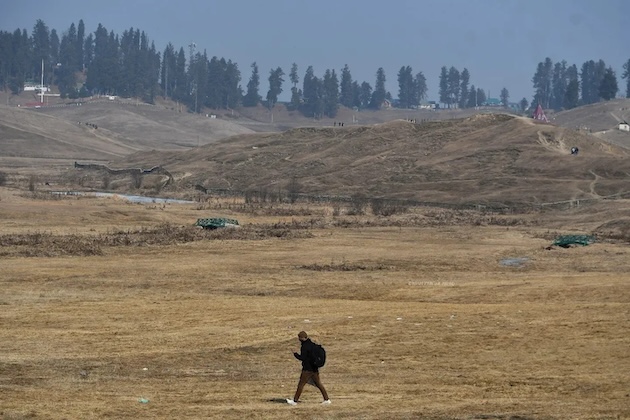
A man walks through an area in Kashmir where low snowfall is causing concern as the region’s economy is highly dependent on it. Credit: Umar Manzoor Shah/IPS

A man walks through an area in Kashmir where low snowfall is causing concern as the region’s economy is highly dependent on it. Credit: Umar Manzoor Shah/IPS

Threat to Agriculture

In Kashmir, 60 percent of the state’s revenue comes from agriculture and horticulture, and about 80 percent of the population lives in rural areas.

However, over the years, the valley has experienced irregular patterns of precipitation. In the first five months of 2022, Kashmir saw a 38 percent rain shortage, according to data provided by the Meteorological Department (MeT) in Srinagar.

The data reveals that the Kashmir Valley has experienced a significant lack of pre-monsoon precipitation over the years. From March 1 to May 31, 2022, the region got 99.5 mm of rain, 70 percent lower than average.

Comparatively, between March and May of each of the following years—2017, 2018, 2019, 2020, and 2021—there was a deficit of 16, 28, 35, and 26 percent, respectively. The dry winter this year is already throwing life out of gear for the farmers.

Abdul Karim Ganaie, a farmer hailing from south Kashmir’s Pulwama, says the threats are menacingly looming large, and people cannot do anything other than watch helplessly as the crisis unfolds.

When IPS contacted Choudhary Mohammad Iqbal, the director of agriculture in Kashmir, he stated that the department was closely monitoring the situation and would be issuing a warning to the farmers in the coming months.

“We accept that the situation is going to prove worrisome for Kashmir’s farming community, but we have to adopt a strategy to ensure minimal losses. We are working on that front,” Choudhary said.

Tourism under Cloud

The famous tourist destinations in Kashmir are also witnessing a dip in tourist arrivals, putting the people associated with this business in dire straits. In January, the famous tourist resorts recorded the lowest arrival of foreign and domestic tourists, with only 30 percent occupancy in hotels.

It snows at last but too little, too late!

Finally, in the first week of February, when the harshest 40-day-long spell was already over, it snowed in most of the areas of Kashmir. However, according to experts, the snow would yield the fewest results as it is not possible to accumulate for an extended period.

What is important, says Mehraj Ahmad, a research scholar working on climate change in Kashmir, is that the snow must accumulate in the higher reaches for as long as possible until the arrival of summers.

“The snowfall of February or March carries the least significance when compared with the snowfall of January. Therefore, we really are keeping our fingers crossed and praying for the safeguard of our lives against the dark, dreadful effects of climate change,” Ahmad said.

IPS UN Bureau Report

IPS UN Bureau, IPS UN Bureau Report, India, Kashmir

  Source

Forced Migration Grows, Justice Withers, Say Activists at World Social Forum

Civil Society, Headlines, Human Rights, Inequality, Migration & Refugees

Migration & Refugees

"Governments are not motivated to fix migrants’ issues because the money they send home keeps their economies running" Credit: Shutterstock

“Governments are not motivated to fix migrants’ issues because the money they send home keeps their economies running” Credit: Shutterstock

KATHMANDU, Feb 19 2024 (IPS) – As involuntary migration rises around the world, partly in response to the impacts of climate change, justice for those leaving their homes and families to earn a living is largely missing, said activists meeting at the World Social Forum (WSF) in Kathmandu on Sunday.


In various sessions, participants from Europe, northern Africa and Latin America detailed governments squeezing doors shut on migrants trying to enter their countries. Disturbing stories from Asia focused on individuals falling victim to employers and traffickers as their governments looked the other way while profiting from migrants’ income remitted home.

The WSF ends in Nepal’s capital Kathmandu on Monday. During the annual event global activists gather to discuss issues ranging from education to debt relief, legalization of sex work, and poor farmers’ lack of control over their land and resources.

“One of the women we talked to told us that she had to sleep with six to seven men daily for six months. The saddest part is the employer’s wife regularly gave her a pill so she wouldn’t get pregnant,” said a researcher with the Bangladeshi organization OKUP. “Another worker was diagnosed with colon cancer: his employer sent him home without paying a single bit of his salary.”

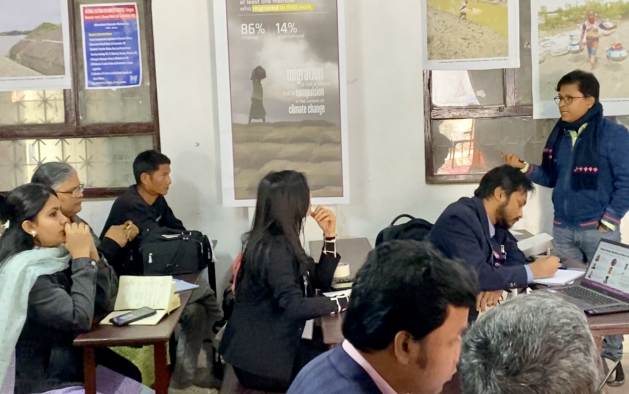
OKUP hosted the session, Climate Change, Migration and Modern Slavery, to share its report documenting the treatment given to migrant workers from coastal regions in Bangladesh who were forced to leave after the impacts of climate change destroyed their farms and other livelihoods.

Research found that 51% of households migrated after being hit by cyclones, floods, salt water intrusion in their fields, erratic rainfall and other climate disasters. “There is no sustainable adaptation opportunities for them. In most cases people receive assistance from the government after disasters, but there is no sustainable assistance. That’s why people rely on loans to rebuild their houses or restart their farming activities,” said OKUP Chairperson Shakirul Islam.

“Before they can repay the money they experience the next cycle of climate emergency,” he added, making them desperate to go earn money elsewhere in the country or abroad.

Eighty-six percent of those displaced migrate within the country; 14% internationally. En route 90% face excessive fees, 81% do not get a promised work permit and 78% have their salaries held back. “I strongly believe that the same situation is present in other countries in South Asia,” said Islam.

Chairperson of the Bangladeshi organization OKUP, (standing far right) introduces the session Climate Change, Migration and Modern Slavery at the World Social Forum on Sunday, Feb. 18. Credit: Marty Logan/IPS

Shakirul Islam, Chairperson of the Bangladeshi organization OKUP, (standing far right) introduces the session Climate Change, Migration and Modern Slavery at the World Social Forum on Sunday, Feb. 18. Credit: Marty Logan/IPS

Malaysian activist Sumitha Shaanthinni Kishna cautioned the group to not blame climate change for the migrants’ problems. “The fear I have is governments using climate change to justify migration. They will say ‘that’s why we have to send our migrants out’. They have done this to justify migration due to poverty.

“The discussion has to be that climate change is real and how the government’s policies are contributing to climate change,” added Kishna, from the organization Our Journey, which provides legal support to migrants and refugees.

In another discussion in another classroom just minutes later and only metres away, activists from India were learning about a hotline created after COVID-19 to help migrant workers in distress. In less than one year, the Migrant Assistance and Information Network has responded to 800-plus calls, said its director, Dr Martin Puthussery.

The cases include 40 deaths (19 accidents, 15 accidents, 6 suicides), 20 instances of forced labour and 16 cases of legal aid or mediation, involving wage theft, delayed payments illegal confinements and imprisonments.

During the question-answer session a participant from northern Bihar state noted that migration is a must because “everything is closed down. Where do the people of Bihar go to earn their livelihood?”

“Can we ourselves create small industries?” she asked. “We can’t depend on the government.”

Governments are not motivated to fix migrants’ issues because the money they send home keeps their economies running, said Arie Kurniawaty from Solidaritas Perempuan in Indonesia at one of the day’s last sessions, Call for Migration Coordination within the WSF in Kathmandu.

“The basic problem is the perspectives of our governments, which think that migrant workers are a commodity… They will try to send many migrant workers abroad without considering if their situation will be good or bad,” added Kurniawaty.

Other speakers in the session, which covered France, Africa, Palestine and Latin America as well as Asia, noted rising numbers of migrants but increasing hostility to them, led by governments.

In Latin America, governments’ actions are linked to rising racism and xenophobia, said Patricia Gainza from the World Social Forum on Migrations. “This is nothing new but in this case we’ve had some very bad decisions by governments, like Peru, who invite people to come but later, for political reasons, pushed them out.”

In Europe, the New Pact on Migration and Asylum, of December 2023, “encourages informal and confidential agreements between European countries and migrant-sending countries that are not legally binding, so that the European Parliament will not have to ratify them,” said Glauber Sezerino of the Paris-based Centre de Recherche et d’Information pour le Développement. “The pact tries to encourage more and more of this kind of agreement, so you can expect more violation of human rights” of migrant workers, he added.

In North Africa, governments are increasingly dominating debate on migration policies, “leaving little room for civil society,” said Sami Adouani of FTDES Tunisia. In February 2023, a xenophobic speech by Tunisian President Kais Saied targeted migrants from sub-Saharan Africa. That triggered an exodus but also “exposed those remaining migrants to more institutional violence,” he added.

  Source

World Social Forum Activists Unravel Roots of Israel’s Occupation of Gaza

Armed Conflicts, Asia-Pacific, Civil Society, Global Governance, Headlines, Human Rights, Middle East & North Africa

Armed Conflicts

Protesting against Israel's attacks on Gaza, at the opening day march of the World Social Forum in Kathmandu. Credit: Marty Logan/IPS

Protesting against Israel’s attacks on Gaza, at the opening day march of the World Social Forum in Kathmandu. Credit: Marty Logan/IPS

KATHMANDU, Feb 17 2024 (IPS) – Romi Ghimire has a busy life running a non-profit organization dedicated to Nepal’s rural people, but she also feels driven to do something about Gaza. “There are a lot of issues happening in the world, but right now the genocide in Gaza is the most urgent one,” she said inside the Palestine tent at the World Social Forum (WSF) in Kathmandu on Saturday.


“We’re watching it live…. we’re seeing it on a daily basis: every morning and evening I’m consuming it and I just can’t stop thinking about it. I can’t pretend that it isn’t happening,” Ghimire told IPS. “We have to raise awareness about it around the world because we are all the (Palestinians) have. They don’t have any arms or ammunition, any military — it’s just people like us that they have.”

“People like us” include the roughly 30,000 activists expected to attend the WSF, the annual global gathering of social activists, happening this year in Nepal’s capital Kathmandu until Monday. This block of the city centre is bustling with activists, rushing to reach a scheduled workshop or bumping shoulders with peers from 90+ countries amid white tents set up as temporary classrooms in a fairground.

Israel’s ongoing assault on Gaza, in response to an attack on Israel by Hamas on Oct. 7, 2023, is one of the most discussed issues.

“Israel has refined the art of colonization through what I call the best business practice of colonialism, which invites multinational actors and corporations to invest in their colonial project. And that provides an economic incentive to ensure that political positions are supportive of Israel”

On Friday, Dr Varsen Aghabekian spoke to 30 activists from Nepal, South Asia and beyond. The former Commissioner General for the Palestinian Independent Commission for Human Rights, Aghabekian detailed the history that has culminated in Israel’s occupation of Palestine, stressing the deep roots of the current assaults.

Demographic strategy

For example, in Mandate Palestine (as it was known in 1947), Palestinians made up 93% of the population and Jewish people were 7%. By 2023 the make-up had changed dramatically, with Palestinians at 51% and the Jewish population equal to 49%, said Aghabekian, labelling the process part of Israel’s “erasure”.

Historical “annexation” includes takeover of public and private property. In 1947, 90% of such property was owned by Palestinians; by 2023 they had been relegated to 22% of historic Palestine.

Israeli laws and policies “institutionalize the superiority and privilege the status of Jews,” added Aghabekian. They reserve the right of self-determination in Israel exclusively for the Jewish people, and declare Hebrew as the official state language, demoting Arabic, which had been the country’s official second language.

“We rightfully call (the situation) apartheid but when we do that many western countries frown and say: ‘It can’t be!’… Israel is trying to project that an occupier state is a victim of our resistance and our violence (but) we have the right to resist as an occupied people who want to be liberated.”

Eventually Israel must make peace with the Palestinians, added Aghabekian. “If they are prospering and we are in pain there will not be peace. The Gaza genocide, despite its disasters, is an opportunity… even the US said seriously ‘maybe we should think about the two-state solution’. I think we’re moving toward that.”

Not only is Israel misrepresenting its occupation and current attack on Gaza, the situation has revealed the hypocrisy of western legal, religious and cultural tradition, argued Mitri Raheb, the first president of Dar-al-Kalima University in Bethlehem, who spoke after Aghabekian.

Israel’s response to the Hamas attack has revealed the “warrior God,” not the God of peace, said Raheb, citing a personal example. A German bishop he met counselled Palestinians to remain non-violent. But just weeks later Raheb, who also served as the pastor of the Christmas Lutheran Church in Bethlehem from 1987 until 2017, saw the bishop on TV calling for western countries to provide Ukraine with tanks to counter Russia’s invasion.

Palestinians, he added, used to “believe in and fight for human rights because we thought they were international, they were for everyone. But I’m starting to question that. I think that human rights were meant for white Europeans, so they won’t kill each other any more, but it’s OK if the rest of the world is killed by the empire.”

“Business of colonialism”

Legal expert Wasem Ahmad dissected the economic structure that props up Israel’s occupation. “Israel has refined the art of colonization through what I call the best business practice of colonialism, which invites multinational actors and corporations to invest in their colonial project. And that provides an economic incentive to ensure that political positions are supportive of Israel.”

A human rights scholar, Ahmad told IPS he recognizes the limitations of the human rights system. “The more you do this work the more cynical you become of the system as it’s proposed. (Human rights) look very nice on paper but when you try to put them into practice you realize that there are a lot of political obstacles to that realization and it has to do with the broader imperial interests at play.”

“Our role,” he continued, “is to push that system and engage it, and force the wheels of justice to turn. Either it works in our benefit or we expose it and over time that system will change, even if it requires a breakdown to rebuild.”

But opposing Israel’s colonization through the legal system is only one approach, added Ahmad. “The idea that I’m only going to rely on the legal mechanisms, ignoring that the law is a social construct connected to economic, political and cultural interests and beliefs in society ignores that reality.”

Despite his critique of the West’s legal and cultural traditions, Raheb said he was invigorated by the throngs of people worldwide, and at the WSF, protesting Israel’s attacks. “Gaza was the wake-up call for all of us. And I think in the future this will just get stronger and stronger… Gaza galvanized the global South because it was the magnifying glass: suddenly we could see clearly. That was the turning point.”

  Source

Grassroots Voices Unite to Call for Climate Justice

Asia-Pacific, Civil Society, Development & Aid, Environment, Global, Headlines, TerraViva United Nations

Civil Society

Shanti Decinis, one of 30,000+ participants expected at the 2024 World Social Forum, which advocates for a just world for all people. She described how in her village in Bihar, India, farmers are dealing with climate-induced unpredictability. Credit: Tanka Dhakal / IPS

KATHMANDU, Feb 16 2024 (IPS) – Kiprotich Peter from the East African country of Kenya is trying to convey his climate crisis message using the platform of the World Social Forum (WSF) taking place in the mountain nation of Nepal, which has also been battered by the impacts of climate change.


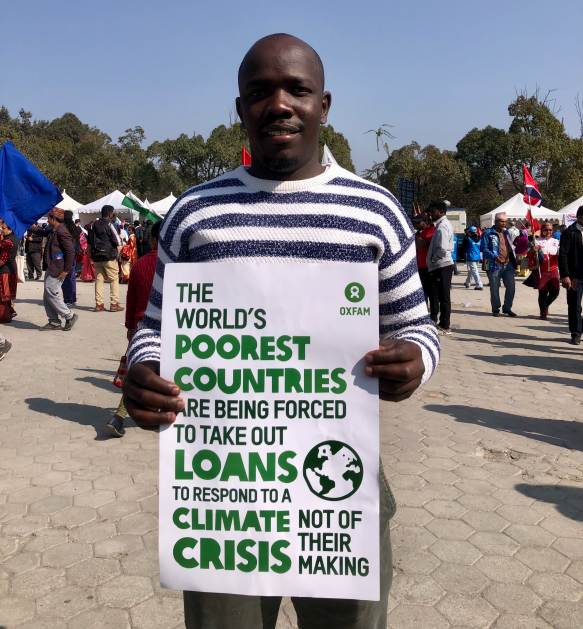
Youth activist Peter, who works for Green World in Kenya to promote environmental education and reforestation, is holding a placard that reads: “The World’s Poorest Countries are being forced to take out loans to respond to a climate crisis not of their making,” on Thursday, Day 1 of the WSF in Nepal’s capital Kathmandu.

“I am here to raise my voice against loans to deal with the climate crisis. Small countries like Kenya and Nepal need grants to fight and mitigate the climate crisis, not loans,” he added. “The climate change is a real-time crisis in Africa, and I think in Nepal and other parts of the global South too.”

Low and mid-income countries like Nepal and Kenya have contributed just tiny amounts of the greenhouse gas emissions that cause climate change, but they are on the frontlines of its impacts, in the forms of droughts, flash floods and other extreme weather events.

According to the 2023 Kenya Country Climate and Development report, to maintain gains in poverty reduction, the country must act on climate change. “Inaction against climate change could result in up to 1.1 million additional poor in 2050, in a dry and hot climate future scenario.”

“Humanity of people is taken away”

Far from Kenya but close to Nepal in South Asia, one third of Pakistan was submerged because of a massive flood in 2022, affecting 33 million people. Pakistani historian and youth leader Ammar Ali Jan described the aftermath of that flood and the international community’s treatment as an ugly image of humanity.

“Almost a province was wiped out; we haven’t seen a flood like that. The way people were attacking food trucks, it was almost as if the humanity of people was taken away,” said the founder and president of the Haqooq-e-Khalq Party addressing a session called, Towards a Global Movement for Climate Justice, on Friday.

“People were in hunger without having anything to eat; they were stuck. It’s as if these people are becoming disposable human beings, and their deaths will not be mourned because their lives are not valued enough,” added the leader of his country’s new ‘Green’-inspired party.

Ali blamed an International Monetary Fund loan for the economic deterioration that followed the disaster. “The IMF’s loan was given after six months, not by saying ‘we will give you this grant and forgive your debt because you are affected by a crisis not of your making.’ They said ‘you must pay every penny to the international creditor.’ We need support, not loans.”

The party leader argues that a large chunk of humanity is lacking empathy, while retaining resources and political power. “To achieve climate justice, we need to find ways to make our agenda, the people’s agenda, heard,” he added. “Progressives need to take power.”

Shanti Devi was listening to Ali and nodding her head. “It’s what’s happening in our village in Bihar, India. We don’t get rainfall when needed, and floods hit at the time of harvesting,” said Devi, adding that she was attending the WSF to make her voice heard.

Kenyan youth climate activist Kiprotich Peter calls for grants instead of loans, for countries grappling with climate-induced crises at the World Social Forum in Kathmandu on 16 February 2024. Credit: Tanka Dhakal / IPS

Kenyan youth climate activist Kiprotich Peter calls for grants instead of loans, for countries grappling with climate-induced crises at the World Social Forum in Kathmandu on 16 February 2024. Credit: Tanka Dhakal / IPS

“No Forum Left Uncontested”

Indian researcher and science activist Soumya Dutta called for continuous pressure to make the voices of the frontline communities that live with the consequences of climate-induced changes heard in every forum. “We have long crossed climate change; we are in a climate crisis,” he said during a discussion on climate justice. “We need to elevate the social movement to create a larger political discourse.”

Other speakers and participants called for collaboration and support to address the world’s crises, including climate change. United Nations Secretary-General Antonio Gutters also urged unity in his message to the WSF: “We need global solidarity to rescue the Sustainable Development Goals – and reform an outdated, dysfunctional and unfair global financial system. We must also rally together to address the climate crisis.”

While laying out the stark reality of climate change’s impacts on communities, water and climate change researcher Ajaya Dixit proposed a way forward. “We are still taking nature for granted, which needs to changed,” said the Nepal-based researcher, who collaborates with other researchers in South Asia. “To understand climate change, we have to understand the water and hydrological cycle, because the crisis we are facing is all connected with water one way or another.”

According to Dixit, to understand the ground reality of climate change, science and community must come together. “We still hesitate to recognize community knowledge, especially the historical knowledge of Indigenous people. Natural science, physical science and community knowledge need to be combined in our education systems; then we will be able to better understand climate change and act accordingly.”

  Source