Innovative Family Farm in Cuba Uses Mix of Clean Energies

Active Citizens, Civil Society, Climate Action, Development & Aid, Editors’ Choice, Energy, Environment, Food and Agriculture, Headlines, Innovation, Integration and Development Brazilian-style, Latin America & the Caribbean, Projects, Regional Categories, Water & Sanitation

Energy

Artist and farmer Chavely Casimiro and her daughter Leah Amanda Díaz feed one of the biodigesters at Finca del Medio, a farm in central Cuba. The biodigester produces about seven meters of biogas per day, enough energy for cooking, baking and dehydrating food. CREDIT: Jorge Luis Baños / IPS

Artist and farmer Chavely Casimiro and her daughter Leah Amanda Díaz feed one of the biodigesters at Finca del Medio, a farm in central Cuba. The biodigester produces about seven meters of biogas per day, enough energy for cooking, baking and dehydrating food. CREDIT: Jorge Luis Baños / IPS

TAGUASCO, Cuba, Oct 2 2023 (IPS) – Combining technologies and innovations to take advantage of solar, wind, hydro and biomass potential has made the Finca del Medio farm an example in Cuba in the use of clean energies, which are the basis of its agroecological and environmental sanitation practices.


Renewable energy sources are used in many everyday processes such as electricity generation, lighting, water supply, irrigation and water heating, as well as in cooking, dehydrating, drying, baking and refrigeration of foodstuffs.

“We started out with windmills on artesian wells and hydraulic rams to pump water. That gave us an awareness of the amount of energy we needed and of how to expand its use,” said farmer José Antonio Casimiro, 65, owner of this agroecological family farm located in the center of this long Caribbean island nation.

“More incentives, better policies and financial support are needed so that farming families have sufficient energy for their work and can improve the comfort of their homes and quality of life.” — José Antonio Casimiro

The farmer expressed his appreciation of the help of his son, 41, also named Antonio Casimiro, in the installation of the two mills at Finca del Medio, during the days in which IPS visited the farm and shared in activities with the family.

“There was no one to assemble or repair them. We both had to study a great deal, and we learned to do a lot of construction things as we went along and perfected the techniques,” said Casimiro junior, referring to the equipment that is now inactive, but is capable of extracting some 4,000 liters of water daily from the water table.

When rainfall is abundant and the volume of the 55,000-cubic-meter-capacity reservoir rises, the hydraulic ram comes to life. The device diverts about 20,000 liters of water to a 45,000-liter tank, 400 meters away and 18 meters above the level of the reservoir.

“The only energy the rams use is the water pressure itself. Placing it on the highest part of the land makes it easier to use the slope for gravity irrigation, or to fill the animals’ water troughs,” explained Chavely Casimiro, 28, the youngest daughter of José Antonio and Mileidy Rodríguez, also 65.

An artist who also inherited the family’s “farming gene”, Chavely highlighted some twenty innovations made by her father to the hydraulic ram, in order to optimize water collection.

Other inventions speed up the assembly and disassembly of the windmills for maintenance, or in the event of tropical cyclones.

“We have been replacing the water supply with solar panels, which are more efficient. They can be removed faster (than the windmill blades) if a hurricane is coming. You can incorporate batteries and store the energy,” said Casimiro.

“Let’s say a windmill costs about 2,000 dollars. With that amount you can buy four 350-watt panels. That would be more than a kilowatt hour (kWh) of power. You buy a couple of batteries for 250 dollars each, and with that amount of kWh you can pump the equivalent of the water of about 10 windmills,” he said.

But the farmer said the windmills are more important than the energy they generate. “It would be nice if every farm had at least one windmill. For me it is very symbolic to see them pumping up water,” he said.

Lorenzo Díaz, the husband of Chavely Casimiro, uses a solar oven to cook food. In the background can be seen a windmill and a solar heater, other technologies that take advantage of the potential for renewable energies on the Finca del Medio farm in central Cuba. CREDIT: Jorge Luis Baños / IPS

Lorenzo Díaz, the husband of Chavely Casimiro, uses a solar oven to cook food. In the background can be seen a windmill and a solar heater, other technologies that take advantage of the potential for renewable energies on the Finca del Medio farm in central Cuba. CREDIT: Jorge Luis Baños / IPS

Innovations

Located in the municipality of Taguasco, in the central province of Sancti Spíritus, some 350 kilometers east of Havana, Finca del Medio follows a family farm model including permaculture, agroecology and agricultural production based on the use of clean energy.

In 1993, Casimiro and Rodríguez with their children Leidy and José Antonio – a year later, Chavely was born – decided to settle on the 13-hectare farm of their paternal grandparents, with the aim of reversing its deterioration and soil erosion and installing perimeter fences.

The erosion of the land was due to the fact that in the past the farm was dedicated to the cultivation of tobacco, which depleted the soil, and later it had fallen into abandonment, as well as the house.

The older daughter is the only one who does not live and work on the farm, although she does spend time there, and a total of ten family members live there, including four grandchildren. All the adults either work on the farm or help out with different tasks.

With the help of technological innovations adapted to the local ecosystem, and empirical and scientific knowledge, the family has become self-sufficient in rice, beans, tubers, vegetables, milk, eggs, honey, meat, fish and more than 30 varieties of fruit. The only basic foodstuffs not produced on the farm are sugar and salt.

They sell all surplus production, including cow’s milk, for which they have specific contracts, and they are also promoting agrotourism, for which they are making further improvements to the facilities.

At Finca del Medio, a system of channels and ditches allows the infiltration of rainwater, reduces erosion of the topsoil and conserves as much water as possible for subsequent irrigation.

These innovations also benefit neighboring communities by mitigating flooding and replenishing the water table, which has brought water back to formerly dry wells.

The construction of the house is also an offshoot of technological solutions to the scarcity of resources such as steel, which led to the design of dome-shaped roofs made of mud bricks and cement.

The design aids in rainwater harvesting, improves hurricane protection, and boosts ventilation, creating cooler spaces, which reduces the need for air conditioning equipment and bolsters savings.

Along with food production, the new generations and members of the Casimiro-Rodriguez family engage in educational activities to raise awareness about good agricultural and environmental practices.

Students from nearby schools come to the farm to learn about these practices, as well as specialists in agroecology and people from different parts of the world, interested in sharing the experience. Meanwhile, several members of the family have traveled abroad to give workshops on agroecology and permaculture.
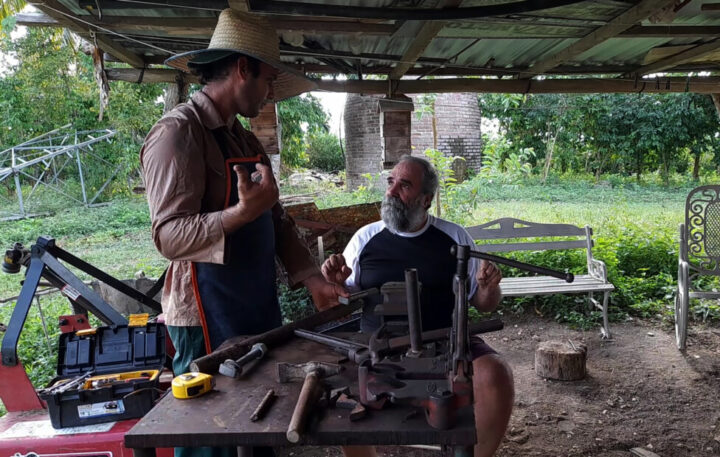
Farmers José Antonio Casimiro and his son of the same name talk in the mechanical workshop at their Finca del Medio farm. Both have come up with innovations for the use of windmills, the hydraulic ram and biodigesters, as well as agricultural tools. CREDIT: Jorge Luis Baños / IPS

Farmers José Antonio Casimiro (R) and his son of the same name talk in the mechanical workshop at their Finca del Medio farm. Both have come up with innovations for the use of windmills, the hydraulic ram and biodigesters, as well as agricultural tools. CREDIT: Jorge Luis Baños / IPS

Solar and biogas potential

On one of the side roofs of the house are 28 photovoltaic panels that provide about eight kWh, connected to batteries. The stored energy covers the household’s needs during power outages that affect the island due to fuel shortages and breakdowns and problems in maintenance of its aging thermoelectric plants.

In addition, the household has three solar water heaters with a capacity of 380 liters.

Next to the kitchen, two fixed-dome biodigesters produce another renewable fuel, biogas, composed mainly of methane and carbon dioxide from the anaerobic decomposition of animal manure, crop waste and “even sewage from the house, which we channel so that the waste does not contaminate the environment,” said Casimiro.

Due to the current shortage of manure as the number of cows has been reduced, only one of the biodigesters is now operational, producing about seven meters of biogas per day, sufficient for cooking, baking and dehydration of foodstuffs.

The innovative family devised a mechanism to extract – without emptying the pond of water or stopping biogas production – from the bottom the solids used as biofertilizers, as well as hundreds of liters of effluent for fertigation (a combination of organic fertilizers and water) of the crops, by gravity.

The installation of the biodigesters, the solar panels and one of the solar heaters was supported by the Swiss Agency for Development and Cooperation (Cosude) and the Indio Hatuey Experimental Station of Pastures and Forages through its Biomass-Cuba project, Casimiro said.

He also expressed gratitude for the link with other scientific institutions such as the Integrated Center for Appropriate Technologies, based in the central province of Camagüey, which is focused on offering solutions to the needs of water supply and environmental sanitation, and played an essential role in the installation of the hydraulic ram.

The farmer said the farm produces the equivalent of about 20 kWh from the combination of renewable energies, and if only conventional electricity were used, the cost would be around 83 dollars a month.
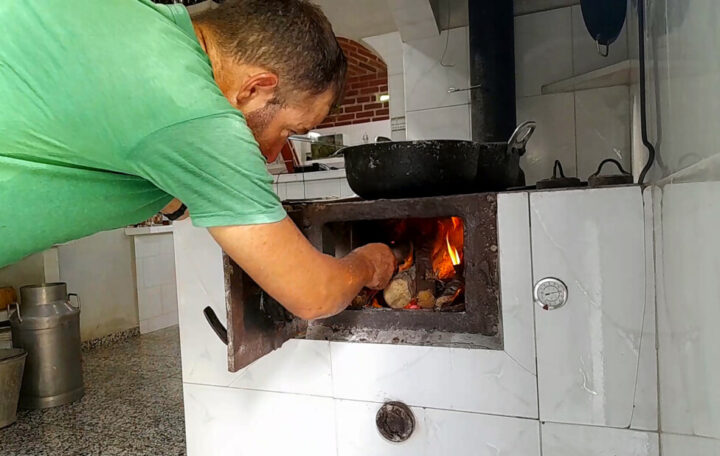
Lorenzo Díaz feeds firewood into an innovative stove that allows the Finca del Medio farm to efficiently cook food, dehydrate or dry fruits and spices, heat water and preserve meat, among other functions. CREDIT: Jorge Luis Baños / IPS

Lorenzo Díaz feeds firewood into an innovative stove that allows the Finca del Medio farm to efficiently cook food, dehydrate or dry fruits and spices, heat water and preserve meat, among other functions. CREDIT: Jorge Luis Baños / IPS

Efficient stove

In the large, functional kitchen, the stove covered with white tiles and a chimney has been remodeled 16 times to make it more efficient and turn it into another source of pride at the farm.

Fueled by firewood, coconut shells and other waste, “the stove makes it possible to cook food, dehydrate fruits and spices, heat water and preserve meat, among other tasks,” Rodríguez told IPS as she listed some of the advantages of this other offshoot of the family’s ingenuity that helps her as a skilled cook and pastry chef.

She pointed out that by extracting all the smoke, “the design makes better use of the heat, which will be used in a sauna” being built next to the kitchen, for the enjoyment of the family and potential tourists.

Casimiro is in favor of incorporating clean energy into agricultural processes, but he said that “more incentives, better policies and financial support are needed so that farming families have sufficient energy for their work and can improve the comfort of their homes and quality of life.”

Since 2014, Cuba has had a policy for the development of renewable energy sources and their efficient use.

A substantial modification of the national energy mix, which is highly dependent on the import of fossil fuels and hit by cyclical energy deficits, is a matter of national security

However, regulations with certain customs exemptions and other incentives to increase the production of solar, wind, biomass and hydroelectric energies in this Caribbean island nation still seem insufficient in view of the high prices of these technologies, the domestic economic crisis and the meager purchasing power of most Cuban families.

Clean sources account for only five percent of the island’s electricity generation, a scenario that the government wants to radically transform, with an ambitious goal of a 37 percent proportion by 2030, which is increasingly difficult to achieve.

  Source

Peru Faces Challenge of Climate Change-Driven Internal Migration

Civil Society, Climate Action, Climate Change, Development & Aid, Editors’ Choice, Featured, Global Governance, Headlines, Humanitarian Emergencies, IPS UN: Inside the Glasshouse, Latin America & the Caribbean, Population, TerraViva United Nations, Water & Sanitation

Climate Change

LIMA, Sep 28 2023 (IPS) – Nearly 700,000 people have migrated internally in Peru due to the effects of climate change. This mass displacement is a clear problem in this South American country, one of the most vulnerable to the global climate crisis due to its biodiversity, geography and 28 different types of climates.


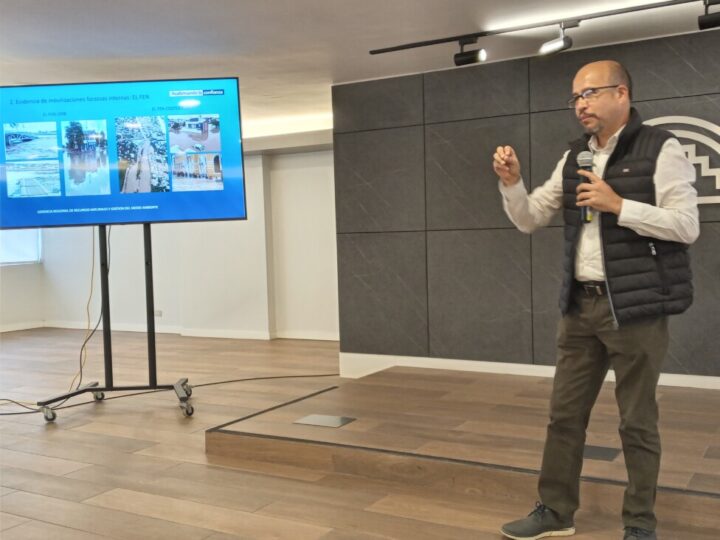
“We recognize migration due to climate change as a very tangible issue that needs to be addressed,” Pablo Peña, a geographer who is coordinator of the Emergency and Humanitarian Assistance Unit of the International Organization for Migration (IOM) in Peru, told IPS.

In an interview with IPS at the UN agency’s headquarters in Lima, Peña reported that according to the international Internal Displacement Monitoring Center, the number of people displaced within Peru’s borders by disasters between 2008 and 2022 is estimated at 659,000, most of them floods related to climate disturbances.

“We recognize migration due to climate change as a very tangible issue that needs to be addressed.” — Pablo Peña

In this Andean country of 33 million inhabitants, there is a lack of specific and centralized data to determine the characteristics of migration caused by environmental and climate change factors.

Peña said that through a specific project, the IOM has collaborated with the Peruvian government in drafting an action plan aimed at preventing and addressing climate-related forced migration, on the basis of which a pilot project will begin in October to systematize information from different sources on displacement in order to incorporate the environmental and climate component.

“We aim to be able to define climate migrants and incorporate them into all regulations,” said the expert. The project, which includes gender, rights and intergenerational approaches, is being worked on with the Ministries of the Environment and of Women and Vulnerable Populations.

He added that this type of migration is multidimensional. “People can say that they left their homes in the Andes highlands because they had nothing to eat due to the loss of their crops, and that could be interpreted, superficially, as forming part of economic migration because they have no means of livelihood. But that cause can be associated with climatic variables,” Peña said.

In a 2022 report, the United Nations Food and Agriculture Organization (FAO) identified Peru as the country with the highest level of food insecurity in South America.

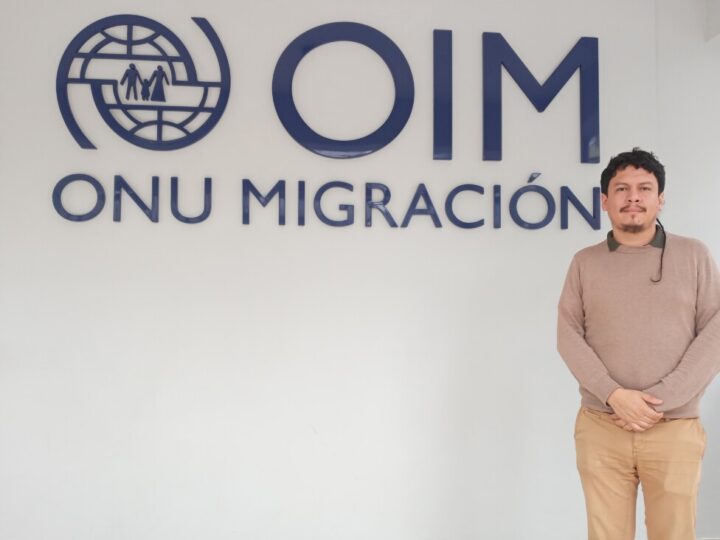
Pablo Peña, coordinator of the Emergency and Humanitarian Assistance Unit of the International Organization for Migration (IOM) in Peru, stands in front of the headquarters of this United Nations agency in Lima. He highlights the need to address the situation of internal migration driven by the impacts of climate change. CREDIT: Mariela Jara / IPS

Pablo Peña, coordinator of the Emergency and Humanitarian Assistance Unit of the International Organization for Migration (IOM) in Peru, stands in front of the headquarters of this United Nations agency in Lima. He highlights the need to address the situation of internal migration driven by the impacts of climate change. CREDIT: Mariela Jara / IPS

The Central Reserve Bank, in charge of preserving monetary stability and managing international reserves, lowered in its September monthly report Peru’s economic growth projection to 0.9 percent for this year, partly due to the varied impacts of climate change on agriculture and fishing.

This would affect efforts to reduce the poverty rate, which stands at around 30 percent in the country, where seven out of every 10 workers work in the informal sector, and would drive up migration of the population in search of food and livelihoods.

“The World Bank estimates that by 2050 there will be more than 10 million climate migrants in Latin America,” said Peña.

The same multilateral institution, in its June publication Peru Strategic Actions Toward Water Security, points out that people without economic problems are 10 times more resistant than those living in poverty to climatic impacts such as floods and droughts, which are increasing at the national level.

The country is currently experiencing the Coastal El Niño climate phenomenon, which in March caused floods in northern cities and droughts in the south. The official National Service of Meteorology and Hydrology warned that in January 2024 it could converge with the El Niño Southern Oscillation (ENSO) global phenomenon, accentuating its impacts.

El Niño usually occurs in December, causing the sea temperature to rise and altering the rainfall pattern, which increases in the north of the country and decreases in the south.

The manager of Natural Resources of the Piura regional government, Juan Aguilar, described the vulnerability to climate change of this northern coastal region of Peru at a September meeting organized by the IOM in Lima. The official explained that the El Niño climate phenomenon has become more intense and frequent due to the effects of climate change, which aggravates its impacts on the population, such as severe flooding this year. CREDIT: Mariela Jara / IPSThe manager of Natural Resources of the Piura regional government, Juan Aguilar, described the vulnerability to climate change of this northern coastal region of Peru at a September meeting organized by the IOM in Lima. The official explained that the El Niño climate phenomenon has become more intense and frequent due to the effects of climate change, which aggravates its impacts on the population, such as severe flooding this year. CREDIT: Mariela Jara / IPS

The manager of Natural Resources of the Piura regional government, Juan Aguilar, described the vulnerability to climate change of this northern coastal region of Peru at a September meeting organized by the IOM in Lima. The official explained that the El Niño climate phenomenon has become more intense and frequent due to the effects of climate change, which aggravates its impacts on the population, such as severe flooding this year. CREDIT: Mariela Jara / IPS

Reluctance to migrate to safer areas

Piura, a northern coastal department with an estimated population of just over two million inhabitants, has been hit by every El Niño episode, including this year’s, which left more than 46,000 homes damaged, even in areas that had been rebuilt.

Juan Aguilar, manager of Natural Resources of the Piura regional government, maintains that the high vulnerability to ENSO is worsening with climate change and is affecting the population, communication routes and staple crops.

At an IOM workshop on Sept. 5 in Lima, the official stressed that Piura is caught up in both floods and droughts, in a complex context for the implementation of spending on prevention, adaptation and mitigation.

Aguilar spoke to IPS about the situation of people who, despite having lost their homes for climatic reasons, choose not to migrate, in what he considers to be a majority trend.

“People are not willing overall to move to safer areas, even during El Niño 2017 when there were initiatives to relocate them to other places; they prefer to wait for the phenomenon to pass and return to their homes,” he added.

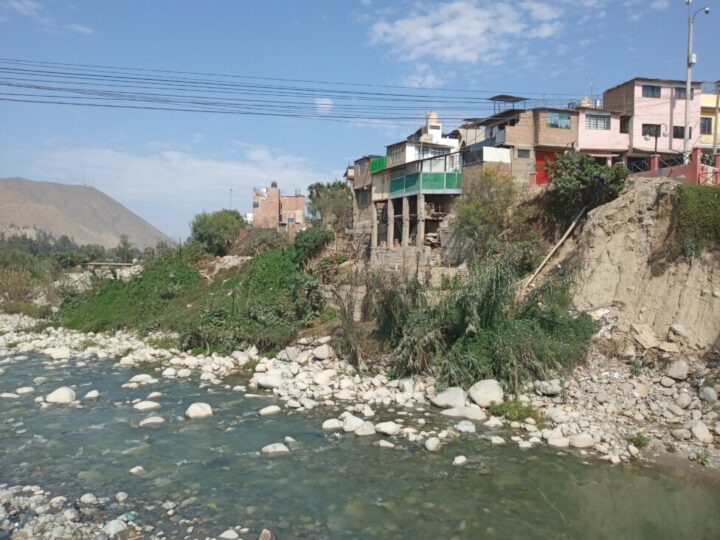
View of the Rimac River as it passes through the municipality of Lurigancho-Chosica, in the Peruvian province of Lima. In this town, many families are still living in housing in areas at high risk, which is exacerbated during the rainy season that begins in December and has intensified due to climate change and the increased recurrence of the El Niño climate phenomenon. CREDIT: Mariela Jara / IPS

View of the Rimac River as it passes through the municipality of Lurigancho-Chosica, in the Peruvian province of Lima. In this town, many families are still living in housing in areas at high risk, which is exacerbated during the rainy season that begins in December and has intensified due to climate change and the increased recurrence of the El Niño climate phenomenon. CREDIT: Mariela Jara / IPS

He explained that this attitude is due to the fact that they see the climatic events as recurrent. “They say, I already experienced this in such and such a year, and there is a resignation in the sense of saying that we are in a highly vulnerable area, it is what we have to live with, God and nature have put us in these conditions,” Aguilar said.

He acknowledged that with regard to this question, public policies have not made much progress. “For example after 2017 a law was passed to identify non-mitigable risk zones, and that has not been enforced despite the fact that it would help us to implement plans to relocate local residents to safer areas,” he added.

The regional official pointed out that “we do not have an experience in which the State says ‘I have already identified this area, there is so much housing available here for those who want to relocate’ , because the social cost would be so high.”

“We have not seen this, and the populace has the feeling that if they are going to start somewhere else, the place they abandon will be taken by someone else, and they say: ‘what is the point of me moving, if the others will be left here’,” Aguilar said.

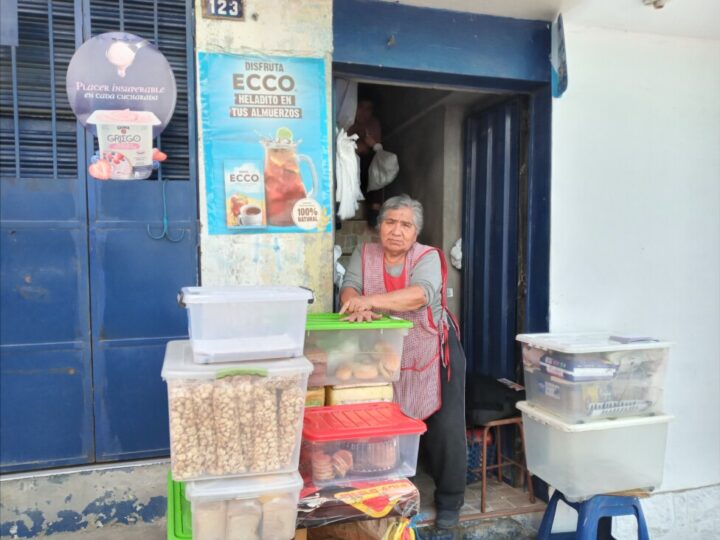
Paulina Vílchez, 72, has always lived in the Peruvian municipality of Lurigancho-Chosica. Despite the fear every year that the Rimac River might flood and that mudslides could occur in one of the 21 ravines in the area, she has never thought of moving away. "I'm not going to go to an empty plot to start all over again, that's why I've stayed. I leave everything in the hands of God," she said. CREDIT: Mariela Jara / IPS

Paulina Vílchez, 72, has always lived in the Peruvian municipality of Lurigancho-Chosica. Despite the fear every year that the Rimac River might flood and that mudslides could occur in one of the 21 ravines in the area, she has never thought of moving away. “I’m not going to go to an empty plot to start all over again, that’s why I’ve stayed. I leave everything in the hands of God,” she said. CREDIT: Mariela Jara / IPS

The fear of starting over

Some 40 km from the Peruvian capital, in Lurigancho-Chosica, one of the 43 municipalities of the province of Lima, the local population is getting nervous about the start of the rainy season in December, which threatens mudslides in some of its 21 ravines. The most notorious due to their catastrophic impact occurred in 1987, 2017, 2018 and March of this year.

Landslides, known in Peru by the Quechua indigenous term “huaycos”, have been part of the country’s history, due to the combination of the special characteristics of the rugged geography of the Andes highlands and the ENSO phenomenon.

In an IPS tour of the Chosica area of Pedregal, one of the areas vulnerable to landslides and mudslides due to the rains, there was concern in the municipality about the risks they face, but also a distrust of moving to a safer place to start over.

“I came here to Pedregal as a child when this was all fields where cotton and sugar cane were planted. I have been here for more than sixty years and we have progressed, we no longer live in shacks,” said 72-year-old Paulina Vílchez, who lives in a nicely painted two-story house built of cement and brick.

On the first floor she set up a bodega, which she manages herself, where she sells food and other products. She did not marry or have children, but she helped raise two nieces, with whom she still lives in a house that is the fruit of her parents’ and then her own efforts and which represents decades of hard work.

Vílchez admits that she would like to move to a place where she could be free of the fear that builds up every year. But she said it would have to be a house with the same conditions as the one she has managed to build with so much effort. “I’m not going to go to an empty plot to start all over again, that’s why I’ve stayed. I leave everything in the hands of God,” she told IPS.

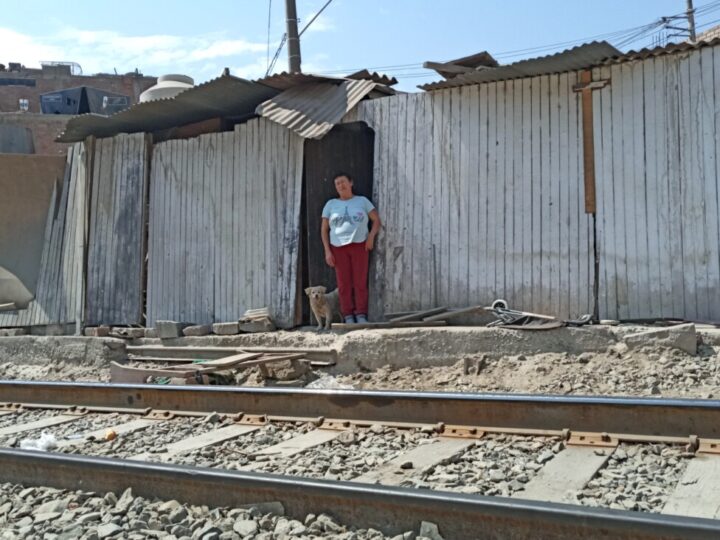
Maribel Zavaleta's home in the Peruvian municipality of Chosica is built of wood, near the Rimac River and just a meter from the train tracks. She arrived there in 1989, relocated after a mud, water and rock slide two years earlier in another part of the town. She constantly worries that another catastrophe will happen again, and says she would relocate if she were guaranteed safer land and materials to build a new house. CREDIT: Mariela Jara / IPS

Maribel Zavaleta’s home in the Peruvian municipality of Chosica is built of wood, near the Rimac River and just a meter from the train tracks. She arrived there in 1989, relocated after a mud, water and rock slide two years earlier in another part of the town. She constantly worries that another catastrophe will happen again, and says she would relocate if she were guaranteed safer land and materials to build a new house. CREDIT: Mariela Jara / IPS

Very close to the Rimac River and next to the railway tracks that shake her little wooden house each time the train passes by lives Maribel Zavaleta, 50, born in Chosica, and her family of two daughters, a son, and three granddaughters.

“I came here in 1989 with my mom, she was a survivor of the 1987 huayco, and we lived in tents until we were relocated here. But it’s not safe; in 2017 the river overflowed and the house was completely flooded,” she told IPS.

Zavaleta started her own family at the age of 21, but is now separated from her husband. Her eldest son lives with his girlfriend on the same property, and her older daughter, who works and helps support the household, has given her three granddaughters. The youngest of her daughters is 13 and attends a local municipal school.

“I work as a cleaner and what I earn is only enough to cover our basic needs,” she said. She added that if she were relocated again it would have to be to a plot of land with a title deed and materials to build her house, which is now made of wood and has a tin roof, while her plot of land is fenced off with metal sheets.

“I can’t afford to improve my little house or leave here. I would like the authorities to at least work to prevent the river from overflowing while we are here,” she said, pointing to the rocks left by the 2017 landslide that have not been removed.

  Source

Don’t Count on PPP Solutions

Civil Society, Climate Action, Development & Aid, Economy & Trade, Global, Headlines, Sustainable Development Goals, TerraViva United Nations

Opinion

KUALA LUMPUR, Malaysia, Sep 27 2023 (IPS) – In recent years, public-private partnerships (PPPs) have spread rapidly. While usually profitable for the private partners, PPPs have generally not served the longer-term public interest.


PPPs as miracle all-purpose solution
As Eurodad has shown, PPP financing has grown in recent years, particularly in the Sustainable Development Goals (SDGs) funding discourses. Adopted by the UN in September 2015, the SDGs endorsed PPP financing.

Jomo Kwame Sundaram

Earlier, the mid-2015 Third UN Conference on Financing for Development in Addis Ababa had failed to ensure adequate financing. This was mainly due to rich nations opposing a UN-led international tax cooperation initiative.

Instead, PPPs were strongly endorsed in the 2015 Addis Ababa Action Agenda. Weeks later, SDG17 referred to PPPs as ‘means of implementation’. This all sought to “encourage and promote effective public, public-private and civil society partnerships”.

PPPs have been promoted as a means to finance and deliver infrastructure, social services and, increasingly, climate-related projects. Advocates claimed PPPs would also help overcome other problems besides funding. PPPs, they claimed, would help improve project selection, planning, implementation and maintenance.

PPP promotion
Some advocates even claim only the private sector can deliver high-quality investment and efficiency in infrastructure and social service delivery. Private financing reduces budget-constrained governments’ need to raise funds upfront to finance, develop and manage projects.

Increased private financing supposedly also overcomes public sector incapacity to deliver high-quality infrastructure and public services. Undoubtedly, many government capacities have been diminished by decades of structural adjustment, austerity and less public finance.

This has been worsened by rich countries’ unmet commitments to contribute 0.7% of national income as official development assistance (ODA) on concessional terms. The global North has also been unwilling to effectively stem illicit financial outflows, e.g., due to tax dodging.

PPP promotion has involved many means, media and institutions, including ‘donor’ agencies, multilateral development banks (MDBs), UN agencies, international consultants, transnational accounting firms, and the World Economic Forum (WEF).

The World Bank has long promoted private financial investments in development, as well as ‘blended finance’ and PPPs more recently. In 2022, the influential WEF even proclaimed PPPs as essential for pandemic recovery.

Promoting private finance
Such promotion of private finance has implications far beyond the actually modest amount of funds raised through ‘blended finance’ and PPPs. Almost every project so funded is touted as proof that private finance should be privileged, including by guaranteeing returns using public finance.

The World Bank and other MDBs are devoting considerable effort to advise governments on the use of PPPs. By contrast, they have not put comparable efforts into improving the quality and effectiveness of publicly financed infrastructure and social services.

Over the years, the World Bank Group has produced different tools – including model language for PPP contracts, which favour private sector interests – often to the detriment of the public partner, ultimately governments in need of financing.

Regional development banks – such as the Asian Development Bank, the African Development Bank and the Inter-American Development Bank – have strategic frameworks, networks and dedicated offices to support countries implementing PPPs.

National PPP promotion
PPP advocacy has led to changes in laws, regulatory frameworks and policy environments at international, national and local levels. Developing countries have also started including PPPs – to scale up infrastructure and public service provision – in national development plans.

Many developing countries have enacted laws enabling PPPs and set up ‘PPP Units’ to implement PPP projects. The World Bank, International Monetary Fund (IMF) and regional development banks work closely with private partners to provide policy guidance advising governments on how to best enable PPPs.

All this has transformed policy formulation for public service provision to attract private investors – an agenda Daniela Gabor dubs the ‘Wall Street Consensus’. This implies “an elaborate effort to reorganize development interventions around partnerships with global finance”.

PPPs have not delivered
But actual experiences have not confirmed this favourable impression promoted by PPP advocates. Instead, PPPs have become a major cause for concern. Reliable data on international PPP trends are hard to find. Also, different PPP definitions and terminology have confused reporting.

The World Bank’s Private Participation in Infrastructure Projects Database reports on economic infrastructure – such as for energy, transport, water and sewerage – in 137 low- and middle-income countries.

The Covid-19 pandemic undoubtedly disrupted PPP planning, preparation and procurement. But even the World Bank admits that delays and cancellations were not only due to Covid-19 as the pandemic exposed projects already in trouble for other reasons.

Nonetheless, PPPs’ financial impacts to date have been small, as the public sector continues to dominate. But little private investment – including PPPs – goes to low-income countries. Most such projects are concentrated in a few countries.

PPPs tend to be found in countries with large and developed markets allowing faster cost recovery and more secure revenues. This implies market ‘cherry-picking’ – a selection bias – with private investments going to more affluent urban areas rather than to the needy.

The major setbacks to both the SDGs and climate progress in the last decade are not only due to financing. But they are more than enough to underscore that recent reliance on blended finance and PPPs has worsened, rather than helped the situation. The empire of private finance has no clothes!

IPS UN Bureau

  Source

Treated Wastewater Is a Growing Source of Irrigation in Chile’s Arid North

Active Citizens, Civil Society, Climate Action, Climate Change, Combating Desertification and Drought, Development & Aid, Economy & Trade, Editors’ Choice, Environment, Featured, Food and Agriculture, Green Economy, Headlines, Integration and Development Brazilian-style, Latin America & the Caribbean, Projects, Regional Categories, Sustainable Development Goals, Water & Sanitation

Water & Sanitation

Alfalfa farmer Dionisio Antiquera stands in front of one of the wastewater treatment ponds at the modernized plant in Cerrillos de Tamaya, a rural community in the Coquimbo region of northern Chile. The thousands of liters captured from the sewers are converted into clear liquid ready for reuse in local small-scale agriculture. CREDIT : Orlando Milesi / IPS

Alfalfa farmer Dionisio Antiquera stands in front of one of the wastewater treatment ponds at the modernized plant in Cerrillos de Tamaya, a rural community in the Coquimbo region of northern Chile. The thousands of liters captured from the sewers are converted into clear liquid ready for reuse in local small-scale agriculture. CREDIT : Orlando Milesi / IPS

COQUIMBO, Chile , Sep 18 2023 (IPS) – The reuse of treated wastewater in vulnerable rural areas of Chile’s arid north is emerging as a new resource for the inhabitants of this long, narrow South American country.


The Coquimbo region, just south of the Atacama Desert, one of the driest in the world, is suffering from a severe drought that has lasted 15 years.

According to data from the Meteorological Directorate, a regional station located in the Andes Mountains measured 30.3 millimeters (mm) of rain per square meter this year as of Sept. 10, compared to 213 mm in all of 2022.

“Rural localities today are already reusing wastewater or gray water. This is going to happen, with or without us, with or without a law. The need for water is so great that the communities are accepting the use of treated wastewater.” — Gerardo Díaz

At another station, in the coastal area, during the same period in 2023, rainfall stood at 10.5 mm compared to the usual level of 83.2 mm.

Faced with this persistent level of drought, vulnerable rural localities in Coquimbo, mostly dedicated to small-scale agriculture, are emerging as a new example of solutions that can be replicated in the country to alleviate water shortages.

The aim is to not waste the water that runs down the drains but to accumulate it in tanks, treat it and then use it to irrigate everything from alfalfa fields to native plants and trees in parks and streets in the localities involved. It is a response to drought and the expansion of the desert.

“We were able to implement five wastewater treatment projects and reuse 9.5 liters per second, which is, according to a comparative value, the consumption of 2,700 people for a year or the water used to irrigate 60 hectares of olive trees,” said Gerardo Díaz, sustainability manager of the non-governmental Fundación Chile.

These five projects, promoted by the Fundación Chile as part of its Water Scenarios 2030 initiative, are financed by the regional government of Coquimbo, which contributed the equivalent of 312,000 dollars. Of this total, 73 percent is dedicated to enabling reuse systems, for which plants in need of upgrading but not reconstruction have been selected.

The common objective of these projects, which together benefit some 6,500 people, is the reuse of wastewater for productive purposes, the replacement of drinking water or the recharge of aquifers.

Díaz told IPS that the amount of reuse obtained is significant because previously this water was discharged into a stream, canal or river where it was perhaps captured downstream.

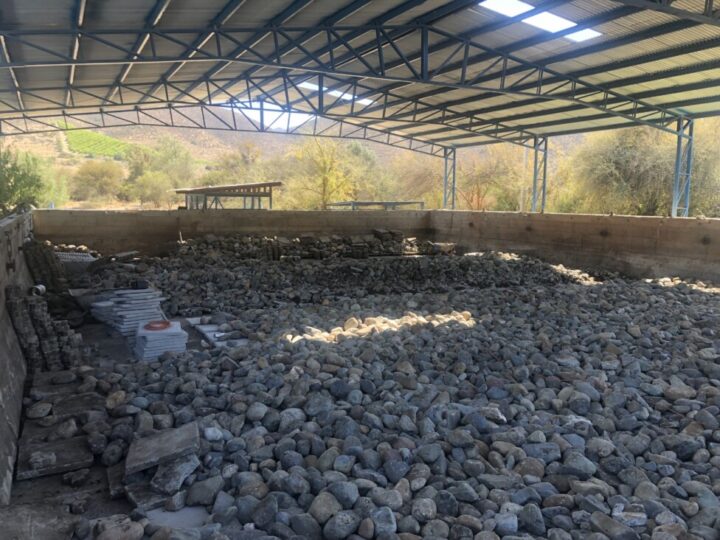
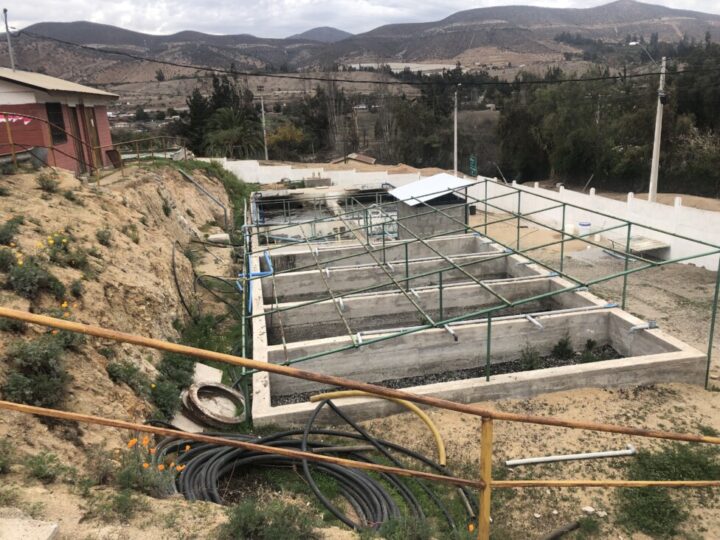
The Huatulame treatment plant in the rural municipality of Monte Patria in northern Chile is being completely repaired with the support of the local municipality. Waterproof plastic sheeting and boulders have been installed, and in the final stage sawdust and earthworms will be incorporated before receiving wastewater from local households for reuse. CREDIT: Orlando Milesi / IPS

The Huatulame treatment plant in the rural municipality of Monte Patria in northern Chile is being completely repaired with the support of the local municipality. Waterproof plastic sheeting and rocks have been installed, and in the final stage sawdust and earthworms will be incorporated before receiving wastewater from local households for reuse. CREDIT: Orlando Milesi / IPS

A successful pilot experience

In Coquimbo, which has a regional population of some 780,000 people, there are 71 water treatment plants, most of which use activated sludge and almost all of which are linked to the Rural Drinking Water Program (APR) of the state Hydraulic Works Directorate.

Activated sludge systems are biological wastewater treatment processes using microorganisms, which are very sensitive in their operation and maintenance and rural sectors do not have the capacity to maintain them.

“Most of these treatment plants are not operating or are operating inefficiently,” Diaz acknowledged.

But one of the plants, once reconditioned, has served as a model for others since 2018. Its creation allowed Dionisio Antiquera, a 52-year-old agricultural technician, to save his alfalfa crop.

“We have had a water deficit for years. This recycled water really helps us grow our crops on our eight hectares of land,” he said in the middle of his alfalfa field in Cerrillos de Tamaya, one of the Coquimbo municipalities that IPS toured for several days to observe five wastewater reuse projects.

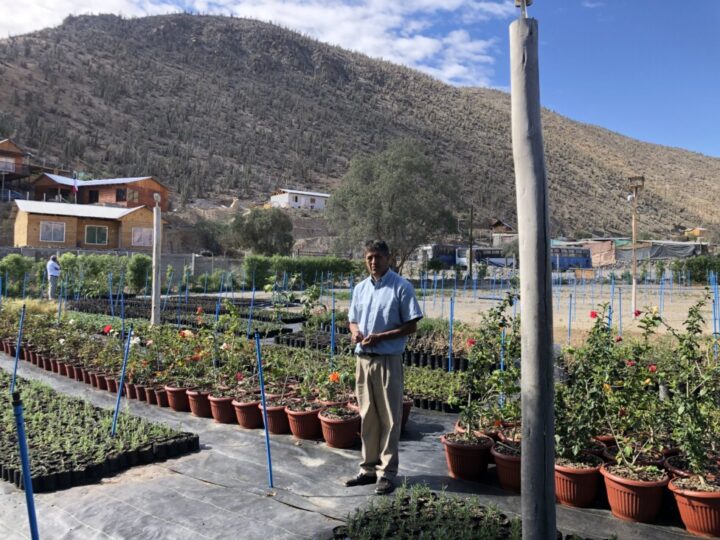
Raúl Ángel Flores stands in his nursery, where the plants and trees are irrigated with recycled water from the Punta Azul project in the town of Villa Puclaro, in Chile's Coquimbo region. All profits from the town's wastewater treatment are reinvested in its maintenance. CREDIT: Orlando Milesi / IPS

Raúl Ángel Flores stands in his nursery, where the plants and trees are irrigated with recycled water from the Punta Azul project in the town of Villa Puclaro, in Chile’s Coquimbo region. All profits from the town’s wastewater treatment are reinvested in its maintenance. CREDIT: Orlando Milesi / IPS

He explained that using just reused water he was able to produce six normal alfalfa harvests per year with a yield per hectare of 100 25-kg bales.

“That’s 4500 to 4800 bales in the annual production season,” he said proudly.

These bales are easily sold in the region because they are cheaper than those of other farmers.

The water he uses comes from an APR plant that has 1065 users, 650 of whom provide water, including Antiquera.

On one side of his alfalfa field is a plant that accumulates the sludge that is dehydrated in pools and drying courts, and on the other side, the water is chlorinated and runs into another pond in its natural state.

“This water works well for alfalfa. It is hard water that has about 1400 parts per million of salt. Then it goes through a reverse osmosis process that removes the salt and the water is suitable for human consumption,” the farmer explained.

In Chile, treated wastewater is not considered fresh water or water that can be used directly by people, and its reuse is only indirect.

Antiquera sold half a hectare to the government to install the plant and in exchange uses the water obtained and contributes 20 percent to the local APR.

He recently extended his alfalfa field to another seven hectares, thanks to his success with treated water.

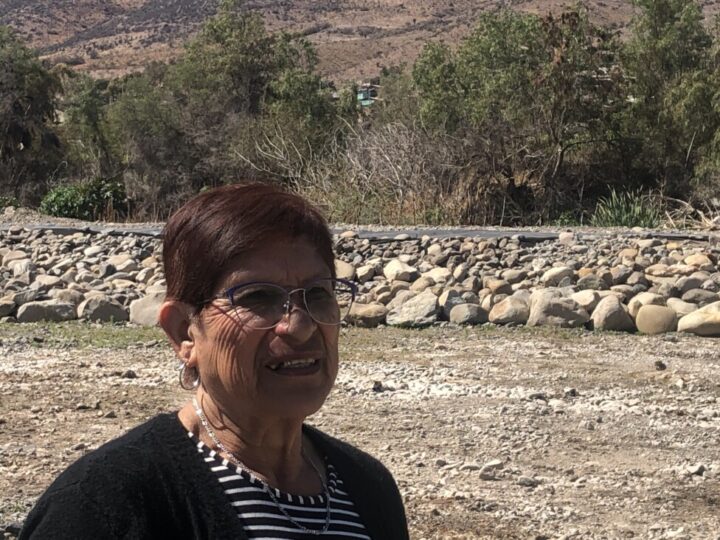
Deysy Cortés, president of a rural drinking water system in Huatulame, stands in front of the dry riverbed of the town of the same name. Today there is no water in the river, where local residents swam and summer vacationers camped on its banks 15 years ago. CREDIT: Orlando Milesi / IPSDeysy Cortés, president of a rural drinking water system in Huatulame, stands in front of the dry riverbed of the town of the same name. Today there is no water in the river, where local residents swam and summer vacationers camped on its banks 15 years ago. CREDIT: Orlando Milesi / IPS

Deysy Cortés, president of a rural drinking water system in Huatulame, stands in front of the dry riverbed of the town of the same name. Today there is no water in the river, where local residents swam and summer vacationers camped on its banks 15 years ago. CREDIT: Orlando Milesi / IPS

Flowers and trees also benefit

In Villa Puclaro, in the Coquimbo municipality of Vicuña, Raúl Ángel Flores, 55, has an ornamental plant nursery.

“I’ve done really well. My nursery has grown with just reuse water….. I have more than 40,000 ornamental, fruit, native and cactus plants. I deliver to retailers in Vicuña and Coquimbo,” a port city in the region, he told IPS.

The nursery is 850 square meters in size, and has an accumulation pond and pumps to pump the water. He has now rented a 2,500-meter plot of land to expand it.

Flores explained to IPS that he manages the nursery together with his wife, Carolina Cáceres, and despite the fact that they have two daughters and a senior citizen in their care, “we make a living just selling the plants…I even hired an assistant,” he added.

In the southern hemisphere summer he uses between 4,000 and 5,000 liters of water a day for irrigation.

“I have water to spare. Here it could be reused for anything,” he said.

Joining the project made it possible for Flores to make efficient use of water with a business model that in this case incorporates a fee for the water to the plant management, which is equivalent to 62 cents per cubic meter used.

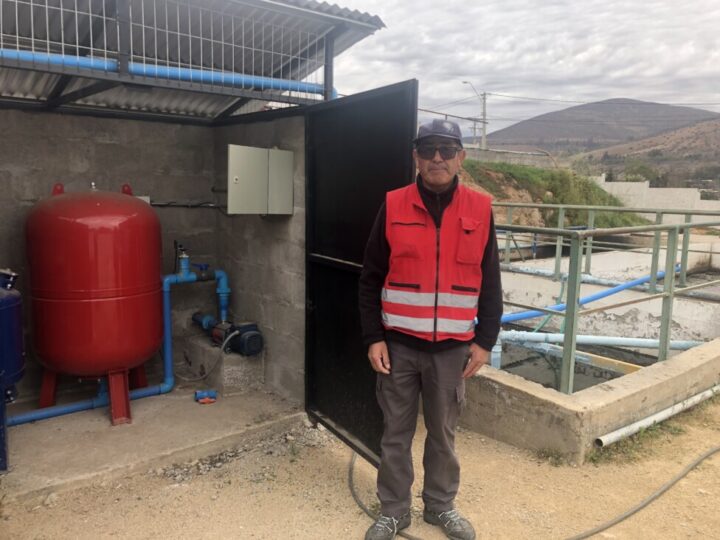
 Arnoldo Olivares operates the water treatment and recycling plant in Plan de Hornos, northern Chile. The plant's infrastructure and operation have been upgraded, and it can now deliver water to rural residents to irrigate trees and plants, instead of using potable water. CREDIT: Orlando Milesi / IPS

Arnoldo Olivares operates the water treatment and recycling plant in Plan de Hornos, northern Chile. The plant’s infrastructure and operation have been upgraded, and it can now deliver water to rural residents to irrigate trees and plants, instead of using potable water. CREDIT: Orlando Milesi / IPS

Eliminating odors, and creating new gardens

In the community of Huatulame, in the municipality of Monte Patria, Fundación Chile built an artificial surface wetland to put an end to the bad odors caused by effluents from a deficient waste-eater earthworm vermifilter treatment plant.

“This wetland has brought us peace because the odors have been eliminated. For the past year people have been able to walk along the banks of the old riverbed,” Deysy Cortés, 72, president of the APR, told IPS.

The municipality of Monte Patria is financing the repair of the plant with the equivalent of 100,000 dollars.

“The sprinklers will be changed, the filtering system will be replaced, and sawdust and worms will be added. It will be up and running in a couple of months,” explained agronomist Jorge Núñez, a consultant for Fundación Chile.

As in other renovated plants, safe infiltration of wastewater is ensured while the project simultaneously promotes the protection of nearby wells to provide water to the villagers.

The Huatulame treatment plant in the rural municipality of Monte Patria in northern Chile is being completely repaired with the support of the local municipality. Waterproof plastic sheeting and boulders have been installed, and in the final stage sawdust and earthworms will be incorporated before receiving wastewater from local households for reuse. CREDIT: Orlando Milesi / IPS

The Huatulame treatment plant in the rural municipality of Monte Patria in northern Chile is being completely repaired with the support of the local municipality. Waterproof plastic sheeting and boulders have been installed, and in the final stage sawdust and earthworms will be incorporated before receiving wastewater from local households for reuse. CREDIT: Orlando Milesi / IPS

Cortés warned of serious difficulties if no more rain falls in the rest of 2023, despite the relief provided by the plant for irrigation.

“I foresee a very difficult future if it doesn’t rain. We will go back to what we experienced in 2019 when in every house there were bottles filled with water and a little jug to bathe once a week,” she said.

During a recent crisis, the local APR paid 2500 dollars to bring in water from four 20,000-liter tanker trucks.

In Plan de Hornos, a town in the municipality of Illapel, irrigation technology was installed using reused water instead of drinking water to create a green space for the community to enjoy.

The project included water taps in people’s homes for residents to water trees and flowers.

Arnoldo Olivares, 59, is in charge of the plant, which has 160 members.

“I run both systems,” he told IPS. “I pour drinking water into the pond. After passing through the houses, the water goes into the drainage system, where there is a procedure to reclaim and treat it.”

“This water was lost before, and now we reuse it to irrigate the saplings. We used to work manually, now it is automated. It’s a tremendous change, we’re really happy,” he said.

Antiquera the alfalfa farmer is happy with his success in Cerrillos de Tamaya, but warns that in his area 150 to 160 mm of rainfall per year is normal and so far only 25 mm have fallen in 2023.

“The water crisis forces us to find alternatives and to be 100 percent efficient. Not a drop of water can be wasted. They have forecast very high temperatures for the upcoming (southern hemisphere) summer, which means that plants will require more water in order to thrive,” he said.

Díaz, the sustainability manager of Fundación Chile, said the Coquimbo projects are fully replicable in other water-stressed areas of Chile if a collaborative model is used.

He noted that “in Chile there is no law for the reuse of treated wastewater. There is only a gray water law that was passed years ago, but there are no regulations to implement it.”

He explained, however, that due to the drought, “rural localities today are already reusing wastewater or gray water. This is going to happen, with or without us, with or without a law. The need for water is so great that the communities are accepting the use of treated wastewater.”

The governor of Coquimbo, Krist Naranjo, argued that “a broader vision is needed to value water resources that are essential for life, especially in the context of global climate change.”

“We’re working on different initiatives with different executors, but the essential thing is to value the reuse of graywater recycling,” she told IPS from La Serena, the regional capital.

  Source

Youth Rally for Peace Through Climate Justice at the UN

Climate Action, Climate Change, Climate Change Justice, Environment, Global, Headlines, IPS UN: Inside the Glasshouse, TerraViva United Nations, Youth Thought Leaders

Climate Change Justice

Youth rally at the UN for climate justice. Credit: Abigail Van Neely/IPS

Youth rally at the UN for climate justice. Credit: Abigail Van Neely/IPS

UNITED NATIONS, Sep 15 2023 (IPS) – “What do we want? Climate justice! When do we want it? Now!” youth chanted in an unusually lively conference at the United Nations Headquarters.


Earlier on Thursday morning (September 14), almost 500 young people had streamed into the room to a DJ’s upbeat soundtrack. Spirits were high despite the more somber rallying cry of this year’s International Day of Peace youth event: the planet is on fire. Many speakers focused on the idea that there cannot be peace without climate justice.

“We cannot begin to talk about peace without talking about the climate crisis,” environmental justice advocate Saad Amer said after leading the crowd in the kind of chants more likely heard at a protest. Fossil fuel disputes spark wars that disproportionately affect people of color, Amer explained. Youth must take charge to “re-write destiny.”

To 21-year-old Mexican climate justice activist Xiye Bastida, “Peace is the ability to drink clean air and clean water.” Bastida, a member of the Otomi-Toltec indigenous community, spoke of her community’s traditional commitment to living in harmony with the earth. Now, indigenous people are being displaced as regenerative practices are forgotten. Bastida called for a world free of extreme weather and exploitation. The climate crisis reflects a broken system, she said, but peace is the bravery to imagine a better world.

Young people are “creating a youth movement for climate action, seeking racial justice, and promoting gender equality,” the Under-Secretary-General for Global Communications, Melissa Fleming, told the audience. In a recorded statement, Secretary-General Antonio Guterres reiterated that youth action has power. Still, only four governments have concrete plans to include young people in policymaking, Youth Envoy Jayathma Wickramanyake noted.

As she lived through brutal conflicts in her home country of Sri Lanka, Wickramanayake said she wondered why people around her continued to fight. Today, she told other young activists that the root causes of conflict always run deep – from inequality to poverty. She stressed that peace cannot be differentiated from development.

The event occurs days before the Sustainable Development Goal (SDG) Summit, a critical opportunity for world leaders to address failures to implement the goals so far.

“Next week there will be an important breakthrough in creating the conditions to rescue the sustainable development goals. I’m very hopeful that the SDG summit will indeed represent a quantum leap in the response to the dramatic failures that we have witnessed,” Guterres said during a news conference.

Meanwhile, youth are left with memories of their chants: “The oceans are rising, and so are we!” “We are unstoppable – another world is possible!”

IPS UN Bureau Report

  Source

African Startups Mull Home-Grown Solutions to Combat Climate Change

Climate Action, Climate Change, Featured, Food and Agriculture, Headlines, Innovation, Sustainable Development Goals, TerraViva United Nations

Innovation

Delegates outside the Climate Action Innovation Hub on the frontlines of the Africa Climate Summit. Credit: Aimable Twahirwa

Delegates outside the Climate Action Innovation Hub on the frontlines of the Africa Climate Summit. Credit: Aimable Twahirwa

NAIROBI, Sep 6 2023 (IPS) – A group of young African startups made their presence known at the Africa Climate Summit in Nairobi, Kenya, hoping to play a big role in promoting home-grown climate-oriented solutions.


In line with the recently adopted African Union Climate Change and Resilient Development Strategy (2022-2032), experts believe that broad-based ownership and inclusive participation are vital for engaging Africa’s women and young people to showcase their ‘game-changing’ innovations.

According to Dr Yossi Matias, Vice-President of the Google Research initiative, pushing for innovative solutions and research around climate change remains critical for Africa when considering that the continent continues to feel the impacts of global warming in many ways.

“Most solutions promoted by African startups and innovators are in danger of being ignored because of many factors, but there is a way to overcome these challenges,” Yossi told IPS.

Among the solutions put forward by young innovators at the Climate Action Innovation Hub, which took place on the sidelines of the summit, were clean energy, climate-smart agriculture and sustainable land management, biodiversity conservation, water storage and conservation, waste management, and circular economy.

The innovations can also enhance the key cross-cutting areas needed to amplify climate cooperation and action, including climate advocacy, empowerment, awareness raising, capacity building, and climate literacy.

Other key areas of innovation are green transport and climate-resilient infrastructure, resilient, climate-smart cities, digital transformation, and food security.

The latest estimates by the UN agencies show that changing precipitation patterns, rising temperatures, and more extreme weather contributed to mounting food insecurity, poverty, and displacement in Africa.

Official figures show that food insecurity increases by 5–20 percentage points with each flood or drought in sub-Saharan Africa

While African Governments are committed to supporting climate solution innovation to varying levels and with different approaches to tackle this phenomenon, some experts believe that what is needed is to encourage a growing number of African startups to shift in mindset—by becoming providers of solutions to improving the continental climate change resilience.

“What is needed for these young African innovators is to look for mentors and incubators because, as an entrepreneur, you need to learn how to develop a successful product that brings some short-term and long-term positive benefits to combat climate change in your community,” Yossi said.

Through its Accelerator programs, the Google Research initiative currently seeks to empower startups, developers, and nonprofits, especially in Africa, to better solve the world’s biggest challenges — from economic development, diversity, sustainability, and climate change — relying on its technology.

For example, one of the initiatives presented at the summit seeks to produce plastic waste collected from local communities in the Rwandan capital Kigali where a startup is producing handcrafts from plastic waste collected in the city.

Sonia Umulinga, a young Rwandan female entrepreneur and owner of ‘Plastic Craft’, a company that seeks to tackle the problem of plastic pollution, told IPS that key priority had been given not only to help reduce plastic pollution but also to her new business model in using the collected waste to produce unique products on the markets.

Harsen Nyambe Nyambe, Director, Sustainable Environment and Blue Economy, African Union Commission, told delegates that the current situation where the lack of ownership over innovations, coupled with a whole narrative built around imported solutions, constitutes a major challenge for the continent to combat climate change.

“Africa needs to redefine on how to engage of the issue of climate change, and countries need to work together to find possible innovative solutions to the challenges they are facing,” he said.

While some officials and experts cite innovation as an important driver of growth and the fight against hunger and malnutrition, which continue to affect major parts of the African continent, others believe there is a need for these African startup entrepreneurs to test and refine these ideas for the benefit of their community.

Current efforts for Africa’s transformation emphasize switching agriculture from subsistence to commercial, which means producing a surplus for the markets and making agriculture become a business while relying on home-grown innovative ideas.

Prof Kindiwe Sibanda, system Board Chair at the Consultative Group for International Agricultural Research (CGIAR), pointed out that the startup initiative is critical for the African Agriculture sector to expedite the production of food.

“We should not give up because we need these startup home-grown solutions to help small-scale farmers meet their needs,” she told delegates.

However, some small-scale farmers and pastoralists believe that indigenous innovation also constitutes another driver for innovation in African Agricultural systems considering that climate change impacts are stalling progress towards food security on the continent.

Tumal Orto, a livestock breeds farmer from Marsabit County in Northern Kenya, told IPS that weaving indigenous knowledge with scientific research remains critical.

“Small-scale farmers are also innovators in their own ways using local ingenuity in their practices,” he said.

However, most experts at the innovation hub on the sidelines of the Africa Climate Summit (ACS) in Nairobi were unanimous that more productive and resilient solutions to combat climate change in Africa will still require a major shift in the way various resources are managed.

IPS UN Bureau Report

  Source