Paraguay: ‘Bureaucratic Criminalisation’, New Legislation Threatens NGOs and Democracy

Civil Society, Crime & Justice, Democracy, Headlines, Human Rights, Latin America & the Caribbean, Press Freedom, TerraViva United Nations

Opinion

March for rights in Asunción, capital of Paraguay. Credit Patricia López

ASUNCIÓN, Paraguay, Jul 29 2024 (IPS) – In a move that has aroused national and international concern, the Paraguayan Senate has given preliminary approval to a controversial bill that imposes strict controls on NGOs in a case of ‘bureaucratic criminalisation’.


The landscape has become increasingly hostile to the activities of civil society organisations, with several laws representing a rollback of historically defended fundamental rights.

‘Additional bureaucratic hurdles”: the effects of new legislation

Non-profit organisations in the country have to deal with a variety of formalities and ongoing procedures before various public bodies. The proposed legislation, promoted by the ruling Colorado Party, now introduces additional registrations for all NGOs and strict reporting requirements. Under the pretext of improving transparency and accountability, the legislation represents a significant threat to democracy and the operational freedom of civil society in Paraguay.

Controversial elements of the bill include a new mandatory registration with the Ministry of Economy and Finance – which would be the law’s implementing authority – for all organisations receiving public or private funds of national or international origin, detailed reporting of all activities, detailed semi-annual financial reports, and severe penalties for non-compliance, including heavy fines and the possibility of dissolution of NGOs. Critics argue that these ‘legal-political arrangements’ are disproportionate and serve more to intimidate and control NGOs than to promote real accountability.

March for rights in Asunción, capital of Paraguay. Credit Patricia López

What civil society says

The passage of this bill comes in a broader context of growing authoritarianism in Paraguay. Since the 2023 elections, there have been several concerns about the ruling party’s consolidation of power and its impact on democratic institutions. The media, opposition parties and civil society organisations have faced increasing pressures, raising fears of a regression to the authoritarian practices of the past.

Monica Centron, Executive Coordinator of the national NGO platform, POJOAJU, emphasises the broader implications of such legislation for democracy: ‘This law threatens the fundamental rights enshrined in our constitution. It undermines the role of civil society in holding government accountable and promoting social justice. NGOs promote transparency and accountability, we have legislation that obliges us to account for our actions such as the Civil Code, reports to Seprelad (Secretariat for the Prevention of Money or Asset Laundering), the Treasury Attorney’s Office, banks, the National Directorate of Tax Revenue, among others’.

Raúl Monte Domecq, from POJOAJU’s coordination team, highlighted the possible adverse effects for smaller NGOs: ‘The administrative burdens and the threat of severe sanctions could lead many smaller organisations to close down. This will have a devastating impact on the communities they serve, particularly the most vulnerable’.

‘It must be understood that we have adopted for our Republic a Social State of Law and as a form of government representative, participatory and pluralist democracy, as enshrined in the National Constitution. The paths of dialogue and consultation, and not the opposite, are necessary requirements for the strengthening of our still incipient process of democratisation,’ says Gladys Casaccia, also a member of the POJOAJU Coordination team.

A threat to democratic principles

The bill has faced strong opposition from various sectors, including religious leaders, civil society organisations and international human rights bodies.

Marta Hurtado, spokesperson for the UN Human Rights Office, said the bill would ‘impose substantial restrictions on NGO funding’ and ‘obstruct the exercise of freedoms of association and expression’.

Ana Piquer, Amnesty International’s Americas director, said that ‘this bill subjects civil society organisations to arbitrary and abusive state control, without giving them the opportunity to defend themselves. It puts human rights defenders and the communities they serve at significant risk’.

Just a few days ago, several UN Special Rapporteurs have joined forces to communicate to the government of Paraguay their concern about the possible approval of the Draft Law on the Control of Non-Profit Organisations.

Cardinal Adalberto Martinez, has urged the Senate to delay the bill, which will be discussed in less than 2 weeks from now, and initiate a dialogue with the affected sectors. ‘This bill could have serious consequences for our representative, participatory and pluralistic democratic system,’ he warned, emphasising the need for inclusive discussions.

This legislative measure also follows a worrying trend observed in other countries where governments have introduced restrictive laws to curb the influence and operations of civil society. By limiting access to international funding and imposing strict oversight, these laws effectively weaken civil society’s ability to operate independently and advocate for human rights and democratic governance.

Call for action

In light of these developments, POJOAJU and other civil society organisations call for urgent action:

    • Postponement and dialogue: they urge the government to halt the legislative process and engage in meaningful consultations with civil society to review the draft law.
    • Protection of rights: They demand that any new regulatory framework respect constitutional rights and international human rights standards, ensuring that it promotes genuine transparency without undermining the independence of civil society.
    • International solidarity: Civil society and governments are also being urged to call for dialogue with the Paraguayan government to reconsider this draft law in law. The stakes are high, not only for Paraguay, but also for the precedent it could set in the region.

Mónica Centrón, POJOAJU, Isabella Camargo and Bibbi Abruzzini, Forus

This article is written by the Forus network in partnership with POJOAJU. For more on the “bureocratic criminalisation” of civil society, consult Abong’s report detailing the context in Brazil under Bolsanaro’s presidency here.

IPS UN Bureau

  Source

USA: ‘The Stakes in the 2024 Election Are Incredibly High for the Fate of US Democracy’

Civil Society, Crime & Justice, Democracy, Featured, Headlines, International Justice, North America, TerraViva United Nations

Jul 25 2024 (IPS) –  
CIVICUS discusses the recent US Supreme Court ruling on presidential immunity and its potential impact on the 5 November presidential election with Ciara Torres-Spelliscy, a professor of Law at Stetson University College of Law.


On 1 July, the US Supreme Court ruled that presidents have absolute immunity for the exercise of their core constitutional powers and are entitled to a presumption of immunity for other official acts, although they don’t enjoy immunity for unofficial acts. The decision comes as Donald Trump faces criminal charges for trying to overturn his 2020 election loss to Joe Biden. The question now is whether Trump’s actions will be considered official or unofficial. But it’s unlikely he’ll be tried before the election, and if he returns as president he could pardon himself. Critics claim the Supreme Court ruling violates the spirit of the US Constitution by placing the president above the law.

What are the main points of the Supreme Court ruling on presidential immunity?

This is a ruling in the federal case against Trump for trying to overturn his loss to Biden in the 2020 election. He is accused of pressuring state officials to overturn the results, spreading lies about voter fraud and using the Capitol riot of 6 January 2021 to delay Biden’s certification and stay in power. Trump pleaded not guilty and asked the US Supreme Court to dismiss the entire case, arguing that he was acting in his role as president and was therefore immune from prosecution.

The Supreme Court didn’t do that, but instead created three new categories of presidential immunity: complete immunity for official acts involving core constitutional powers, potential immunity for acts within the ‘outer perimeter’ of official duties and no immunity for private, unofficial acts.

The key question now is whether Trump’s actions will be deemed official, giving him immunity, or unofficial, leaving him open to prosecution. This is the first case of its kind, as Trump is the first American president to be prosecuted.

How does this ruling affect Trump’s other criminal cases?

This immunity ruling is likely to delay all four of his criminal cases, as judges will have to apply these new rules and drop any charges that involve the use of core presidential powers, as these can no longer be used as evidence against him.

As well as being accused of trying to overturn his 2020 defeat, Trump is also accused of paying adult film actress Stormy Daniels hush money during the 2016 election and not properly accounting for it in his business records. This case is unlikely to be affected by the ruling, as his actions don’t involve either core or peripheral presidential powers. Judge Merchan will have to decide whether any of his 34 felony business fraud convictions will stand or be thrown out.

But some of his other crimes occurred during his time in the Oval Office. Trump is accused of conspiring to overturn his 2020 loss in Georgia by asking the state’s top election official to ‘find 11,780 votes’. Trump has pleaded not guilty and could be prosecuted in his personal capacity, as presidents have no role in administering US elections. As in the Capitol case, this was a private action he took as a candidate and it would be difficult to fit into the category of presidential immunity.

The fourth case Trump faces is the Mar-a-Lago classified documents case. Trump is accused of mishandling classified documents by taking them to his Mar-a-Lago residence after leaving office and refusing to return them to the National Archives when he could no longer lawfully possess them. As his alleged crimes took place when he was no longer president, this case shouldn’t be affected by the immunity ruling. However, he could argue he possessed the documents while in office and ask that his case be treated differently from other defendants. This case was dismissed by Judge Cannon. However, the Mar-a-Lago criminal case could come back to life if the 11th Circuit reverses her dismissal.

What are the broader implications of this case for the presidential election?

After this decision, the American public should think about the consequences of who they elect as president, because the presidency can become a wellspring of crime.

An honest president wouldn’t be affected by the Trump v. US decision, because an honest person doesn’t need criminal immunity. Only time will tell whether the Supreme Court has invited future presidents to go on a crime spree. But what is certain is that only US voters can keep criminals out of the White House. So, as I write in my new book, Corporatocracy, the stakes in the 2024 election are incredibly high for the fate of US democracy.

Civic space in the USA is rated ‘narrowed’ by the CIVICUS Monitor.

  Source

This Time is Different for Fiscal Policy – Ageing Proceeds Fast

Civil Society, Democracy, Featured, Global, Global Governance, Headlines, Human Rights, IPS UN: Inside the Glasshouse, Population, TerraViva United Nations

Opinion

Senior citizens are exercising at a park in Bangkok. Out of 67 million Thais, 12 million are elderly. Credit: UNFPA Asia and the Pacific

BANGKOK, Thailand, Jul 25 2024 (IPS) – Several Asia-Pacific countries are ageing fast. This transition is neither unique nor limited to the region — it is a global megatrend. However, this time it is different. Why? Because ageing proceeds quite fast.


While France and Sweden took 115 and 85 years, respectively, to progress from being an ageing society (with 7-14 per cent of the population aged 60 or older) to an aged society (14-21 per cent aged 60 or older), the same transition in China, Singapore, Thailand and Viet Nam is expected to take only 19-25 years.

Compared to other global megatrends that are shaping economies, such as digitalization or climate change, demographic shifts remain relatively foreseeable and slower by nature. This provides some soothing yet misleading comfort to policymakers. The impact these shifts have on economies is far from being simple, and analysts struggle to fully understand and/or quantify them.

The economy is the people. Therefore, demographic shifts stand out as one of the most influential factors shaping any aspect of an economy. Changing demographics means altering the essence and purpose of all economic activities.

As the purpose changes, so do the needs. Changes in productivity, the share of population in job markets, fiscal policy conduct and effectiveness, and how monetary policy affects economies – all these processes introduce high uncertainty into long-term economic and fiscal policy planning.

Why do the analysts struggle with quantifying the economic impact of ageing? The net change is a sum of multiple factors, often working in opposing directions. As people age, their productivity tends to fall. On the other hand, this trend is offset by technological progress, though to a largely unknown extent, making the net impact difficult to predict.

Ageing societies also exhibit a shift in consumption from durables (e.g. cars) to essential services (e.g. health care), thus affecting a country’s composition of demand for goods and services and tax revenues. Ageing also changes labour force participation. In simple terms, the share of working people in aged societies is lower than in young ones.

Furthermore, the more developed a society is, the greater the temptation to withdraw from the workforce as older people have the possibility to withdraw faster from labour force and enjoy the comfort of retirement. In contrast, in developing societies older people must work up until very old age to avoid poverty. No stone remains unturned.

Why is that all troublesome from the perspective of fiscal policymaking?

First, policymakers would like to know how much of goods and services are and will be produced so that they can plan how to redistribute them through taxes and fiscal expenditures. In plain words, policymakers need to know how to cut and redistribute the “economic pie” (GDP) – and it is not easy to predict its size in the future.

Second, some fiscal expenditures increase and some fall as societies age. Fiscal expenditures on pensions rise along with health care and other forms of social protection. In contrast, education expenditures fall given less demand for children education.

Third, the exact scale and time of these shifts is not easy to determine.

However, Governments do not have to remain passive observers of the demographic shifts, as they have multiple tools to soften the negative impact and boost positive processes. For example, premature retirement results in excessive burden on the fiscal system. Reskilling and upskilling of older people do retain them in work force, increase economic output and reduce poverty among older persons.

At the same time, governments may implement society-wide policies that support healthy and active ageing. With the help of modern technologies and experience from other aged countries, such as Japan, much can be done to keep people active into old age.

All such actions not only improve quality of life and economic performance among older people, but also, directly alleviate the fiscal burden of pension systems as retirement is postponed.

Finally, all the challenges highlighted above and policies needed to address them are closely linked. Therefore, policymakers should seek to address few problems at a time looking for synergies.

For example, greater investments in health care, education, social protection, and environment protection do not only improve the quality of life but also allow people to stay employed for a longer time period.

A better environment improves people’s health condition, which supports economic activity and decreases public spending needs for social protection and health care. In turn, saved social protection and health care expenditures can be used to support other development priorities.

This holistic approach must become the norm of government policy planning. Socioeconomic policies must embrace the idea of synergies between their goals, so that spending on one policy target also supports other goals.

For more insights into how demographic shifts are reshaping Asia-Pacific economies, fiscal policy, and the overall development agenda please delve into the Economic and Social Survey of Asia and the Pacific 2024, prepared by the United Nations Economic and Social Commission for Asia and the Pacific.

Michał Podolski is Associate Economic Affairs Officer

IPS UN Bureau

  Source

Iconic Image Makes Trump the Ultimate Hero

Civil Society, Democracy, Global, Global Governance, Headlines, Human Rights, IPS UN: Inside the Glasshouse, North America, TerraViva United Nations

Opinion

Donald J. Trump, President of the United States, addresses the General Assembly’s 75th session in September 2020. Credit: UN Photo/Rick Bajornas

ATLANTA, Georgia, Jul 19 2024 (IPS) – Republican Vice-Presidential nominee JD Vance and other speakers at the GOP Convention gleefully referenced the party’s latest icon: a wounded Donald Trump with blood on his face raising his fist in defiance beneath Old Glory’s stars and stripes.


The MAGA party realizes that they have a powerful symbol that will likely return Trump to the White House, because symbols are supremely powerful for both politics and religion. Associated Press photographer Evan Vucci captured the image, one of the most iconic ever recorded in American history. It fits perfectly into the Republican Campaign theme—“Trump is a hero and only he can save us.” The only other comparable photograph is the unforgettable one showing embattled Marines raising the American flag on Iwo Jima during WW II.

Vucci’s photograph framed a bloody former President, wounded in the assassination attempt, heroically pumping his fist in defiance beneath a red, white, and blue flag against a clear blue sky. It was the perfect photo, taken at a moment of extreme peril for American democracy, and sure to win a Pulitzer Prize.

It could be the key visual message that motivates people to side with Trump as a hero and propel him back to the White House. Photojournalist Doug Mills of the New York Times snapped a remarkable photo of the bullet in mid-air just beyond Trump, but Vucci’s stirring image of the wounded former president conveys a much more impactful message of heroism and patriotism.

Americans clearly prefer a tough, vigorous, even pugnacious and younger male leader (even if the image is false) to an old, decrepit President, especially one stammering to express himself and now sidelined with Coronavirus.

MAGA Republicans insist that people should vote for their hero Trump instead of Biden, pictured as a weak old man, or heaven forbid, by a scrappy female like Hillary Clinton, Kamala Harris, or even Republican Nikki Haley.

Aging leaders have been required to prove their virility from time to time throughout history—in ancient Egypt by running around a course, and in Communist China by swimming, or more likely floating, for ten miles in the Yangtze River, as did Mao Tse-tung in 1966.

His claim of fitness, especially in the photo of him swimming, became an icon across China and revived his political fortunes after the disaster of the Great Cultural Revolution.

Americans consider themselves to be a tough breed. That in turn requires a macho man to be our leader. Even if Trump is not really that, the picture of a defiant Trump surviving an assassin’s bullet and pumping his fist is an incredibly powerful icon at this moment of destiny in the nation’s politics.

There were no photos when Lincoln was shot and the Kennedy assassination photos show blurs in the back of a speeding convertible. The only other iconic photo to stir the emotions of patriotic Americans with equally intense feelings would be that snapshot by photographer Joe Rosenthal Showing US Marines raising the flag on Mount Suribachi.

That picture captured American patriotism so perfectly that it was later sculpted into a colossal statue near the US Capitol in Washington.

Not many people know about semasiography—the science of symbols—but throughout history symbols have had an underlying, supremely powerful influence on religion, politics, and human behavior. This photo of Trump, like the one of the marines, has the capacity to impact people at a visceral level and therefore to change human behavior on a large scale.

There is no question of the overwhelming influence of such a potent symbol at this point in an evenly balanced and fiercely divided, nation.

The way symbols work is like this: they are simple, convey meaning in a generalized sense, and have the capacity to rally multitudes of people, sometimes continuing to evoke allegiance for thousands of years. Many national flags in the modern era include symbols.

The red, white, and blue of the American flag can cause tears to flow, pride to swell the chest, and infuse soldiers with the courage to face cannons on the battlefield.

One of the most omnipresent symbols worldwide is the Christian Cross, which has provided meaning and identity for millions of people over thousands of years. The Nazi Swastika and the Hammer and Sickle rallied Germans and Russians, functioning in a similar way for unbelievably vast numbers of people during WW II.

The swastika, or broken cross, was an ancient Aryan cultural sign, meaning to the Germans “Deutchland Uber Alles,” the racial-political creed of Germany. Hitler was delighted when he found it, knowing he could use it to rally the nation to his banner.

The Soviet hammer and sickle dominated great parts of the globe for much of the Twentieth Century, signifying the rise of the Proletariat. During the Vietnam War, millions of college students protested wearing the peace sign in support of the anti-war movement.

A symbol can carry a different meaning for millions of people, allowing each individual to put his or her own meaning into it, often leading to action. In short, a symbol is a way to capture and intensify personal feelings.

An appropriate and timely icon can be used to lure, move, or drive masses of people toward a desired goal, even if its message is vague and diffuse.

Several modern psychiatrists have focused on symbolism, beginning of course with Freud. The study of semasiography became a major preoccupation of his most prominent successor, Jung. Both knew the power of symbols.

Soon the icon of a defiant Trump—the ultimate American tough guy—will appear on t-shirts and coffee mugs, helping to build a different national culture than the one bequeathed to Americans by Roosevelt, Eisenhower, Kennedy, and others of the Greatest Generation.

This new political culture has already shown its true colors—dominance, retribution, reaction, discrimination, with threats of violence and coercion as the new mechanism of control. Sadly, this is the way history works. Change is coming—prepare for it.

James E. Jennings is President of Conscience International and Executive Director of US Academics for Peace.

IPS UN Bureau

  Source

Rights Groups Demand Governments Protect Exiled Journalists, Dissidents

Civil Society, Democracy, Editors’ Choice, Featured, Freedom of Expression, Global, Headlines, Human Rights, Press Freedom, Sustainable Development Goals, TerraViva United Nations

Freedom of Expression

Irene Khan, Special Rapporteur for freedom of expression and opinion, briefs reporters at UN Headquarters. Credit: Manuel Elías/UN

Irene Khan, Special Rapporteur for freedom of expression and opinion, briefs reporters at UN Headquarters. Credit: Manuel Elías/UN

BRATISLAVA, Jul 19 2024 (IPS) – Rights groups have called for governments to do more to combat transnational repression as a series of recent reports show growing numbers of exiled journalists, political dissidents and rights defenders are being targeted by autocratic regimes in an attempt to silence them.


They say governments must do more to deal with the repression, which takes the form of online harassment, surveillance, enforced disappearances, physical attacks and sometimes even killings, to protect the safety of these people.

“We have seen an increase in transnational repression, tied into the rise in authoritarianism around the world in general. Generally, there is a growing awareness of this complex problem among host countries and a willingness to do something about it.

“But more work needs to be done in some areas and governments need to support exiled journalists and understand the vital importance of the work they do,” Fiona O’Brien, UK Bureau Director at Reporters Without Borders (RSF), told IPS.

The scale of the problem has been laid bare in a number of reports in recent months.

In February, rights group Freedom House released a report documenting scores of attacks, including assassinations, abductions and assaults, carried out by governments against people outside their borders in 2023.

Naming Russia, Cambodia, Myanmar, Turkmenistan and China as the biggest perpetrators, it also reported on the first known cases of transitional repression sanctioned by a number of governments, including the regimes of Cuba, the Democratic Republic of the Congo, El Salvador, Myanmar, Sierra Leone and Yemen.

The group said that 44 countries—more than a fifth of the world’s national governments—have attempted to silence dissidents, activists, political opponents and members of ethnic or religious minorities beyond their own borders in the last ten years, with 1,034 recorded direct, physical incidents of transnational repression.

Meanwhile, at the end of June, while presenting a report on transnational repression, the United Nations special rapporteur on freedom of opinion and expression, Irene Khan, raised concerns not just about increasing incidents of transnational repression, but host countries’ responses to it.

“Too often, states are either unwilling for political reasons or unable for lack of capacity or resources to protect and support journalists in exile. Journalists should not be treated as political pawns but as human beings in distress who, at great cost to themselves, are contributing to the realization of our human right to information,” Khan said.

Following the report, scores of governments issued a joint statement condemning the repression and committing to coordinated action to help people being targeted and to hold accountable those behind any attacks. But it did not spell out any specific measures that should be implemented to do this.

Rights groups say that concrete steps must be taken by host governments to address the problem both in their own countries, and to confront those regimes perpetrating such acts.

Phil Lynch, Executive Director at the non-profit organisation International Service for Human Rights, said such action should involve host states not only providing comprehensive protection and support to those at risk of acts of transnational repression, but also measures, to undermine the capabilities of regimes to target people abroad.

He said host states must ensure they do not support or acquiesce in acts of transnational repression, such as through extradition or refoulement to states engaged in the persecution of human rights defenders; do not provide or export the tools or technologies of transnational repression, such as spyware and arms, to repressive states; must build awareness and law enforcement capabilities to respond to acts of transnational repression; and publicly denounce, investigate and pursue accountability for acts of transnational repression, including through sanctions and diplomatic repercussions.

“They should also prioritise human rights in foreign policy and relations both at bilateral and multilateral levels, adopting a principled and consistent approach to human rights in all situations, without selectivity and without discrimination,” he told IPS.

The lack of any serious consequences for regimes using transnational repression is helping perpetuate its widescale use, experts say.

“Governments don’t seem to be shying away from using transnational repression. This is likely because there has been very little accountability even in the most well-publicized cases, like the assassination of [Saudi dissident writer] Jamal Khashoggi. Since governments aren’t paying a price for targeting dissidents abroad, there’s little reason for them not to attempt it,” Yana Gorokhovskaia, Research Director, Strategy and Design, at Freedom House, told IPS.

But it is not just host country governments that could do more, experts say.

“Most of the harassment and attacks are online. Big tech have been totally absent from [efforts to fight transnational repression]. Governments have to hold big tech to account on this,” said O’Brien.

“Increasingly, acts of transnational repression occur online or are technology-facilitated. Technology providers have a duty to conduct due diligence to ensure their technologies and tools are not used, directly or indirectly, to restrict or violate human rights, including through acts of transnational repression. Governments should also legislate to mandate that human rights due diligence is undertaken by companies,” added Lynch.

It appears that some countries are becoming increasingly aware of the issue and willing to improve how they tackle it.

O’Brien said this following an RSF report on harassment of Iranian journalists in the UK released earlier this year. British authorities have “shown a lot of interest in how to tackle this problem better,”  while Freedom House has highlighted how President Joe Biden’s administration has made addressing the issue a priority across law enforcement and security agencies.

Gorokhovskaia also pointed out that over the last four years various countries have adopted policies to mitigate the threat posed by transnational repression, including improved training for police and security agencies and more outreach to communities that can be targeted.

“Countries have also become more aware of how international organizations, like Interpol, can be misused for transnational repression and taken steps to address this (by examining Interpol notices from certain perpetrator countries),” she said.

But research from other groups shows a much less reassuring picture.

A report from Human Rights Watch (HRW) said some host country governments were not only failing to ensure adequate protective measures for those at risk but were even actively facilitating transnational repression.

UN special rapporteur Khan also warned of host states becoming enablers “of transnational repression, for instance, by colluding in abductions instigated by the home state.”

Some alleged cases of such facilitation involve ostensibly stable, democratic, western states.

Abdulrahman Al-Khalidi, a political activist and a known dissident, arrived in Bulgaria in October 2021.

A campaigner for human rights and advocate for democratic reforms, he had fled his home country in the wake of mass arrests following the Arab Spring.

But since crossing into Bulgaria and claiming asylum, he has faced a complicated and, he says, at times incomprehensible legal battle over authorities’ continued refusal to grant him asylum and release him from detention at the migration centre despite court rulings in his favour.

He is facing deportation to Saudi Arabia, where, he told IPS, he will almost certainly be killed.

Al-Khalidi believes the Saudi secret service is behind the Bulgarian authorities’ blocking of his asylum. He says that during questioning by agency officials, he was told they were working with Saudi authorities on his case and that Saudi officials wanted him returned to Saudi Arabia. The Bulgarian state security agency has repeatedly said Al-Khalidi is a threat to national security, thereby blocking his asylum and release from detention.

Speaking to IPS in early July as he began a hunger strike while at a migrant detention centre near the Bulgarian capital, Sofia, where he has been held for the last three years, Al-Khalidi had a warning for governments hosting exiled dissidents and journalists.

“We live in a time full of international turmoil in which younger generations believe in anarchism more than they believe in democratic principles. This is very dangerous. The blame for this is fully borne by politicians who benefit from this and whose actions contradict the principles of the state, subsequently raising generations who lose their faith in both,” he said.

IPS UN Bureau Report

  Source

Kanak Ambition for Independence Is Defiant Following Political Turmoil in New Caledonia

Asia-Pacific, Civil Society, Democracy, Editors’ Choice, Global Governance, Headlines, Human Rights, Indigenous Rights, Sustainable Development Goals, TerraViva United Nations

Indigenous Rights

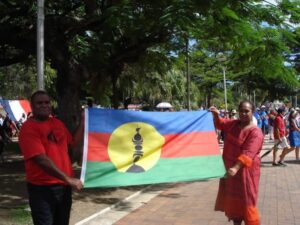
Kanak Pro-Independence supporters display the Kanak flag during a rally in the streets of Noumea prior to New Caledonia's first referendum on Independence in 2018. Credit: Catherine Wilson/IPS

Kanak Pro-Independence supporters display the Kanak flag during a rally in the streets of Noumea prior to New Caledonia’s first referendum on Independence in 2018. Credit: Catherine Wilson/IPS

NOUMEA, New Caledonia , Jul 17 2024 (IPS) – It’s been 26 years since a peace agreement, the Noumea Accord, was signed following an outbreak of conflict in the 1980s between Kanak islanders and French armed forces in the French overseas territory of New Caledonia.


But the eruption of turbulent protests and unrest again two months ago has shown that the cleavage of indigenous political grievances with the French state remains deep in this group of islands located east of Australia in the southwest Pacific.

The centre of New Caledonia’s capital, Noumea, a popular holiday destination in the Pacific Islands, is usually abuzz with tourists patronizing sidewalk cafes. But many of the streets, now patrolled by French police, are deserted and eerily quiet.

The protests, which began in mid-May, escalated to armed clashes between activists and French security forces, resulting in ten deaths. And the destruction of homes, public buildings and looting of shops and businesses has had a devastating impact on the small island society. The cost of the damage is estimated to be more than USD 1 billion; at least 7,000 people have lost jobs and incomes, and the territory’s economy has suffered a major downturn.

Barricades were erected in the streets of Noumea when confrontations escalated between Pro-Independence activists and French police in May following the French Parliament's adoption of electoral reforms in New Caledonia. Credit: Catherine Wilson/IPS

Barricades were erected in the streets of Noumea when confrontations escalated between Pro-Independence activists and French police in May following the French Parliament’s adoption of electoral reforms in New Caledonia. Credit: Catherine Wilson/IPS

The unrest has revealed the gaping fracture between France’s determination to retain control of the territory and the indigenous Kanak islanders, who are riled at lack of progress toward their call for self-determination.

“We protested in the streets. We wanted to say to the French state, you must respect the Kanaks because France voted for the reforms without consent from us,” Jacques (his name has been changed), a Kanak activist in Noumea, told IPS.

He was speaking of the adoption of electoral changes in New Caledonia by the French Parliament, which would have opened the electoral roll to tens of thousands of recent migrant settlers, the majority from Europe.

About 41 percent of New Caledonia’s population is indigenous and many believe it would have led to the declining influence of their vote against rising numbers of Loyalists in future elections and referendums. The changing demographic balance between Kanaks and non-Kanaks is a longstanding grievance.

The uprising in the 1980s was driven by grievances about land dispossession, poverty, inequality, the absence of civil and political rights, and France’s policy of promoting migration from France to New Caledonia.

While French President Emmanuel Macron suspended the electoral reforms in mid-June, many Pro-Independence supporters are unappeased.

Jacques is among a group of Kanak activists who have set up a campaign site next to a main road on the outskirts of the capital. They are sitting around a table under a marquee, surrounded by flags and banners.

“We want our country to be decolonized, as it is written in the Noumea agreement. The French state is only interested in dominating the population here. If the French state stays here, we will have more violence,” Jacques claims.

The French government agreed in the 1998 Noumea Accord to grant New Caledonia more governing powers, recognition of Kanak culture and right to consultation, restrictions on the local electoral roll allowing only Kanaks and long-term residents to vote and the holding of referendums on its future political status.

But by 2021, three referendums had been held, all with majority outcomes, to remain part of France. There was a 43.33 percent vote for Independence in the first referendum in 2018, which increased to 46.74 percent in the second in 2020. But Kanaks, severely affected by the COVID-19 pandemic, boycotted the third referendum in 2021. The overwhelming Loyalist vote of 96.5 percent has never been accepted by Pro-Independence political parties, such as the Kanak and Socialist National Liberation Front (FLNKS).

“We firmly support the call by FLNKS for the UN to declare the result of the third referendum null and void due to the non-participation of the people of Kanaky. Voter turnout was below 50 percent of registered voters; hence, it cannot be taken as the legitimate wish of the silent majority,” the sub-regional inter-governmental organization, the Melanesian Spearhead Group, stated in 2021.

Kanak separatists’ determination to keep their aspirations alive, even though options for changing the political status quo through referendums have been exhausted, has led to an increasingly polarized political landscape. Some entrenched Loyalists believe that the French state should “take over the New Caledonian government because of all the political problems that we have,” Catherine Ris, President of the University of New Caledonia in Noumea, told IPS. And, “on the Pro-Independence side, we do not hear the moderate people anymore.”

The recent mobilization of the Field Action Coordinating Cell (CCAT) by the Pro-Independence Caledonian Union party was a sign of some Kanaks’ belief that their demands are not being met through the political process. The core group of activists were a major force behind the recent protests and the Cell’s leader, Christian Tein, is currently being held in a jail in France on charges related to the unrest. Similarly, the major presence of youths on the streets in May is evidence that a new generation has lost faith in the pace of social and political change.

“The younger people want the change now because in their lives they have experienced and seen a lot of hardship—the persecution of the Kanak people, the difficulties of getting a job,” Jacques emphasized. An estimated 45 percent of people in New Caledonia who don’t have a high school certificate are indigenous, and the Kanak unemployment rate is reported to be as high as 38 percent.

Yet the representation of Kanaks in the territory’s government and politics has steadily increased over the past two decades. The number of seats held by Pro-Independence politicians in New Caledonia’s 54 seat Congress rose from 18 to 25 between 2004 and 2014, while Loyalists witnessed a decrease from 36 to 29 seats, reports Australia’s Lowy Institute for International Policy.

In 2021, Louis Mapou, the first Kanak Pro-Independence President of the government, was elected. And, following the French national election this month, Emmanuel Tjibaou, a Kanak leader from the rural North Province, was voted in as one of New Caledonia’s two members of the National Assembly in Paris.

In the wider region, New Caledonia’s self-determination movement has the international support of other Pacific Island countries, especially those that have indigenous Melanesian populations, such as Papua New Guinea and Fiji, as well as Azerbaijan and Russia. And the French overseas territory has been on the United Nations’ Decolonization List since 1986.

Yet there are New Caledonians who are concerned about the viability of a New Caledonian state. The territory relies heavily on France’s fiscal support, which amounts to 20 percent of the local gross domestic product (GDP) and pays for public services, local economic development programs and civil service salaries.

“We have a good economy here,” Marcieux, a Frenchman who has lived in New Caledonia for 30 years, told IPS in Noumea. “It is easy to speak of independence, but, in reality, it is very difficult. You need a way to make independence.”

But, until the yawning political divisions laid bare by the events of May are addressed, it will be difficult for New Caledonia’s leaders to present a united will to President Macron and the French Parliament located more than 16,000 kilometres away.

However, Tjibaou, the new member of the French National Assembly, is the focus of hope that meaningful dialogue can emerge from the recent conflict. He told local media soon after his election this month that “we all have to offer a framework for discussions to resume between the three partners, which are France, the FLNKS and the Loyalists… we have to capitalize on this.”

IPS UN Bureau Report

  Source