Water Harvesting Strengthens Food Security in Central America

Active Citizens, Civil Society, Combating Desertification and Drought, Development & Aid, Editors’ Choice, Environment, Food & Agriculture, Headlines, Latin America & the Caribbean, Poverty & SDGs, Regional Categories, TerraViva United Nations, Water & Sanitation

Water & Sanitation

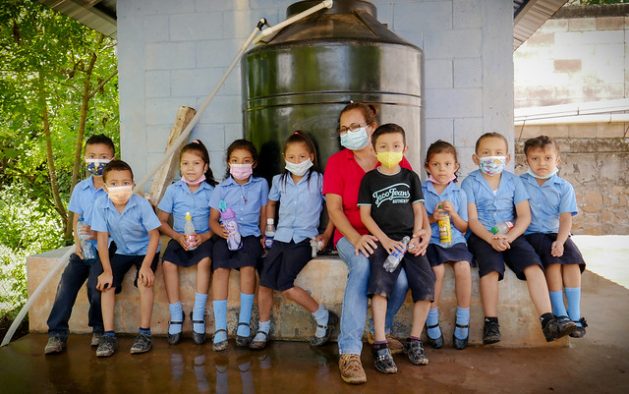
Angélica María Posada, a teacher and school principal in the village of El Guarumal, in eastern El Salvador, poses with primary school students in front of the school where they use purified water collected from rainfall, as part of a project promoted by FAO and Mexican cooperation funds. The initiative is being implemented in the countries of the Central American Dry Corridor. CREDIT: Edgardo Ayala/IPS

Angélica María Posada, a teacher and school principal in the village of El Guarumal, in eastern El Salvador, poses with primary school students in front of the school where they use purified water collected from rainfall, as part of a project promoted by FAO and Mexican cooperation funds. The initiative is being implemented in the countries of the Central American Dry Corridor. CREDIT: Edgardo Ayala/IPS

SENSEMBRA, El Salvador , Jun 23 2021 (IPS) – At the school in El Guarumal, a remote village in eastern El Salvador, the children no longer have to walk several kilometers along winding paths to fetch water from wells; they now “harvest” it from the rain that falls on the roofs of their classrooms.


“The water is not only for the children and us teachers, but for the whole community,” school principal Angelica Maria Posada told IPS, sitting with some of her young students at the foot of the tank that supplies them with purified water.

The village is located in the municipality of Sensembra, in the eastern department of Morazán, where it forms part of the so-called Central American Dry Corridor, a semi-arid belt that covers 35 percent of Central America and is home to some 11 million people, mostly engaged in subsistence agriculture.

In the Corridor, 1,600 kilometers long, water is always scarce and food production is a challenge, with more than five million people at risk of food insecurity.

In El Guarumal, a dozen peasant families have dug ponds or small reservoirs and use the rainwater collected to irrigate their home gardens and raise tilapia fish as a way to combat drought and produce food.

“We are all very proud of this initiative, because we are the only school in the country that has a (rainwater harvesting) system like this.” — Angélica María Posada

This effort, called the Rainwater Harvesting System (RHS), has not only been made in El Salvador.

Similar initiatives have been promoted in five other Central American countries as part of the Mesoamerica Hunger Free programme, implemented since 2015 by the United Nations Food and Agriculture Organisation (FAO) and financed by the Mexican Agency for International Development Cooperation (Amexcid).

The aim of the RHS was to create the conditions for poor, rural communities in the Dry Corridor to strengthen food security by harvesting water to irrigate their crops and raise fish.

In Guatemala, work has been done to strengthen an ancestral agroforestry system inherited from the Chortí people, called Koxur Rum, which conserves more moisture in the soil and thus improves the production of corn and beans, staples of the Central American diet.

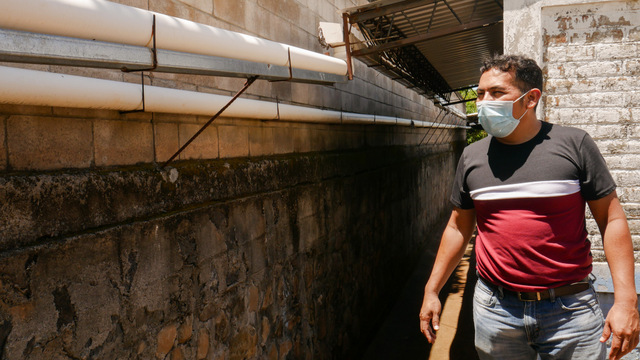
José Evelio Chicas, a teacher at the school in the village of El Guarumal, in El Salvador's eastern department of Morazán, supervises the PVC pipes that carry rainwater collected from the school's roof to an underground tank, from where it is pumped to a filtering and purification station. The initiative is part of a water harvesting project in the Central American Dry Corridor. CREDIT: Edgardo Ayala/IPS

José Evelio Chicas, a teacher at the school in the village of El Guarumal, in El Salvador’s eastern department of Morazán, supervises the PVC pipes that carry rainwater collected from the school’s roof to an underground tank, from where it is pumped to a filtering and purification station. The initiative is part of a water harvesting project in the Central American Dry Corridor. CREDIT: Edgardo Ayala/IPS

“The best structure for conserving water is the soil, and that is where we have to work,” Baltazar Moscoso, national coordinator of Mesoamerica Hunger Free, told IPS by telephone from Guatemala City.

Healthy schools in El Salvador

The principal of the El Guarumal school, where 47 girls, 32 boys and several adolescents study, said that since the water collection and purification system has been in place, gastrointestinal ailments have been significantly reduced.

“The children no longer complain about stomachaches, like they used to,” said Posada, 47, a divorced mother of three children: two girls and one boy.

She added, “The water is 100 percent safe.”

Before it is purified, the rainwater that falls on the tin roof is collected by gutters and channeled into an underground tank with a capacity of 105,000 litres.

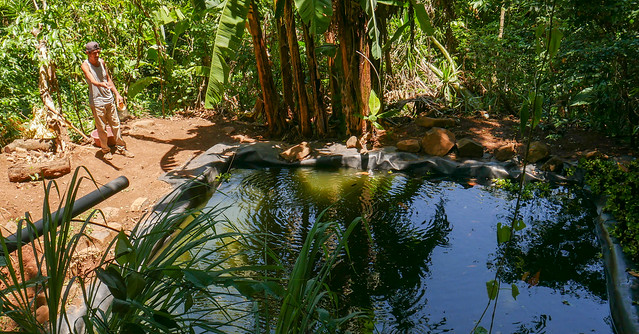
Farmer Cristino Martínez feeds the tilapia he raises in the pond dug next to his house in the village of El Guarumal in eastern El Salvador. A dozen ponds like this one were created in the village to help poor rural families produce food in the Central American Dry Corridor. CREDIT: Edgardo Ayala/IPS

Farmer Cristino Martínez feeds the tilapia he raises in the pond dug next to his house in the village of El Guarumal in eastern El Salvador. A dozen ponds like this one were created in the village to help poor rural families produce food in the Central American Dry Corridor. CREDIT: Edgardo Ayala/IPS

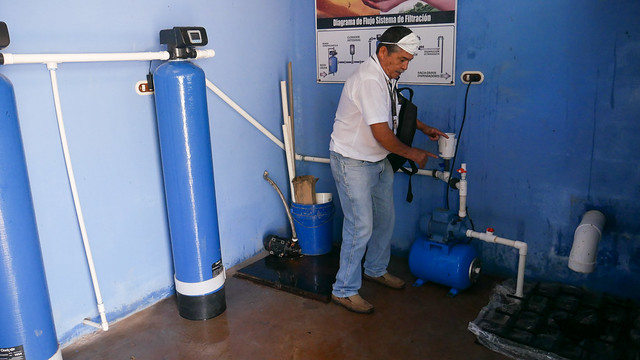
It is then pumped to a station where it is filtered and purified, before flowing into the tank which supplies students, teachers and the community.

The school reopened for in-person classes in March, following the shutdown declared by the government in 2020 to curb the spread of the COVID-19 pandemic.

“We are all very proud of this initiative, because we are the only school in the country that has a system like this,” added the principal.

There are 40 families living in El Guarumal, but a total of 150 families benefit from the system installed in the town, because people from other communities also come to get water.

A similar system was installed in 2017 in Cerrito Colorado, a village in the municipality of San Isidro, Choluteca department in southern Honduras, which benefits 80 families, including those from the neighbouring communities of Jicarito and Obrajito.

Rainwater is filtered and purified in a room adjacent to the classrooms of the school in the village of El Guarumal, in the eastern department of Morazán, El Salvador. Gastrointestinal ailments were reduced with the implementation of this project executed by FAO and financed by Mexican cooperation funds. CREDIT: Edgardo Ayala/IPS

Rainwater is filtered and purified in a room adjacent to the classrooms of the school in the village of El Guarumal, in the eastern department of Morazán, El Salvador. Gastrointestinal ailments were reduced with the implementation of this project executed by FAO and financed by Mexican cooperation funds. CREDIT: Edgardo Ayala/IPS

Vegetable gardens and tilapias boost food security

About 20 minutes from the school in El Guarumal, following a narrow dirt road that winds along the mountainside, you reach the house of Cristino Martínez, who grows tomatoes and raises tilapia in the pond dug next to his home.

The ponds are pits dug in the ground and lined with a polyethylene geomembrane, a waterproof synthetic material. They hold up to 25,000 litres of rainwater.

“The pond has served me well, I have used it for both the tilapia and watering tomatoes, beans and chayote (Sechium edule),” Martínez told IPS, standing at the edge of the pond, while tossing food to the fish.

The cost of the school’s water harvesting system and the 12 ponds totaled 77,000 dollars.

Martínez has not bothered to keep a precise record of how many tilapias he raises, because he does not sell them, he said. The fish feed his large family of 13: he and his wife and their 11 children (seven girls and four boys).

And from time to time he receives guests in his adobe house.

“My sisters come from San Salvador and tell me: ‘Cristino, we want to eat some tilapia,’ and my daughters throw the nets and start catching fish,” said the 50-year-old farmer.

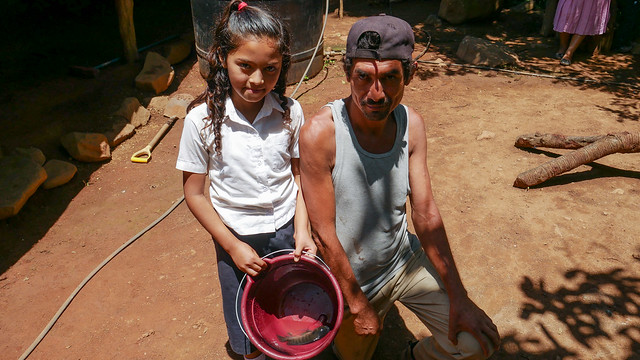
Cristino Martínez and one of his daughters show the tilapia they have just caught in the family pond they have dug in the backyard of their home in the village of El Guarumal in the eastern department of Morazán, El Salvador. The large peasant family raises fish for their own consumption and not for sale. CREDIT: Edgardo Ayala/IPS

Cristino Martínez and one of his daughters show the tilapia they have just caught in the family pond they have dug in the backyard of their home in the village of El Guarumal in the eastern department of Morazán, El Salvador. The large peasant family raises fish for their own consumption and not for sale. CREDIT: Edgardo Ayala/IPS

According to FAO estimates, the ponds can provide about 500 fishes two to three times a year.

The ponds are built on the highest part of each farm, and the drip irrigation system uses gravity to water the crops or orchards planted on the slopes.

Tomatoes are Martínez’s main crop. He has 100 seedlings planted, and manages to produce good harvests, marketing his produce in the local community.

“The pond helps me in the summer to water the vegetables I grow downhill,” another beneficiary of the programme, Santos Henríquez, also a native of El Guarumal, told IPS.

Henríquez’s 1.5-hectare plot is one of the most diversified: in addition to tilapias, corn and a type of bean locally called “ejote”, he grows cucumbers, chili peppers, tomatoes, cabbage and various types of fruit, such as mangoes, oranges and lemons.

“We grow a little bit of everything,” Henríquez, 48, said proudly. He sells the surplus produce in the village or at Sensembra.

However, some beneficiary families have underutilised the ponds. They were initially enthusiastic about the effort, but began to let things slide when the project ended in 2018.

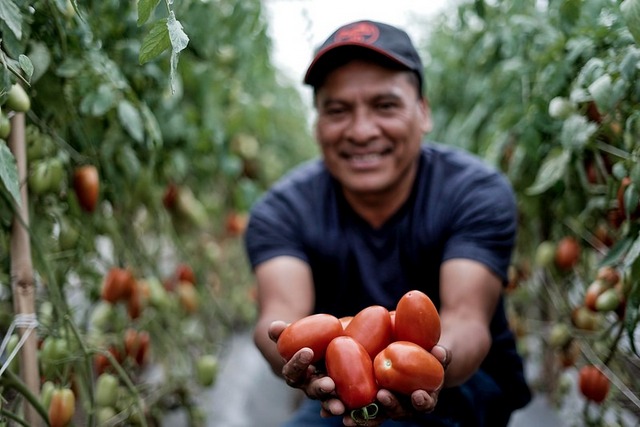
A farmer proudly displays some of the tomatoes he has grown in the region known as Mancomunidad Copán Chortí in eastern Guatemala, which includes the municipalities of Camotán, Jocotán, Olopa and San Juan Ermita, in the department of Chiquimula. Water harvesting initiatives have been implemented in the area to improve agricultural production in this region, which is part of the so-called Central American Dry Corridor. The initiative is supported by FAO and Mexican cooperation funds. CREDIT: FAO Guatemala

A farmer proudly displays some of the tomatoes he has grown in the region known as Mancomunidad Copán Chortí in eastern Guatemala, which includes the municipalities of Camotán, Jocotán, Olopa and San Juan Ermita, in the department of Chiquimula. Water harvesting initiatives have been implemented in the area to improve agricultural production in this region, which is part of the so-called Central American Dry Corridor. The initiative is supported by FAO and Mexican cooperation funds. CREDIT: FAO Guatemala

An ageold Chorti technique in Guatemala

In Guatemala, meanwhile, some villages and communities are betting on an agroforestry technique from their ancestral culture: Koxur Rum, which means “wet land” in the language of the Chortí indigenous people, who also live in parts of El Salvador and Honduras.

The system allows corn and bean crops to retain more moisture with the rains by combining them with furrows of shrubs or trees such as madre de cacao or quickstick (Gliricidia sepium), a tree species that helps fix nitrogen in the soil.

By pruning the trees regularly, leaves and crop stubble cover and protect the soil, thereby better retaining moisture and nutrients.

“Quickstick sprouts quickly and gives abundant foliage to incorporate into the soil,” farmer Rigoberto Suchite told IPS in a telephone interview from the village of Minas Abajo, in the municipality of San Juan Ermita, Chiquimula department in eastern Guatemala, also located in the Central American Dry Corridor.

Suchite said the system was revived in his region in 2000, but with the FAO and Amexcid project, it has become more technical.

As part of the programme, some 150 families have received two 1,500-litre tanks and a drip irrigation system, he added.

“Now we are expanding it even more because it has given us good results, it has improved the soil and boosted production,” said Suchite, 55.

In the dry season, farmers collect water from nearby springs in tanks and, using gravity, irrigate their home gardens.

“Many families are managing to have a surplus of vegetables and with the sales, they buy other necessary food,” Suchite said.

The programme is scheduled to end in Guatemala in 2021, and local communities must assume the lessons learned in order to move forward.

  Source

Maldives’ UN General Assembly Presidency Renews Hope for Small Island Developing States

Civil Society, Development & Aid, Economy & Trade, Featured, Global, Headlines, Human Rights, Inequity, TerraViva United Nations

Opinion

Taking Stock, Looking Forward. Credit UNESCO

JEDDAH, Saudi Arabia , Jun 23 2021 (IPS) – Earlier this month, Abdulla Shahid, the Maldives’ foreign minister, was elected President of the 76th Session of the United Nations General Assembly (UNGA), which commences in September.


This is the sixth time a candidate from a Small Island Developing State (SIDS) has been elected to steer the work of the UN’s highest policy-making organ during its 76-year history:

Rudy Insanally of Guyana became the first president of the General Assembly elected from the UN-SIDS category in 1993; followed by Saint Lucia’s Julian Hunte in 2003; Haya Rashed Al-Khalifa of Bahrain in 2006; and the late John William Ashe of Antigua and Barbuda in 2013, while Peter Thomson of Fiji, took the helm during the GA’s 71st session in 2016.

https://www.un.org/ohrlls/content/list-sids

It may seem surprising that such small nations have so frequently been named to this high position—the aggregate population of all SIDS is only 65 million, less than one percent of the global population—but the UN’s 38 SIDS constitute one fifth of the international organization’s total voting membership.

This position gives SIDS outsized power as a voting bloc, which they have wielded to great effect, perhaps most significantly when it comes to climate change, which as we will see has benefited the entire global community.

Abdulla Shahid. Credit: United Nations

Far from representing a monolithic group, SIDS hail from every region of the world and are home to dozens of languages and a wide variety of social and economic characteristics. Some, like Guyana and Belize, are not even islands, but they all share unique social, economic and environmental vulnerabilities (like size, remoteness, and limited resources base) that the UN has recognized a distinct group of developing countries since 1992.

They are also highly vulnerable to the impacts of climate change, like extreme weather, sea level rise, and biodiversity loss, making them natural allies in the fight to cut the greenhouse gas emissions responsible for the crisis.

In fact, in 1989, the Maldives hosted one of the first international conferences on sea level rise, a consequential event in the international climate change fight and the inspiration for the creation of the Alliance of Small Island States (AOSIS), which has been credited to establish the the United Nations Framework Convention on Climate Change in 1992 and winning the inclusion of the 1.5 degree Celsius temperature goal in the Paris climate accord in 2015, the latter during the Maldives chairmanship of the group.

SIDS have also shown critical leadership in the creation of the UN’s Sustainable Development Goals (SDGs).

In 2014, SIDS helped lead the negotiations, ultimately creating what is known as the SAMOA Pathway, a blueprint to ensure priorities of SIDS were reflected in the final 17 SDGs.

Before that, John William Ashe skillfully set the stage for the SDGs by working with larger countries to create a process for the SDGs that truly had global buy in.

All along, SIDS main argument that the specific challenges they face need to be given special consideration, and today a number of the SDGs do just that, including sustainable management of fisheries, aquaculture, and tourism. Such recognition was further solidified in 2015 as part of the Addis Ababa Action Agenda adopted at the UN Conference on Financing for Development and again that year in the Sendai Framework for Disaster Risk Reduction.

Catherine Haswell, the UN Resident Coordinator in the Maldives (left) meets a group of local women. May 2021. Credit: UN Maldives/Nasheeth Thoha

Unsurprisingly, another theme that has emerged in SIDS international diplomacy over the years is ocean conservation. In December 2017, under Peter Thomson’s leadership, the General Assembly decided to convene negotiations towards an international legally binding instrument under the UN Convention on the Law of the Sea (UNCLOS) on the conservation and sustainable use of marine biological diversity of areas beyond national jurisdiction, what is known as the high seas.

Thomson was also instrumental in developing the UN Ocean Conference that sets out to conserve and sustainably use ocean resources.

SIDS’ important endeavors during the General Assembly not only showcase the value of their contributions there, but of the GA itself, a place where all 193 UN countries, large and small, can elevate their concerns.

During the campaign for the post competing with Zalmai Rassoul, the candidate from Afghanistan, the Maldives’ Shahid launched “a presidency of hope”, noting that his priorities during the year-long presidency are to recover from the Covid-19 pandemic and rebuild economies better and greener.

“The General Assembly can boost efforts towards greater climate action” and “renew momentum” on issues of energy, biological diversity, sustainable fisheries, desertification and the oceans – that are at the heart of SIDS’ concerns.

The UN Secretary General Antonio Guterres, while welcoming the new President-elect Shahid commended his “selection of hope as the central theme in his vision statement” and noted that, “coming from a small island developing state, Mr. Shahid will bring unique insights to the 76th session of the General Assembly, as we prepare for COP26 in Glasgow in November.”

Shahid’s election, as with the SIDS leaders before him, not only offers new hope for islands, but the whole international community. At this precarious moment in history, it is truer than ever that by promoting the interests of SIDS, what we are really doing is protecting the future of mankind.

Ahmed Sareer was the Ambassador/ Permanent Representative of the Maldives to the United Nations from 2012 to 2017 and chairman of the Alliance of Small Island States from 2015 to 2017. He is presently serving at the General Secretariat of the Organization of Islamic Cooperation (OIC) based in Jeddah.

  Source

‘Let’s Talk About Sex’ Discussion Highlights Risks to Women

Civil Society, Crime & Justice, Development & Aid, Economy & Trade, Gender, Gender Violence, Global, Headlines, Health, Human Rights, Humanitarian Emergencies, Poverty & SDGs, TerraViva United Nations, Women’s Health

Nordic Talk moderator Katja Iversen shown here with Natasha Wang Mwansa, Emi Mahmoud, Dr Natalia Kanem and Flemming Møller Mortensen during a recent Nordic Talks webinar. Credit: Shuprova Tasneem

DHAKA and NEW YORK, Jun 4 2021 (IPS) – Every two minutes, a girl or woman dies from pregnancy or childbirth-related complications, including unsafe abortions. Every year, around 12 million girls are married while in their childhoods. An additional 10 million are now at risk of child marriage due to the Covid-19 pandemic.


In this context, the most recent Nordic Talk—a high-level debate on bodily autonomy and sexual and reproductive health and rights (SRHR) as a cornerstone of gender equality, aptly titled “Let’s Talk About Sex” — could not have come at a better time.

Moderator Katja Iversen, Dane of the Year (2018) and former CEO of Women Deliver, kicked off the discussion by focusing on the close link between bodily autonomy, gender equality, economic growth, and a healthy planet.

In an exclusive interview with IPS, Iversen said it was clear that “bodily autonomy for girls and women—in all their rich diversity—is political, social, economic and health-related.”

Women needed to have power and agency over their “bodies, fertility, and future, living a life free of violence and coercion in both the private and public sphere. It ties into norms, structure, systems – and if we want equity and health for all, we need to address all of it.”

Emi Mahmoud, two-time World Champion Poet and Goodwill Ambassador for the UNHCR, set the tone for the Nordic Talk with her emotive poetry reflecting women’s experiences in patriarchal societies, asking: “What survivor hasn’t had her struggle made spectacle?”

The three other panellists agreed that the right to control their bodies was a fundamental aspect of women’s rights and that gender equality was an essential part of the sustainable development agenda.

As Dr Natalia Kanem, Executive Director of the UNFPA, explained that “(women’s) freedom over her own body means freedom of choice”, and that all the data points towards how investment in SRHR could be the first step to empowering women to “ultimately contribute to sustainable development.”

It was critical that SRHR was adequately resourced – but warned these would be in short supply because of the COVID pandemic recovery plans.

“Part of the financing challenge is what we abbreviate as political will. It actually does not cost a lot for the agenda for SRHR to be a reality by 2030. It would take $26 billion a year to end the unmet need for contraception and to stop mothers dying at birth, many of whom were too young to be pregnant, but resources are going to be a challenge now with Covid having affected the world economies.”

While Flemming Møller Mortensen, Danish Minister for International and Nordic Development and Nordic Cooperation, expressed optimism regarding resources for SRHR now that “the US is back on track” and the global gag rule had been revoked. He was worried about a growing conservatism and pushback against women’s rights, particularly in the pandemic’s wake.

Iversen told IPS the cuts in various countries could be devastating.

“UNFPA estimates that with the $180 million the UK wants to withdraw from the Supplies Partnership, UNFPA could have helped prevent around 250,000 maternal and child deaths, 14.6 million unintended pregnancies and 4.3 million unsafe abortions. We will need foundations and other donor countries to step up, and we will need national government step up and step in and ensure that their national budgets reflect and fill the SRHR needs.”

She expressed concern that women on COVID-19 decision-making bodies were unrepresented.

“Less than 25% of national COVID-19 decision-making bodies have women included. It is too easy to cut resources from people who are not at the decision-making tables,” she said. “We urgently need to get a lot more women into leadership, including of the COVID-19 response and recovery efforts. All evidence shows that when more women are included in decision-making, there is a more holistic approach and both societies and people fare better.”

This call for inclusivity, not just for women but for the youth, was strongly echoed by adolescent sexual and reproductive health rights expert Natasha Wang Mwansa.

“So many commitments have been made by so many countries, yet there is no meaningful progress or accountability, and young people are not involved when making these decisions,” Mwansa said. “Young people are here as partners, but we are also here to take charge. From making choices over our own bodies to choices on our national budgets, we are ready to be part of these decisions.”

To deal with challenges in providing access to SRHR, Kanem stressed the importance of gender-disaggregated data for planning. She added that despite the hurdles, she was hopeful about the future because “young people and women are not waiting to make the case and show solidarity and understanding when it comes to racism or issues of discrimination and equity that divide us.”

Iversen echoed this optimism in her IPS interview.

“It gives me hope that comprehensive sexual and reproductive health services are included in the roadmap for Universal Health Coverage, in the Global Action Plan for Healthy Lives and Well-being, and latest in the Generation Equality Forum blueprint,” she said.

“Civil society has played a key role in ensuring this with good arguments, data and a lot of tenacity. But words in the big global documents about Health For All is one thing; gender equality and women’s rights, if it has to matter, it has to manifest in concrete action.”

The conversation rounded off with recommendations and commitments from the panellists: Mwansa stressed more investments in youth-run organisations and more social accountability from decision-makers; Mortensen asked for governments to be held accountable and for youth voices to be heard; and Kanem reaffirmed the UNFPA’s goal to put family planning in the hands of women as a means of empowerment, to end preventable deaths in pregnant women and girls, and change fundamental attitudes to end gender-based violence.

In her final comments to IPS, Iversen also stressed the importance of SRHR as a means of empowerment.

“Study after study shows that it pays to invest in girls, women and SRHR – socially, economically and health-wise. But we cannot look at SRHR alone; we need a full gender lens to the COVID response and recovery and development in general,” she said.

“And if we want to see positive change, we have to put girls and women front and centre of coronavirus response and recovery efforts, just as we, in general, need to see many more women in political and economic leadership.”

The Nordic Council of Ministers supports the Nordic Talks, and “Let’s Talk about Sex” was organised in partnership with UNFPA, the Danish Ministry of Foreign Affairs, Generation Equality, the Danish Family Planning Association, and Mind your Business, as a lead up to the Paris Generation Equality Forum.

  Source

From Non-aligned to One Aligned

Civil Society, Development & Aid, Global, Global Geopolitics, Global Governance, Headlines, IPS UN: Inside the Glasshouse, TerraViva United Nations
Opinion

The implications of Colombo’s foreign policy shift under Sri Lanka President Gotabaya Rajapaksa, from a time-honoured adherence to non-alignment to a clear affiliation with Beijing. Former minister Dr Wijeyadasa Rajapakshe said Colombo Port City (above) might turn out to be a ‘colony’ of China.

LONDON, Jun 4 2021 (IPS) – June 4, 2021 marks 30 years since the killings of an undisclosed number of Chinese protestors at Beijing’s Tiananmen Square. For many years, the Chinese government and its ruling Chinese Communist Party (CCP), with characteristic understatement, called it the ‘June Fourth incident’.


It was the hardliners in the CCP who forced the ouster of its general secretary Hu Yaobang, a party moderate who had encouraged democratic reform, and eventually ordered the military crackdown on the protestors at Tiananmen – perhaps the blackest day in the history of post-revolutionary China.

Sri Lankans should recall the central role of the Chinese Communist Party in turning Tiananmen Square into a horrendous killing field that provoked an unprecedented outpouring of public grief and condemnation from neighbouring Hong Kong, in light of the apparent reverence that Sri Lanka’s President Gotabaya Rajapaksa appears to pay to the CCP’s style of governance.

And he has done so more than once, even telling China’s Defence Minister Wei Fenghe, during his visit to Colombo in April, that he hoped to ‘learn from the governance experience’ of the CCP in poverty alleviation and rural revitalisation.

While the CCP’s role in poverty alleviation might be conceded, the same cannot be said of corruption elimination. It was growing corruption among those in the Chinese government and Communist Party that triggered the massive student protest, which demanded an end to the burgeoning graft and lack of accountability by officialdom, and collectively called for democratic reform in China’s politically regimented society.

Critics say Sri Lanka’s foreign policy of neutrality and its ‘India First’ declaration are mere geopolitical window dressing.

While President Rajapaksa, who has been invited to China, might pick up a thing or two about the success of the CCP in alleviating poverty, there is little he could learn about ridding society of other malaise prevalent in China – a pity, as such knowledge might help to eliminate Sri Lanka’s own political viruses that are causing serious concern, not only in Sri Lankan society but also in the region.

From the early years of Sri Lanka’s independence from British rule, Ceylon (as it was then known) had followed a policy of peaceful co-existence, articulated earlier by India’s Prime Minister Jawaharlal Nehru as the five principles of ‘Panchaseela’, deriving from Buddhist Thought.

It was this Nehruvian Panchaseela that eventually formed the bedrock of the foreign policy of most newly independent states in Asia, Africa and Latin America, under the banner of non-alignment.

Under Prime Minister Sirimavo Bandaranaike, the world’s first woman prime minister, Ceylon was among founding members of the Non-Aligned Movement (NAM) when 25 countries met in Belgrade at NAM’s first summit in 1961

It was a foreign policy that most Ceylon/Sri Lanka governments were wedded to, except perhaps the pro-western United National Party (UNP) government under President Junius Richard Jayewardene, who cynically told me there were only two non-aligned countries in the world: the USA and the USSR.  

This was in 1979 and, ironically, he was then the Chairman of NAM having taken over the chairmanship from Sirimavo Bandaranaike who lost the 1977 general election having hosted the NAM summit in Colombo in 1976.

President Jayewardene was very much pro-American. Still, he went to Communist Cuba, an arch enemy of the US to pass on the baton to President Fidel Castro who was hosting the next NAM summit in Havana in 1979.

Then, with the advent of another Rajapaksa, Gotabaya, as president, Sri Lankan foreign policy was redefined. He said at his inauguration in November 2019 that it was now one of ‘neutrality’, dropping any reference to the long-standing policy of non-alignment.

Though never clearly defined, to Rajapaksa junior this meant staying aloof from Big Power conflicts. By that time, the Indian Ocean had perceptibly turned into a conflict zone as China’s push into this vital maritime international sea route led to counter responses from other major powers, namely the US, Japan, Australia and India.

Moreover, New Delhi saw the growing Chinese naval and economic presence in the region under China’s Belt and Road Initiative (BRI) and Maritime Silk Route as an intrusion into its sphere of influence, raising strategic security concerns.

So, there was a congruence of interest among other major powers and users of the Indian Ocean in challenging what was perceived as Beijing’s expansionism, that is, asserting its own presence in the region and the freedom of navigation for all.

Shortly after Narendra Modi became India’s prime minister in 2014, he made a dramatic shift in India’s own foreign policy, turning from a ‘Look East’ policy to an ‘Act East’ one. This implied a more conscious and determined involvement in South East Asia, particularly ASEAN.

If Modi enunciated a ‘Neighbourhood First’ doctrine, Gotabaya Rajapaksa claimed his to be ‘India First’, perhaps in an attempt to balance the elder Rajapaksa, Mahinda’s, pro-China predilections as president. It was during Mahinda’s nine years at the helm, from 2005, that bilateral relations were at their strongest, perhaps not without cause.

President Mahinda Rajapaksa, with brother Gotabaya as his defence secretary, was at war with the ruthless separatist Liberation Tigers of Eelam (LTTE), popularly known as the Tamil Tigers.

The only country at the time ready to help the Rajapaksas defeat the separatists, with substantial finance and arms aid, was China, which it did in May 2009.

Mahinda returned the favour by contracting China for some major infrastructure projects, including the new Hambantota port in the deep south some 15 nautical miles or so from vital international sea lanes. This port, which is now on a 99-year lease to China because Sri Lanka could not meet its loan repayments, has turned out to be a serious strategic concern to India and other major trading nations.

Last month another major Chinese project Colombo Port City (CPC), some 270 hectares of land reclaimed from the sea close to the capital’s principal port, came alive after the Supreme Court approved the Bill to set up the managing commission after the Court called for several changes to clauses that were inconsistent with the constitution.

The CPC, in which the Chinese development holds 43 per cent of the land (also for 99 years) is intended to be a huge investment and business centre for foreign investors. This made the US ambassador in Colombo, among others, reach for the panic button for fear that the CPC could be a source of money laundering and other ‘dirty’ money.

A former minister in the previous government and a member of the ruling party, Dr Wijeyadasa Rajapakshe, even warned that the Port City might well turn out to be a ‘colony’ of China, given the exclusion of Sri Lankan entrepreneurs from investing there, even if they had foreign currency to do so.

Critics of the Rajapaksa government’s policies – including the militarisation of the civil administration and the handling of the Covid-19 pandemic that is still surging in the country – say that Sri Lanka’s foreign policy of neutrality and its ‘India First’ declaration are nothing more than geopolitical window dressing.

They claim it is unsupported by fact and is meant to cover the government’s strong pro-China commitments. They also point to a media release by the Chinese Embassy in Colombo, following Defence Minister Wei Fenghe’s April visit, in which President Rajapaksa is quoted as telling the visiting minister that Sri Lanka ‘has prioritised developing relations with China and firmly supports China’s positions on issues concerning its core issues’.

If, by jettisoning non-alignment and embracing ‘neutrality’, Sri Lanka means it is following an equidistant foreign policy, it has not shown so by its actions. China obviously knows best. In its statement on the defence minister’s visit, the Chinese embassy says: ‘China appreciates Sri Lanka’s independent and non-aligned foreign policy.’

Scant wonder many are puzzled by the nomenclature.

Source: Asian Affairs

Neville de Silva is a veteran Sri Lankan journalist who held senior roles in Hong Kong at The Standard and worked in London for Gemini News Service. He has been a correspondent for foreign media including the New York Times and Le Monde. More recently he was Sri Lanka’s deputy high commissioner in London

  Source

Global Austerity Alert: Looming Budget Cuts in 2021-25 and Alternatives

Aid, Civil Society, Development & Aid, Economy & Trade, Financial Crisis, Global, Headlines, Health, Humanitarian Emergencies, Inequity, TerraViva United Nations

Opinion

Map of countries with projected austerity cuts in 2021-2022, in terms of GDP, based on IMF fiscal projections. Credit: I. Ortiz and M. Cummins, 2021

NEW YORK and NAIROBI, Apr 15 2021 (IPS) – Last week Ministers of Finance met virtually at the Spring Meetings of the International Monetary Fund (IMF) and the World Bank to discuss policies to tackle the pandemic and socio-economic recovery.


But a global study just published by the Initiative for Policy Dialogue at Columbia University, international trade unions and civil society organizations, sounds an alert of an emerging austerity shock: Most governments are imposing budget cuts, precisely at a time when their citizens and economies are in greater need of public support.

Analysis of IMF fiscal projections shows that budget cuts are expected in 154 countries this year, and as many as 159 countries in 2022. This means that 6.6 billion people or 85% of the global population will be living under austerity conditions by next year, a trend likely to continue at least until 2025.

The high levels of expenditures needed to cope with the pandemic have left governments with growing fiscal deficit and debt. However, rather than exploring financing options to provide direly-needed support for socio-economic recovery, governments—advised by the IMF, the G20 and others—are opting for austerity.

The post-pandemic fiscal shock appears to be far more intense than the one that followed the global financial and economic crisis a decade ago. The average expenditure contraction in 2021 is estimated at 3.3% of GDP, which is nearly double the size of the previous crisis. More than 40 governments are forecasted to spend less than the (already low) pre-pandemic levels, with budgets 12% smaller on average in 2021-22 than those in 2018-19 before COVID-19, including countries with high developmental needs like Ecuador, Equatorial Guinea, Kiribati, Liberia, Libya, Republic of Congo, South Sudan, Yemen, Zambia and Zimbabwe.

The dangers of early and overly aggressive austerity are clear from the past decade of adjustment. From 2010 to 2019, billions of people were affected by reduced pensions and social security benefits; by lower subsidies, including for food, agricultural inputs and fuel; by wage bill cuts and caps, which hampered the delivery of public services like education, health, social work, water and public transport; by the rationalization and narrow-targeting of social protection programs so that only the poorest populations received smaller and smaller benefits, while most people were excluded; and by less employment security for workers, as labor regulations were dismantled. Many governments also introduced regressive taxes, like consumption taxes, which further lowered disposable household income. In many countries, public services were downsized or privatized, including health. Austerity proved to be a deadly policy. The weak state of public health systems—overburdened, underfunded and understaffed from a decade of austerity—aggravated health inequalities and made populations more vulnerable to COVID-19.

Today, it is imperative to watch out for austerity measures with negative social outcomes. After COVID-19’s devastating impacts, austerity will only cause more unnecessary suffering and hardship.

Austerity is bad policy. There are, in fact, alternatives even in the poorest countries. Instead of slashing spending, governments can and must explore financing options to increase public budgets.

First, governments can increase tax revenues on wealth, property, and corporate income, including on the financial sector that remains generally untaxed. For example, Bolivia, Mongolia and Zambia are financing universal pensions, child benefits and other schemes from mining and gas taxes; Brazil introduced a tax on financial transactions to expand social protection coverage.

Second, more than sixty governments have successfully restructured/reduced their debt obligations to free up resources for development. Third, addressing illicit financial flows such as tax evasion and money laundering is a huge opportunity to generate revenue. Fourth, governments can simply decide to reprioritize their spending, away from low social impact investments areas like defense and bank/corporate bailouts; for example, Costa Rica and Thailand redirected military expenditures to public health.

Fifth, another financing option is to use accumulated fiscal and foreign reserves in Central Banks. Sixth, attract greater transfers/development assistance or concessional loans. A seventh option is to adopt more accommodative macroeconomic frameworks. And eighth, governments can formalize workers in the informal economy with good contracts and wages, which increases the contribution pool and expands social protection coverage.

Expenditure and financing decisions that affect the lives of millions of people cannot be taken behind closed doors at the Ministry of Finance. All options should be carefully examined in an inclusive national social dialogue with representatives from trade unions, employers, civil society organizations and other relevant stakeholders.

#EndAusterity is a global campaign to stop austerity measures that have negative social impacts. Since 2020, more than 500 organizations and academics from 87 countries have called on the IMF and Ministries of Finance to immediately stop austerity, and instead prioritize policies that advance gender justice, reduce inequality, and put people and planet first.

Isabel Ortiz is Director of the Global Social Justice Program at Joseph Stiglitz’s Initiative for Policy Dialogue at Columbia University, former Director at the International Labour Organization (ILO) and UNICEF
Matthew Cummins is senior economist who has worked at UNDP, UNICEF and the World Bank.

  Source

Recipes with a Taste of Sustainable Development on the Coast of El Salvador

Biodiversity, Civil Society, Development & Aid, Economy & Trade, Editors’ Choice, Energy, Environment, Featured, Food & Agriculture, Global Governance, Green Economy, Headlines, Integration and Development Brazilian-style, IPS UN: Inside the Glasshouse, Latin America & the Caribbean, Poverty & SDGs, Projects, Regional Categories, Special Report, TerraViva United Nations

Environment

María Luz Rodríguez stands next to her solar oven where she cooked lasagna in the village of El Salamar in San Luis La Herradura municipality. In this region in southern El Salvador, an effort is being made to implement environmental actions to ensure the sustainable use of natural resources. CREDIT: Edgardo Ayala/ IPS

María Luz Rodríguez stands next to her solar oven where she cooked lasagna in the village of El Salamar in San Luis La Herradura municipality. In this region in southern El Salvador, an effort is being made to implement environmental actions to ensure the sustainable use of natural resources. CREDIT: Edgardo Ayala/ IPS

SAN LUIS LA HERRADURA, El Salvador, Mar 31 2021 (IPS) – Salvadoran villager Maria Luz Rodriguez placed the cheese on top of the lasagna she was cooking outdoors, put the pan in her solar oven and glanced at the midday sun to be sure there was enough energy for cooking.


“Hopefully it won’t get too cloudy later,” Maria Luz, 78, told IPS. She then checked the thermometer inside the oven to see if it had reached 150 degrees Celsius, the ideal temperature to start baking.

She lives in El Salamar, a coastal village of 95 families located in San Luis La Herradura, a municipality in the central department of La Paz which is home to some 30,000 people on the edge of an impressive ecosystem: the mangroves and bodies of water that make up the Estero de Jaltepeque, a natural reserve whose watershed covers 934 square kilometres.

After several minutes the cheese began to melt, a clear sign that things were going well inside the solar oven, which is simply a box with a lid that functions as a mirror, directing sunlight into the interior, which is covered with metal sheets.

“I like to cook lasagna on special occasions,” Maria Luz said with a smile.

After Tropical Storm Stan hit Central America in 2005, a small emergency fund reached El Salamar two years later, which eventually became the start of a much more ambitious sustainable development project that ended up including more than 600 families.

Solar ovens and energy-efficient cookstoves emerged as an important component of the programme.

Aerial view of Estero de Jaltepeque, in San Luis La Herradura, a municipality on the Pacific coast in southern El Salvador where a sustainable development programme is being carried out in local communities, including the use of solar stoves and sustainable fishing and agriculture techniques. CREDIT: Edgardo Ayala /IPS

Aerial view of Estero de Jaltepeque, in San Luis La Herradura, a municipality on the Pacific coast in southern El Salvador where a sustainable development programme is being carried out in local communities, including the use of solar stoves and sustainable fishing and agriculture techniques. CREDIT: Edgardo Ayala /IPS

The project was financed by the Global Environment Facility‘s (GEF) Small Grants Programme, and El Salamar was later joined by other villages, bringing the total number to 18. The overall investment was more than 400,000 dollars.

In addition to solar ovens and high-energy rocket stoves, work was done on mangrove reforestation and sustainable management of fishing and agriculture, among other measures. Agriculture and fishing are the main activities in these villages, in addition to seasonal work during the sugarcane harvest.

While María Luz made the lasagna, her daughter, María del Carmen Rodríguez, 49, was cooking two other dishes: bean soup with vegetables and beef, and rice – not in a solar oven but on one of the rocket stoves.

This stove is a circular structure 25 centimetres high and about 30 centimetres in diameter, whose base has an opening in which a small metal grill is inserted to hold twigs no more than 15 centimetres long, which come from the gliridicia (Gliricidia sepium) tree. This promotes the use of living fences that provide firewood, to avoid damaging the mangroves.

The stove maintains a good flame with very little wood, due to its high energy efficiency, unlike traditional cookstoves, which require several logs to prepare each meal and produce smoke that is harmful to health.

María del Carmen Rodríguez cooks rice on a rocket stove using a few twigs from a tree species that emits less CO2 than mangroves, whose sustainability is also preserved thanks to the use of the tree. Many families in the community of El Salamar have benefited from this energy-efficient technology, as well as other initiatives promoted along the Pacific coast in southern El Salvador. CREDIT: Edgardo Ayala /IPS

María del Carmen Rodríguez cooks rice on a rocket stove using a few twigs from a tree species that emits less CO2 than mangroves, whose sustainability is also preserved thanks to the use of the tree. Many families in the community of El Salamar have benefited from this energy-efficient technology, as well as other initiatives promoted along the Pacific coast in southern El Salvador. CREDIT: Edgardo Ayala /IPS

The rocket stove can cook anything, but it is designed to work with another complementary mechanism for maximum energy efficiency.

Once the stews or soups have reached boiling point, they are placed inside the “magic” stove: a circular box about 36 centimetres in diameter made of polystyrene or durapax, as it is known locally, a material that retains heat.

The food is left there, covered, to finish cooking with the steam from the hot pot, like a kind of steamer.

“The nice thing about this is that you can do other things while the soup is cooking by itself in the magic stove,” explained María del Carmen, a homemaker who has five children.

The technology for both stoves was brought to these coastal villages by a team of Chileans financed by the Chile Fund against Hunger and Poverty, established in 2006 by the government of that South American country and the United Nations Development Programme (UNDP) to promote South-South cooperation.

The Chileans taught a group of young people from several of these communities how to make the components of the rocket stoves, which are made from clay, cement and a commercial sealant or glue.

The blue crab is one of the species raised in nurseries by people in the Estero de Jaltepeque region in southern El Salvador, as part of an environmental sustainability project in the area financed by the Global Environment Facility’s Small Grants Programme. CREDIT: Edgardo Ayala/IPS

The blue crab is one of the species raised in nurseries by people in the Estero de Jaltepeque region in southern El Salvador, as part of an environmental sustainability project in the area financed by the Global Environment Facility’s Small Grants Programme. CREDIT: Edgardo Ayala/IPS

The use of these stoves “has reduced carbon dioxide (CO2) emissions by at least 50 percent compared to traditional stoves,” Juan René Guzmán, coordinator of the GEF’s Small Grants Programme in El Salvador, told IPS.

Some 150 families use rocket stoves and magic stoves in 10 of the villages that were part of the project, which ended in 2017.

“People were given their cooking kits, and in return they had to help plant mangroves, or collect plastic, not burn garbage, etc. But not everyone was willing to work for the environment,” Claudia Trinidad, 26, a native of El Salamar and a senior studying business administration – online due to the COVID pandemic – at the Lutheran University of El Salvador, told IPS.

Those who worked on the mangrove reforestation generated hours of labour, which were counted as more than 800,000 dollars in matching funds provided by the communities.

In the project area, 500 hectares of mangroves have been preserved or restored, and sustainable practices have been implemented on 300 hectares of marine and land ecosystems.

Petrona Cañénguez shows how she cooks bean soup on an energy-efficient rocket stove in an outside room of her home in the hamlet of San Sebastián El Chingo, one of the beneficiaries of a sustainable development programme in the municipality of San Luis La Herradura, on El Salvador's southern coast. CREDIT: Edgardo Ayala /IPS

Petrona Cañénguez shows how she cooks bean soup on an energy-efficient rocket stove in an outside room of her home in the hamlet of San Sebastián El Chingo, one of the beneficiaries of a sustainable development programme in the municipality of San Luis La Herradura, on El Salvador’s southern coast. CREDIT: Edgardo Ayala /IPS

Petrona Cañénguez, from the town of San Sebastián El Chingo, was among the people who participated in the work. She was also cooking bean soup for lunch on her rocket stove when IPS visited her home during a tour of the area.

“I like the stove because you feel less heat when you are preparing food, plus it’s very economical, just a few twigs and that’s it,” said Petrona, 59.

The bean soup, a staple dish in El Salvador, would be ready in an hour, she said. She used just under one kilo of beans, and the soup would feed her and her four children for about five days.

However, she used only the rocket stove, without the magic stove, more out of habit than anything else. “We always have gliridicia twigs on hand,” she said, which make it easy to use the stove.

Although the solar oven offers the cleanest solution, few people still have theirs, IPS found.

This is due to the fact that the wood they were built with was not of the best quality and the coastal weather conditions and moths soon took their toll.

Maria Luz is one of the few people who still uses hers, not only to cook lasagna, but for a wide variety of recipes, such as orange bread.

However, the project is not only about stoves and ovens.

 Some families living in coastal villages in the municipality of San Luis La Herradura have dug ponds for sustainable fishing, which was of great help to the local population during the COVID-19 lockdown in this coastal area of southern El Salvador. CREDIT: Edgardo Ayala /IPS

Some families living in coastal villages in the municipality of San Luis La Herradura have dug ponds for sustainable fishing, which was of great help to the local population during the COVID-19 lockdown in this coastal area of southern El Salvador. CREDIT: Edgardo Ayala /IPS

The beneficiary families also received cayucos (flat-bottomed boats smaller than canoes) and fishing nets, plus support for setting up nurseries for blue crabs and mollusks native to the area, as part of the fishing component with a focus on sustainability in this region on the shores of the Pacific Ocean.

Several families have dug ponds that fill up with water from the estuary at high tide, where they raise fish that provide them with food in times of scarcity, such as during the lockdown declared in the country in March 2020 to curb the spread of coronavirus.

The project also promoted the planting of corn and beans with native seeds, as well as other crops – tomatoes, cucumbers, cushaw squash and radishes – using organic fertiliser and herbicides.

The president of the Local Development Committee of San Luis La Herradura, Daniel Mercado, told IPS that during the COVID-19 health emergency people in the area resorted to bartering to stock up on the food they needed.

“If one community had tomatoes and another had fish, we traded, we learned to survive, to coexist,” Daniel said. “It was like the communism of the early Christians.”

  Source