Bombing and Ballots, Myanmar’s Contentious Election

Armed Conflicts, Asia-Pacific, Civil Society, Crime & Justice, Democracy, Editors’ Choice, Featured, Freedom of Expression, Headlines, Human Rights, Press Freedom, TerraViva United Nations
Human Rights

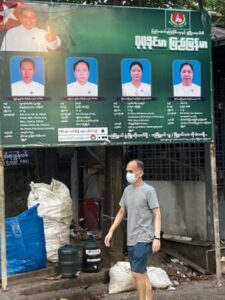
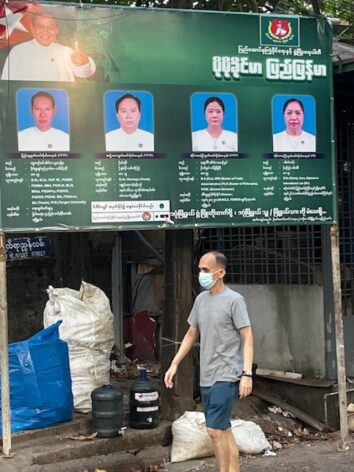
A man walks past a campaign poster for the military’s proxy party USDP ahead of strictly controlled elections in Myanmar. Credit: Guy Dinmore/IPS

A man walks past a campaign poster for the military’s proxy party USDP ahead of strictly controlled elections in Myanmar. Credit: Guy Dinmore/IPS

YANGON, Myanmar and BANGKOK , Jan 6 2026 (IPS) – With thousands of civilians killed in years of civil war and over 22,000 political prisoners still behind bars, no one was surprised that early results from Myanmar’s first but tightly controlled elections since the 2021 coup show the military’s proxy party speeding to victory.


“How can you hold elections and bomb civilians at the same time?” asked Khin Ohmar, a civil rights activist outside Myanmar who is monitoring what the resistance forces and a shadow government reject as “sham” polls.

The junta had already cleared the path towards its stated goal of a “genuine, disciplined multi-party democratic system” by dissolving some 40 parties that refused to register for polls, which they regard as illegitimate, with their leaders and supporters still in prison.

These include the National League for Democracy (NLD) and its leader, Aung San Suu Kyi, who won a landslide second term  in the 2020 elections – only for the results to be annulled by Senior General Min Aung Hlaing, a coup leader and self-appointed acting president. Mass street protests were crushed in early 2021 and war spread across Myanmar.

Although these elections will deliver just a façade of the legitimacy craved by some of the generals, they did succeed in projecting a power and authority that was quickly slipping away just two years ago as long-standing ethnic armed groups and newly formed People’s Defence Forces (PDFs) inflicted a series of humiliating defeats on the junta.

“The tide has turned in favour of the military,” commented a veteran Myanmar analyst in Yangon, crediting China, which reined in the ethnic groups on its shared border, fully embraced Min Aung Hlaing and, along with Russia, delivered the arms, technology and training needed to peg back the resistance.

Campaigners for the pro-military USDP canvas residents and check voters lists in Yangon ahead of the December 28 parliamentary election that excluded major anti-junta parties. Credit: Guy Dinmore/IPS

Campaigners for the pro-military USDP canvas residents and check voters lists in Yangon ahead of the December 28 parliamentary election that excluded major anti-junta parties. Credit: Guy Dinmore/IPS

The regime’s air power and newly acquired drones have been deployed to ruthless effect, often hitting civilian targets in relatively remote areas where the resistance has grassroots support. Air strikes were stepped up as the elections approached. Major cities like Yangon were calm; people subdued.

Bombs dropped on Tabayin township in the Sagaing Region on December 5 killed 18 people, including many in a busy tea shop, AFP reported. On December 10, air strikes on a hospital in the ancient capital of Mrauk-U in Rakhine State were reported to have killed 10 patients and 23 others. The regime accused the insurgent Arakan Army and PDFs of using it as a base.

“I don’t think that anyone believes that those elections will be free and fair,” UN Secretary General Antonio Guterres stated while visiting the region ahead of the polls. He called on the junta to end its “deplorable” violence and find “a credible path” back to civilian rule.

In contrast, the Trump administration declared in November that the junta’s election plans were “free and fair” and removed Temporary Protected Status from Myanmar refugees in the US, saying their country was safe for them to return to.

“I’ll be jailed if I don’t vote,” said Min, a Yangon taxi driver, only half-joking on the eve of voting in Yangon, the commercial capital. “And what difference does it make? We are ruled by China and Xi Jinping, not Min Aung Hlaing,” he added.

With the polls spread over three stages, the first 102 townships voted on December 28. Others will follow on January 11 and January 25 to make a total of 265 of Myanmar’s 330 townships scheduled to vote for the bicameral national parliament and assemblies in the 14 regions and states.
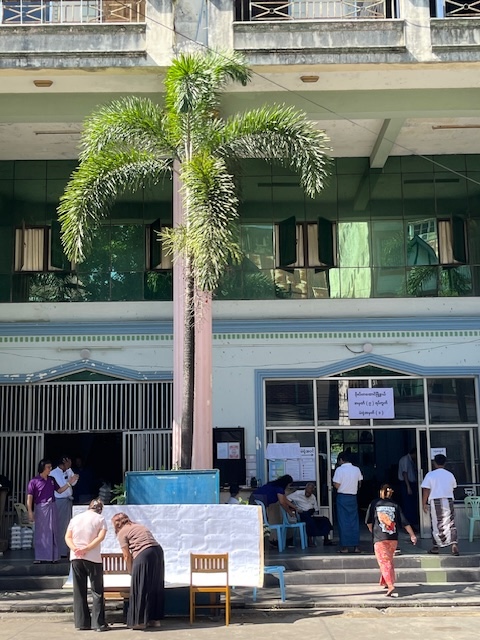
Residents in downtown Yangon check their names on the electoral register and then cast their votes in a polling station on December 28. Credit: Guy Dinmore/IPS

Residents in downtown Yangon check their names on the electoral register and then cast their votes in a polling station on December 28. Credit: Guy Dinmore/IPS

No voting is to be held at all in the remaining 65 townships that the election commission deemed too unsafe.

Voting in the first round in Yangon, an urban and semi-rural sprawl of seven million people, proceeded calmly and slowly on a quiet Sunday – despite intense efforts, and sometimes threats, by the regime to boost the turnout.

In 2020 and 2015 – when Myanmar arguably held the region’s most open and fair elections and the military’s proxy Union Solidarity and Development Party (USDP), was soundly defeated – people gaily posted images of their ink-stained little fingers on social media as evidence of their vote after weeks of packed rallies and vibrant campaign rallies.

But not this time. Social media posts hurled insults, some comic and vulgar, at the regime. Those eager to support the resistance’s boycott but who were afraid of reprisals were relieved if they found their names had been omitted by mistake on electoral lists. Electronic voting machines in use for the first time made it impossible to leave a blank.

But as in past elections, a solid core of people close to the military and its web of powerful economic interests turned out to vote for the USDP.

“We are choosing our government,” declared one man exiting a polling station in central Yangon with his family, apparently USDP supporters. One proudly waved his little finger dipped in indelible ink.

How can you hold elections and bomb civilians at the same time? – Khin Ohmar, civil rights activist

Turnout for the first round was put by regime officials at 52 percent. This compares with about 70 percent in the past two elections. China’s special envoy – sent as an official observer, along with others from Russia, Belarus, Vietnam and Cambodia – praised the elections.

On January 2, the election commission unexpectedly issued partial results: the USDP, led by retired generals, had won 38 of 40 seats in the lower house where votes had been tallied to date. No one blinked.

The USDP campaign message focused on two main elements – get out and vote with all your family, and back a USDP government to restore stability and progress to Myanmar.

Its underlying message was a reminder that the last USDP administration, led by President Thein Sein introduced socio-economic and political reforms and ceasefire negotiations with ethnic groups after securing a large majority in the 2010 elections when the NLD and other opposition groups were also absent.

Aung San Suu Kyi, then under house arrest, was released just after the 2010 polls and went on to contest and win a seat in a 2012 by-election ahead of the NLD’s own sweeping victory in 2015. Aung San Suu Kyi governed in a difficult power-sharing arrangement with the military for the next five years and was thrown back into prison in the coup.

For now a large proportion of Myanmar’s population lives in areas under junta control, including all 14 of the state and regional capitals, swollen by an influx of people fleeing conflict.  The military also holds major seaports and airports and – to varying degrees – the main border crossings for China and Thailand.

But in terms of territory, over half of Myanmar is in the hands of disparate ethnic armed groups and resistance forces. Alliances are fluid and negotiable.

The shadow National Unity Government is trying to establish its own authority over liberated territory, looking to cement a consensus around the concept of a democratic and federal Myanmar free of the military’s interference – something that has eluded the country since independence from British colonial rule in 1948.

Front lines shift back and forth as the military struggles to regain control over the Bamar heartlands of central Myanmar, once considered their bastion, while stretched elsewhere after losing vast tracts of border areas since the coup. Several million people have fled the country or are internally displaced.

Once again there is some speculation that a “smooth” election and the formation of a USDP government in April will lead to a gesture signalling the military’s confidence, such as a possible ending of forced conscription and the release of some political prisoners. Project power, then collect legitimacy.

“Political prisoners are used as bait,” said Khin Ohmar, the civil rights activist in Bangkok. “The world would at least have to applaud.”

IPS UN Bureau Report

  Source

The Silent War Before COP30: How Corporations Are Weaponising the Law to Muzzle Climate Defenders

Active Citizens, Civil Society, Climate Action, Climate Change, Climate Change Justice, Conferences, COP30, Crime & Justice, Development & Aid, Economy & Trade, Energy, Environment, Freedom of Expression, Global, Headlines, Indigenous Rights, Latin America & the Caribbean, Press Freedom, TerraViva United Nations

Opinion

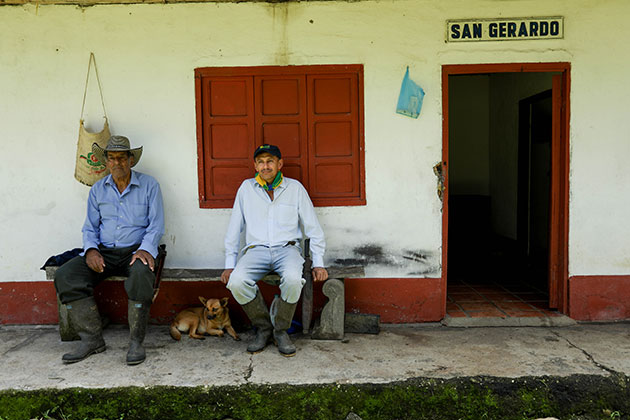
Family agriculture and land defenders in Colombia. Credit: Both Nomads/Forus

BELÉM, Brazil, Nov 10 2025 (IPS) – As the world prepares for the next COP30 summit, a quieter battle is raging in courtrooms. Strategic Lawsuits Against Public Participation (SLAPPs) are the fossil-fuel industry’s new favourite weapon, turning justice systems into instruments of intimidation.


“Speak out, and you’ll pay for it”

On a humid morning in August 2025, two small environmental groups in Panama — Centro de Incidencia Ambiental and Adopta Bosque Panamá — found out through social media that they were being sued for “slander” and “crimes against the national economy.” Their offence? Criticising a port project on the country’s Pacific coast.

A few days later, across the border in Costa Rica, two environmental content creators woke up to find their bank accounts frozen and salaries withheld. Their “crime” was posting videos about a tourism project they said was damaging Playa Panamá’s fragile coastline.

In both cases, the message was straightforward: speak out, and you’ll pay for it.

These are part of a growing global trend that is particularly ominous as climate activists, Indigenous defenders, and journalists push their demands upon the upcoming COP30 negotiations. The battle to protect the planet increasingly comes with an additional cost: defending yourself in court.

SLAPPs: Lawsuits Designed to Scare, Not Win

The acronym sounds almost trivial — SLAPP — but its impact is anything but. SLAPP stands for Strategic Lawsuits Against Public Participation, a term coined decades ago to describe legal actions intended not to win on merit but to intimidate, exhaust, and silence those who speak out on matters of public interest.

According to Transparency International, “SLAPPs are also known as frivolous lawsuits or gag lawsuits, as they silence journalists, activists, whistleblowers, NGOs and anyone who brings facts to light in the public interest.”

These are not just lawsuits; they are in fact strategy. They don’t need to win, they just need to drain your time, your money, and your hope.

The claimants are usually powerful, ranging from corporations, politicians, or investors.

In the Costa Rican case, the company linked to the Playa Panama tourism project did not even allege material harm. Yet the court imposed “precautionary embargoes,” blocking credit cards, freezing wages, even restricting property rights, punishing through the process.

In Panama, the developers of the Puerto Barú port project filed a criminal complaint against environmental NGOs who had challenged the project’s environmental impact assessment before the Supreme Court. Those challenges are still pending. Rather than waiting for the judiciary’s ruling, the company launched a separate legal attack, accusing those NGOs of harming the national economy.

Observers call it “judicial intimidation.” The case triggered several alerts across the EU SEE Early Warning Mechanism, warning of a “chilling effect on civic participation.”

‘Unfortunately, in Panama, judicial harassment of journalists and activists by politicians and businesspeople is already common practice because criminal law allows it. Reform is needed in relation to so-called crimes against honour and the grounds for seizure of assets. International organisations such as the Inter-American Press Association have warned about this,’ says Olga de Obaldía, executive director of Transparency International – Panama Chapter, a national member of the EU SEE network.

In Costa Rica, the embargoes imposed on content creators Juan Bautista Alfaro and Javier Adelfang sparked outrage. Within days, 72 organisations and more than 3,000 individuals — from academics to Indigenous leaders — signed an open letter condemning the action as “an assault on public interest advocacy.”

The backlash worked: members of the Frente Amplio Party introduced a bill to restrict the use of preventive embargoes in cases involving public interest speech.

But for those already targeted, the damage – emotional, financial and reputational – has already been done.

We do not just see SLAPPs deployed in Latin America. Examples of SLAPPs as a means of lawfare by the rich and powerful have been around for a long time across the globe.

In Thailand, Thammakaset sued several members of the NGO Fortify Rights and other activists for denouncing abusive working conditions. Still today content posted by communities or NGOs, or even comments under local government posts, are often picked up and turned into criminal defamation cases.

Despite the existence of anti-SLAPP provisions in the Criminal Procedure Code, experiences indicate that they are largely ineffective. The constant threat of facing litigation based on online content disrupts CSO work and chills free speech.

Climate Activism Under Pressure

As the world heads toward another global climate summit in Brazil – where journalist Amanda Miranda faces a SLAPP by government officials for uncovering corruption – we face a paradox: while governments make promises about protecting the environment, environmental defenders are being prosecuted for holding them accountable.

Brazil’s baseline snapshot on an enabling environment also highlights a related trend: environmental defenders are frequently framed as “anti-development,” a narrative used to delegitimise their work and undermine public support. SLAPPs reinforce this strategy. Beyond draining time and resources, these lawsuits inflict reputational harm, serving as tools in broader campaigns to discredit and silence critics.

According to research from the Business & Human Rights Resource Centre, the highest number of SLAPPs – almost half of them – took place in Latin America, followed by Asia and the Pacific (25%), Europe & Central Asia (18%), Africa (8.5%), and North America (9%). Nearly three-quarters of cases were brought in countries in the Global South and 63% of cases involved criminal charges. Furthermore, most individuals and groups facing SLAPPs raised concerns about projects in four sectors: mining, agriculture and livestock, logging and lumber, and finally palm oil.

In an International Center for Non-Profit law – ICNL – study on over 80 cases of SLAPPs across the Global South, out of them “91% were brought by private companies or company officials(…) 41% brought by mining companies and (…) 34% brought by companies associated with agriculture.”

According to data from the CASE Coalition, SLAPP cases have risen sharply in recent years: from 570 cases in 2022 to over 820 in 2023 in Europe alone. Around half of those targeted climate, land, and labor rights defenders. Fossil fuel and extractive industries remain the most frequent initiators.

It is important to remember that those numbers under-represent the extent of SLAPP use, they are based on reported legal cases and can’t include the many cases in which the mere threat of a lawsuit was enough to silence before filing a complaint

The Business & Human Rights Resource Centre has documented that companies linked to mining, tourism, and large infrastructure projects are increasingly using SLAPPs to paralyse critics ahead of international events like COP, when scrutiny intensifies.

The danger of SLAPPs lies in their quietness. They happen behind closed doors, in legal language, far from the marches and hashtags. The trials often do not even end up in lawsuits. Yet their effect is profound. Every frozen bank account, every unpaid legal fee, every public apology extracted under duress weakens the collective courage needed to hold power to account.

Across regions, SLAPPs follow the same playbook: identify outspoken defenders, sue them on vague charges like “defamation” or “economic harm”, drag the process out for years, win by exhausting, not convincing.

Of course, the specific tactics vary by legal context. In some countries, certain charges carry strategic advantages. For example, in the Philippines, authorities frequently rely on serious, non-bailable allegations — including charges like illegal possession of firearms — to keep activists detained for extended periods.

The Philippines remains the most dangerous country in Asia for land and environmental defenders with frequent attacks linked to mining, agribusiness, and water projects.

Political repression persists and civil society groups continue to face “red-tagging” and SLAPPs, further enabled by the passage of the Anti-Terrorism Act, the Anti-Money Laundering Act of 2001, and the Terrorism Financing Prevention and Suppression Act of 2012.

Authorities have also used fabricated firearms and explosives charges to target activists, journalists, and community leaders, often accompanied by asset freezes, surveillance, and prolonged detention. In these settings, SLAPPs can “weaponise” the criminal justice system itself to remove critics from public life entirely.

SLAPPs have become the invisible front of the climate struggle, a slow-motion suppression campaign that rarely makes headlines.

Tactics to Fight Back

In early 2024, the European Union adopted its first-ever Anti-SLAPP Directive, a milestone achievement after years of campaigning by journalists and civil society. It sets out minimum standards to prevent abusive lawsuits and protect public participation.

But implementation remains uncertain. The Vice-President of the European Commission, Vera Jourova, called the Directive “Daphne’s law,” in memory of the Maltese journalist Daphne Caruana Galizia, who was killed in 2017 while she was the victim of numerous legal proceedings against her, and whose tragic story helped raise awareness of the issue.

Beyond the European context, similar efforts to counter SLAPPs have emerged elsewhere, for example in Colombia with the Guerra v. Ruiz-Navarro case. This case illustrates the importance of investigating sexual violence and abuse of power, recognising it as a matter of public interest that warrants protection. This ruling sets a strong precedent against the misuse of courts to silence the press by influential figures and underscores that defending victims and informing the public are acts of defending human rights.

In Indonesia, another country where SLAPPs are being deployed, civil society groups continue to advocate for stronger legal protections, including legislation to protect from SLAPPs. A small step forward came in September 2024, when the Ministry of Environment and Forestry issued Regulation No. 10/2024, on legal protection for environmental defenders.

“While the Ministry of Environment and Forestry Regulation No. 10/2024 represents an initial step toward safeguarding environmental defenders, civil society organisations expect its effective implementation, coupled with broader anti-SLAPP legislation, to ensure comprehensive protection against retaliatory lawsuits and foster a secure environment for public participation in environmental governance,” says Intan Kusumaning Tiyas of INFID, national civil society platform in Indonesia.

Civil society groups are calling for action on immediate priorities.

These include stronger legal safeguards by enacting robust national anti-SLAPP laws that allow for early case dismissal, ensure defendants can recover legal costs, and penalise those who file abusive lawsuits.

Setting up solidarity and support through regional and global networks can quickly mobilise legal assistance, mental health support, and emergency funding for those targeted.

Finally, actions around visibility and accountability are needed to bring SLAPPs into the public eye and raise awareness. SLAPPs need to be framed not as ordinary legal conflicts, but as violations of human rights that weaken an enabling environment for civil society, democratic participation and obstruct climate justice.

At COP30, negotiators will debate carbon credits and transition funds. But the real test of climate commitment may lie in whether states protect the people defending rivers, forests, and coastlines from powerful interests.

Civil society hopes to push a bold message into COP30 discussions: defending the environment requires defending those who defend it and supporting an enabling environment for civil society.

This article was written with the support of the Forus team, particularly Lena Muhs, and members of the EU SEE network.

IPS UN Bureau


UNGA80: Lies Spread Faster Than Facts

Crime & Justice, Featured, Freedom of Expression, Global, Headlines, Multimedia, Press Freedom, TerraViva United Nations, Video

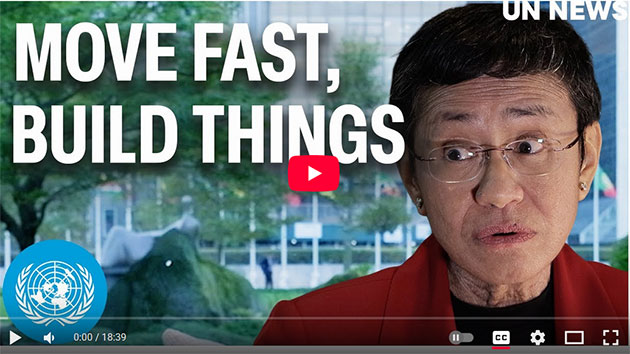
NEW YORK, Sep 30 2025 (IPS) – DANGER – WARNING – ALARM: Nobel Peace Prize Laureate Maria Ressa is warning that lies are being weaponized deliberately to manipulate people around the world. Big, profit-oriented, and technology-enabled companies are now disregarding or trampling over the sanctity and veracity of facts and information to speed up disinformation, (using AI) in ways that quickly erase truth and leave people manipulated.


Even democratic elections are getting manipulated to the extent that some 72 per cent of the world is now living under illiberal or authoritarian regimes that have been “democratically” elected. Journalism, fact-checking, and public trust are under attack from this deliberate subversion of information integrity.

Enjoy this interview I conducted with Ms Ressa, (produced, directed and edited by my UN News and Media colleagues, Paulina Kubiak and Alban Mendes De Leon).

[embedded content]

Ben Malor is the Chief Editor, UN Dailies, at UN News.

  Source

‘Israeli Offensive in Gaza City an Existential Threat to the Two-State Solution’

Armed Conflicts, Crime & Justice, Editors’ Choice, Featured, Freedom of Expression, Headlines, Human Rights, Humanitarian Emergencies, International Justice, Middle East & North Africa, Press Freedom, Sustainable Development Goals, TerraViva United Nations

Armed Conflicts

As Israel escalates its attack on Gaza City, the UN moves to stop further violence and humanitarian violations by renewing UNIFIL’s mandate for the last time.

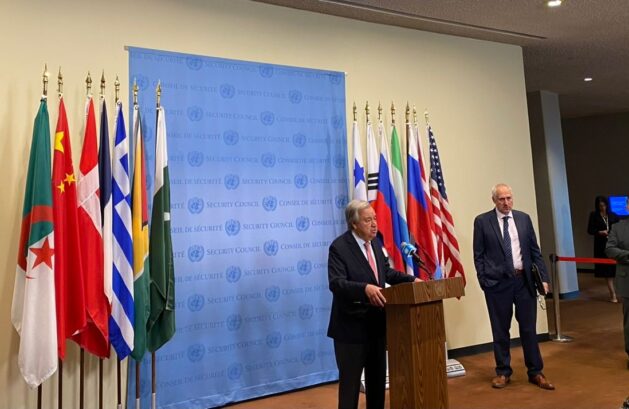
United Nations Secretary-General António Guterres at a press briefing on Israel’s plans to take over Gaza City. Credit: Jennifer Xin-Tsu Lin Levine/IPS

United Nations Secretary-General António Guterres at a press briefing on Israel’s plans to take over Gaza City. Credit: Jennifer Xin-Tsu Lin Levine/IPS

UNITED NATIONS, Aug 28 2025 (IPS) – Ahead of the Security Council meeting on the situation in the Middle East, United Nations Secretary-General António Guterres spoke to the press on the “unfolding tragedy that is Gaza,” calling Israel’s new plans to take over Gaza City with the military a “deadly escalation” and an “existential threat to the two-state solution.”


He warned that such a move could precipitate an unprecedented humanitarian catastrophe that imperiled any remaining prospects for negotiated peace.

The Secretary-General also reiterated his plea for an immediate ceasefire, emphasizing that capturing Gaza City would result in massive civilian casualties and widespread destruction—including severe impacts on the health sector already teetering on collapse.

At the daily press briefing, spokesperson for the Secretary-General Stéphane Dujarric reported on the displacement in Gaza since Israel’s most recent invasion, confirming the Secretary-General’s statements about refugees. UN experts report that the total number of people who have fled from north Gaza to south Gaza since August 14, when the Israeli invasion was announced, is 20,000.

The Secretary-General went on to address the most recent Israeli air strike on the Nasser Hospital in the southern Strip of Gaza, where at least 20 people were killed and 50 others were injured. Israel’s military defended the strike by asserting that it targeted a camera used by Hamas to surveil troop movements.

Dorothy Shea, United States ambassador to the United Nations, defended Israeli actions and urged condemnation of Hamas’ use of civilian facilities for military purposes. She also noted the Hamas members killed by the airstrike.

Prime Minister Benjamin Netanyahu issued a statement calling the strike a “tragic mishap” with no mention of a specific Hamas target. The Secretary-General called for an impartial investigation into these contrasting claims.

Although Netanyahu reaffirmed his respect for journalists on X, formerly known as Twitter, UNESCO reported at least 62 journalists and media workers killed in Palestine while working since October 2023. At least five journalists were killed in the Nasser air strike, according to World Health Organization Director Tedros Adhanom Gebreyesus.

At the Security Council meeting debating whether or not to renew the mandate for the United Nations Interim Force in Lebanon (UNIFIL), many representatives acknowledged Israel’s current military action and called UNIFIL’s work “vital” in maintaining borders, minimizing conflict and stabilizing tensions.

The representative for Algeria Amar Bendjama was critical of UNIFIL’s failures, but spoke in favor of the renewal. He said, “We must ask, has UNIFIL fulfilled its mandate? Clearly, the answer is no. Lebanese lines remain under Israeli occupation, and we regret that our proposal to include a clear reference to the 1949 general armistice agreement was not retained. Without ending Israel’s occupation of Arab lands, peace and stability in the region will remain elusive.”

UNIFIL was initially created in 1978 to oversee Israeli withdrawal from Lebanon. The mandate was adjusted and has played a significant role in maintaining Lebanese army control on the border between Lebanon and Israel rather than Hezbollah, a paramilitary organization, taking over. Critics, led by the United States, see the mandate as a waste of money that has helped Hezbollah consolidate power.

Dujarrac emphasized the necessity of all participating parties to respect UNIFIL’s mandate for it to successfully fulfill its promises.

The Council ultimately voted to renew UNIFIL’s mandate, with many members stressing that the mission continues to play an important role in preventing further escalation along the Israel-Lebanon border.

Guterres’s warnings on Gaza and the debate over UNIFIL underscored the overlapping crises in the region that face the Security Council.

As displacement in Gaza mounts and humanitarian needs continue to fester, UNIFIL’s renewal has bought time rather than answers for a region caught between humanitarian crisis and unresolved conflict.

IPS UN Bureau Report

  Source

A Step Closer to Justice For Slain Journalist Daphne Caruana Galizia

Editors’ Choice, Europe, Featured, Freedom of Expression, Headlines, Human Rights, Press Freedom, Sustainable Development Goals, TerraViva United Nations

Press Freedom

Protestors march down Valletta's Republic Street on the first anniversary of Daphne's assassination. Credit: Miguela Xuereb/Daphne Caruana Galizia Foundation

Protestors march down Valletta’s Republic Street on the first anniversary of Daphne’s assassination. Credit: Miguela Xuereb/Daphne Caruana Galizia Foundation

BRATISLAVA, Jun 16 2025 (IPS) – “We didn’t want revenge. We want justice—justice for Daphne and for the [crimes exposed in] her stories.”


Corinne Vella, sister of murdered Maltese journalist Daphne Caruana Galizia, is speaking to IPS soon after the sentencing of two men to life imprisonment for their involvement in the killing.

She explains that while the long sentences are an important step forward in her family’s pursuit of justice for her sister, they have wider ramifications for press freedom too.

“These sentences are a step towards that justice, but also a step towards making a safer world for journalists,” she says.

Caruana Galizia, Malta’s most prominent investigative journalist, was killed by a car bomb in October 2017 outside her home in the village of Bidnija.

Her murder made headlines around the world, focusing attention on the rule of law in Malta, as well as highlighting the murky links between Maltese politicians and big business—her investigations had exposed high-level government corruption linked to companies.

It also highlighted issues around the safety of journalists. A public inquiry held in the wake of the killing delivered a damning verdict of the state’s role in her murder and pointed to institutional failures to protect Caruana Galizia.

The inquiry’s findings, released in a 457-page report in 2021, were that her death had been preventable and that responsibility lay with the state for creating “an atmosphere of impunity… which led to the collapse of the rule of law.”

The report said, “…acts, certainly illicit if not illegal, were committed by persons within State entities that created an environment that facilitated the assassination. This even by failing to do their duty to act promptly and effectively to give proper protection to the journalist.”

Four years on from the publication of that report, Caruana Galizia’s family believes that the life sentences handed down on June 10 to local crime gang members Robert Agius and Jamie Vella, who were found guilty of complicity in the murder by supplying the bomb that killed her, have sent a powerful message.

“We believe the sentences will have a deterrent effect, telling potential killers that there are serious consequences when a journalist is murdered. The sentences have sent out shockwaves already. People literally thought they could get away with murder, and this has shown that they can’t,” Corinne Vella says.

She points out that the significance of the sentences for press freedom reaches well beyond just Malta.

Since the death of Caruana Galizia, other journalists investigating alleged corruption linked to high-level political figures have been killed in Europe, and press freedom groups have said it is imperative state institutions, including the judiciary, are seen as being able to not just protect journalists but bring to justice those behind killings to show they cannot act with impunity.

“The fight against impunity for the murder of journalists in Europe and around the world is fundamental to the wider climate for the safety of journalists,” Jamie Wiseman, Europe Advocacy Officer at the United International Press Institute (IPI), told IPS.

“Convictions like these send an important signal that those who carry out such assassinations will not escape accountability. So these sentences are another big step forward in the push towards full justice and emblematic of media freedom in Europe more widely,” he added.

However, despite the sentences, both Corinne Vella and press freedom groups remain concerned that the failings they say led to Caruana Galizia’s death have not been dealt with.

“Daphne’s murder did not take place in a vacuum. The murder of a journalist for their work happens because of failures in the system that happen before that person has been murdered. And the circumstances that led to Daphne’s murder have not been addressed. The whole post-inquiry history has been one of a lack of urgency and reluctance to respond to the problems identified in that inquiry,” said Corinne Vella.

Media freedom organization Reporters Without Borders (RSF) said the convictions of Agius and Vella mark progress in the quest for justice for Caruana Galizia.

But they pointed out the alleged mastermind behind the killing has yet to be brought to trial, and the majority of recommendations on journalist safety and press freedom that emerged from the public inquiry—including, among others, detailed legal and procedural proposals to bolster protection of journalists and journalism’s role in protecting democracy and helping ensure the rule of law—have yet to be implemented.

RSF says it is now essential that Maltese authorities ramp up efforts to do both.

Pavol Szalai, Head of the European Union-Balkans Desk at RSF, told IPS the sentences of Agius and Vella would act as a deterrent to other potential journalist killers but that “the biggest deterrent would be a timely conviction and long sentence for the mastermind of the killings.”

“Globally there is a clear pattern of the masterminds of such killings escaping justice while the middleman and hitmen are convicted. So it’s vital that we keep pushing and ensure the mastermind behind Daphne’s assassination is put behind bars. The Maltese government must also fully implement the recommendations of the Public Inquiry into Daphne’s murder, which would help tackle the culture of impunity in Malta that created an environment in which a leading journalist could be murdered in an EU member state,” added Wiseman.

Meanwhile, Caruana Galizia’s family continues to pursue justice for her.

Prior to the convictions of Agius and Vella, three other men were already serving sentences for installing and detonating the bomb in Caruana Galizia’s vehicle: brothers Alfred and George Degiorgio, sentenced to 40 years in prison, and Vincent Muscat, who negotiated a reduced sentence of 15 years in exchange for testimony, which was seen as key in the trial of Agius and Vella.

Another man, Melvin Theuma, the middleman in the murder, was granted a pardon in exchange for information on the suspected mastermind, businessman Yorgen Fenech.

Fenech, who was charged with complicity in Caruana Galizia’s murder in 2019 but released on bail in February this year, is awaiting trial.

“The convictions and sentencing [of Agius and Vella] are a step closer to justice for Daphne. But it’s not over yet,” said Vella.

IPS UN Bureau Report

  Source

Hungary’s LGBTQI Amendment an Affront to Human Rights, Say Activists

Active Citizens, Civil Society, Editors’ Choice, Europe, Featured, Freedom of Expression, Gender, Headlines, Human Rights, Inequality, LGBTQ, Sustainable Development Goals, TerraViva United Nations

LGBTQ

An amendment to Hungary’s constitution includes the banning and criminalisation of Pride marches and their organisers, with penalties including large fines and, in certain cases, imprisonment. Credit: Sara Rampazzo/Unsplash

An amendment to Hungary’s constitution includes the banning and criminalisation of Pride marches and their organisers. Credit: Sara Rampazzo/Unsplash

BRATISLAVA, May 13 2025 (IPS) – A controversial amendment to Hungary’s constitution has left the country’s LGBTQI community both defiant and fearful, rights groups have said.


The amendment, passed by parliament on April 14, includes, among others, the banning and criminalisation of Pride marches and their organisers, with penalties including large fines and, in certain cases, imprisonment.

It also allows for the use of real-time facial recognition technologies for the identification of protestors.

It has been condemned by domestic and international rights groups and members of the European Parliament (MEPs) as an assault on not just the LGBTQI community but wider human rights.

And there are now fears it will lead to a rise in violence against LGBTQI people whose rights have been gradually eroded in recent years under populist prime minister Viktor Orban’s authoritarian regime.

“There is serious concern that this legislative package could lead to an increase in threats, harassment, and violence against LGBTI communities in Hungary. When authorities criminalise Pride organisers and create a chilling effect on peaceful assembly, it not only emboldens hostile rhetoric but also signals impunity for those who wish to intimidate or harm LGBTI people,” Katja Štefanec Gärtner, Communications and Media Officer, ILGA-Europe, told IPS.

“The risks are not theoretical. Pride marches have long been a target for extremist groups, and this legal crackdown sends a dangerous message: that state institutions may no longer protect those marching but instead criminalise them. This creates an unsafe and unpredictable environment for all those standing up for human rights and democratic freedoms,” she added.

The amendment codifies legislation already passed in March banning LGBTQI events. It was met with widespread outrage in the LGBTQI community in Hungary. But there was also defiance, with Pride organisers insisting the event would go ahead.

Budapest’s mayor, Gergely Karácsony, also backed the organisers, pledging last month to help them find a way to hold the event despite the new legislation.

But while LGBTQI activists have said they will not give in to the new law, groups working with the community say some LGBTQI people have been shaken by the legislation.

“Depending on who you speak to, the mood now among the LGBTQI community is one of fear and worry or defiance,” Luca Dudits, press spokesperson for the Hatter Society, one of Hungary’s largest LGBTQI NGOs, told IPS.

“We will see how the new provisions [in the amendment] will affect the lives of LGBTQI people in the upcoming months, especially in June, which is Pride month, with the march taking place on the 28th,” she added, noting that after legislation was passed in 2021 banning the depiction and promotion of “diverse gender identities and sexual orientations” to under 18s, there had been  “a wave of violence and discrimination against LGBTQI people”.

“I’m hoping this will not be the case this time. A lot of people have expressed their solidarity and said that they will attend the Pride March for the first time because of this shameful constitutional amendment,” Dudits said.

Outside Hungary, organisations and politicians have also raised the alarm over the legislation.

In a letter sent to the European Commission (EC) on April 16, dozens of LGBTQI and human rights organisations demanded the EC take immediate action to ensure the event can go ahead and that people can safely attend.

They said the ban on LGBTQI events was an attack on EU fundamental rights of freedom of peaceful assembly and freedom of expression and that its provisions marked a significant infringement on privacy and personal freedoms protected under EU law.

Meanwhile, MEPs among a delegation which visited Hungary from April 14-16 attacked the ban and said they were calling on the EC to request the European Court of Justice to suspend the law pending further legal action.

One of the MEPs, Krzysztof Smiszek, of the Polish New Left, said the new law had led to a rise in violent attacks and hate crimes against the LGBTQI community in Hungary.

The government has defended the amendment, with Orban saying after the vote in parliament that it was designed to “protect children’s development, affirming that a person is born either male or female, and standing firm against drugs and foreign interference”.

The amendment also declares that children’s rights take precedence over any other fundamental right (except the right to life) and codifies in the Constitution the recognition of only two sexes – male and female – essentially denying transgender and intersex identities.

It also allows for the suspension of Hungarian citizenship for some dual nationals if they are deemed to pose a threat to Hungary’s security or sovereignty.

Many observers see the ban and the other measures included in the amendment as part of a wider attempt by Orban’s regime to suppress dissent and weaken rights protections as it looks to consolidate its grip on power by scapegoating parts of the population, including not just LGBTQI people but migrants and civil society groups, to appeal to conservative voters.

“Authoritarian governments around the world have discovered a playbook for keeping in power – it involves vilifying certain communities. That’s the logic behind attacks on LGBTQI communities and that’s what’s behind this. I don’t think Orban cares one way or the other about LGBT people; it’s just that they are an easy target,” Neela Ghoshal, Senior Director of Law, Policy, and Research at LGBTQI group Outright International, told IPS.

“Once you prohibit one form of protest or dissent, it becomes easier to prohibit all forms of dissent. I really do think Orban wants to prohibit all forms of dissent. He is seeking absolute power; he is not interested in the traditional architecture of democracy, i.e., checks and balances and accountability,” she added.

Dudits also pointed out the absurdity of the reasoning behind the government’s defence of the amendment.

“It is true that a large majority of society are either male or female. However, there are some people who have sex characteristics (chromosomes, hormones, external and internal sex organs, and body structure) that are common to both sexes. Intersex conditions occur in many different forms and cover a wide range of health conditions. The amendment is therefore even scientifically unsound, contradicting the very biological reality that it claims to be defending so belligerently,” she said.

If picking up voter support is behind the regime’s attacks on its perceived critics, it is unclear to what extent this policy is working.

Parliamentary elections are due to be held in Hungary in April next year and current polls put Orban’s Fidesz party – which has been in power since 2010 – behind the main opposition party, Tisza, amid voter concerns about a struggling economy, a crumbling healthcare system, and alleged government corruption.

Meanwhile, although some MEPs have publicly condemned the amendment, since the parliamentary vote the EC has said only that it needs to analyse the legislative changes to see if they fall foul of EU law but would not hesitate to act if necessary.

Rights groups say EU bodies must take action or risk allowing even greater curbs on freedoms in Hungary under Orban.

“From scapegoating LGBT people to suspending Hungarian citizenship of dual citizens, the Hungarian government is cementing a legal framework that is hostile to the rule of law, equality, and democracy in blatant violation of EU law,” Hugh Williamson, Europe and Central Asia director at Human Rights Watch, said in a press release.

“Orban has shown once more his willingness to trample rights and shred protections, and there is no reason to think he won’t continue on this authoritarian path. EU institutions and member states should stand in solidarity with those in Hungary upholding EU values and do everything they can to halt the downward spiral toward authoritarianism,” he added.

Ghoshal said, though, that whatever happens, the LGBTQI community in Hungary would not give up their rights.

“The community has been through cycles of oppression and freedom. The younger members might not be able to remember it, but older members of the community will know what it is like to live under an authoritarian regime; it is in the country’s history. They have also had a taste of freedom too and they will not want to give that up.

“I think there will be a Pride march and I think there could be state violence and arrests there, but the community will remain defiant no matter what,” she said.

IPS UN Bureau Report

  Source