Preserving World’s Biodiversity: Negotiations Convene at FAO Headquarters

Biodiversity, Civil Society, Climate Change, Conferences, Economy & Trade, Environment, Featured, Food & Agriculture, Gender, Global, Headlines, Indigenous Rights, Natural Resources, TerraViva United Nations
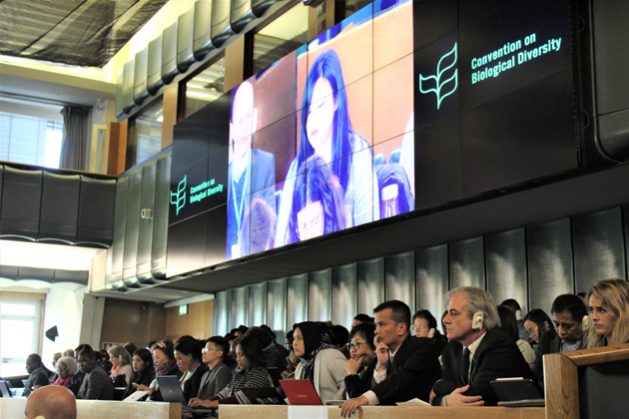
Delegates gather at FAO headquarters to advance negotiations of the post-2020 global biodiversity framework. Credit: Maged Srour/IPS

ROME, Feb 24 2020 (IPS) – “The world out there is watching and waiting for results,” Elizabeth Maruma Mrema warns while talking to IPS regarding the preservation of biodiversity of our planet.


The acting Executive Secretary of the Secretariat of the Convention on Biological Diversity, is referring to a worrying report[1] released by the Food and Agriculture Organization (FAO) which paints a grim picture of the planet.

“Many key components of biodiversity for food and agriculture at genetic, species and ecosystem levels are in decline and evidence suggests that the proportion of livestock breeds at risk of extinction is increasing,” the report says.

The FAO also warns that “nearly a third of fish stocks are overfished, and a third of freshwater fish species assessed are considered threatened”.

These are just some of the critical issues being debated during the open-ended working group on the post-2020 biodiversity framework. This round of negotiations is taking place at FAO headquarters from 24 to 29 February. In the run-up to October’s historic UN Biodiversity Conference, government officials, experts and activists from around the world gathered today at FAO headquarters, Rome, to forge ahead with negotiations. This round of talks was supposed to take place in Kunming, China, on the same dates. Due to the ongoing situation following the outbreak of the novel coronavirus 2019 (COVID-19), it was moved to Rome, Italy.

Background

The fourteenth meeting of the Conference of Parties (COP) to the Convention on Biological Diversity (CBD) had its meeting in Sharm el-Sheikh, Egypt, in 2018. It was here that the working group on the post-2020 global biodiversity framework was appointed. The working group’s mandate was to prepare the text of a framework that would guide the work of the Convention after the year 2020. At the working group’s first meeting held in Nairobi in August 2019, the Open-ended Working Group (WG2020) requested the Co-Chairs and the Executive Secretary to prepare a zero-draft text of the post-2020 global biodiversity framework. This framework is under consideration at its second meeting, which is currently taking place in Rome. The aim of the second meeting of the Working Group is to significantly advance the negotiation of the post-2020 global biodiversity framework, discussing the different aspects of the whole ambitious project.

‘Healthy Diets’ was among the proposed initiatives during the first day of the six-day event at FAO headquarters. The initiative emphasised the importance of ‘geographical indications’ for biodiversity, with examples and experiences from Africa and Eastern Europe. Credit: Maged Srour/IPS

Negotiations in Rome: Promoting a bi-directional approach

In the coming days, the working groups will be divided on a regional basis. They will discuss a wide variety of concerns including biodiversity, food, agriculture and fishing systems, to the importance of promoting an approach that leaves no one outside of this circuit. Civil society, the private sector, indigenous people, local communities, women and youth are all represented to create a functional framework for the whole society and at all levels. Many organisations, like Bioversity International, supported by a host of international agencies, have submitted research reports on biodiversity and food systems. It has also made representations on alternative models for access and benefit-sharing rules, practices and impacts in the Post-2020 Global Biodiversity Framework.

The voice of indigenous people

Key to the discussions is the role of indigenous people in biodiversity and Aslak Holmberg, the representative of the indigenous people, is convinced that policymakers can learn from these groups.

“There is a key message we want to share with other groups here during these negotiations,” he told IPS. “Indigenous peoples and local communities’ management of natural resources is (in fact) conserving biodiversity. (This is) because these management practices are built on a balanced relationship with the respective environment.

“Biological and cultural diversity are linked, and by this, I mean that (for indigenous communities) culture plays a fundamental role in the process of preserving biodiversity: it is in our culture to use our areas in a sustainable way. That is the message we want to share with others”.

The voice of the business sector

Representatives of the private sector too, in particular of the business world, wish to be part of the framework that will result from the negotiations and officially approved in October, in China.
Eva Zabey, Executive Director of the Business for Nature Coalition, told IPS she was grateful to the CBD secretariat for giving business and opportunity to engage and contribute to the zero draft of the post-2020 framework.

This coalition is a unique global group of influential business and conservation organisations participating in the negotiations.

“Forward-thinking businesses are starting to change the way they operate, based on their understanding of the value of nature – but this is still the exception, not the norm,” she told IPS.
“Therefore,” said Zabey, “Political leadership is needed now to transform our economic and financial systems in a way that places nature at the heart of global decision-making. It needs to create a level playing field and a stable operating environment for business.”

Zabey is looking forward to an ambitious post-2020 framework which will facilitate businesses’ involvement and create and positive “policy-business feedback loop,” she said.

Perspectives

Audrey Azoulay, United Nations Educational, Scientific and Cultural Organization (UNESCO) Director-General, perfectly summarised urgency at the negotiation.

Commenting on the global assessment report, she said: “The present generations have the responsibility to bequeath to future generations a planet that is not irreversibly damaged by human activity.”

“Our local, indigenous and scientific knowledge are proving that we have solutions and so no more excuses: we must live on earth differently”.

Zabey echoes Azouley. She said entrepreneurs are increasingly aware that the profit-sustainability ‘conflict’ is no longer feasible or conceivable.

“Companies planning on being successful in the future are starting to realise that financial performance is irrelevant on a dead planet.’

[1] http://www.fao.org/3/CA3129EN/ca3129en.pdf
 

Fiscal Policies For Women’s Economic Empowerment

Civil Society, Development & Aid, Editors’ Choice, Featured, Gender, Global, Global Governance, Headlines, IPS UN: Inside the Glasshouse, TerraViva United Nations

Opinion

International Monetary Fund (IMF)

Credit: IPS

WASHINGTON DC, Feb 20 2020 (IPS) – Making sure that opportunities to enter the workforce are fair and rewarding for women benefits everyone. Yet, the average female workforce participation rate across countries is still 20 percentage points lower than the male rate, largely because gender gaps in wages and access to opportunities, such as education, stubbornly persist.


Our new study finds that fiscal policy choices that address gender equality—such as investing in education or infrastructure, developing better sanitation facilities, implementing individual-based tax regimes, and offering parental leave—create more economic opportunities for women, increase growth, and reduce poverty and inequality.

When governments actively promote policies to increase female labor force participation, more women do indeed join the labor force. Most measures pay for themselves in the long run without additional costs for governments and the added bonus—a larger workforce leads to higher economic activity and growth, which generate additional tax revenue for the country.

Inclusive fiscal policies

Since the mid-1980s, at least 80 countries across all levels of development and regions have adopted fiscal policies to promote gender equality. Previous IMF research suggests that in advanced economies, when governments actively promote policies to increase female labor force participation, more women do indeed join the labor force.

Canada, Czech Republic, and Sweden, for example, have witnessed a substantial increase in women’s paid work when the countries switched to using individual rather than family income taxation.

For low-income and developing countries, programs aimed at reducing gender gaps in education, particularly for secondary and university education, have supported more economic opportunities for women.

Other effective fiscal policies, such as better infrastructure, decrease the time spent on unpaid care work, while providing more women the choice to enter into paid employment.

The bottom line is that greater gender parity at all levels, from unskilled workers to top management positions, can also foster the creation of new ideas—leading to higher productivity.

Credit: Food Tank

Competing demands

Policymakers face difficult choices every day, given limited room in the budget and competing demands. These choices often come down to investing in schools or roads, introducing new revenue measures, or offering free, high-quality childcare.

Here, policymakers must consider not only what happens to economic growth, but also how these policies can reduce income and gender inequality.

To help with these decisions, our recent analysis examines how policies designed to increase women’s labor force participation can accomplish multiple economic and social goals.

We find that some gender-responsive fiscal policies increase labor productivity and in turn, sustainable growth. Take for instance, an effort to reduce the gender gap in literacy rates.

In low-income countries the average literacy rate of men is about 70 percent while it is only 54 percent for women. But if fiscal policies can be used to close this gap, then women’s productivity increases and ultimately, more women are equipped for jobs in more skill-intensive sectors.

Labor-saving infrastructure, such as greater access to safe water, frees time, particularly for women. For instance, in Malawi, women on average spend 54 minutes a day collecting water. Better access to infrastructure means that women may then choose to pursue paid work.

Removing tax distortions for the earner in the family with the lower wage, usually the woman, by changing the personal income tax structure from a family to an individual system creates incentives for more women to work, and with greater diversity in the workforce, fresh and innovative ideas can boost productivity.

Securing the future

Not all gender-responsive fiscal policies benefit women equally. Subsidizing childcare and providing paid maternity leave would have a greater impact on poorer women because they typically face higher childcare costs relative to their income.

For example, in the US, poorer women spend 17.4 percent of their income on childcare compared to 7.8 for richer women.

Time horizons matter too. A mix of measures could help support economic goals in a sustainable manner while tackling immediate social needs.

For example, investing in education to equip girls with the same skills as boys would boost women’s human capital while shaping future labor productivity. In the meantime, cash transfers that target poorer working women may help reduce poverty and inequality.

Our research shows that tackling gender-biased social norms is crucial. In fact, removing discriminatory practices and addressing social norms amplifies the positive effects of gender-responsive measures. Not only would this improve human rights, but it also would help promote women’s economic empowerment.

According to the Organization for Economic Co-operation and Development (OECD), discriminatory laws and social practices reduce women’s years of schooling by 16 percent and decrease labor force participation by 12 percent, resulting in a global income loss of 7.5 percent of the global GDP.

Progress in some countries is encouraging. For example, under the Promundo initiative, 34 countries have introduced programs to engage men and boys on gender norms with participants responding very positively to the initiative.

Real changes are happening. Still, we have a long way to go to make the world a place with the same opportunities for men and women. Policymakers and citizens working together can foster equality, equity, and brighter prospects for all, and ensure that gender equality becomes a reality in all of our lifetimes.

IMFBlog, where this article was originally published, is a forum for the views of the International Monetary Fund (IMF) staff and officials on pressing economic and policy issues of the day.

The views expressed are those of the author(s) and do not necessarily represent the views of the IMF and its Executive Board.

  Source

Coming Down the Davos Mountain with a Gender Lens

Conferences, Education, Featured, Gender, Global, Headlines, Labour, TerraViva United Nations

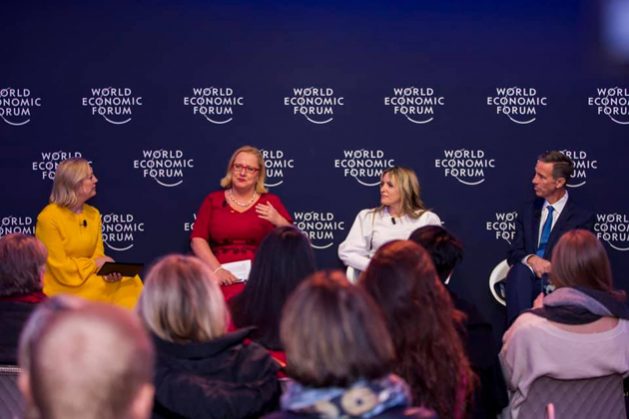
NEW YORK, Feb 15 2020 (IPS) – In a recent report by World Economic Forum (WEF) shows women suffer a “triple whammy” in the workplace. Without drastic action, gender parity will take more than a lifetime to achieve. This is the challenge that Katja Iversen, President and CEO of Women Deliver is staring down.


“We know that achieving gender equality is not a women’s issue. It is a societal issue. To be successful … boys and men must be involved at all levels and all ages,” said Iversen.

Iversen’s involvement WEF 2020 annual meeting in Davos increased the spotlight on gender equality. She was involved in a myriad of discussions, conversations, panel debates, midnight huddles and a social media drive. As the woman who heads leading global advocate for gender equality, health and rights of girls and women her role at the annual forum was clear cut.

“We provoked discussions using our ‘gender lens’ – a small magnifying glass. We gave this to leaders and influencers to bring down the mountain and apply to their businesses, governments, and lives,” Iversen said in an exclusive interview with IPS.

“Along with our partners, Promundo and Unilever/Dove Men+Care, we released a series of recommendations on male engagement in gender equality, condensed in a catchy infographic.”

Iversen went on to emphasise how “everybody – including the men and women in Davos – must apply a gender lens to every aspect of life, from leadership, to health systems, to schools, the workplace, and at home. That is an important step to change systems, to change harmful norms, and drive progress.”

This may seem a momentous task. The WEF report, released in December 2019, highlighted the factors that fuel the economic gender gap. This included a noticeably low level of women in leadership positions, wage stagnation, labour force participation and income.

The report highlights what it terms a ‘Triple Whammy’ for women in the workplace. Women, the report said, are highly represented in many of the roles that have been hit hardest by automation.

Moreover, not enough women are entering technology-driven professions where wage growth is more profound. This puts women into the middle to low wage categories that have been stagnant since the financial crisis in 2009.

Thirdly, a lack of access to capital prevents them from pursuing entrepreneurial activities, another key driver for income.

WEF aims to close the gender gap by setting up coalitions between relevant ministries and the largest employers to increase female labour force participation, increase women in leadership positions, close wage gaps and prepare women for jobs of the future. Additionally, the global business commitment on Hardwiring Gender Parity in the Future of Work mobilises businesses to commit to hiring 50% women for their five highest growth roles between now and 2022.

Iversen said women must be involved in the development and growth of Artificial Intelligence (AI) and ubiquitous digital technology for them to benefit.

“We know that innovation and technology hold a lot of power and can be used for good – but only if it works for girls and women and identifies the bias that holds them back,” she said.

While there was potential for digital technologies, like AI, to unlock better health access and information, new employment and leadership opportunities, and greater economic security for women – it could “just as likely leave big parts of the population behind and exacerbate existing inequalities”.

This was why the gender lens in the development and implementation of AI and other tech solutions is so critical, said Iversen. Having women involved in the growth of digital technology “can ensure technology is more representative and can eliminate unconscious bias in hiring, promotion, and recruitment”.

It is critical that women’s education, especially in the field of technology, is enhanced, enabling them to participate in future workforce equally.

“We also need to make sure we are investing in women’s lifelong education and training, particularly in science, technology, engineering, and math. It is key to their professional and financial security in the workforce of tomorrow.”

Investment in women and their participation in the economy has a ripple effect.

“Evidence and common sense confirm that when leadership and the workforce represent the population and include women, it leads to better economic, social, and political cohesion and puts us on a better, more sustainable path.”

The Secretary-General of the United Nations, António Guterres, noted in his speech at WEF 2020 that while problems were global, the responses were fragmented.

“If I had to select one sentence to describe the state of the world, I would say we are in a world in which global challenges are more and more integrated, and the responses are more and more fragmented, and if this is not reversed, it’s a recipe for disaster,” he warned.

Iversen explains that by putting the gender lens at the centre of the solutions, it would enhance society’s ability to achieve its Sustainable Development Goals. It would also mitigate the ‘fragmented responses’ to global challenges.

“Gender is cross-cutting, it is essential to progress and to achieving the Sustainable Development Goals. Conservation of our planet; eradicating poverty and ensuring health; education; peace, and prosperity for all need to be integrated. This requires putting a gender lens to the entire development agenda,” Iversen said.

“One of the reasons the world is facing so many challenges right now, including trade wars, conflict, climate change, and growing inequality, is that girls, women, and marginalised groups are prevented from accessing power, both political and financial. Big egos, narrow interests, and profit over people and planet have been, mistakenly, prioritised, and we are paying the price for that.”

Women Deliver’s President was emphatic that “development actors from across the spectrum must abandon siloed approaches. It was essential to work together to drive progress for the people and planet, including girls and women, both through financial investment and multi-sector partnerships.”

Iversen is confident. WEF was “good start to the Decade of Action for the Global Goals and the 2020 Generation Equality push, demanding women’s equal participation in political life and decision-making in all areas of life.”

Involving the younger generation was also paramount to achieving the Sustainable Development Goals.

“What was also clear coming down the Davos mountain is that any efforts to push the development agenda over the finish line will fail if they don’t involve young people. Because youth not only have a stake in reaching our ambitious development goals by 2030, they are also well-suited to identify solutions right now.”

To address and improve gender equality, Iversen emphasised that it required a global effort. The private sector has a vested interest and a significant role to play in advancing gender equality. “We want governments and business leaders to use the gender lens in all they do. They should complete a concrete analysis of what progress they have made and what gender gaps remain,” Iversen said.

Both should ask themselves: What policies and procedures are inhibiting or promoting progress? What gender norms are prevalent and need to be addressed? What investments in gender equality could be made?

“And once that analysis is complete – get to work!”

Women Deliver has been relentless in that message and in bringing the evidence to bear with great partners. “And in recent years we have seen that the world – including at WEF – has started to catch on. Our challenge now is to move from talking to mobilising dedicated action.”

Women Deliver continues to be serious advocates, speaking up for girls and women in every setting.

“We’ll continue to advise committees for big corporations and international agencies. We’ll continue to elevate the voices of young advocates and local organisations around the world. We will continue to push back on the pushback to protect our gains and drive further progress,” Iversen said.

“We will continue to communicate from podiums, in boardrooms and hallways of major summits, on the pages of major newspapers, on (television) screens and social media – with the clear message: In a gender-equal world, everybody wins.”

IPS asked about the trend of women participating as policy-makers at WEF. Just how prominent is women’s role? Iversen replied that “24% of the 2,700 formal WEF participants were women. While that is an improvement from previous years, it’s still way too small. WEF has pledged to double female participation by 2030, and we are ready to help to speed it up.”

“We have a long way to go, but I saw progress at WEF,” said Iversen, adding, “More and new world leaders – in business and government – are picking up the gender lens. There is still so much to be done, and progress is slow for an impatient optimist like myself. But I came down the Davos mountain more hopeful than I went up, and more ready than ever to power progress for girls, women and gender equality in the Super Year ahead.”

Iversen remains optimistic. “Ultimately, we want to work ourselves out of a job. Then sit back and see a world where gender inequality is a thing of the past, where it is something people make fun of like the ‘old days’. Where people say, ‘I can’t believe we didn’t do this sooner’.”


World’s Young Activists at War: First, Occupy Wall Street, Next Un-Occupy Palestine

Active Citizens, Climate Change, Editors’ Choice, Featured, Global, Headlines, IPS UN: Inside the Glasshouse, Peace, Regional Categories, TerraViva United Nations

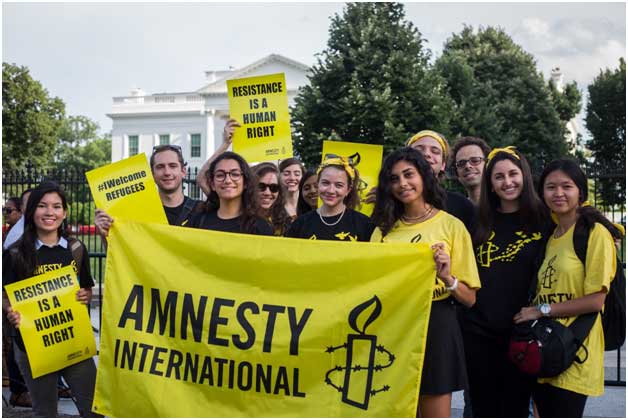
Credit: Amnesty International

UNITED NATIONS, Feb 6 2020 (IPS) – The world’s young activists, numbering over 3.8 billion, are on the war path.

The rising new socialist movements—which originated with “Black Lives Matter” and “Occupy Wall Street” (one protester’s slogan read: “Un-Occupy Palestine”) — were aimed at battling racism, political repression and institutionalized inequalities in capitalist societies.


In its recent cover story, Time magazine dubbed it “Youthquake” – a new phenomenon shaking up the old order, as young activists lead the fight against right-wing authoritarianism, government corruption and rising new hazards of climate change.

Joanne Mariner, Senior Crisis Response Adviser at Amnesty International (AI), told IPS “it is stunning to see how aggressive government efforts to quash protests, including by killing protesters, have not even succeeded in stopping them in the short run”.

In the long run, far too much is at stake, she said, where the coming years are likely to see more protests rather than fewer.

And it is more so in Asia, says AI, in a recently-released report which reviews human rights in 25 Asian and Pacific states and territories during 2019.

“2019 was a year of repression in Asia, but also of resistance”.

“As governments across the continent attempt to uproot fundamental freedoms, people are fighting back – and young people are at the forefront of the struggle,” says Nicholas Bequelin, AI’s Regional Director for East and South-East Asia and the Pacific.

“From students in Hong Kong leading a mass movement against growing Chinese encroachment, to students in India protesting against anti-Muslim policies; from Thailand’s young voters flocking to a new opposition party to Taiwan’s pro LGBTI-equality demonstrators. Online and offline, youth-led popular protests are challenging the established order,” he added.

Also, the rise of a new generation determined to lead the fight against climate emergency has led to a major youth movement worldwide, resulting in protest marches, with thousands of young people demonstrating in the streets of New York and in several world capitals.

According to Time magazine, the world’s under-30 population has been rising since 2012, and today accounts for more than half of the world’s 7.5 billion people.

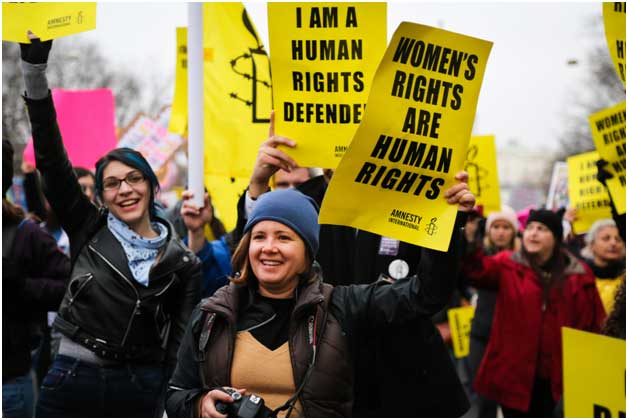
Credit: Amnesty International

Asked for the primary reasons for this surge in young activism, Mariner said this new era of youth activism reflects young people’s understanding that it’s their future at stake.

“If they don’t demand more from governments, including a voice in the decisions that affect their lives, their future is uncertain. It is the young who will inherit this fast-warming planet, and they see all too clearly the consequences of their elders’ inaction and irresponsibility,” she argued.

Meanwhile, the Youth Assembly, described as one of the longest-running and largest global youth summits, is scheduled to take place in New York city February 14-16.

The theme of next week’s 25th session will be: “It’s Time: Youth for Global Impact” aimed at underlining the importance of engaging young people, “especially at a time when the youth are influencing and leading movements that can change the world.”

Meanwhile, the Amnesty International report says China and India, Asia’s two largest powers, set the tone for repression across the region with their overt rejection of human rights.

Beijing’s backing of an Extradition Bill for Hong Kong, giving the local government the power to extradite suspects to the mainland, ignited mass protests in the territory on an unprecedented scale.

Since June, Hong Kongers have regularly taken to the streets to demand accountability in the face of abusive policing tactics that have included the wanton use of tear gas, arbitrary arrests, physical assaults and abuses in detention. This struggle against the established order has been repeated all over the continent, said AI.

In India, the AI report noted, millions decried a new law that discriminates against Muslims in a swell of peaceful demonstrations. In Indonesia, people rallied against parliament’s enactment of several laws that threatened public freedoms.

In Afghanistan, marchers risked their safety to demand an end to the country’s long-running conflict. In Pakistan, the non-violent Pashtun Tahaffuz Movement defied state repression to mobilize against enforced disappearances and extrajudicial executions.

Divya Srinivasan, Equality Now’s South Asia Consultant, told IPS young people across Asia have shown incredible resilience and bravery in their continuing battle against government repression in 2019.

One remarkable feature of these protests is that in many instances, they have been led by women and girls, including those from minority communities, she added.

In India, one of the epicentres of protests against the new anti-Citizenship Amendment Act (CAA) which discriminates against Muslims, has been the neighbourhood of Shaheen Bagh in New Delhi.

Srinivasan said women and children have braved the winter chill and gathered in huge numbers to continuously occupy a highway around the clock in a peaceful protest that has already lasted over a month.

“The voices of these women, particularly Muslim women, have been bravely opposing the Government’s discriminatory laws, and voicing concerns about the oppression of minorities and police brutality.”

“The Shaheen Bagh protest began on December 14th with around a dozen local women and their children and numbers soon swelled into the hundreds”, she said.

And the site has become a creative space for many children and young people, with singing, storytelling, poetry, and talks happening daily, and drawings, graffiti, posters, photographs, and art installations decorating the roadside where people are camping”

In early 2019, Srinivasan said, India saw another historic protest in the form of the Dignity March, which was a 10,000-kilometre long march through 24 states that brought together thousands of survivors of sexual violence, including many young women and girls, who were raising their voices to call for justice, dignity, and an end to victim-blaming and stigma.”

“Young women across Asia are making their voices heard. We cannot ignore them any longer,” declared Srinivasan, a licensed attorney in India with a background in women’s rights, including work on sexual harassment in the workplace and sexual violence against women.

Asked whether there is a role for the United Nations to either support or give its blessings to these youth activists, AI’s Mariner said: “The UN, including at the highest levels, can and should speak out to demand that governments respect the right of peaceful protest”

She pointed out it was heartening to hear UN Secretary General Antonio Guterres condemn the killings of protesters in Iraq, “although he has been far less vocal regarding repression elsewhere”.

Also encouraging, from the perspective of UN action, are the numerous UN special rapporteurs who have called on the authorities in Hong Kong, India, and Indonesia, among others, to protect the rights of those who participate in protests, she declared.

The AI repot said people speaking out against these atrocities were routinely punished, but their standing up made a difference. There were many examples where efforts to achieve human rights progress in Asia paid off.

In Taiwan, same-sex marriage became legal following tireless campaigning by activists. In Sri Lanka, lawyers and activists successfully campaigned against the resumption of executions.

Brunei was forced to backtrack on enforcing laws to make adultery and sex between men punishable by stoning, while former Malaysian prime minister Najib Razak took the stand on corruption charges for the first time.

The Pakistani government pledged to tackle climate change and air pollution, and two women were appointed as judges on the Maldivian Supreme Court for the first time.

And in Hong Kong, the power of protest forced the government to withdraw the Extradition Bill. Yet, with no accountability for months of abuses against demonstrators, the fight goes on.

The writer can be contacted at thalifdeen@aol.com

  Source

Our Message at Davos: Water & Sanitation Are a Critical Line of Defence Against Climate Change

Civil Society, Climate Change, Development & Aid, Environment, Featured, Global, Headlines, Health, Population, Poverty & SDGs, TerraViva United Nations, Water & Sanitation

Opinion

Tim Wainwright is Chief Executive of WaterAid UK.

Credit: WaterAid/ DRIK/ Habibul Haque

LONDON, Jan 31 2020 (IPS) – There was only one topic on everyone’s lips at Davos this year – climate change. The headlines focused on the cold war between Greta Thunberg and Donald Trump, but there was much greater consensus among those gathered for the annual meeting of the World Economic Forum (WEF).


The Forum itself updated its manifesto for responsible business – with climate right at its core.

Among those calling for urgent action was WaterAid’s own president, His Royal Highness the Prince of Wales. It’s more than 30 years since he last attended Davos and, as he reminded the audience, 50 years since he made his first speech on the environment.

His message was stark, and his call to action challenging: the climate emergency requires nothing less than an overhaul of the current economy, with a new deal for people and planet.

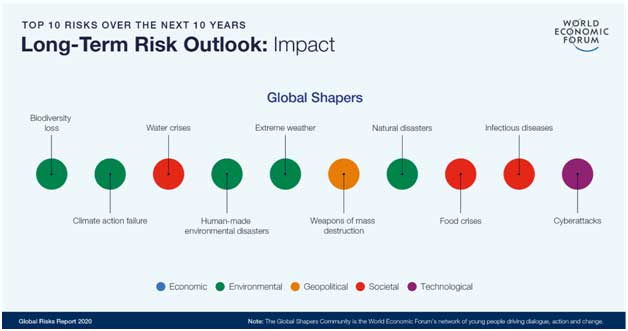
The mood is slowly shifting towards the scale of action needed, given that climate change will affect every part of the economy. This cannot be truer than for water – the WEF has ranked water crises in its top five global risks in terms of likelihood or impact every year since 2012.

Infographic showing the top 10 risks over the next 10 years, according to the World Economic Forum’s 2020 report. Credit: World Economic Forum

The climate crisis is a water crisis, and a threat multiplier

Throughout the forum I had one consistent message: for the world’s poorest, the climate crisis is a water crisis. Yes, it has long-term implications for your businesses and economies. But, first and foremost, it is a question of survival, dignity and justice, with climate change already having devastating impacts on the lives of the people who did least to cause it.

Flooding, storms and droughts, which all impact on how and if people can get clean water, are becoming more frequent and extreme, and these trends are predicted to rise as the climate continues to change. This will undermine the already precarious access to water for billions around the world.

Climate change acts as a huge threat multiplier, worsening existing barriers to these services and rolling back progress already made.

As people living in climate-vulnerable areas experience changing weather patterns, less predictable rainfall, salt water intrusion and increased exposure to disease, water and sanitation become a critical line of defence.

If your water supply comes from a shallow aquifer that fills with sea water, then you can no longer drink it. But if the person designing your water supply has thought of this threat and factored it in, perhaps by drawing on deeper aquifers, then you can carry on living in your neighbourhood.

If your toilets and sanitation systems are constructed to withstand flooding, then your community does not suffer the same level of contamination after flooding as if human waste had been spread by the high waters.

The water and sanitation sector could become a leader in climate adaptation

But we currently lack the level of public and private sector investment and innovation required to deliver the sustainable water services that would benefit poverty reduction, industry and economic development.

This is a huge blind spot for business leaders and politicians, and a missed opportunity for creating a more sustainable future.

Rather than lagging behind, the water and sanitation sector could become a leader in delivering the kind of green infrastructure, services and jobs urgently required to enable adaptation to the worst impacts of climate change.

Tim Wainwright, Chief Executive of WaterAid UK, speaking with Hassan Nasir Jamy, Secretary Ministry of Climate Change, at Pakistan’s Ministry of Climate Change in Islamabad, Pakistan. Credit: WaterAid/ Sibtain Haider

Water, sanitation and hygiene are core to a sustainable future

Leaving Davos last year, I was frustrated. I felt that too few understood or discussed the impact climate change would have on the already grave state of the world’s water and sanitation, and the devastating consequences for education, health, productivity and development.

This year, I sensed a greater understanding of the interlinked challenges we face, and with that an air of urgency and proactivity. Businesses are looking for solutions – not just raising concerns.

That is why WaterAid will be one of the organisations working closely with HRH the Prince of Wales as part of his 2020 year of action.

In March, in London, we will bring together the public, private and philanthropic sectors for a high-level summit that will position water, sanitation and hygiene at the forefront of the fight against climate, and work on the solutions that will ensure a sustainable future for all.

And we will continue that work across the WaterAid federation throughout the year, including at the Commonwealth Heads of Government Meeting in Kigali in June, and at the UN Climate Change Conference, COP 26, in Glasgow in November, to help build momentum for decisive action.

In this way we hope WaterAid can play its part in shifting the global trajectory in the coming decade, resulting in a fairer world for the poorest and most marginalised people.

Read our guide Water and resilient business: the critical role of water, sanitation and hygiene in a changing climate to learn more about how businesses can take action.

  Source

Urbanization as a Path to Prosperity

Civil Society, Editors’ Choice, Environment, Featured, Global, Global Governance, Headlines, IPS UN: Inside the Glasshouse, Population, Poverty & SDGs, TerraViva United Nations

Opinion

Chris Wellisz. Credit: Porter Gifford

WASHINGTON DC, Jan 29 2020 (IPS) – Growing up in New York City in the 1970s, Edward Glaeser saw a great metropolis in decline. Crime was soaring. Garbage piled up on sidewalks as striking sanitation workers walked off the job. The city teetered on the edge of bankruptcy.


By the mid-1980s, it was clear that New York would bounce back. But it could still be a scary place; there was a triple homicide across the street from his school on the Upper West Side of Manhattan. Glaeser was nevertheless captivated by New York’s bustling street life and spent hours roaming its neighborhoods.

“It was both wonderful and terrifying, and it was hard not to be obsessed by it,” Glaeser recalls in an interview at his office at Harvard University.

Today, that sense of wonder still permeates Glaeser’s work as an urban economist. He deploys the economist’s theoretical tool kit to explore questions inspired by his youth in New York.

Why do some cities fail while others flourish? What accounts for sky-high housing costs in San Francisco? How does the growth of cities differ in rich and poor countries?

“I have always thought of myself as fundamentally a curious child,” Glaeser, 52, says. Rather than “pushing well-established literature forward,” he seeks to comprehend “something that I really don’t understand when I start out.”

While still a graduate student at the University of Chicago, Glaeser made his mark as a theorist of the benefits of agglomeration—the idea that dense and diverse cities are hothouses of innovation, energy, and creativity that fuel economic growth.

In the years since, his work has ranged across a breathtaking variety of subjects, from rent control and real estate bubbles to property rights, civil disobedience, and carbon emissions.

“For a couple decades now, Ed has been the leading thinker about the economics of place,” says Lawrence Summers, a Harvard professor who served as director of the National Economic Council under US President Barack Obama. “And the economics of urban areas are increasingly being seen as central to broad economic concerns.”

Glaeser and Summers are collaborating on a study of the hardening divide between well-educated, affluent coastal regions of the United States and islands of economic stagnation in what they call the “eastern heartland,” the interior states east of the Mississippi River.

There, in cities like Flint, Michigan, the proportion of prime-age men who aren’t working has been rising—along with rates of opioid addiction, disability, and mortality.

How can policy help? Traditionally, economists have been skeptical of the value of place-based policies like enterprise zones that offer tax breaks to investors, saying it is better to help people, not places.

People, they assumed, would move to where the jobs were. But labor mobility has declined in recent decades, partly because of high housing costs, partly because demand for relatively unskilled factory work has diminished.

Breaking with economic orthodoxy, Glaeser and Summers say that the federal government should tailor pro-employment measures, such as reducing the payroll tax or increasing tax credits to low earners, to fit the needs of economically distressed areas such as West Virginia. They also make the case for boosting investment in education.

As a Chicago-trained economist, Glaeser is a strong believer in the magic of free markets and opposes measures that distort incentives. “I have always been against spatial redistribution, taking from rich areas and giving to poor areas,” he says. “That doesn’t mean that you want the same policies everywhere.”

Urban economics seemed like a natural pursuit for Glaeser. His German-born father, Ludwig, was an architect who taught him how the built environment shapes people’s lives. His mother, Elizabeth, was an asset manager who introduced him to economics. Glaeser recalls how she used the example of competing cobblers to explain marginal cost pricing.

“I remember thinking what an amazing and fascinating thing it is to think about the impact of competition,” he says. He was 10 years old.

In high school, Glaeser excelled at history and mathematics. As a Princeton University undergraduate, he considered majoring in political science before choosing economics, seeing it as a path to Wall Street.

But dreams of a career in finance ended with the stock market crash of 1987, just as he started job interviews. So he opted for graduate school, because “it didn’t seem like I was cutting off many options,” he says.

“Then I got to Chicago, and that was when I really fell in love with economics.”

Glaeser keeps a framed photograph of himself with Gary Becker, the Chicago economist and Nobel prize laureate. Becker taught him that the discipline’s conceptual tools could be used to explore topics that had once been the domain of fields like sociology or anthropology—topics like racial discrimination, fertility, and the family.

“It was that sense of the creative side of economics that could work on a virtually unlimited canvas and try to make sense of any problem that you thought was important—that was the part that was so exciting to me,” Glaeser says.

At the time, Chicago economists Robert Lucas and Paul Romer were developing the so-called endogenous growth theory, which focused on the role of innovation and the exchange of ideas in economic development.

As Glaeser recalls it, Lucas pointed to cities as places where knowledge spillovers occur—meaning people can benefit from other people’s ideas without paying for them. Think of a city like Detroit early last century, where Henry Ford used his experience as chief engineer at the Edison Illuminating Company to start his automobile business.

That concept inspired a groundbreaking 1992 paper, “Growth in Cities.” Glaeser and three co-authors set out to use cities as a laboratory in which to test the new growth theories. Using 30 years of data covering 170 US cities, they found that local competition and diversity, rather than specialization, are the prime motors of urban growth.

The paper instantly made Glaeser a star and earned him a job offer from Harvard.

Glaeser “showed that urban variety, not specialization in one particular thing, was a big driver of employment growth,” says Joseph Gyourko, a professor at the University of Pennsylvania’s Wharton School and a longtime collaborator. “It was Ed’s first really well-cited article, so it did start him on his path.”

Gyourko and Glaeser started working together in the early 2000s, when Glaeser took a year’s sabbatical at Penn. They wondered why some cities, such as Detroit, declined so slowly, and why so many people stayed instead of moving elsewhere. They hit upon a simple answer: housing is durable, and as cities slump, it becomes cheaper to live there.

That insight prompted a related question: Why is housing so much more expensive than the cost of construction in cities like New York and Boston? The answer: land-use restrictions limit density, curbing the supply of housing and driving up prices. It was basic economics, yet until then, urban economists hadn’t focused on the role of regulation.

Glaeser argues that excessive regulation is destructive of the very essence of urban life—density. Cities thrive on the creativity that occurs when people living cheek by jowl exchange ideas and know-how. Sunbelt cities like Houston have grown because an easy regulatory environment keeps housing inexpensive.

To economists like Glaeser, building and zoning regulations are a tax on development. Some level of tax makes economic sense, because construction imposes costs on residents in the form of noise, congestion, and pollution.

But overly stringent regulation, often pushed by residents who want to keep out newcomers and protect their property values, can make housing unaffordable for most people.

Glaeser is similarly skeptical of historic preservation rules, to the dismay of followers of Jane Jacobs, the legendary critic of urban-renewal projects who celebrated the lively street life of New York’s old ethnic neighborhoods.

Glaeser is a big Jacobs fan—he owns an autographed copy of her 1961 classic, The Death and Life of Great American Cities—but argues that her efforts to oppose development in Greenwich Village were at odds with her support for low-income housing.

“I believe that many of our oldest buildings are treasures,” he says. “But don’t simultaneously pretend that that’s a route toward affordability. Affordability is created by mass-produced cheap housing or mass-produced cheap commercial space. And you might not like it aesthetically, but that is the affordable route.”

In 2000, Glaeser published “Consumer City,” a paper he wrote with Jed Kolko and Albert Saiz. In it, he took the concept of agglomeration a step further, arguing that people are drawn not only to the opportunities that cities offer, but also to amenities such as theaters, museums, and restaurants.

“We know that cities can attract the disproportionately young and innovative,” says Richard Florida, a professor of urban studies at the University of Toronto. “Ed was identifying the factors driving that, this whole idea that cities are not only places of production, but places of consumption.”

Glaeser laments policies such as the mortgage interest deduction, which encourages people to buy homes rather than rent apartments; highway subsidies, which make it easier to drive to the suburbs; and a school system that disadvantages inner-city students.

Such policies, he argues, not only are antiurban but also contribute to climate change, because city dwellers, who live in smaller homes and use mass transit, consume less electricity and gasoline than their suburban counterparts.

Surprisingly, he and his wife, Nancy, who have three children, decided to move to the suburbs of Boston several years ago. To Glaeser, it was a perfectly rational decision: the suburbs offer more living space, better schools, and a reasonably fast commute.

Already well known in academia, Glaeser started to reach a broader audience with the publication in 2011 of his bestselling book, Triumph of the City, a lively study of urbanization from ancient Baghdad to modern Bangalore.

His eloquence and enthusiasm make him a sought-after speaker at academic forums and TED Talks. Invariably, he is impeccably attired in well-pressed suits and preaches the gospel of urbanization in crisp, rapid-fire sentences.

Despite his celebrity, he takes teaching seriously. Rebecca Diamond, who attended his advising sessions as a graduate student, said he was generous with his time. “He taught me perspective and not to get too stuck in the weeds,” says Diamond, who now teaches at Stanford University and stays in touch with Glaeser.

Developing-world cities are his latest passion. True to form, he sees them as relatively uncharted territory, neglected both by urban economists, who focus on advanced-economy cities, and development economists, who concentrate on rural areas. They are also growing fast, and their physical and institutional infrastructure are works in progress, so economists’ policy advice can have an impact.

“The ability of economists to make a difference by getting engaged is just very large,” he says. “So, I think it is the new frontier.”

It also takes him to interesting places. His latest research project, with Nava Ashraf and Alexia Delfino of the London School of Economics, took him to the markets of Lusaka, Zambia, to study barriers to female entrepreneurship.

They found women are more likely to go into business if the rule of law is strong enough to help overcome inherently unequal relations with men.

Like Jane Jacobs, Glaeser is big believer in observing what he sees around him. “You don’t really understand a city until you’ve actually walked in the streets,” Glaeser says.

“That’s what makes Ed a first rate applied theorist,” says Gyourko. “You’ve got to get your hands messy in the data. Sometimes data is just walking around.”

While researching Triumph of the City, Glaeser explored places like Mumbai’s Dharavi quarter, which was a “completely magical experience.” Among the world’s most densely populated places, Dharavi hums with entrepreneurial energy, with potters, tailors, and other craftsmen working side by side in cramped, ill-lit quarters.

At the same time, unpaved streets, polluted air, and open sewers are reminders of the downsides of density. But Glaeser doesn’t bemoan the poverty of such places; on the contrary, he says cities attract the poor precisely because they offer opportunity. For the developing world, urbanization is the best path to prosperity.

“For all of their problems, amazing things are happening in India and sub-Saharan Africa and Latin America,” Glaeser says. “And things obviously don’t always go the right direction, but cities have been working miracles of collaboration for thousands of years, and whenever I go to a developing-world city, it is obvious to me that the age of miracles is not over.”

Opinions expressed in articles and other materials are those of the authors; they do not necessarily reflect IMF policy.

  Source