Sri Lanka’s Easter Sunday Carnage: Quo Vadis?

Armed Conflicts, Asia-Pacific, Civil Society, Featured, Global, Global Governance, Headlines, Human Rights, IPS UN: Inside the Glasshouse, Peace, TerraViva United Nations

Opinion

Dr. Purnaka L. (“PL”) de Silva is Director, Institute for Strategic Studies and Democracy (ISSD) Malta


“If we believe in absurdities we shall commit atrocities” – Voltaire
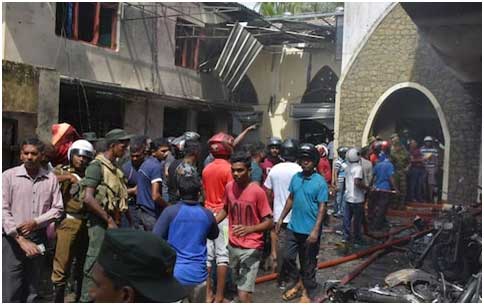
NEW YORK, Apr 22 2019 (IPS) – I returned from attending a three-hour Easter Sunday mass at the Fordham University Church around midnight New York time on May 20, 2019, when my phone rang and a colleague asked me what’s going on in Sri Lanka? I said what is going on?


He said there were a series of coordinated terrorist bombings with multiple fatalities and scores of injuries in my native country. For the next four and a half hours I was on the phone trying to piece together what happened, including reaching out to Sri Lanka’s Secretary of Defence Hemasiri Fernando.

The toll as of Monday, April 22 is 290 dead and 500 injured. Sri Lanka’s Ministry of Foreign Affairs confirmed that 36 foreigners died, with 20 still unidentified; and those identified include: 5 British (2 with dual US nationality), 3 Danes, 1 Dutch, 1 Portuguese, 2 Turks, 3 Indians and 1 Japanese.

This is the second time in history that the Indian Ocean island of Sri Lanka has been bombed on an Easter Sunday morning when the faithful were at prayer. The first was a coordinated air attack on the capital Colombo, launched from aircraft carriers of the Imperial Japanese Navy at 7:30 a.m. on Easter Sunday, April 5, 1942 – the same date that the U.S. Pacific Fleet in Pearl Harbor was also attacked in a different time zone.

Timeline in infamy – April 21, 2019

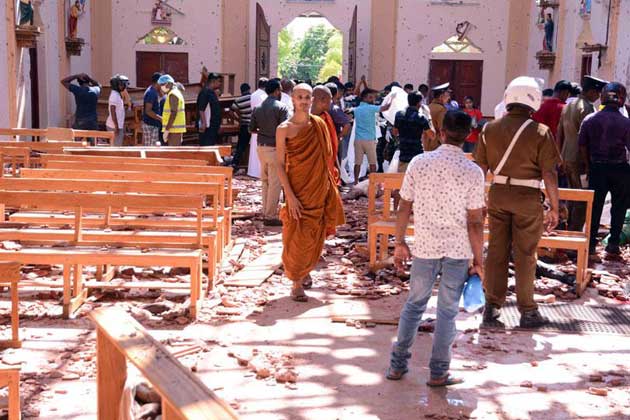
Around 8:45 a.m. on Easter Sunday morning five massive explosions simultaneously rocked Colombo, western Sri Lanka:

    • 18th century St. Anthony’s Shrine Roman Catholic Church in Kochchikade, near Colombo harbor, 3.4 km from Colombo.
    • St. Sebastian’s Roman Catholic Church in Katuwapitiya, Negombo, 10.2 km north of Sri Lanka’s Bandaranaike International Airport (32.4 km north of the capital).
    • Shangri-La 500 room 5-star hotel downtown Colombo
    • Kingsbury 229 room 5-star hotel downtown Colombo
    • Cinnamon Grand 483 room 5-star hotel downtown Colombo

9:05 a.m.

    • Zion Protestant Christian Church in Batticaloa on the eastern seaboard of Sri Lanka, 318.1 km from Colombo.

1:45 p.m.

    • Tropical Inn Guest House in Dehiwala near the zoo, 10.2 km south of Colombo.

2:15 p.m.

    • Two explosions at suspected safe house in Dematagoda on the northwestern outskirts 3.1 km from Colombo, owned by a spice trader, allegedly the father of one of the suicide bombers. At least three police officers died in the blasts including Special Task Force (STF) police commandos, with seven suspects arrested.

Late Sunday night

    • A 6-foot pipe bomb was located and destroyed near Bandaranaike International Airport by the Sri Lanka Air Force.
 
Perpetrators

An internal Sri Lanka Police circular dated April 11, 2019 issued by Deputy Inspector General Srilal Dassanayake noted: “warning of plan to launch a campaign of suicide attacks led by Mohammed Zahran of National Thawheed Jama’ath (NTJ) has been received by intelligence sources, and request extreme precautions be taken.”

A fact commented on in the aftermath of the first wave of bombings by Defence Secretary Hemasiri Fernando, who confirmed that some of the attacks were carried out by suicide bombers.

Sri Lankan authorities have arrested 24 suspects and at least 1 woman as of Monday in an ongoing investigation to root out all the terrorists, who may number 30 with 20-30 targets, according to a suspect arrested down Ramakrishna Road, Wellawatte, 8.0 km south of Colombo.

At least three of the suicide terrorist bombers have been identified, all local Sri Lankan Muslims allegedly from eastern Sri Lanka:

    • Mohamed Azzam Mohamed registered as a guest the previous night and blew himself up during the Easter breakfast buffet in Taprobane Restaurant – Cinnamon Grand Hotel. Apparently he queued patiently before triggering his explosives.
    • Zahran Hashim – Shangri-La hotel.
    • Abu Mohammad – Zion Protestant Christian Church, Batticaloa.

Active measures taken

    • 3:00 p.m. curfew lifted at 6:00 a.m. Monday morning to enable security forces to apprehend wanted terror suspects in ongoing hunt and stop escapees.
    • Blocking all major social media platforms and messaging Apps to prevent spread of misinformation and rumors.
    • Maintaining law and order to stop any retaliation (e.g. Mosque petrol bombed in Putlam, 132.9 km north of Colombo; arson attacks on two Muslim owned shops in Kalutara, 43.5 km south of Colombo).
    • U.S. Federal Bureau of Investigation (FBI) and Australian police teams in place to help with forensic investigations.

National Thawheed Jama’ath (NTJ)

Five years ago on March 24, 2014 the Peace Loving Moderate Muslims in Sri Lanka (PLMMSL) urged the Government of Sri Lanka to ban without delay an Islamic religious movement calling itself the (National) Thawheed Jama’ath “because it was fast becoming a cancer within Sri Lanka’s Muslim community.”

It is alleged that NTJ headed by Moulavi Zahran had holed up in Kattankudi, 327 km east of Colombo, and recruited impressionable Muslim high school students to travel to Syria via Turkey. The hypothesis is that following military defeat at the hands of multinational forces, these Daesh or so-called Islamic State (IS) associated recruits had returned to Sri Lanka.

These allegations are yet to be proven beyond reasonable doubt in a court of law. Having said that I would argue that the spectacular terrorist bombings on Easter Sunday perpetrated on wholly unsuspecting Christians, tourists and citizens could be a last hurrah from Daesh to demonstrate to their supporters and the world at large that they are not defeated. Every suicide bombing though is a defeat for Daesh as they are losing cadres on each occasion.

Quo Vadis?

So where do we all go from here? Sri Lanka will recover, as it has done commendably from the decades long brutal civil wars and bloodletting that ended ten years ago. What of the human spirit and fragile inter-communal harmony between minority Christians, Muslims and majority Buddhists in Sri Lanka, and beyond?

That is the greatest challenge moving forward and Sri Lanka’s fractious political leaders have to demonstrate true statesmanship, and invest the required time, effort and resources in partnership with all faith leaders to make a difference.

Thereby, defeating the forces of darkness, ignorance and evil, and bringing enlightenment, peace and harmony to a beleaguered land. Similar actions must be taken by world leaders to overcome growing dystopia and unchecked authoritarianism that is haunting the 21st century, putting the planet and liberal democracy in dire peril.
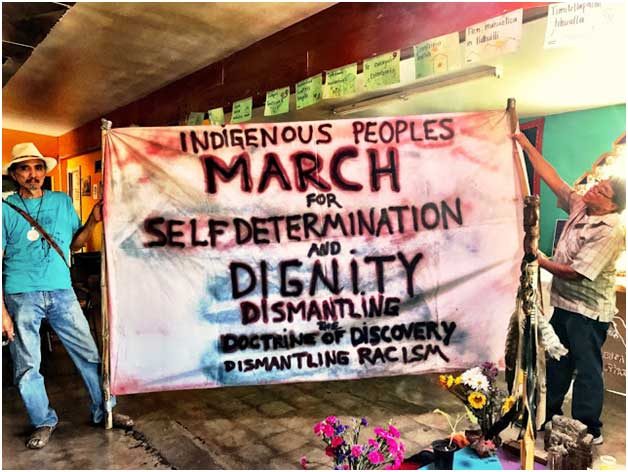
 

UN’s Empty Promises to World’s Indigenous Peoples

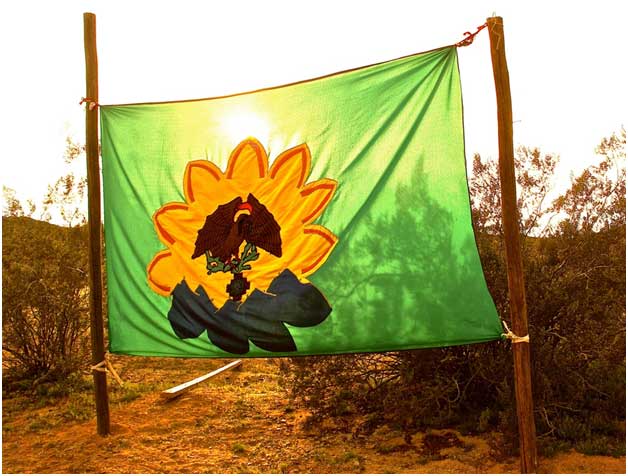
Tupac Enrique Acosta is a member of the Nahuatl Nation and serves as firekeeper for the Nahuacalli, Embassy of Indigenous Peoples in Phoenix, Arizona.

The 18th Session of the United Nations Permanent Forum on Indigenous Issues (UNPFII) will take place 22 April 3 May 2019. The theme of the session will be: “Traditional knowledge: Generation, Transmission and Protection”

PHOENIX, Arizona, Apr 19 2019 (IPS) – The United Nations, as in so many other areas, gives lip service in support of Indigenous issues while lacking the political will and enforcement power over individual member states to comply with the protection of fundamental human rights for the Original Nations of Indigenous Peoples of the world.


It took 47 years since the 1960’s UN declaration in support of the right of “all peoples” to self-determination to be extended to Indigenous Peoples, with the adoption of the 2007 UN Declaration on the Rights of Indigenous Peoples.

But twelve years later, those words have not moved far off the paper on which they are written. Indigenous issues are still being subsumed under the individual domestic rubric of the member states of the UN Nations General Assembly, in defiance of the commitment to universal human rights that self-determination invokes and professes for all humanity.

It is no accident that the last four nation states to support the Declaration – Australia, New Zealand, Canada and the United States – were precisely those nations where the Anglo-European colonizers of the British Empire globally entrenched their colonial relationship with the Indigenous Peoples subsequent to the decline of Great Britain as a world power.

The devastation and genocide of Indigenous Nations and territories continues till today, but under a new mantle of progress called “Development”

For the Original Nations of Indigenous Peoples of the Great Turtle Island Abya Yala [Americas], we know that the subjugation of Indigenous Peoples started 526 years ago with the sword and the cross are now perpetrated with trade agreements and the empty promises of dead letters from the United Nations.

It is all a reflection of the continuing pernicious influence of the Doctrine of Discovery, the series of 15th century papal bulls in which a succession of popes authorized European explorers “discovering” lands in the New World that were not occupied by Christians to consider those lands vacant – terra nullius, in the words of the Doctrine – and to seize those lands in the names of their sovereign and enslave those people who lived there.

Pope Francis, the first pontiff from the Americas, in a 2015 speech in Bolivia went so far as to apologize for the sins of the Church – not individual conquistadores, but the Church itself – in the subjugation and colonization of Indigenous peoples during the conquest of the Americas.

But even as the Pope denounced the “new colonialism” of global capital oppressing Indigenous peoples, he ignores the pleas by a wide array of Christian denominations, including the World Council of Churches, for the Church to renounce the Doctrine. It is ancient history; the Papal Nuncio at the United Nations has said.

But it is not ancient history. It remains the basis of all Indigenous land law in the United States, and across the continent. In Mexico, the entire legal infrastructure since independence from Spain in 1836 is also based on the dictates of the Doctrine, known as the legaloid concept of Original Property of the State.

That is why Indigenous peoples take Mexican President Andres Manuel Lopez Obrador’s recent letter to the Spanish king and the Pope asking for apologies for those genocidal colonial campaigns with little more than a grain of salt.

We know the Doctrine of Discovery’s impact is still pernicious. We see it in the Trump Administration’s racist immigration and refugee policies in the United States, which refuses to even recognize the historical reality of the descendants of those Indigenous peoples who have traveled freely across the US-Mexican border region before it even existed.

We see it in Brazil, where President Jair Bolsinairo has emboldened racist attacks on Indigenous Amazonian communities in the name of promoting even more destruction of ancient forest and waterways that sustain the entire planet.

We see it in Mexico, where President Lopez Obrador has pushed ahead with the tourism-promoting “Maya Train” across the Yucatan peninsula, tearing through the jungles and rivers in Indigenous homelands without even legitimately consulting the indigenous peoples who have lived there since time immemorial.

And we see it in the continuing devastation that a capital-centered economy, with its extractive industries that destroy the air and water we all rely on for survival, threatens the very future of global humanity. The stakes could not be higher.

We had hoped the UN’s creation of the Permanent Forum and passage of the Declaration on the Rights of Indigenous Peoples had started to turn the battleship of oppression at long last, but we have been disappointed. Instead of extending the universal human rights enshrined in those actions to include protection for Indigenous Peoples, the UN member states have subsumed them to the interests of the nation states that wield the most power with the UN’s halls.

That is why we will take to the streets on Monday, April 22, in New York across from the UN on the first day of this year’s session of the Permanent Forum on Indigenous Issues to let delegates know that we will not be quiet, and we will not ignore the continuing impact of the racist and white-supremacist policies let loose on the Western Hemisphere by the Doctrine of Discovery.

And we will continue to call on the United Nations to live up to the commitments it has made to ensuring that the universal human rights it professes to champion before the world extends to the Indigenous peoples as it has, at least in word, committed. We call for world peace, and peace with Mother Earth.

We know the United Nations is far better at its words than at its deeds. We are here to say that is not enough.


Why the Prosecution of Julian Assange is Troubling for Press Freedom

Civil Society, Crime & Justice, Democracy, Featured, Global, Headlines, Human Rights, Press Freedom, TerraViva United Nations

Opinion

Alex Ellerbeck* is North America Program Coordinator at the Committee to Protect Journalists & Avi Asher-Schapiro* is North America Research Associate

NEW YORK, Apr 16 2019 (IPS) – After a seven-year standoff at the Ecuadorean embassy in London, British police last week arrested WikiLeaks founder Julian Assange–a development press freedom advocates had long feared.


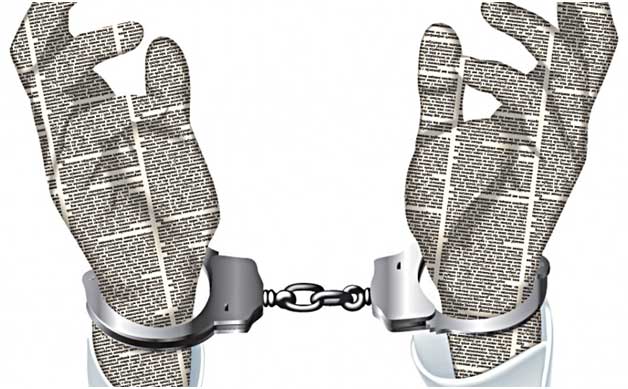
For years, journalists and press freedom advocates worried the U.S. would prosecute Assange under the Espionage Act for the publication of classified information, a scenario that potentially would have set a devastating legal precedent for U.S. news organizations that regularly publish such material.

During the Obama administration, officials ultimately said they would not prosecute because of the possible consequences for press freedom.

It was unclear whether the Trump administration would have the same compunction: while Trump praised WikiLeaks, then-CIA Director Mike Pompeo labeled it a “non-state hostile intelligence service.”

Trump has shown little concern for freedom of the press, once allegedly urging then-FBI Director James Comey to jail journalists. (In response to news of Assange’s arrest, Trump said he would leave it to the Justice Department).

In this context, the charge on which Assange was arrested seemed modest: A single count of conspiracy (with former Army Pfc. Chelsea Manning) to “commit computer intrusion” under the U.S. Computer Fraud and Abuse Act, with a maximum penalty of five years.

Unlike the publication of classified information, hacking computers is not a tool for reporters. Some journalists were quick to point out this out.

“[The] charge here is attempting to help crack a password to steal classified material. Didn’t work but would news orgs do that? (Not in my experience.),” said Greg Miller, a national security reporter at The Washington Post, said on Twitter.

But press freedom advocates, and some journalists, have not expressed relief based on the indictment. A host of organizations, including CPJ, spoke out against the prosecution. Here’s why:

(1) The indictment is flimsy and could simply be a pretext to punish Assange for publishing classified information.

The diplomatic time and resources expended between three countries to detain Assange strikes some observers as disproportionate to the single computer misuse charge.

The indictment is vague about the exact nature of the aid Assange allegedly provided Manning in the course of their interaction, but it does not appear that Assange successfully hacked any password.

Even if his attempts were successful, they would have helped Manning cover her tracks, but not let her break into a system to which she didn’t already have access.

Prosecutors have wide range of latitude; it’s worth remembering that the Obama administration likely had all the same information, but declined to pursue an indictment.

Matthew Miller, a former Justice Department spokesperson in the Obama administration, told The New York Times that he thought the charge was justified but “This is not the world’s strongest case.”

So, is it just a pretext on the part of the U.S. government to punish Assange for the publication of classified information — a practice that should be constitutionally protected? The issue comes in a time of heightened concern for investigative journalists and national security reporters.

Since the September 11 attacks, the government has increasingly classified large amounts of material and punished those who share it with the press. CPJ has written extensively about the chilling effect of this crackdown on reporting in the public interest.

“Given the nature of the charge — a discussion 9 years ago about an unsuccessful attempt to figure out a password — I think it’s fair to debate whether this is a fig leaf for the government punishing someone for publishing stuff it doesn’t want published,” tweeted Scott Shane, a national security reporter for The New York Times.

“If it wasn’t Julian Assange, it would be very unlikely you’d see this prosecution,” Cindy Cohn, executive director of the Electronic Frontier Foundation, told CPJ. “This is what over-broad discretion in prosecution does, it gives them a pretext for going after people they don’t like.”

(2) The charge could be a placeholder, with more to come.

Another reason why the charge may seem so modest: It could be the first of several. Last week, CNN cited U.S. officials promising additional charges against Assange. The press freedom implications of any future charges could be significant–especially if they involve the Espionage Act.

“It may be part of a larger case,” Ben Wizner the director of the American Civil Liberties Union, told CPJ. The current indictment already cites the Espionage Act and describes the cracking of a password as part of a conspiracy to violate it.

The DOJ’s legal strategy could be to pile on more charges after Assange is extradited. The extradition treaty between the U.S. and the U.K. says an individual can only be charged for the “offense for which extradition was granted” or similar offenses, but it also stipulates how governments can waive this rule.

Assange has an extradition hearing on May 2, which gives the U.S. government time to develop new charges.

(3) The language of the case seems to criminalize normal journalistic activities.

While the charge against Assange relates to the alleged conspiracy to hack a password, the language of the indictment sweeps in a broad range of legally protected and common journalistic activity.

Count 20 of the indictment states, “It was part of the conspiracy that Assange encouraged Manning to provide information and records from departments and agencies of the United States.”

The indictment goes on to characterize a number of journalistic practices as part of a criminal conspiracy, including use of a secure message service, use of a cloud-based drop box, and efforts to cover Manning’s tracks.

The cultivation of sources and the use of encryption and other means to protect those sources are essential to investigative journalism. While the government may include these details to show intent or to describe the means and context for the alleged criminal action, they seem to go beyond what is necessary.

Barton Gellman, who led The Washington Post’s Pulitzer Prize-winning reporting on the Snowden documents, told CPJ, “If asking questions and protecting a source are cast as circumstantial evidence of guilt, we’ll be crossing a dangerous line.”

“A lot of the way the crime is described here could be applied to other journalists,” Wizner, at the ACLU, told CPJ. “If the government wanted to just target the attempted intrusion, they could have written a very different complaint.”

(4) The Computer Fraud and Abuse Act is incredibly broad.

In all of the concern over the Espionage Act, journalists may not have sufficiently raised alarm over the law under which the U.S. charged Assange: the Computer Fraud and Abuse Act (CFAA). “Thinking we should breathe a sigh of relief because it was the CFAA instead of the Espionage act is premature.” Cohn, of Electronic Frontier Foundation, told CPJ.

The CFAA carries its own set of free expression issues. While it encompasses clearly illegal behavior like hacking, it also criminalizes “unauthorized access to a computer.”

Manning was prosecuted under the CFAA in addition to the Espionage Act, but prosecuting a publisher under the under the CFAA for conspiracy in obtaining the classified information could potentially create a dangerous legal model.

While reporters do not conspire to decrypt passwords, they are often aware of, and might actively discuss with sources, activities that could fall under the broad frame of “unauthorized access.”

As the Cato Institute’s Julian Sanchez wrote on Twitter, “The way ‘helping to hack’ is being charged is as a conspiracy to violate 18 USC §1030 (a)(1) [of the Computer Fraud and Abuse Act]. And good reporters conspire with their sources to do that constantly.”

“For almost every reporter working with a source, the source is providing information in digital form. Anyone who is working with a source who obtained that info in a way that they weren’t supposed to has a CFAA risk,” Cohn said.

She added that any journalists who don’t think there are broader press freedom implications to the Assange prosecution are “whistling past the graveyard.”

(5) Ecuador’s withdrawal of asylum raises questions.

Assange’s arrest came after Ecuador withdrew his asylum protection. In a tweet on April 11, Ecuadorean President Lenin Moreno said the decision came after Assange’s “repeated violations to international conventions and daily-life protocols.”

In a video statement accompanying the tweet, he cited Assange’s repeated “intervening in the internal affairs of other states” via WikiLeaks publications.

Ecuador had previously restricted Assange’s access to the internet based on allegations that he was interfering in U.S. elections and in the referendum for Catalan independence from Spain.

While Assange’s unusual presence in a diplomatic mission created tensions–both inside the embassy and in Ecuador’s broader international relations–withdrawing asylum is an extreme measure, and one that could have troubling implications if it was done in response to publishing.

*Alexandra Ellerbeck, CPJ’s North America program coordinator, previously worked at Freedom House and was a Fulbright teaching fellow at the State University of Pará in Brazil. She has lived in Chile, Bolivia, and Brazil.

*Asher-Schapiro is CPJ’s research associate for North America. He is a former staffer at VICE News, International Business Times, and Tribune Media, and an independent investigative reporter who has published in outlets including The Atlantic, The Intercept, and The New York Times.


Global Governance and Information

Civil Society, Civilisations Find Alliances, Climate Change, Development & Aid, Education, Environment, Featured, Global, Global Governance, Headlines, Human Rights, Natural Resources, Peace, Poverty & SDGs, TerraViva United Nations

Opinion

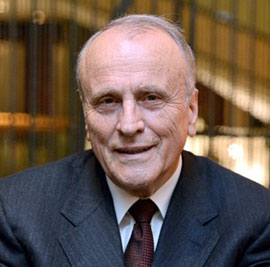
Ambassador Walther Lichem* of Austria is President Inter Press Service (IPS).

VIENNA, Apr 16 2019 (IPS) – The past seventy years since the end of the second world war have been marked by profound changes in our international system. Relations between states have become more horizontally structured interactions with a rising significance of the common good articulated and pursued by newly-created international programmes and organisations.


Ambassador Walther Lichem

The international agenda increasingly consists of items addressing internationally and globally-shared challenges of dependencies and interdependencies.

The traditional security and peace focus has been broadened into areas of concern which require contributions and activities not only by states but by international organisations and programmes who jointly with non-state actors such as academic institutions and associations, civil society organisations, the private sector including those who joined the Global Compact, have contributed to a new pattern of leadership in the processes of defining our global goals and in the implementation of the related programmes of action.

Another characterizing element in our Global Agenda related-approach is the inter-sectoral interdependence reflected in the international community’s agenda marked by “AND” – “climate change and international security”, “human rights and societal cohesion” etc.

These agenda—and interrelated-ness—require, however, also institutional integration cutting across the institutional development marked by sectoral segregation. There is a rising need for each agenda sector to be fully up-to-date regarding the entire pattern of global challenges and the related plans of action, using this level of information for the development of institutional integration.

There is also a rising need for information flows between governmental/ intergovernmental and non-governmental organizations (NGOs).

The new global agenda benefits from the work and conclusions of academic institutions and programmes, a relationship which regrettably has not yet been fully recognized by the international system.

Many of our important global agenda items based their policy approach on research and academic discourse – e.g. the issue of environmental protection, the concept of sustainability, the process of climate change, the societal development needs and human rights etc.

Another dimension of the pluralisation of global governance affectedness and responsibility is the role of each and every citizen on the globe to know and understand these challenges and assume a rising responsibility in addressing them.

Certain agenda areas, such as environmental protection, the sustainable development and use of our natural resource systems, human rights and human security have given the citizen an almost central role in the achievement of the declared objectives.

Today, every citizen can contribute to the recognition of the dignity of the other and the related human rights. The impact of citizen-focused human rights programmes is visible in human rights cities in all regions of the world. The citizen creating conditions of societal cohesion also essentially contributes to peace and security.

Private sector decisions can make important contributions to both the natural resources related and societal cohesion-related challenges. Academic institutions must adjust their programmes of research and of university education to the global agenda-related challenges.

The cultural sector provides important inputs into the development of values and related behavioural patterns related to the challenges of pluri-identity societies and the integration of otherness.

All these new patterns of responsibility and contributions to achievements for our Global Agenda, however, do require qualified information. It must be recognized that complex academic or policy-process related studies and reports are not accessible to the general citizenship including those in positions of responsibility at local and national levels.

Even governmental institutions and the international diplomatic community cannot internalize all the documents which are to serve as a basis for multilateral negotiations.

The development of this new participatory system of global governance with intergovernmental institutions and processes, national governments and local authorities has led to the recognition of an urgent need for qualified patterns of information which translate challenges, achievements and failures to the political responsibilities at local, national and also international levels, to governmental, inter-governmental and non-governmental institutions who have increasingly shaped our Global Agenda and articulated the rising need for societal understanding and information.

Media are the classical providers of such information combining data with assessments and the vision of our common future. Yet, as analysis of the current situation underlines, there is an urgent need to strengthen qualified information systems which would provide not only governmental, intergovernmental and non-governmental institutions and the citizens but also the media with pertinent and needed information.

There is no way into a future of shared global responsibility without a qualified and also ethically committed system of information related to our processes of global change.

There is a need to recognize that such highly pertinent information related to our common future requires recognition and support from the global society as a contribution to our shared global public space.

This implies that support is to be provided from governmental, intergovernmental and non-governmental institutions. A respective policy discourse with participation from these institutions is to be envisaged in order to prevent the decay or elimination of qualified programmes like Inter Press Service.

*Walther Lichem, retired Austrian Ambassador with studies in law and oriental archaeology (Univ. of Graz, Austria) and political science (Univ. of North Carolina, Chapel Hill; Institute for Advanced Studies, Vienna) started his professional career in 1966 at the United Nations Secretariat in New York in the field of international water resources with development cooperation missions to Ethiopia (1971), Argentina (1971-74) and to the Senegal River Development Organisation (1980). He was also Rapporteur on international river basins at the International Conference on Water Law (Caracas, 1976) and at the IVth World Water Conference (Buenos Aires, 1982).
Ambassador Lichem undertook major assignments in the UN system at the Human Rights Summit in Vienna in 1992 and as Ambassador to Chile and to Canada, as a member of the UN Committee on the Peaceful Uses of Outer Space and as an adviser to the 16 countries sharing the Guinea Current in West and Central Africa on the creation of a regional organisation.


Civil Society Under Attack in Name of Counterterrorism

Active Citizens, Civil Society, Conferences, Development & Aid, Editors’ Choice, Featured, Global, Global Governance, Headlines, Human Rights, IPS UN: Inside the Glasshouse, Peace, Population, Regional Categories, TerraViva United Nations

Civil Society

This article is part of a series on the current state of civil society organisations (CSOs), which was the focus of International Civil Society Week (ICSW), sponsored by CIVICUS, and which took place in Belgrade, April 8-12.

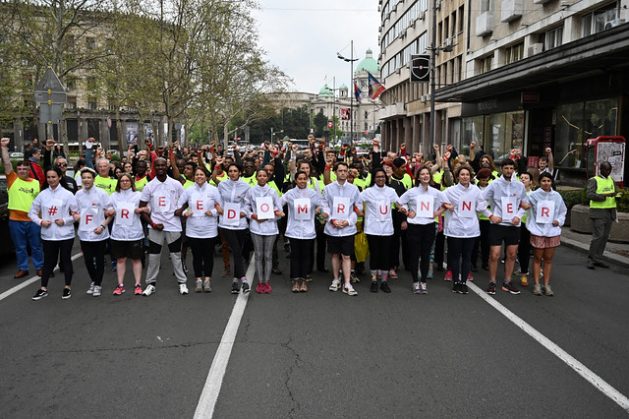
More than 200 civil society leaders and human rights activists from some 100 countries took to the streets of Belgrade, Serbia in solidarity with those whose basic freedoms are at risk. They participated in the International Civil Society Week (ICSW), sponsored by CIVICUS, which took place in Belgrade, April 8-12. Courtesy: CIVICUS

UNITED NATIONS, Apr 15 2019 (IPS) – Counterterrorism measures are not only affecting extremist groups, but are also impacting a crucial sector for peace and security in the world: civil society.


Civil society has long played a crucial role in society, providing life-saving assistance and upholding human rights for all.

However, counterterrorism measures, which are meant to protect civilians, are directly, and often intentionally, undermining such critical work.

“Civil society is under increased assault in the name of countering terrorism,” Human Rights Watch’s senior counterterrorism researcher Letta Tayler told IPS, pointing to a number of United Nations Security Council resolutions as among the culprits.

“Nearly two decades after the September 11 attacks, we are seeing a very clear pattern of overly broad counterterrorism resolutions. We are seeing a clear pattern of violations on the ground that are being carried out in the name of complying with binding Security Council counterterrorism resolutions,” she added.

Just two weeks after September 11, 2001, the UN Security Council unanimously adopted Resolution 1373 which called states to adopt and implement measures to prevent and combat terrorism.

Since then, more than 140 countries have adopted counterterrorism laws.

The newly approved Resolution 2462, passed at the end of March, requires member states to criminalise financial assistance to terrorist individuals or groups “for any purpose” even if the aid is indirect and provided “in the absence of a link to a specific terrorist act.”

While the resolution does include some language on human rights protections, Tayler noted that it is not sufficient.

“It is not sufficiently spelled out to make very clear to member states what they can and cannot do that might violate human rights on the ground,” she said.

Blurred Lines

Among the major issues concerning these resolutions is that there is no universal, legal definition of terrorism, allowing states to craft their own, usually broad, definitions. This has put civil society organisations and human rights defenders (HRDs) alike at risk of detention and left vulnerable populations without essential life-saving assistance.

“I think it is irresponsible of the Security Council to pass binding resolutions that leave up to States to craft their own definitions of terrorism…that’s how you end up with counterterrorism laws that criminalise peaceful protest or criticising the state,” Tayler said.

Oxfam’s Humanitarian Policy Lead Paul Scott echoed similar sentiments to IPS, stating: “The Security Council, by being overly broad, is just giving [governments] the tools to restrict civil society.”

According to Front Line Defenders, an Irish-based human rights organisation, 58 percent of its cases in 2018 saw HRDs charged under national security legislation.

Special Rapporteur on the promotion and protection of human rights while countering terrorism Fionnuala Ní Aoláin found that 67 percent of her mandate’s communications regarding civil society were related to the use of counter-terrorism, and noted that country’s counterterrorism laws are being used as a “shortcut to targeting democratic protest and dissent.”

In April 2018, thousands of people took to the streets in Nicaragua to protest controversial reforms to the country’s social security system.

According to the Office of the UN High Commissioner for Human Rights, over 300 people have been killed, more than 2,000 injured, and 2,000 arrested—some of whom were reportedly subject to torture and sexual violence when detained.

Many of those arrested will also be tried as terrorists due to a new law that expanded the definition of terrorism to include a range of crimes such as damage to public and private property.

At least 300 people, including human rights defenders, face charges of terrorism.

The Central American country said that the law was passed to comply with the Financial Action Task Force (FATF), an intergovernmental body that works alongside the Security Council to combat terrorist financing.

A Civil Society Facing Uncivility

Tayler also pointed to the lack of consequences for States that pass counterterrorism laws that do not abide by their obligations under international law.

In Resolution 2462, member states are told to comply with international humanitarian law when cracking down on terrorist financing but does not require countries to consider the effect of such measures on humanitarian activities such as providing food and medical care.

“In the zeal to be as tough looking as they can possibly can, governments have overlooked very very easy ways to protect those of us who are providing life-saving aid,” Paul told IPS.

The lack of protections for civil society and its impacts was most visible during the 2011 famine in Somalia.

In an effort to restrict “material support” to terrorist groups, countries such as the United States enacted counterterrorism legislation which blocked aid into areas controlled by Al-Shabab.

This not only impeded local and international organisations from doing their job, but one report noted that the constraints contributed to the deaths of over 250,000 people in the East African nation.

The problem has only gotten worse since then, Paul noted.

“The measures imposed by governments are unnecessarily broad and they prevent us from working in areas that are controlled by designated terrorist entities. What they have essentially done is criminalise humanitarian assistance,” he said.

Tunisia has used its terrorism financing laws to shut down a number of civil society organisations.

According to the Euro-Mediterranean Human Rights Monitor, approximately 200 organisations were dissolved and almost 950 others were delivered notices, referring them to courts on charges of “financial irregularities” or “receiving foreign funds to support terrorism” despite the lack of substantive evidence.

Many of the dissolved organisations provided aid and relief for orphans and the disabled.

All Eyes on Deck

Tayler highlighted the importance of the UN and civil society to monitor how counterterrorism resolutions such as Resolution 2462 are used on the ground.

“While we would love to see amendments to this resolution, pragmatically the next best step is for all eyes—the eyes of civil society, the UN, regional organisations—to focus on just how states implement this resolution to make sure that overly broad language is not used by states to become a tool of repression,” she said.

“The UN and leaders of countries around the world should use International Civil Society Week as an opportunity to take stock of the risk that this trend has posed on both to life-saving aid organisations and human rights defenders and to reverse this dangerous trend,” Tayler added.

Paul pointed to the need to educate both the public and policymakers on counterterrorism and its spillover effects as well as the importance of civil society in the global system.

“Civil society is a key part of effective governance. We don’t get effective public services, we don’t get peace, we don’t get to move forward with the anti-poverty agenda if civil society actors aren’t strong and empowered,” he said.

“If governments aren’t careful about protecting our right to stand up for marginalised and vulnerable populations, everyone will hurt. Not just those populations. It will have an effect broadly on our societies,” Paul added.


Hard Battle Ahead for Independent Arab Media

Civil Society, Crime & Justice, Democracy, Featured, Global, Headlines, Human Rights, Press Freedom, TerraViva United Nations

Opinion

This article is part of a series on the current state of civil society organisations (CSOs), the focus of International Civil Society Week (ICSW), sponsored by CIVICUS, which concluded in Belgrade, April 12

 
Mouna Ben Garga is an Innovation Officer with CIVICUS, a global alliance of civil society organisations.

TUNIS, Apr 12 2019 (IPS) – Sometimes a peak into the future reminds us just how stuck we are in the past and present.

It was the talk of the Middle East’s largest annual media industry gathering: a robot journalist – the region’s first – that wowed some 3,000 industry leaders and practitioners at the Arab Media Forum (AMF) in Dubai recently.


In an address titled “Future News Anchors”, the robot, known as A20-50, waxed lyrical about robots that would report ‘tirelessly’ all day, every day and be programmed to do any task.

At a conference organised around the theme, “Arab Media: From Now to The Future”, it was ironic that journalism produced by programmed automatons was held up as a glimpse of what the future held for media in the Arab world.

Ironic because, considering the state of journalism in the Middle East, it doesn’t sound as much like the future as the region’s present and past.

Looking at news output in this polarized landscape, it often seems that journalists (and their organisations) are like robots, programmed to produce and promote certain political agendas ‘tirelessly’, all day, every day.

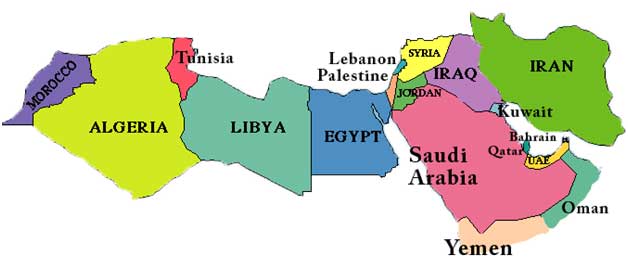
From Egypt to Kuwait, most news outlets support specific positions, usually those espoused by the companies or organisations that own or control them – often either toeing the official line or supporting rival agendas or political opposition.

Following the 2013 coup in Egypt and the civil wars in Syria, Yemen and Libya over the past decade, the pro-government media used the fear of instability and war to silence citizens and twist the facts.

For instance, the Egyptian mainstream media convinced its audience that the 2013 massacre of more than 900 people in Cairo was the only way to fight against terrorism.

In the context of the Middle Eastern media coverage of the killing of the Saudi journalist Khashoggi, both Al-Jazeera and Al-Arabiya television channels took up positions in front of the Saudi Consulate in Istanbul and resumed the fierce row between Qatar and Saudi Arabia, from there.

The truth was lost in this fierce political conflict and the Arab viewer had to cross-check the presented facts with other international reporting. This implicit bias and lack of balance polarized Arab public opinion and pushed news consumers to social media in search of trusted factual information, crushing the credibility in traditional media.



And when they aren’t busy working to manipulate bias in news coverage, Arab authorities are old hands at plain old media repression. Not surprisingly, nations in the Middle East and North Africa again find themselves at the bottom of Reporters Without Borders’ World Press Freedom Index of 2018.

Across the region, journalists and media organisations are under attack for their reporting – from intimidation to arrests, detention, prosecution and the shuttering of outlets. Four Arab countries – Egypt, Saudi Arabia, Bahrain and Syria – top the list of the world’s worst jailers of journalists ,according to the 2018 press freedom report by the Committee to Protect Journalists (CPJ).

Egypt jailed the most number of journalists on “false news” charges – 19, amid heightened global rhetoric about so-called fake news; The murder of exiled Saudi journalist Jamal Khashoggi by Saudi agents in the country’s Instanbul consulate illustrated the extreme lengths the Gulf kingdom’s leaders would go to stop published criticism.

And in Syria, 13 journalists were killed in 2017, and more than 40 journalists and citizen-journalists are currently detained, kidnapped or have disappeared.

In this complex context of divisions, repression and lack of public trust, the future of trustworthy Arab media is in the hands of alternative media, journalists’ unity and active citizens.

Since the Arab spring, independent journalism platforms such as Daraj, Nawaat in Tunisia, and Beirut-based Raseef22 have emerged, offering alternative narratives that counter state propaganda and mainstream media self-censorship.

But the challenges for these organisations are their limited reach – many mainstream news consumers consider them elitist and targeting “intellectual” users – and their financial sustainability.

The key here is inclusivity. One of the most successful news outlets is AJ+ Arabic, a project that grew out of Al Jazeera’s Incubation and Innovation Group, focusing exclusively on social platforms targeting millennials.

The other major challenge – financial survival – calls for new, sustainable journalism business models developed around new forms of storytelling and original content production supported by creative funding approaches including crowdfunding and data sales or services, for example.

Empowering citizen journalism is another possible solution to producing independent media in the Arab world. Indeed, citizen journalists, young bloggers, and active tweeps are not governed by the same relationship between the state and media professionals and are authentic voices and channels to the Arab street – they speak its language and represent its concerns and challenges.

Alternative media leaders need to build the citizen capacity beyond data collection and reporting to include online security, storytelling and counter-narratives. Increasing the transfer of these savoir-faire to citizens would amplify more voices to tackle the polarization effect through facts.

But of course, there is a place in the future of quality Arab media for professional journalism. Professional bodies have a role to play in fight for press freedom in the region.

Local unions have to wage numerous battles for their own independence through advocating for better legislation that affords greater protection to reporters and that prohibits prosecutions for reporting.

They have to promote the development of more journalistic organisations and more actively resist government attempts to contain and control the media by positioning themselves as defenders of free, independent media, creating strong alliances with alternative media, citizens journalists and social media influencers.

They need to be inclusive to promote a positive narrative about the role of the media in citizens’ lives and bridge the social gap between journalists and the general public to increase support for stronger independent media.

As a major regional proxy war rages on in the region, dominating headlines and geopolitical agendas, the battle for a future independent Arab media that is trusted and trustworthy, is one that seeks to do away with robotic journalists and organisations programmed only to serve the interests of the powerful.