Uyghur Violations a Litmus Test for Global Governance & Rules-based International Order

Asia-Pacific, Civil Society, Crime & Justice, Democracy, Featured, Global Geopolitics, Global Governance, Headlines, Human Rights, TerraViva United Nations

Opinion

Protesters in Washington, DC, march against the alleged killing of Uyghur Muslims. June 2022. Credit: Unsplash/Kuzzat Altay

NEW YORK, Oct 3 2022 (IPS) – This week is a momentous one for the world’s premier human rights body. At stake is a resolution to decide whether the UN Human Rights Council in Geneva can hold a debate on a recently released UN report.


The report concludes that rights violations by China’s government in its Xinjiang region ‘may constitute international crimes, in particular crimes against humanity’.

Unsurprisingly, China’s government is doing everything in its power to scotch plans for a debate on the report’s contents. Its tactics include intimidating smaller states, spreading disinformation and politicising genuine human rights concerns – the very thing the Human Rights Council was set up to overcome.

The historic report, which affirms that the rights of Xinjiang’s Uyghur Muslim population are being violated through an industrial-level programme of mass incarceration, systemic torture and sexual violence, attracted huge controversy before it was released on 31 August 2022, minutes before the end of the term of the outgoing High Commissioner for Human Rights, Michelle Bachelet.

The report was supposedly ready in September 2021 but so great was the pressure exerted by the Chinese state that it took almost another year for it to be aired. Absurdly, the 46-page report includes a 122 page annex in the form of a rebuttal issued by China, rejecting the findings and calling into question the mandate of the Office of the High Commissioner for Human Rights.

The Office of the High Commissioner has asserted that the report is based on a rigorous review of documentary evidence with its credibility assessed in accordance with standard human rights methodology. The report’s recommendations are pretty straightforward: prompt steps should be taken to release all people arbitrarily imprisoned in Xinjiang, a full legal review of national security and counter-terrorism policies should be undertaken, and an official investigation should be carried into allegations of human rights violations in camps and detention facilities.

Nevertheless, a proposed resolution to hold a debate on the report’s contents in early 2023 is facing severe headwinds. A number of states inside and outside the Human Rights Council, united by their shared history of impunity for rampant human rights abuses – such as Cuba, Egypt, Laos, North Korea, Pakistan, Saudi Arabia, Syria and Venezuela – have already rallied to China’s defence in informal negotiations on the brief resolution.

What is most worrying is that China appears to be leaning on smaller states that make up the 47-member Human Rights Council by inverting arguments about politicisation of global human rights issues and projecting itself as the victim of a Western conspiracy to undermine its sovereignty.

If China were to have its way, it would be a huge setback for the Human Rights Council, which was conceived in 2006 as a representative body of states designed to overcome the flaws of ‘declining credibility and lack of professionalism’ that marred the work of the body it replaced, the UN Commission on Human Rights.

Former UN Secretary-General Kofi Annan, in his ground-breaking In Larger Freedom report, lamented that states sought membership ‘not to strengthen human rights but to protect themselves against criticism or to criticize others’.

Human Rights Council members are expected to uphold the highest standards in the protection and promotion of human rights. But our research at CIVICUS shows that eight of the Council’s 47 members have the worst possible civic space conditions for human rights defenders and their organisations to exist. In these countries – Cameroon, China, Cuba, Eritrea, Libya, Sudan, United Arab Emirates and Uzbekistan – human rights are routinely abused and anyone with the temerity to speak truth to power is relentlessly persecuted.

Regimes that serially abuse human rights may be motivated to block findings of investigations being aired on the international stage, but the international community has a collective responsibility to the victims. Civil society groups are urging Human Rights Council members to stand firm on the call for a debate on the China report.

Human Rights Council member states that assert the importance of human rights and democracy in their foreign policy are expected to vote in favour. Nevertheless, the influence of regional and geo-political blocs within the Council mean that the issue will essentially be settled by the decisions of states such as Argentina, Armenia, Benin, Brazil, Côte d’Ivoire, Gabon, Honduras, India, Indonesia, Malawi, Malaysia, Mexico, Paraguay, Senegal, Ukraine and Qatar.

China will undoubtedly pressure these states to try to get them to oppose or abstain in any vote that seeks to advance justice for the Uyghur people.

The stakes are particularly high for China’s mercurial leader, Xi Jinping, who is seeking to anoint himself as president for a third term – after abolishing term limits in 2018 – at the Chinese Communist Party’s Congress, which begins on 16 October.

Recognition of the systematic abuses to which Xi’s administration has subjected the Uyghur people would be considered an international affront to his growing power.

If China were to prevail at the Human Rights Council, it would be another blow to the legitimacy of the UN, which is already reeling from the UN Security Council’s inability to overcome Russia’s permanent member veto to block action on the invasion of Ukraine. So much – for the UN’s reputation, and for the hope that human rights violators, however powerful, will be held to account – is resting on the vote.

Mandeep S. Tiwana, is chief programmes officer and representative to the United Nations at global civil society alliance, CIVICUS.

IPS UN Bureau

  Source

Reasonable Left, Irresponsible Right: & the Future of Social Democracy

Civil Society, Democracy, Featured, Global, Global Governance, Headlines, Human Rights, TerraViva United Nations

Opinion

Credit: Pexels via

VIENNA, Sep 28 2022 (IPS) – With no shortage of catastrophes in the past 15 years worldwide — the democratic left is stepping up to provide stability amid the storm.

Throughout the history of mankind, there have been catastrophes. In modern times, there have also been media representations of catastrophe, including worked-up or even imagined catastrophes.


More than 60 years ago, the German author Friedrich Sieburg wrote about the ‘lust for doom’, which, strangely enough, has a tremendous appeal especially in eras perceived as stable: ‘The everyday life of democracy with its dreary problems is boring, but the impending catastrophes are highly interesting.’

Now that we have had no shortage of real catastrophes in the past 15 years, we no longer have to conjure them up. First came the global financial crisis, which threatened to topple banks and other financial institutions — even states — as if houses of cards.

Later the pandemic arrived and then the military invasion of the second largest country in Europe by the largest. Its shockwaves are devastating half the world, with energy crisis, broken supply chains, price explosion, food shortages, impoverishment and destitution.

Robert Misik

And all the time comes the onrushing climate catastrophe, whose consequences are already apparent and which intersects with the current geopolitical crisis. The global electricity markets are going crazy because there is a lack of gas from Russia, but also because the rivers are drying up, the hydroelectric power plants are empty and nuclear power plants have to be shut down because the cooling water in the rivers is becoming too scarce — even the coal-fired plants are having problems where coal can no longer be shipped.

In any case, disaster is not now something we frivolously imagine because we are bored. It is there — very real for many and at least felt by most. Not only does it colour political debates but an atmosphere of pessimism, insecurity and fear has settled over most societies.

This is so even, perhaps especially, in the affluent societies of the west, which had become accustomed to stability and relative prosperity. A sentiment is spreading: the whole machinery no longer works, it is broken — and the political elites have no plan.

The left choosing stability

Against this backdrop, while the left is trying to develop programmes and instruments to master the crises, to stem the decline in prosperity and the social costs for ordinary people, those on the hard right are betting on things getting even worse, playing up catastrophe.

They hope this will benefit them, that they can thereby achieve electoral success — as with the right-wing radicals in Sweden recently or the right-wing bloc in Italy over the weekend.

It’s no surprise, then, that the far-right contenders paint the ‘elite’ and its networks in dark colours. They rummage through supposedly suppressed news and hidden secrets. They identify, to their satisfaction, how the powerful secure their dominance and say all this is connected. They imagine themselves as if detectives smugly putting pieces of the political puzzle together, in the manner of a latter-day Hercule Poirot.

It is not a completely new phenomenon to offer such a fundamental critique of ‘the system’. What is astonishing is that the far right has hijacked what used to be a prerogative of Marxist intellectuals — and of those activists who imagined a terminal catastrophe would some day issue in a socialist millennium.

Right-wing propaganda has appropriated elements of left-wing critical thinking — the questioning of the conventional and familiar, of the all-too-obvious, and the healthy suspicion of power. Amazingly, the motifs of the enlightenment have been subverted to serve conspiracy theories and fanaticism, in the cause of authoritarianism and nationalism.

The democratic left, in sharp contrast, sees its task today, grosso modo, as providing stability amid the storm. Of course, this is true where it is in government. But it in most cases it also has this reflex of responsibility where it is in opposition.

This has consequences. The left sometimes finds itself defending the status quo, against its deterioration. It knows it cannot score points with simple answers but has to work out complex plans whose realisation is tough.

This liberal left has always stood for freedom, democracy, the rule of law — for social equality and against hierarchy and fascist temptations. The Russian president, Vladimir Putin, has however drawn his country back into despotism in recent decades, aligned with an ideology of expansionism.

While the radical right (and some pro-Russian hard leftists) propose to kneel to Putin, the democratic left supports Ukraine’s right to self-defence and an independent path.

Russia’s imperialism has been met with sanctions from liberal Europe and north America, rebutted in turn in an economic quasi-war with the help of the ‘weapon’ of gas and oil. Yet in a multipolar and chaotic world where not all are on their side, progressives find themselves having to balance decisiveness and prudence.

Now their own economies must be stabilised and protected, and their societies, because the supply of energy and the functioning of the critical infrastructure has a much broader social centrality. This includes changes in the design of energy markets, which simply no longer function when panic on the markets leads to price explosions of 600 or even 1,000 per cent.

The colonisation of lifeworlds by market ideology has however meant that even the essential goods of everyday infrastructure have been left to the mercy of the markets. Energy suppliers which get into trouble have thus to be bailed out by governments.

The dangers of ‘politics without a project’

The effects of inflation are also different from what we know from economics textbooks. Classic inflation occurs when there is a boom, an economy reaches the limits of its capacity and there is more or less full employment. Then asset owners lose, while borrowers gain. But above all, workers and employees do not really lose out: prices rise but so do wages.

Classical inflation is characterised by a wage-price spiral in which real wages rise along with them. Historically, wage earners lost out primarily because of anti-inflationary policies, not because of inflation.

Today, however, inflation is not the result of a boom but an economic shock: it is imported, primarily due to higher energy prices and supply problems. Many companies too are groaning under their energy overheads, as they cannot fully pass on the cost increase to consumers. This in turn will mean workers will not be able to make up fully for price increases through wage rises.

The unions will fight but it will be very difficult to avoid real wage losses. Low wage increases lead to impoverishment and a decline in aggregate demand but high wage increases would lead to more bankruptcies and thus more unemployment.

The most likely result will be a combination of misfortune — a marked recession plus high inflation. Government will have to intervene with price controls, by dramatically accelerating the shift to renewable energy, by providing payments to the most vulnerable segments of the population, by accepting further budget deficits.

None of these solutions will be perfect. We must be careful not to enter a new era of depoliticised pragmatism — a ‘politics without a project’, to borrow an old formulation from a famous German book edited by the legendary Suhrkamp publisher Siegfried Unseld 30 years ago. But there will tend to be no grand design to policy, just muddling through.

Public debates will be characterised by a certain confusion, as we are already observing. On the one hand, most citizens want clear and focused plans, but at the same time they know that there are no easy, simplistic answers.

A pandering left-wing populism is therefore not an attractive alternative. It is not only a too-narrow preaching to the converted but also there is a broad swath of potential support among liberal and left citizens for a politics of reason and responsibility.

In times of such uncertainty, we do not need trumpeters and bullshiters. We need people who can be trusted to do the best they can to sort things out.

Robert Misik is a writer and essayist. He publishes in many German-language newspapers and magazines, including Die Zeit and Die Tageszeitung.

Source: International Politics and Society is published by the Global and European Policy Unit of the Friedrich-Ebert-Stiftung, Hiroshimastrasse 28, D-10785 Berlin.

IPS UN Bureau

  Source

From Indonesia to India: Is There Hope for Anti-Corruption Efforts Within the G20?

Civil Society, Development & Aid, Economy & Trade, G20, Global, Global Governance, Headlines, TerraViva United Nations

Opinion

Many of the global crises we face are caused or exacerbated by corruption. Credit: Ashwath Hedge/Wikimedia Commons

Many of the global crises we face are caused or exacerbated by corruption. Credit: Ashwath Hedge/Wikimedia Commons

WASHINGTON DC, Sep 27 2022 (IPS) – As global crises mount, the G20 is proving unable to find solutions. Political disagreements within the bloc- including most prominently with Russia over the ongoing war in Ukraine- have hamstrung collective efforts.


Economic challenges have inevitably led to a focus on domestic priorities. And significant political changes in key G20 countries over the past few months- such as the UK and Italy- have further undermined joint decision-making.

Equally, on corruption issues, the G20 has a long way go, although the body continues to reiterate its commitment fighting graft and leading by example on core issues such as the role of audit institutions, anti-corruption education, money laundering and graft in the renewable energy sector.

The G20 Anti-Corruption Working Group (ACWG) meets for the final time under the Indonesian Presidency this week- and while there remains plenty to do, there are also glimmers of hope for the future, as India takes on leadership of the G20 for 2023.

It is easy to get disheartened about the continued ubiquity of corruption- but beyond the headlines and if we pay attention to the small print, there is some important progress being made

To better understand the progress made, Accountability Lab, as one of the international Co-Chairs of the C20 Anti-Corruption Working Group (ACWG), has partnered with the Royal United Services Institute (RUSI) to distill complex and scattered information on anti-corruption within G20 countries (often buried in lengthy reports, as we’ve highlighted previously) into a set of easy-to-understand one-pagers. Each of these (see Australia here or South Africa here for example) outlines for each of the member countries the progress made against key priorities, with the goal of encouraging sharing of ideas and learning within the G20.

Here is what we found:

Enhancing the role of audit in tackling corruption

The G20 ACWG recognizes the important role of audit in preventing corruption in both the public and private sectors, and member countries have institutions and systems in place to deter corruption.

For instance, 17 out of the 19 G20 member countries (the 20th is the EU) score over a global average of 63 on the International Budget Partnership’s metric for oversight by supreme audit institutions. Brazil has received a great deal of scrutiny in recent years because of corruption, but Brazil’s Tribunal de Contas da Uniao (TCU) is cited as an example for its innovative use of data analytics and artificial intelligence including identifying indicators of corruption.

Member countries are also improving existing laws, with Japan proposing to reform its audit law to provide more enforcement power to the Japanese Institute of Certified Public Accountants and improve oversight of listed companies.

Promoting public participation and anti-corruption education

Most G20 member countries have policies guaranteeing the right to participation through specific laws such as the right to information, public information disclosure or public procurement, to name a few.

In India, the Pre-legislative Consultation Policy was passed recently to ensure public participation in policy-making processes, and government as well as civil society platforms are available to promote public education, including on corruption issues.

Similarly, South Korea’s Public-Private Consultative Council for Transparent Society under the Anti-Corruption and Civil Rights Commission provides a platform to inform and disseminate anti-corruption messages. South Korea also aims to strengthen civic space and public participation including through a national Participatory Budgeting Citizens’ Committee.

In Australia a public-private partnership (Bribery Prevention Network) launched in October 2020 bringing together the private sector, civil society, government and academia to provide free resources to help corporates implement anti-bribery programmes, and was runner up in the Anti Corruption Collective Action Awards 2022.

Professional enablers of money laundering

The G20 acknowledges gaps in member countries’ anti-money laundering efforts, particularly related to preventive measures targeting professional enablers, including accountants, lawyers, or real estate agents- and is aiming to pull together guidance on these issues through a Compendium for Professional Enablers of Money Laundering.

While most countries do not have a comprehensive definition of Designated Non-Financial Business Professionals (DNFBPs), Indonesia, Japan, Mexico, and Saudi Arabia comply with the 2012 Financial Action Task Force (FATF) standards on the definition. The 2021 follow-up review from FATF noted that the revisions to China’s anti-money laundering law will include general provisions and supervision of DNFPBs.

In the US, if the ENABLERS Act– which was approved by the House of Representatives in July 2022– is passed by the Senate, it could regulate professional enablers; and in the UK, lack of supervision of enablers is being acknowledged by the government as it looks at different models to strengthen the supervision of accountants and lawyers.

Promoting corruption in the renewable energy sector

The G20 is working on a background note on Promoting Anti-Corruption in Renewable Energy in order to raise awareness and increase collaboration to prevent corruption in the energy sector. In 2022, Argentina launched an open information system (SIACAM) which provides public access to data on mining activities in the country, including their environmental and socio-economic impacts.

The Resource Governance Index notes that Argentina is one of only 7 countries that has made this type of data available. Similarly in Mexico, progress has been made with the publication of all oil procurement contracts on the state-owned website oil company, Pemex.

Japan’s cooperation agreement with India and the European Union to share experiences and best practices on liquid natural gas is cited as an example to follow by the International Energy Agency.

It is easy to get disheartened about the continued ubiquity of corruption- but beyond the headlines and if we pay attention to the small print, there is some important progress being made.

With the G20, the key now- as India assumes leadership of group- is for member countries to double down on their commitments and follow-through on implementation of reforms. Many of the global crises we face are caused or exacerbated by corruption- now is the time for our leaders to get this right.

Blair Glencorse is Executive Director of Accountability Lab; Sanjeeta Pant is of Accountability Lab. This piece draws on research carried out with RUSI. Follow the Lab on Twitter @accountlab

  Source

We Need Urgent Commitment, Resources & Action to Tackle Hunger Crisis

Civil Society, Development & Aid, Editors’ Choice, Featured, Food and Agriculture, Global, Headlines, Population, Poverty & SDGs, TerraViva United Nations

Opinion

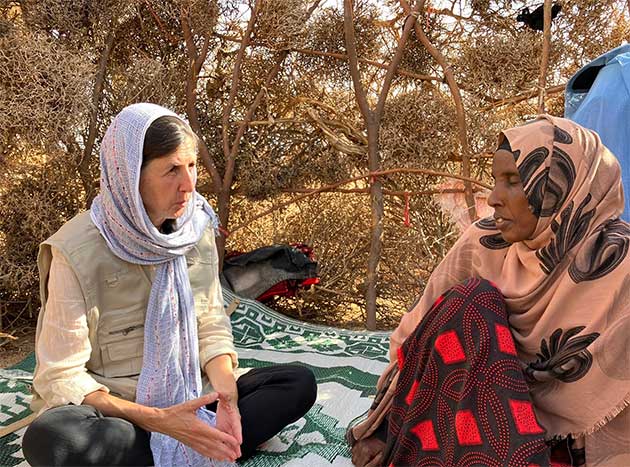
Conversation at the UN General Assembly Side Event on Responding to the Urgent Humanitarian Needs in the Horn of Africa. Credit: Karelia Pallan/Oxfam

NEW YORK, Sep 27 2022 (IPS) – Last week, as world leaders gathered in New York for the 77th United Nations General Assembly, one topic came up more than most: looming famine. That’s because despite a global commitment to make famine a relic of the past, it is once again knocking at our door.


In Somaliland two weeks ago, I witnessed communities past their breaking points. Grandparents there told me they could not recall a drought like this in their lifetimes.

At UNGA, I was honored to take part in many discussions on this and other topics – in particular a panel about the urgent humanitarian needs in the Horn of Africa. The region is facing several interlinked issues, including hunger, conflict, climate, and COVID-19. As we discuss – and more importantly, respond to – the crisis, we should keep in mind three themes: the urgency of the moment, the need for more access and more funding, and the implementation of a systemic solution.

The humanitarian crisis in the Horn needs to be at the top of the international agenda, and we need commitment, resources and action urgently. We have seen the warning signs that famine is coming for quite some time – and now we have been warned that it could be declared in Somalia as soon as next month.

Often, the international community is reactionary to crises, but this time we must also be anticipatory in assessing and responding to the needs of the region. In my trip to Somaliland, I spoke to farmers, pastoralists, and visited communities impacted by conflict, climate, and COVID-19. It was my first visit back to Somaliland in more than 20 years, which offered an interesting perspective of the arc of change.

Abby Maxman speaks with Safia, a woman forced to leave her home in Somaliland amid the drought and growing hunger. Credit: Chris Hufstader/Oxfam

Their shared experience is clear: their livelihoods and way of life – and that of their ancestors – are in danger and the need for action now is more urgent than ever. It is dispiriting that these preventable tragedies continue to repeat when the world has the resources and know-how to prevent them.

I spoke with Safia, a 38-year-old divorced mother of eight children, who lost 90% of her livestock. She stayed as long as she could in her community until she felt unsafe as the weak and dead livestock attracted hyenas at night, compelling her to make the five-day journey to reach the Dur-Dur IDP (Internally Displaced Person) camp near Burao.

At Dur Dur they were welcomed with clean water, some food, and materials to build a shelter. She and her children have been there for about three months. They are struggling to get enough food and might eat one meal a day, if they can. Oxfam and others are there offering support, but it’s not nearly enough to meet their basic needs.

Safia’s experience was just one of countless more of those who are bearing the brunt of the dual global hunger and climate crises that has been brought on by distant forces who are prioritizing profits over people and planet.

Earlier this year, Oxfam’s research estimated that one person is dying from acute hunger in the region every 48 seconds. Since then, the situation has only gotten worse. We have a narrow window of opportunity to stave off hunger in the horn. It is not too late to avert disaster, but more needs to be done immediately.

We know that anticipatory action saves lives, livelihoods, and scarce aid money, and across Oxfam and with our partners we have been sounding the alarm of this slow, onset emergency at local, national, and global levels for the past two years. Yet we are witnessing a system that is failing the people who are least responsible for this crisis.

We need more access and a lot more funding that supports frontline organizations and leaders. During the panel, it was encouraging to hear Under-Secretary-General for Humanitarian Affairs and Emergency Relief Coordinator Second Martin Griffiths put such emphasis on funding local organizations and leaders who have the knowledge, access, and courage to make real impact.

Local organizations know where the most vulnerable people are located, they can reach disaster zones quickly, and they understand the languages, cultures, geography, and political realities of the affected communities far better than outsiders.

These local leaders should be given the resources and space to make decisions to have the most effective response that will save lives now and in the long run. This may mean that international donors and organizations need to be more flexible in how they coordinate, fund, and implement a humanitarian response. The old way may not be the most effective – in fact we know it is not – especially where there are access challenges.

Finally, we must take a systemic approach in tackling these issues. We know that hunger, climate, and conflict do not happen in silos – they are inextricably linked. We must make sure we are fighting these interlinked crises, especially hunger and climate, together.

Climate change is causing more extreme weather events like droughts, floods, and heatwaves, which devastate crops and displace vulnerable communities. In fact, hunger has more than doubled in 10 of the worst climate hotspots in recent years.

Countries that have contributed the least to emissions are bearing the worst impacts of the climate crisis, while fossil fuel companies see record-breaking profits. Less than 18 days of profits from fossil fuel companies could cover the whole UN humanitarian appeal of $48.82 billion for 2022.

These conversations and convenings are important, but we must do more than raise the alarm – we must see action to follow them up. I hope that leaders recommit the political will to fulfill their moral obligation to meet this crisis in the Horn head on.

Safia is doing all she can to ensure her family’s survival – we must see leaders do all in their power, right now, to make sure she and millions more get the urgent aid they need now to survive, and see their right to a safe, healthy future recognized and realized in years to come.

Abby Maxman is President and CEO Oxfam America.

IPS UN Bureau

  Source

Women Advocates for Harvesting Rainwater in Salinity-Affected Coastal Bangladesh

Asia-Pacific, Climate Change, Development & Aid, Editors’ Choice, Environment, Featured, Headlines, Humanitarian Emergencies, Innovation, Natural Resources, TerraViva United Nations

Humanitarian Emergencies

Lalita Roy now has access to clean water and also provides a service to her community by working as a pani apa (water sister), looking after the community's rainwater harvesting plants. Credit: Rafiqul Islam/IPS

Lalita Roy now has access to clean water and also provides a service to her community by working as a pani apa (water sister), looking after the community’s rainwater harvesting plants. Credit: Rafiqul Islam/IPS

KHULNA, Bangladesh, Sep 23 2022 (IPS) – Like many other women in Bangladesh’s salinity-prone coastal region, Lalita Roy had to travel a long distance every day to collect drinking water as there was no fresh water source nearby her locality.


“In the past, there was a scarcity of drinking water. I had to travel one to two kilometers distance each day to bring water,” Roy, a resident of Bajua Union under Dakope Upazila in Khulna, told IPS.

She had to collect water standing in a queue; one water pitcher was not enough to meet her daily household demand.

“We require two pitchers of drinking water per day. I had to spend two hours each day collecting water. So, there were various problems. I had health complications, and I was unable to do household work for lack of time,” she said.

After getting a rainwater harvesting plant from the Gender-response Climate Adaptation (GCA) Project, which is being implemented by United Nations Development Programme (UNDP), Roy is now collecting drinking water using the rainwater harvesting plant, which makes her life easier.

“I am getting the facilities, and now I can give two more hours to my family… that’s why I benefited,” she added.

Shymoli Boiragi, another beneficiary of Shaheber Abad village under Dakope Upazila, said women in her locality suffered a lot in collecting drinking water in the past because they had to walk one to three kilometers every day to collect water.

“We lost both time and household work. After getting rainwater harvesting plants, we benefited. Now we need not go a long distance to collect water so that we can do more household work,” Boiragi said.

Shymoli revealed that coastal people suffered from various health problems caused by consuming saline water and spent money on collecting the water too.

“But now we are conserving rainwater during the ongoing monsoon and will drink it for the rest of the year,” she added.

THE ROLE OF PANI APAS

With support from the project, rainwater harvesting plants were installed at about 13,300 households under 39 union parishads in Khunla and Satkhira. One pani apa (water sister) has been deployed in every union from the beneficiaries.

Roy, now deployed as a pani apa, said the GCA project conducted a survey on the households needing water plants and selected her as a pani apa for two wards.

“As a pani apa, I have been given various tools. I go to every household two times per month. I clean up their water tanks (rainwater plants) and repair those, if necessary,” he added.

Roy said she provides services for 80 households having rainwater harvesting plants, and if they have any problem with their water tanks, she goes to their houses to repair plants.

“I go to 67 households, which have water plants, one to two times per month to provide maintenance services. If they call me over the cellphone, I also go to their houses,” said Ullashini Roy, another pani apa from Shaheber Abad village.

She said a household gives her Taka 20 per month for her maintenance services while she gets Taka 1,340 (US$ 15) from 67 households, which helps her with family expenses.

Ahoke Kumar Adhikary, regional project manager of the Gender-Response Climate Adaptation Project, said it supported installing rainwater harvesting plants at 13,300 households. Each plant will store 2,000 liters of rainwater in each tank for the dry season.

The water plants need maintenance, which is why the project has employed pani apas for each union parishad (ward or council). They work at a community level on maintenance.

“They provide some services, and we call them pani apas. The work of pani apas is to go to every household and provide the services,” Adhikary said.

He said the pani apas get Taka 20 from every household per month for providing their services, and if they need to replace taps or filters of the water plants, they replace those.

The pani apas charge for the replacements of equipment of the water plants, he added.

NO WATER TO DRINK

The coastal belt of Bangladesh is one of the most vulnerable areas to climate change as it is hit hard by cyclones, floods, and storm surges every year, destroying its freshwater sources. The freshwater aquifer is also being affected by salinity due to rising sea levels.

Ullashini Roy said freshwater was unavailable in the coastal region, and people drinking water was scarce.

“The water you are looking at is saline. The underground water is also salty. The people of the region cannot use saline water for drinking and household purposes,” Adhikary said.

Ahmmed Zulfiqar Rahaman, hydrologist and climate change expert at Dhaka-based think-tank Center for Environmental and Geographic Information Services (CEGIS), said if the sea level rises by 50 centimeters by 2050, the surface salinity will reach Gopalganj and Jhalokati districts – 50 km inside the mainland from the coastal belt, accelerating drinking water crisis there.

PUBLIC HEALTH AT RISK

According to a 2019 study, people consuming saline water suffer from various physical problems, including acidity, stomach problems, skin diseases, psychological problems, and hypertension.

It is even being blamed for early marriages because salinity gradually changes girls’ skin color from light to gray.

“There is no sweet water around us. After drinking saline water, we suffered from various waterborne diseases like diarrhea and cholera,” Ullashini said.

Hypertension and high blood pressure are common among coastal people. The study also showed people feel psychological stress caused by having to constantly collect fresh water.

Shymoli said when the stored drinking water runs out in any family; the family members get worried because it’s not easy to collect in the coastal region.

SOLUTIONS TO SALINITY

Rahaman said river water flows rapidly decline in Bangladesh during the dry season, but a solution needs to be found for the coastal area.

The hydrologist suggested a possible solution is building more freshwater reservoirs in the coastal region through proper management of ponds at a community level.

Rahaman said low-cost rainwater harvesting technology should be transferred to the community level so that coastal people can reserve rainwater during the monsoon and use this during the dry season.

He added that the government should provide subsidies for desalinization plants since desalinizing salt water is costly.

IPS UN Bureau Report

  Source

Multi-Faith Team Urges Repeal of Blasphemy Laws– in the Name of Religious Freedom

Civil Society, Crime & Justice, Featured, Global, Headlines, IPS UN: Inside the Glasshouse, TerraViva United Nations

Opinion

Independent UN human rights experts condemned the death sentence of a university lecturer charged with blasphemy in Pakistan, calling the ruling “a travesty of justice”. December 2019. Credit: UNICEF/Josh Estey

NEW YORK, Sep 12 2022 (IPS) – In nations lacking certain religious freedoms, the bold multi-faith membership of the International Religious Freedom Roundtable’s Campaign to Eliminate Apostasy and Blasphemy Laws, would be forbidden.


This archaic, and at times, violent fact is driving a biblical justice authority, an international activist and a team of culturally and religiously diverse advocates to raise their voices with member states, just before world leaders arrive for the high-level segment of the 77th UN General Assembly session which commences in New York City September 20.

The trip will highlight the twelve nations currently imposing the death penalty for apostasy and blasphemy charges, calling for its immediate repeal.

Freedom of religion or belief is universally regarded as fundamental human right and is protected by international covenants and national constitutions alike.

However, courts continue to mete out unjustifiably long prison sentences and even death sentences to individuals for non-violent, victimless conduct such as committing blasphemy or apostasy.

Recently, Nigerian humanist Mubarak Bala was sentenced to an unimaginable 24 years’ imprisonment for an allegedly blasphemous Facebook post he made expressing his disbelief in an afterlife.

Though the death penalty is not actually imposed upon a convicted individual in a vast majority of cases, the sentence itself relegates convicts to years and decades of prolonged imprisonment on death row, denial of medical care while in prison, withholding of legal counsel, and endless interrogation.

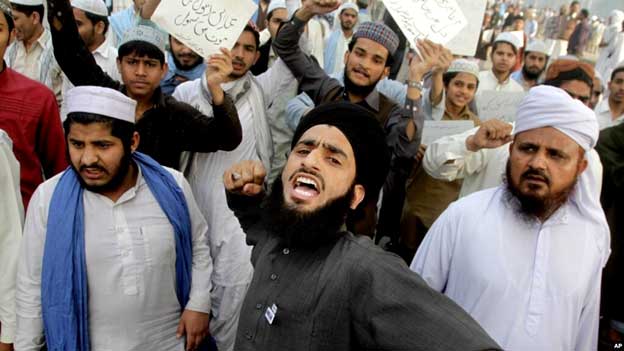
Pakistanis rally in support of Mumtaz Qadri who was convicted and executed for a blasphemy-motivated killing of a former governor, in Lahore, Pakistan, Feb. 2016. Credit: Voice of America

Previously, Asia Bibi, a Pakistani woman, languished on death row for eight years on charges of blasphemy simply for drinking water from a canteen while picking berries with a group of Muslim women.

After her release and acquittal in 2019, Asia was forced to flee her home country in fear of reprisal attacks by radical Islamists.

In 2014, a pregnant Sudanese woman Mariam Ibrahim – who was imprisoned on apostasy charges for her marriage to a Christian man, and as a woman born to a Muslim father – was forced to give birth to her second child while her legs remained shackled to the cell floor.

As a Christ follower, I am reminded of times when God revealed his heart for justice through stories like that of Esther, whom was strengthened to boldly intercede for an oppressed group of religious minorities.

The time is now for United Nations Member States to do the same, through their set own of convictions, in an effort to create communities of human flourishing and safety for those who are persecuted for freedom of religion or belief.

Speaking on Islam’s position on blasphemy, there is much evidence that Prophet Muhammad pardoned his worst critics. Blasphemy laws and inhumane punishments for blasphemy have no legitimacy in the Quran.

The Quran does not command Muslims to kill blasphemers.
Surah (verse) 4:140 of the Quran states – “If you hear people denying and ridiculing God’s revelation, do not sit with them unless they start to talk of other things…”

There is no reference to killing and or issuing fatwas.

Even where moratoriums on the death penalty exist, faith minorities and individuals who express views and perspectives deviating from those prescribed by the majority religion can be in tremendous danger.

Mauritania, which has upheld a moratorium on the death sentence since 1987, convicted blogger Mohamed Cheikh Ould Mkhaitir of apostasy and sentenced him to death as recently as 2014 for an article he wrote criticizing the use of Islam to justify the caste system in his country. Fortunately, Mkhaitir was released from prison in 2019.

In Pakistan, where the death sentence is often issued to perceived blasphemers – most often Christian and Ahmadi Muslim minorities – but not carried out– laws criminalizing apostasy and blasphemy embolden state and non-state actors alike to commit acts of violence against innocent civilians.

In July 2021, a police constable slashed and killed a man named Muhammad Waqas who had been previously acquitted of blasphemy charges; the perpetrator explicitly stated perceived blasphemy as the crimes’ impetus.

A few months later, in December 2021, a Sri Lankan national Priyantha Kumara was lynched by a mob and had his body burned by an angry mob in the Pakistani city of Sialkot.

Kumara was a garment factory manager who had been accused of committing blasphemy after removing an Islamic poster from the factory’s walls to prepare for a renovation project.

These non-state actors, fortified by lackluster laws, pose a serious obstacle to human rights, free speech and dignity, creating a system where sometimes even state supported religious leaders call for the death penalty and other inhumane punishments.

A more recent and equally horrific incident occurred in Sokoto Nigeria, when young Christian college student Deborah Samuel Yakubu was stoned to death and set on fire by her very own Muslim classmates.

Days prior, Yakubu had angered the perpetrators by questioning why her school course’s WhatsApp chat was being used to discuss contentious religious affairs rather than focusing on academic issues.

Currently, twelve nations that maintain the death penalty for apostasy, blasphemy, or both; these include Afghanistan, Brunei, Iran, Maldives, Mauritania, Nigeria, Pakistan, Qatar, Saudi Arabia, Somalia, United Arab Emirates, and Yemen. * [New Penal Code implemented in 2022 in UAE removes hudud punishments – including apostasy from the penal code]

Additionally, approximately 40% of UN Member States – some of them holding seats in the Human Rights Council – criminalize apostasy and blasphemy, despite their lack of the death sentence for such ‘crimes’.

However, it is not without criticism and attention by human rights and religious freedom activists and even representatives of the United Nations who have emphasized the inhumanity of apostasy and blasphemy laws and called for their repeal.

This includes the UN General Assembly, the UN Secretary-General, the UN High Commissioner for Human Rights, the Human Rights Council, and the Special Rapporteurs on freedom of religion or belief, and on extrajudicial killings, respectively.

Now, civil society is taking matters into its own hands.

Efforts to work toward the abolition of the death penalty for apostasy and blasphemy have been a bottom-up grassroots approach. Next week, a delegation of human rights and religious freedom advocates will travel to the United Nations to meet with representatives from the missions of numerous UN Member States, including Luxembourg, Canada, Nigeria, Sri Lanka, Niger, and Australia.

Their goal is to increase support among UN Member States for the insertion of language in the UNGA Resolution on Extrajudicial, summary or arbitrary executions stating that “the death penalty should never be imposed as a sanction for apostasy, blasphemy, or other perceived religious offense.

As a capstone to the multifaith, multicultural and multidisciplinary United Nations advocacy fly-in, the group will host an issue briefing pointing to the critical proposed resolution language, calling for the immediate repeal of the death penalty for apostasy and blasphemy charges.

The briefing, which is open to the press, will spotlight survivors in their own voice. The development of pluralistic resilient communities which uphold basic human rights and allow for human flourishing amongst inevitable interdependent globalized societies depend on the undaunted actions those in power.

We call upon all Member States to join us in this fight toward international religious freedom by supporting the IRF Campaign’s resolution language today.” More info here.

Dr. Christine M. Sequenzia, MDiv. is Co-Chair, International Religious Freedom Roundtable Campaign to Eliminate Blasphemy and Apostasy Laws

Soraya Marikar Deen, is a Lawyer, Community Organizer, International Activist; HumanRights & Gender Equity Advocate. She is also Co-chair Women’s Working Group @ Int. Religious Freedom Roundtable and Founder MuslimWomenSpeakers

IPS UN Bureau

  Source