UN Women Ambassadors Rise to New Heights But Fall Short of Gender Parity

Civil Society, Editors’ Choice, Featured, Gender, Global, Global Governance, Headlines, IPS UN: Inside the Glasshouse, TerraViva United Nations
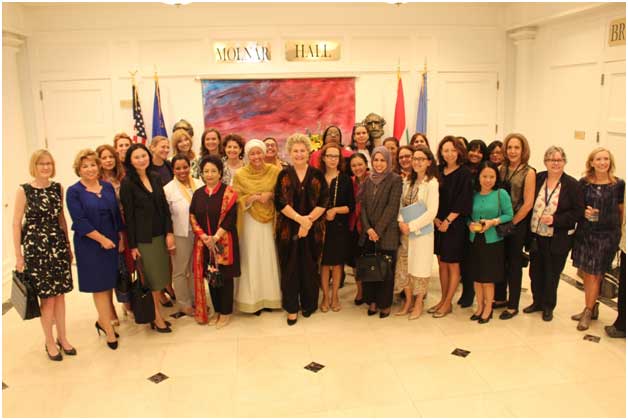
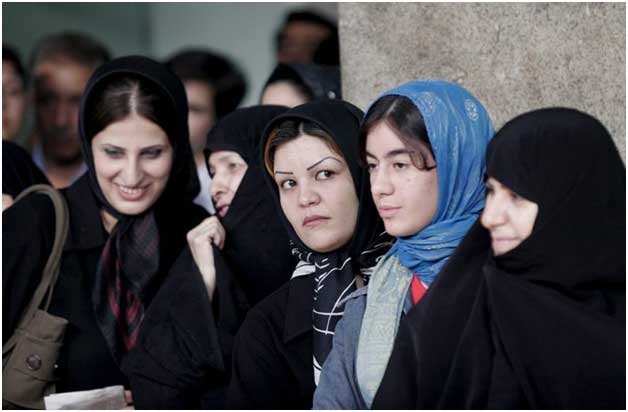
Circle of Women Ambassadors

UNITED NATIONS, Oct 8 2019 (IPS) – New York’s diplomatic community has continued to be enriched by a record number of women Permanent Representatives (PRUNs)—50 in all, as of October 2 – compared with about 15 to 20 back in the 1980s and early 1990s.


But the history-making number is still short of gender parity, falling far behind the 140 men who are PRUNs in the 193-member General Assembly, the highest policy-making body at the United Nations.

The remaining three women are designated Charge d’Affaires ad interim or acting heads of their respective diplomatic missions – and don’t hold the rank of PRUN.

https://protocol.un.org/dgacm/pls/site.nsf/files/HoM/$FILE/HeadsofMissions.pdf

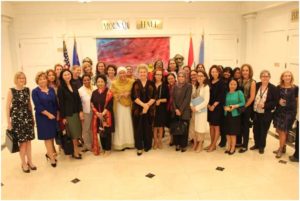
The 50 PRUNs, who are also designated as Ambassadors, are members of an exclusive association called the “Circle of Women Ambassadors”— even as the circle has steadily kept widening.

The only other glass-shattering UN event took place in September 2014 when six of the 15 members of the UN Security Council– long monopolized by men– were women.

“It’s a little strange that it’s taken us this long,” Ambassador Sylvie Lucas of Luxembourg, was quoted as saying, more than five years ago.

UN Secretary-General Antonio Guterres told delegates last week that “no country in the world is on track to attain gender equality by 2030, and women continue to be hampered by discriminatory laws, unequal access to opportunities and protections, high levels of violence, and damaging norms and attitudes.”

So, gender parity among men and women ambassadors may be a long way off.

Ambassador Anwarul K. Chowdhury, former Permanent Representative of Bangladesh, and a one-time UN Under-Secretary-General told IPS: “To me any progress which manifests equality and representation of women’s recognized engagement is welcome.”

The fact that, at the moment, the number of women Permanent Representatives to the UN at its headquarters has reached the highest point ever is a development worthy of our attention, he said.

“However, we have a long way to go even to reach the numerical equality among 193 Member States”, said Ambassador Chowdhury, the initiator of UN Security Council Resolution (UNSCR) 1325 as President of the Security Council in March 2000: a resolution that underlined the important role of women in the prevention and resolution of conflicts, and on peace negotiations and peace-building.

“In this context, I recall the Call to Action by civil society (which I proudly co-signed) for the world leaders on 25 September 2013 as they converged in New York for the General Assembly’s high level meetings urging them to take action for equality of women’s participation at all decision-making levels in four areas”, he added.

    • 1. Appointment of a woman as the next UN Secretary-General. [reality: none out of 9 Secretaries-General in 74 years of UN history]
    • 2. Nomination of Women as future Presidents of the General Assembly by the Regional Groups. [reality: only 4 out of 74 Presidents]
    • 3. Election of More Women as Heads of Various UN Governing Bodies, [reality: overwhelmingly underrepresented by women]
    4. Appointment by Member-states of More Women as Ambassadors to the UN in New York and Geneva. [reality: overwhelmingly underrepresented by women]

On all four points, the UN community needs to do much more to call it history-making, said Ambassador Chowdhury.

Kshenuka Senewiratne, Sri Lanka’s trailblazing ambassador– her country’s first female permanent representative (PRUN) in over 63 years– told IPS that gender empowerment has continued to advance in her home country, even as women outnumber men in many walks of life, and particularly in higher education.

She said this is also reflected in the Sri Lankan foreign service where women have dominated over men in open competitive exams.

“And it is possible the same trends continue in many developing nations— even as the UN tries to advance its 2030 Development Agenda where gender empowerment remains one of the priorities.”

But still, “I have yet to hear my colleagues here say that it was a concerted gesture of gender balance that they got posted to New York,” she declared.

Barbara Crossette, a former UN Bureau Chief for the New York Times, told IPS: “My initial thought is that this phenomenon of more powerful women in diplomacy is not unlike women rising on their own in politics and not just by inheriting leadership as widows, daughters or other kin of men, such as Indira Gandhi, Sirimavo Bandaranaike, Benazir Bhutto, Chandrika Kumaratunga or Cristina Fernández de Kirchner”.

She pointed out there are now more Angela Merkels, Michelle Bachelets or Elizabeth Warrens, to name only a few.

“Women are also rising in international agencies and civil society organizations, gaining expertise in global affairs, geopolitics and armed conflict, often in uniform and wearing a peacekeeper’s beret”, said Crossette, the senior consulting editor and writer for PassBlue and the United Nations correspondent for The Nation.

Asked whether more female diplomats will aid the cause of greater gender equality, she said: “ I would say, not necessarily, unless the Secretariat and missions in the field come down harder on denigrators and abusers of women. And, as Louise Frechette (a former UN deputy Secretary-General) told me in an interview, only if member states chose the most competent, outstanding women when making nominations to fill appointments in the UN system. They should be the models”, she declared.

Reinforcing his arguments further, Ambassador Chowdhury said the political significance of this increase in the number of the women Ambassadors would be that their joint actions would draw more attention, bearing, of course, in mind that all Ambassadors to the UN act generally on the basis of instructions from their respective capitals.

“But, I believe, their coalition can join hands to focus on issues particularly those directly related to women’s empowerment and equality, like Goal 5 of SDG.”

They can also ask for greater engagement of Secretary-General’s leadership in the implementation of UNSCR 1325 on women and peace and security which has made the realization of women’s equal participation at all decision-making levels obligatory on all members of the United Nations and whose 20th anniversary is coming up in October 2020, he noted.

Realizing gender parity at the senior posts of the UN, both at headquarters and at field levels, could be another area for joint effort.

“Women Ambassadors could strategize to turn this newly gained numerical enhancement into an effective coalition to attain global objectives of women’s equality and empowerment,” he argued.

Apart from this increase in the number of women Ambassadors, another encouraging development had been that three consecutive women Ambassadors have been elected as President of the Economic and Social Council (ECOSOC) in 2017 –from the Czech Republic, 2018, from St. Vincent and the Grenadines, and 2019 from Norway.

This has improved somewhat ECOSOC’s dismal record of women Presidents, he said.

Since its beginning in 1946 and all the way upto 2003, ECOSOC’s practice of electing only men was challenged by Ambassador Marjatta Rassi of Finland as its first woman President, followed by second woman in 2009 before the successive three women Presidents – a total of 5 out of 74, said Ambassador Chowdhury.

“Given the unacceptably poor women’s representation as General Assembly and ECOSOC Presidents, women Ambassadors can continue their relentless efforts to improve gender parity in high offices,” he declared.

Meanwhile, addressing a working luncheon of the Circle of Women Ambassadors last April, the former President of the General Assembly Maria Fernanda Espinosa Garces said: “At the UN too – where we should be leading by example – only a quarter of Permanent Representatives are women. Only one of the General Assembly’s main committees is chaired by a woman. I hope that we, in this Circle, can encourage our colleagues to nominate more women to leadership positions in the General Assembly, and across the UN.”

In his annual report on “The Work of the Organization” released last week, UN Secretary-General Antonio Guterres claimed the world body continues to make significant progress towards gender parity.

For the first time in the history of the United Nations, “we have achieved gender parity in the Senior Management Group and among Resident Coordinators, and are almost at parity among the senior leadership ranks across the Organization, well ahead of my target date of 2021.”

The writer can be contacted at thalifdeen@ips.org
  Source

Reforms Will Grant Nationality to Children of Iranian Women

Civil Society, Editors’ Choice, Featured, Gender, Global, Global Governance, Headlines, Human Rights, IPS UN: Inside the Glasshouse, TerraViva United Nations

Opinion

Rothna Begum is Senior Researcher, Women’s Rights Division at Human Rights Watch

GENEVA, Oct 7 2019 (IPS) – After more than a decade of women’s rights activism, Iran’s Guardian Council has finally approved an amendment that would grant Iranian citizenship to the children of Iranian women married to foreign men.


The Guardian Council was the last body needed to approve this long overdue reform to Iran’s discriminatory citizenship law.

Previously, Iran’s civil code granted children and spouses of Iranian men citizenship automatically, while children born in Iran to Iranian women and foreign fathers must live in Iran at least until they are 19 before they can apply.

It is unclear how many children in Iran have Iranian mothers and foreign fathers. However, the issue has come to prominence in recent years because of tens of thousands of registered and unregistered marriages between Iranian women and Afghan men whose children are unable to obtain citizenship on an equal basis.

Rothna Begum

Research in other countries has shown that such discrimination can harm children’s access to education, health care, housing, and employment when they become adults.

The latest attempt to reform the law was inspired by Maryam Mirzakhani, a world-renowned Iranian mathematician and Fields Medal recipient who passed away from cancer in 2017. Because her husband is not Iranian, her daughter cannot obtain Iranian nationality.

In May, Iran’s Parliament finally adopted the proposed reform, but it went back and forth from the Guardian Council, a body of 12 Islamic jurists, to determine whether it is in accordance with Iran’s Constitution and Sharia (Islamic law). They approved the amendment last week.

While this is a long-awaited victory for Iranian women, the newly-amended law does not equalize access to citizenship completely. Iranian women must apply for nationality for their children, while children of Iranian men are granted nationality automatically.

Children who turn 18 can apply for nationality themselves. A security check is required in both cases.

Most concerning is that that the amended law requires the Intelligence Ministry or the Intelligence Organization of the Islamic Revolutionary Guard Corps (IRGC) to certify that there is no “security problem” before approving citizenship in these specific applications.

This vaguely defined provision can be used to arbitrarily disqualify applicants if they or their parents are seen as critical of the government, particularly in eastern and western border areas where cross-border marriages are more common and where authorities keep a tight grip over peaceful activism.

In a matter of weeks, Iran’s newly-amended law will finally see children of Iranian women able to apply for the same benefits that children of Iranian men have.

But Iran should remove the remaining obstacles to ensure that children of Iranian citizens, whether men or women, are granted citizenship on an equal basis. They are all, after all, Iranian children.

  Source

Watchdog Pushes U.S. to Publish ‘Duty to Warn’ Khashoggi Files

Civil Society, Editors’ Choice, Featured, Global Governance, Headlines, Human Rights, IPS UN: Inside the Glasshouse, Middle East & North Africa, Press Freedom, Regional Categories, TerraViva United Nations

Press Freedom

The Committee to Protect Journalists (CPJ) seeks disclosure of files under the U.S. intelligence community’s “duty to warn” obligations, which demand officials alert folks in imminent danger. The CPJ wants to know if they knew about an assassination plot against Jamal Khashoggi. Photo by Sam McGhee on Unsplash

UNITED NATIONS, Sep 30 2019 (IPS) A media watchdog has asked United States intelligence agencies to reveal whether they knew about an assassination plot against Jamal Khashoggi and failed to warn the Saudi journalist he was in mortal danger.

A legal brief, filed in a Washington DC district court by the Committee to Protect Journalists (CPJ), comes almost exactly one year after a Saudi hit squad butchered the renegade writer inside the Saudi consulate in Istanbul on Oct. 2.

CPJ’s advocacy manager Michael DeDora told IPS that his lawsuit against the U.S. government “asks a simple question: did the intelligence community know of yet fail to warn Jamal Khashoggi of threats to his life?”

Khashoggi, a U.S.-based Washington Post columnist, who was once a royal Saudi insider and had grown critical of the regime, was reportedly lured to the Saudi consulate in Istanbul in an elaborate and brutal plot to silence him.

Khashoggi was allegedly killed, dismembered and removed from the building; his remains were never found. The CIA reportedly assessed that crown prince Mohammad bin Salman, known as MBS, had ordered the operation.

The CPJ seeks disclosure of files under the U.S. intelligence community’s “duty to warn” obligations, which demand officials alert folks in imminent danger. The brief, filed Thursday, follows the Trump administration’s rejection of a previous CPJ disclosure request.

“Nearly one year after Khashoggi’s murder, disclosure of these documents would provide transparency and help efforts to secure accountability,” DeDora told IPS in an email.

“But this lawsuit has broader implications: journalists around the world should have the security of knowing that the U.S. will not ignore threats to their lives.” 

Khashoggi’s assassination sparked global outrage, blighted MBS’ global standing and undercut his ambitions to improve the kingdom’s poor human rights record and diversify its economy away from hydrocarbons. 

Saudi officials, who initially said Khashoggi had left the consulate unharmed, now say he was killed in a rogue operation that did not involve the prince. A domestic Saudi trial of 11 suspects is widely viewed as a sham.

Speaking with IPS among a small group of journalists in New York this month, Hatice Cengiz, Khashoggi’s former fiancée, explained how she was saddened by the lack of global pressure on Riyadh to come clean about the affair.

MBS has not visited Europe or the U.S. since the murder. While the prince was briefly shunned by foreign leaders, Riyadh’s long-standing diplomatic support from the U.S., Britain and others has largely resumed.

“This silence and inertia created huge disappointment on my side,” said Cengiz. 

“Countries could have demonstrated a more honourable attitude instead of remaining silent, particularly the United Nations, the European Union and the five members of the U.N. Security Council.”

Cengiz was joined at an event on the sidelines of the U.N. General Assembly by Agnes Callamard, the U.N. rapporteur on extrajudicial, summary or arbitrary executions who investigated the killing and concluded it was a “deliberate, premeditated execution,” and called for MBS and other officials to be probed.

Callamard, a French academic, said she knew that achieving justice for Khashoggi’s murder would be an uphill struggle, given Riyadh’s deep pockets, clout in the world energy markets and powerful friends in Washington, London and elsewhere.

“This single year [since Khashoggi’s death] is just the first phase in our journey for accountability and justice. And that means that it will demand and deserve patience, resilience, and time,” said Callamard.

“Early on, I could see that justice for Jamal Khashoggi would have to be found beyond the usual path and beyond our usual understanding of accountability.”

Callamard urged the CIA to publish its files, while also calling for an FBI investigation and a public inquest in Turkey. Meanwhile, a draft U.S. law on human rights and accountability, if enacted, would unmask and sanction the culprits and send “ripple effects” towards accountability around the world.

  Source

World Summit of Nobel Peace Laureates Calls for Decisive Action, With No Time to Waste

Armed Conflicts, Civil Society, Featured, Global, Global Governance, Headlines, Human Rights, Peace, TerraViva United Nations

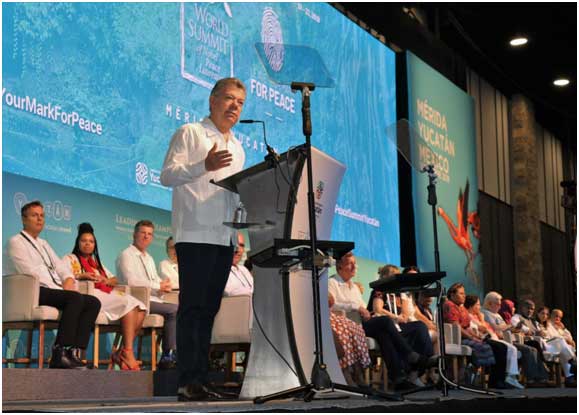
Nobel Peace Laureate and Former President of Colombia Juan Manuel Santos, opens the summit with other Laureates onstage (David Dickstein/Prose & Comms Inc.)

MERIDA, Mexico, Sep 23 2019 (IPS) – In a world of increasing fragility and declining resources, can the world foster peace? With a looming climate crisis, is war inevitable? Will nuclear war be the final result? Are women the ultimate peace builders? How do we train and engage youth to promote peace?


These are some of the questions posed during last week’s three-day World Summit of Nobel Peace Laureates in Merida, Mexico which brought together 1,200 youth and 30 Nobel Peace Laureates — individual and organizations — Juan Manuel Santos, Former President of Colombia; F.W. De Klerk, former President of South Africa; Lord David Trimble, Northern Ireland; and Lech Walesa, former President of Poland.

Women continue to claim a larger seat at the Nobel Peace table. In attendance were Rigoberta Menchu Tum for her work promoting the rights of indigenous peoples; Jody Williams, awarded for her work to eradicate landmines; Shirin Ebadi, for the struggle for women and children’s rights; Tawakkol Karman of Yemen; and Leymah Gbowee of Liberia.

A few key takeaways:
Former President of Colombia, Juan Manuel Santos, awarded a Nobel Peace Prize for work with FARC to negotiate peace and end a brutal civil war, noted positive developments at home, but said some segments are taking steps backwards.

However, he remained steadfast in his commitment to peace: “For each terrorist blinded by hate, there are millions of youth that wish to preserve it. We are not here to say everything is fine, but we are here to leave our mark for peace.”

Discussing the social and economic dimensions of peace, Nobel Laureate Jody Williams railed on the world’s grotesque amounts of income disparity, and called for a total restructuring of the world’s socioeconomic systems.

While many citizens move to massive cities — megalopolises — to access employment, education and health care, they end up encountering racism. “How do we move forward on the common good?” she asked, noting that in America alone, 57 percent of the US disposable budget is spent on the military and weapons, while only 6 percent goes to health and education.

Nobel Laureate Lord David Trimble of Northern Ireland expressed concern over several regions in the world where conflicts continue, such as the Mideast, where there are proxy wars, as well as Iran’s moves to become a hegemonic state.

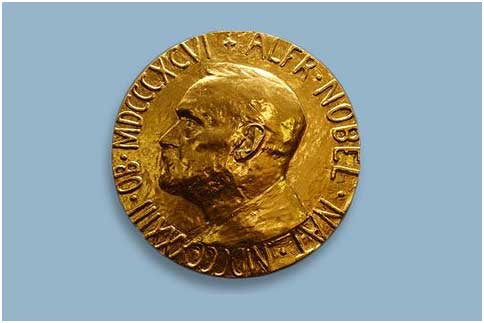
Photographic reproduction of the Nobel Peace Medal. Credit: UN Photo/John Isaac

There are dangers in the South China sea, and threats of a US-China trade war – all of it having a ripple effect, with a potential to greatly impact business and other activities.

Things are getting worse on the democracy front, according to Trimble. “It is not going as well as we would like,” he said, referring to the elections last week in Russia, where the state coerced and manufactured results, producing outcomes that were presented as democratic, but were far from it.

Highlighting the danger of technology controlled in the hands of a few mega corporations, Nobel Laureate Kailash Satyarti called for democratization of tech, and added that, the world has globalized everything, but that it needed to “globalize the compassion that exists in all of us.”

Bernice King, CEO of the King Center, and the youngest daughter of civil rights leader Martin Luther King, challenged all those who came to the summit. “ All of you have a passion to see positive change in our world. We all want peace but it has to be intentional on a daily basis,” she said. Her practical advice? Peace builders need to find an accountability partner to support them when frustrated or depressed.

King offered a message of hope: just like her father: “The only way our world is going to change, is that we have it in our hearts to be love, compassion, strength, nurturing and kindness,” she said, adding that Martin Luther King said that the children of darkness were much more determined than the children of light.

In a panel on nuclear disarmament, Jonathan Granoff, President of the Global Security Institute, and UN Representative of the Permanent Secretariat of the World Summits of Nobel Peace Laureates, posed the question: “Is it legal to annihilate the future?” Because with the power of today’s nuclear weapons, they are a quick end,” he said.

Humanity has come very close to another nuclear war but has been unbelievably lucky, according to Dr. Ira Helfand, co-chair of the Physician’s for Social Responsibility’s nuclear weapons abolition committee.

“Sooner or later our luck will run out. It is no longer a question of when there will be a nuclear war, not if there will be one,” he said, adding that youth today did not understand the enormity of the threat – greater in power and numbers. Put simply, today’s nuclear weapons can annihilate the planet in short order.

In a nod to youth’s achievements, Mohamad Al Jounde was awarded the Turner Social Change Prize, and local student Saskia Niño de Rivera was given the Leave Your Mark for Peace Award.

During closing ceremonies, delegates stated that human rights are non-negotiable. The final document, the Merida Declaration states that: “As long as basic freedoms are violated and gross corruption, violence, extreme poverty, inequality, racism, modern-day slavery and trafficking of persons, discrimination, and discrimination phobias exist, there can be no true peace. We proclaim that true peace is inseparable from the achievement of true justice.”

To learn more and watch archived panel discussions, please visit the Facebook group at World Summit of Nobel Peace Laureates. Also, The World Summit of Nobel Peace Laureates.

  Source

Hiring for Inclusion

Asia-Pacific, Civil Society, Headlines, Labour, Regional Categories, TerraViva United Nations

Opinion

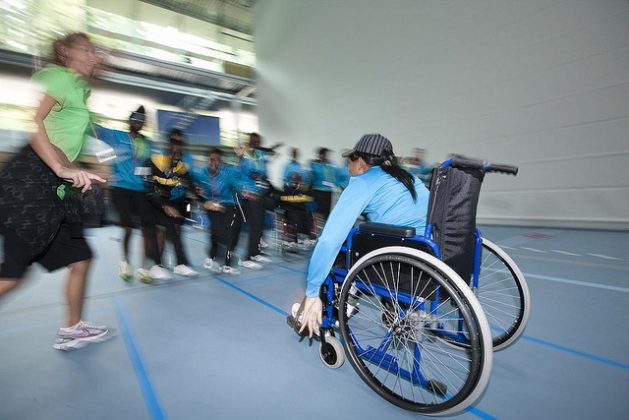
As companies begin to focus on hiring people with disabilities, we need to shape how they think and act on this interest.

Courtesy: United Nations

HYDERABAD, TELANGANA, India, Sep 20 2019 (IPS) – As companies begin to focus on hiring people with disabilities, we need to shape how they think and act on this interest.


In the first decade of this century, Andhra Pradesh had several self-help groups (SHGs)–women who were saving, borrowing, and generating livelihood opportunities for themselves as well as their communities.

As these groups grew, the government began to notice that the aspirations of children were different from their SHG-member mothers, who were mostly marginal farmers or weavers. The state felt that they needed to do something to fulfil these aspirations and from this was born the Employment Generation and Marketing Mission (EGMM)–a skilling mission under the Department of Rural Development in undivided Andhra Pradesh.

EGMM started in 2004 with a pilot–a Rural Retail Academy was set up in Warangal for youth who were 10th and 12th standard dropouts; local school teachers were taught to train them on customer-facing skills, and after six months they were ready to be placed.

Higher efficiencies, near-zero errors in an industry where margins are small–opened up almost 50,000 cashiering jobs for disabled youth in the retail sector.

Kishore Biyani of the Future Group was the first one to hire these young people, and him doing so changed the way India looked at rural youth. It made people realise that: a) you didn’t need graduates with degrees for customer service, and b) rural youth, if skilled right, could get formal private sector jobs.

Prior to the establishment of the EGMM, government skilling programmes didn’t think of job placement as something they were responsible for. All of them did skilling for skilling’s sake. Now placement has become the norm in every skilling programme offered by either the government or the private sector.

EGMM was also able to demonstrate innovation at scale. However, it’s relatively easy to achieve scale when you are sitting inside the government. When I thought of what to focus on after rural youth, it was important for me to enter a space where there wasn’t an existing model for scale, and to prove that it could be done outside of the government as well. Disability was that space.

Moving to disability

The statistics around disability are alarming–80 percent of the world’s disability population is in developing countries like India. Despite this, a decade ago, little was being done about it.

Cities with a booming IT industry like Bangalore and Delhi, had organisations training and placing disabled people in jobs, but this was limited to 30 people a year at best. And, most of them were urban and educated. However, 69 percent of the disabled youth in India live in the villages–and at the time, in 2012, nobody was focusing on less-educated rural youth with disability. 

There were many challenges

When we went to the villages, we faced several obstacles:

  • Getting youth to join: Disabled youth who lived in rural areas were doubly disadvantaged: they were cut off from the job market because of their rural location, and they (and their families) didn’t believe that they could ever get a job.
  • Finding trainers: We were also faced with a shortage of people who could train these youth. Disability is one word but within that word there are different kinds of disability–speech impaired, visually challenged, physical disabilities, and so on–and each one of them has different needs. Even when we did find trainers who could work with disabled youth–sign language instructors, for example–they were ill-equipped to train in the short-term training formats that we had developed.
  • Providing them job opportunities: Companies came with a lot of mindsets. They would ask us “Can you give us youth who look like you and me? Will it be expensive to hire and manage them? Will my other employees have a problem if I hire your youth?”

There is a gap in the urban disabled space as well

As we started working with the corporates, some multinational companies started asking us, “Where are the youth with English, the ones who are educated?” The perception is that if the disabled youth are educated, they will perhaps get jobs on their own.

However, in most cases, educated youth with disability have low skill levels. They qualify as engineers, have an engineering certificate and so their aspirations are to get into the well-known global and Indian tech companies. However, their technical knowledge is poor since colleges don’t have special educators to guide them.

The perception is that if the disabled youth are educated, they will perhaps get jobs on their own. However, in most cases, educated youth with disability have low skill levels. Picture courtesy: Rawpixel

The perception is that if the disabled youth are educated, they will perhaps get jobs on their own. However, in most cases, educated youth with disability have low skill levels. Picture courtesy: Rawpixel

The market is beginning to think about disability more actively

We are hearing companies talk about focusing on disability. So, while the timing is right, we need to shape how companies think and act on their interest.

Here are a few approaches that skilling organisations that work with disabled youth can adopt to ensure that larger numbers of corporates hire and retain these young people and that they do it in the right manner.

1. Try to place youth with disability in customer-facing roles

When they have to interact with customers, awareness about the issue of disability goes up automatically; you don’t have to work on that separately. We piloted this hypothesis by placing a speech- and hearing-impaired individual in a cashier’s job, with some simple workplace adaptations.

Three months later the retailer ran a survey to ask their customers for feedback and 95 percent of the respondents said that having ‘silent’ cashier had led to faster service. This insight–higher efficiencies, near-zero errors in an industry where margins are small–opened up almost 50,000 cashiering jobs for disabled youth in the retail sector.

2. Create a sensitive ecosphere

Hiring youth with disabilities is not just about matching profiles to jobs. We do sensitisation workshops, low cost adaptations, accessibility audits, going as far as to sync companies’ existing software to ensure that hired youth are productive. Otherwise, it merely reiterates the myth that youth with disabilities cannot work.

3. Build up jobs sector by sector

We did this with the automotive industry. We started with one company–Valeo–and hardwired all our best practices over there. More importantly, their HR director and I started talking about these innovations and the value provided by these youth at conferences and forums. As a result, 15 more auto companies started hiring disabled youth.

4. Teach portable skills and not specific job skills

Typically, skilling organisations give youth job-specific training–like say a three-day training in folding clothes. However, the danger with this approach is that if the folding clothes process stops, so does their job. It is important therefore, irrespective of the sector, to teach English, communications, and life skills–skills that they can take across jobs. This allows them to be mobile across jobs and capitalise on the opportunities available.

5. Encourage companies to measure impact

An executive from a multinational company that we at Youth4Jobs work with said that our alumni manage 75 forms a day versus their average of 45-50. Once companies experience the business case and see the results, their senior executives become champions for the programmes.

6. Prepare companies to be ready for changes in the law

It is likely that one day, a particular state might suddenly decide to make hiring of disabled youth mandatory in sync with the Right to PwD Act 2016 which speaks to the right of disabled to education and employment. And if that happens, other states will follow. It is important that companies are ready for it when it happens.

Meera Shenoy is the founder of Youth4Jobs, where she works on skilling young people with disabilities. She has been at the forefront of job-linked skilling for rural youth, tribal youth, and now youth with disabilities, at a scalable level. She was previously Executive Director, Employment Generation and Marketing Mission (EGMM), the first state government skilling mission. Meera has also consulted with the World Bank and the UNDP.

This story was originally published by India Development Review (IDR)

  Source

NYC Library Ditches Controversial Saudi Royal MBS’ Event

Active Citizens, Armed Conflicts, Civil Society, Crime & Justice, Editors’ Choice, Featured, Global Governance, Headlines, Human Rights, IPS UN: Inside the Glasshouse, Middle East & North Africa, North America, Peace, Press Freedom, Regional Categories, TerraViva United Nations

Human Rights

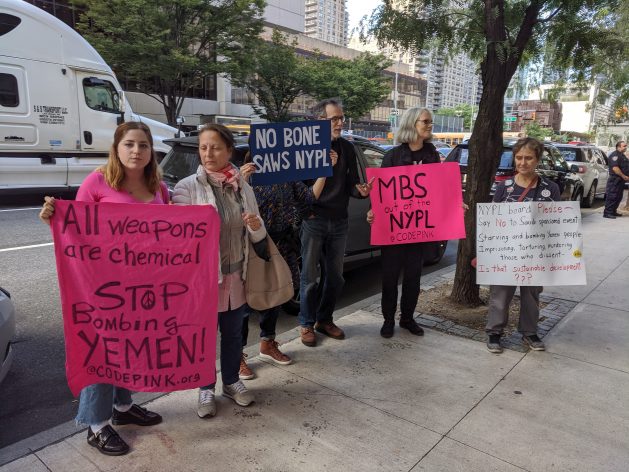
Protestors rallied outside a library building in Manhattan on Wednesday, carrying placards about Saudi Arabia’s war in Yemen and referencing the “bone saw” that was reportedly used to dismember Jamal Khashoggi, a prominent critic of Saudi prince Mohammad bin Salman. Credit: James Reinl/IPS

UNITED NATIONS, Sep 19 2019 (IPS) A New York library appeared to bow to pressure this week when it canceled an event that was being co-hosted by Saudi Arabia’s crown prince Mohammad bin Salman, who is accused of a range of human rights abuses.


On Wednesday, the New York Public Library (NYPL) said it was scrapping the so-called Misk-OSGEY Youth Forum, a workshop on Sept. 23 that was being co-hosted by bin Salman’s Misk Foundation and U.N. youth envoy Jayathma Wickramanayake. 

The event had been blasted by Human Rights Watch (HRW) and other campaign groups, who said it served to whitewash bin Salman’s reputation after the killing of Saudi journalist Jamal Khashoggi in October last year — reportedly on the crown prince’s orders. 

Evan Chesler, chairman of the NYPL board, said that dropping the workshop was the “appropriate thing to do” after weeks of protests and an online petition that had garnered more than 7,000 signatures.

In a statement, the library said it had cancelled the “space rental” amid “concerns about possible disruption to library operations as well as the safety of our patrons” amid “public concern around the event and one of its sponsors”. 

It remains unclear whether the Misk Foundation will seek an alternative venue for the workshop at short notice. A U.N. spokesman told IPS it was “up to Misk to provide information on whether the event will take place elsewhere or not”.

Saudi Arabia’s mission to the U.N. and the Misk Foundation declined to comment on the controversy.

Protestors rallied outside a library building in Manhattan on Wednesday, carrying placards about Saudi Arabia’s war in Yemen and referencing the “bone saw” that was reportedly used to dismember Khashoggi, a prominent critic of bin Salman. 

“This week’s protests show that the public will not keep quiet while the leadership of the NYPL, a treasured repository of civilisation, hires our library out to the butcherer of Khashoggi,” Matthew Zadrozny, president of the Committee to Save the New York Public Library, told IPS.

“The NYPL leadership must explain to the public it serves who signed the deal with bin Salman’s foundation and why.”

Kenneth Roth, director of HRW, blasted the “repression-whitewashing event” on Twitter and asked U.N. secretary-general Antonio Guterres to scrap the partnership between his youth envoy, Wickramanayake, and the crown prince’s charity. 

Suzanne Nossel, CEO of rights group PEN America, said the library had made the “right choice”, addiing bin Salman’s government had “orchestrated the murder and dismemberment of journalist Jamal Khashoggi”.

“Hosting this event just days before the anniversary of Jamal’s killing would have been particularly appalling not just for his family, friends, and colleagues, but also for those currently being persecuted in the kingdom.”

Nossel also noted that the library “is the crown jewel of the literary community in New York” and it stands for “free exchange of ideas and free expression, qualities that the crown prince has repeatedly disdained in both words and actions”.

The NYPL event was set to see some 300 budding young entrepreneurs learn about green themes, corporate responsibility and other parts of the U.N.’s Sustainable Development Goals (SDG) agenda.

Khashoggi, a U.S.-based journalist who frequently criticised the Saudi government, was killed and dismembered on Oct. 2 last year after visiting the Saudi consulate in Istanbul, where he collecting documents for his wedding.

The CIA assessed that bin Salman had ordered Khashoggi’s killing. U.N. expert Agnes Callamard has described the death as a “premeditated execution,” and called for bin Salman and other high-ranking Saudis to be investigated.

Officials in Riyadh, who initially said Khashoggi had left the premises unharmed, now say the journalist was killed by a rogue hit squad that did not involve bin Salman. Activists have since pushed for accountability over the killing.

  Source