YOHEI SASAKAWA, World Health Organization’s (WHO) Goodwill Ambassador for Leprosy Elimination and chairperson of The Nippon Foundation, speaks to IPS correspondent Stella Paul about his decades long campaign to achieve zero leprosy and eliminate stigmatisation of those affected.
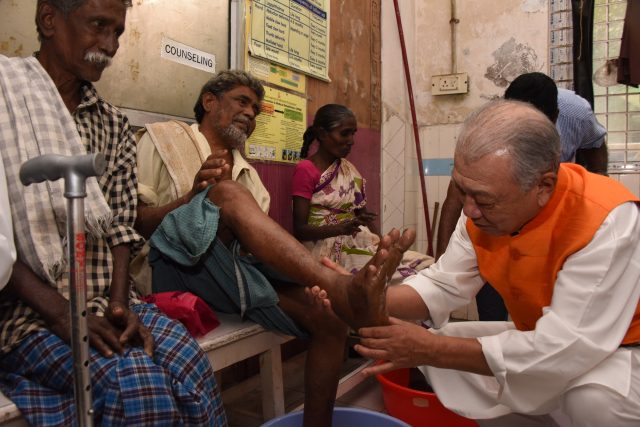
MANILA, Sep 10 2019 (IPS) – Octogenarian Yohei Sasakawa has travelled to more than 90 countries across the globe; from areas of conflict, to the jungles of Brazil, shaking hands, hugging and washing the feet of Hansen’s disease-affected people. His message is simple: Stop stigmatisation and eliminate the disease.
Sasakawa, who has spent more than 40 years working towards elimination of Hansen’s disease, is the World Health Organization’s (WHO) Goodwill Ambassador for Leprosy Elimination and chairperson of The Nippon Foundation (TNF). Since 1975, TNF and its sister organisation, the Sasakawa Health Foundation (SHF), have contributed over USD200 million in financial support for the WHO’s Global Leprosy programme. Both foundations support elimination of the disease globally and provide information and awareness about the disease through the Leprosy Today website.
Sasakawa told IPS in an exclusive interview that he does not believe in sitting in “air-conditioned rooms” looking at data and making decisions about the elimination of the disease. “That will not be helpful to people. You must go to the actual site. That is why I travel across the world — even if it’s scorching deserts or the jungles of Brazil or areas that are difficult to reach or even areas that are dangerous.”
Sasakawa, who says that discrimination and stigmatisation against people affected by Hansen’s disease was the original human rights violation, advocated for this to be included in the United Nations human rights agenda.
Yohei Sasakawa, the World Health Organization’s (WHO) Goodwill Ambassador for Leprosy Elimination and chairperson of The Nippon Foundation, has dedicated more than four decades towards eliminating Hansen’s disease and putting an end to the stigmatisation that people affected by the disease face globally. Courtesy: Sasakawa Health Foundation/The Nippon Foundation
In 2010, his efforts bore fruition when the United Nations General Assembly Resolution on elimination of discrimination against persons affected by leprosy and their family members and accompanying principle and guidelines was passed.
“If you look around us, there are multiple issues in front of us. When it comes to leprosy, people discriminating against people started in the age of the Old Testament. So it goes back a long time in our past history. So I think leprosy is the origin of human rights violation because of the fact that it started such a long time ago,” the recipient of the 2019 Order of the Rising Sun and 2018 Gandhi Peace Prize winner told IPS.
He said that 60 percent of the more than 210,000 new global leprosy cases for 2017 originated in India, adding that India’s Prime Minister Narendra Modi had made a strong commitment to make 2030 the year of zero leprosy in the country.
Sasakawa is currently in Manila, Philippines, to attend the TNF/SHF-sponsored Global Forum of People’s Organisations on Hansen’s Disease, which is being held Sept. 7 to 10. He will also deliver a keynote address at the 20th International Leprosy Congress (ILC), which takes place Sept. 11 to 13.
Through his work Sasakawa has met more than 150 national leaders, including presidents and prime ministers, sharing his message and gaining their support and commitment to eliminate leprosy.
However, he stressed, that his efforts alone would not eliminate the disease and called on the youth to “take action in their own countries” and encouraged them to begin discussions for solutions on social media platforms.
“I would definitely ask young people to join me on this journey.”
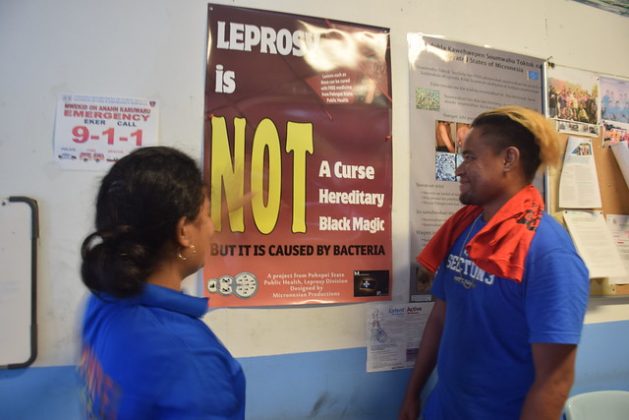
Dexter, a 25-year-old fisherman from Pohnpei in the Federated States of Micronesia, received treatment for Hansen’s disease, also known as leprosy, for over a year. He has been cured of the disease. Credit: Stella Paul/IPS
MANILA, Sep 9 2019 (IPS) – Increasing awareness of the continuing existence of Hansen’s Disease (leprosy) is critical to sustaining effective public health efforts against the disease, eliminating the social stigma associated with it, and halting its transmission.
That was the consensus reached by participants at the Global Forum of People’s Organisations on Hansen’s Disease in Manila on Sept. 9, following a lecture by Dr. Arturo Cunanan, the Chief Medical Officer of the Culion Sanitarium and General Hospital in the Philippines.The forum was organised by Japan’s Sasakawa Health Foundation (SHF) and The Nippon Foundation.
Cunanan noted that for several years, the number of new cases has plateaued at about 200,000 per year, a troubling statistic that he attributed in part to a lack of awareness among public health bodies as well as people affected by the disease.
The social stigma attached to leprosy is a barrier to early detection of the disease, which is the key to slowing its rate of transmission. Cunanan said that the average length of time between the onset of the disease and the beginning of treatment is about two years.
This happens because on the one hand, patients are unaware of medical help available to them, unwilling, or otherwise unable to seek treatment due to stigma; and on the other, a lack of expertise and resources on the part of public health departments due to a misunderstanding of the persistence of the disease.
Not a priority
“Many public health and government officials confuse elimination and eradication,” Cunanan told the forum participants. “They think that leprosy being eliminated as a public health problem means it has been eradicated, so they are surprised when they learn it still exists.”
What this has resulted in is a decline in the material and human resources available for combatting leprosy. “Leprosy will never be a priority” for government health programmes, Cunanan said. “There are more pressing problems, bigger emergencies.”
The Philippines is a good example. The disease is considered a minor problem, and the number of new cases each year is relatively low – there were 2,108 new cases in 2017, out of a national population of about 107 million – but has been relatively consistent year after year, “between 2,000 and about 3,000”.
Because of the mistaken belief that leprosy has either disappeared entirely or has become rare, medical expertise and programmes have disappeared from public health institutions. That in turn has degraded the supervision and monitoring needed to identify new cases and prevent the transmission of the disease, Cunanan explained.
Lucy Massao, a member of the Tanzania Leprosy Association (TLA), noted that the stigma and lack of understanding of leprosy among the public in her country was also reflected in the shortcomings of the public health framework.
“We at TLA really spend a lot of time trying to educate people, including the officials,” she said. “Many patients, the health officials refer to us, because they cannot offer much support except for the medications. But they are improving, through working with us.”
Role of people’s organisations
Public health authorities elsewhere are also gradually recognising the value of the organisations of people who have been affected by leprosy. “You are the best experts,” Cunanan told the forum participants, “Because you have first-hand experience.”
Organisation members can assist in early detection and outreach, Cunanan explained, and help public health authorities improve their services to leprosy patients.
In the Philippines, collaboration with people’s organisations such as Coalition of Leprosy Advocates of the Philippines has actually been included in official policy. Philippine Assistant Secretary of Health Dr. Maria Laxamana, who delivered the keynote address on the forum’s first day, noted that “intensified collaborative efforts among [government] agencies and with private partners” is a key objective of the government’s National Leprosy Control Programme.
Dr. V.R. Pemmaraju of the World Health Organisation’s (WHO) Global Leprosy Programme said that there has been a marked growth in talent and inclusiveness among people’s organisations, which is increasing their effectiveness in supporting and extending public health efforts towards leprosy.
“What we’re seeing, and you can see it at this forum, is that the groups are more global, include more women, and are more educated about the disease and the support needed,” Pemmaraju told IPS.
“This has been very good from the point of view of the WHO, because of the added social aspect of the Global Leprosy Partnership,” he explained. Where people’s organisations still need to develop is in working effectively with governments.
“They [the organisations] have the experience and knowledge about leprosy, but what I’ve seen is that most need more skills in negotiating and engaging with government officials,” Pemmaraju said. “There is still some gap in inclusion of people’s organisations in forming public health policy [related to leprosy], and developing those skills would help to reduce that.”
Pemmaraju is upbeat about the prospects of people’s organisations gaining a bigger voice in public health policy towards leprosy.
“In each of these meetings, I see the groups growing globally and gaining more influence,” Pemmaraju said. “With the engagement of the people’s organisations, we [the WHO] are optimistic that we can achieve our goal of ‘zero leprosy.’”
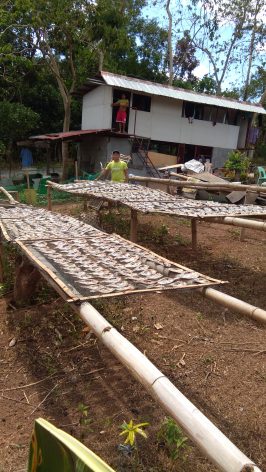
Ariel Lazarte of the Coalition of Leprosy Advocates of the Philippines (CLAP) shows off the dried fish production run by patients of a transient house operated by HD (Hope & Dignity) Philippines. Courtesy: Ariel Lazarte
MANILA, Sep 8 2019 (IPS) – Organisations supporting people affected by Hansen’s disease (leprosy) have social rather than capitalist aims, but they need to take a business-minded approach to their work if they wish to be sustainable, experts at a global conference in Manila, Philippines said.
In workshops conducted at the Global Forum of People’s Organisations on Hansen’s Disease in Manila on Saturday and Sunday, Sept. 7 and 8, representatives of organisations from Asia, Africa, and Latin America agreed that sustainability is the biggest challenge they face.
Every organisation faces some uncertainty over the continuity of donor or government financial support, so reducing or eliminating reliance on external funding is considered a critical priority.
Japan’s The Nippon Foundation (TNF) and Sasakawa Health Foundation (SHF), which sponsored the global forum and provided capacity support to the participating organisations, have long taken the view that sustainability should be the ultimate goal.
At a regional conference of people’s organisations held here in March, SHF Executive Director Dr. Takahiro Nanri stressed that his foundation’s goal was to see its beneficiaries become self-supporting. “In order to be truly sustainable, the organisation needs to develop an income-generating programme,” Nanri said at the time.
Dr. Marie Lisa Dacanay president of the Institute for Social Entrepreneurship in Asia (ISEA) outlined the fundamentals of effective social enterprises, which were derived from research conducted by ISEA in India, Indonesia, Bangladesh and the Philippines. Credit: Ben Kritz/IPS
Fundamentals of social enterprises
On Sunday Sept. 8, Dr. Marie Lisa Dacanay president of the Institute for Social Entrepreneurship in Asia (ISEA) outlined the fundamentals of effective social enterprises, which were derived from research conducted by the institute in India, Indonesia, Bangladesh and the Philippines.
Social enterprises have three common traits, Dacanay explained:
They are driven by a social mission instead of an enterprise mission;
Successful social enterprises are wealth-creating organisations that provide some form of marketable products or services; and
They follow a distributive enterprise philosophy in that profits are directed towards the social mission rather than being collected as return on investment.
In carrying out its mission, a social enterprise faces a number of external and internal challenges, Dacanay said.
External pressures come in the form of climate or environmental factors – a significant concern of agriculture-based enterprises; unfavourable government policies; harmful industry or market practises; inadequate government support for social programs; and institutional corruption.
Internal challenges include difficulty in accessing needed technology; securing initial financing; organisational and management capacity; production efficiency; and developing practical measures of the enterprise’s social impact.
Based on ISEA’s research, successful social enterprises can be organised following an entrepreneur non-profit model, a social cooperative model, a social business model, or what she described as “social entrepreneurship intervention,” which is a hybrid combining characteristics of all three models. In determining which form of organisation is most suitable to the social mission, Dacanay told IPS, “I think everything starts with the reality. Every social entrepreneur starts with, ‘what are the needs, and the problem?’”
“The first step is really understanding the stakeholders you want to help,” Dacanay continued, “find out what they are doing already, and look at what gaps there are. That, along with the resources and capabilities available, define a way of moving forward, and then the organisational form will follow.”
Social business is still business
In the Saturday workshop, Earl Parreno, the chairman of the Philippines’ Altertrade Foundation, Inc. (ATFI) conducted a training in business planning basics for the assembled people’s organisations.
Defining a social enterprise as one that pursues a triple bottom line philosophy (financial, social, and environmental results), Parreno explained that the fundamentals of business planning must still be applied, but that organisations that are made up of people who are both the providers and beneficiaries of a social mission are often handicapped by a complete lack of capacity.
“Poverty is not just lack of financial resources,” Parreno told the workshop participants in his presentation, “It’s really incapability, a lack of knowledge.”
Developing the capabilities can be an arduous process, but is achievable. One of ATFI’s areas of focus in the Philippines is among poor farmworkers in Negros Province, a centre for sugar production. Parreno described the success of the social enterprise supported by ATFI in marketing Muscovado sugar – semi-raw sugar that was at one time considered “poor man’s sugar,” but is now a premium-priced staple in organic food stores.
“The business ideation is really critical,” Parreno explained to IPS. “We have a saying here in the Philippines: gaya-gaya puta maya, which means something like ‘copycat.’” A common problem among new social enterprises, Parreno said, is a lack of originality in the revenue-generating product or service they wish to pursue.
“What we stress to our social enterprise partners is that they should not conceive a product or service that’s just better, but one that is truly different and has a ‘solidarity market,’” Parreno said, such as the market of “mindful consumers” for organic Muscovado sugar discovered by the Negros sugar farmers. “That solidarity market is so important. It really gives the people’s organisation a fighting chance.”
According to Parreno, developing a sound business plan, from business ideation through resource mapping, feasibility study, and market analysis answers one of the key concerns expressed by many of the forum participants in the post-workshop discussion: The difficulty in securing initial funding to launch a social enterprise.
“The only difference between this kind of (social) business and a conventional business is where the profits go,” Parreno explained. “The discipline and the steps that need to be taken to develop it are very much the same, and if the result is a good business plan, the investors to get it off the ground will follow.”
A poultry and dried fish production project located in Baras, Rizal Province, east of the Philippine capital, employs about 10 people, all residents of a transient house for leprosy patients. It is a good example of a social enterprise that has proved successful.
Ariel Lazarte, a member of Coalition of Leprosy Advocates of the Philippines (CLAP) who runs the social enterprise, told IPS that sales have been good enough that his out-of-pocket expenses have been fully covered by the revenue, as well as providing much-needed funding for the transient house residents. The social enterprise, part of HD (Hope and Dignity) Philippines, a non-profit managed by Lazarte, makes about 560 dollars a month.
Half of this is ploughed back into the social enterprise and the remainder is used to pay for the living expenses of the patients, including paying for medicines, transport, food, water, and vitamins. “The only outside funding we had was for [the pen for the chickens],” Lazarte told IPS, noting that the Tikkun Olam Foundation, which supports Hansen’s disease in the country, provided the funding for this.
“The residents of the house who are capable help to tend the chickens, which are layers, and produce the dried fish. We then sell the eggs and fish in the local market.”
Part of the marketing advantage the poultry project has is that the eggs are organic. “We use organic feed for the chickens,” Lazarte said. “No synthetic feed.”
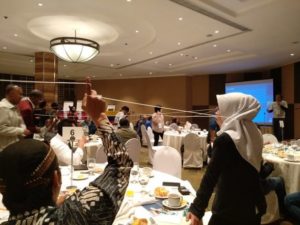
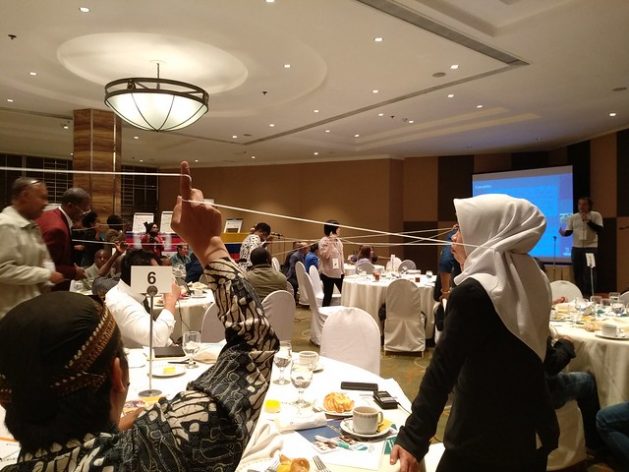
Participants at the first Global Forum of People’s Organizations on Hansen’s Disease which began on Sept. 7 in Manila, Philippines, play a game to build better connectivity among themselves. Credit: Stella Paul/IPS
MANILA, Sep 7 2019 (IPS) – Organisations of people affected by Hansen’s Disease or leprosy agree that a global network of volunteer groups is key to eradicating the disease, but concrete steps need to be taken to move the idea from an often-discussed concept to a reality.
“I don’t think anyone here is not convinced about the importance of a network,” Dr. Arturo Cunanan Medical Director of Culion Sanitarium and General Hospital told attendees following a workshop on volunteers and networking at the Global Forum of People’s Organisations on Hansen’s Disease in Manila on September 7. “But we need to put our foot forward.”
Artur Custodio Moreira de Sousa, who heads Brazil’s Movement for Reintegration of People Affected by Hansen’s Disease (MORHAN), led the workshop and firmly agreed with Cunanan’s observation, but was more upbeat.
“This forum exists because the network already exists,” Sousa said, speaking through an interpreter. “The idea exists, the network is created, the work needs to continue to solidify and formalise it.”
Sousa conducted the workshop at the forum organised by Japan’s Sasakawa Health Foundation (SHF) and The Nippon Foundation to share some ofMORHAN’s success in organising volunteers and networks in Brazil, encouraging the participating groups from Asia, Africa, and South America to consider ways in which they could contribute to an effective global network.
Making the most of volunteers
As Sousa described it, the development of a network is in a sense development of a volunteer organisation writ large. MORHAN, which was formed after the fall of Brazil’s dictatorship in 1981, is itself a network of local volunteer groups. Keeping these human resources organised and making the best use of individual talents and intentions is a significant focus area for MORHAN.
“Attracting the people (volunteers) is easy,” Sousa told the forum attendees. “Maintaining the people is very difficult.” Where MORHAN has been successful in this is by encouraging its volunteers to decide how they can contribute. “The people must be free to create,” Sousa said.
Morhan community outreach volunteer Glaucia Maricato, who was doing double duty at the forum as an English interpreter for her Portuguese-speaking colleagues, is a good example of how MORHAN uses volunteers to the best advantage for the individual and the organisation.
Maricato, an anthropologist, explained that she first was introduced to MORHAN in 2010, after the group made an agreement with a group of geneticists to reunite children who had been separated from their families due to leprosy – with either the children or the parents isolated in a sanitarium. “The idea was to use DNA testing to prove who the children’s parents were,” Maricato explained. “I was interested in the project so I got in touch with MORHAN, and then started doing fieldwork,” as the project was related to Maricato’s doctoral studies.
To Maricato, the volunteer work has far more significance than simply applying a person’s skills to a task. “MORHAN was born with democracy in Brazil [in 1981],” Maricato said. “And that spirit really carries on its work, in the DNA testing project and overall. It’s the sense of building equality, removing barriers between people.”
From local organisation to network
Organising volunteers into effective networks can greatly facilitate management of organisations and the services they provide, the chairperson of the Philippines’ Coalition of Leprosy Advocates of the Philippines (CLAP) Francisco Onde agreed.
“Our country is an archipelago, so traveling from one place to another to deal with situations is sometimes difficult,” Onde told the forum participants.
“For example, we had an issue between one of our groups and the administration of the Tala Sanitarium [located north of Manila], but we’re located in Cebu [in the central Philippines]. But through our network and our Luzon coordinator, we were able to get an attorney to assist our colleagues to resolve the problem.”
Scaling up that sort of effective communication and action to a global level is the aspiration of the people’s organisations gathered at the forum, with representatives from the various groups urging their colleagues to join the effort by applying the tools to organising volunteers discussed in the workshop. Kofi Nyarko, president of International Association for Integration, Dignity, and Economic Advancement (IDEA) Ghana stressed that the key to effective action was for people’s organisations “to first help themselves.”
“If we do this, we can do something for the public as much as the public can do something for us,” Nyarko said. “Inclusiveness is very important.”
Evidently encouraged by Cunanan’s call to not let the idea of a global network “be a talking network just within this four-cornered room,” representatives of the people’s organisations in attendance held an impromptu meeting led by Sousa and Cunanan following the workshop that ended the forum’s first day to discuss formalising efforts to create the global network, the initial details of which Cunanan told attendees he hoped would be available for presentation “at the next meeting”.
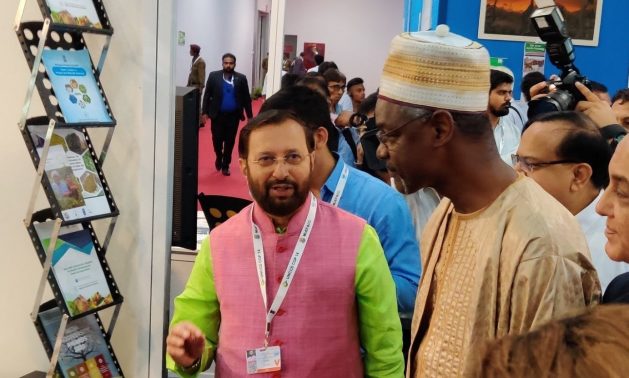
India’s minister for environment, forests and climate change, Prakash Javadekar (left), said he would be happy if CoP 14 could achieve consensus on such difficult issues as drought management and land tenure. Courtesy: Ranjit Devraj
NEW DELHI, Sep 4 2019 (IPS) – Expectations are high, perhaps too high, as the 14th Conference of the Parties (CoP 14) of the United Nations Convention to Combat Desertification (UNCCD), now into the third day of its two-week session, is being held outside the smog-filled Indian capital of New Delhi.
At the inauguration on Monday, India’s minister for environment, forests and climate change, Prakash Javadekar, soon after ceremonies to mark his taking over as president of the Convention for the next two years, said he would be happy if CoP 14 could achieve consensus on such difficult issues as drought management and land tenure.
Other issues on the agenda of CoP14, themed ‘Restore land, Sustain future’ and located in Greater Noida, in northern Uttar Pradesh state, include negotiations over consumption and production flows that have a bearing on agriculture and urbanisation, restoration of ecosystems and dealing with climate change.
The IPCC report covered interlinked, overlapping issues that are at the core of CoP14 deliberations — climate, change, desertification, and degradation, sustainable land management, food security and greenhouse gas fluxes in terrestrial ecosystems.
“Sustainable land management can contribute to reducing the negative impacts of multiple stressors, including climate change, on ecosystems and societies,” the IPCC report said. It also identified land use change as the largest driver of biodiversity loss and as having the greatest impact on the environment.
Javadekar said he saw hope in the fact that of the 196 parties to the Convention 122, including some of the most populous like Brazil, China, India, Nigeria, Russia and South Africa have agreed to make the U.N. Sustainable Development Goal of achieving land degradation neutrality (LDN) targets by 2030 as national objectives.
But the difficulty of seeing results on the ground can be gauged from India’s own difficult situation. Nearly 30 percent of India’s 328 million hectares, supporting 1.3 billion people, has become degraded through deforestation, over-cultivation, soil-erosion and wetland depletion, according to a satellite survey conducted in 2016 by the Indian Space Research Organisation.
A study, conducted last year by The Energy and Resource Institute (TERI), an independent think-tank based in New Delhi, estimates India’s losses from land degradation and change in land use to be worth 47 billion dollars in 2014—2015.
The question before CoP14 is how participating countries can slow down loss of land and along with it biodiversity threatening to impact 3.2 billion people across the world. “Three out of every four hectares have been altered from their natural states and the productivity of one every four hectares of land has been declining,” according to UNCCD.
Running in parallel to CoP14 is the 14th session of UNCCD’s committee on science and technology (CST14), a subsidiary body with stated objectives — estimating soil organic carbon lost as a result of land degradation, addressing the ‘land-drought nexus’ through land-based interventions and translating available science into policy options for participating countries.
On Tuesday, as CoP4 launched into substantive business, the participants at the CST and other subsidiary bodies began to voice real apprehensions and demands.
Bhutan representing the Asia Pacific group, highlighted the need for cooperation at all levels to disseminate and translate identified technologies and knowledge into direct benefits for local land users.
Bangladesh pointed out that LDN targets are sometimes linked to transboundary water resources and also called for mobilising additional resources for capacity building.
Colombia, speaking for the Latin America and Caribbean group, appreciated the value of research by the scientific panels, but urged introduction of improved technologies and mitigation strategies to reduce the direct impacts of drought on ecosystems, starting with soil degradation.
Russia, on behalf of Central and Eastern Europe, mooted the establishment of technical centres in the region to support the generation of scientific evidence to prevent and manage droughts, sustainable use of forests and peatlands and monitoring of sand and dust storms.
Civil society organisations, led by the Cape Town-based Environmental Monitoring Group, were also critical of the UNCCD for putting too much emphasis on LDN and demanded optimisation of land use through practical solutions that would ensure that carbon is retained in the soil.
“Retaining carbon in the soil is of particular value to India and its neighbouring countries, which presently have the world’s greatest rainwater runoffs into the sea,” says Himanshu Thakkar, coordinator, South Asia Network on Dams, Rivers and People (SANDRP), a New Delhi based NGO, working on the water and environment sectors.
“What South Asian countries need to do urgently is to improve the rainwater harvesting so as to recharge groundwater aquifers and local water bodies in a given catchment so that water is available in the post-monsoon period that increasingly see severe droughts,” Thakkar tells IPS. “This is where governments can be supportive.”
Benefits such as preventing soil degradation and consequent landslides that have become a common feature in South India, Sri Lanka and Bangladesh.
A study published in May said half of the area around 16 of India’s 24 major river basins is facing droughts due to lowered soil moisture levels while at least a third of its 18 river basins has become non-resilient to vegetation droughts.
Responding to the suggestions and demands the Secretariat highlighted recommendations to ensure mainstreaming of LDN targets in national strategies and action programmes, partnerships on science-policy to increase awareness and understanding of LDN and collaborations to assess finance and capacity development needs.
In all, the delegates, who include 90 ministers and more than 7,000 participants drawn from among government officials, civil society and the scientific community from the 197 parties will thrash out 30 decision texts and draw up action plans to strengthen land-use policies and address emerging threats such as droughts, forest fires, dust storms and forced migration.
“The agenda shows that governments have come to CoP14 ready to find solutions to many difficult, knotty and emerging policy issues,” said Thiaw at the inaugural session. The conference ends with the parties signing a ‘New Delhi Declaration’ outlining actions to meet UNCCD goals for 2018-2030.
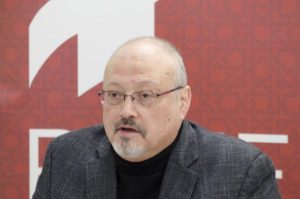
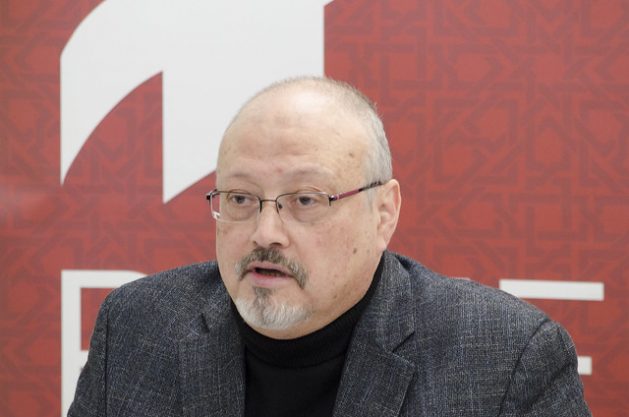
Jamal Kahshoggi, a US-based journalist who frequently criticised the Saudi government, was killed while visiting the Saudi consulate in Istanbul, where he was collecting papers for his wedding. Courtesy: POMED/CC by 2.0
UNITED NATIONS, Sep 4 2019 (IPS) – The United Nations is under growing pressure to scrap an event it is co-hosting with the private foundation of Saudi Arabia’s crown prince Mohammad bin Salman, who has been linked to the killing of journalist Jamal Khashoggi.
On Tuesday, Sunjeev Bery, director of Freedom Forward, became the latest leader of a campaign group to press the U.N. to cancel the Sept. 23 event, saying it would help repair bin Salman’s reputation over the Khashoggi murder.
The event, known as the Misk-OSGEY Youth Forum, is a partnership between the U.N.’s youth envoy, Jayathma Wickramanayake, and the Misk Foundation, a culture and education foundation chaired by bin Salman, who is better known as MBS.
“No one — especially not the U.N. — should be partnering with MBS or his personal Misk Foundation,” Bery told IPS.
“Saudi Arabia’s brutal crown prince is responsible for the deaths of thousands of Yemeni children. His thugs imprisoned leading women’s rights activists and murdered Jamal Khashoggi.”
Kenneth Roth, the director of Human Rights Watch, a campaign group, last week accused the world body of helping to “whitewash” MBS’s record; Mandeep Tiwana, from Civicus, a rights group, called the event “disturbing”.
Why is the UN helping the Saudi crown prince whitewash his record by co-hosting a conference with a foundation he leads just a year after the murder of Jamal Khashoggi? https://t.co/r65LWZWN0Jpic.twitter.com/7C8LoV4MTb
The U.N. youth envoy’s office declined to comment on the row. U.N. spokesman Stephane Dujarric said the world body had repeatedly issued “very strong statements … calling for accountability” in Khashoggi’s killing.
The Misk-OSGEY Youth Forum will take place in New York only 10 days before the first anniversary of Khashoggi’s murder on Oct. 2 last year, when Saudi government agents killed and dismembered the journalist inside the country’s consulate in Istanbul.
The CIA later determined that MBS had personally ordered the hit. Saudi officials, who initially said Khashoggi had left the consulate alive, now say the journalist was killed in a rogue operation that did not involve MBS.
Saudi Arabia’s mission to the U.N. did not answer requests for comment from IPS.
The four-hour workshop for 300 young people at the New York Public Library will occur on the sidelines of the U.N. General Assembly and promote green themes, corporate responsibility and other aspects of the U.N.’s Sustainable Development Goal (SDG) agenda.
It will feature Alexandra Cousteau, an environmentalist and granddaughter of French explorer Jacques-Yves Cousteau; and Bart Houlahan, an entrepreneur who promotes sustainable business practices.
Other speakers include Andrew Corbett, an expert on entrepreneurship at Babson College, Paul Polman, former CEO of consumer goods firm Unilever, and Ann Rosenberg, an author and U.N. technology expert.
Dr. Reem Bint Mansour Al-Saud, a Saudi princess and an envoy to U.N. headquarters in New York, who advocates for empowering women and development in the Gulf kingdom, will also speak at the workshop.
Khashoggi, a United States-based journalist who frequently criticised the Saudi government, was killed while visiting the Saudi consulate in Istanbul, where he was collecting papers for his wedding.
U.N. expert Agnes Callamard issued a report in June that described the assassination as a “deliberate, premeditated execution,” and called for MBS and other Saudi officials to be probed.
The Misk-OSGEY Youth Forum comes after years of tensions between the U.N. and Riyadh over the war in Yemen, where Saudi Arabia is leading a military coalition against the country’s Houthi rebels.
The conflict has killed tens of thousands of people and caused led to a major humanitarian crisis.
“The crown prince and his violent government must be held accountable for their human rights crimes,” said Bery, who advocates for the U.S. to cut ties with Saudi Arabia and other authoritarian regimes.
“Instead, misguided U.N. staff are absurdly giving the crown prince a public relations platform as he attempts to wipe away the blood of so many dead Yemeni children.”