ATLANTA, USA, Nov 11 2024 (IPS) – For religious, humanitarian, and scientific reasons, Israel’s increasingly apparent plan for the de facto colonization of the Northern Gaza Strip is a bad idea. When that program was rejected recently by Israel’s own Defense Minister Yoav Galant, he was summarily fired by Prime Minister Netanyahu.
However, the founding document of the worldwide Jewish community, the Torah, and especially the Decalogue, states plainly, “Thou shalt not covet thy neighbor’s wife…or anything that is thy neighbors.” If religion still means anything to people in the modern nation of Israel, it should be clear that whatever belongs to others should be left alone and neither coveted nor stolen.
For obvious humanitarian reasons the one-sided bombing of Gaza must stop. After more than a year of an ongoing holocaust in Gaza, Israel’s relentless bombing has produced casualties totaling nearly 150,000 dead and wounded people, mostly civilians.
Now with UN sources reporting that starvation is setting in, people everywhere must demand that this racist, inhumane bloodshed stop immediately. Otherwise, international law has no force and the word “humane” has no meaning.
In scientific terms, the contamination of the water, soil, and air in northern Gaza from explosive dust, including Depleted Uranium, will clearly persist for decades, if not generations. That is neither good for the inhabitants if they manage to return to their homes, nor for the Jewish colonists if they should return to their previous colonies in the strip.
US bombing of Iraq two decades ago, especially in and around Basra, as much scientific and eyewitness testimony—including my own on the scene report—proves, has produced a plethora of birth defects.
The idea of some capitalists that Gaza will become a future Dubai—a wealthy trade zone that will be a veritable Las Vegas on the Mediterranean shore—is actually a good one. Geographically and commercially, Gaza is a potential Hong Kong.
The only thing wrong with the plan is the question of who will control this mighty future entrepot, the Palestinians, investors from the Gulf States and the West, or Israel? Answering that will take another century of bloodletting.
Far better that the United States, NATO, the United Nations, the International Court of Justice in the Hague or somebody other than HAMAS or the extreme right wing and increasingly bloodthirsty Likud government now in power in Jerusalem should deal with that issue and guarantee justice.
The ICJ/International Court of Justice, responsible governments everywhere, and especially the campus protesters and those on the streets of cities around the world, must keep chanting, “NO JUSTICE, NO PEACE!” “NO JUSTICE, NO PEACE!”
James E. Jennings, PhD is President of Conscience International and Executive Director of US Academics for Peace
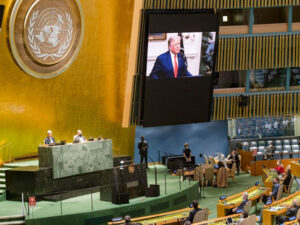
Donald J. Trump, President of the United States of America, addresses the General Debate of the General Assembly’s 75th session September 2020. Credit: UN Photo/Rick Bajornas
NEW YORK, Nov 8 2024 (IPS) – On the day following the US election, UN Secretary General, Antonio Guterres issued a brief statement commending the people of the United States for their active participation in the democratic process. He wisely omitted to mention that the election of Donald J. Trump – who attempted to overturn the people’s mandate by inciting an insurrection in 2020 – is a major setback for the UN’s worldwide quest to advance human rights and the rule of law.
Trump is a self-avowed admirer of authoritarian strongmen like Russia’s Vladimir Putin and Hungary’s Viktor Orban who disdain international norms that the UN seeks to uphold. Unsurprisingly, questions posed to the UN Secretary General’s spokesperson, Stéphane Dujarric, in a press conference on November 6, ranged from what will be Trump’s response to the war in Ukraine to potential funding cuts that might come with the new US administration to whether the UN has contingency plans ready for when Trump takes office.
The US plays an outsized role in global affairs. Therefore, any changes in policy in Washington impact the whole world. As someone who bears responsibility for stewarding a global civil society alliance, it worries me what a second Trump presidency will unleash.
Even without Trump in power we are living in a world where wars are being conducted with complete disregard for the rules; corrupt billionaires are dictating public policy for their benefit; and greed induced environmental degradation is putting us on a path to climate catastrophe. Hard fought gains on gender justice are in danger of being rolled back.
The first Trump administration showed disdain for the UN Human Rights Council and pulled the US out of vital global commitments such as the Paris Agreement to combat climate change. It restricted support for civil society groups around the world and targeted those that sought to promote sexual and reproductive rights of women. Promotion of democracy and human rights are key pillars of US foreign policy.
It’s deeply concerning that when disinformation and misinformation have assumed pandemic level proportions, the majority of the US electorate have cast their vote in favour of a candidate who ran his campaign on divisive dog whistles, half-truths and outright lies. These tactics have deepened fissures in an already polarized United States.
Families countrywide were left devastated by Trump’s negligence and COVID denialism as president which resulted in tens of thousands of Americans dying of avoidable infections. His administration’s immigration detention and deportation policies instilled fear in minority communities. This time Trump has vowed to deport millions of people.
Trump’s stances on abortion rights have caused women immeasurable suffering in several US states that have introduced laws to ban the procedure. He has promised to accelerate harmful fossil fuel extraction and undoubtedly views gender justice advocates, environmental defenders and migrant rights activists as a threat his power.
Given the stated predilections of Trump and his advisors, opposition politicians, activists and journalists exposing corruption and rights violations are likely to be at risk of enhanced surveillance, intimidation and persecution by the new administration.
At the international level, Trump’s election casts a pall over efforts to ensure accountability for war crimes, crimes against humanity and genocidal actions in the Occupied Palestinian Territories, Sudan and Ukraine due to his tacit support for authoritarian leaders in Israel, Russia and the United Arab Emirates, all of whom are fueling conflicts and causing havoc abroad. A future Trump administration could try to starve the UN of funding to erode the rules based international order, emboldening autocrats.
Even if things appear bleak today, it’s important to remember that there are hundreds and thousands of civil society activists and organisations around the world who remain steadfast in their resolve to celebrate diversity and promote justice and equality. To imagine the future we sometimes have to take heart from the past.
India’s freedom struggle, South Africa’s struggle against apartheid and the civil rights movement in the United States wasn’t won by authoritarian leaders but by brave and determined individuals united in solidarity and determined to resist oppression for as long as it takes.
There is a lesson here for civil society in the US that higher American ideals are worth standing up for and will outlive any sitting president.
Mandeep S. Tiwana is Interim Co-Secretary General of CIVICUS, the global civil society alliance. He also serves as CIVICUS representative to the United Nations.
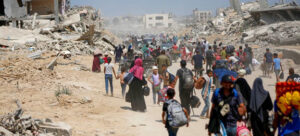
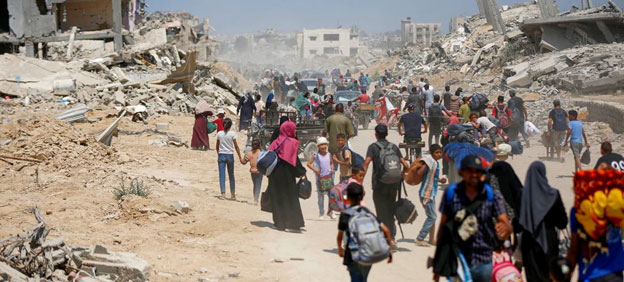
In Khan Younis, thousands of people are fleeing for their lives again. Credit: UNRWA
UNITED NATIONS, Nov 8 2024 (IPS) – When the United Nations imposes sanctions or penalizes a member state – be it the General Assembly or the Human Rights Council – the resolutions are “non-binding” and often remain unimplemented.
But the Security Council resolutions are “binding” – and still openly violated by countries such as North Korea—because all these UN bodies have no means of implementing these resolutions, nor a standing army to forcibly enforce them. But they only carry moral weight.
The Council can also impose its own sanctions, mostly in economic, financial and trade sectors, against violators of its decisions.
And last week there was a move to impose arms sanctions against Israel – and rightly so, judging by the 43,000 plus, mostly Palestinian civilians, killed in Gaza largely with US-supplied weapons since October last year.
But how effective will this be since the strongest opposition will come from the US, an unyielding supporter of Israel, which will unhesitatingly use its veto power if the resolution comes before the Security Council?
Ambassador Anwarul K. Chowdhury, a former UN Under-Secretary-General and one-time Permanent Representative of Bangladesh to the United Nations, told IPS anything short of a real, permanent ceasefire would not create a pathway to end the perpetration of the ongoing genocidal aggression by Israel.
In this context, he said, the joint letter calling on all countries to stop the sale of arms and ammunition to Israel, signed by 52 countries and two UN-recognized multilateral organizations, is meaningfully forward-looking, and contains a purposeful objective of contributing to that “pathway”.
In fact, the Foreign Minister of Turkiye, whose country initiated the letter, asserted that “We must repeat at every opportunity that selling arms to Israel means participating in its genocide.”
“It would be argued rightfully that the United Nations and its apex body, the General Assembly have no powers to enforce such an arms embargo. The Security Council, the sole UN entity which can authorize an arms embargo and obligate the arms suppliers desist from sending arms to the areas of conflict, also becomes powerless if one of the P-5 uses the notorious veto”.
“However, I strongly believe that a General Assembly resolution following the call for the arms embargo to Israel would have a moral value which has its own merit. Despite the politics and power-play which is destroying the UN’s credibility and marginalizing its operational capacity to resolve conflicts, the arms embargo would highlight the principled position taken by the UN,” said Ambassador Chowdhury.
In a way, he pointed out, that would strengthen the Secretary-General’s efforts to promote the much-needed ceasefire.
In the aftermath of Israel’s declaration of the Secretary General as persona non-grata (PNG) and its extension of the attacks on UNIFIL in Lebanon, the General Assembly needs to show that its moral and normative role as envisaged in the UN Charter has not been cowed down by the politics of the frequently-used threat of veto, he declared.
Stephen Zunes, Professor of Politics and International Studies at the University of San Francisco, who has written extensively on the politics of the Security Council, told IPS: “This initiative reflects the view of the vast majority of the world’s governments and peoples and is consistent with imperatives of international humanitarian law, but given that the major arms supplier of Israel is a veto-wielding permanent member of the Security Council, it is unlikely to have much of an impact.”
Also problematic, he pointed out, is that some of the countries sponsoring the initiative, such as Russia and Saudi Arabia, have been guilty not only of similarly providing weapons to those engaging in war crimes but engaging in war crimes themselves.
Turkiye’s foreign minister Hakan Fidan said last week his country had submitted a letter to the United Nations, signed by 52 countries and two inter-governmental organizations, calling for a halt in arms deliveries to Israel.
“We have written a joint letter calling on all countries to stop the sale of arms and ammunition to Israel. We delivered this letter, which has 54 signatories, to the UN on November 1,” said Fidan, according to the Times of Israel.
“We must repeat at every opportunity that selling arms to Israel means participating in its genocide,” said Fidan, adding that the letter is “an initiative launched by Turkiye.”
Among the signatories were Saudi Arabia, Brazil, Algeria, China, Iran and Russia, plus the Arab League and the Organization of Islamic Cooperation (OIC),
Elaborating further, Ambassador Chowdhury said the UN should not forget that the UN’s International Court of Justice which determined that Israel’s occupation of the Gaza Strip and West Bank is illegal under international law. The judgment was followed by a General Assembly resolution last September, demanding Israel leave the occupied territories within a year.
“I am encouraged by the UN’s own 45 Human Rights Experts and Special Rapporteurs, who, driven by their conscience, forcefully called for a ‘permanent ceasefire, … an ‘arms embargo on all warring parties,’ and ‘the deployment of an international protective presence in the occupied Palestinian territory under the supervision of the UN.’ All these well-thought-out measures would only promote dialogue and diplomacy over death and destruction”.
The UN Secretary-General needs to endorse and welcome this call by his in-house experts and recommend to the General Assembly to do the same without any delay, he declared.
Back in April 2024, in a resolution adopted by 28 votes in favour, six against and 13 abstentions, the 47-member Human Rights Council backed a call “to cease the sale, transfer and diversion of arms, munitions and other military equipment to Israel, the occupying Power…to prevent further violations of international humanitarian law and violations and abuses of human rights”.
Presented by Pakistan on behalf of the Organization of Islamic Cooperation, delegates heard that the resolution had also been motivated by the need to stop “egregious” human rights violations in the Occupied Palestinian Territory.
Co-sponsors of the text included Bolivia, Cuba and the State of Palestine, ahead of the vote which saw support from more than two dozen countries including Brazil, China, Luxembourg, Malaysia and South Africa, according to UN News.
Unlike the UN Security Council, Human Rights Council resolutions are not legally binding on States but carry significant moral weight, and in this instance is intended to increase diplomatic pressure on Israel as well as potentially influence national policy decisions.
Israel’s two largest arms sources, the United States and Germany, have resisted calls for an embargo on Israel, though each has been accused of withholding certain arms during the war.
In an October 2024 report, the Stockholm International Peace Institute (SIPRI) said in the past decade, Israel has greatly increased its imports of arms. SIPRI estimates that in the five-year period 2019–23, Israel was the world’s 15th largest importer of major arms, accounting for 2.1 per cent of global arms imports in the period. In 2009–13 it ranked only 47th.
Although only three countries supplied major arms to Israel in 2019–23, the United States, Germany and Italy, many others supplied military components, ammunition or services. The three other global major arms exporters among the top 10: the United Kingdom, France and Spain.
Forum of Arab Parliamentarians on Population and Development met in Bahrain to to address water scarcity. Credit: APDA
MANAMA & NAIROBI, Nov 7 2024 (IPS) – The Arab region is among the most water-scarce areas globally, as nearly 392 million people live in countries facing water scarcity or absolute water scarcity. So dire is the situation that, of the 22 Arab countries, 19 fall below the annual threshold for water scarcity in renewable resources, defined as 1,000 cubic meters per person.
Worst still, 13 countries fall below the absolute water scarcity threshold of 500 cubic meters per person per year. Water scarcity in the Arab region poses a serious challenge, threatening the achievement of Sustainable Development Goals and the realization of the fundamental human right to access water and sanitation.
It is within this context that the Forum of Arab Parliamentarians on Population and Development, in collaboration with the Asian Population and Development Association in Japan and with support from the United Nations Population Fund, held a meeting on October 26, 2024, in the Kingdom of Bahrain to address water scarcity as a development concern and promote coordinated action across different sectors.
Dr. Mohamed Al-Samadi, Secretary-General of the Forum of Arab Parliamentarians on Population and Development, stressed the need for coordinated governance and measures to close the gap between water security and the Sustainable Development Goals. The gathering that included Bahraini parliamentarians from committees focused on population and development, along with representatives from civil society organizations, experts, academics, and government officials.
The gathering reiterated that “researchers in the field of water science have set the water poverty line at 500 cubic meters per person annually, while 1,000 cubic meters of freshwater per person is considered the threshold for achieving water security. Reports also link this to food security, showing that producing an individual’s annual food supply requires over 2,000 cubic meters of water.
Lawmakers and experts stressed the need for coordinated governance and measures to close the gap between water security and the Sustainable Development Goals. Credit: APDA
Stressing that the “water security in the Arab world is now critically at stake as annual usable water resources fall below 40 billion cubic meters. A large portion of these resources is lost to evaporation and infiltration into the soil, and additional amounts are necessary to sustain river flows to their endpoints. Any country that uses 40 percent or more of its total annual water resources is considered to be facing severe water scarcity according to the Water Scarcity Index, also known as the Water Sustainability Index.”
Dr. Muneer Ibrahim, a Member of Parliament and member of the Committee on Water, Environment, and Public Utilities, spoke about water security and the SDGs, emphasizing that water is the fundamental pillar for achieving these global goals across their economic, social, and environmental dimensions, as water security is an essential requirement for their realization.
Further stressing that the relationship between water and sustainable development is reciprocal, and this interconnectedness poses significant challenges in the Arab region, especially given the current water situation. Necessitating the development and implementation of effective policies and solutions to ensure sustainable water resources for various uses.
Hassan Ibrahim, a Member of Parliament and the rapporteur for the Water Committee, spoke about innovation for sustainable water management, highlighting that resolving the water crisis is essential for a livable future on our planet. Noting that whether water is overly abundant, severely scarce, or highly polluted, it presents a triple threat exacerbated by climate change, depriving billions of people of access to clean, safe water and sanitation services.
He said that this then “threatens economies, encourages migration, and may fuel conflict. We need global action to establish water security to enable inclusive and resilient green growth while addressing the interconnected relationship between water, climate, and conflict. Despite the progress made, we are falling behind in achieving the SDGs related to water, which directly affect inclusive development.”
Current trends indicate that by 2030, 1.6 billion people will lack access to safe drinking water, 2.8 billion will be deprived of safe sanitation services, and 1.9 billion will be without basic hygiene facilities. Globally, the investment needs for the water sector exceed USD 1.37 trillion and must increase sixfold from current levels to meet the sixth SDG on ensuring availability and sustainable management of water and sanitation for all by 2030.
“Water accounts for less than 2 percent of public spending, and private investment levels in this sector are also low in low- and middle-income countries. Bahrain has adopted strategies and initiatives to improve the management of water resources, support the strategic water stock, and increase the area and sustainability of rainwater harvesting efficiency to enhance natural groundwater resources,” Ibrahim said.
Bahrain is implementing advanced technical solutions to utilize treated wastewater for irrigation needs, which also helps reduce environmental pollution, address the impacts of climate change, and minimize the depletion of natural water resources. Bahrain, through the Water Security Strategy 2030 launched by the Ministry of Energy and Environment, aims to ensure the sustainability and continuity of access to water under both normal conditions and extreme emergencies.
The key targets of the strategy include reducing total water resource demand by 21 percent, increasing the water productivity index to USD 110 per cubic meter, lowering the water scarcity index by three degrees, and raising the percentage of treated water reuse to 95 percent. Dr. Walid Zubari, a water resources expert and president of the Arab Water Association, presented on the vital role of civil society institutions in raising water awareness to achieve water sustainability and address the challenges facing the water sector in Bahrain.
Regarding civil society institutions, Dr. Zubari said, “It is important for them to play a role in water awareness. Once community members understand the implications of their behavior in dealing with water and there is a religious and moral incentive, it is likely that they will voluntarily rationalize their water usage. If this happens, the community and the executors will be in the same boat, enabling them to achieve water sustainability.”
Dr. Karim Rashid, Member of Parliament, delivered a comprehensive presentation on the importance of water and its essential role in supporting sustainable development, as water impacts all aspects of development and is closely linked to nearly every SDG, driving economic growth, supporting healthy ecosystems, and being essential for life itself.
Still, nearly two billion people worldwide lack access to safely managed drinking water services, while around 3.6 billion suffer from inadequate sanitation services. To enable effective climate change adaptation, he said activities should reflect the importance of water management in reducing vulnerability to risks and building resilience against climate change.
Further emphasizing the necessity of political commitment and leadership, technological innovations, and the advancement of service delivery models and financing to support governments in fulfilling their commitment to achieve Target 6.2 of the SDGs—”to ensure access for all to adequate and equitable sanitation and hygiene services by 2030.”
The expert and water sector advisor at the Ministry of Water in the Kingdom of Bahrain, Eng. Mohammed Sawar, called for adopting a model transformation in the management of water resources in the GCC countries, shifting from the current focus on “supply sustainability” to “consumption sustainability.” Emphasizing economic efficiency in water usage and financial sustainability of water services.
Note: This meeting was supported by the Asian Population and Development Association (APDA), the United Nations Population Fund (UNFPA) and the Japan Trust Fund (JTF).
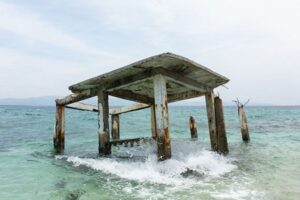
Submerged structure in Tubigon, Philippines. Credit: Greenpeace
In the Philippines, a group of islands is rapidly sinking due to an unprecedented rise in sea levels. This blog dives into how these coastal communities are utilizing marine resources and ecosystems to find solutions and build resilience against climate risks.
KUALA LUMPUR, Malaysia, Nov 6 2024 (IPS) – Imagine living with water up to your knees for half of the year, where homes are flooded, and people constantly fear that the sea might one day engulf the town and everyone in it.
This is the reality for the sinking islands in the Philippines—a cluster of four island barangays in Tubigon located in the south-central region of Bohol. Here, the sea level is rising at an alarming rate of 10.8 millimeters per year, three times faster than the global average. If this continues, these islands could disappear by 2100.
Tubigon sank by one meter after being hit by a 7.2 magnitude earthquake over a decade ago. While still recovering, the islands were devastated by a super typhoon in 2021, unleashing four-meter-high tidal waves that destroyed over 1.7 million homes and displaced more than 3 million people. This year, the islands were declared inhabitable by the government.
Existential Climate Threats to Coastal Communities
Coastal communities like the Philippines are severely threatened by accelerating sea level rise compounded by extreme weather events. Similar to small island developing states, also known as SIDS, low-lying coastal areas are the most vulnerable to climate change.
Their geographic location leaves them highly-exposed to natural disasters and hazards like cyclones and tidal flooding. These vulnerabilities exacerbate coastal communities’ unique development challenges.
The Intergovernmental Panel on Climate Change (IPCC) reports that with the current 1.5 degree temperature increase, global sea levels will continue to rise and low-lying coastal regions are to experience extreme sea events such as storm surges and massive tides annually by 2050.
SIDS, including Tuvalu and the Maldives, along with the sinking islands of Tubigon, are proof of the existential threats of climate change. These communities are at risk of vanishing unless urgent action is taken.
Bouncing Back from Climate Risks
While island communities are under threat, they are not powerless. Many of them have shown commitment to addressing climate-related risks in their national climate action plans. Their goal is to build climate resilience.
The term “resilience” is often mentioned in climate change discussions, but what does it really mean? It comes from the Latin verb resilire, meaning “to bounce back.” Resilience refers to the ability to recover from risks, which, in the context of climate change, is determined by the degree of vulnerability and exposure to climate-related threats.
For coastal communities and low-lying islands, rising sea levels pose a significant risk, so they must build resilience to endure and recover from climate-related hazards and disasters.
Turning to Blue Carbon Ecosystems for Solutions
Many SIDS set a good example in piloting measures to build resilience and adapt to the impacts of climate change. Similarly, the residents of Tubigon, many of whom are fisherfolks, have learned to adapt to the rising tides.
The local community has developed resilience strategies and initiatives to help them sustain their lives on the islands. One promising solution involves utilizing the sea and its resources, part of what is called the blue carbon ecosystem.
Blue carbon ecosystem is a collective term for natural marine resources such as mangroves, seagrasses, and marshes known for their ability to capture and store carbon dioxide from the atmosphere. Research shows that these coastal resources can transfer and store carbon ten times more effective than tropical forests.
These ecosystems also support fishery production, protect shorelines and reduce flooding, and provide habitats for wildlife and migratory species. Studies indicate that conserving blue carbon ecosystems is a timely and cost-effective strategy to help coastal communities adapt to climate change.
Harnessing Coastal Resources for Climate Change Adaptation
Tubigon and the Bohol region have long implemented measures to protect their blue carbon ecosystems, helping residents adapt to climate-related risks. Their strategy is two-fold: eliminating destructive fishing practices and conserving coastal resources particularly mangroves.
The local community has designated bantay dagat (which translates literally to sea protectors) to patrol its marine area spanning 156 hectares of coral reefs and 335 hectares of mangroves. These protectors report illegal fishing activities and safeguard the mangrove forests.
Over time, many locals have transitioned from destructive fishing methods, such as dynamite and cyanide use, to more sustainable aquaculture and alternative livelihoods, including crab and squid jigging, grouper farming, and ecotourism.
Moreover, particular focus is given to mangrove conservation. The vast mangrove area in Tubigon is considered a valuable blue ecosystem resource playing an important role in sequestering carbon. Experts estimate that a 4-decade mangrove plantation can store over 370 tons of carbon per hectare.
Additionally, mangroves act as natural seawalls, reducing wave energy and shielding residents from rising sea levels and tidal flooding. By investing in the preservation of blue carbon ecosystems, coastal communities like Tubigon tap into an essential resource that supports their livelihoods and enhances their resilience to the effects of climate change.
Turning the Tide
The islands of Tubigon stay afloat amidst the intensifying battle against climate threats. Most recently, the Philippines joined an alliance to build the resilience of coastal communities. It was also selected as the host of a fund dedicated to supporting countries to respond to loss and damage, enabling them to recover and rebuild from the adverse effects of the climate crisis.
Allowing islands to sink and entire communities to disappear is unimaginable, especially when we have the resources and tools to address the planet’s most significant crisis. Time is running out, but there is still hope to turn the tide.
This article is originally published in Global Dev as part of its Climate Resilience series.
Anne Cortez is a communications and knowledge management consultant with over a decade of experience working with governments, academic institutions, and international organizations including the UN, ADB, and The Asia Foundation. She has spearheaded and managed development programs and capacity building initiatives promoting climate action, digital inclusion, and health equity across Asia and the Pacific. Previously, she led the knowledge and communications team at the UN think tank for global health based in Malaysia, and the social mobilization division at the Department of Education in the Philippines. Anne has a master’s degree in international studies and an undergraduate degree in communications. Learn more about her work here.
Small-scale fishers on the coast of Kerela, India with a variety of fish and prawns. Credit: Aishwarya Bajpai/IPS
CALI, Columbia & DELHI, Nov 5 2024 (IPS) – Small-scale fishers play a fundamental role in feeding people—they use sustainable methods of catching and processing fish products and are a significant force in the employment and livelihoods of millions of people internationally—yet, until now, they have been excluded from climate and biodiversity conferences.
For the first time at COP 16, which closed in Cali, Colombia, on November 1, fishworkers, the most vulnerable small-scale fishers communicated that they seek active participation in decision-making processes that affect the oceans. It seems their message was heard because before the negotiations were suspended, parties adopted a historic decision to open the door for Indigenous Peoples and local communities to influence the global plan to halt the destruction of biodiversity.
Small-scale fisheries provide essential employment and sustenance across the globe, as highlighted in the Illuminating Hidden Harvests: The Contributions of Small-Scale Fisheries to Sustainable Development report (2023). Based on data from 78 national household surveys, around 60.2 million people were employed part- or full-time along the small-scale fishing value chain in 2016, representing nearly 90 percent of all global employment in the industry.
Of these, 27.5 million worked directly in harvesting, with 14.6 million engaged in inland and 12.9 million in marine fisheries. Women play a central role in small-scale fisheries, making up 35 percent of the workforce (around 20.9 million) and almost half (49.8 percent) of those in post-harvest roles.
Conference of the Parties to the Convention on Biological Diversity, fisherpeople conference held in Cali, Columbia. Credit: Aishwarya Bajpai/IPS.
This sector supports 113 million workers, who, along with their 378.7 million household members, make up a community of 491.7 million people reliant on these fisheries. Together, they represent 6.6 percent of the world’s population and 13.2 percent of those living in the 45 least developed countries. Despite the scale of their contributions, small-scale fishworkers remain among the most vulnerable populations.
These communities face entrenched poverty and social hardships, exacerbated by multiple challenges.
Environmental shifts—such as changing ecological cycles, biodiversity loss, fish diseases, and habitat degradation—disrupt their resources and directly impact their livelihoods. Economic pressures, including the modernization of fisheries, Blue Economy infrastructure projects, and port construction, threaten to marginalize these communities further.
Minfer Pervez, a Colombian fishworker speaking at a press conference in Cali, put it succinctly:
“I represent small-scale fishers. We face displacement and violations of our rights—the right to dignified work, access to social security, health services, and economic resources to strengthen small-scale fishing communities. We are also exploited due to pollution and hydrocarbons in the sea. Today, we call for a unified government position that includes us in decision-making and participation because we are key to conservation efforts.”
And it was clear these issues were faced by small-scale fishers around the globe.
A fish worker from Madina, Colombia, said the threats faced were often from mining and similar industries.
“The main threat we face is the proliferation of extractive industries, which intrude into our areas and damage the coastal system. This jeopardizes the productivity of fisher people and threatens food security. Governance must be returned to and entrusted to small-scale fishers and communities.”
Alfonso Simon from Panama added that declarations were often imposed upon them without their involvement or consent.
When asked about human rights in the context of small-scale representatives, a fisher from Panama who identified herself as Marta explained: “Our rights are violated when decisions are made without prior consultation or citizenship recognition. We are forcefully displaced, and when our families migrate from fishing areas, we lose not only our physical space but also our cultural identity, customs, and future. Denying us access to the sea and the right to fish, which is our ancestral practice, undermines both our food security and that of others (who do not fish). We feel vulnerable because decisions are made without considering the voices of our people. Small-scale fishers must be part of decision-making processes.”
On society, conservation, and development, Zoila Bustamante from Chile said, “Representing a geographical point on Earth, we must be heard. We are not only representing this region but also millions of small-scale fishers globally. We feed you, and it is important for you to listen to us. We represent several countries, and goal 23, which pertains to artisanal fishing, is being addressed. We want to be involved in drafting policies and decisions about us, not have others speak on our behalf.”
German Hernander from Honduras, speaking for 2 million fisher people, explained, “We are well organized and want our voices heard at the UN and other global platforms. We don’t want others speaking for us because we know our territories best and are better equipped to take part in global events and activities.”
Small-scale fishers are key to conservation, Eduardo Mercado from Panama said.
“We represent fisher people around the world and use ancestral fishing methods, including nets that do not damage the environment. We avoid fishing species that are reproducing and only fish for what we eat. Sadly, small-scale fishing is coming to an end.”
Aaron Chacon from Costa Rica added, “As artisanal fishermen, I believe we are here to pass the torch to the next generation. The future of artisanal fishing lies with young people, and this is an opportunity for us to preserve our culture and protect it for future generations.”
Libia Arcinieges from Colombia explained that this went beyond the seas.
“On behalf of fishworkers, we call on governments to respect and return our fishing territories. This is vital for the sustainability of water bodies and food sovereignty. Rivers and lagoons feed the world, and continental territories support 500 million people.”
Despite the acknowledgement of huge challenges, there was also an understanding that COP16 had opened doors.
“We must celebrate COP 16 because, for the first time, we have a platform to raise our voices. Conservation begins in rural territories. Real conservation is done by people, and it is necessary to guarantee food security. We must ensure good species management and work towards the 2030 goals. We deserve the proper treatment for our efforts in achieving these goals. Conservation cannot coexist with hunger,” said Luis Perez from Colombia.
This was crucial because Indigenous people and small-scale fishers look after the earth; their practices are sustainable.
“Conservation is the result of nature’s use and management by Indigenous people and small-scale fishers. It is not something that comes after the fact but is embedded in our practices. Problems cannot be solved by megaprojects. Evidence shows that the best conservation is done at the local level, and it is managed by Indigenous and local communities. We must not shy away from discussing this. We have a strong relationship with our territories, and our governance capacities lead to real conservation results,” Albert Chan from Mexico’s Maya Community said.
The fishworkers were emphatic—their representation may have been ignored until now, but they would continue to ensure their voices were heard. Their voices at COP16 underscore the determination of small-scale fishworkers worldwide to claim their place in global decision-making forums—a place where they have historically been absent, despite their role as the ocean’s frontline stewards.
Through their collective call for active participation, respect for territorial rights, and recognition of their contribution to sustainable fisheries, they have highlighted the urgent need for inclusive and equitable governance of ocean resources.
The conference ended with the saying, ‘Artisanal fishing is here to stay, and from now on, we will participate in all events, one way or another!’
The voices at COP 16 underscore the determination of small-scale fishworkers worldwide to claim their place in global decision-making forums—a place where they have historically been absent, despite their role as the ocean’s frontline stewards. Through their collective call for active participation, respect for territorial rights, and recognition of their contribution to sustainable fisheries, they have spotlighted the urgent need for inclusive and equitable governance of ocean resources.
As the world confronts the intersecting crises of climate change, biodiversity loss, and food insecurity, it is clear that the sustainable practices and ancestral knowledge held by small-scale fishers and Indigenous communities are indispensable to conservation and global food security.
Their call is not just for policy inclusion but for a fundamental shift that respects their lived realities, cultural heritage, and essential role in preserving marine ecosystems. With this historic milestone, small-scale fishers have opened a new chapter of advocacy that seeks not only acknowledgment but also partnership in building a sustainable and resilient future for the oceans and the communities that depend on them.
IPS UN Bureau Report
IPS UN Bureau, IPS UN Bureau Report, Cali, Columbia, COP16,