COVID-19 & Human Health Risks Linked to Wildlife Trade Practices

Civil Society, Economy & Trade, Featured, Global, Headlines, Health, Humanitarian Emergencies, TerraViva United Nations

Opinion

Steven Broad is Executive Director, TRAFFIC, the Wildlife Trade Monitoring Network
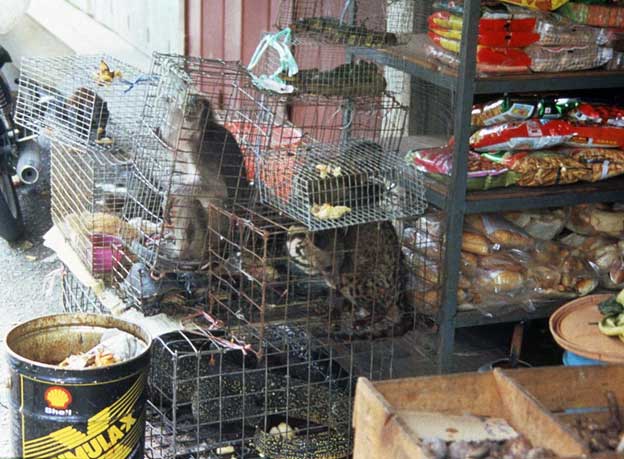
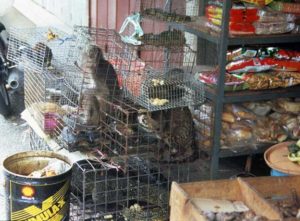
An animal market in Indonesia. Credit: TRAFFIC

CAMBRIDGE, UK, May 7 2020 (IPS) – At the time of writing, the COVID-19 pandemic is raging worldwide, causing human mortality and socio-economic disruption on a massive scale and it appears highly likely that profound impacts will continue for many years to come.


Although the precise origins of the disease remain unproven, there are strong indications of a wild animal source and a direct link to wildlife trade in China.

Even if evidence points elsewhere in future, the magnitude of the current outbreak places under an intense spotlight concerns raised by zoonotic disease experts over many decades about human health risks linked to wild animal trade in the increasingly inter-connected global economy.

As calls for new health-focused restrictions on wildlife trade have increased in volume in response to the current pandemic, some countries have taken immediate action. Building on immediate emergency restrictions placed on wildlife markets in January 2020, China is implementing a long-term prohibition on trade and consumption of wild animals for food as a public health protection measure.

Viet Nam is also considering new health-focused market restrictions and Gabon has introduced new species-specific trade restrictions. Looking ahead, there is a critical need to improve understanding of what sort of interventions might make the biggest difference in reducing risks of zoonotic disease emergence.

However, it is also important to work out how such actions might best complement, rather than conflict with, the range of existing conservation-focused wildlife trade regulation and management measures that are already struggling to contain over-exploitation of nature by people.

Zoonotic disease risks have not been wholly ignored before now. Many countries have live animal quarantine requirements and other rules governing the cross-border movement of meat, fish and other animal products.

Similarly, production, trade and use of live animals and products are subject to animal and human health regulations within domestic markets of most countries. However, such measures are typically designed primarily to address trade and consumption of domesticated species, the volume and value of which vastly exceed wild animal business.

As a result, the provisions of such regulations are seldom tailored to the specific dynamics and risks of the trade in wild animals.

Design of new interventions should be based on evidence-based assessment of disease-related vulnerabilities in current wild animal trade chains. Based on study of past cases, experts point to heightened risks of zoonotic disease spillover in places where large numbers of stressed live animals of different species (wild or domesticated) and people are in close proximity, such as transport hubs, holding facilities and markets.

However, there remains considerable uncertainty about differentiation of risk levels between different wild animal species (or species groups) and about the likelihood of transmission from different wild animal parts and products.
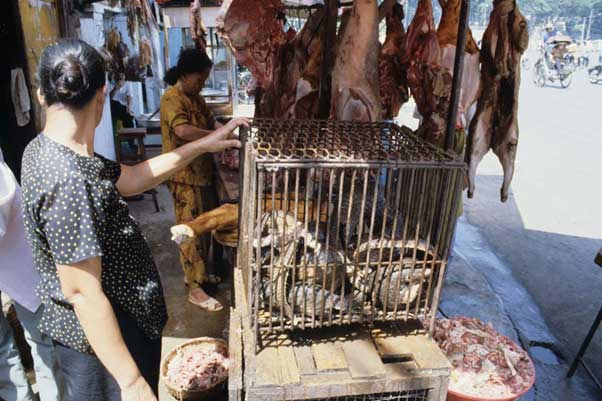
Credit: TRAFFIC

There is a wide range of options for future intervention based on assessment of such risks. Prohibitions on trade and consumption of certain species or products could be warranted. This would likely require new or modified national legislation in many countries, as most current restrictions are explicitly justified by conservation threat levels and jurisdiction is often limited to import/export controls only.

Such measures would of course face the same challenges that undermine existing wildlife trade laws: enforcement is inconsistent, often under-resourced, undermined by criminality and corruption, and given insufficient priority by governments. Risky trade may simply continue through illicit markets.

It is possible that the greatest benefit might come from changes in management practices for holding, trade and processing wild animals in trade. These might include regulatory or voluntary private sector measures aimed to improve animal husbandry, increase separation between species in trade, enhance sanitation at holding facilities and improve personal protection for workers.

These measures may again require modification of existing animal and human health legislation, but there is considerable practical experience from the domesticated animal sector that could be applied to this challenge.

Despite the clear imperative for action provided by the tragic impacts of the COVID-19 pandemic, it will be critical to ensure that remedial restrictions on wildlife commerce are tailored to achieve specific risk reduction goals and designed to take into account potential negative impacts on social equity, livelihoods, and indirect conservation impacts.

Such measures also need to be set in the context of other zoonotic disease pathways and risk factors that need careful attention, such as land-use change, domestic livestock management practices and other human/wildlife interactions.

It is also vital that amidst the urgent need to reduce zoonotic disease threats from wildlife trade, the ongoing drive to address over-exploitation threats to wildlife does not lose momentum. It is of course possible that new health-focused restrictions on wild animal trade and increased scrutiny of wildlife commerce more generally owing to its likely connection with the pandemic may reinforce conservation-focused action.

However, trade in what may be identified as higher risk sectors, such as that of live wild mammals and birds, makes up a small proportion of the global wildlife trade. The greatest over-exploitation threats are faced by marine species and the biggest wildlife trade flows are of timber and other wild plant products.

There is additional cause for concern that socio-economic impacts of the COVID-19 pandemic may be driving new trends in wildlife trade patterns that need careful attention. Past disease outbreaks linked to wild meat trade have led to increased demands for marine fish and there is already evidence of greater attention to wild plant-based medicinal treatments and tonics.

Although some illegal wildlife trade flows may now be suppressed by transport interruptions and retail market closures, there is every likelihood that criminal syndicates will move fast to rebuild illicit businesses and exploit diversion of government enforcement resources to other priorities.

A new focus on human health risks linked to wildlife trade practices is certainly warranted as a component of wider thought and action on the relationship between people and nature as the COVID-19 epidemic persists.

The response should be targeted, appropriate to the task and its design grounded in experience gained from past wildlife trade interventions. In the same way that human and environmental health are intimately connected, it is essential that new health-focused wildlife trade interventions are considered in concert with those already focused on conservation gain.

The “super-year for biodiversity” may have been delayed, but the imperative for conservation action remains.

An abridged version of the article appeared in the April issue of the TRAFFIC Bulletin, available for download at: https://www.traffic.org/site/assets/files/12779/bulletin-32_1-final-web.pdf
  Source

World’s Poor Hit by Double Jeopardy: a Deadly Virus & a Devastating Debt Burden

Civil Society, Economy & Trade, Featured, Global, Headlines, Health, Human Rights, Humanitarian Emergencies, Inequity, TerraViva United Nations

Credit: UNFPA

UNITED NATIONS, May 7 2020 (IPS) – The world’s poorer nations, reeling under an unrelenting attack on their fragile economies by the COVID-19 pandemic, have suffered an equally deadly body blow: being buried under heavy debt burdens.


Abiy Ahmed, prime minister of Ethiopia who was awarded the Nobel Peace Prize in 2019, said last week that in 2019, 64 countries, nearly half of them in sub-Saharan Africa, spent more on servicing external debt than on health.

Ethiopia alone, he said, spends twice as much on paying off external debt as on health. “We spend 47 percent of our merchandise export revenue on debt servicing”, he wrote in an oped piece in the New York Times.

According to the UK-based Jubilee Debt Campaign, some of the countries battling debt burdens include Lebanon, which spends about 41% of its revenue on debt service; El Salvador, which spends 38% of its revenues on debt service; and South Sudan, which spends 29%.

And these are not necessarily the most highly-indebted poor countries in the world — Sri Lanka pays 48% of its revenue in debt service, and Angola 43%.

On April 15, the Group of 20 countries (G20) offered temporary relief to some of the world’s lowest-income countries by suspending debt repayments until the end of the year.

But, regrettably, their best offer fell far short of expectations.

Secretary-General Antonio Guterres has called for a “debt standstill” across all developing countries affected by debt vulnerabilities. This includes external public and commercial debt.

“The private sector’s voluntary and well-coordinated engagement in debt relief discussions is crucial”, he adds.

In 2020, “we expect to lose the equivalent of more than 300 million jobs; a decline in global trade between 13 and 32 per cent; remittance flows to low‐ and middle‐income countries to drop by around 20 per cent; and foreign direct investment to decline by 35 per cent,” the United Nations warned last week.

Clemence Landers, a Policy Fellow at the Washington-based Center for Global Development (CGD), told IPS the G20 bilateral debt suspension is a good start, but it’s only a temporary stopgap measure.

In the months ahead, she pointed out, it will be clear that some countries need deeper and more permanent relief.

“The global community should use this time to establish the broad contours of an orderly debt relief process that distributes the burden equitably between all bilateral and commercial creditors”.

In parallel, argued Landers, the international financial institutions should find ways to deploy financing packages above levels that they have already announced to ensure that net flows to countries are robust. But an effective and orderly process is far from a given.

“It will largely hinge on the G20’s ability to provide an ambitious plan and maintain strong political pressure to achieve a coordinated approach,” she declared.

Professor Kunal Sen, Director United Nations University– World Institute for Development Economics Research (UNU-WIDER), told IPS the recent announcement by the governments of the G20 countries of a debt moratorium for the poorest countries is a welcome initiative as it allows these countries to allocate the funds that would have gone to service external debt to deal with the immediate needs of the pandemic.

According to Jubilee Debt Campaign, the suspension covers debt payments by 77 countries to G20 and other governments, from 1 May to the end of 2020, estimated to be $12 billion.

The payments will not be cancelled but come due to be paid between 2022 and 2024, along with interest accrued in the meantime. There will be a review by the G20 before the end of 2020 as to whether further action will be taken.

The G20 announcement also calls on private creditors to similarly suspend debt payments, and calls on multilateral creditors to explore options for doing so.

The G20 members are Argentina, Australia, Brazil, Canada, China, France, Germany, India, Indonesia, Italy, Japan, Mexico, Republic of Korea, Russia, Saudi Arabia, South Africa, Turkey, the United Kingdom, the United States and the European Union (EU).

The Ethiopian Prime Minister said at the very least, the suspension of debt payments should last not just until the end of 2020 but rather until well after the pandemic is truly over.

“It should involve not just debt suspension but debt cancellation. Global creditors need to waive both official bilateral and commercial debt for low-income countries,” he declared.

Richard Ponzio, Senior Fellow and Director of the Stimson Center’s Just Security 2020 Program, told IPS the G20 Finance Ministers wisely agreed on a ‘time-bound suspension of debt service payments’, between now and the end of the year, for 77 of the world’s poorest countries.

“Now it’s time for private creditors, who are owed USD $3 billion (or a quarter of total debt), to step up and participate in this initiative,” he noted.

Since the COVID-19 pandemic continues to affect countries in different ways, once they begin to transition from the current emergency to a full recovery phase, the G20 should revisit the need to sustain this policy, in 2021 and 2022, on a country-by-country basis, with the goal of helping all countries adversely affected by the pandemic to get back-up on their feet, Ponzio declared.

Anuradha Mittal, Executive Director at the Oakland Institute, a leading US-based policy think tank, told IPS the Covid-19 pandemic has unleashed a crisis of untold proportions – the disastrous impact of which is being felt by the poorest and poor nations.

According to the World Bank itself, COVID has pushed about 40-60 million people into extreme poverty, with best estimate being 49 million.

Bank’s projections suggest that Sub-Saharan Africa will be the region hit hardest in terms of increased extreme poverty, she said.

“At such a time, an inclusive bailout requires that united global response should ensure a just recovery and transition to a better future for those most in need.”

She pointed out that Central African Republic has just three ventilators, Sierra Leone has 13, Liberia has three, South Sudan has four.

Mittal said developing countries should be boosting healthcare systems to defend against the virus and protecting their economies and the poor, instead of using precious resources to pay off external debt, which anyway never benefitted the communities.

“These loans were often generated for so called “development” projects which have failed to bring development to the countries or populations that were intended to benefit”.

At this time, she argued, it is pertinent to cancel bilateral, multilateral and private debt for this year and instead, emergency additional finance should be provided. This time also calls for real negotiations around debt cancellation.

Above all, it is important to ensure removal of loan leverage to open up markets and force reforms such as the opening of land markets in Ukraine. Loan programs intended to control economies and natural resources have to stop, said Mittal.

Sarah-Jayne Clifton, Director of Jubilee Debt Campaign said the G20 offer is a first step in dealing with the magnitude of the coronavirus debt crisis, but much more needs to be done.

The G20 deal keeps vital money in countries for now, but today’s suspension will soon become tomorrow’s debt crisis unless payments are cancelled in full.

“We urgently need a UN-led process to cancel external debt owed to all creditors, for all countries in crisis,” said Clifton.

“The suspension of debt payments to private creditors is only voluntary. The UK and New York can make sure it happens by introducing emergency legislation to prevent any lender suing a country for stopping debt payments during the current crisis”.

Otherwise, she argued, “the real beneficiaries of today’s deal could be rich speculators who keep being paid thanks to debt suspensions by other lenders.”

Meanwhile, several Asian countries, including Sri Lanka, India, Pakistan, Bangladesh and the Philippines, have taken a severe beating primarily because of a sharp fall in migrant earnings resulting from the closure of industries and construction work in the Middle East and Gulf nations due to COVID-19.

According to the New York Times, millions of Indians who work in the Arab world — particularly in the oil-rich countries of the Gulf — have lost their jobs in recent weeks as Arab economies have contracted under lockdown.

“We have been getting distress calls from the Gulf,” said Mahesh Kumar, a spokesman for India’s foreign ministry.

The Times said Indian media have reported more than 150,000 Indians in the United Arab Emirates requesting to be evacuated — and that several large naval warships have already been dispatched to the UAE and the Maldives.

The writer can be contacted at thalifdeen@ips.org

  Source

Financial Scams Rise as Coronavirus Hits Developing Countries

Civil Society, Economy & Trade, Featured, Global, Headlines, Health, Human Rights, Humanitarian Emergencies, Inequity, TerraViva United Nations

Opinion

David Medine is Senior Financial Sector Specialist at the Consultative Group to Assist the Poor (CGAP). He is also CGAP’s lead on data protection and security and works to develop novel, consumer-oriented approaches to data protection and to encourage the creation of cyber security resource centers for developing countries.

Credit: County of Los Angeles

WASHINGTON DC, May 5 2020 (IPS) – In the Philippines, Peru, India, Kenya, South Africa and many other developing countries, poor people who are already struggling with the health impact of the coronavirus pandemic have been targeted by online fraudsters trying to take unfair advantage of them.


There is the risk that these scams could undermine confidence in digital technologies that are proving so very important in keeping people informed and connected during the pandemic.

In particular, trust in digital financial services, which have been useful in advancing financial inclusion efforts, could be damaged at the very time that they have proven to be an effective means of getting payments to poor people quickly and efficiently.

Here are some examples of virus-related scams:

phishing

    • attack is offering housebound people in India a free Netflix subscription during the lockdown if they click on a survey link and forward the message to 10 WhatsApp users.
    • • Emails with suspicious links have also been sent purporting to be from the World Health Organization, United Nations and Centers for Disease Control and Prevention.

Scammers

    • have been visiting homes in South Africa to “recall” banknotes and coins they say are contaminated with the coronavirus, providing receipts for “clean” cash that is never delivered.

Fake

    • offers of emergency money for essentials have been reported in India.
    • • INTERPOL

warns

    • that criminals have been calling victims pretending to be clinic or hospital officials, reporting that a relative has fallen sick with the virus and requesting payments for medical treatment.
    • • People desperate to protect themselves are falling for offers of

fake

    • medical products, such as masks, vaccines and

testing kits

    • Education and COVID-19: UN helps children continue their learning

There have even been false claims that the coronavirus is related to exposure to new technologies (such as 5G, which can be used to deliver money mobiles services). There are measures authorities can take in response to better protect consumers.

Regulators, providers and consumer protection agencies can alert people to the risks; providers can make sure they have adequate consumer complaint mechanisms in place; and law enforcement can coordinate firm action, not only in country but across borders.

Credit: United Nations

Preying on vulnerable populations in developing countries at a time of crisis is unconscionable. A multi-pronged effort is needed to protect more people from becoming victimized at a time when many are struggling with lost income as a result of being forced to stay at home to combat the illness.

A concerted effort by the public and private sectors is needed to protect customers through educational efforts and high visibility law enforcement actions.

In the short term, education is key, and governments are often best positioned to take the lead. For instance, the South African Banking Risk Information Centre (Sabric) has been warning bank customers about criminals exploiting the virus to engage in phishing.

Similarly, the Philippines Department of Information and Communications Technology has asked Filipinos to be mindful of their safety online and to be wary of unverified COVID-19 websites or applications that require consumers to provide their personal data.

There is a need for governments to continue to identify consumer protection threats — initially, by reaching out to banks, microfinance institutions, fintechs, NGOs and other entities to find out what they are seeing in their markets. Efforts should then be made to warn people how to identify potential scams.

The Central Bank of South Africa has stated that neither banknotes nor coins have been withdrawn from circulation, so anyone offering to “recall” currency should be met with a skeptical eye.

While there is a natural instinct to provide financial support for friends and family in need of medical care, it is important to follow INTERPOL’s warning and confirm that unknown callers are really acting on their behalf. Such consumer warnings could be sent via SMS, WhatsApp or along with other governmental communications.

The private sector must also play a critical role in protecting consumers during the crisis. In the course of providing financial services, trusted firms can educate customers about how to avoid pitfalls, such as responding to fraudulent communications.

There is also the need for digital financial services companies to have effective consumer complaint and resolution centers so that customers who have been scammed have some recourse.

Prosecuting digital scam artists promptly and meting out harsh punishments will send a strong message. One recent example is the response to a brazen attempt by a fraudster in India purporting to sell the world’s tallest statue, the Statue of Unity, for $4 billion to raise money for the Gujarat state to fund its fight against coronavirus.

This action led the Indian police to lodge a case. Similarly, Indian police have registered cases against fake offers of discounted Jio and Netflix services. Such enforcement actions help further educate members of the public about protecting themselves against fraudulent actors.

In the connected world in which we live, it is often easier to commit fraud across borders than inside one’s own country. There is no better time than now for governments to work with their neighbors and go after criminals in each other’s countries.

Such an effort has been led by INTERPOL, an inter-governmental organization with 194 member countries, including many developing countries. INTERPOL has been receiving information from member countries on a near-daily basis regarding coronavirus fraud cases, along with requests to help stop fraudulent payments.

While targeted victims have been primarily located in Asia, criminals have used bank accounts in other regions such as Europe. INTERPOL has helped national authorities to block some of the payments, assisting with some 30 COVID-19 related fraud scam cases.

Where cooperative agreements between countries do not exist, perhaps a silver lining of the current crisis would be to promote such cross-border consumer protection efforts.

Collectively, we can combat the outrageous attempts by some to take advantage of this crisis for their financial benefit. Of course, to survive many people will need more medical and financial help, not just tips on how to avoid scams.

Many countries have undertaken wide-ranging relief efforts. Digital financial services, such as mobile money, are proven mechanisms for getting financial aid quickly to the poorest and neediest in times of crisis.

Let’s take steps now to ensure digital technology is used as a force for good.

  Source

Impact of COVID-19 on Tourism in Small Island Developing States

Civil Society, Development & Aid, Economy & Trade, Featured, Global, Headlines, Health, Human Rights, Humanitarian Emergencies, Inequity, TerraViva United Nations

Opinion

Pamela Coke-Hamilton, Director, Division on International Trade and Commodities, UN Conference on Trade & Development (UNCTAD)

Small island developing states are most vulnerable to the impact of COVID-19 on tourism not only because they are highly dependent on tourism, but also because any shock of such magnitude is difficult to manage for small economies

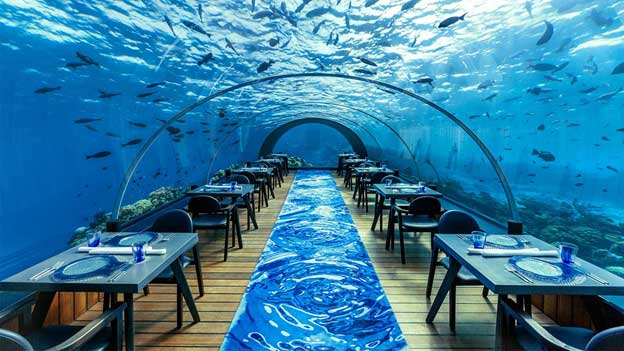
An undersea restaurant in the Maldives, a Small Island Developing State (SIDS)

GENEVA, May 4 2020 (IPS) – The COVID-19 pandemic and the measures put in place to contain its diffusion are taking a heavy toll on the tourism sector. According to the United Nations World Tourism Organization (UNWTO), the COVID-19 pandemic will result in a contraction of the tourism sector by 20% to 30% in 2020.


This estimate is likely to be conservative for countries relying on foreign tourists, as the recent data on daily air traffic indicate a drop of almost 80% since January 2020.

While many economic sectors are expected to recover once restrictive measures are lifted, the pandemic will probably have a longer lasting effect on international tourism. This is largely due to reduced consumer confidence and the likelihood of longer restrictions on the international movement of people.

According to the World Travel and Tourism Council (WTTC), in previous viral epidemics the average recovery time for visitors to a destination was about 19 months.

Highly vulnerable countries

The sudden, deep and likely prolonged downturn in the travel and tourism sector has made countries that rely heavily on foreign tourism very concerned about their finances.

Among these, small island developing states (SIDS) are most vulnerable not only because they are highly dependent on tourism, but also because any shock of such magnitude is difficult to manage for small economies.

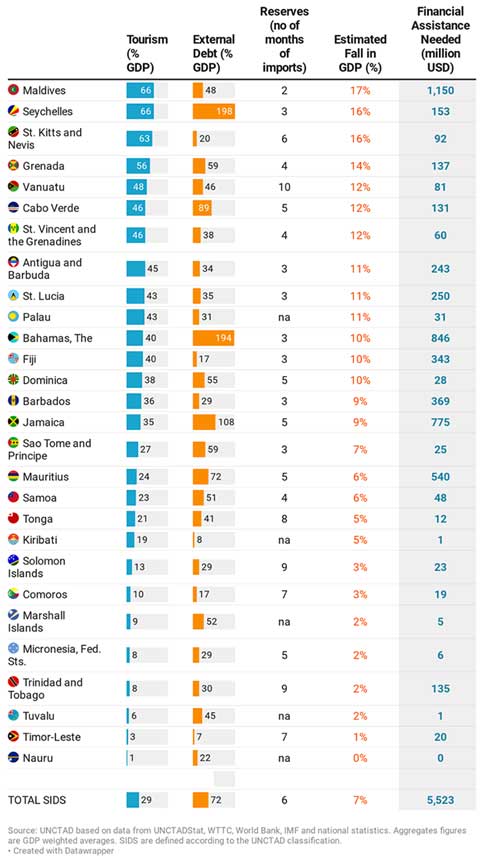
On average, the tourism sector accounts for almost 30% of the gross domestic product (GDP) of the SIDS, according to WTTC data. This share is over 50% for the Maldives, Seychelles, St. Kitts and Nevis and Grenada.

Overall, travel and tourism in the SIDS generates approximately $30 billion per year. A decline in tourism receipts by 25% will result in a $7.4 billion or 7.3% fall in GDP. The drop could be significantly greater in some of the SIDS, reaching 16% in the Maldives and Seychelles.

It is expected that for many SIDS, the COVID-19 pandemic will directly result in record amounts of revenue losses without the alternative sources of foreign exchange revenues necessary to service external debt and pay for imports.

Devastating economic consequences

In general, countries may be able to weather economic storms by relying on additional debt or using available foreign reserves.

However, access to global capital markets is increasingly tight, more so for small countries such as SIDS, which are often highly indebted and not well diversified.

The external debt of the SIDS as a group accounts for 72.4% of their GDP on average, reaching up to 200% in the Seychelles and the Bahamas.

Foreign reserves are also generally low, with many of the SIDS possessing only the reserves sufficient for a few months of imports. Given these statistics, it is evident that without international assistance, the economic consequences of the pandemic will be devastating for many of the SIDS.

Immediate financial needs

By considering the economic impact of reduced tourism revenues (assuming a 25% decline in tourism receipts and restoring the minimum level of import coverage (three months), it is possible to provide a rough estimate of each country’s immediate financial needs to offset the damage of the pandemic.

Currently, the SIDS would need about $5.5 billion to counteract the adverse effects of the pandemic on their economies.

The Maldives stands out with a need of $1.2 billion due to its reliance on tourism revenues, followed by the Bahamas and Jamaica.

Many of the SIDS, like Jamaica and the Bahamas, also face high external debt burdens which require complementary external debt suspension or relief programmes.

Table 1: Tourism, Debt and Foreign Currency Reserve Indicators

International response

While governments all over the world have announced fiscal measures totalling $8 trillion to combat the pandemic, the international community has also mobilized funds through international financial institutions to counteract the economic crisis in the most vulnerable countries.

The International Monetary Fund (IMF) created a $50 billion fund through its rapid-disbursing emergency financing facilities for low-income and emerging market countries. It has earmarked $10 billion to serve its poorest members with a zero-interest rate. Regional banks have also created response facilities aimed at financially supporting their members.

What options are available for SIDS?

The IMF has just revamped the Catastrophe Containment and Relief Trust (CCRT) to offer short term debt reliefs to some of its members.

While some SIDS such as Comoros, São Tomé and Príncipe, and the Solomon Islands have already requested and obtained debt relief, there is room for more SIDS to take advantage of this option. While many of the SIDS are not among the poorest countries, they are vulnerable. This is further compounded by high levels of external debt many SIDS experience.

It is critical that SIDS have access to funding at zero interest rates and can suspend existing debt payments until they are financially ready to service their external debt obligations.

Ultimately, this can help blunt the impact of external shocks such as COVID-19 and equip them with the necessary financial resources to plan their next steps for their economic development.

  Source

Collaboration Can Help Eradicate COVID-19

Civil Society, Development & Aid, Education, Featured, Global, Headlines, Health, Humanitarian Emergencies, TerraViva United Nations

Opinion

Rev Liberato C. Bautista is assistant general secretary for United Nations and International Affairs of the United Methodist Board of Church and Society. He also serves as president of the Conference of Non-Governmental Organizations in Consultative Relationship with the United Nations.

Coronavirus pandemic threatens crises-ravaged communities, UN appeals for global support. Credit: United Nations

NEW YORK, Apr 23 2020 (IPS) – Since the founding of the United Nations in 1945, space for multilateral policy development and commitment has grown. Its growth in the global health field augurs well as we find ways to mitigate the spread of the novel coronavirus.


Multilateralism is a difficult word, often misconstrued to be about the global and not the local and daily life. Perception plays a major role in how the public perceives multilateralism. This is in part due to the complexity of modern global challenges, which are well beyond the capacity of any one state or even a small group of states to resolve by themselves.

The novel coronavirus pandemic may yet change this perception.

As the saying goes, all politics is local. My rejoinder to this is that one’s local is another’s global. The local and the global are simultaneous realities. United Methodist connectionalism is akin to multilateralism.

As a church, we address social issues central to the multilateral agenda, including health, migration, peace, climate, and concerns about global poverty, trading and commerce, sustainable development, social justice, women, children and gender justice, human rights, indigenous peoples, and more.

Holistic health, healing and wholeness are intrinsic to Methodism and its Wesleyan roots. John Wesley attended to both the care for the soul and for the biological body with his abundant tips and remedies for ailments during his time.

Throughout the United Methodist connection, we are doing advocacy on public health policies at national legislatures and multilateral settings. We are in global mission together for sustainable development and humanitarian assistance, building capacity for peoples and communities to manage their healthcare needs.

Our numerous United Methodist-affiliated clinics, hospitals, colleges and universities around the world are training medical, health, social work and pastoral care professionals.

The Rev. Liberato Bautista. Credit: Marcelo Schneider, World Council of Churches

Human rights intrinsic to health, healing and wholeness

Global pandemics such as the novel coronavirus respect no sovereign boundaries or national allegiances. The coronavirus ravages all peoples across races and social classes, but its effects are more devastating on vulnerable populations everywhere and on struggling low- and middle-income economies around the world.

To mitigate the virulent spread of COVID-19, we are called by national authorities to stay at home, wash our hands, stay in place and practice physical distancing. These public health directives imply that we have houses to stay in, water to wash our hands, and some space where we can move around and still maintain six feet distance from each other.

When Philippine government officials issued the directive for Filipinos to stay at home, Norma Dollaga, a United Methodist deaconess and justice advocate from the Philippines, reacted through her Facebook page: “Stay at home. That’s for those who have homes. How about the homeless?”

The reality is that the human rights to health, housing and water, along with human mobility, have long been imperiled in many places around the world prior to COVID-19’s onslaught. Moreover, the health crisis has been used as an excuse in other parts of the world to grab power or tighten national security laws that are assaulting civil liberties and violating democratic rights.

Neither pandemic nor political or economic exigency can derogate from the enjoyment of fundamental human rights.

That the outbreak of COVID-19 started in Wuhan City in China has resulted in undue rise in racist and xenophobic acts especially against people of Chinese origin, or Asians in general. This is on top of an ongoing surge of populism and xenophobic nationalism around the world.

Health is wealth, fund it robustly

If health is wealth, it behooves peoples and their governments to protect it. Health care workers who are on the front line against this pandemic should have all the resources they need without begging for them.

A war may have been declared in the eradication of the novel coronavirus pandemic. But it is looking more like the deployment of war rhetoric and not the funding that real wars have received.

National budgets are moral documents. Health is the true common wealth that we must invest human and budgetary resources to. Yet we know that defense spending today far outweighs the puny investments from national coffers that health care urgently needs and strategically deserves.

Global collaboration is indispensable

The role of the U.N. in forging global cooperation is crucial, in times of crisis or calm. Global cooperation in the surveillance of emerging viruses and bacteria is necessary if pandemics are to be mitigated and diseases eradicated.

Coordinating this global collaboration and leading the development of a vaccine to treat the COVID-19 disease gives the public good reason to trust global institutions like World Health Organization. Think of the eradication of smallpox — and the ongoing programs to eventually eradicate polio and malaria — as examples of how global cooperation benefits us in our local daily lives.

To triumph over COVID-19, comprehensive cooperation is needed on many fronts — medical, pharmaceutical, healthcare workers, mental health providers, healthcare facilities. Public and private coordination is necessary in ensuring that the supply chain for much needed testing kits, ventilators, as well as personal protective equipment like N95 face masks, gloves, gowns, aprons, face shields and respirators remain unbroken.

A successful multilateral response requires a “whole-of-government,” “whole-of-society” and evidence-based public health approach. Mitigation works best when countries share expertise and scientific knowledge about threats to health, to climate, to populations and to peace and security.

Social inequalities imperil public health

The Commission on the Social Determinants of Health established by WHO in 2005 elaborated on the disastrous effects of social inequalities on people’s health. The intersections of physical, mental and social health, healing and wholeness are abundantly clear.

The commission’s 2008 final report stated: “The social determinants of health are the conditions in which people are born, grow, live, work and age. These circumstances are shaped by the distribution of money, power and resources at global, national and local levels.

The social determinants of health are mostly responsible for health inequities — the unfair and avoidable differences in health status seen within and between countries.”

The U.N. commemorates its 75th anniversary this year. It is an auspicious time to reaffirm support for its mandates, especially the securing of health for all peoples and the planet. A healthy population makes for a healthy planet.

Nongovernmental organizations, including faith-based organizations like our United Methodist representations at the U.N., are in a kairos moment to help achieve the U.N.’s mandates.

COVID-19 may have been virulent and will forever change the rules of social etiquette and socialization. But the novel coronavirus has done what multilateral negotiations have not done — pause globalization and its unbridled pursuit of profit and capital.

When the world reopens from the ravages of the virus, we have a momentous task not to return to, but to transform, global and local arrangements to protect humanity and the planet, at least from the ravages of pandemics and social inequalities.

It comforts me that not all contagions are deadly. Some are beneficial. Love and kindness are. So are hospitality, mercy and justice.

*This article 0riginally appeared in UM News”. The link follows: https://www.umnews.org/en/news/collaboration-can-help-eradicate-covid-19

  Source

Citizen Action is Central to the Global Response to COVID-19

Active Citizens, Development & Aid, Economy & Trade, Global, Headlines, Health, Humanitarian Emergencies, Labour, TerraViva United Nations

Opinion

NEW YORK and MANILA, Apr 22 2020 (IPS) – The coronavirus (COVID-19) pandemic has created an unprecedented human and economic crisis. Governments are taking strong actions, enforcing quarantines to reduce contagion, testing populations, building emergency intensive care units. Governments have also launched large fiscal stimulus plans to protect jobs and the economy, as well as temporary social protection programs such as income/food support, subsidies to utilities and care services.


Isabel Ortiz

But in many countries, even stronger actions are needed if we are to protect lives and jobs. States must respond adequately to this public emergency. Citizens must question if the measures implemented by their governments are sufficient and adequate.

The following are important issues for citizens and civil society organizations (CSOs) to watch out at the country level:

    1. It is time to invest in universal public health, not only emergency support. Given COVID-19, governments are advised to ramp up public health expenditures. Indeed, respirators, tests and masks are necessary, but countries need more than just emergency support. There is a risk that, as governments will become indebted, they continue with austerity cuts and privatizations that have been eroding public health systems in recent years, returning to a situation where millions are excluded from healthcare.
    2. Stimulating the economy and employment. This is much necessary to support job-generating enterprises during the COVID-19 lockdown. However, citizens need to be vigilant that fiscal stimulus do not go to the wrong hands, to large corporations avoiding taxes, to cronies, to the untaxed financial sector. If public funds are given to companies, it should be with strict conditions to stop tax evasion and share buybacks, undergo adequate regulation, cut obnoxious management bonusses, pay living wages and preserve employment.
    3. Providing social protection, income and food support to people. These measures are extremely urgent if people are to be quarantined and are unable to telework. In developing countries, most work precariously in the informal economy and isolation is not possible, households will suffer hunger with no income. Given the low living conditions in most developing countries, policymakers should consider the need for universal social protection floors.
    4. Governments need more executive powers to implement these measures. States and public policies have been weakened over the last decades by deregulations, privatizations and budget cuts. Better planning, better resources and better public policies for all citizens are needed, but it is important to ensure that far right and authoritarian leaders do not use the need for decisive executive action to grab more power for their own ends (eg. Brazil, Hungary, India, Philippines, US).

Additionally, it is important for citizens and CSOs to push for the following measures at the global level:

Walden Bello

    5. Support for global public health, at stake is the survival of the planet. The coronavirus pandemic has revealed the weak state of global public health systems – generally overburdened, underfunded and understaffed because of earlier austerity policies and privatizations. There is urgent need to improve the global governance of health, including the strengthening the WHO and UN agencies that support the extension of public health systems, as well as CSOs monitoring progress.
    6. Put pressure on the international financial institutions such as the IMF and the development banks, so their policies support universal public health systems, jobs and social protection floors at present as well as after the COVID-19 emergency, including resources and fiscal space to finance them.
    7. Given high sovereign debt levels, continue lobbying for debt forgiveness or radical debt relief to ensure that countries get the needed financing; or at least a debt moratoria, and later debt restructuring/relief.
    8. Watch out that new debt and fiscal deficits created to respond to COVID-19 do not result in a new round of austerity cuts with negative social impacts that will undermine public health systems, jobs and social protection.
    9. Ensure capital controls. Capital is flying North to safety, to the US, to Europe. Developing countries are going to be hard hit, not only because of the capital drain but also from the fall of commodity prices and others. Capital controls are easy to implement, with immediate results.
    10. A Global Marshall Plan, or a Global Green New Deal. Global problems require global solutions; after the WW2, the US implemented a Marshall Plan to rebuild Europe. This time, no country alone can or should finance a global plan, it can be built as part of a progressive multilateralism. There are many ways to finance it, solidarity taxes to wealth may well be a best way to reduce inequalities and even up world’s development. It can be complemented by other measures such as issuing more Special Drawing Rights (SDRs) at the international organizations.

The coronavirus pandemic has provided stark evidence of the weaknesses and extreme injustices of our world. We must not return to “normality”, a world where half of its population is living below the poverty line of $5.50 a day. We must move away from an inequitable model based on unregulated finance and corporate power, blind to harmful social and environmental impacts. We must back away from a system that disregards the work of health staff, cleaners, garbage collectors, farmers, and instead reward with huge salaries corporate managers, football players, and others who do not perform any essential activity. Now citizens have the opportunity to move forward.

As countries and enterprises recuperate from the crisis, they will have to rethink their economic model, including fewer links with global supply chains, and more links closer to home. It will be an important time for citizens and CSOs to press for “deglobalization”, making the domestic market again the center of gravity of the economy by preserving local production with decent jobs and green investments, and question global supply chains based on taking advantage of cheaper wages, lesser taxes and environmental regulations elsewhere.

Now is the time for citizens to ensure that world leaders forcefully respond to the COVID-19 crisis, in accordance with human rights. This time it cannot be like many earlier crisis experiences, where insufficient support was provided, or ended in the wrong hands, bailing out banks not the population. Citizens and CSOs have a very important role to play to ensure that governments respond to people.

Isabel Ortiz is Director of the Global Social Justice Program at the Initiative for Policy Dialogue, Columbia University, and former director of the International Labour Organization (ILO) and UNICEF.

Walden Bello is senior analyst at the Bangkok-based Focus on the Global South and the International Adjunct Professor of Sociology at the State University of New York at Binghamton.

  Source