Rural Education: Moving Past “Poor Solutions for Poor People”

Asia-Pacific, Civil Society, Development & Aid, Education, Headlines, Poverty & SDGs, Regional Categories, TerraViva United Nations
Education

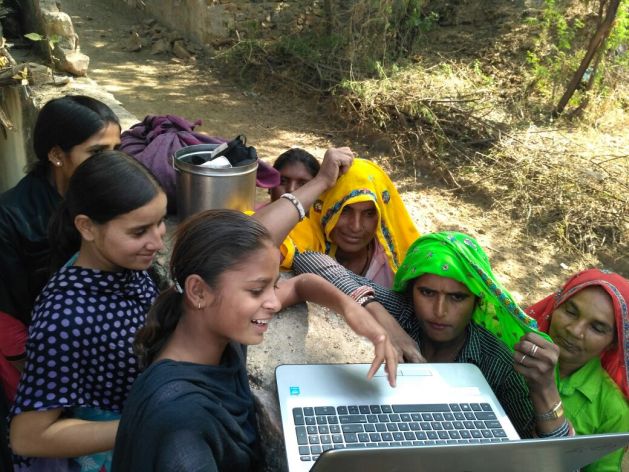
People often believe that the problems in the education space have more to do with curricula or pedagogy, or with the capacity of teachers. We disagree. The main issue is that today, communities are missing from the school ecosystem.

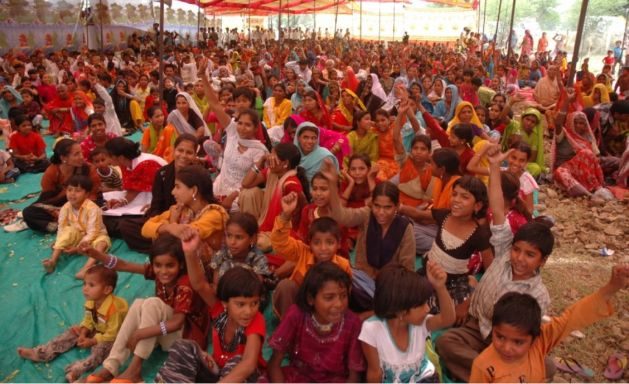
Photo Courtesy: Sachin Sachdeva

NEW DELHI, May 6 2019 (IPS) – Communities are treated as passive recipients, giving them no say in the functioning of their schools. Here’s why this needs to change.


During our work with people living around the Ranthambhor National Park on issues of conservation, livelihoods, and eco-development, a constant question we were asked was how long we thought we could continue helping them. And then, an accompanying question — would their children never be in a position to help themselves? To advocate for and implement the change they wanted to see?

People had been led to believe that sending children to school was a precondition for a better future. Despite this, what they kept seeing was that the education system accessible to them was not equipping their children with the skills and abilities that they required to negotiate better futures for themselves.

Poor solutions for poor people

Working in Sawai Madhopur made us painfully aware of the community’s past experiences with education. Over time they had experienced the Shiksha Karmi Programme (which trained daughters-in-law to run schools), and the Rajiv Gandhi Pathshalas (which trained a young person who had passed Class 10, to run schools), not counting their countless experiences with government schools in the larger villages, most of which were sub-optimal.

When we look at the pitfalls of the government schooling system — be it teacher absenteeism, quality of textbooks, a lack of adequate infrastructure, constrained budgets and human resources — and the plans or schemes that have been created to address them, we realise that most of them could be categorised as ‘poor solutions for poor people’.

People often believe that the problems in the education space have more to do with curricula or pedagogy, or with the capacity of teachers. We disagree. The main issue is that today, communities are missing from the school ecosystem.

The current school system has made communities passive recipients of whatever the government tosses at them, giving them no say in the functioning of the school. It does not work with the community to help them actively engage with the process.

People don’t understand the gap between their aspirations and reality

The idea that any kind of education should lead to a job (preferably a government one) is prevalent amongst the communities we work with. However, what is less clear is how exactly that will happen, and what the probability is of it happening at all.

People had begun to realise that their education system was leaving children under prepared – they may have completed class 10 or 12, but their capacities and skill sets were far lower than they should have been – making it impossible for them to find the job they dreamed of, or continue on an educational path that would get them there.

What’s worse, by dedicating most of their time and resources to school, these children were sometimes unable to take up their traditional occupations – be it in agriculture or livestock rearing – making them incapable of earning a substantial income.

In such a situation, with huge gaps between their reality and aspirations, young people often found themselves helpless. There was scarcely anyone in the village who could have told them what needed to be done to become a doctor, engineer, bureaucrat, lawyer, entrepreneur – or what it entailed.

Despite this, children would go through their schools and come to urban centres looking for opportunities – be it that elusive government job or being a professional. It was only upon reaching the cities that they would realise how under-prepared they were, and as a result end up taking whatever work they could get–as waiters, drivers, cleaners, helpers, construction workers and similar positions in the informal sector.

It is no surprise then, that when it came to education, people in the community were losing faith in government schools.

Communities are the main stakeholder in their education

People often believe that the problems in the education space have more to do with curricula or pedagogy, or with the capacity of teachers. We disagree. The main issue is that today, communities are missing from the school ecosystem.

The community is the biggest stakeholder in the education space, and they need to be treated as such. People need to have a real idea of what they can expect from the system, and they need the system to be accountable to them. This has never happened.

So while there is plenty of work being done to train teachers, help principals, build the skills of School Management Committees (SMCs), design curriculum and change pedagogy, there is not enough being done with parents and community members. Even though parents make up the bulk of the SMC, they tend to be involved only in issues related to infrastructure or for instance, looking at teacher attendance or organising events – essentially any activity that is easy to monitor and does not demand engagement in processes.

It is time that we understood that education is about creating the right ecosystem for learning to happen, and that a village and its community are part of that process. When families have a better understanding of learning processes, they will also ensure that the home environment provides the right encouragement. When community members are able to offer their knowledge—as farmers, mechanics or officers in government—to students, they are teaching children about different possibilities in their future. It is only through involvement of the community that people will learn to ask the right questions, to seek accountability from the system. SMCs, being a subset of the community, offer a channel to do this. And if the community is aware, the SMCs will also function well.

For change to occur, communities must be more aware, and in charge of their education.
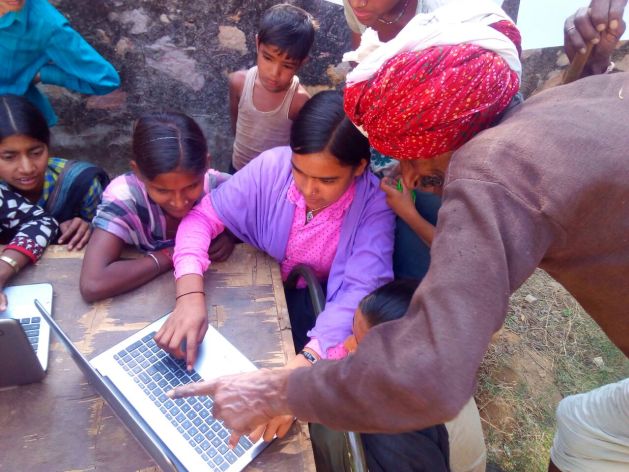
People often believe that the problems in the education space have more to do with curricula or pedagogy, or with the capacity of teachers. We disagree. The main issue is that today, communities are missing from the school ecosystem.

Photo Courtesy: Sachin Sachdeva

Working with communities to improve the education system

Having said that, we have to keep in mind that today, most communities, having been passive recipients of education thus far, are unprepared to challenge the system. It is therefore essential that we work to change this.

Based on our work at Gramin Shiksha Kendra (GSK) – an organisation which works with communities to enhance the quality of education in government schools – over the last 14 years, here are some suggestions on how this can be done:

1. Give them positions of seniority/power

Include members of the local community in your organisation board and involve them in the decision making. For example, at GSK we have people from the community on our board – some of them are parents who missed the opportunities of a quality education for their children, and two of them have never been to school but bring in their insights, wisdom and understanding of the local context.

These community members have guided and helped the organisation evolve its strategies, brought concerns and aspirations of the people to the board, and cautioned us against taking decisions that might not have the right impact.

2. Change your metrics of success

For example, we have kept the strength and management capacities of the school management committees as our apex indicator of success/failure, rather than only focussing on learning outcomes. We believe that when the schools and government-appointed school teachers become accountable to the SMC, and the SMC is in a position to guide and manage, the initiative will have succeeded.

3. Involve them in the work being done

Members from the community are invited to teach in the schools as guest teachers. Their experiences add to the curriculum of the school and are adapted for the schools. To be a teacher is still a valued profession, which gives parents a sense of importance and respect in the area.

Additionally, in an attempt to create a community-led ecosystem for education, we have an annual education festival called Kilol in our villages. The village community takes responsibility to organise Kilol’s and GSK shares, through exhibits and processes, our ways of teaching science, language, math, as well as the importance of components like pottery, sport and carpentry. The festival gives everyone in the community an opportunity to celebrate learning and understand what happens in school.

4. Give the initiative that is for them, to them

Our latest attempt is in handing over one of the schools that GSK set up back to the community to manage. That is when the school will become truly community-owned and community-managed.

We made this possible by, over the last 14 years, giving different members from the community a chance to be a part of the SMC. This has resulted in over 35 members in the community who have at one point or another been members of the SMC.

Because of their experience, the SMCs will soon be able to take over the management of the school and run it. GSK plans to facilitate this process and will help the SMC and the community evolve a future course of action – whether that leads to a science education initiative in the area, a comprehensive school, or an outreach programme.

This is important, as it defines our education initiative in the area. We don’t intend running the schools for ever, we want the community to take over. This will be our biggest success and we will continue providing them the technical support – or any other support that they may require. Most importantly, by giving the school back to the community, we are giving power back to the people – which is where it should be.

Sachin Sachdeva is a Co-Founder of Gramin Shiksha Kendra, www.graminshiksha.org.in , an organisation which works with communities to enhance the quality of education in government schools. Sachin has worked with development initiatives over the past 25 years and has been working with communities to help them look at their futures from a position of strength. GSK works with over 70 schools around the Ranthambhor National Park and along with the community runs three schools, one of which has been set up in a rehabilitated village. He is currently Director of the Paul Hamlyn Foundation’s India programme.

This story was originally published by India Development Review (IDR)
 

Want Social Change? Give Communities More Agency

Asia-Pacific, Civil Society, Development & Aid, Featured, Headlines, Human Rights, Poverty & SDGs, TerraViva United Nations

Human Rights

if issues around social justice had to be taken to scale, and if we wanted to create deeper impact,we needed to involve the communities affected.

Photo Courtesy: Jan Sahas.

DEWAS, India, May 3 2019 (IPS) – No external force can bring about real change in society. Only the community itself can.


There are 650 districts in India. However, most nonprofits work only in a few districts. Given how large our country is, there are only two types of people that can work towards creating change at scale – the communities that are facing the issues first hand, and the government.

The government has not been able to work on issues related to social justice in the last 60 years. Perhaps they think that this is not important enough, or there is no political will to do it. So, we at Jan Sahas, chose to involve the community.

We realised that if issues around social justice had to be taken to scale, and if we wanted to create deeper impact,we needed to involve the communities affected. If it didn’t become the community’s own initiative, or if they kept thinking that some civil society organisation or government agency would come and work on their issues, it would never be sustainable.

That’s why in 2001, we started a national campaign named Rashtriya Garima Abhiyan. Centred around the idea of dignity, this campaign was aimed at mobilising Dalit manual scavengers, all of whom were women. We wanted to empower them to move out of this work and enable them to scale up the programme on their own. We thought that working with manual scavengers would be a good entry point to work on ending exclusion.

Caste-based marginalised communities in our country have faced historical injustice — not just for the last five-six generations, but for the last 2,500 years

But caste-based marginalised communities in our country have faced historical injustice — not just for the last five-six generations, but for the last 2,500 years. Even if they earn money and stop doing caste-based work, the social stigma never goes away. Even if the person becomes a collector, or starts an enterprise, the discrimination continues.

We need three types of rehabilitation

If people have to come out of caste-based work, they need three types of rehabilitation:

1. Economic or livelihood rehabilitation

In the caste-based work of manual scavenging, the biggest issue is that the oppressor or employer provides them food, clothing and shelter. In rural India, they get two rotis every day, clothes twice a year — during Holi and Diwali, and the panchayat gives them a place to stay, So, in essence, their basic needs of roti-kapda-makaan are taken care of by the person or the institution that employs them. What this means though is that they are unable to negotiate with their employers.

If you are going to get paid in cash for work, you can negotiate. For instance, if the employer says ‘I will give you INR 20’, you can say, ‘No, I will charge INR 50’. But if your life itself is dependent on what they give you, then you can never negotiate.

Therefore, if we have to start changing the way caste is viewed and reinforced, we have to start with economic rehabilitation. If marginalised caste groups get work which pays them in cash, they can negotiate the terms for their wages, working conditions, dignity and relationships at the workplace.

However, this is only step one. The second, and more important one, is social rehabilitation.

2. Social rehabilitation

The government never thinks about this aspect. Under social rehabilitation, if someone gives up their (caste-based) work, they should be given work that factors in the social aspect as well.

For instance in 2013, we appealed to several state governments; we said that when you appoint ICDS workers and helpers — positions that do not require an educational background, offer INR 3,000-4,000 monthly salary and where the employee has to be a woman, give priority to the women from the manual scavenging community.These women could prepare the meals provided under the ICDS scheme, and all children regardless of their caste would eat that food.

This process was started in Uttar Pradesh but many powerful groups forced the state to rescind the order; today it is no longer compulsory. In Madhya Pradesh on the other hand, while there was some struggle to start with, it has now been firmly established in many districts.

The discrimination extends across several government schemes. In many villages, where the PMAY is being implemented, Dalit communities are given homes in a separate place. They call it a ‘colony’ and it is commonly understood to be land outside the village. However, all the resources such as electricity, water, anganwadis are available only inside the village.

If you want to stop caste-based practices, you cannot work with the excluded people alone. Other related stakeholders have to be held accountable. Like they say in the gender discourse — if you want to end sexual violence, you have to get the male members of the community involved.

3. Political rehabilitation

Being political is not about party politics. It is about the power of representation. If women from excluded communities want to be part of the local panchayat, they should have the space to do so. The problem is, that today, they don’t have this space.

For example, we started a campaign with rape survivors, that they should contest elections for the panchayat. As a result of this campaign, 104 women participated in panchayat elections. Almost 50 percent of them won. Many of them contested on unreserved seats. They fought and they won. The idea was for them to challenge the power structure.

In some places we had to work with their family members as well, in some with the society at large. When these excluded women gain power, then at some level, the discrimination stops.

We realised that if issues around social justice had to be taken to scale, and if we wanted to create deeper impact,we needed to involve the communities affected.

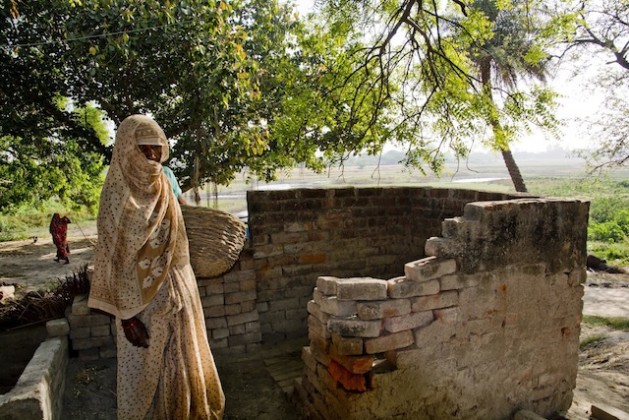
A Dalit woman stands outside a dry toilet located in an upper caste villager’s home in Mainpuri, in the northern Indian state of Uttar Pradesh. Credit: Shai Venkatraman/IPS

It takes years to break social barriers, even among the marginalised

Jan Sahas works with manual scavengers, rape survivors and young girls who have been forced into commercial sexual exploitation. One of the biggest challenges we face is that it is very difficult to make these communities come together. Getting ‘outsiders’ to change their social behaviour requires work at a different level. But even within these disadvantaged groups, people follow discrimination and untouchability practices.

For example, in Bhaurasa, a village in Madhya Pradesh, we had women who had managed to stop doing caste-based work.  There were 17 women from the Valmiki community, and 10 from the Hela community. Valmiki is a Dalit Hindu community, while Hela is a Muslim community. It took us three years to bring them together in one place for a meeting.

For two and a half years, we conducted meetings with adults in the community to convince them. Despite that we failed to change their beliefs. But when we started working with the young — using games and activities — it took almost no time.

One of the games we played was taking one child from the Valmiki community and the other from the Hela — one a Dalit and the other a non-Dalit. We told them that the Dalit child would become non-Dalit for a day, and vice versa.

We observed a big change in behaviour. The children soon realised that what one was doing with another human being was not based on any rationale. There is no rationale for caste discrimination, and that it didn’t make sense to follow this nonsensical practice.

The activities brought about a change in the children; they then started convincing their families and the families changed because of the children’s intervention.

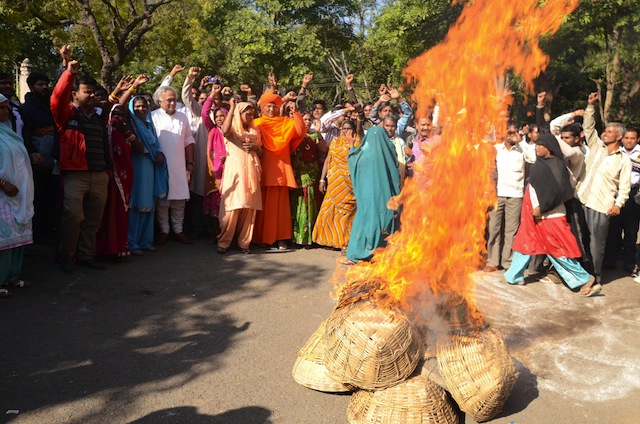
At a rally in New Delhi, Dalit women burn baskets used to collect human waste as a sign of protest against the caste-based practice of ‘manual scavenging’. Credit: Shai Venkatraman/IPS

Communities can solve their own problems. All they need are platforms.

Most of us in civil society who work with marginalised communities feel that ‘we are going to give them something’, ‘deliver’ something. In reality though, no one really is in a position to deliver anything to the community. What do we really know about the communities? How can we assume leadership on their behalf when we don’t know enough?

Consider the Dignity March where 25,000 rape survivors travelled over 10,000 kms and spoke openly in public forums about being raped. Jan Sahas might have coordinated the march, but the idea was not ours.

We were conducting a meeting in a village. There were four rape survivors along with their family members. One of the women said that there had been a conviction in her case, while a second women said that she was still struggling with her case and was facing many problems. The families were fighting among themselves, and demanding answers from us, saying if  one woman’s case was solved, why wasn’t there a judgement yet in the second case?

One of the rape survivors told us: “You don’t explain what the problems are; let the woman who got the conviction explain to the others what steps need to be taken and how they can bring their own case to a closure”.

When she started explaining, the idea clicked in our minds; that instead of us doing this work — going to each village and talking to all the families about how to fight their cases — what if 1,000 rape survivors came together in one place and travelled all over the country and explained how to get a conviction to other survivors.

Nonprofits should only play the role of facilitators

We can’t be leaders of the manual scavengers, or rape survivors, or communities who are involved caste-based commercial sexual exploitation. They are their own leaders because they know what that pain has meant in how they live their lives. We cannot even imagine how much power or courage is required to change this situation.

No one else can do it — no Chief Minister or Prime Minister can work on it as effectively as a rape survivor can work on rape, or manual scavengers can work on their own issues. We need to understand this.

The role of the government or nonprofits is limited in this. We can help create appropriate forums for them; but it is they who will come up with the strategies. During the march, we observed this very clearly: people who’ve been facing oppression and discrimination, were ready to take up the struggle; they were ready to find solutions. What they needed was a platform to talk about their issues.

The current strategies which are made by the government or other institutions, rarely involve the affected communities. But no external force can bring about real change in society. Only the community itself can.

Translations from Hindi to English by Anupamaa Joshi.

Ashif Shaikh is an Indian social activist, known for his role in Rashtriya Garima Abhiyan, a campaign for the eradication of manual scavenging. He is also a co-founder of Jan Sahas, a human rights organisation. Since 2000, Jan Sahas has been working to end caste- and gender-based slavery and violence through the eradication of manual scavenging, caste-based sex work, forced labour, and trafficking. He has won several awards for this work, including the Sadbhavana Award and the Times of India Social Impact Award.

This story was originally published by India Development Review (IDR)