Thailand’s LGBTQI+ Rights Breakthrough

Asia-Pacific, Civil Society, Featured, Gender, Headlines, Human Rights, LGBTQ, TerraViva United Nations

Opinion

Credit: Chanakarn Laosarakham/AFP via Getty Images

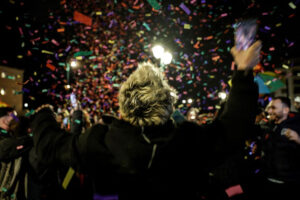
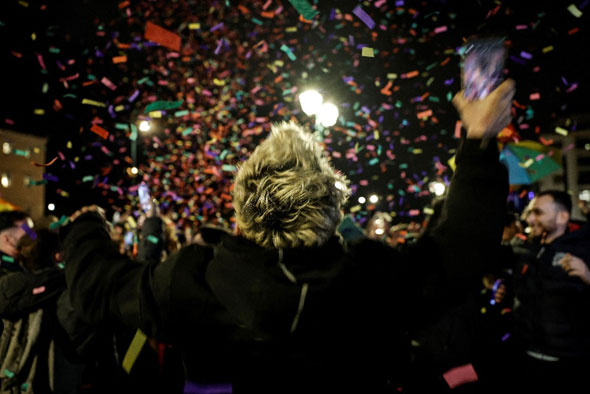
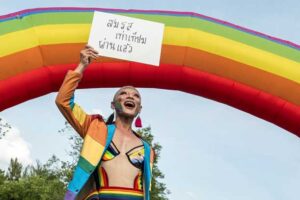
MONTEVIDEO, Uruguay, Jun 27 2024 (IPS) – At the height of 2024 Pride season, decades of civil society campaigning came to fruition in Thailand. With 130 votes for and only four against, on 18 June the Senate passed the Marriage Equality Bill. With a few strokes of the pen, the bill tweaked the language of the Civil and Commercial Code, replacing gendered references such as ‘man’ and ‘woman’ with gender-neutral ones such as ‘persons’ and ‘spouses’. It now goes for formal assent to King Maha Vajiralongkorn and will take effect 120 days after publication in the official bulletin.


This means equal marriage is now recognised in 37 countries. Recent progress has seen Estonia become the first post-Soviet state to join the ranks in 2023, and Greece the first majority-Orthodox Christian country to do so in early 2024. Thailand is the first country in Southeast Asia and the third in Asia, following Taiwan and Nepal, to recognise the right to marry and all associated rights for same-sex couples.

SAME-SEX MARRIAGE AROUND THE WORLD

The long road to equality

With its vibrant LGBTQI+ culture, Thailand has long been advertised as ‘an exceptional destination for gay travellers’. But things weren’t quite so good for local LGBTQI+ people, whose identities and relationships lacked legal recognition and associated rights.

Civil society worked to change that. Efforts to advance the rights of same-sex couples in Thailand date back at least as far as 2011.

The first shift came in 2012, when the government began to consider some kind of recognition for same-sex relations. In 2013 it drafted a civil partnership bill with bipartisan support, but progress stalled under the military government formed as a result of a 2014 coup.

The country remained under military rule until mid-2019, but rather than stopping, LGBTQI+ activism gained strength by connecting with the country’s youthful and outspoken movement for democracy. In 2017, a petition calling for the recognition of civil partnerships gathered over 60,000 signatures. The government responded by preparing a draft bill and holding public hearings where it received overwhelming public support. But by mid-2020, the bill – which activists criticised for not ensuring the same rights as marriage – died in parliament.

When youth-led protests for democratic change erupted in 2020, their demands included LGBTQI+ rights and led to the development of a new bill that was eventually introduced but failed to pass before parliament was dissolved ahead of a general election in May 2023.

LGBTQI+ activists also took to the courts, but received a setback. In 2021, in response to a petition filed by two LGBTQI+ people seeking to get married, the Constitutional Court ruled that the section of the Civil and Commercial Code that defined marriage as being between a man and a woman was constitutional. LGBTQI+ activists were particularly unhappy with the court’s sexist and demeaning language.

Cultural and political battles

Longstanding efforts to normalise the presence of LGBTQI+ people and shift conservative narratives produced high levels of acceptance and support for LGBTQI+ rights. Thailand ranks 44 out of 196 countries in Equaldex’s Equality Index, which rates countries according to their LGBTQI+-friendliness. But unlike most other countries, it places higher for public attitudes than for its laws.

This meant Thai LGBTQI+ activists were able to use the broadly favourable climate of opinion to pressure politicians. They turned LGBTQI+ rights into a bandwagon politicians wanted to join for political gain. As a result, some of the major parties competing in the 2023 election campaigned on pledges to push for marriage equality. This included the progressive Move Forward party, which won the most seats.

But military-appointed senators stopped Move Forward forming a government, and instead Pheu Thai Party, a populist party twice deposed in military coups, formed a coalition with military-aligned parties – not the outcome young democracy activists had hoped for. Still, the new prime minister, Srettha Thavisin, had also promised to send a bill to parliament.

He still took his time, and LGBTQI+ activists gave him the push he needed. By early September 2023, when the new government was sworn in, the Rainbow Coalition for Marriage Equality had collected over 362,000 signatures in support of marriage equality. Srettha sent the bill to parliament in November, and in December debate started on the government’s bill plus three other versions submitted by other parties and civil society.

The House of Representatives passed all four bills with an overwhelming majority, then formed a committee to merge them into one, and passed the combined bill with near unanimity. The Senate completed the process on 18 June.

What – and where – next

The Marriage Equality Bill recognises rights in relation to inheritance, adoption and healthcare decisions. But beyond these direct effects, activists expect it to have powerful indirect impacts, sending a message of acceptance and encouraging younger LGBTQI+ people to come out and lead full lives free of discrimination and violence.

Now marriage equality has been achieved, LGBTQI+ activism is turning to the next big issue – trans rights. Despite playing a prominent role in entertainment, transgender people in Thailand face steep barriers, particularly in employment. They have few legal protections against discrimination, and those that exist aren’t fully enforced. They’re unable to obtain legal documents that reflect their gender identity, and what few rights they have in this regard depend on bureaucratic discretion. To change this, LGBTQI+ activists will keep campaigning for a Gender Recognition Bill.

The significance of the change achieved in Thailand, and the further change that seems sure to come, extends far beyond the country’s borders. Most countries in the region don’t recognise same-sex marriage, and some, including Brunei, Malaysia and Myanmar, still severely criminalise same-sex relations.

Thai activists believe their success can both bring further change at home and set an example for other countries to follow. Given what they’ve achieved, they have every reason for hope.

Inés M. Pousadela is CIVICUS Senior Research Specialist, co-director and writer for CIVICUS Lens and co-author of the State of Civil Society Report.
  Source

Billions will Vote this Year – LGBTIQ+ People Must not be Excluded

Civil Society, Democracy, Gender, Global, Global Governance, Headlines, Human Rights, IPS UN: Inside the Glasshouse, LGBTQ, TerraViva United Nations

Opinion

UNDP is working in all regions of the world to integrate LGBTIQ+ people and issues in development efforts. Credit: UNDP Dominican Republic

UNITED NATIONS, May 20 2024 (IPS) – This year has been called the ‘super election’ year, with 3.7 billion people potentially going to the polls. This historic political moment is also an opportunity to reflect on what these billions of voter experiences will look like. Who will vote, who can run for office and who might be excluded from the political process?


It goes without saying and is enshrined in the Universal Declaration of Human Rights, that everyone should have the right to participate in the political processes in their country, and huge strides have been made in recent years to recognize and advocate for LGBTIQ+ rights. But the reality for LGBTIQ+ people is often very different.

Because despite progress, one third of countries maintain laws that make same-sex relationships illegal. For the LGBTIQ+ people living in these countries, what is their experience with elections, as voters or as candidates?

Consider the transgender person who faces harassment whenever they leave their home and is ultimately excluded from their community. Or the LGBTIQ+ groups that are receiving constant online hate because of a wave of social media disinformation. To what extent are they free to express their political views, without fear of discrimination, hate speech or even physical violence?

These experiences do not exist in a vacuum. They are the result of a vast swathe of anti-LGBTIQ+ laws and policies, which in some countries are continuing to gather momentum, compounded by the pervasive stigma and discrimination many LGBTIQ+ people face in their everyday lives.

And they directly impact our political processes by silencing people, limiting the extent to which they can have a voice in their societies and in the decisions which affect them, and entrenching structural discrimination.

UNDP has been working for decades to help break these barriers and to strengthen laws, policies and programmes that respect the human rights of all individuals. This demands we work with a broad range of global partners and advocates, recognizing that LGBTIQ+ people are a diverse group and face multiple and intersecting forms of discrimination.

But with estimates suggesting about half of the global population may vote this year, it does throw into sharp focus the need to ensure that the people determining the leadership and political direction of their countries, truly reflects the full diversity of the world we live in.

We have reason to be hopeful that they will. Because with the steadfast support of partners like Luxembourg, UNDP has been supporting global efforts, including LGBTIQ+ organizations and activists, to help transform LGBTIQ+ rights.

For instance, last October, UNDP launched its global publication ‘Inclusive Democracies: A guide to strengthening the participation of LGBTI+ persons in political and electoral processes,’ in a jointly cohosted event with the LGBTI intergroup of the European Parliament.

Its aim is to provide policymakers, electoral management bodies, legislators, civil society and other stakeholders a clear set of tools to work towards a more equal exercise of civic and political rights, freedom of expression and association, and access to public services. The publication, informed by UNDP’s work globally, includes best practices from over 80 countries, mainly from the Global South.

At the same time, UNDP is working in 72 countries and all regions of the world to integrate LGBTIQ+ people and issues in development efforts.

This includes working with young key populations in Southern Africa – which includes young gay men and other men who have sex with men, lesbian, gay, bisexual, transgender and intersex people – to help challenge some of the negative stereotypes appearing in mainstream media, and to change the negative narratives.

Support has focused on organizing media skills training for young people to build their journalistic skills and enhance the use of digital platforms for advocacy on issues affecting them.

But digital platforms also have the power to do great harm, and LGBTIQ+ individuals often face disproportionate online harassment, posing a threat to their equal political participation. With support from Luxembourg, UNDP has been able to prioritize combating dangerous online speech that targets individuals based on gender, sexual orientation or ethnicity.

For example, the Cabo Verde Free and Equal Campaign, part of UNDP’s efforts, focuses on fighting gender stereotypes and eliminating prejudices through legal and communication channels.

The global efforts to address LGBTIQ+ rights are having an impact. The recent HIV Policy Lab report – produced jointly by Georgetown University’s O’Neill Institute, UNDP and the Global Network of People Living with HIV (GNP+) shows a clear and ongoing trend toward decriminalization of consensual same-sex sex around the world, with more countries removing punitive laws in 2022 than in any single year in the past 25 years.

These advances are part of a collective effort, because building inclusive and equitable societies means building a coalition of partners. At UNDP, the importance of partners like Luxembourg in helping to fund this vital work, and shining a light on the injustices LGBTIQ+ people face, is never underestimated.

This is important because investments in human rights are investments in our societies. And thanks to Luxembourg and our core donors, UNDP has been able to help people, whoever and wherever they are, to have a voice in shaping their societies.

This year, the stakes have never been higher. The decisions made in the elections taking place will set the course for how societies develop, and to what extent human rights are respected. Which is why we must also use this moment to recognize our partners and to renew our commitments to the LGBTIQ+ community.

The world’s attention will be focused on the election winners and losers. But the outcome is only one piece of the puzzle. Ensuring the political processes taking place are inclusive, credible and peaceful is how we ultimately build a world where everyone can vote, anyone can run for office, and most importantly, where no one will be silenced.

Ulrika Modeer is UN Assistant Secretary-General and Director of the Bureau of External Relations and Advocacy, UNDP; Christophe Schiltz is Director General, Directorate for Development Cooperation and Humanitarian Affairs, Ministry of Foreign and European Affairs, Defence, Development Cooperation and Foreign Trade, Luxembourg

Source: UNDP

IPS UN Bureau

  Source

Civil Society Scores LGBTQI+ Rights Victory in Dominica

Civil Society, Crime & Justice, Featured, Gender Violence, Headlines, Health, Human Rights, Latin America & the Caribbean, LGBTQ, TerraViva United Nations

Opinion

MONTEVIDEO, Uruguay, May 6 2024 (IPS) – On 22 April, Dominica’s High Court struck down two sections of the country’s Sexual Offences Act that criminalised consensual same-sex relations, finding them unconstitutional. This made Dominica the sixth country in the Commonwealth Caribbean – and the fourth in the Eastern Caribbean – to decriminalise same-sex relations through the courts, and the first in 2024.


Similar decisions were made in Antigua and Barbuda, St Kitts and Nevis and Barbados in 2022 – but progress then threatened to stall. Change in Dominica revives the hopes of LGBTQI+ activists in the five remaining English-speaking Caribbean states – Grenada, Guyana, Jamaica, St Lucia and St Vincent and the Grenadines – that still criminalise same-sex relations. Sooner than later, one of will be next. A small island has made a big difference.

Winds of change

The criminalisation of consensual gay sex in the Anglophone Caribbean dates back to the British colonial era. All former British colonies in the region inherited identical criminal laws against homosexuality targeting either LGBTQI+ people in general or gay men in particular. They typically retained them after independence and through subsequent criminal law reforms.

That’s what happened in Dominica, which became independent in 1978. Its 1998 Sexual Offences Act retained criminal provisions dating back to the 1860s. Section 16 of that law made sex between adult men, described as ‘buggery’, punishable with up to 10 years’ imprisonment and possible compulsory psychiatric confinement.

The offence listed in section 14, ‘gross indecency’, was initially punishable by up to five years in jail if committed by two same-sex adults. A 2016 amendment increased the penalty to 12 years.

As in other Caribbean countries with similar provisions, prosecutions for these crimes have been rare in recent decades, and have never resulted in a conviction. But they’ve been effective in stigmatising LGBTQI+ people, legitimising social prejudice and hate speech, enabling violence, including by police, obstructing access to essential social services, particularly healthcare, and denying people the full protection of the law.

Change has begun only in the past decade, but it’s been rapid. Bans on same-sex relations were overturned by the courts in Belize in 2016 and Trinidad and Tobago in 2018. More soon followed.

The legal case

In July 2019, an unnamed gay man identified as ‘BG’ filed a legal case challenging sections 14 and 16 of the Sexual Offences Act. The defendants named in the complaint were the Attorney General, the Bishop of Dominica’s capital Roseau, the Anglican Church and the Methodist Church. The Dominica Association of Evangelical Churches was also listed as an interested party.

The lawsuit was supported by Minority Rights Dominica (MiRiDom), the country’s main LGBTQI+ advocacy group, and three international allies: the Canadian HIV/AIDS Legal Network, the University of Toronto’s International Human Rights Program and Lawyers Without Borders. The law was challenged as discriminatory and an enabler of violence against LGBTQI+ people.

The High Court heard the case in September 2022, and on 22 April 2024, Justice Kimberly Cenac-Phulgence issued a ruling setting out the reasons why sections 14 and 16 violated the applicant’s constitutional rights to liberty, freedom of expression and privacy, and were therefore null and void.

The backlash

LGBTQI+ advocates around the world welcomed the court ruling, as did UNAIDS – the United Nations agency leading the global effort to end HIV/AIDS. But resistance wasn’t long in coming.

Religious institutions, which hold a lot of influence in Dominica, were quick to decry gains in LGBTQI+ rights as losses in moral values. The day after the ruling was announced, Dominica’s Catholic Church published a statement reaffirming its position that sex should only take place within a heterosexual marriage and, while expressing compassion towards LGBTQI+ people, reiterated its belief in the centrality of traditional marriage and family. The Seventh-day Adventists expressed alarm about the potential of the court ruling to lead to same-sex unions and marriages. Some faith leaders voiced outright bigoty, with one prominent figure calling sexual acts between persons of the same sex an ‘abomination’.

The road ahead

Having decriminalised same-sex relations, Dominica is now ranked 116th out of 198 countries on Equaldex’s Equality Index, which rates countries according to their LGBTQI+ friendliness. There’s clearly much work to be done. Outstanding issues include protection against discrimination in employment and housing, marriage equality and adoption rights. LGBTQI+ activists will also continue to push for the recognition of non-binary genders, the legalisation of gender change and the prohibition of conversion therapy.

The Equality Index makes clear that, as in all the Caribbean countries that have recently decriminalised same-sex relations, changes to laws remain far ahead of social attitudes, with considerable public homophobia. As the instant conservative reactions to the court ruling suggest, changing laws and policies isn’t nearly enough. Shifting social attitudes must now be a top priority.

Dominican LGBTQI+ activists know this, which is why they’ve been working to challenge prejudice and foster understanding since long before launching their legal challenge – and why they see the court victory as not the end of a journey but a stepping stone to further change.

The challenge for Dominica’s LGBTQI+ civil society is to replace the vicious circle of legal prohibition, which has reinforced social stigma, with a virtuous one in which legal progress normalises the presence and social acceptance of LGBTQI+ people, which in turn enables effective access to legally enshrined rights.

But they’ll take heart from being part of a broader regional and global trend. While working to ensure rights are realised domestically, they’ll also offer a powerful example that change can result to the circa 64 countries around the world that still criminalise gay sex, including the five holdouts in the Commonwealth Caribbean. More progress will come.

Inés M. Pousadela CIVICUS Senior Research Specialist, co-director and writer for CIVICUS Lens and co-author of the State of Civil Society Report.

  Source

Transgender Health Rights Boosted by Hospitals’ ‘Separate Room’ Policy

Asia-Pacific, Civil Society, Development & Aid, Featured, Gender, Gender Identity, Headlines, Health, Human Rights, Humanitarian Emergencies, LGBTQ, Sustainable Development Goals, TerraViva United Nations

Health

The community frequently targets transgender people. Now they are able to welcome new measures that mean they will be able to safely access health care. Credit: Yusufzai Ashfaq/IPS

The community frequently targets transgender people. Now they are able to welcome new measures that mean they will be able to safely access health care. Credit: Yusufzai Ashfaq/IPS

PESHAWAR, Pakistan, Apr 30 2024 (IPS) – Transgender people and civil society organizations have welcomed the decision of the chief minister in Khyber Pakhtunkhwa, Pakistan, to allocate separate rooms in hospitals for the transgender community so they can avail themselves of uninterrupted healthcare.


“We demand that all provinces follow suit and announce facilities for more than 500,000 transgender people in the country,” Farzana Shah, president of the Khyber Pakhtunkhwa (KP) Transgender Association, told IPS.

On April 6, KP Chief Minister Ali Amin Khan Gandapur announced separate rooms for transgender persons in public hospitals after complaints that they aren’t getting admissions because they face violence in the facilities.

“In the last year, about 47 transgender people have died because of violence, and 90 have been injured. Many injured transgender people die due to delayed treatment. In most cases, we can’t get healthcare at hospitals,” Shah, 40, said.

The Chief Minister’s directives to reserve rooms have received a positive response.

Members of a delegation of transgender people who recently met him quoted Gandapur as saying, “Provision of better health facilities to transgender persons in the province is our priority. We will help the underprivileged community.”

Arzoo Khan, a social activist, is overwhelmed.

“In all 38 district-level hospitals, we now have a separate room. Previously, the hospitals denied admission to our colleagues,” Khan said.

“The problem we face is that most transgender people have been deserted by their families because of social repercussions. People look down on transgender people.”

“We don’t have anyone to help us; therefore, the government’s support is a highly welcome step,” Khan said.

In addition to the allocation of space, the government also provided land for a separate graveyard for transgender people.

Civil society activist Jamal Khan said that there are several instances when the local communities have denied the burial of eunuchs because they don’t consider them Muslims.

“They earn their livelihoods through dancing at marriage parties and on other festive occasions where they have social acceptability,” he said. “The allocation of separate hospitals’ rooms and land for graveyards are really commendable measures that will lead to the protection and respect of transpeople.”

Transgender people are often deprived of last rituals, like giving them baths and performing their funerals after deaths.

Sobia Khan, another leader, said they are deeply vulnerable and subject to abuse and violent attacks, despite being a cheap source of entertainment.

“Some transgender people also have HIV/AIDS and other potentially fatal diseases for which they need continuous medication,” Sobia said.

The attitude of the police towards the group was also bad, she added

“More often than not, police beat up our members; they pull them by their collars and drag them into the streets.”

Khan claimed that her parents have been excluding her for the past ten years.

“Peshawar, the capital of KP, is home to 9,000 transgender persons; most of them have lost connections with their families and they were regarded as sinners and hence ditched by near and dear ones,” Sobia said.

Where the group was targeted by violence, the perpetrators were seldom brought to justice, which emboldens others to mistreat transgender people.

“Sexual harassment of trans people is a common sight. Everyone thinks that we are sex workers, which is untrue because we only dance. Many are raped,” she said.

Police officer Rahim Shah told IPS that many transgender people were invited to marriage parties where they danced for money.

Shah claimed that upon their return from the performance at night, robbers targeted them and killed or injured those who attempted to resist.

“In cases of murder or transgender injuries, their family members don’t come to receive dead bodies for burial or look after the wounded in hospitals,” he said. Their problems are complex, as they neither enjoyed respect in the community nor in their families.

Sumaira Shah, 29, narrates her ordeal after running away from home.

“My family was staunchly opposed to dancing and my father and brothers used to beat me every day, forcing me to quit dancing as it was a source of dishonoring the family but it was my fashion,” she said.

“Sick of daily taunts and beatings, I ran away from my native Swat district to Peshawar when I was just 14,” she said. Since then, I haven’t seen any of my relatives. Shah said she welcomed the hospital room policy.

“A month ago, a hospital in Peshawar sent me back home with some medicines despite having a high fever,” she said.

She said, “People frequently threaten me when I decline their offer for sex relations, and I’m afraid because many of our seniors have died at the hands of gangsters when they didn’t comply with their demand for illicit relations.”

Social rights activist Pervez Ahmed appreciates the government’s new initiatives.

He claimed that this was the first time the government had made an effort to safeguard the health of those who had lost their parents’ support and faced harsh rejection from the community.

Ahmed said that the government has already included transgender people in a free health insurance program, under which they can avail themselves of USD 12,000 per year.

IPS UN Bureau Report

  Source

Greece: Another First for LGBTQI+ Rights

Civil Society, Crime & Justice, Europe, Featured, Gender, Gender Identity, Headlines, Human Rights, LGBTQ, Religion, TerraViva United Nations

Opinion

Credit: Louisa Gouliamaki/Reuters via Gallo Images

MONTEVIDEO, Uruguay, Mar 1 2024 (IPS) – After almost two decades of civil society campaigning, Greece’s parliament has passed a law enabling same-sex couples to marry and adopt children. It’s the first majority-Orthodox Christian country to realise marriage equality.


Equal marriage is now recognised in 36 countries, with Estonia last year becoming the first post-Soviet state to join the ranks. These notable firsts have however been accompanied by regression elsewhere, including in the country with the world’s biggest Orthodox Christian population, Russia.

SAME-SEX MARRIAGE AROUND THE WORLD

A long campaign

Debate on the rights of Greek same-sex couples dates back to 2006. That year and again in 2008, the centre-left PASOK party submitted bills to recognise unmarried couples, including same-sex ones. Neither made it through parliament, and a cohabitation law was eventually passed that didn’t include same-sex couples.

In 2008, LGBTQI+ rights activists exploited a loophole in a law that didn’t specify that marriage must involve a man and a woman. Despite instant backlash and legal threats, the mayor of the island of Tilos, a gay tourist destination, held a civil wedding ceremony for two same-sex couples. Courts soon annulled these weddings, but they helped put the issue on the agenda.

In the run-up to the 2009 election, the Lesbian and Gay Community of Greece sent candidates a questionnaire on LGBTQI+ rights. PASOK, which won the election, said it supported same-sex registered partnerships. But in office it dragged its heels.

LGBTQI+ activists took to regional and international human rights systems. They submitted shadow reports to the UN Human Rights Council’s review of Greece’s human rights record. In 2009, four gay couples brought two cases to the European Court of Human Rights (ECHR), stating that the restriction of civil unions to heterosexual couples amounted to unjustified discrimination.

In November 2013, the ECHR ruled that there was indeed discrimination, ordering the state to provide compensation. Within days, the PASOK-led government announced it would introduce a bill to extend civil unions to same-sex couples.

But time dragged. A year on, the government again said it was considering the change, but soon after, parliament was dissolved and snap elections were called for early 2015. Amid public anger at economic austerity measures imposed in response to Greece’s debt crisis, left-wing party Syriza won power.

Political change

The pace quickened under the Syriza-led government, and after a long and contentious December 2015 parliamentary debate, same-sex couples gained civil partnership rights. They still weren’t able to adopt or exercise parental rights over non-biological children, but the change was a vital first step. A year on, parliament further amended the law to extend some of the same rights as marriage, including labour rights.

LGBTQI+ rights activists made more gains during Syriza’s four years in power. In 2017, parliament passed a gender identity law enabling people to change gender on official documents without undergoing any medical procedure and allowing trans people to affirm their gender from 15 years onwards. Almost the entire political opposition voted against, including Kyriakos Mitsotakis, leader of the centre-right New Democracy party and current prime minister.

In June 2019, Prime Minister Alexis Tsipras promised his government would legalise same-sex marriage if it won the upcoming election. But he was defeated by New Democracy and its bill was shelved. It renewed its promise ahead of the 2023 election, but again New Democracy won.

In a surprise move, an unlikely champion introduced a same-sex marriage bill in January 2024: Prime Minister Mitsotakis, having consolidated his hold over the political right, now sought to make inroads into socially progressive territory.

On 15 February, several prominent New Democracy parliamentarians abstained or voted against the bill but opposition parties on the left compensated. Syriza lawmakers voted overwhelmingly for.

The religious factor

But powerful forces still oppose equality. According to a 2018 survey, Greece is Europe’s fourth most religious country. Around half of adults consider themselves ‘highly religious’ and 59 per cent say they believe in God with ‘absolute certainty’. Up to 98 per cent identify as Greek Orthodox Christians. For many, belonging to the church goes beyond religion – it’s bound up in Greek identity.

The church has fiercely resisted every victory of the women’s and LGBTQI+ rights movements. It’s been particularly belligerent towards the gender identity law. Church authorities condemned it as ‘a satanic deed’ and shared the same conspiracy theories as far-right groups.

With public opinion evenly divided, the debate on same-sex marriage was deeply polarising. Parliamentary debates saw a barrage of abusive language and hate speech. Far-right politicians claimed the bill was ‘anti-Christian’ and warned it would enable paedophiles. Church representatives insisted homosexuality was a ‘mortal sin’. The church insisted the bill would destroy the family. Priests propagated disinformation and threatened excommunication.

What – and where – next

As Equaldex’s Equality Index shows, the new law is way ahead of prevailing public attitudes. Activists will need to do much more work to shift public opinion to prevent regression and keep moving forward. But they’re optimistic this latest victory will help further normalise the presence of LGBTQI+ people and bring more social acceptance of diversity.

It matters too outside Greece, which is ahead of the curve among Orthodox-majority states – and could offer an example to follow.

Belarus, Russia and Moldova are the Orthodox-majority countries with the most hostile environments for LGBTQI+ people. Belarus and Russia have closed civic space, making it next to impossible to advocate for rights, and Russia has further intensified its repression of LGBTQI+ people as a matter of national identity during its full-scale invasion of Ukraine.

But Moldova, along with several other of Greece’s Orthodox-majority neighbours – Bulgaria, Montenegro and Romania – have relatively enabling civic space and active LGBTQI+ movements seeking change.

Activists in Greece will keep pushing for social change to match legal progress. And activists in neighbouring states will keep campaigning, knowing that, sustained advocacy can pay off even in hostile contexts. They’ll keep trying to force open political windows of opportunity so decades-sought change can finally materialise.

Inés M. Pousadela is CIVICUS Senior Research Specialist, co-director and writer for CIVICUS Lens and co-author of the State of Civil Society Report.

  Source

Serbia’s Suspicious Election

Civil Society, Crime & Justice, Democracy, Europe, Featured, Headlines, Human Rights, LGBTQ, Press Freedom, TerraViva United Nations

Opinion

Credit: Vladimir Zivojinovic/Getty Images

LONDON, Jan 26 2024 (IPS) – Serbia’s December 2023 elections saw the ruling party retain power – but amid a great deal of controversy.

Civil society has cried foul about irregularities in the parliamentary election, but particularly the municipal election in the capital, Belgrade. In recent times Belgrade has been a hotbed of anti-government protests. That’s one of the reasons it’s suspicious that the ruling Serbian Progressive Party (SNS) came first in the city election.


Allegations are that the SNS had ruling party supporters from outside Belgrade temporarily register as city residents so they could cast votes. On election day, civil society observers documented large-scale movements of people into Belgrade, from regions where municipal elections weren’t being held and from Bosnia and Herzegovina and Montenegro. Civil society documented irregularities at 14 per cent of Belgrade voting stations. Many in civil society believe this made the crucial difference in stopping the opposition winning.

The main opposition coalition, Serbia Against Violence (SPN), which made gains but finished second, has rejected the results. It’s calling for a rerun, with proper safeguards to prevent any repeat of irregularities.

Thousands have taken to the streets of Belgrade to protest about electoral manipulation, rejecting the violation of the most basic principle of democracy – that the people being governed have the right to elect their representatives.

A history of violations

The SNS has held power since 2012. It blends economic neoliberalism with social conservatism and populism, and has presided over declining respect for civic space and media freedoms. In recent years, Serbian environmental activists have been subjected to physical attacks. President Aleksandar Vučić attempted to ban the 2022 EuroPride LGBTQI+ rights march. Journalists have faced public vilification, intimidation and harassment. Far-right nationalist and anti-rights groups have flourished and also target LGBTQI+ people, civil society and journalists.

The SNS has a history of electoral irregularities. The December 2023 vote was a snap election, called just over a year and a half since the previous vote in April 2022, which re-elected Vučić as president. In 2022, the Organization for Security and Co-operation in Europe (OSCE) pointed to an ‘uneven playing field’, characterised by close ties between major media outlets and the government, misuse of public resources, irregularities in campaign financing and pressure on public sector staff to support the SNS.

These same problems were seen in December 2023. Again, the OSCE concluded there’d been systemic SNS advantages. Civil society observers found evidence of vote buying, political pressure on voters, breaches of voting security and pressure on election observers. During the campaign, civil society groups were vilified, opposition officials were subjected to physical and verbal attacks and opposition rallies were prevented.

But the ruling party has denied everything. It’s slurred civil society for calling out irregularities, accusing activists of trying to destabilise Serbia.

Backdrop of protests

The latest vote was called following months of protests against the government. These were sparked by anger at two mass shootings in May 2023 in which 17 people were killed.

The shootings focused attention on the high number of weapons still in circulation after the wars that followed the break-up of Yugoslavia and the growing normalisation of violence, including by the government and its supporters.

Protesters accused state media of promoting violence and called for leadership changes. They also demanded political resignations, including of education minister Branko Ružić, who disgracefully tried to blame the killings on ‘western values’ before being forced to quit. Prime Minister Ana Brnabić blamed foreign intelligence services for fuelling protests. State media poured abuse on protesters.

These might have seemed odd circumstances for the SNS to call elections. But election campaigns have historically played to Vučić’s strengths as a campaigner and give him some powerful levers, with normal government activities on hold and the machinery of the state and associated media at his disposal.

Only this time it seems the SNS didn’t think all its advantages would be quite enough and, in Belgrade at least, upped its electoral manipulation to the point where it became hard to ignore.

East and west

There’s little pressure from Serbia’s partners to both east and west. Its far-right and socially conservative forces are staunchly pro-Russia, drawing on ideas of a greater Slavic identity. Russian connections run deep. In the last census, 85 per cent of people identified themselves as affiliated with the Serbian Orthodox Church, strongly in the sway of its Russian counterpart, in turn closely integrated with Russia’s repressive machinery.

The Serbian government relies on Russian support to prevent international recognition of Kosovo. Russian officials were only too happy to characterise post-election protests as western attempts at unrest, while Prime Minister Brnabić thanked Russian intelligence services for providing information on planned opposition activities.

But states that sit between the EU and Russia are being lured on both sides. Serbia is an EU membership candidate. The EU wants to keep it onside and stop it drifting closer to Russia, so EU states have offered little criticism.

Serbia keeps performing its balancing act, gravitating towards Russia while doing just enough to keep in with the EU. In the 2022 UN resolution on Russia’s invasion of Ukraine, it voted to condemn Russia’s aggression and suspend it from the Human Rights Council. But it’s resisted calls to impose sanctions on Russia and in 2022 signed a deal with Russia to consult on foreign policy issues.

The European Parliament is at least prepared to voice concerns. In a recent debate, many of its members pointed to irregularities and its observation mission noted problems including media bias, phantom voters and vilification of election observers.

Other EU institutions should acknowledge what happened in Belgrade. They should raise concerns about electoral manipulation and defend democracy in Serbia. To do so, they need to support and work with civil society. An independent and enabled civil society will bring much-needed scrutiny and accountability. This must be non-negotiable for the EU.

Andrew Firmin is CIVICUS Editor-in-Chief, co-director and writer for CIVICUS Lens and co-author of the State of Civil Society Report.

  Source