NITERÓI, Brazil, Jan 9 2026 (IPS) – “We moved from a context of socio-environmental exclusion to one of environmental justice,” said Dionê Castro, coordinator of the Sustainable Oceanic Region Program which led Brazil’s largest nature-based solutions project.
Having won national and global awards, the Orla Piratininga Park (POP) built 35,000 square meters of filtering gardens and improved the water quality of the Piratininga lagoon, in the oceanic south of Niterói, a municipality in metropolitan Rio de Janeiro, across the Guanabara Bay.
The project, named after the late Brazilian environmentalist Alfredo Sirkis, began in 2020, and aims to environmentally restore an area of 680,000 square meters on the lagoon’s shores whose waters cover an area of 2.87 square kilometers.
[embedded content]
At the heart of the project are the treatment systems for the waters of the Cafubá, Arrozal, and Jacaré rivers, which flow into the lagoon. Sedimentation and pollution were deteriorating the water resource and the quality of life in the surrounding area.
A weir, which receives the river flow, a sedimentation pond, which removes solid waste, and the filtering gardens make up the chain that partially cleans the water before releasing it into the lagoon, reducing environmental impacts, in a process called phytoremediation.
The gardens are small reservoirs where aquatic plants called macrophytes are planted, which feed on the nutrients from the pollution, explained Heloisa Osanai, the biologist specialized in environmental management of the Sustainable Oceanic Region Program (PRO Sustainable).
Three polluted water treatment stations are in the neighborhoods crossed by the rivers, based on natural resources, “without the use of electrical energy, chemicals, or concrete,” explained Castro, the coordinator of PRO Sustainable.
Furthermore, some macrophytes produce abundant flowers. Only native Brazilian species are planted, with priority given to biodiversity, added Osanai.
Along with these water treatment systems, 10.8 kilometers of bike paths, 17 recreation centers, a 2,800-square-meter Eco-Cultural Center, and other environmental works with social goals were built.
The bike path, generally along a pedestrian sidewalk, caters to physical and leisure activities but is also a factor in protecting the lagoon shoreline by blocking urban occupation and real estate invasions, explain the officials.
The area where the water system was built at the mouth of the Cafubá river was highly degraded by an open-air dump and flooding. A reformed “belt channel,” in some sections also reinforced by macrophyte islands, corrected the waterlogging.
On the other side of the lagoon, 3.2 kilometers of bioswales improve the drainage of rainwater. They are trenches with pipes, stones, and other materials, plus vegetation, that accelerate drainage and prevent pollutants from reaching the lagoon.
The main result, according to Castro, reconciled the local population with the lagoon. The old houses that “turned their backs on the lagoon” are joined by new buildings facing the water, some with balconies overlooking the new landscape, said Mariah Bessa, the engineer in charge of hydraulic aspects of the project.
The local population was highly involved in the design and construction of the new environmental and social facilities that transformed the lagoon shoreline. This led to new attitudes, such as not littering on the ground or in the water and preventing others from doing so, according to Castro.
The Ecocultural Center promotes permanent environmental education, with films, children’s games, audiovisual resources, and a large space for visits and classes.
“We moved from a context of socio-environmental exclusion to one of environmental justice,” said the coordinator of PRO Sustainable.
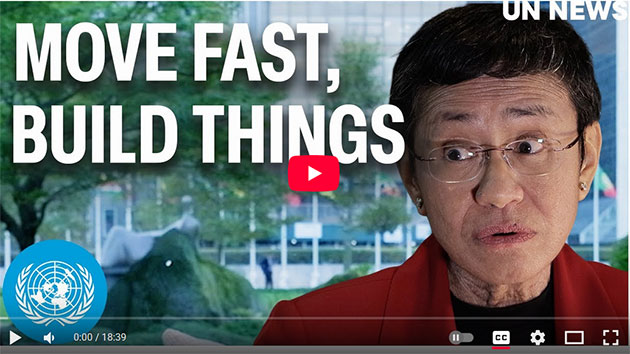
NEW YORK, Sep 30 2025 (IPS) – DANGER – WARNING – ALARM: Nobel Peace Prize Laureate Maria Ressa is warning that lies are being weaponized deliberately to manipulate people around the world. Big, profit-oriented, and technology-enabled companies are now disregarding or trampling over the sanctity and veracity of facts and information to speed up disinformation, (using AI) in ways that quickly erase truth and leave people manipulated.
Even democratic elections are getting manipulated to the extent that some 72 per cent of the world is now living under illiberal or authoritarian regimes that have been “democratically” elected. Journalism, fact-checking, and public trust are under attack from this deliberate subversion of information integrity.
Enjoy this interview I conducted with Ms Ressa, (produced, directed and edited by my UN News and Media colleagues, Paulina Kubiak and Alban Mendes De Leon).
[embedded content]
Ben Malor is the Chief Editor, UN Dailies, at UN News.
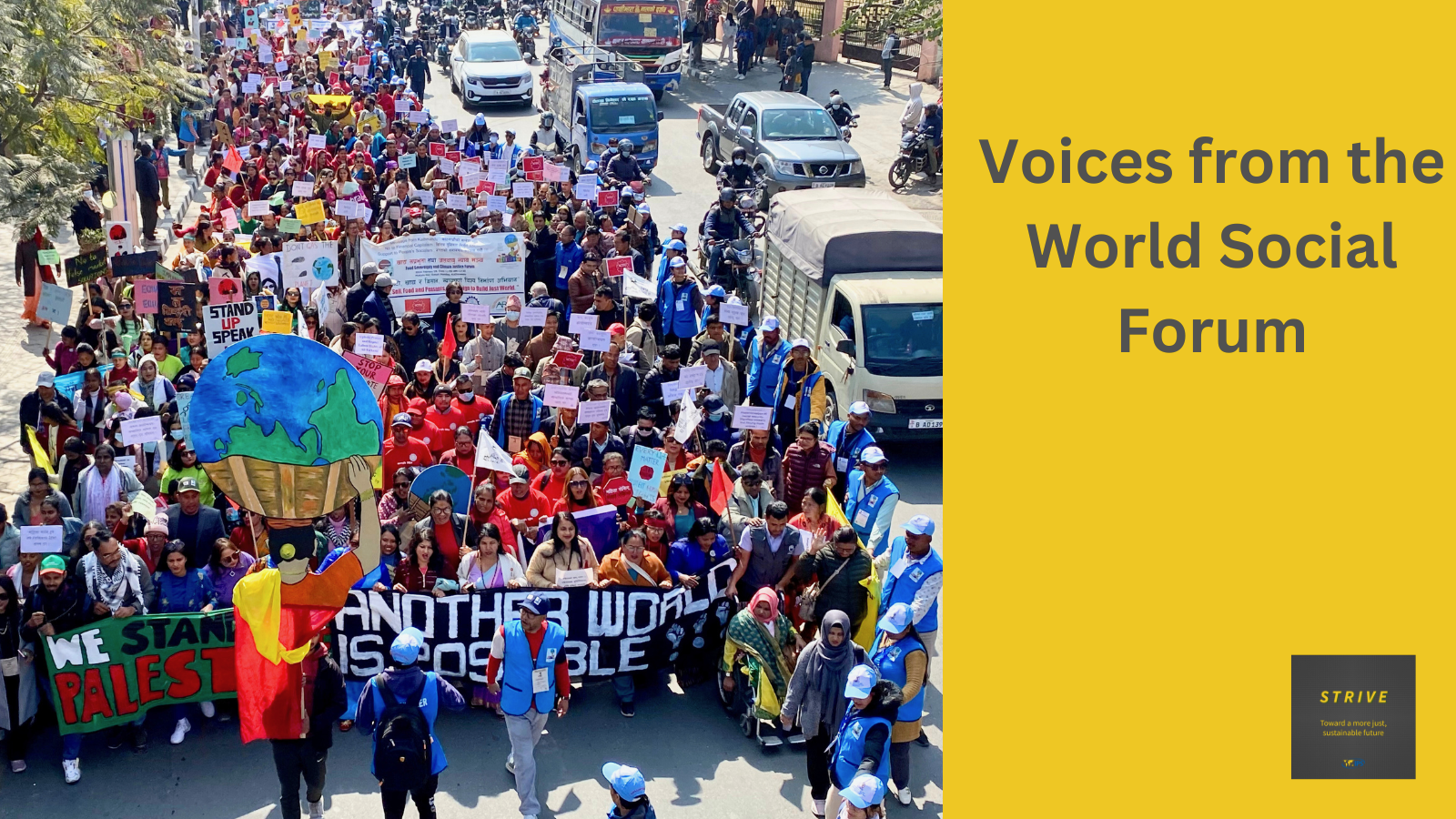
Feb 23 2024 (IPS) – After interviewing a member of the Nepal organizing committee ahead of opening day, I was excited about covering my first ever World Social Forum (WSF). He suggested that at least 30,000 and as many as 50,000 activists from over 90 countries would attend the three-day event.
But day 1 disappointed me. The march through the centre of Kathmandu was large, but not the massive showing I expected to see — perhaps because police in the vehicle-clogged city centre didn’t close roads along the route, but squeezed marchers into one lane of traffic. Again, thousands crowded in front of the stage for the opening ceremony but while it was impressive, it was far from a stupendous showing.
But as I hurried to attend various workshops over the next three days I became increasingly impressed. Each session — most held in cold, dusty classrooms in a series of colleges lining a downtown road— was full, some to overflowing.
On closing day more than 60 declarations were reportedly issued by the various ‘movements’, the thematic groups that comprise the WSF. I’m sure they assert the need for change: for peace, equality, rights and dignity — for people, nature and the planet. As usual, I support these calls.
But what I learned at my first WSF is that energy and enthusiasm for a world that looks and runs vastly differently than the often terrible one that we inhabit today has not waned among a huge number of people, young and old.
I’d hazard a guess that the ones you’re about to hear, who I recorded at the start of the Forum, would be as engaged and energetic if I had spoken with them after it ended, following hours of listening, learning, and networking about how to create a better world.
Regarded as one of the modern world’s icons of diplomacy, what is Kofi Annan’s legacy today? What can we learn from him, and how can we prepare for tomorrow, based on his vision for a better world?
In this exclusive 10-part podcast, Ahmad Fawzi, one of Kofi Annan’s former spokespersons and communication Advisor, will examine how Kofi Annan tackled a specific crisis and its relevance to today’s world and challenges.
Kofi Annan’s call to bring all stakeholders around the table — including the private sector, local authorities, civil society organisations, academia, and scientists — resonates now more than ever with so many, who understand that governments alone cannot shape our future.
Join us on a journey of discovery as Ahmad Fawzi interviews some of Kofi Annan’s closest advisors and colleagues including Dr Peter Piot, Christiane Amanpour, Mark Malloch-Brown, Michael Møller and more.
Brought to you by the Kofi Annan Foundation and the United Nations Information Service.
Kofi Time: The Official Trailer
Join us as we take a journey of discovery about Kofi Annan’s leadership style and what makes it so relevant and important today.
Multilateralism: Then & Now | Kofi Time with Lord Mark Malloch-Brown | Episode 1
In this episode, Lord Malloch Brown shares insights with podcast host Ahmad Fawzi on how Kofi Annan strengthened the United Nations through careful diplomacy and bold reforms, and how significant advances were made during his tenure as Secretary-General. He comments on the state of multilateralism today, as the organization is buffeted by the crisis in Ukraine and the paralysis of the Security Council.
Making Peace: Then & Now | Kofi Time with Christiane Amanpour | Episode 2
In this episode of Kofi Time, host Ahmad Fawzi interviews renowned journalist Christiane Amanpour. Together, they discuss a world in turmoil, and what would Kofi Annan – who did so much for peace – do today?
Christiane shares her thoughts on the ‘Kofi Annan way’, the difficult job mediators and peacebuilders face, and the courage they must show. With Ahmad, they deliberate whether there is a type of ‘calling’ for those who work in this field.
Health Crises: Then & Now | Kofi Time with Dr Peter Piot | Episode 3
In this episode of Kofi Time, our special guest is Dr Peter Piot. Dr Piot discusses how he and Kofi Annan worked together to reverse the HIV/AIDs tide that swept through Africa in the 1990s, through patient but bold diplomacy, innovative partnerships and an inclusive approach that brought to the table previously marginalized communities. Dr Piot and podcast host Ahmad Fawzi discuss whether this approach be replicated today as the world enters the third year of the COVID-19 pandemic and must prepare for future heath emergencies.
Fighting Hunger: Then & Now | Kofi Time with Catherine Bertini | Episode 4
In episode 4 of Kofi Time, our special guest is Catherine Bertini. Ms. Bertini discusses how she worked with Kofi Annan to fight hunger and malnutrition around the world. Not only is access to food far from universal, but it is also severely impacted by conflicts and climate change. As food prices increase and access becomes even more challenging, how can we replicate Kofi Annan’s approach to improving food systems to make sure no one gets lefts behind on the path to food security globally?
Leadership: Then & Now | Kofi Time with Michael Møller | Episode 5
In episode 5 of Kofi Time, host Ahmad Fawzi interviews diplomat Michael Møller on Kofi Annan’s special kind of leadership. A respected leader among his peers and the public, Kofi Annan served the people of the world with courage, vision and empathy. Embodying moral steadfastness and an acute political acumen, his leadership was one of a kind. What drove him, and how can we emulate his leadership style to face today’s global challenges?
Human Rights: Then & Now | Kofi Time with Zeid Raad Al Hussein | Episode 6
In episode 6 of Kofi Time, our special guest is Zeid Raad Al Hussein. Zeid discusses his friendship with Kofi Annan and how they worked together to protect human dignity and promote human rights. Through the creation of the Human Rights Council and International Criminal Court, Kofi Annan played a critical role in establishing the mechanisms that we have today to protect human rights and fight impunity. How can we uphold Kofi Annan’s legacy and ensure that respect for human rights is not just an abstract concept but a reality?
Podcast Host & Guests
Ahmad Fawzi Kofi
Time Podcast Host
Mr Fawzi is the former head of News and Media at the United Nations. He worked closely with Kofi Annan both during his time as Secretary-General and afterwards, on crises including Iraq and Syria. Before joining the United Nations, he worked for many years in broadcast journalism, as a news editor, reporter and regional news operations manager. From 1991 to 1992, he was the News Operations Manager for the Americas for Visnews — now Reuters Television. Also with Reuters Television, Mr Fawzi served as Regional News Manager for Eastern Europe, based in Prague, from 1989 to 1991 — a time of tumultuous political change in that region. Concurrently with his assignment in Prague, he coordinated coverage of the Gulf war, managing the war desk in Riyadh, as well as the production centre in Dahran, Saudi Arabia. In 1989, Mr Fawzi was Reuters Television Bureau Chief for the Middle East, based in Cairo. Prior to that, he worked in London as News and Assignments Editor for Reuters Television. Previously, he was Editor and Anchor for the nightly news on Egyptian Television.
Lord Mark Malloch-Brown
Episode 1 Guest
Mark Malloch‐Brown is the president of the Open Society Foundations. He has worked in various senior positions in government and international organizations for more than four decades to advance development, human rights and justice. He was UN Deputy Secretary‐General and chief of staff under Kofi Annan. He previously Co-Chaired the UN Foundation Board. Malloch-Brown has worked to advance human rights and justice through working in international affairs for more than four decades. He was UN deputy secretary‐general and chief of staff under Kofi Annan. Before this, he was administrator of the UNDP, where he led global development efforts. He covered Africa and Asia as minister of state in the United Kingdom’s Foreign Office. Other positions have included World Bank vice president, lead international partner in a political consulting firm, vice-chair of the World Economic Forum, and senior advisor at Eurasia Group. He began his career as a journalist at the Economist and as an international refugee worker. He was knighted for his contribution to international affairs and is currently on leave from the British House of Lords. Malloch-Brown is a Distinguished Practitioner at Oxford University’s Blavatnik School of Government, an adjunct fellow at Chatham House’s Queen Elizabeth Program, and has been a visiting distinguished fellow at the Yale Center for the Study of Globalization.
Christiane Amanpour
Episode 2 Guest
Christiane Amanpour is a renowned journalist, whose illustrious career has taken her from CNN where she was Chief international correspondent for many years, to ABC as a Global Affairs Anchor, PBS and back to CNN International for the global affairs interview program named after her. She has received countless prestigious awards, including four Peabody Awards, for her international reporting and her achievements in broadcast journalism. She served as a member of the board of directors of the Committee to Protect Journalists and a UNESCO Goodwill Ambassador for Freedom of Expression and Journalist Safety. She is also an honorary citizen of Sarajevo and was made a Commander of the British Empire in 2007 by Her Majesty Queen Elizabeth.
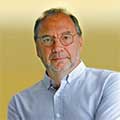
Dr Peter Piot
Episode 3 Guest
Dr Peter Piot co-discovered the Ebola virus in Zaire in 1976. He has led research on HIV/AIDS, sexually transmitted diseases, and women’s health, mostly in sub-Saharan Africa. Peter Piot was the founding Executive Director of UNAIDS and Under-Secretary-General of the United Nations from 1995 until 2008. Under his leadership, UNAIDS has become the chief advocate for worldwide action against AIDS. It has brought together ten organizations of the United Nations system around a common agenda on AIDS, spearheading UN reform Peter Piot was the Director of the Institute for Global Health at Imperial College; London and he held the 2009/2010 “Knowledge against poverty” Chair at the College de France in Paris. He is a Fellow of the Academy of Medical Sciences and was elected a foreign member of the National Academy of Medicine of the US National Academy of Sciences.
Catherine Bertini
Episode 4 Guest
An accomplished leader in food security, international organization reform and a powerful advocate for women and girls, Catherine Bertini has had a distinguished career improving the efficiency and operations of organizations serving poor and hungry people in the United States and around the world. She has highlighted and supported the roles of women and girls in influencing change. She was named the 2003 World Food Prize Laureate for her transformational leadership at the World Food Programme (WFP), which she led for ten years, and for the positive impact she had on the lives of women. While in the US government, she expanded the electronic benefit transfer options for food stamp beneficiaries, created the food package for breastfeeding mothers, presented the first effort to picture healthy diets, and expanded education and training opportunities for poor women. As a United Nations Under-Secretary-General, and at the head of the World Food Programme for ten years (1992 to 2002), she led UN humanitarian missions to the Horn of Africa and to Gaza, the West Bank, and Israel. During her time serving with WFP, Catherine Bertini was responsible for the leadership and management of emergency, refugee, and development food aid operations, reaching people in great need in over 100 countries, as well as advocacy campaigns to end hunger and to raise financial resources. With her World Food Prize, she created the Catherine Bertini Trust Fund for Girls’ Education to support programs to increase opportunities for girls and women to attend school. At the Maxwell School of Citizenship and Public Affairs at Syracuse University, where she is now professor emeritus, she taught graduate courses in humanitarian action, post-conflict reconstruction, girls’ education, UN management, food security, international organizations, and leadership. She served as a senior fellow at the Bill and Melinda Gates Foundation early in its new agricultural development program. Bertini is now the chair of the board of the Global Alliance for Improved Nutrition (GAIN). Concurrently, she is a Distinguished Fellow at the Chicago Council on Global Affairs. She has been named a Champion of the 2021 United Nations Food Systems Summit. She is a professor emeritus at Syracuse University.
Michael Møller
Episode 5 Guest
Mr Møller has over 40 years of experience as an international civil servant in the United Nations. He began his career in 1979 with the United Nations High Commissioner for Refugees and worked for the United Nations in different capacities in New York, Mexico, Iran, Haiti, Cyprus and Geneva. He worked very closely with Kofi Annan as Director for Political, Peacekeeping and Humanitarian Affairs in the Office of the Secretary-General between 2001 and 2006, while serving concurrently as Deputy Chef de Cabinet of the Secretary-General for the last two years of that period. Mr Møller also served as the Secretary-General’s Special Representative for Cyprus from 2006 to 2008 and was the Executive Director of the Kofi Annan Foundation from 2008 to 2011. From 2013 to 2019, Mr Møller served as Director-General of the United Nations Office at Geneva as well as Personal Representative of the United Nations Secretary-General to the Conference of Disarmament. He currently is Chairman of the Diplomacy Forum of Geneva Science and Diplomacy Anticipator. A Danish citizen, Mr Møller earned a Master’s degree in International Relations from Johns Hopkins University, and a Bachelor’s degree in International Relations from the University of Sussex, in the United Kingdom.
Zeid Raad Al Hussein
Episode 6 Guest
Zeid Ra’ad Al Hussein is IPI’s President and Chief Executive Officer. Previously, Zeid served as the UN’s High Commissioner for Human Rights from 2014 to 2018 after a long career as a Jordanian diplomat, including as his country’s Permanent Representative to the UN (2000-2007 & 2010-2014) and Ambassador to the United States (2007-2010). He served on the UN Security Council, was a configuration chair for the UN Peace-Building Commission, and began his career as a UN Peacekeeper in the former Yugoslavia. Zeid has also represented his country twice before the International Court of Justice, served as the President of the Assembly of State Parties to the Rome Statute of the International Criminal Court from 2002-2005, and in 2005, authored the first comprehensive strategy for the elimination of Sexual Exploitation and Abuse in UN Peacekeeping Operations while serving as an advisor to Secretary-General Kofi Annan. Zeid is also a member of The Elders, an independent group of global leaders working together for peace, justice and human rights, founded by Nelson Mandela. Zeid holds a PhD from Cambridge University and is currently a Professor of Practice at the University of Pennsylvania.
KATHMANDU, Aug 4 2022 (IPS) – The largest ever settlement in Canadian legal history, 40 billion Canadian dollars, occurred in 2022, but it didn’t come from a court – it followed a decision by the Canadian Human Rights Tribunal. In 2016 the Tribunal affirmed a complaint that the Government of Canada’s child welfare system discriminated against First Nations children. (First Nations are one of three groups of Indigenous people in Canada).
When I heard about that amount and subsequently how the government was negotiating the details of that settlement, I was astounded. Although I’ve had an interest in and reported regularly about human rights in the past three decades, my most intense experience has been here in Nepal, where for a couple of years I worked at the United Nations human rights office.
Nepal’s Human Rights Commission has a long history of having its recommendations virtually ignored by the government of the day. In fact, since 2000, only 12% of the NHRC’s 810 recommendations have been fully implemented. So when I compared the situation in Nepal to the tribunal’s decision and aftermath in Canada, my first question was ‘how’? How could the human rights situation in the two countries be so different that one government was compelled to pay out $40 billion for discrimination while another could virtually ignore recommendations?
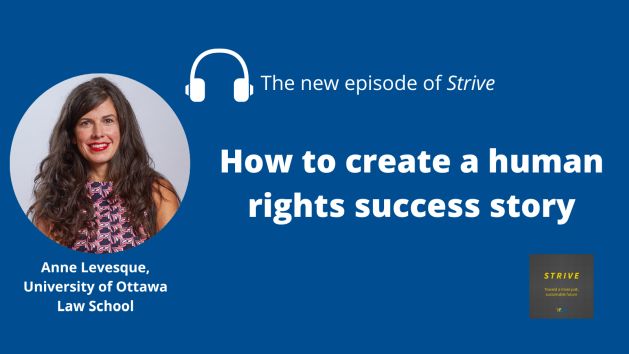
First, I have to confess that my understanding of the human rights framework in Canada and Nepal was lacking. As today’s guest, Professor Anne Levesque from the University of Ottawa, explains, Canada, like Nepal, has a federal human rights commission (as well as commissions in its provinces). But Canada also has the tribunal, a quasi-judicial body that hears complaints and can issue orders. Nepal however, lacks a human rights body that has legal teeth.
But is that the whole story, or are there other reasons why the Government of Canada must – and does – pay up when it loses a human rights case while the Government of Nepal basically files away the NHRC’s recommendations for some later date? Nepal, by the way, is not a human rights pariah. It is serving its second consecutive term on the UN Human Rights Council and the NHRC has been given an ‘A’ rating by an independent organization for conforming to international standards.






 Kofi Annan’s call to bring all stakeholders around the table — including the private sector, local authorities, civil society organisations, academia, and scientists — resonates now more than ever with so many, who understand that governments alone cannot shape our future.