Jul 25 2024 (IPS) – CIVICUS discusses the recent US Supreme Court ruling on presidential immunity and its potential impact on the 5 November presidential election with Ciara Torres-Spelliscy, a professor of Law at Stetson University College of Law.
On 1 July, the US Supreme Court ruled that presidents have absolute immunity for the exercise of their core constitutional powers and are entitled to a presumption of immunity for other official acts, although they don’t enjoy immunity for unofficial acts. The decision comes as Donald Trump faces criminal charges for trying to overturn his 2020 election loss to Joe Biden. The question now is whether Trump’s actions will be considered official or unofficial. But it’s unlikely he’ll be tried before the election, and if he returns as president he could pardon himself. Critics claim the Supreme Court ruling violates the spirit of the US Constitution by placing the president above the law.
What are the main points of the Supreme Court ruling on presidential immunity?
This is a ruling in the federal case against Trump for trying to overturn his loss to Biden in the 2020 election. He is accused of pressuring state officials to overturn the results, spreading lies about voter fraud and using the Capitol riot of 6 January 2021 to delay Biden’s certification and stay in power. Trump pleaded not guilty and asked the US Supreme Court to dismiss the entire case, arguing that he was acting in his role as president and was therefore immune from prosecution.
The Supreme Court didn’t do that, but instead created three new categories of presidential immunity: complete immunity for official acts involving core constitutional powers, potential immunity for acts within the ‘outer perimeter’ of official duties and no immunity for private, unofficial acts.
The key question now is whether Trump’s actions will be deemed official, giving him immunity, or unofficial, leaving him open to prosecution. This is the first case of its kind, as Trump is the first American president to be prosecuted.
How does this ruling affect Trump’s other criminal cases?
This immunity ruling is likely to delay all four of his criminal cases, as judges will have to apply these new rules and drop any charges that involve the use of core presidential powers, as these can no longer be used as evidence against him.
As well as being accused of trying to overturn his 2020 defeat, Trump is also accused of paying adult film actress Stormy Daniels hush money during the 2016 election and not properly accounting for it in his business records. This case is unlikely to be affected by the ruling, as his actions don’t involve either core or peripheral presidential powers. Judge Merchan will have to decide whether any of his 34 felony business fraud convictions will stand or be thrown out.
But some of his other crimes occurred during his time in the Oval Office. Trump is accused of conspiring to overturn his 2020 loss in Georgia by asking the state’s top election official to ‘find 11,780 votes’. Trump has pleaded not guilty and could be prosecuted in his personal capacity, as presidents have no role in administering US elections. As in the Capitol case, this was a private action he took as a candidate and it would be difficult to fit into the category of presidential immunity.
The fourth case Trump faces is the Mar-a-Lago classified documents case. Trump is accused of mishandling classified documents by taking them to his Mar-a-Lago residence after leaving office and refusing to return them to the National Archives when he could no longer lawfully possess them. As his alleged crimes took place when he was no longer president, this case shouldn’t be affected by the immunity ruling. However, he could argue he possessed the documents while in office and ask that his case be treated differently from other defendants. This case was dismissed by Judge Cannon. However, the Mar-a-Lago criminal case could come back to life if the 11th Circuit reverses her dismissal.
What are the broader implications of this case for the presidential election?
After this decision, the American public should think about the consequences of who they elect as president, because the presidency can become a wellspring of crime.
An honest president wouldn’t be affected by the Trump v. US decision, because an honest person doesn’t need criminal immunity. Only time will tell whether the Supreme Court has invited future presidents to go on a crime spree. But what is certain is that only US voters can keep criminals out of the White House. So, as I write in my new book, Corporatocracy, the stakes in the 2024 election are incredibly high for the fate of US democracy.
Civic space in the USA is rated ‘narrowed’ by the CIVICUS Monitor.
Donald J. Trump, President of the United States, addresses the General Assembly’s 75th session in September 2020. Credit: UN Photo/Rick Bajornas
ATLANTA, Georgia, Jul 19 2024 (IPS) – Republican Vice-Presidential nominee JD Vance and other speakers at the GOP Convention gleefully referenced the party’s latest icon: a wounded Donald Trump with blood on his face raising his fist in defiance beneath Old Glory’s stars and stripes.
The MAGA party realizes that they have a powerful symbol that will likely return Trump to the White House, because symbols are supremely powerful for both politics and religion. Associated Press photographer Evan Vucci captured the image, one of the most iconic ever recorded in American history. It fits perfectly into the Republican Campaign theme—“Trump is a hero and only he can save us.” The only other comparable photograph is the unforgettable one showing embattled Marines raising the American flag on Iwo Jima during WW II.
Vucci’s photograph framed a bloody former President, wounded in the assassination attempt, heroically pumping his fist in defiance beneath a red, white, and blue flag against a clear blue sky. It was the perfect photo, taken at a moment of extreme peril for American democracy, and sure to win a Pulitzer Prize.
It could be the key visual message that motivates people to side with Trump as a hero and propel him back to the White House. Photojournalist Doug Mills of the New York Times snapped a remarkable photo of the bullet in mid-air just beyond Trump, but Vucci’s stirring image of the wounded former president conveys a much more impactful message of heroism and patriotism.
Americans clearly prefer a tough, vigorous, even pugnacious and younger male leader (even if the image is false) to an old, decrepit President, especially one stammering to express himself and now sidelined with Coronavirus.
MAGA Republicans insist that people should vote for their hero Trump instead of Biden, pictured as a weak old man, or heaven forbid, by a scrappy female like Hillary Clinton, Kamala Harris, or even Republican Nikki Haley.
Aging leaders have been required to prove their virility from time to time throughout history—in ancient Egypt by running around a course, and in Communist China by swimming, or more likely floating, for ten miles in the Yangtze River, as did Mao Tse-tung in 1966.
His claim of fitness, especially in the photo of him swimming, became an icon across China and revived his political fortunes after the disaster of the Great Cultural Revolution.
Americans consider themselves to be a tough breed. That in turn requires a macho man to be our leader. Even if Trump is not really that, the picture of a defiant Trump surviving an assassin’s bullet and pumping his fist is an incredibly powerful icon at this moment of destiny in the nation’s politics.
There were no photos when Lincoln was shot and the Kennedy assassination photos show blurs in the back of a speeding convertible. The only other iconic photo to stir the emotions of patriotic Americans with equally intense feelings would be that snapshot by photographer Joe Rosenthal Showing US Marines raising the flag on Mount Suribachi.
That picture captured American patriotism so perfectly that it was later sculpted into a colossal statue near the US Capitol in Washington.
Not many people know about semasiography—the science of symbols—but throughout history symbols have had an underlying, supremely powerful influence on religion, politics, and human behavior. This photo of Trump, like the one of the marines, has the capacity to impact people at a visceral level and therefore to change human behavior on a large scale.
There is no question of the overwhelming influence of such a potent symbol at this point in an evenly balanced and fiercely divided, nation.
The way symbols work is like this: they are simple, convey meaning in a generalized sense, and have the capacity to rally multitudes of people, sometimes continuing to evoke allegiance for thousands of years. Many national flags in the modern era include symbols.
The red, white, and blue of the American flag can cause tears to flow, pride to swell the chest, and infuse soldiers with the courage to face cannons on the battlefield.
One of the most omnipresent symbols worldwide is the Christian Cross, which has provided meaning and identity for millions of people over thousands of years. The Nazi Swastika and the Hammer and Sickle rallied Germans and Russians, functioning in a similar way for unbelievably vast numbers of people during WW II.
The swastika, or broken cross, was an ancient Aryan cultural sign, meaning to the Germans “Deutchland Uber Alles,” the racial-political creed of Germany. Hitler was delighted when he found it, knowing he could use it to rally the nation to his banner.
The Soviet hammer and sickle dominated great parts of the globe for much of the Twentieth Century, signifying the rise of the Proletariat. During the Vietnam War, millions of college students protested wearing the peace sign in support of the anti-war movement.
A symbol can carry a different meaning for millions of people, allowing each individual to put his or her own meaning into it, often leading to action. In short, a symbol is a way to capture and intensify personal feelings.
An appropriate and timely icon can be used to lure, move, or drive masses of people toward a desired goal, even if its message is vague and diffuse.
Several modern psychiatrists have focused on symbolism, beginning of course with Freud. The study of semasiography became a major preoccupation of his most prominent successor, Jung. Both knew the power of symbols.
Soon the icon of a defiant Trump—the ultimate American tough guy—will appear on t-shirts and coffee mugs, helping to build a different national culture than the one bequeathed to Americans by Roosevelt, Eisenhower, Kennedy, and others of the Greatest Generation.
This new political culture has already shown its true colors—dominance, retribution, reaction, discrimination, with threats of violence and coercion as the new mechanism of control. Sadly, this is the way history works. Change is coming—prepare for it.
James E. Jennings is President of Conscience International and Executive Director of US Academics for Peace.
KATHMANDU, Aug 4 2022 (IPS) – The largest ever settlement in Canadian legal history, 40 billion Canadian dollars, occurred in 2022, but it didn’t come from a court – it followed a decision by the Canadian Human Rights Tribunal. In 2016 the Tribunal affirmed a complaint that the Government of Canada’s child welfare system discriminated against First Nations children. (First Nations are one of three groups of Indigenous people in Canada).
When I heard about that amount and subsequently how the government was negotiating the details of that settlement, I was astounded. Although I’ve had an interest in and reported regularly about human rights in the past three decades, my most intense experience has been here in Nepal, where for a couple of years I worked at the United Nations human rights office.
Nepal’s Human Rights Commission has a long history of having its recommendations virtually ignored by the government of the day. In fact, since 2000, only 12% of the NHRC’s 810 recommendations have been fully implemented. So when I compared the situation in Nepal to the tribunal’s decision and aftermath in Canada, my first question was ‘how’? How could the human rights situation in the two countries be so different that one government was compelled to pay out $40 billion for discrimination while another could virtually ignore recommendations?
First, I have to confess that my understanding of the human rights framework in Canada and Nepal was lacking. As today’s guest, Professor Anne Levesque from the University of Ottawa, explains, Canada, like Nepal, has a federal human rights commission (as well as commissions in its provinces). But Canada also has the tribunal, a quasi-judicial body that hears complaints and can issue orders. Nepal however, lacks a human rights body that has legal teeth.
But is that the whole story, or are there other reasons why the Government of Canada must – and does – pay up when it loses a human rights case while the Government of Nepal basically files away the NHRC’s recommendations for some later date? Nepal, by the way, is not a human rights pariah. It is serving its second consecutive term on the UN Human Rights Council and the NHRC has been given an ‘A’ rating by an independent organization for conforming to international standards.
NEW YORK, Sep 13 2021 (IPS) – Today, on 13 September 2021, the UN Declaration and Programme of Action adopted by the General Assembly in 1999 will be turning 22.
You would recall that the 20th anniversary of The Culture of Peace of its adoption by the world’s highest multilateral body in 2019 was observed by the United Nations in an appropriate and befitting manner, as called for by the Assembly. It was an occasion for reiteration and recommitment by us all to create the culture of peace in our world, beginning with each one of us.
After the UN Charter, this is the only major document of the UN which focuses on peace in a most comprehensive manner. We need to pay increasingly more attention to this landmark document for its full and effective implementation.
Last week another integrally-connected milestone gathering – the 2021 UN High Level Forum on The Culture of Peace – took place at the UN General Assembly convened by its President of the 75th session.
This day-long event organized on 7 September 2021 attained a special profile and attention as it was the 10th anniversary of the annual UN high level forums which was first initiated in 2012 during the 66th session of the Assembly by its then President, Ambassador Nassir Al-Nasser of Qatar.
His objective was to create a new platform for the culture of peace at the UN to be held on an annual basis for an opportunity to exchange ideas between the Member States and civil society organizations.
I happened to be his senior special advisor involved in conceptualizing and organizing that very first forum on 14 September, the day after the 11th anniversary of The Culture of Peace.
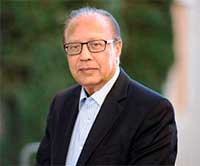
Ambassador Anwarul K Chowdhury
This year’s Forum was held in a hybrid format, both in-person and virtual platforms. With its focus on the theme “The Transformative Role of The Culture of Peace: Promoting Resilience and Inclusion in Post-Covid Recovery”, the Forum provided the opportunity to the participants and all stakeholders to exchange ideas and make suggestions on how to utilize the values of culture of peace in post-Covid recovery efforts, especially to ensure that the recovery, which unfortunately is yet to happen, is durable, resilient and inclusive.
The President of the General Assembly Volkan Bozkir of Turkey, under whose leadership the 2021 Forum took place, earned the grateful tribute of all stakeholders for his guidance, initiative and encouragement in convening and holding this 10th anniversary forum under extremely challenging circumstances very successfully. The Panel Discussion was a fitting conclusion to this remarkable gathering.
As I was preparing for the Panel Discussion, I ran into the historical perspective that this year will reach the quarter century mark of my close association with and advocacy for the culture of peace at the United Nations. In 1997, I took the lead in proposing along with some other Ambassadors in a letter to the newly-elected UN Secretary-General Kofi Annan to include a specific, self-standing agenda item of the UN General Assembly (UNGA) on The Culture of Peace.
A new agenda item was thus agreed upon after considerable negotiating hurdles and the new item was allocated to the plenary of the General Assembly for discussion on an annual basis. That is the basis for the annual resolutions on The Culture of Peace by the General Assembly from that year.
Under this item, UNGA adopted in 1997 a resolution to declare the year 2000 the “International Year for The Culture of Peace”, and in 1998, a resolution to declare the period from 2001 to 2010 as the “International Decade for The Culture of Peace and Nonviolence for the Children of the World”.
In the year after that the United Nations adopted its Declaration and Programme of Action on The Culture of Peace, a monumental document that transcends boundaries, cultures, societies and nations. It was an honor for me to Chair the nine-month long negotiations that led to the adoption of this historic norm-setting document by consensus.
As I mentioned Secretary-General Kofi Annan earlier, let me quote his thoughts on the culture of peace – I cite this quote often: “Over the years we have come to realize that it is not enough to send peacekeeping forces to separate warring parties. It is not enough to engage in peace-building efforts after societies have been ravaged by conflict. It is not enough to conduct preventive diplomacy. All of this is essential work, but we want enduring results. We need, in short, the culture of peace.”
Absolutely right – we need “enduring results” and for that we need “The Culture of Peace”. The Culture of Peace is not a hollow phrase – or an empty sentiment. It has a transformational opportunity for humanity – it has the energy and enthusiasm of many of us individually and collectively around the world.
These annual forums are very special in their involvement of civil society. These are the only High-Level Forums in the UN which are fully 50-50 gender balanced in their panel compositions. I am proud to say that this was possible as the Global Movement for The Culture of Peace (GMCoP) which is the civil society partner in supporting the Forum has been very diligent in upholding these values.
The concept note of this year’s Forum forcefully reiterated that “…it is an imperative to inculcate the values of The Culture of Peace among nations, societies and communities, with particular attention to the younger generation, through promotion of compassion, tolerance, inclusion, global citizenship and empowerment of all people.”
The theme focusing on the transformative role of the culture of peace in relation to Covid recovery provided a platform to explore and discuss multiple ways and means for empowering all segments of the society, towards a resilient recovery, including by ensuring vaccine equity, asserting universal vaccination as a public good, bridging digital divide, ensuring centrality of women’s equality and empowerment, harnessing the power of youth and highlighting education, health and overall wellbeing of children.
Bangladesh Foreign Minister Dr. AK Abdul Momen in his pre-recorded video presentation at the Forum articulated succinctly that “We must recognize that rebuilding from the COVID pandemic necessitates a renewed commitment and partnership of all stakeholders. Our efforts should be undergirded by the values of “The Culture of Peace’ as instilling these values contribute to building a resilient, inclusive and peaceful society.”
This year’s Forum heard the inspirational keynote speech by Dr. Beatrice Fihn, the Executive Director of 2017 Nobel Peace Prize winning organization ICAN, International Coalition for the Abolition of Nuclear Weapons, by calling on all that “On this 10th anniversary of the culture of peace, I am urging you all to continue and strengthen your work to promote education, sustainable and economic developments, human rights, gender equality, democratic participation and international peace and security.
She is the sixth Nobel Peace Prize laureate as the keynote speaker at The Culture of Peace Forums, which also make us proud that all of them are distinguished women Nobel Peace laureates. Complimenting Dr. Fihn for her keynote, I underlined that the essence of her keynote message has now become more pertinent in the midst of the ever-increasing militarism and militarization that is destroying both our planet and our people.
Video message by the activist and globally respected Mayor Kazumi Matsui of Hiroshima, the city which along with Nagasaki bear the scars of nuclear destruction and yearn for global peace, highlighted a major engagement of his world-wide peace organization announcing that “On the 7th of July this year, Mayors for Peace, which I preside over, adopted our new Vision, a set of concrete action guidelines, titled: “Vision for Peaceful Transformation to a Sustainable World.”
One of the objectives set forth by the new Vision is to ‘promote a culture of peace’.” Informing that the foundation of this policy change rests in the ability to build a consensus in favor of the abolition of nuclear weapons, he asserted that “To do this, first cultivating a culture of peace-a culture in which the everyday actions of each person are grounded in thinking about peace-is essential.
It is our belief, that this “bottom-up” approach is the most viable approach to peace, and is in line with the values which prompted the efforts of Ambassador Chowdhury and those in attendance.”
The Mayor’s passionate message included in the Peace Declaration, which he delivered in Hiroshima on 6th of August this year, advocated forcefully that “When like-minded people who seek peace unite for the same purpose, we can bring about a significant change in the world.”
Mayor Matsui encouraged the Forum by informing that “Mayors for Peace consists of over 8,000 member cities in 165 countries and regions around the world. With support from member mayors for our aforementioned cause, we will work to promote a culture of peace by expanding our membership and reaching out to a wider public.”
Often, I am asked how I assess the progress made so far since the Assembly adopted the Programme of Action in 1999. At this year’s High-Level Forum, as the Chair-Moderator of its Panel Discussion, I repeated my concern that lamentably, The Culture of Peace has yet to attain its worth and its due recognition at global and national levels as a universal mandate for the humanity to attain sustainable peace in the true sense.
When people wonder what are my plans to advance the concept in the UN system, my response verges on my advocacy message in general. The Declaration and Programme of Action on Culture of Peace adopted without any reservation is a landmark document of United Nations.
The Organization should, therefore, own it and internalize its implementation throughout the UN system. There seems to be lethargy in that direction because, I believe, the Secretary-General needs to make the culture of peace a part of his leadership agenda.
We should get that attention and engagement from him. Also, the UN entities, at least most of them, are preoccupied with what is known as “active agenda” which is a kind of daily problem-solving or problem-shelving.
That means no opportunities to focus on longer term, farsighted objective of sustainable peace with a workable tool that UN possess in the culture of peace programme adopted by its own apex body, the General Assembly. It is like a person who needs a car to go to work and has a car… but with a minimal interest in knowing how to drive it.
Many treat peace and culture of peace synonymously. There is a subtle difference between peace as generally understood and the culture of peace. Actually, when we speak of peace we expect others namely politicians, diplomats or other practitioners to take the initiative while when we speak of The Culture of Peace, we know that initial action begins with each one of us.
For more than two decades, my focus has been on advancing The Culture of Peace which aims at making peace and non-violence a part of our own self, our own personality – a part of our existence as a human being.
I believe The Culture of Peace is not a quick-fix. It is a movement, not a revolution!
Ambassador Anwarul K. Chowdhury is Founder of The Global Movement of The Culture of Peace (GMCoP); former Under-Secretary-General of the UN and the Chair of the negotiations which resulted in the consensus adoption of the UN Declaration and Programme of Action on The Culture of Peace in 1999. He was the Chair and Moderator of the virtual Panel Discussion at 2021 UN High Level Forum on The Culture of Peace on 7 September 2021.
Emily Standfield is CIVICUS Member and data volunteer.
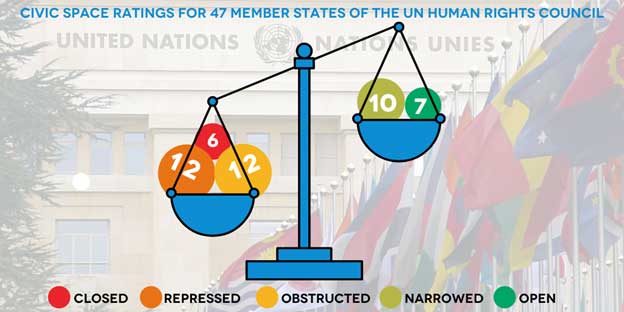
National civic space ratings from the CIVICUS Monitor, which uses up-to-date information and indicators to assess the state of freedom of association, peaceful assembly and expression for all UN Member States. Credit: CIVICUS Monitor
TORONTO, Canada, Feb 24 2021 (IPS) – A month into Joe Biden’s presidency, the U.S. has rejoined nearly all the multilateral institutions and international commitments that it withdrew from under Trump. These include the World Health Organization and the Paris Climate Accords.
Most recently, on February 8th, the U.S. announced it would also rejoin the United Nations Human Rights Council (HRC) as an observer. The U.S.’ role in the human rights forum looks different than it did four years ago in light of its recent track record on civil liberties.
The HRC has two primary functions: to draft and adopt new standards for human rights and to conduct investigations into specific human rights issues. In 2018, U.S. Ambassador to the UN Nikki Haley and U.S. Secretary of State Mike Pompeo announced that the U.S. would be leaving the HRC, claiming that it was a barrier to any genuine global human rights protection. The U.S. had two primary grievances.
First, that the HRC has an “unconscionable” and “chronic bias” against Israel. And second, that the HRC’s membership criteria allows chronic human rights abusers to have a seat on the Council. Neither of which are entirely baseless claims.
Israel remains the only country-specific agenda item covered at every HRC meeting and Russia, China, and Eritrea — to name a few — all currently hold seats on the Council and have some of the worst human rights records in the world.
Emily Standfield. Credit: CIVICUS
On Monday, the HRC’s 47 member states met for its 46th session, it’s third time meeting since the beginning of the pandemic. The further decline of political and civil rights as enshrined in international law will be an unavoidable hot topic.
The CIVICUS Monitor which rates UN member states’ track records of upholding the legal tenets of freedom of expression, freedom of peaceful assembly and freedom of association finds that 30 of the Council’s full member states routinely and severely restrict these rights.
And in the case of its newest observer state, the USA was recently downgraded to the Monitor’s third worst civic space rating of ‘Obstructed’. The body is a long way off from adequately representing its values.
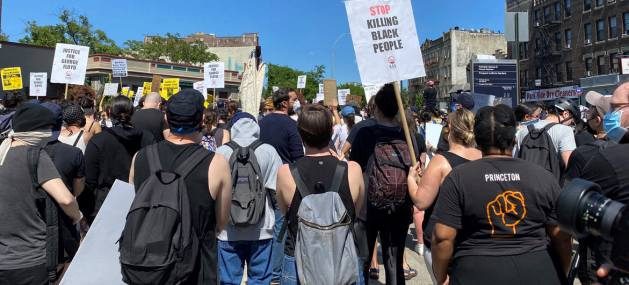
In the case of the USA, the rating change and decline in rights is reflected by the police response to the Black Lives Matter (BLM) protest movement. During protests in 2020, law enforcement detained thousands of demonstrators, used teargas and projectiles to disperse crowds, and attacked journalists, despite the fact that most wore media credentials.
President Trump and other authority figures encouraged police officers to respond forcefully and, in some cases, requested such violent actions for their own benefit. In a perfect example of this, the Attorney General ordered the use of teargas against peaceful protesters so that President Trump could have a photo-op in front of a church.
While the BLM protests may have made the decline in civic freedoms abundantly clear, this rating change represents a longer deterioration of political and civil rights.
In response, in June the HRC unanimously passed a mandate that called for a report on ‘systemic racism’ targeted at individuals of African descent. Philonise Floyd, the brother of George Floyd, whose murder at the hands of white police officers began the mass protests, called on the human rights body to examine the U.S.’ history of racial injustice and police brutality.
In the end, the final resolution passed by the HRC called for an investigation of systemic racism globally and regrettably did not single out the U.S.
While Biden has rejoined the HRC as an observer, the U.S. must win elections in October 2021 if it wants to regain its seat on the Council. In 2019, Biden said, “American leadership on human rights must begin at home” and — in some ways — it has.
The BLM protests have sparked a degree of state and local level police reform, and Biden has made a commitment to achieving racial equity. While the U.S. should focus on improving freedoms within its borders, it should also not exempt itself from becoming a full member of the HRC again in October.
Former President Barack Obama ran for a seat on the Council because he believed the U.S. could do more to advance human rights as a member of the body. This turned out to be true— the U.S. supported the creation of several important international commissions of inquiry to investigate human rights violations.
If the rationale by Trump was that leaving the council would do more for human rights than holding a seat, it’s clear that this has not come to fruition. Whether it is freedom of speech or the right to peacefully protest, today more of the world’s population lives in ‘Closed’, ‘Repressed’ or ‘Obstructed’ countries as compared to four years ago, finds the CIVICUS Monitor.
Leadership is needed at the UN Human Rights Council on these issues, but it must come from those that have a full seat at the table and have a demonstrated track record of upholding their commitments. The U.S. is currently disqualified on both accounts. Credibility and moral leadership must come from somewhere else.
Instead, the U.S. must support other member states that are leading by example on these issues. Seven members of the HRC — Denmark, Germany, Uruguay, Netherlands, Marshall Islands, and Czechia — are rated ‘Open’ by the CIVICUS Monitor, the highest civic space rating a country can achieve.
These countries are adequately representing the values that the HRC is committed to defending. While there are surely other issues at the HRC that the U.S. will prove influential, the country is far from the inspirational example it often likes to present itself on these world stages.
At the current session of the HRC, which began on February 22nd, the U.S. should champion these members who have made meaningful progress on civil liberties and be prepared to take a backseat on issues that it so obviously falls short on.
Protests have been taking place in cities across the United States. Credit: UN News/Shirin Yaseen
MIAMI, Sep 4 2020 (IPS) – Why, in the United States, where change is the most pronounced hallmark, do some aspects never change? Why do many bad habits resist giving way to novelties that prove to be the basis of the success of the most developed country on earth and still the leading power? Why is the explanation for that leadership due to a few factors? Why does Trump profess a visceral opposition to immigration, knowing that it is the key to the country’s success? Because millions of his compatriots interpret the sinew of American DNA as a threat to their comparative social advantage.
Meanwhile, in this drama, blacks continue to bear the brunt of it all. The explanation for their endemic discrimination is the contrast between their implantation in the United States and the way the rest of the public settled in the “American dream.” Almost everyone came to this idea that is the United States of free will.
No one can say that their grandparents were forced to change residence. Although it can be argued that hunger, religious persecution, and the desire for economic improvement were important factors in driving emigration from Europe, Africa, or Asia, it is also true that voluntary americanization is the key to the success of the United States.
Joaquín Roy
This country is the most genuine example of national construction opposed to that based on ethnicity, religion, race. America is the most definite specimen of the nation of choice, based on personal conviction.
It is not by chance that theorists of nationalism call this alternative “liberal.” The “American dream” explains its survival. As long as millions of citizens of other continents answer Ernest Renan’s question with a negative vote every night in his imaginary “daily plebiscite”, and decide to opt for the residency trick, the United States will exist.
The day a majority of Americans vote negative for residency, the country would be deserted. There is nothing that unites Americans, except their desire to be. Their religion is summarized in the offer provided by the Declaration of Independence: life, liberty and the pursuit of happiness. He does not give them a guarantee, but a promise. And it is enough for them.
However, the absence of a residency obligation has two crucial exceptions: black and indigenous minorities. These two sectors contrast in their implementation in what for them is, more than a dream, an “American nightmare.”
Although it can be argued that hunger, religious persecution, and the desire for economic improvement were important factors in driving emigration from Europe, Africa, or Asia, it is also true that voluntary americanization is the key to the success of the United States.
The original owners of the immense territory, although their immemorial ancestors crossed the Straits of Alaska at the dawn of North America, have been reduced to their reservations, marginalized, eaten away by poverty and alcoholism. Even in the sporadic mythos in Hollywood movies, Sitting Bull and his imitators do not overcome the mystique of Buffalo Bill.
The blacks were unfortunately marked by the original sin of not having booked a ticket for the forced trip to the United States. Their implantation has been resisted from the beginning by themselves and by the descendants of the merchants who deposited them in America.
With their emancipation and its disastrous execution, the peculiarity of their residence became more apparent. When they were stripped of the benefits that they had given away to their owners for free, their value was lost in Wall Street.
The successive corrective measures of discrimination and segregation only made the division of society even more evident. Despite the actions of Martin Luther King, who paid for his daring with his life, legal advances supercharged racist resentment from a part of society that resisted reform. “Affirmative Action” and food stamps multiplied the opposition.
Simultaneously, the black community, which had ceased to call itself “colored,” to take a curious journey back to being classified as “African,” watched with amazement as other newcomers from other continents were climbing ranks.
Latin Americans began to outnumber blacks not only in economic resources, but in numbers. As a result of the new census parameters, while whites held 63%, Hispanics (15%) and Asians (10%) cornered blacks (13%).
Internally, the new “African-Americans” decided to opt for a peculiar nationalism: they defended themselves with their signs of “black is beautiful”, they enthroned their peculiar English inherited from their owners, and they monopolized some entertainment professions.
Some were more fortunate and co-opted the rosters of basketball teams. For their part, some managed to settle on the ladders of power as senators and congress people, thanks in part to the restructuring of electoral districts.
Then they even aimed, with the decisive support of white sectors, to opt for the incredible: the presidency of the United States. It was already too much and the opposition to this impudence did not forgive Obama or the rest of the community, and even less the Democrats and liberals.
The mirage of the election of the first black president bypassed the resistance of deep America and the withdrawal of the “silent majority” that Nixon tried to awaken. Now Trump has reinvented it.
It was forgotten that only about a third of the electorate voted for Obama, while another third chose the Republican candidates. Another third stayed home. Among those 60-70% of Americans who abstained from voting on the traditional electoral correction, crouched was the mostly white sector, both high-income and lower-middle-class that followed the sounds of the piper Trump.
Those who rejected the candidate Hillary Clinton believed, and still believe, that their faltering economies have been pierced by the rise of the historically vanquished. They now believe that their pristine suburbs, real or imagined, are threatened by the “socialist” hordes of predominantly Latino origin, and the “terrorists” who insist on protesting against what they consider dangerous interference by the security forces in daily life.
The only thing missing is that the statistical evidence of the black overpopulation of the prisons and the number of crime victims of the same origin is “enriched” with sad deaths of blacks at the hands of white policemen.
Joaquín Roy is Jean Monnet Professor and Director of the European Union Center at the University of Miami