From Pledges to Proof: UN Biodiversity Meeting Begins First Global Review of Nature Action

Biodiversity, Climate Action, Conferences, Development & Aid, Editors’ Choice, Environment, Featured, Gender, Global, Headlines, Indigenous Rights, Natural Resources, Sustainable Development Goals, TerraViva United Nations
Biodiversity

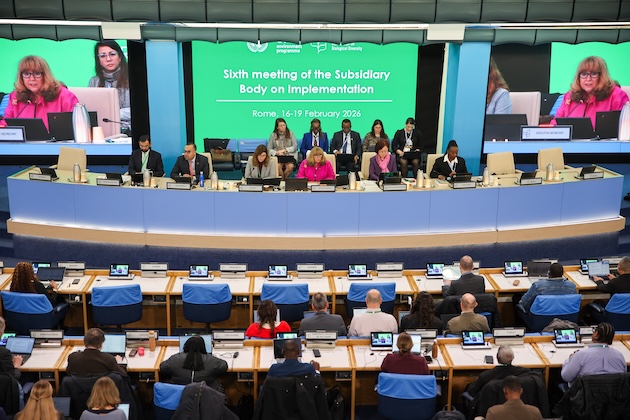
The 6th meeting of the Subsidiary Body of Implementation (SBI-6) is in progress in Rome. Credit: Mike Muzurakis | IISD/ENB

The 6th meeting of the Subsidiary Body of Implementation (SBI-6) is in progress in Rome. Credit: Mike Muzurakis | IISD/ENB |

ROME & DELHI, Feb 17 2026 (IPS) – Governments convened in Rome on Monday (February 16) for a critical round of UN biodiversity negotiations, launching the world’s first global review of how countries are acting to protect nature.


The sixth meeting of the Subsidiary Body on Implementation (SBI-6) of the Convention on Biological Diversity opened at the headquarters of the Food and Agriculture Organization (FAO), drawing government negotiators, technical experts and civil society observers from around the world. It will continue until February 19.

Although considered a technical gathering, the four-day session is expected to play a decisive role in shaping how progress under the Kunming–Montreal Global Biodiversity Framework will be assessed and whether political promises can be translated into measurable, on-the-ground action.

“This is a moment to move from commitments to delivery,” said Clarissa Souza Della Nina of Brazil, Chair of the Subsidiary Body on Implementation. “The task before us is to help countries accelerate action to halt and reverse biodiversity loss.”

Clarissa Souza Della Nina of Brazil, Chair of the Subsidiary Body on Implementation. Credit: Mike Muzurakis | IISD/ENB

Clarissa Souza Della Nina of Brazil, Chair of the Subsidiary Body on Implementation. Credit: Mike Muzurakis | IISD/ENB

A Global Stocktake for Nature

The Rome talks come two years after countries completed the first global stocktake under the Paris Agreement, which confirmed the world remains far off track on climate goals.

Now, a parallel exercise begins for biodiversity.

Under the CBD, governments will undertake the first global review of progress in implementing the Kunming–Montreal Global Biodiversity Framework (KMGBF), adopted in 2022. The framework includes 23 targets spanning conservation, finance, equity and economic transformation, with the overarching objective of halting and reversing biodiversity loss by 2030.

Biodiversity tracking is more complex than emissions accounting, but, according to CBD leadership, it is urgently needed.

“The time has come to make peace with nature… the implementation of the Kunming-Montreal Global Biodiversity Framework and the Paris Agreement in a synergistic fashion will make peace with nature within reach,” said Astrid Schomaker, Executive Secretary of the Convention on Biological Diversity.

Why Rome Matters

SBI-6 plays a central role in preparing for the upcoming global biodiversity review by examining implementation progress, highlighting gaps, and proposing ways to accelerate action. Negotiators will submit the outcomes directly to COP17 in Yerevan, Armenia, later this year.

“One year after COP16 concluded here in Rome, we must ensure these meetings deliver real progress. Submitting national reports on time is essential for a strong and credible global review in the race to 2030,” Schomaker said.

A major focus of SBI-6 is the Secretariat’s analysis of national biodiversity strategies and action plans submitted since 2022. But despite growing momentum, significant gaps persist. Many strategies still do not adequately integrate Indigenous Peoples, local communities, women, youth, or the private sector. Crucial targets relating to economic and social transformation — including sustainable consumption, equity and benefit sharing — remain underemphasised.

Inger Andersen, Executive Director of the United Nations Environment Programme (UNEP), underscored the stakes at the launch of the State of Finance for Nature 2026 report:

“Whether investments flow into nature’s destruction or into its protection will determine if we live in climate-vulnerable concrete jungles or in climate-resilient green cities,” she warned, stressing that financial and policy decisions made today will shape countries’ ability to meet biodiversity goals.

An indigenous woman and biodiversity defender from the Amazon is pictured holding a forest coconut. Women are asking for better implementation of article 23 of the KMGBF. Credit: Stella Paul/IPS

An indigenous woman and biodiversity defender from the Amazon is pictured holding a forest coconut. Women are asking for better implementation of article 23 of the KMGBF. Credit: Stella Paul/IPS

Gender, Finance and Capacity Challenges

Delegates are also reviewing progress under the CBD Gender Plan of Action (2023–2030). Early assessments show that only a quarter of countries involved women’s groups in shaping biodiversity strategies, and just 12 percent plan to do so in the future.

“Ensuring the full, effective and meaningful participation of women and other rights holders is fundamental to accountability, inclusivity and the effectiveness of biodiversity action, and to achieving the full ambition of the global framework,” the CBD Women’s Caucus stated in its official submission.

Finance remains another major point of discussion. While major funding decisions are expected later this year, Rome’s deliberations draw heavily on new research on biodiversity finance, sovereign debt, and the connections between climate and nature funding.

“If we want to mobilise the finance and resources that nature critically needs, business, finance and governments must confront the reality that persistent gaps in reliable data, incentives and institutional capacity are holding back meaningful action — and unless these barriers are addressed, many countries and sectors will continue to struggle to turn agreed goals into results,” said Matt Jones, Co-Chair of the IPBES Business and Biodiversity Assessment 2026.

Countdown to National Reports

The Rome meeting comes just weeks before countries must submit their Seventh National Reports under the CBD, due on 28 February 2026.

These national publications will serve as a principal source of information for the global biodiversity review, alongside national strategies and targets.

However, many countries remain unprepared to submit on time. On day one, Brazil, one of the most influential players in global biodiversity policy, stressed the need for flexibility.

“Ensuring the quality, consistency and internal validation of data and indicators requires additional time. In this context, Brazil suggests that SBI recommendations prioritise technical guidance, operational flexibility and targeted capacity-building support to enable high-quality reporting, rather than focusing solely on reinforcing deadlines,” the country’s delegate said.

A Test of Accountability

While SBI-6 is unlikely to produce headline-grabbing announcements, it will shape how global biodiversity action is evaluated over the next decade.

For Indigenous Peoples and local communities—who steward a significant share of the world’s remaining biodiversity—the meeting represents a critical test of whether rights, participation and lived realities will be meaningfully reflected in the global assessment process.

“This process must lead to accountability, not just documentation,” emphasised Pirawan Wongnithisathaporn, the Environment Program Officer at the Asia Indigenous Peoples Pact (AIPP), calling for tangible action rather than reporting alone.

SBI-6 will conclude on Thursday, February 19. Negotiations will continue at SBI-7 in August 2026 as governments move steadily toward the first global biodiversity review at COP17.

IPS UN Bureau Report


Biodiversity Meetings in Nairobi End, All Eyes Are Now on COP16

Biodiversity, Climate Change, Conferences, Development & Aid, Environment, Featured, Gender, Global, Headlines, Natural Resources, Sustainable Development Goals, TerraViva United Nations

Biodiversity

A banner demanding an end to harmful subsidies is on display on the last day of the SBI meeting in Nairobi. Credit: Stella Paul/IPS

A banner demanding an end to harmful subsidies is on display on the last day of the SBI meeting in Nairobi. Credit: Stella Paul/IPS

NAIROBI, Jun 3 2024 (IPS) – Regions struggling to revise and update their National Biodiversity Plans aligning them with the Global Biodiversity Framework adopted at COP15, will now be given the technical and scientific support to develop and submit their plans on time.

This was one of the key decisions of the 4th meeting of the Subsidiary Body on Implementation (SBI)—the crucial pre-COP meetings of the United Nations Convention on Biodiversity (UNCBD)—to review the status and challenges of implementing the Global Biodiversity Framework (GBF), which started on May 22 and ended in Nairobi late in the evening of May 29, 2024.


More than 1000 participants from 143 countries gathered for the nine-day meeting, which UNCBD referred to as one of the “largest SBI meetings ever,” to discuss a variety of issues pertaining to the timely implementation of the GBF. As the meeting ended, the participants came up with a list of recommendations that will be presented for nations to consider at the next Biodiversity COP (COP16), scheduled to be held in October in Cali, Colombia.

IPS provided coverage of the twin meetings of SBI and the Subsidiary Body on Scientific, Technical, and Technological Advisors (SBSTTA), which took place earlier on May 13–18.  In this article, we bring you the key issues that topped the agenda of the SBI and the biggest recommendations that were made.

National Biodiversity Strategic Action Plans

In December 2022, at the COP15, parties agreed to revise and update their national biodiversity plans (NBSAP), aligning the targets with the global biodiversity framework that was adopted at the COP. These updated plans are to be submitted to UNCBD by or before the next COP, scheduled to be held in October.

However, as earlier reported by IPS, despite being just five months away from the next COP, only 11 countries have submitted their NBSAPs, while the majority of the countries have not, citing various reasons, including a lack of capacity and resources.

The top agenda item of the SBI has been reviewing these reasons and recommending steps that can help countries close this gap and complete the task of submitting their plans on time.

David Cooper, acting Executive Director of UN Biodiversity and Chirra Achalendar Reddy, chair of SBI-4, address the press conference. Credit: Stella Paul/IPS

David Cooper, acting Executive Director of UN Biodiversity and Chirra Achalendar Reddy, chair of SBI-4, address the press conference. Credit: Stella Paul/IPS

Capacity Building

After the nine-day discussions, delegates at the SBI decided that it would be necessary to provide all countries with specific technical and scientific support that can help them develop their NBSAPs and submit them on time. To provide this support, SBI decided that a network of technical and scientific support centers would be set up at regional and sub-regional level.

According to Chirra Achalender Reddy, Secretary, National Biodiversity Authority, India, and the chair of the SBI-4 meeting, the recommendation to set up these support centers was one of the key decisions made at the meeting.

“I thank the parties for their commitment to implementation of the Convention, as demonstrated by their engagement during the negotiations this week.  While we have many issues to resolve at COP16, the foundation is laid for our discussions in Cali, Colombia, later this year,” said Reddy.

Elaborating further on the decision, David Cooper, Acting Executive Director of the UNCBD, said that 18 regional organizations have been selected worldwide as the support centers. “They will foster and facilitate technical and scientific cooperation as countries harness science, technology and innovation to help halt and reverse biodiversity loss by 2030.”

Cooper also expressed hope that, in the future, these 18 organizations could create more such support centers, expanding the network from regional and sub-regional to national level.

“These subregional support centers will also promote technology transfer among countries, including through joint research programs and joint technology development ventures, acting as “one-stop service centers” offering wide-ranging resources to help meet Biodiversity Plan targets.  The centers are expected to help expand, scale up, and accelerate efforts such as the existing Bio-Bridge initiative,” Cooper added.

Resource Mobilization

In the Global Biodiversity Framework, the financial ambitions set out include investing USD 200 billion a year from both public and private sources until 2030. In addition, the goal also includes saving another USD 500 billion by ending subsidies that are harmful to biodiversity yet are still practiced by countries. This will bring the total available finance for biodiversity conservation to USD 700 billion per year until 2030, the deadline to achieve all GBF targets.

At the SBI, there was an intense discussion on resource mobilization. Several countries complained that, despite being signatories to the GBF, they had not been able to access any resources meant for biodiversity conservation, especially the Global Biodiversity Framework Fund (GBFF), which was launched last year and is managed by the Global Environment Facility.

Delegates from Syria, who spearheaded this discussion, revealed that their country had not been able to receive any money and suggested that the final document prepared by the CBD Secretariat reflect this. Syria’s voice was amplified by Russia, which said that Syria’s inability to access resources should be interpreted as a denial of resources.

Almost all the governments also discussed their own parameters for national biodiversity finance plans, the role of multilateral development banks, existing UN initiatives, and private finance.

An important discussion that took place was about setting up a new Global Biodiversity Fund, separate from the current Global Biodiversity Framework Fund (GBFF).

Women4Biodiversity, a group of women-led NGOs and gender champions, launched a training module on how to mainstream gender at the Global Biodiversity Framework meeting. Credit: Stella Paul/IPS

Women4Biodiversity, a group of women-led NGOs and gender champions, launched a training module on how to mainstream gender at the Global Biodiversity Framework meeting. Credit: Stella Paul/IPS

Gender and Indigenous Peoples

One of the most interesting developments that took place on the sidelines of the SBI meeting was the launch of a training module by Women4Biodiversity, a group that advocates for gender mainstreaming across all 23 targets of the GBF and participates in the meetings as an observer.

Titled “Training Module on Advancing Women’s Rights and Gender Equality in the Implementation of the Kunming Montreal-Global Biodiversity Framework,” the document was prepared in collaboration with World Wildlife Fund (WWF).

Speaking to the press about the training module, Alejandra Duarte, Policy Associate at Women4Biodiversity, said the main objective of the publication was to serve as a source of information for decision-makers, negotiators, indigenous peoples and local communities, women, youth, civil society, businesses, and the whole of society who are engaged in the planning, monitoring, and implementation of the Biodiversity Plan.

Mrinalini Rai, Director of Women4Biodiversity, also explained that the module was created to be understood by all and customized as per the context, community, or country.

Supporting Rai’s comments, Cristina Eghenter, senior global governance policy expert at WWF, said, “I hope that the module will help understand the gaps and what needs to be done for women to be a part of the Biodiversity Plan.”

Rodah Rotino, an indigenous community leader and President of the Pastoral Communities Empowerment Programme (PACEP), a Kenya-based women-led NGO, highlighted the contribution of indigenous women to biodiversity conservation across the world, including Africa.

“In my community, we have started a seed bank that preserves indigenous tree seeds. We plant indigenous plants that help preserve and conserve the local biodiversity and help community members benefit from their many uses, as they have done for centuries,” Rotino said, citing the example of her own community in West Pokot County, where women have started several initiatives. “We even promote the use of our traditional food systems, including the use of traditional indigenous crops, fruits, and vegetables, and we are seeing that after using these, our people, especially women and children, have many health improvements and quick recovery from some ailments. In short, we are going ahead with using our indigenous knowledge without even waiting for the formal implementation of the GBF.”

What’s Next

In Cali, Colombia, the CBD secretariat will present the decisions of the SBI-4 and the SBSTTA to the nations for their consideration and adoption.

However, just before the COP begins, yet another SBI meeting (SBI-5) will be held in Cali. The sole focus of that meeting will be to review the latest status of the national biodiversity plans and the plans that will be submitted between now and the COP.

“Right now, countries are in various stages of developing their NBSAPs and by October, we expect most of them to complete and make the submissions. The SBI-5 will review the plans and the status then,” Cooper explained.

IPS UN Bureau Report



