Our Message at Davos: Water & Sanitation Are a Critical Line of Defence Against Climate Change

Civil Society, Climate Change, Development & Aid, Environment, Featured, Global, Headlines, Health, Population, Poverty & SDGs, TerraViva United Nations, Water & Sanitation

Opinion

Tim Wainwright is Chief Executive of WaterAid UK.
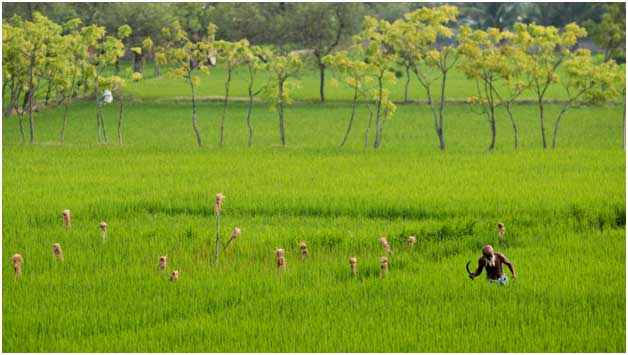
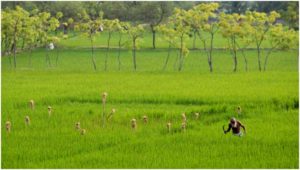
Credit: WaterAid/ DRIK/ Habibul Haque

LONDON, Jan 31 2020 (IPS) – There was only one topic on everyone’s lips at Davos this year – climate change. The headlines focused on the cold war between Greta Thunberg and Donald Trump, but there was much greater consensus among those gathered for the annual meeting of the World Economic Forum (WEF).


The Forum itself updated its manifesto for responsible business – with climate right at its core.

Among those calling for urgent action was WaterAid’s own president, His Royal Highness the Prince of Wales. It’s more than 30 years since he last attended Davos and, as he reminded the audience, 50 years since he made his first speech on the environment.

His message was stark, and his call to action challenging: the climate emergency requires nothing less than an overhaul of the current economy, with a new deal for people and planet.

The mood is slowly shifting towards the scale of action needed, given that climate change will affect every part of the economy. This cannot be truer than for water – the WEF has ranked water crises in its top five global risks in terms of likelihood or impact every year since 2012.
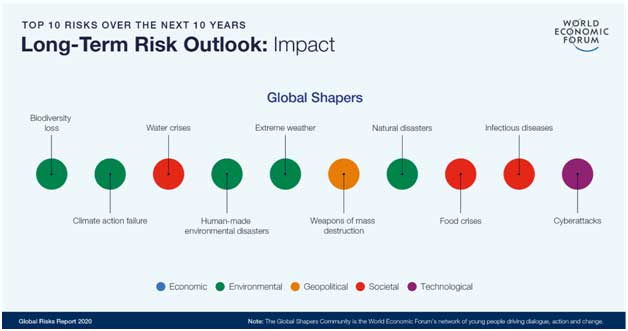
Infographic showing the top 10 risks over the next 10 years, according to the World Economic Forum’s 2020 report. Credit: World Economic Forum

The climate crisis is a water crisis, and a threat multiplier

Throughout the forum I had one consistent message: for the world’s poorest, the climate crisis is a water crisis. Yes, it has long-term implications for your businesses and economies. But, first and foremost, it is a question of survival, dignity and justice, with climate change already having devastating impacts on the lives of the people who did least to cause it.

Flooding, storms and droughts, which all impact on how and if people can get clean water, are becoming more frequent and extreme, and these trends are predicted to rise as the climate continues to change. This will undermine the already precarious access to water for billions around the world.

Climate change acts as a huge threat multiplier, worsening existing barriers to these services and rolling back progress already made.

As people living in climate-vulnerable areas experience changing weather patterns, less predictable rainfall, salt water intrusion and increased exposure to disease, water and sanitation become a critical line of defence.

If your water supply comes from a shallow aquifer that fills with sea water, then you can no longer drink it. But if the person designing your water supply has thought of this threat and factored it in, perhaps by drawing on deeper aquifers, then you can carry on living in your neighbourhood.

If your toilets and sanitation systems are constructed to withstand flooding, then your community does not suffer the same level of contamination after flooding as if human waste had been spread by the high waters.

The water and sanitation sector could become a leader in climate adaptation

But we currently lack the level of public and private sector investment and innovation required to deliver the sustainable water services that would benefit poverty reduction, industry and economic development.

This is a huge blind spot for business leaders and politicians, and a missed opportunity for creating a more sustainable future.

Rather than lagging behind, the water and sanitation sector could become a leader in delivering the kind of green infrastructure, services and jobs urgently required to enable adaptation to the worst impacts of climate change.

Tim Wainwright, Chief Executive of WaterAid UK, speaking with Hassan Nasir Jamy, Secretary Ministry of Climate Change, at Pakistan’s Ministry of Climate Change in Islamabad, Pakistan. Credit: WaterAid/ Sibtain Haider

Water, sanitation and hygiene are core to a sustainable future

Leaving Davos last year, I was frustrated. I felt that too few understood or discussed the impact climate change would have on the already grave state of the world’s water and sanitation, and the devastating consequences for education, health, productivity and development.

This year, I sensed a greater understanding of the interlinked challenges we face, and with that an air of urgency and proactivity. Businesses are looking for solutions – not just raising concerns.

That is why WaterAid will be one of the organisations working closely with HRH the Prince of Wales as part of his 2020 year of action.

In March, in London, we will bring together the public, private and philanthropic sectors for a high-level summit that will position water, sanitation and hygiene at the forefront of the fight against climate, and work on the solutions that will ensure a sustainable future for all.

And we will continue that work across the WaterAid federation throughout the year, including at the Commonwealth Heads of Government Meeting in Kigali in June, and at the UN Climate Change Conference, COP 26, in Glasgow in November, to help build momentum for decisive action.

In this way we hope WaterAid can play its part in shifting the global trajectory in the coming decade, resulting in a fairer world for the poorest and most marginalised people.

Read our guide Water and resilient business: the critical role of water, sanitation and hygiene in a changing climate to learn more about how businesses can take action.
  Source

Water Is Worth More than Milk in Extrema, Brazil

Biodiversity, Civil Society, Development & Aid, Economy & Trade, Editors’ Choice, Environment, Featured, Food & Agriculture, Green Economy, Headlines, Integration and Development Brazilian-style, Latin America & the Caribbean, Projects, Regional Categories, TerraViva United Nations, Water & Sanitation

Water & Sanitation

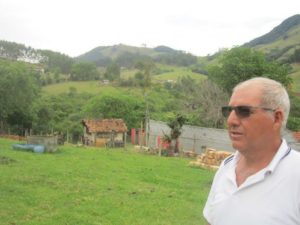
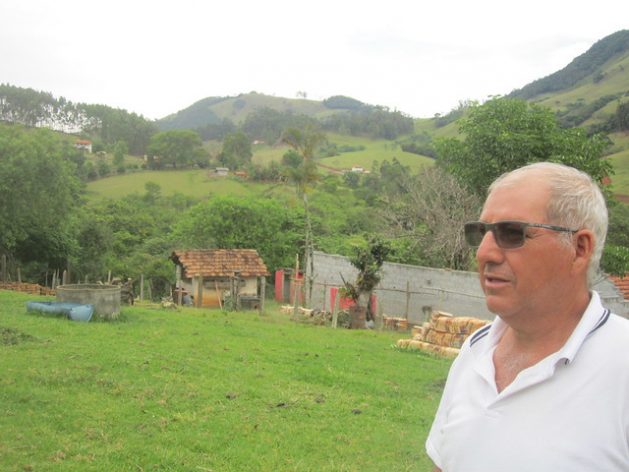
Elias Cardoso is proud of the restored forests on his 67-hectare farm, where he has protected and reforested a dozen springs as well as streams. "I was a guinea pig for the Water Conservator project, they called me crazy," when the mayor's office was not yet paying for it in Extrema, a municipality in southeastern Brazil. Credit: Mario Osava/IPS

Elias Cardoso is proud of the restored forests on his 67-hectare farm, where he has protected and reforested a dozen springs as well as streams. “I was a guinea pig for the Water Conservator project, they called me crazy,” when the mayor’s office was not yet paying for it in Extrema, a municipality in southeastern Brazil. Credit: Mario Osava/IPS

EXTREMA, Brazil, Nov 29 2019 (IPS) – “They called me crazy” for fencing in the area where the cows went to drink water, said Elias Cardoso, on his 67-hectare farm in Extrema, a municipality 110 km from São Paulo, Brazil’s largest metropolis.


“I realized the water was going to run out, with cattle trampling the spring. Then I fenced in the springs and streams,” said the 60-year-old rancher. “But I left gates to the livestock drinking areas.”

Cardoso was a pioneer, getting the jump on the Water Conservancy Project, launched by the local government in 2005 with the support of the international environmental organisation The Nature Conservancy and the Forest Institute of the southeastern state of Minas Gerais, where Extrema, population 36,000, is located at the southern tip.

The project follows the fundamentals of the National Water Agency‘s Water Producer Programme, which focuses on different ways to preserve water resources and improve their quality, such as measures to conserve soil, preventing sedimentation of rivers and lakes.

But at the core of the project is the Payments for Environmental Services (PES), which in the case of Extrema compensate rural landowners for land they no longer use for crops or livestock, to restore forests or protect with fences.

The “Water Conservator” (Conservador das Águas) began operating in 2007, with contracts offered by the PES to farmers who reforest and protect springs, riverbanks and hilltops, which are numerous in Extrema because it is located in the Sierra de Mantiqueira, a chain of mountains that extends for about 100,000 square km.

“Then everyone jumped on board,” Cardoso said, referring to the project in the Arroyo das Posses basin, where he lives and where the environmental and water initiative began and had the biggest impact.

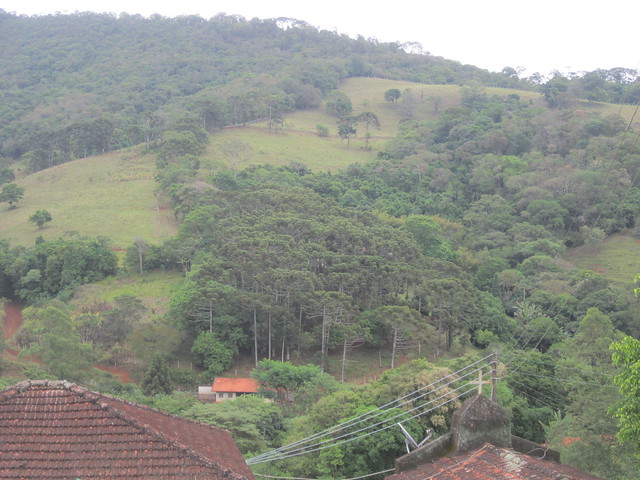
View of the new landscape in the hilly area around Extrema, after the reforestation of thousands of hectares in three basins in this municipality in southeastern Brazil, where the local government has fomented the process of recovery by paying landowners for environmental services. The priority is to restore the forests at the headwaters of the rivers and on hilltops and protect them with cattle fences. Credit: Mario Osava/IPS

View of the new landscape in the hilly area around Extrema, after the reforestation of thousands of hectares in three basins in this municipality in southeastern Brazil, where the local government has fomented the process of recovery by paying landowners for environmental services. The priority is to restore the forests at the headwaters of the rivers and on hilltops and protect them with cattle fences. Credit: Mario Osava/IPS

In the 14 years since it was launched, the project has only worked fully in three basins, where two million trees were planted and close to 500 springs were protected. It is now being extended to seven other watersheds.

“The goal is to reach 40 percent of forest cover with native species” in the municipality and “so far we already have 25 percent covered, and 10 percent is thanks to the Water Conservator,” said Paulo Henrique Pereira, promoter of the project as Environment Secretary in Extrema since 1995.

“Planting trees is easy, creating a forest is more complex,” the 50-year-old biologist told IPS, stressing that it’s not just about planting trees to “produce” and conserve water.

The project began with the prospecting of areas and the training of technicians, after the approval of a municipal PES statute, since there is no national law on remunerated environmental services.

“The bottleneck is that there is no skilled workforce” to reforest and implement water conservation measures, Pereira said.

The project now has its own nursery for the large-scale production of seedlings of native tree species, to avoid the past dependence on external acquisitions or donations, which drove up costs and made planning more complex.

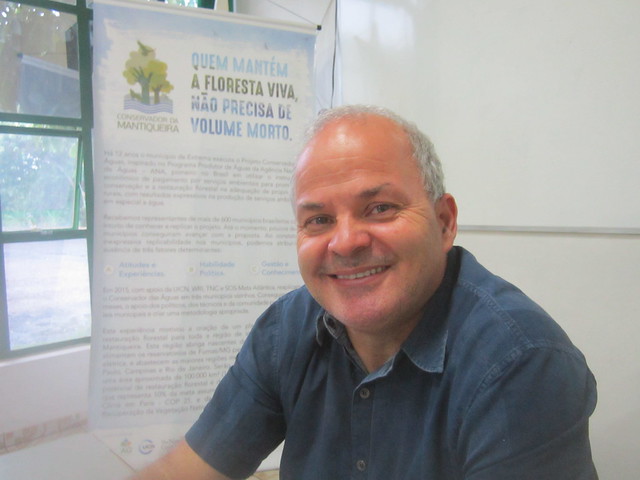
Since 2005 Paulo Henrique Pereira, Secretary of Environment in Extrema since 1995, has promoted the Water Conservator Project, which has won national and international awards for its success in recovering and preserving springs and streams, by paying for environmental services to rural landowners who reforest in this municipality in southeastern Brazil. "Planting trees is easy, creating a forest is more complex," he says. Credit: Mario Osava/IPS

Since 2005 Paulo Henrique Pereira, Secretary of Environment in Extrema since 1995, has promoted the Water Conservator Project, which has won national and international awards for its success in recovering and preserving springs and streams, by paying for environmental services to rural landowners who reforest in this municipality in southeastern Brazil. “Planting trees is easy, creating a forest is more complex,” he says. Credit: Mario Osava/IPS

The success of Extrema’s project, which has won dozens of national and international good practice awards, “is due to good management, which does not depend on the continuity of government,” said the biologist, although he admitted that it helped that he had been in the local Secretariat of the Environment for 24 years and that the mayors were of the same political orientation.

“It is a well-established project that is not likely to suffer setbacks,” he said.

The fact that the project offers both environmental and economic benefits helps keep it alive.

“My grandfather, who spent his life deforesting his property, initially rejected the project. It didn’t make sense to him to plant the same trees he had felled to make pasture for cattle,” said Aline Oliveira, a 19-year-old engineering student who is proud of the quality of life achieved in Extrema.

“When I was a girl, I didn’t accept the idea of protecting springs to preserve water either. I thought it was absurd to plant trees to increase water, because planting 200 or 300 trees would consume a lot of water. That was how I used to think, but then in practice I saw that springs survived in intact forest areas,” she said.

Later, when the PES arrived in the area, her grandfather gave in and more than 10 springs on the 112-hectare farm were reforested and protected. The payment is 100 municipal monetary units per hectare each year, currently equivalent to about 68 dollars.

Aline Oliveira studies engineering and lives on her family's farm in southeastern Brazil. She is proud of the way life has improved in Extrema, a process that began with the establishment of the Payments for Environmental Services system, which guarantees income to farmers and ranchers for reforesting watersheds. It is a secure income at a time of falling milk prices and in a town far from the dairy processing plants. Credit: Mario Osava/IPS

Aline Oliveira studies engineering and lives on her family’s farm in southeastern Brazil. She is proud of the way life has improved in Extrema, a process that began with the establishment of the Payments for Environmental Services system, which guarantees income to farmers and ranchers for reforesting watersheds. It is a secure income at a time of falling milk prices and in a town far from the dairy processing plants. Credit: Mario Osava/IPS

“The PES is a secure income, while milk prices have dropped, and everything has become more expensive than milk in the last 10 years. In addition, there were losses due to lack of transportation, since there is no major dairy processing plant within 50 km,” she told IPS.

Thanks to the municipal payments, “we were able to invest in cows with better genetics, buy a milking parlor and improve health care for the cattle, thus increasing productivity,” which compensated for the reduction in pastures, added the student, who works for the project.

The programme coincided with a major improvement in the economy and quality of life in Extrema. “I was born in Joanópolis, where there were better hospitals than in Extrema. But now it’s the other way around” and people from there come to Extrema, 20 km away, for heath care, Oliveira said.

This is also due to the industrialisation experienced by Extrema in recent decades, which becomes evident during a walk around the town, where many new industrial plants can be seen.

The water conservation project has also contributed to the water supply for a huge population in the surrounding area.

Arlindo Cortês, head of environmental management at Extrema's Secretariat of the Environment, stands in the nursery where seedlings are grown for reforestation in this municipality in southeastern Brazil. "Building reservoirs does not ensure water supply if the watershed is deforested, degraded, sedimented. There will be floods and water shortages because the rainwater doesn't infiltrate the soil," he explains. Credit: Mario Osava/IPS

Arlindo Cortês, head of environmental management at Extrema’s Secretariat of the Environment, stands in the nursery where seedlings are grown for reforestation in this municipality in southeastern Brazil. “Building reservoirs does not ensure water supply if the watershed is deforested, degraded, sedimented. There will be floods and water shortages because the rainwater doesn’t infiltrate the soil,” he explains. Credit: Mario Osava/IPS

The Jaguari River, which crosses Extrema, receives water from fortified streams and increases the capacity of the Jaguari reservoir, part of the Cantareira system, which supplies 7.5 million people in greater São Paulo, one-third of the total population of the metropolis.

“If the watersheds are deforested, degraded and sedimented, merely building reservoirs solves nothing,” said Arlindo Cortês, the head of environmental management at Extrema’s Secretariat of the Environment.

Extrema’s efforts have translated into local benefits, but contributed little to the water supply in São Paulo, partly because it is over 100 km away, said Marco Antonio Lopez Barros, superintendent of Water Production for the Metropolitan Region at the local Sanitation Company, Sabesp.

“No increase in the capacity of the Cantareira System has been identified since the 1970s,” he said in an interview with IPS.

“Thousands of similar initiatives will be necessary” to actually have an impact in São Paulo, because of the level of consumption by its 22 million inhabitants, he said, adding that improvements in basic sanitation in cities have greater effects.

São Paulo experienced a water crisis, with periods of rationing, after the 2014 drought in south-central Brazil, and faces new threats this year, as it has rained less than average.

Extrema also felt the shortage. “Since 2014 we have only had weak rains,” said Cardoso. The problem is the destruction of forests by the expansion of cattle ranching in the last three decades.

“The creek where I used to swim has lost 90 percent of its water. The recovery will take 50 years, the benefits will only be felt by our children,” he said.

  Source

Rock Glaciers Supply Water to Highlands Communities in Argentina

Civil Society, Combating Desertification and Drought, Development & Aid, Editors’ Choice, Environment, Featured, Food & Agriculture, Human Rights, Indigenous Rights, Integration and Development Brazilian-style, Latin America & the Caribbean, Projects, Regional Categories, Water & Sanitation

Water & Sanitation

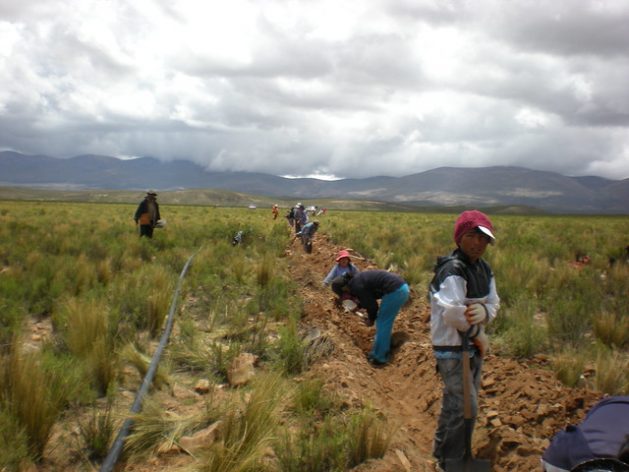
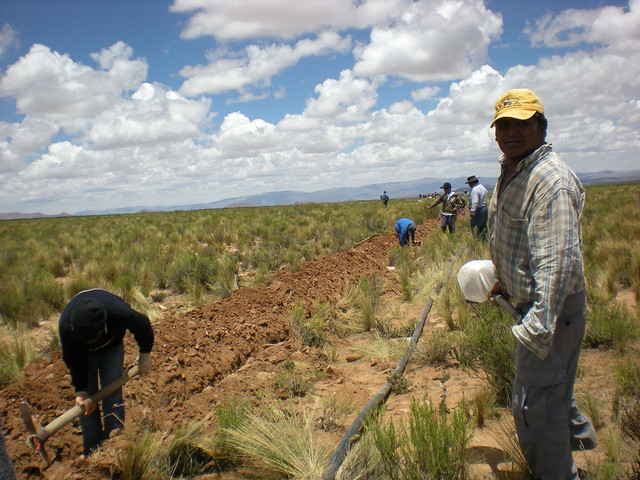
Long months of community work to install pipes to bring water from rock glaciers to indigenous villages in the Puna region in northwest Argentina served to strengthen collective organisation and community ties in an inhospitable ecoregion, where solidarity and joint efforts are essential to daily survival. Credit: Courtesy of Julio Sardina

Long months of community work to install pipes to bring water from rock glaciers to indigenous villages in the Puna region in northwest Argentina served to strengthen collective organisation and community ties in an inhospitable ecoregion, where solidarity and joint efforts are essential to daily survival. Credit: Courtesy of Julio Sardina

EL CÓNDOR, Argentina, Nov 14 2019 (IPS) – In Argentina’s Puna region, at 4,000 metres above sea level, the color green is rare in the arid landscape, which is dominated by different shades of brown and yellow. In this inhospitable environment, daily life has improved thanks to a system of piping water downhill from rock glaciers to local communities.


“When I was a girl we would walk an hour or two to fetch water from the hills. Since we didn’t have jerry cans or buckets, we carried it in sheepskin bags,” Viviana Gerónimo, a 50-year-old Kolla indigenous woman, tells IPS.

“We also built dams, to retain rainwater. We used it for ourselves and for our animals,” she adds. Gerónimo, a married mother of five, lives in Hornaditas de la Cordillera, an indigenous hamlet of just 15 families in the province of Jujuy in northwest Argentina, a few kilometres from the Bolivian border.

The Puna highlands region is a desert where only a few shrubs grow to less than half a metre in height and where it hardly ever rains – the average is around 200 millimetres a year, almost all of which falls in the southern hemisphere summer: December to March.

These high plateaus located above 3,000 metres altitude in the Andes mountains cover not only northwest Argentina but also northern Chile and southern Bolivia and Peru.

Local inhabitants in the Puna region depend mainly on livestock, although they cannot raise cows due to the poor quality of the pastures.

Geronimo’s family has 80 llamas and 120 sheep – the domestic species that best adapt to the climate of the Puna, although the profit margins are slim. In fact, the local indigenous people rarely shear them anymore because the wool fetches such low prices. They raise them for their own consumption and to sell the surplus meat.

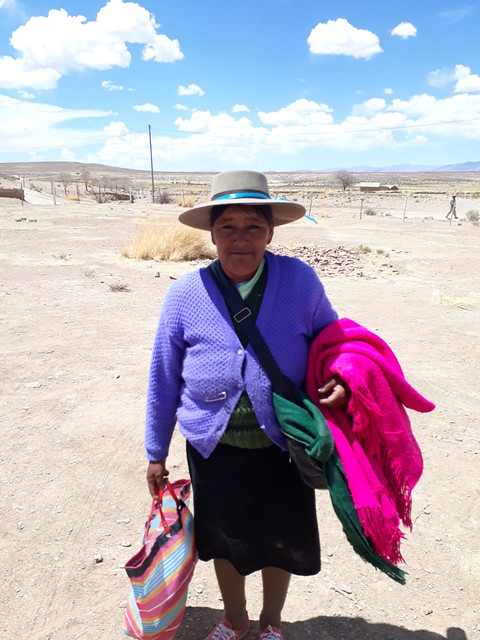
Viviana Gerónimo adds color to the yellow and brown arid landscape of Hornaditas de la Cordillera, one of the Kolla indigenous communities that now have water for the consumption of the 15 local families and for their sheep, llamas and vicuñas, as well as subsistence crops, in this Andean highlands region in the northwest Argentine province of Jujuy. Credit: Daniel Gutman/IPS

Viviana Gerónimo adds color to the yellow and brown arid landscape of Hornaditas de la Cordillera, one of the Kolla indigenous communities that now have water for the consumption of the 15 local families and for their sheep, llamas and vicuñas, as well as subsistence crops, in this Andean highlands region in the northwest Argentine province of Jujuy. Credit: Daniel Gutman/IPS

The Kolla are the largest of the dozen or so indigenous peoples in Jujuy, where 7.8 percent of the population was recognised as native in the last national census in 2010 – more than three times the national figure of only 2.4 percent. Officially, there are 27,631 members of the Kolla people, although the real number is probably much higher, as there are more than 100 Kolla communities in the Puna.

Water brings change

The water collection system benefits the indigenous communities of Hornaditas de la Cordillera, Escobar Tres Cerritos and Cholacor, and the town of El Condor, the municipal seat, which has a primary and secondary school and first aid clinic.

El Cóndor is an hour’s drive from La Quiaca, the main Argentine city on the border with Bolivia. It has about 400 inhabitants, while the communities of the rest of the municipality number less than 100 people in all.

Climate change also seems to be playing its part in exacerbating the scarcity of water. “Although the biggest problem here has always been water, our grandparents said it used to rain more,” says 53-year-old Ricardo Tolaba, another resident of Hornaditas.

“In the past, the ponds, where underground water comes to the surface, dried up in June or July, after the summer rains. Now they dry up in March or April,” he told IPS.

The most important resource are the so-called rock glaciers: moving ice in the mountains covered in rocks and debris which keep them from melting; invisible but strategic water reserves.

The province of Jujuy has 255 rock glaciers, according to the National Glacier Inventory published by the Argentine government in 2018.

With government support, the local communities built a system of underground pipes that run down the slopes for 33 kilometres, using the force of gravity to pipe water to different villages.

“Back in 2007 we began to talk to the communities about how we could build a solution to the lack of water,” says agronomist Julio Sardina, a technician with the Secretariat of Family Agriculture who has worked with the indigenous settlements of Jujuy for more than 20 years.

Long months of community work to install pipes to bring water from rock glaciers to indigenous villages in the Puna region in northwest Argentina served to strengthen collective organisation and community ties in an inhospitable ecoregion, where solidarity and joint efforts are essential to daily survival. Credit: Courtesy of Julio Sardina

Long months of community work to install pipes to bring water from rock glaciers to indigenous villages in the Puna region in northwest Argentina served to strengthen collective organisation and community ties in an inhospitable ecoregion, where solidarity and joint efforts are essential to daily survival. Credit: Courtesy of Julio Sardina

“The problem was that people in the lower-lying areas didn’t have water for their animals. And some wanted to plant crops but couldn’t because of the lack of water,” he adds during his tour with IPS through the different communities participating in the project, which are precariously connected by dirt roads in poor condition.

Sardina explains that the Secretariat of Family Agriculture provided the materials to build the system, thanks to funding from the Socioeconomic Inclusion in Rural Areas Project (Pisear), a national government programme.

From the outset, it was stipulated that the work had to be carried out by the members of the beneficiary communities.

“The project, besides bringing water to the villages, helped the communities organise and forge closer ties, since the families were isolated from each other,” says Sardina.

The system benefits some 600 people in an area where families are often nomadic, moving around to find the best pastures. Many Kolla Indians have communal land titles, which is not common among native peoples in Argentina.

When it reaches the communities, the water is stored in a tank. It is also piped to some of the houses and to water troughs for livestock.

But the greatest impact of the project was on agriculture, which has always been limited in the Puna region by the lack of water.

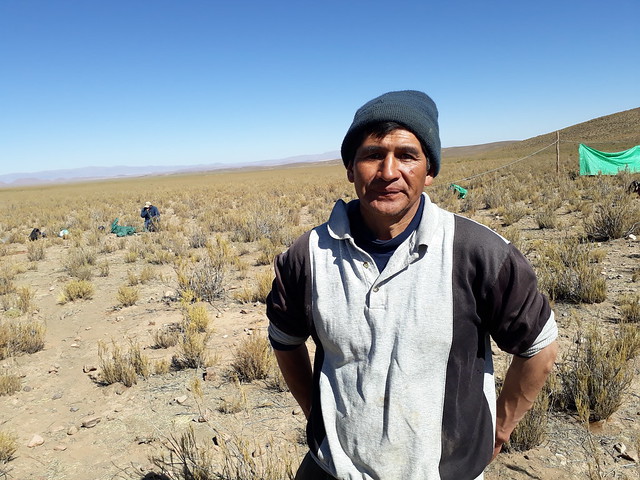
In the high Andean plateau of the Puna, in northwest Argentina, the biggest need was always water, says Ricardo Tolaba. People walked for hours to find it and carry it back in small containers, for human and animal consumption. With the new community-built system that pipes it from rock glaciers, "things began to change," he adds. Credit: Daniel Gutman/IPS

In the high Andean plateau of the Puna, in northwest Argentina, the biggest need was always water, says Ricardo Tolaba. People walked for hours to find it and carry it back in small containers, for human and animal consumption. With the new community-built system that pipes it from rock glaciers, “things began to change,” he adds. Credit: Daniel Gutman/IPS

David Quiquinte, also from Hornaditas, proudly relates that “a 40-centimetre-deep ditch was dug, where the pipe was buried to prevent freezing,” since in the wintertime temperatures in the Puna region can drop to 25 degrees Celsius below zero.

“For nearly six months, the entire community threw its effort into this work… except for one or two people,” the 40-year-old local resident told IPS, without concealing his irritation with those who didn’t help out.

During meetings with technicians from the Secretariat of Family Agriculture, the indigenous communities in Jujuy’s Puna region raised their concern about the growth of the population of vicuñas, a wild South American camelid native to the Andean highlands.

The vicuña came close to extinction in the 1960s, but recovered thanks to protection measures agreed by the countries of the Puna ecoregion.

“We needed water, especially because there wasn’t enough for the animals. And in the meetings about the water system project, many people complained that the vicuñas were eating the grass needed by the llamas and sheep,” Luis Gerónimo, 30, who lives in the community of Escobar Tres Cerritos, told IPS.

That is how the idea arose for training for the “chaccu”, an ancestral practice that the Kolla Indians have taken up again, as have other indigenous communities in Bolivia and Peru, which consists of capturing, shearing and releasing wild vicuñas.

“We’ve been practicing the chaccu for five years and people no longer see vicuñas as a problem. Today they are taken care of. The llamas and sheep graze in the lowlands and the hills are left to the vicuñas,” says Luis Gerónimo.

The chaccu and the water project pursue the same ultimate goal: to enable people from the communities to stay in Jujuy’s Puna region instead of migrating to the cities.

“I am one of the people who went to work in different parts of Argentina and came back. And I’m convinced that we have the resources to keep young people in the Puna,” says Tolaba.

He points out that “the main need in the Puna has always been water. Walking for hours to fetch water or to take the animals to drink are things we’ve been used to since we were kids here.”

But “with this project, things have begun to change,” he adds.

  Source

Urgent Need to Replace Competition with Cooperation in the Aral Sea Basin

Asia-Pacific, Climate Change, Conferences, Development & Aid, Economy & Trade, Education, Environment, Featured, Global, Headlines, Humanitarian Emergencies, Poverty & SDGs, TerraViva United Nations, Water & Sanitation

Opinion

Stefanos Xenarios is a Professor at Nazarbaev University, Kazakhstan and co-editor-in-chief of the Central Asian Journal of Water Research; Iskandar Abdullaev is Deputy Director, CAREC Institute, China and Vladimir Smakhtin is Director, UN University Institute for Water, Environment and Health, Canada and series editor of the Routledge publishers’ Earthscan Series on Major River Basins of the World, in which the Aral Sea Basin Book is the latest addition.

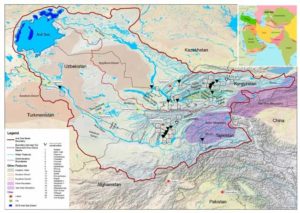
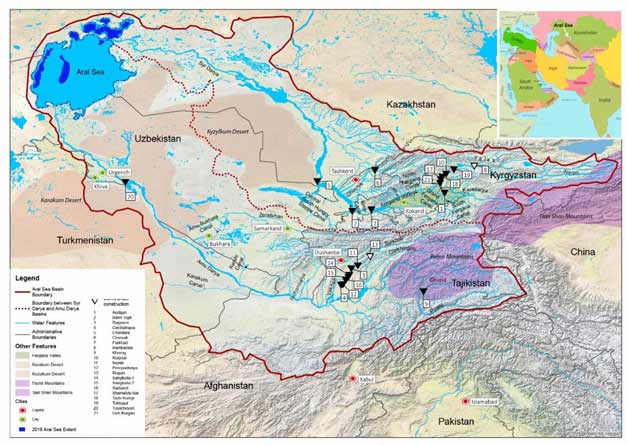
The Aral Sea Basin, defined in red, straddles six countries in Central Asia. See detailed map in full at http://bit.ly/2BQPpRm. Credit: UNU-INWEH

NUR-SULTAN CITY, Kazakhstan, Nov 7 2019 (IPS) – The water resources in Central Asia’s Aral Sea Basin support the lives and livelihoods of about 70 million people — a population greater than Thailand, France, or South Africa.


And unless well-funded and coordinated joint efforts are stepped up, with competition replaced by cooperation, ongoing over-withdrawals compounded by climate change will cause dangerous water shortages in this huge, highly complex watershed spanning six nations: Afghanistan, Kazakhstan, Kyrgyzstan, Tajikistan, Turkmenistan, and Uzbekistan.

That’s the key message of a new book co-authored by 57 regional and international experts from 14 countries and the United Nations, who spent years examining a suite of challenges in the Aral Sea Basin.

The new book assembles the views of nearly all major regional and international experts on the great challenges faced in the Aral Sea Basin. They include three co-authors from the UN University’s Institute for Water, Environment and Health, in Hamilton, Canada.

And almost half of the authors are based in Central Asia, creating a unique blend of regional and international voices and expertise on these critical issues.

The Basin’s two major rivers, the Amu Darya and Syr Darya, discharge now only about 10% of what flowed into the Aral Sea until the 1960s, shrinking the sea by more than 80 percent — “one of the world’s most severe and emblematic environmental disasters.”

Freshwater is key to food, energy, environmental security and social stability among the six Aral Basin countries. And given the countries’ prospective economic and population growth, reliance on water resources will increase, compelling cooperation in sharing benefits and reducing costs.

Intensive, wasteful irrigated farming when the nations were part of the Soviet Union was the main cause of the Aral Sea drying up and irrigation continues to consume about 90 percent of the total water withdrawal in the Basin, with agriculture contributing from 10 to 45 percent of GDP, and 20 to 50 percent of rural employment.

Most irrigation, hydropower and other water-related infrastructural systems and facilities are in transition, a blend today of past and present. Unfortunately, the existing observational meteorological and hydrological networks in the Basin, which declined in the 1990s when the Soviet period ended, are insufficient to support informed water management, and regional water data sharing is suboptimal.

Degradation of land and water are among the major hindrances to sustainable development in the region, with land degradation alone estimated to cost about US$3 billion of losses in ecosystem services annually.

There has been uneven progress across the countries on the Sustainable Development Goals (SDGs), and particularly Goal 6 (Clean Water and Sanitation), with contrasting progress also between urban and rural populations within each nation, most particularly Afghanistan.

The new book suggests a number of interventions and initiatives to end and reverse deterioration of the Aral Basin. For example, if existing large hydropower projects were managed in a collaborative manner, they can bring all countries multiple benefits, including improved reliability of supply and availability of water for agriculture, domestic use and electricity generation.

Monitoring of snow and glaciers in high altitude mountain areas, as well as permafrost, is essential for sound estimates of water availability and water-related hazards. Such systems need to be re-installed.

Also needed: institutions for decentralized management of natural resources, such as water user associations to promote cooperative, sustainable, intra-regional management between upstream and downstream countries and integrated rural development approaches.

Existing regional frameworks must either be reformed or replaced by new mechanisms of cooperation in order to successfully translate political will into highly effective, integrated regional water management.

Reforming the water sector, however, goes well beyond new policies and initiatives, updating the legislative framework, and building new institutions. A key challenge is to achieve continuous, strong, high-level political engagement throughout the Basin countries, the active participation of stakeholders, and technical and financial support.

The Aral Basin’s many water-related issues must be addressed jointly by all involved states within the concept that water, energy, and food issues represent a critical, interlinked nexus of needs.

Major geopolitical and economic development interests are placing increasing pressure on countries of the Basin to end resource competition and find a way to closer cooperation and effective pursuit of their shared interests.


Red Alert for Blue Planet and Small Island States

Asia-Pacific, Climate Change, Conferences, Development & Aid, Economy & Trade, Education, Environment, Featured, Global, Headlines, Humanitarian Emergencies, Poverty & SDGs, TerraViva United Nations, Water & Sanitation

Opinion

Farhana Haque Rahman is Senior Vice President of IPS Inter Press Service; a journalist and communications expert, she is a former senior official of the United Nations Food and Agriculture Organization and the International Fund for Agricultural Development.

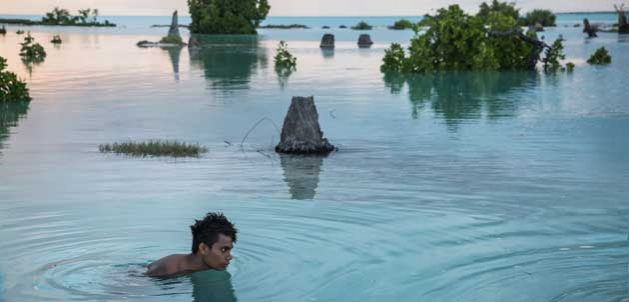
The Pacific island is one of the countries worst affected by sea-level rise. Credit: UNICEF

ROME, Oct 31 2019 (IPS) – Barely a week passes without alarming news of the most recent scientific research into the global climate crisis compounding a growing sense of urgency, particularly the impact on small island states from rising sea levels and extreme weather.


Latest findings suggest that several hundred million more people than previously thought are at risk of coastal flooding due to climate change. Climate Central, a non-profit research and news organisation, found data used in past calculations overstated the elevation of many low-lying coastal communities.

And for the people of the Bahamas who had just endured Hurricane Dorian, the most intense tropical cyclone on record to hit their islands, it came as little surprise when the UN Intergovernmental Panel on Climate Change (IPCC) soon after released its landmark special report on the planet’s oceans and frozen regions, warning of “multiple climate-related hazards” for coastal regions.

“The ocean is warmer, more acidic and less productive,” the IPCC report stated.

The “Blue Pacific” concept sees the island states establishing themselves as “large ocean states” and guardians of the region rather than “small island states”

Oceans are absorbing heat twice as fast as just two decades ago, with hundreds of billions of tonnes of melting ice raising sea levels at an average rate of 3.6 millimetres a year, more than twice as fast as during the last century.

If greenhouse gas emissions “continue to increase strongly”, the IPCC report said, then levels could rise more than a metre by 2100.

Some island states in the Pacific face becoming uninhabitable. As UN Secretary-General Antonio Guterres noted while visiting Tuvalu, the sea level rise in some Pacific countries is four times greater than the world average, posing “an existential threat” to several island states.

Against this background the UN COP25 climate change summit scheduled to be held in Santiago in December had been dubbed the Blue COP, with expectations of a focus on the oceans and commitments of aid to poorer nations most at risk. So it comes as a serious blow that President Sebastian Pinera has just announced that Chile is calling off its hosting of COP25 because of mass anti-government protests rocking the country.

While the UN anxiously looks for an alternative venue (and Santiago had been the second choice after Brazil’s newly elected president, Jair Bolsonaro, pulled out of hosting it), the small island states of the Pacific will be making their voices heard as they seek to confirm themselves in the role of custodians of the world’s largest region.

It is an existential struggle but it is not a blame game however.

As Micronesia’s President David Panuelo declared last week in The Diplomat: “Rather than point fingers, we must all point the way toward solutions.”

“No single country created this problem, and certainly a small country like ours is bearing far greater responsibility for the solution than we ever contributed to the crisis in the first place. But we sit shoulder to shoulder in a coalition which has set a goal of growing economies while achieving 30 percent marine protection globally,” he wrote in a plea for action to save the oceans.

“Everyone must do more when garbage patches larger than entire countries float in the Pacific, and rising carbon dioxide levels increase ocean acidity and devastate coral reefs and marine life.”

The Pacific Community, the principal scientific and technical organisation in the region and founded as the SPC in 1947, counts 22 Pacific island countries and territories among its members who see themselves as the “tip of the spear” in terms of the impacts of climate change and their efforts to adapt.

SPC has recently established the Pacific Community Centre for Ocean Science (PCCOS) to provide the framework to “focus its scientific and technical assistance on providing solutions that will build, sustain, and drive blue economies in Pacific Island countries and territories” and support SDG 14 of conserving and sustainably using oceans and marine resources.

The SPC’s new and growing Pacific Data Hub is a public resource of data and publications on the Pacific across key sectors, from education and human rights to oceans and geoscience.

Such initiatives reflect how Pacific Island states have grown more assertive in their diplomacy, becoming more active in global multilateral forums and using their voices and votes for increased leverage rather than the old reliance on support from Australia and New Zealand.

The “Blue Pacific” concept sees the island states establishing themselves as “large ocean states” and guardians of the region rather than “small island states”. As stewards of the Pacific with their cultural identity shaped by the ocean, the Blue Pacific framework seeks to establish leadership on issues, with smart policies backed by scientific expertise and data.

As Micronesia’s president has reminded us, the climate crisis is neither abstract nor “tomorrow’s faraway challenge”. It is happening now and as the IPCC’s special report on the oceans and cryosphere warned in September the crisis is gathering speed, as seen in the recent acceleration of sea level rise.

In Antarctica the rate of ice loss tripled in the decade 2007-2016. May and August in 2019 were the warmest on record for the Arctic while this year saw the summer minimum extent of sea ice reaching a joint-second lowest in 40 years of satellite records.

As summarised by Carbon Brief, the IPCC warns that this accelerating ice loss, and the more rapid sea level rises it causes, will continue to gather pace over this century regardless of whether greenhouse gas emissions are reduced. The “likely” maximum rise of 1.1 metres by 2100 is some 10cm above the top-end estimate from its previous estimate, while a rise of 2 metres cannot be ruled out.

Such warnings were intended to provide input at COP25 for world leaders who face mounting calls to adopt more ambitious goals for carbon emission cuts. Those negotiations will not be happening in December in Santiago after all. An alternative must be found urgently.


Disaster Risk Resilience: Key to Protecting Vulnerable Communities

Active Citizens, Aid, Asia-Pacific, Climate Change, Economy & Trade, Education, Environment, Featured, Food & Agriculture, Headlines, Health, Human Rights, Labour, Poverty & SDGs, TerraViva United Nations, Water & Sanitation

Opinion

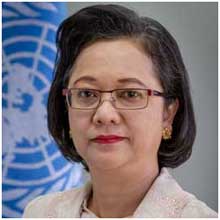
Armida Salsiah Alisjahbana is Under-Secretary-General of the United Nations and Executive Secretary of the United Nations Economic and Social Commission for Asia and the Pacific (ESCAP).

BANGKOK, Thailand, Aug 28 2019 (IPS) – The past five years have been the hottest on record in Asia and the Pacific. Unprecedented heatwaves have swept across our region, cascading into slow onset disasters such as drought. Yet heat is only part of the picture. Tropical cyclones have struck new, unprepared parts of our region and devastatingly frequent floods have ensued. In Iran, these affected 10 million people this year and displaced 500,000 of which half were children. Bangladesh is experiencing its fourth wave of flooding in 2019. Last year, the state of Kerala in India faced the worst floods in a century.


Armida Salsiah Alisjahbana

This is the new climate reality in Asia and the Pacific. The scale of forecast economic losses for the region is sobering. Including slow-onset disasters, average annualised losses until 2030 are set to quadruple to about $675 billion compared to previous estimates. This represents 2.4 percent of the region’s GDP. Economic losses of such magnitude will undermine both economic growth and our region’s efforts to reduce poverty and inequality, keeping children out of schools and adults of work. Basic health services will be undermined, crops destroyed and food security jeopardised. If we do not act now, Asia-Pacific’s poorest communities will be among the worst affected.

Four areas of Asia and the Pacific are particularly impacted, hotspots which combine vulnerability to climate change, poverty and disaster risk. In transboundary river basins in South and South-East Asia such as the Ganges-Brahmaputra-Meghna river basin, floods alternate with prolonged droughts. In South-East Asia and East and North-East Asia earthquakes, tsunamis and landslides threaten poor populations in the Pacific Ring of Fire. Intensifying sand and dust storms are blighting East, Central and South-west Asia. Vulnerable populations in Pacific Small Islands Developing States are five times more at risk of disasters than a person in South and South-East Asia. Many countries’ sustainable development prospects are now directly dependent on their exposure to natural disasters and their ability to build resilience.

Yet this vicious cycle between poverty, inequalities and disasters is not inevitable. It can be broken if an integrated approach is taken to investing in social and disaster resilience policies. As disasters disproportionately affect the poor, building resilience must include investment in social protection as the most effective means of reducing poverty. Conditional cash transfer systems can be particularly effective as was shown in the aftermath of Typhoon Haiyan in the Philippines. Increasing pre-arranged risk finance and climate risk insurance is also crucial. While investments needed are significant, in most countries these are equivalent to less than half the costs forecast to result from natural disasters.

The use of technological innovations to protect the region from natural disasters must go hand in hand with these investments. Big data reveal patterns and associations between complex disaster risks and predict extreme weather and slow onset disasters to improve the readiness of our economies and our societies. In countries affected by typhoons, big data applications can make early warning systems stronger and can contribute to saving lives and reducing damage. China and India are leading the way in using technology to warn people of impending disasters, make their infrastructure more resilient and deliver targeted assistance to affected farmers and citizens.

Asia and the Pacific can learn from this best practice and multilateral cooperation is the way to give scale to our region’s disaster resilience effort. With this ambition in mind, representatives from countries across the region are meeting in Bangkok this week at the United Nations Economic and Social Commission for Asia and the Pacific (ESCAP) to explore regional responses to natural disasters. Their focus will include strengthening Asia-Pacific’s Disaster Resilience Network and capitalising on innovative technology applications for the benefit of the broader region. This is our opportunity to replicate successes, accelerate drought mitigation strategies and develop a regional sand and dust storm alert system. I hope the region can seize it to protect vulnerable communities from disaster risk in every corner of Asia and the Pacific.

  Source