Linking the Malawian Diaspora to the Development of Malawi”
Malawi
Malawi (/məˈlɔːwi,məˈlɑːwi/; Chichewa pronunciation:[maláβi]; Tumbuka: Malaŵi), officially the Republic of Malawi and formerly known as Nyasaland, is a landlocked country in Southeastern Africa. It is bordered by Zambia to the west, Tanzania to the north and northeast, and Mozambique to the east, south and southwest. Malawi spans over 118,484 km2 (45,747 sq mi) and has an estimated population of 19,431,566 (as of January 2021). Malawi’s capital and largest city is Lilongwe. Its second-largest is Blantyre, its third-largest is Mzuzu and its fourth-largest is its former capital, Zomba.
The BBC has fired a British radio presenter who tweeted an image of a chimpanzee dressed in clothes below the caption “Royal Baby leaves hospital”.
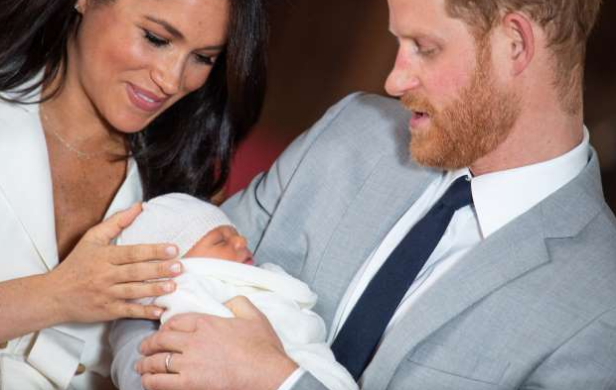
Meghan, wife of Prince Harry, gave birth in the early hours of Monday morning to a baby boy, Archie, the first mixed race child to be born into a senior position in British royalty in recent history.
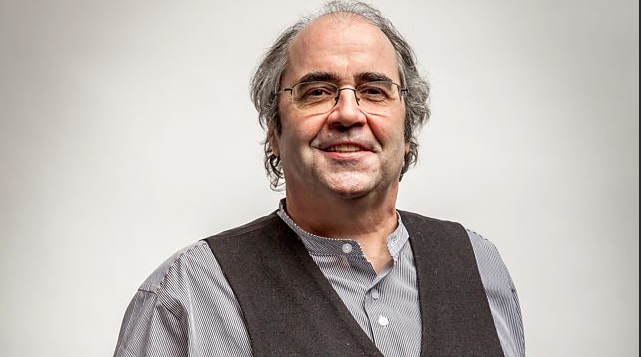
“Just got fired,” Danny Baker, a broadcaster with BBC Radio 5 Live, said on Twitter.
Danny Baker
The BBC said the tweet was a serious error of judgment that went “against the values we as a station aim to embody”.
“Danny’s a brilliant broadcaster but will no longer be presenting a weekly show with us,” the BBC said.
Meghan, whose mother is African-American and father is white, has been the target of racist commentary on social media in the past.
The Ghanaian government needs to protect our country and beautiful culture
Ghana becomes the second country, after Malawi to launch vital malaria vaccine. On April 30, 2019, the country rolled out the world’s only proven malaria vaccine for infants as part of a landmark campaign against the deadly mosquito-borne disease, a week after Malawi became the first country to do so.
Just a few days before World Malaria Day, a vaccine is launched in Malawi that could revolutionize millions of lives, according to the World Health Organization and the goal is to spread the treatment on a large scale, reaching about 360,000 children every year.
Malawi and Ghana are not the only African countries to make progress, according to the World Health Organization. This is a pilot project that will start in the coming weeks, also in another African country, Kenya.
In the past and present, there are pieces of evidence of medical crimes in Africa, which were coordinated by the World Health Organization and rich people such as Bill Gates.
The cure for polio and other diseases were an opportunity for the World Health Organization to collaborate with the US government to spread diseases, such as Aids, Burkitt’s lymphoma, Kaposi’s sarcoma, nodding disease, etc, in Uganda Kenya and throughout Africa.
In Kenya, under the supervision of the World Health Organization, contaminated medicine was induced resulting in sterilization of women so that they could not give birth again.
Then followed the Ebola epidemic, in Sierra Leone, Guinea, and Liberia, in 2014, and currently in Congo. Ebola is a biological weapon, yet the World Health Organization, Centers for Disease Control and the US government lied to the world that bats are responsible, without any word from African leaders.
It’s therefore, a very disturbing issue if the Ghanaian government continues to trust the World Health Organization to begin vaccinating its population with a new malaria medicine. The World Health Organization can’t refute this article.
The German medical doctor, Wolff Geisler, who worked in several African countries, including Uganda, witnessed all the crimes of WHO. Above all, the medical research of the Dutch scientist, Johan Van Dongen, also shared information about the clandestine crimes committed by the World Health Organization in Africa.
African leaders always open their arms to embrace and accept every medicine the World Health Organization and Centers for Disease Control send to Africa because of poverty and laziness.
They don’t even know if the medicine is contaminated, fake or has any poisonous substances to retard the growth of Africa’s population or not. Africa has become a target for foreign powers. They want to kill all of us because they are scared Africa will take over the world because of the high birth rate. Even African-Americans who haven’t been to African before are having the highest rate of HIV-Aids, than the white population. Why America?
Why one specific continent alone, will suffer slavery, colonialism, Apartheid, Aids, and Ebola, yet, African leaders without hesitation, take whatever evil medicine which comes from the West and the US to Africa? Why are African leaders gambling with the lives of poor innocent Africans?
Now Ghana has accepted a malaria vaccine which they are not even sure of. They don’t even know what could probably happen to the population after using this new medicine. They have just taken it and ready to use it in their population. Let Ghana manufacture any headache tablet and ship them free of charge to Europe and America, the next day, Ghanaians will see them down the drain.
Malaria is a disease transmitted through the bite of a mosquito, especially in Africa. It affects about 219 million people every year. There are 435,000 deaths a year, of which 250,000 are children under 5 years.
This is also why the vaccine will be given to children under 2 years old but why must the Ghanaian government accept such medicine they are not even sure of when they can clean their environments to reduce malaria?
“We have seen tremendous progress has been made in malaria control over the past 15 years, but that progress has stopped and even reversed in some areas.”
“We need new solutions and this vaccine provides us with a promising tool,” says the director general of the WHO, Tedros Adhanom Ghebreyesus, another criminal appointed by the World Health Organization.
Being an African, the World Health Organization thought it’s the right person to be given that post, that will avoid Africans to know the fact that Ebola is a biological weapon.
In fact, the entire African continent is surrounded by criminal health officials and corrupt African leaders, therefore, we are in a dangerous period that common Africans must be very careful.
The easiest methods the US government has used in the past to spread diseases in Africa is through food, water, and medicine (vaccination).
Like parents protecting their children, African leaders must protect Africans because, without them, politicians have a zero chance to take the positions they represent. They must take that malaria vaccine to the laboratory to investigate before they make any attempt to use it in Ghana.
Disclaimer: “The views/contents expressed in this article are the sole responsibility of the author(s) and do not neccessarily reflect those of Modern Ghana. Modern Ghana will not be responsible or liable for any inaccurate or incorrect statements contained in this article.”
Reproduction is authorised provided the author’s permission is granted.
Finally, power to mobile email users. AltaMail adds email rules, work-life balance, filters and full customization – African American News Today – EIN News
Trusted News Since 1995
A service for global professionals·Thursday, May 2, 2019 · 484,049,649 Articles · 3+ Million Readers
A student talent show brought parents, grandparents, sisters and brothers to the Winooski schools auditorium on a Friday night at the end of March. The toddlers among them cavorted happily below the stage, creating an impromptu program of their own — even after a red velvet curtain opened to reveal a stage with a festive sign that read “Celebrating Winooski’s Talent.”
School board member Margaret Bass emceed the event. “Let’s give them another round of applause,” she urged after eight youngsters sawed their way through a beginner violin sequence. “Does Winooski have talent?” Bass asked the crowd.
“Yes!” the audience responded loudly.
One girl danced a ballet solo in a fluffy pink dress. Another sang and recited a number from Hamilton. Kids did gymnastics, standup comedy and improv routines.
“What’s the best school district in the state of Vermont?” Bass shouted.
The crowd roared in response: “Winooski!”
That kind of school spirit hasn’t always been evident in the 7,200-population mill town. For years, voters were fickle about backing education budgets. Steady turnover of teachers and principals created instability, and the student body consistently scored below average on standardized tests.
The superintendent job became a revolving door, too. In 2012, the school board was searching for its sixth CEO in eight years.
“When we were looking for a superintendent back in 2012, 2013, we as a district were a bit disheveled,” said school board president Mike Decarreau. “We were looking for someone who could bring direction, focus and peace.”
To lead the most diverse district in the state, officials tapped a middle-aged white guy named Sean McMannon, who was then the principal of suburban Champlain Valley Union High School in Hinesburg.
In his six years on the job, the soccer-loving, ex-Peace Corps volunteer has earned praise — and awards — for increasing staff morale and teacher retention and expanding nutrition and health programs. He’s bolstered English instruction for students, 40 percent of whom began their lives speaking a different language.
Fifty-eight percent of Winooski’s 884 students are black, Asian, Hispanic or multiracial, according to the Vermont Agency of Education, making Winooski the only “minority-majority” district in overwhelmingly white Vermont.
“We have this incredibly diverse and unique experience to offer,” McMannon said of the school community. Winooski kids go home to young hipsters, descendants of French Canadian and Irish mill workers, and newcomers from Nepal, the Democratic Republic of the Congo and Somalia.
“The world looks a lot more like us than it does the rest of Vermont — that’s pretty amazing to offer that,” said McMannon.
Like other school districts in the state, Winooski has discussed consolidation scenarios over the years. The high school graduated just 38 seniors last year; it has 214 students today. The school offers only one foreign language — French — and a single Advanced Placement course in World History. Fielding varsity teams is difficult.
None of that has dulled McMannon’s enthusiasm for the place. The week after the talent show, he watched the Winooski School Board vote 4-0 to advance his plan for the future: a $57.8 million renovation of the city’s school complex, which dates back to the 1950s.
The superintendent stood smiling in the John F. Kennedy Elementary School library as school board members high-fived one another after the unanimous decision to put the question to the public.
A yes vote is not assured in the special election bond vote on May 7. But if it’s approved, the investment will signal Winooski’s commitment to operating a public school system through grade 12 for years to come.
‘Purposeful Life’
McMannon, 50, grew up in a middle-class suburb of Detroit and attended an all-boys parochial high school in Bloomfield Hills. But his parents, he said, “came from abject poverty.” His dad served in Vietnam and later landed a job at the Burroughs Corporation, where a manager and fellow veteran took him under his wing. The encouragement helped his dad professionally and personally, McMannon said.
“My father’s story always reminds me that education, persistence, support — caring adults — can really change people’s lives,” McMannon said.
McMannon graduated from Penn State University in 1991 with a bachelor’s degree in business logistics. He played central defender on the NCAA Division I varsity soccer team, fulfilling a dream. “It was my No. 1 sport,” said McMannon.
He headed to Colorado for a snowboard-bumming stint and met his future wife, Jennifer Cromie. McMannon won her over by hosting a five-course dinner party. “He had this strawberry sauce that went on top of the meat,” Jennifer recalled. “I was like, Wow, I don’t know that many guys who can cook fancy meals like this.”
McMannon joined the Peace Corps and started his first teaching job — in Botswana. He sent Jennifer letters as well as occasional rolls of film that, once developed, produced images of him riding a donkey, sporting a new ponytail and beard.
Eighteen months in, McMannon contracted schistosomiasis, a disease caused by parasitic worms, after a swim in Lake Malawi, and it forced him to return home. He reconnected with Jennifer, and they landed jobs at the Becket School in Pike, N.H., where he became a residential counselor for court-referred adolescent boys.
With grad school in mind, they gravitated to Boston. McMannon worked with students with special needs there until both he and Jennifer earned master’s degrees at Lesley College in Cambridge in 1996. They married that summer and then headed to the tiny town of White Mountain, Alaska, pop. 190, to teach.
About 85 percent of its residents were indigenous Alaskans. “We did everything,” McMannon recalled. “I did all of the special education from preschool to high school. I taught middle school math. I taught Spanish.”
The couple loved “the incredibly different cultural experiences we had, like catching fresh salmon in the Fish River and crab in the Bering Sea, gathering berries, hunting moose and caribou, and sharing the meat with other families and village elders,” McMannon recalled.
When the first of their two daughters, Brenna, was born, the elders gave her an Inuit name, Qunik, which means “snowflake.”
In 1999, the family left for California to be closer to McMannon’s parents; his mother had breast cancer. She had often helped families at church and others in need, McMannon recalled, and taught him that a “purposeful life is one that is … helping others to raise themselves up.”
Around then, McMannon began to meditate and became interested in Buddhism, which, he said, offers a belief in the “basic goodness” of people. Meditating helped McMannon “stay present,” he said, to support his parents while his mother was ill. He still rises at 5 a.m. most mornings and meditates for 30 minutes.
After his mother’s death, McMannon and his wife found jobs in Vermont. He started as a special education teacher at CVU in 2001, and by 2005 was principal of the school of 1,300 students — more than the entire student population in Winooski. CVU, which draws from four towns including well-to-do Shelburne and Charlotte, has a low poverty rate, high test scores and relatively few English language learners. In 2010 McMannon won the Robert F. Pierce Vermont Secondary Principal of the Year award.
“I loved CVU, and it’s a great school,” he said. But when the superintendent post in Winooski opened up, McMannon decided to apply. “One of the things I really missed was working with more ethnically diverse populations.”
Another plus: The superintendent’s office is in the school complex. “The richness of the experience for me was being around kids,” McMannon explained.
He got the job and now earns $146,794 annually.
Rainbow Chen got to know the superintendent when she served as a student rep on the local school board and the Vermont State Board of Education. When she had problems, the 2017 Winooski High School graduate said, McMannon was a thoughtful listener. Now a sophomore at Brown University, Chen described McMannon as “genuinely empathetic. He cares about you as a person and not necessarily as a number or a student.”
Education officials noticed him, too. Former Vermont education secretary Rebecca Holcombe said McMannon is one of the state’s best superintendents. “Sean is a guy who knows how to get down to business,” she said. “But he puts people first in everything.”
From the start, McMannon identified health care and good nutrition as prerequisites for academic success. He worried that too many students were coming to school hungry, so he expanded food programs. In addition to getting breakfast, lunch and an after-school snack, students can take home bags of nonperishable free food every Friday to help their families get through the weekend. The Vermont Foodbank’s VeggieVanGo distributes free fresh produce twice monthly in the school parking lot.
McMannon added “newcomer” classrooms for recently arrived immigrants at the elementary and middle school levels. He doubled the number of home-school liaisons who work with immigrant families in their native languages, to six. He helped set up in-school pediatrician visits.
He’s been a decisive leader. In March, a newsletter mentioned a “cakewalk” at JFK Elementary’s upcoming Fun Fair. Parents and others said that the phrase hearkened back to a racist tradition of the slavery era, and not just in the South. The University of Vermont’s Kake Walk tradition, which died in the late 1960s, featured a blackface dance competition.
The PTO organizers defended the game, a variation on musical chairs in which children competed to stand on a gradually decreasing number of dots on the floor. They said the newsletter misidentified a harmless activity as a “cakewalk.”
As the disagreement hit social media and email inboxes, McMannon quickly canceled the game. Any possibility of a racist connection made it wrong, he told Seven Days. In a letter to families, he explained that while organizers had “no racist intent,” cakewalks promote racist stereotypes.
“I would reiterate that we are immensely and unabashedly proud to be the only racially minority-majority school in Vermont and experience every day the value of learning in a multi-racial, cultural and linguistic environment,” McMannon wrote.
“I appreciated his response tremendously,” said Nicole Mace, a former Winooski city councilor and the executive director of the Vermont School Boards Association, who has a daughter at JFK Elementary. His message, she said, was “quick and clear and really not equivocating.”
The $57.8 Million Question
click to enlarge
Luke Awtry
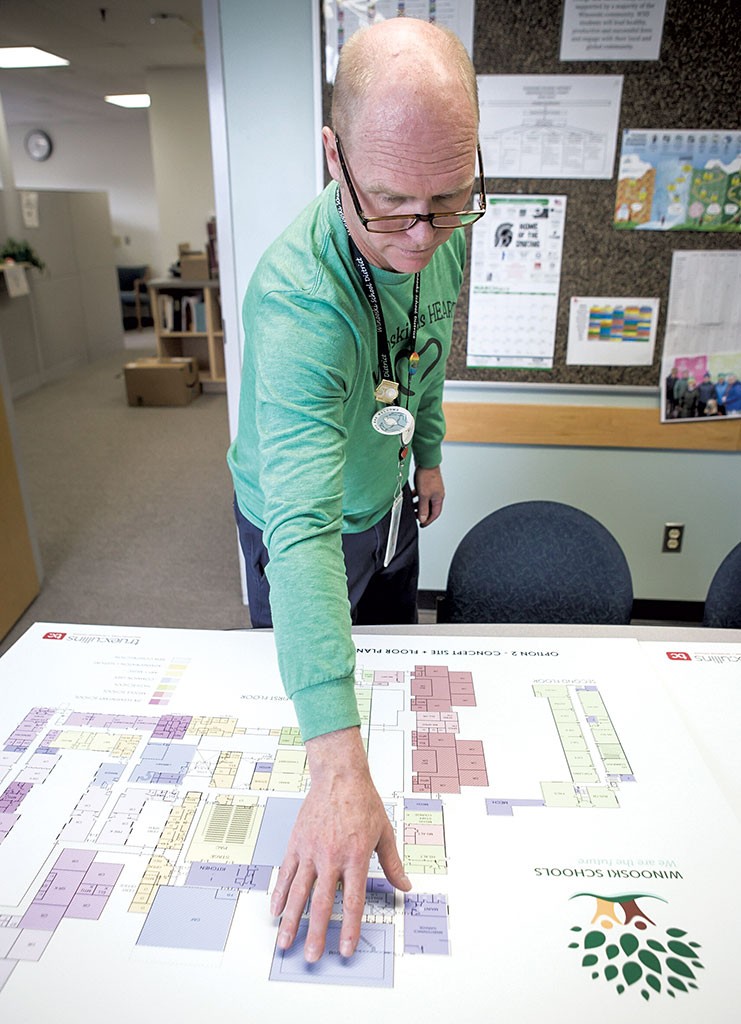
The man with the plan
On a recent walk through the school complex, McMannon chatted and waved to students wearing baseball caps and jeans, as well as hijabs and floor-length skirts. Spotting a high school student in a Manchester United shirt, McMannon joked, “Do you really still support Man U?” The teen laughed. McMannon is up-front about his soccer loyalties. “I’m a huge Liverpool supporter,” he revealed. “They are my team. I am rabid about them.” Although he no longer plays soccer competitively, McMannon still looks the part. He runs, hikes and loves the outdoors.
This wasn’t his first tour of the Winooski campus on Normand Street. McMannon has led parents, taxpayers and others through the building to make the case for the renovation. He’s breakfasted and lunched with city leaders and business owners. He’s invited key stakeholders into his office to chat.
Winooski’s elementary, middle and high schools share a central entrance and are laid out in interconnected wings built between 1957 and 2000. The plan calls for rebuilding much of the 140,000-square-foot complex wing by wing, with completion set for 2022. Almost half the $57.8 million tab would go to replace aging roofing, floors, windows, electrical and heating systems.
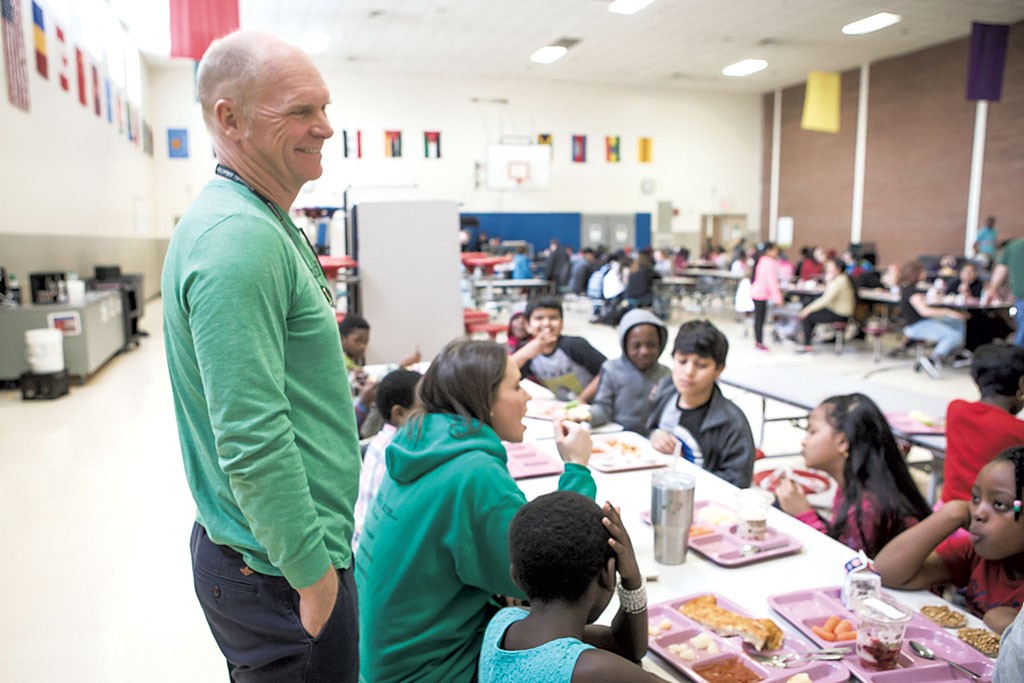
Today, the school has one gym and a “gymteria,” as McMannon calls it, which hosts the midday meal and then quickly gets converted for physical education classes. After renovations, the facility would have two gymnasiums and a separate cafeteria.
The existing performing arts center, with hand-me-down chairs from Saint Michael’s College, would be rebuilt in the gymteria’s space. The number of preschool classrooms would double from two to four to accommodate a wait list of children.
Elementary and middle school classrooms would be reconfigured in clustered “pods” with movable dividers that allow spaces to expand or shrink. Special education and other support staff offices would be moved closer to classrooms.
McMannon led Seven Days to the cramped, living room-size health office, where more than 100 staff and students might drop by during a school day. A wan-looking teen rested on a bed, and a washer and dryer hummed. Some children arrive in clothes that need to be washed; others dirty their outfits at recess. A cabinet stored medication for dozens of students who need doses for everything from epilepsy to asthma.
The renovation would create more space for health checks by the school nurses and the pediatricians who visit two mornings a week. The space would also include dental chairs, so children who now go off-site under a school-coordinated program could get the services without leaving the building.
The renovation would also expand office space for special education teachers.
The school has run out of rooms to accommodate them. “We’re sticking people in closets,” said McMannon.
While he worked at CVU, the school underwent a major renovation. The benefits went beyond physical improvements and made a big “difference in wellness,” McMannon said.
“My belief,” he added, “is that Winooski deserves that as much as CVU.”
Grades and ‘Grit’
Sarah McGowan-Freije said other parents often “give her a look” when they find out she sends her two kids to Winooski schools. It’s hurtful, she said during the talent show’s intermission, acknowledging that outside of Winooski, the district “has a bad reputation.”
Over the years, Joe Smith, a father of three Winooski schoolchildren, noticed some local parents either didn’t send their kids to city schools or pulled them out as they grew.
“My oldest daughter, everyone that she made friends with left,” said Smith, who teaches in Milton.
“The word on the street was that the schools were no good,” said Mace, who bought her first house in Winooski almost 15 years ago from a family that was moving to Essex because their children had reached school age, and the parents did not want to send them to Winooski schools, she recalled.
A primary reason is the poor performance of district students on standardized tests. The scores were low when McMannon arrived. They still are.
Only about 20 percent of Winooski High School juniors met or exceeded the proficiency standard in English language arts in 2017 on the Smarter Balanced assessment tests. That compares to 58 percent statewide. In math, 4 percent of Winooski juniors were at or above proficient in 2017, compared to 36 percent statewide. Scores for third graders at JFK Elementary lagged similarly.
Poverty, limited education at home and frequent moves put some students at a disadvantage on standardized tests, national studies have shown. Further, it can take six to eight years for new English speakers to reach academic fluency, McMannon said, adding that many Winooski students make remarkable progress in a single academic year.
McMannon has helped lead Winooski away from an unhealthy preoccupation with test scores, according to the school board president. “We are not teaching kids how to take a test. We’re trying to teach our kids how to learn,” Decarreau declared. Classroom lessons, homework and projects in Winooski schools are designed to require problem-solving, working successfully in groups and persistence, he said. “We’re trying to instill grit.”
It worked for his family. A Winooski native, Decarreau is the brother of former city manager Katherine “Deac” Decarreau, who oversaw much of the city’s revitalization. His five children all graduated from Winooski High School — and college. Several went on to earn graduate degrees.
Winooski’s approach to education has a name: proficiency-based learning. Introduced in 2012 through an initiative called the Partnership for Change and a multimillion-dollar grant from the Nellie Mae Education Foundation, it is designed to offer more personalized paths to education and new measures of success. In Winooski, the A-F grading system has been phased out at the middle school level and at the high school for all students except the current senior class. A new report card with a proficiency-based numerical assessment system will be fully implemented next year at the high school.
The rest of Vermont is heading in the same direction. The state requires all public schools to adopt proficiency-based graduation standards by 2020. Some oppose the approach, however, and earlier this year Vermont Education Secretary Dan French told critics the deadline is not a “hard-and-fast” one.
School enrollment has been dropping by about 1 percent annually in Vermont, but it’s been slowly growing in Winooski. The number of students increased from 774 in 2014 to the current 884. Projections call for about a dozen new students a year over the coming decade.
That’s due in large part to the fact that Winooski continues to be a first stop for many refugee families. Although U.S. State Department figures show that arrivals in Vermont dropped from 397 in 2016 to 116 last year under President Donald Trump’s restrictive policies, Winooski still gets newcomers. Children from about 10 new families, many of them from the Democratic Republic of the Congo, joined the student body this year.
“My kids, they are happy in the schools,” said Abdelouafi Laaroussi, a taxi driver who moved to Winooski from Morocco in 2013. He has three children in the school district, and they are progressing well. He hopes his 16-year-old daughter will be a doctor someday.
Some New American students achieve their dreams. But academic experiences vary in Winooski schools, according to Cleophace Mukeba, who tutors and translates for families that speak French or Swahili. Speaking for the refugee students, he said too many arrive knowing little or no English and are being pushed too quickly to graduation, based on their age rather than their achievement.
Some juniors “can’t even write a paragraph,” Mukeba said. “The problem is, next year he’s a senior, and he wants to graduate.”
Students can put in extra years. But others graduate despite weak skills and then find themselves unable to manage entry-level coursework at schools such as the Community College of Vermont, Mukeba said. Their parents, who had believed a diploma conferred a certain level of academic attainment, are surprised.
Mukeba also noted the lack of diversity of the faculty; only two out of 110 teachers are black. This sends the wrong message to the student body, he said.
A Congolese refugee who arrived in Vermont in 2005, Mukeba graduated cum laude from St. Michael’s College in 2012 and earned a master’s degree from Vermont Law School in 2015. He’s planning to seek an educator license under the eight-month Teacher Apprenticeship Program at Champlain College. He said he’d like to teach in Winooski.
He’s not the only critic of the academics there. McGowan-Freije said at times she has felt “like the higher achievers sort of fall between the cracks.” She wishes the district could offer more AP classes and instruction in additional foreign languages. Yet she praised McMannon, saying he is “very attuned to the population we have here” and understands the district’s struggles and needs.
Meanwhile, the city’s demographics are changing. The portion of students who qualify for free and reduced lunch has dropped from 82 percent in the 2013-14 school year to 63 percent this year. Housing prices suggest people with bigger pocketbooks are moving in.
In 2018, the median sale price on single-family homes in the city increased 18 percent, compared to a 5.6 percent average increase in Chittenden County. The median price was $281,500 — still lower than the $339,900 median for all of Chittenden County, but Winooski homes are drawing multiple offers from buyers interested in the revitalized downtown, according to a recent report by Coldwell Banker Hickok & Boardman Realty.
Parents see their neighbors starting to make different choices about education. Smith, whose older daughter watched her friends leave the district, said his middle child, an 11-year-old student, is not having that experience. “Perception is changing,” he said. He’s happy with Winooski’s schools. So is Mace.
“When I drop my daughter off in the morning,” she said, “it just feels like a place where there’s a lot of love and excitement and positive energy.”
Selling It
click to enlarge
Luke Awtry
Students at JFK Elementary School
Less than a week before the school bond vote, McMannon is lobbying hard for it.
The super, who lives in Colchester, has a contract with the district that runs through June 2020. He hopes to stay on beyond that and, should the bond pass, to see construction through.
“One of the proudest days that … I kind of envision is having this building project come to fruition and opening the doors and seeing how happy and proud our parents, our students and our staff are,” he said. “That, to me, would be pretty amazing.”
It would be costly, too.
The financial impact of the 30-year bond would be phased in and vary, based on income. For Winooski homeowners with household incomes of $50,000, the bond would add incrementally about $76 to property taxes in 2021, $150 in 2022 and $64 in 2023. For households with incomes of $99,000, it would add incrementally $168 in 2021, $307 in 2022 and $134 in 2023, according to district projections.
Some Winooski residents are already feeling tapped out by current and projected property tax increases, said City Councilor Mike Myers. In the past year, voters have approved four bond questions that authorized borrowing more than $40 million for a municipal pool, improvements along Main and Hickok streets, and a second downtown parking garage.
He predicts this one will be a “tough sell” to voters like Darrell Desautels, who posted on Front Porch Forum: “Winooski is a very poor community with massive amounts of low income and retired people. How can we afford all this tax increase that these projects will bring upon us?”
Myers hasn’t made up his own mind about the bond vote.
“I don’t want to vote against the future of Winooski, but also I don’t know if I can support it because of taxes,” Myers said. “As a taxpayer, it’s a heavy burden.”
Across the river, Queen City voters approved a $70 million bond last November to renovate Burlington High School.
Plenty of Winooski parents would do the same for their city’s school. Mark and Liz Edsell volunteered to host a house party to promote the renovation, and in April they attended an organizing session with McMannon at the O’Brien Community Center.
The couple, who are white, recently moved from Montpelier with their adopted African American daughter, partly because they want her to attend a diverse elementary school, they said.
“We both deeply believe in the school and the great work the school is doing,” stay-at-home dad Mark Edsell said at the O’Brien Center. “It doesn’t get the credit it deserves.”
The Edsells sat at a table with McMannon and Winooski parent Liz Casey, the mother of a 3-year-old and an early childhood special educator in the nearby Chittenden East Supervisory Union.
The super thanked them for volunteering and offered up lawn signs the way a political campaign manager would. Then, peering over his reading glasses like a seasoned administrator, he asked the parents for feedback on the text of a flyer that promoted the school makeover.
They went over it line by line, including a quote that proclaimed the schools, in dire need of repair, play a central role in Winooski.
Keep that line, the young parents advised McMannon.
“It’s true,” Casey said. “The school really is the heart of the community.”
EIN Presswire’s distribution footprint reaches millions. And unlike our competitors we combine a press release distribution service with media monitoring and RSS feeds that are used world-wide by journalists, professionals and businesses – everyday – and this means greater effectiveness for you. Just pay as you go or opt-in to plans such as the Pro+ bundle (10 releases for $399) and get access for one year to EIN Newsdesk for free.
Melinda Gates, the most powerful woman in philanthropy, has written a book about hope and female empowerment, at a time when women’s rights are coming under increasing threat in developed countries.
She and her husband, Bill Gates, the Microsoft founder, head a charitable foundation with the largest endowment in the world: US$50.7 billion.
This makes The Moment of Lift a major publishing event. The press kit comes with a printout of advance praise from the likes of Julie Bishop, Trevor Noah and Malala Yousafzai.
It also makes the author pretty handy at summarising her life for Australian interviewers: as she told Hack, she grew up in Dallas, Texas, and her dad was an engineer on the Apollo program. He’d take them to see the big rockets blasting off. She fell in love with computers in high school, did her MBA, and then took a job at Microsoft straight out of university. There she met Bill.
In 2000, the couple launched the Bill and Melinda Gates Foundation. Six years later Warren Buffett, then the world’s richest person, pledged US$37bn.
“I remember the moment when we learned about it and we both had tears,” Melinda told Hack.
“Bill and I went for a very long walk which is often where we work things through and just said oh my gosh what does this mean?”
By 2017, it meant the foundation was spending US$5 billion a year.
The enormously wealthy organisation, controlled entirely by trustees Bill, Melinda and Warren, ploughed money into reproductive health, agricultural research, family planning, and the control of malaria, tuberculosis, and STDs and other infectious disease.
The Moment of Lift is Melinda’s attempt to articulate what she’s learned from this frenzy of United States-led humanitarian aid and development.
Melinda Gates in Dangbo, Benin, in 2010 with the AIDS World Fund.
Over the years, she’s had a insight: “It was like a slow-rising sun, gradually dawning on me – part of an awakening shared and accelerated by others”.
She describes this as her “huge missed idea”.
Humanity, she says, is at a defining moment where women are finally breaking free of centuries of oppression, and lifting up the whole of society: “As women gain rights, families flourish, and so do societies … Gender equity lifts everyone.”
“The engines are igniting; the earth is shaking; we are rising,” she writes.
“More than at any time in the past, we have the knowledge and energy and moral insight to crack the patterns of history. We need the help of every advocate now. Women and men. No one should be left out. Everyone should be brought in.
‘A wrestle with my faith’
In the book, Melinda names what she says is the greatest life-saving poverty-ending women-empowering innovation ever: birth control.
“If you look at what has allowed women in any economy to go into the workforce in droves it’s because they could plan and space the births of their children,” she told Hack.
“Women all over the world who don’t have access to contraceptives but know about them or had access in the past and now don’t they will tell you this is often a matter of life and death.
“They’ll say I can’t have another child, I cannot feed another child or even if I can feed the ones I have I can’t educate all of them.
“When you make sure that a woman has access to a contraceptive tool … she can then plan and space those births, and if she chooses she can go out and get a job and it literally lifts her out of poverty.
Having been raised a Catholic (the Vatican is opposed to birth control), it took Melinda a while to come to this impious realisation: “I was travelling more and more and more for the foundation. I was in and out of countries like Malawi and Senegal and Kenya.
“I would be there to talk to them about vaccines.
“They would bring the conversation around to ‘what about my contraceptive?’.
“As I heard those cries among women just yelling at me I thought gosh why aren’t we doing something about this? It took me a few years honestly to wrestle with my faith.”
Teaching equality to Bill Gates
While learning about the structural causes of mass poverty, Melinda was also managing the challenges that came with being married to one of the richest men in the world.
“I mean he was running Microsoft,” she told Hack.
“He was in the position of power so he wasn’t used to sharing power, or he wasn’t used to even understanding that when he walks in the room or sits down at a table everybody assumes he’s the smartest person in the room.”
If he spoke over her at a dinner party she’d pull him up on the drive home: “He had to learn to make room for me, which he absolutely does now.”
Bill and Melinda Gates at the 2014 Stanford commencement ceremony.
This may seem a long way from access to birth control, but Melinda says she tells this story to connect equality within a marriage with the broader issue of gender relations in society.
“Until we have these conversations in our home we don’t then fully live them out in our communities and our workplaces,” she says.
She says she and Bill and have removed hierarchy in their relationship, except for flexible and alternating hierarchies based on talent, interest or experience: “It is a little bit tricky but it works for us, and I think it can work for other people.”
Again, she connects this with the broader issue of women being expected to perform unpaid labour in the home – something that adds up to years of missed opportunity.
“In the US over the course of a lifetime it’s actually seven years of unpaid labour in the home,” she told Hack.
“I don’t know about you but with seven years I could get a couple of degrees, I’d go back to school – so we need to rethink those assumptions.”
Bill and Melinda go to the White House
In March 2017, Bill and Melinda met Donald Trump in the White House after the President had announced plans to systematically roll back healthcare for women – including limiting access to birth control and abortion and bolstering abstinence-only sex education.
“I thought it was important for me to speak out,” Melinda said.
The conversation, she says, didn’t go well: the President simply didn’t seem to be taking on any of what she was saying.
“I don’t think I got very far – I wish I’d gotten farther but I just didn’t.
The Moment of Lift has been published during a dark and uncertain period for women’s rights in the United States, and potentially in other developed countries.
Politicians with hyper-masculine identities and ideologies are on the rise everywhere – often in response to the forces of women’s liberation that Melinda champions.
Her message for young Australians: “You can change somebody’s life – one small act has ripples in the pond that sometimes you don’t even know are there.
“Go out and learn about the needs of somebody else in your community.
“If you’re lucky enough to travel outside of Australia, learn about the needs of someone else in the world because if you help lift up someone else and particularly if you help lift up a girl or woman she lifts up everyone else.”



 The Ghanaian government needs to protect our country and beautiful culture